Why Were Teeth-Pulling Barbers Once Common?
Before modern dentistry, barbers were sometimes responsible for pulling teeth alongside haircuts, bloodletting, and minor surgical procedures. Discover how this strange medical tradition developed and disappeared.
Why Were Teeth-Pulling Barbers Once Common?
Imagine walking into a barbershop because you need a haircut.
You sit down.
The barber sharpens a blade.
You expect:
A shave.
A haircut.
Maybe a little conversation.
Instead, the barber looks inside your mouth and says:
"That tooth has to come out."
And apparently, that was once a perfectly ordinary professional service.
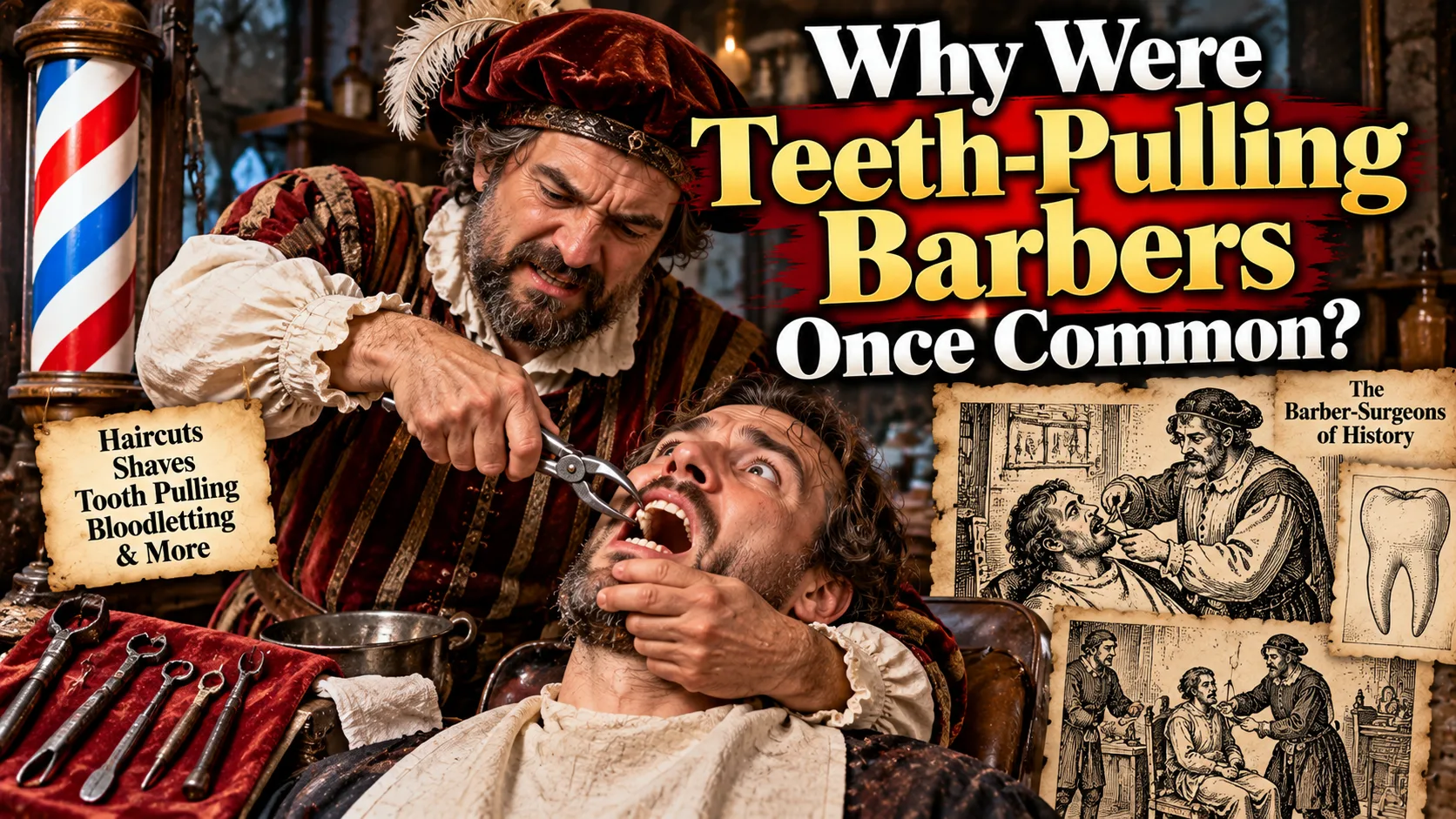
For centuries in parts of Europe, barbers and barber-surgeons performed procedures that modern people would associate with dentists, surgeons, or physicians.
They could:
Pull teeth.
Bleed patients.
Treat wounds.
Drain abscesses.
Set bones.
Dress injuries.
Perform minor surgery.
And, of course, cut hair.
The combination seems bizarre now.
But in its historical context, it made considerable sense.
Modern medicine is divided into highly specialized professions.
A dentist focuses on oral health.
A surgeon operates.
A physician diagnoses and manages disease.
A barber cuts hair.
In medieval and early modern Europe, those boundaries were far less clear.
Medical knowledge was limited.
Universities trained relatively small numbers of physicians.
Surgery was often considered a manual craft rather than an academic discipline.
And the people who already worked with sharp instruments were, somewhat conveniently, barbers.
The result was one of the strangest professional combinations in medical history.
A person could walk in needing a haircut and leave with a considerably more memorable afternoon.
The Barber Wasn't Originally a Dentist
It's important to start with a misconception.
Barbers did not become tooth-pullers because someone suddenly decided:
"Haircuts and dentistry are basically the same thing."
The connection developed through the history of barber-surgeons.
Barbers worked with:
Razors.
Scissors.
Knives.
Combs.
Hot towels.
They were accustomed to handling the head and face.
They also encountered customers with:
Wounds.
Swelling.
Tooth pain.
Skin problems.
Other minor injuries.
Meanwhile, surgery increasingly became associated with practical manual skills.
Someone had to perform these procedures.
Barbers were already established craftspeople with tools and customers.
The occupational overlap grew from there.
Surgery Wasn't Always a University Profession
Modern people tend to imagine medicine as one unified profession.
Historically, it wasn't.
In medieval Europe, different kinds of practitioners occupied different social and professional positions.
There were:
Physicians
who were often university-trained and focused on diagnosis and internal disease.
Surgeons
who increasingly specialized in practical procedures.
Barber-surgeons
who performed various hands-on interventions.
Apothecaries
who prepared and supplied medicines.
Midwives
who handled childbirth.
Local healers and practitioners
who operated outside formal institutions.
The categories were not identical everywhere, and they changed over time.
But the basic pattern is clear:
Medical work was divided by training, social status, and practical skill.
🟢 Established Evidence
Barber-surgeons were a real occupational group in medieval and early modern Europe.
They performed procedures that today belong to several different medical professions.
Tooth extraction was among the procedures associated with this tradition.
Why Barbers Were Comfortable With Blood
There was another reason the profession developed this way.
Historically, bloodletting was widely practiced in European medicine.
Bloodletting could involve:
Lancets.
Knives.
Cupping instruments.
Other sharp tools.
A barber already possessed some of the practical skills and equipment required to perform such procedures.
So the profession became strongly associated with bloodletting.
This is part of the origin of the famous red-and-white barber pole.
The Barber Pole Has a Bloody History
The familiar barber pole is often linked to barber-surgeons.
The traditional colors are commonly interpreted as representing:
Red = blood
White = bandages
The pole itself is associated with the staff or rod used during bloodletting, around which bandages could be wrapped.
The exact origins of the modern barber-pole design are more complicated than a single universal story, and barber symbols varied by region.
But the connection between barbering, bloodletting, and surgical practice is historically well established.
So that spinning red-and-white pole outside a barbershop has a much stranger history than:
"We cut hair here."
Teeth Were Another Problem
Before modern dentistry, tooth pain was a serious problem.
There were no:
Modern fillings.
Root canals.
Dental implants.
Antibiotics.
Reliable local anesthetics.
Modern radiography.
Modern infection control.
If a tooth became severely infected or damaged, options were limited.
Pain could become intense.
And sometimes the most practical solution available was:
Remove the tooth.
That created demand for people capable of doing exactly that.
Tooth Extraction Is Older Than Barbering
People didn't wait until medieval Europe to start pulling teeth.
Dental surgery has a much older history.
Ancient civilizations performed various forms of dental treatment and extraction.
Archaeological and written evidence from ancient societies shows attempts to deal with:
Dental pain.
Tooth damage.
Infection.
Missing teeth.
Prosthetic replacement.
So the barber-surgeon wasn't inventing tooth extraction.
They were inheriting an already ancient problem.
Ancient Dentistry Could Be Surprisingly Sophisticated
Ancient practitioners used tools and techniques that demonstrate a real understanding of dental problems, even though their medical theories were very different from modern science.
Some ancient Roman and Greek writers discussed:
Tooth pain.
Dental care.
Extraction.
Oral conditions.
There is also archaeological evidence of surprisingly sophisticated dental interventions in several ancient societies.
This is important because the history of dentistry did not suddenly begin with modern dental schools.
It evolved slowly.
The Problem Wasn't Knowing Teeth Hurt
Everyone understood that bad teeth hurt.
The difficult question was:
What do you do about it?
And historically, many explanations for tooth pain were based on theories that modern medicine rejects.
Different cultures attributed dental problems to:
Decay.
Infection.
Humoral imbalance.
Supernatural causes.
Diet.
"Tooth worms."
The famous idea of a tooth worm appears in ancient and medieval medical traditions.
The Tooth Worm
The belief was that a tiny worm lived inside a painful tooth and caused the pain.
This idea appeared in various ancient and medieval cultures.
It made intuitive sense within historical medical frameworks.
A tooth hurt.
Something must be inside it.
Perhaps a tiny creature was responsible.
The theory persisted for centuries.
The actual cause of dental pain, of course, involves processes such as inflammation, infection, tissue damage, and nerve stimulation.
There was no little worm conducting unpaid dentistry inside your molar.
Without Germ Theory, Infection Was Hard to Understand
Modern people know that bacteria can cause dental infections.
Historical practitioners did not possess modern microbiology.
They could observe:
Swelling.
Pus.
Pain.
Fever.
Bad breath.
Tooth loss.
But they didn't understand microorganisms as the underlying cause.
That made prevention and treatment much more difficult.
Why Extraction Was Often the Final Solution
Imagine a severely damaged tooth.
No antibiotics.
No root canal.
No dental X-ray.
No modern restorative materials.
The practitioner may have limited ways to save the tooth.
Extraction could remove:
The damaged structure.
The source of pain.
Sometimes infected tissue.
It was crude.
But compared with leaving a severely damaged tooth untreated, it could be useful.
The Tools Were Brutal by Modern Standards
Historical tooth-pulling instruments included various forms of:
Forceps.
Dental keys.
Levers.
Specialized extraction tools.
The infamous dental key became particularly associated with European dentistry in later centuries.
It looked somewhat like a small metal key with a claw or hook.
The practitioner placed it around the tooth and used leverage to remove it.
The problem?
It could damage surrounding tissue.
Sometimes the tooth fractured.
Sometimes nearby teeth or bone could be injured.
Modern dentists would probably prefer almost anything else.
The Dental Key Was a Mechanical Solution
Imagine a damaged tooth firmly attached to the jaw.
The practitioner needed:
Force
and
leverage.
The dental key attempted to provide both.
In principle, the design was mechanically clever.
In practice, it could be traumatic.
This is a recurring pattern in premodern medicine:
A technically understandable solution applied without modern anatomical knowledge, anesthesia, or infection control.
Anesthesia Changed Everything
One reason historical dentistry sounds horrifying is that patients often experienced procedures with little or no effective anesthesia.
Modern anesthesia fundamentally transformed surgery.
Before effective anesthesia:
A procedure had to be:
Quick.
Practical.
Direct.
The longer the operation, the more unbearable it became.
This put enormous pressure on practitioners.
The Patient Wasn't Necessarily "Brave"
Historical accounts often describe people enduring procedures without anesthesia.
It's tempting to say:
"People back then were tougher."
More accurately:
They had fewer alternatives.
Pain tolerance varies.
Humans adapt.
But adaptation isn't the same thing as comfort.
Getting a tooth extracted without modern anesthesia was still painful.
Human nervous systems have not changed dramatically enough to make medieval dental surgery enjoyable.
Alcohol Was Sometimes Used
Alcoholic drinks were sometimes used historically to dull discomfort or relax patients.
Other substances were also used across different periods and cultures.
But these were not equivalent to modern local anesthetics.
They could impair consciousness or judgment without selectively blocking pain.
Why Barbers Were Trusted With Surgery
Trust developed partly from familiarity.
The barber was already working directly around:
Your face.
Head.
Skin.
Hair.
Blood.
Small cuts.
Razors.
The tools were visible.
The service was practical.
And in many communities, the barber was a familiar local figure.
This made the profession a natural place for certain minor procedures to occur.
Barbers Were Craftsmen
This is another important distinction.
Medieval physicians were often trained in theoretical medicine.
Barbers and surgeons were more likely to learn through:
Apprenticeship.
Observation.
Practice.
Manual skill.
This was a world in which:
Knowing how to use a tool
could matter more for certain procedures than knowing a great deal of medical theory.
The Social Status Problem
Manual surgery could be considered lower-status than academic medicine.
That distinction caused tension.
University-trained physicians sometimes regarded surgeons as craftspeople rather than intellectual professionals.
Barber-surgeons occupied an even more unusual position.
They were neither simply hairdressers nor fully equivalent to modern surgeons.
They belonged to a transitional professional world.
Guilds Controlled the Trade
In many European cities, trades were organized through guilds.
Guilds regulated:
Training.
Apprenticeships.
Standards.
Membership.
Business practices.
Barber-surgeons could form their own professional organizations or belong to combined guilds.
This helped establish rules around who was permitted to practice certain procedures.
The United Company of Barbers
One famous example is England.
The Barber-Surgeons' Company became an important institution in London.
Barbers and surgeons were formally connected within the company for centuries.
Their combined professional identity reflected the historical overlap between:
Hair cutting.
Shaving.
Bloodletting.
Surgery.
Medical procedures.
Henry VIII Got Involved
In sixteenth-century England, King Henry VIII granted privileges to the barber-surgeons.
Regulations helped distinguish the work of barbers and surgeons while maintaining their institutional connection.
Eventually, the professions were separated.
This wasn't just a change in job titles.
It reflected the increasing professionalization and specialization of surgery and medicine.
The Red and White Pole Was Once a Medical Advertisement
Imagine a medieval street.
No neon signs.
No Google Maps.
No online reviews.
You need someone who can perform:
Shaving.
Bloodletting.
Minor surgery.
Perhaps tooth extraction.
How do you advertise?
A recognizable symbol helps.
The barber pole became associated with the profession.
The stripes served as a visual marker.
Over time, the medical associations faded.
The symbol remained.
Why Didn't Doctors Pull Teeth?
Some did.
Medical practitioners' responsibilities overlapped substantially with those of surgeons and other specialists depending on region and period.
But there was no universal professional rule saying:
Doctors never touch teeth.
The separation of dentistry into a distinct profession developed gradually.
Dentistry Became Its Own Profession
Over the eighteenth and nineteenth centuries, dentistry increasingly became formalized as a specialized field.
Training became more structured.
Dental instruments improved.
Anatomical knowledge expanded.
Professional organizations developed.
Dental schools appeared.
Regulation increased.
The person pulling your tooth gradually became:
a dentist
rather than:
the local barber with a scary metal instrument.
Why Specialization Happened
Medicine was becoming more scientifically complex.
Anatomy improved.
Pathology developed.
Chemistry advanced.
Surgery became more sophisticated.
Anesthesia transformed operations.
Antisepsis improved infection control.
Medical education became more formal.
There was simply too much knowledge for one practitioner to master everything.
Specialization became practical.
The Discovery of Anesthesia Was a Turning Point
In the nineteenth century, the development and adoption of effective surgical anesthesia radically changed dentistry and surgery.
Patients no longer had to endure the full pain of many procedures while conscious.
Operations could become:
Longer.
More precise.
More careful.
More ambitious.
This was one of the biggest transformations in the history of surgery.
Ether and Nitrous Oxide
Nitrous oxide had been used for entertainment before its medical potential was recognized.
Ether and other anesthetic agents later became important in surgery.
Dentistry played an important role in the early history of anesthesia.
Dental procedures provided particularly obvious demonstrations of the value of pain control.
People desperately wanted to stop screaming.
An excellent scientific motivation.
Modern Local Anesthesia Changed Dentistry Again
Later developments allowed dentists to numb specific areas.
This is profoundly different from simply sedating someone.
The patient can remain conscious while the painful sensation from the targeted area is blocked or greatly reduced.
That made dental procedures much more controlled.
Sterilization and Germ Theory
Anesthesia solved the pain problem.
Germ theory helped solve another enormous problem:
infection.
Once microorganisms were recognized as important causes of infection, medical practice changed.
Clean instruments.
Hand hygiene.
Sterilization.
Antisepsis.
Aseptic technique.
These transformed surgery.
Imagine Tooth Extraction Before Sterile Instruments
The same tools might be used:
On multiple patients.
Without modern sterilization.
With limited understanding of microorganisms.
That created serious infection risks.
A successful extraction could still lead to dangerous complications.
The Tooth Puller Had a Difficult Job
Imagine being a historical tooth extractor.
The patient arrives with:
Severe pain.
Swelling.
A broken tooth.
Fear.
You need to:
Identify the tooth.
Secure it.
Apply force.
Remove it quickly.
Control bleeding.
Hope there isn't a serious infection.
And do all of this without:
X-rays.
Modern anesthesia.
Antibiotics.
Modern lighting.
Sterile equipment.
Not exactly a dream career.
The Barber's Training Was Not Necessarily Primitive
This is another misconception.
Barber-surgeons often had structured apprenticeships.
They weren't simply random people picking up tools.
They could learn:
Anatomy.
Bloodletting.
Wound care.
Surgical techniques.
Instrument handling.
Practical procedures.
Their education was simply different from modern medical training.
Some Were Highly Skilled
Skill matters enormously in manual procedures.
A practiced practitioner could become very good at:
Recognizing conditions.
Handling instruments.
Extracting teeth.
Controlling bleeding.
Treating wounds.
The absence of modern science didn't mean the practitioner had no skill.
It meant their skill operated within much more limited medical knowledge.
Experience Could Matter More Than Theory
A local barber-surgeon might have performed hundreds of extractions.
A newly trained academic physician might have had much less practical experience with physically removing a tooth.
For the patient, practical skill mattered.
This helps explain why specialist craftspeople developed around surgery.
The Barber-Surgeon Was a Transitional Profession
The occupation sits at an interesting point in medical history.
On one side:
Traditional craft.
Apprenticeship.
Humoral medicine.
Bloodletting.
Limited anatomical knowledge.
On the other:
Modern surgery.
Professional schools.
Anesthesia.
Antisepsis.
Scientific anatomy.
Specialization.
The barber-surgeon belongs to the transition between these worlds.
🟢 Established Evidence
Barber-surgeons existed as real professional practitioners in parts of medieval and early modern Europe.
Their services could include:
Bloodletting.
Wound treatment.
Minor operations.
Shaving and haircutting.
Tooth extraction in some settings.
The precise range of services varied by place and period.
🟡 Historical Variation Matters
It is easy to say:
"Medieval barbers were all surgeons."
That isn't accurate.
Not every barber performed surgery.
Not every barber pulled teeth.
Not every society had the same professional structure.
The overlap varied according to:
Region.
Period.
Regulation.
Guild structure.
Training.
Local custom.
🔴 Popular Myth
"Every medieval barber was basically a dentist and surgeon."
No.
The phrase barber-surgeon refers to a specific professional tradition.
Ordinary barbers were not automatically trained to perform every medical procedure.
The famous image of every medieval barber casually pulling teeth is an exaggeration.
Why Were Barbers Especially Associated With Teeth?
Because they occupied a practical medical niche.
They were:
Accessible.
Local.
Tool-equipped.
Used to handling the head and face.
Trained through apprenticeship.
Part of established guild systems.
Meanwhile, formal dentistry had not yet developed into the distinct profession we know today.
The service therefore emerged where demand and practical skills already existed.
Dentistry Wasn't Always About Saving Teeth
Modern dentistry often emphasizes:
Prevention.
Restoration.
Preservation.
Root canals.
Crowns.
Fillings.
Implants.
Historical dentistry was much more limited.
A painful or damaged tooth might simply become:
A tooth to remove.
The objective was often pain relief rather than preserving the natural tooth.
Why Keeping the Tooth Was Hard
A tooth with:
Deep decay.
Severe fracture.
Advanced infection.
could be difficult to treat with historical technology.
Without:
Modern filling materials.
Root canal therapy.
Antibiotics.
X-ray imaging.
the options were limited.
Extraction was often the practical endpoint.
Tooth Pulling Was Also a Business
Barber-surgeons didn't perform procedures purely from kindness.
They earned money.
Services cost money.
Different procedures could carry different fees.
A professional service industry developed around bodily care.
This included:
Haircuts.
Shaving.
Bloodletting.
Wound treatment.
Tooth extraction.
In a premodern city, the barbershop could therefore function as a kind of informal health-service center.
The Barbershop Was a Social Institution
There is another reason these businesses were successful.
People already visited them regularly.
A barber was a familiar person.
Customers talked.
News circulated.
Local information spread.
The shop was part business, part social environment.
Medical services could fit naturally into that space.
This Is Where "Barber Shop Talk" Comes From
Barbers historically had access to a huge amount of local information.
People talked while:
Getting shaved.
Getting hair cut.
Waiting.
Drinking.
Discussing politics.
Discussing neighbors.
Discussing illnesses.
The barber could become a social hub.
Not exactly a medieval internet.
But certainly a human information network.
The Barber Pole Survived the Medical Profession
Eventually:
Bloodletting declined.
Surgery separated.
Dentistry professionalized.
Hair cutting remained.
The barber pole stayed.
That's why a modern barbershop can still display a symbol whose history is partly connected to medical procedures that disappeared centuries ago.
A tiny museum hanging outside the shop.
The Separation of Barbering and Surgery
As surgery became increasingly specialized, barbers gradually lost their role in formal surgical practice.
In England, the long institutional association between barbers and surgeons eventually ended.
The professions were formally separated in the eighteenth century.
Surgeons became a distinct profession.
Barbers focused increasingly on hair and grooming.
That separation reflects a much larger transformation in medicine.
The Rise of Professional Dentistry
Dentistry developed alongside this wider movement.
Training became standardized.
Professional societies formed.
Dental education expanded.
Scientific anatomy improved.
New technologies appeared.
The dentist became a specialist.
A tooth was no longer simply something someone pulled.
It became part of a complex medical system.
Dental Tools Became More Precise
Compare historical extraction tools with modern dental instruments.
Modern tools are designed around:
Anatomy.
Controlled force.
Visibility.
Sterility.
Patient comfort.
Specific tooth structures.
Different procedures require different instruments.
This reflects a broader shift:
From generalized manual skill to specialized technical knowledge.
X-Rays Changed the Game
The discovery of X-rays transformed dentistry.
A dentist could see structures below the surface.
Roots.
Impacted teeth.
Bone.
Hidden infections.
Crowding.
Without imaging, practitioners had to rely much more heavily on:
Physical examination.
Experience.
Symptoms.
Touch.
Guesswork.
X-ray technology didn't just make dentistry more advanced.
It changed what dentists could know before acting.
Antibiotics Changed It Again
The development of antibiotics transformed the management of bacterial infections.
A serious dental infection no longer had to be approached only through:
Drainage.
Extraction.
Supportive care.
Pain relief.
Modern treatment could target the infection itself when antibiotics are clinically appropriate.
This dramatically expanded options.
But Extraction Didn't Disappear
Modern dentists still pull teeth.
Wisdom teeth.
Severely damaged teeth.
Some infected or non-restorable teeth.
Orthodontic extractions.
Other specific indications.
The difference is:
Tooth extraction is now a specialized medical procedure.
The barber is no longer the person you visit for it.
Why Wisdom Teeth Were a Problem
The third molars commonly called wisdom teeth can become:
Impacted.
Crowded.
Infected.
Painful.
Sometimes extraction is recommended depending on the individual situation.
Imagine dealing with an impacted molar centuries ago.
No panoramic X-ray.
No modern surgical instruments.
No antibiotics.
No reliable anesthesia.
It would have been an unpleasant problem.
What About General Anesthesia?
Modern dentistry can use several approaches to pain and anxiety management, depending on the procedure and patient.
These include:
Local anesthesia.
Nitrous oxide.
Sedation.
General anesthesia in selected circumstances.
This is an extraordinary contrast with historical tooth extraction.
The basic task is the same.
The surrounding medical system is completely different.
The Barber Didn't "Know Nothing"
It's tempting to look backward and laugh.
But consider the constraints.
A barber-surgeon didn't have:
Microbiology.
Modern pharmacology.
Radiology.
Modern anatomy.
Reliable anesthesia.
Modern surgery textbooks.
Sterilization technology.
They worked with what existed.
Given those limits, some developed considerable technical skill.
History Is Full of Transitional Professions
The barber-surgeon isn't unique.
As societies develop, professions merge.
Then split.
Then specialize.
Then disappear.
A single worker once handled multiple functions.
Modern systems divide them among specialists.
This has happened in:
Medicine.
Transportation.
Communication.
Manufacturing.
Computing.
Construction.
The barber-surgeon is simply a particularly entertaining example.
Why We Find It So Strange
Because modern professional boundaries feel natural.
You wouldn't expect your:
Hairdresser
to perform surgery.
Your:
Surgeon
to cut your hair.
Your:
Dentist
to serve as your barber.
These seem like completely unrelated occupations.
Historically, they weren't always separated.
The categories developed over time.
The Bigger Story Is Professionalization
The history of the barber-surgeon tells us how modern medicine became what it is.
At first:
Many practitioners performed overlapping tasks.
Then:
Knowledge expanded.
Regulation increased.
Training became formal.
Tools became specialized.
Institutions developed.
Professions separated.
The result was specialization.
Why Specialization Makes Sense
Modern medicine contains an enormous body of knowledge.
Consider what a dentist needs to know:
Oral anatomy.
Pathology.
Pharmacology.
Radiology.
Materials science.
Periodontology.
Surgery.
Prosthodontics.
Infection control.
Pain management.
Trying to combine all of that with hair cutting would be absurd.
Modern specialization exists because knowledge became too large to fit comfortably inside one profession.
The Old Barbershop Was a Multi-Service Business
Think of it as:
Haircut.
Shave.
Bloodletting.
Tooth extraction.
Minor wound care.
Social conversation.
Information exchange.
One building.
Multiple services.
The modern world split that system into:
Barbershops.
Dentists.
Hospitals.
Clinics.
Pharmacies.
Specialty practices.
Medical laboratories.
Convenience increased.
So did specialization.
🟢 Established
The historical barber-surgeon profession demonstrates that medical work was once organized very differently from the modern healthcare system.
Barbering and minor surgery overlapped in parts of Europe.
Tooth extraction could be one of the procedures performed by practitioners associated with this tradition.
🟡 Interpretation
The exact reason tooth extraction became associated with particular barbers likely varied by place.
Several factors probably contributed:
Practical tool use.
Existing customer relationships.
Apprenticeship traditions.
Guild structures.
Limited access to physicians.
Demand for treatment.
The lack of a separate modern dental profession.
There wasn't one moment when someone officially declared:
"Barbers shall now become dentists."
Occupations evolve.
They rarely bother to issue a press release.
🔴 Myth
"Dentistry only became possible once modern dentists appeared."
False.
Humans have treated teeth for thousands of years.
Modern dentistry represents an enormous improvement in:
Diagnosis.
Pain control.
Infection control.
Restoration.
Imaging.
Surgical technique.
Materials.
Prevention.
The profession is new in its modern form.
The problem is ancient.
Frequently Asked Questions
Did barbers really pull teeth?
Yes. In parts of medieval and early modern Europe, practitioners associated with barber-surgeons performed tooth extractions among other hands-on procedures. Not every barber did so.
Why were barbers involved in medicine?
Barbers already worked with sharp instruments and had practical manual skills. Historical medical practice also separated academic physicians from hands-on surgical work, creating a niche for barber-surgeons.
Did medieval barbers perform surgery?
Some barber-surgeons performed various surgical and wound-related procedures. The exact range differed by place, time, training, and regulation.
Did barbers invent dentistry?
No. Dental treatment predates the medieval barber-surgeon tradition by thousands of years.
Did people have anesthesia when barbers pulled teeth?
Effective modern anesthesia was not available in the medieval period. Various substances were sometimes used to dull pain, but these were not equivalent to modern local anesthesia.
What was a dental key?
A historical extraction instrument that used leverage to help remove teeth. It could be traumatic and cause damage to surrounding tissues.
Why is the barber pole red and white?
The colors are traditionally associated with the bloodletting and bandaging history of barber-surgeons, although the exact development of barber-pole designs is historically more complicated.
When did dentists become separate from barbers?
The separation happened gradually. In Britain, the institutional connection between barbers and surgeons ended in the eighteenth century, while dentistry continued developing into a specialized profession through the eighteenth and nineteenth centuries.
Did barber-surgeons understand infection?
They observed infection and had practical methods for dealing with wounds, but they did not understand microorganisms in the modern germ-theory sense.
Was historical tooth extraction always dangerous?
Not every procedure produced complications, but the risks were substantially greater than in modern dentistry because anesthesia, imaging, sterilization, antibiotics, and modern surgical techniques were unavailable.
Myth vs. Reality
🟢 Barbers historically performed medical procedures.
Yes, particularly barber-surgeons.
🟢 Some barber-surgeons pulled teeth.
Yes.
🔴 Every historical barber was a dentist.
No.
🟢 Dentistry existed before modern dentists.
Yes.
🔴 Medieval practitioners were simply untrained amateurs.
Not necessarily. Many learned through structured apprenticeships and developed significant practical skills.
🟢 Modern dentistry is radically different.
Yes.
Anesthesia, imaging, infection control, pharmacology, materials science, and professional education transformed the field.
🔴 Tooth extraction was invented by medieval barbers.
No.
Tooth extraction is far older.
Final Thoughts
The idea of getting a haircut and having a tooth pulled in the same building sounds ridiculous today.
But it only sounds ridiculous because modern medicine has trained us to think in professional compartments.
Dentist.
Surgeon.
Physician.
Barber.
Those divisions feel obvious.
They weren't always.
For centuries, barber-surgeons occupied a practical space between grooming and medicine.
They worked with sharp tools.
They treated wounds.
They performed bloodletting.
They carried out minor procedures.
And in some settings, they pulled teeth.
The practice wasn't evidence that historical people were foolish.
It reflected the medical world available to them.
A painful tooth created a real problem.
Someone needed to remove it.
The people with practical skills, instruments, and access to the public were often the ones who did it.
The procedure itself could be brutal.
There was no modern local anesthetic.
No panoramic X-ray.
No sterile dental operatory.
No antibiotic prescription waiting on the counter.
The practitioner had limited information and limited tools.
Yet they were still solving a real problem with the technology available.
That is the deeper story.
Medical professions are not timeless categories.
They evolve.
A skill begins as part of one craft.
It becomes specialized.
Training becomes formal.
New technology arrives.
The profession separates.
Eventually, nobody remembers that the two were ever connected.
Today's dental clinic is the result of centuries of that process.
The modern dentist didn't suddenly appear.
The profession emerged from a long history of:
Craft.
Experimentation.
Apprenticeship.
Anatomical study.
Scientific discovery.
Professional regulation.
Anesthesia.
Infection control.
Imaging.
Specialization.
And thousands of people trying, with varying degrees of success, to stop other people from having terrible toothaches.
Perhaps the strangest part is that the barber-surgeon wasn't really a bizarre exception.
They were a glimpse of what medicine looked like before specialization transformed it.
One person might cut your hair.
Treat your wound.
Drain an abscess.
Bleed you.
And pull the tooth that had been ruining your week.
Today, thankfully, we divide those responsibilities.
Your barber has scissors.
Your dentist has an X-ray machine.
Your surgeon has an operating room.
And your teeth can now receive something medieval patients could only dream about:
pain control.
The next time you see a barber pole spinning outside a modern shop, remember that you're looking at a relic from a time when "getting cleaned up" could involve considerably more blood than anyone had planned.