Why Did People Believe Bloodletting Could Cure Diseases?
For centuries, physicians believed removing blood could restore the body's balance and treat disease. Discover how ancient medical theories made bloodletting seem logical and why the practice eventually disappeared.
Why Did People Believe Bloodletting Could Cure Diseases?
Imagine you are sick.
You have a fever.
Your head hurts.
Your body aches.
You feel weak.
A doctor examines you and reaches a conclusion:
You have too much blood.
The treatment is straightforward.
A vein is opened.
Blood flows into a bowl.
Perhaps a few spoonfuls.
Perhaps considerably more.
And everyone in the room believes something useful has just happened.
To modern medicine, the practice seems almost absurd.
Someone is sick, so the doctor removes blood.
Someone is weak, so the doctor removes more.
Someone has a headache, fever, inflammation, or even a serious illness, and bloodletting is presented as a possible remedy.
Yet bloodletting survived for more than two thousand years in various medical traditions.
It was practiced by physicians.
Recommended in medical texts.
Used by surgeons.
Performed by barber-surgeons.
Prescribed for kings.
Administered to ordinary people.
And for enormous stretches of history, it was not considered primitive or foolish.
It was considered medicine.
That is the important part.
The interesting historical question is therefore not:
"Why were people stupid enough to believe bloodletting worked?"
That's too easy.
The better question is:
"What did people believe about the human body that made bloodletting seem scientifically reasonable?"
The answer takes us into one of the most influential medical theories in history:
the theory of the four humors.
And once you understand that theory, bloodletting stops looking completely irrational.
It becomes the logical treatment for a medical system that happened to be wrong.
The Body Was Once Seen as a Balance
Modern medicine thinks in terms of:
Cells.
Organs.
Hormones.
Genes.
Microorganisms.
Immune responses.
Neural pathways.
Biochemical reactions.
Ancient and medieval physicians didn't have access to that framework.
Instead, many medical traditions tried to understand disease through balance.
The human body was believed to contain fundamental substances whose proper relationship was necessary for health.
In the influential Greco-Roman medical tradition, these became the famous:
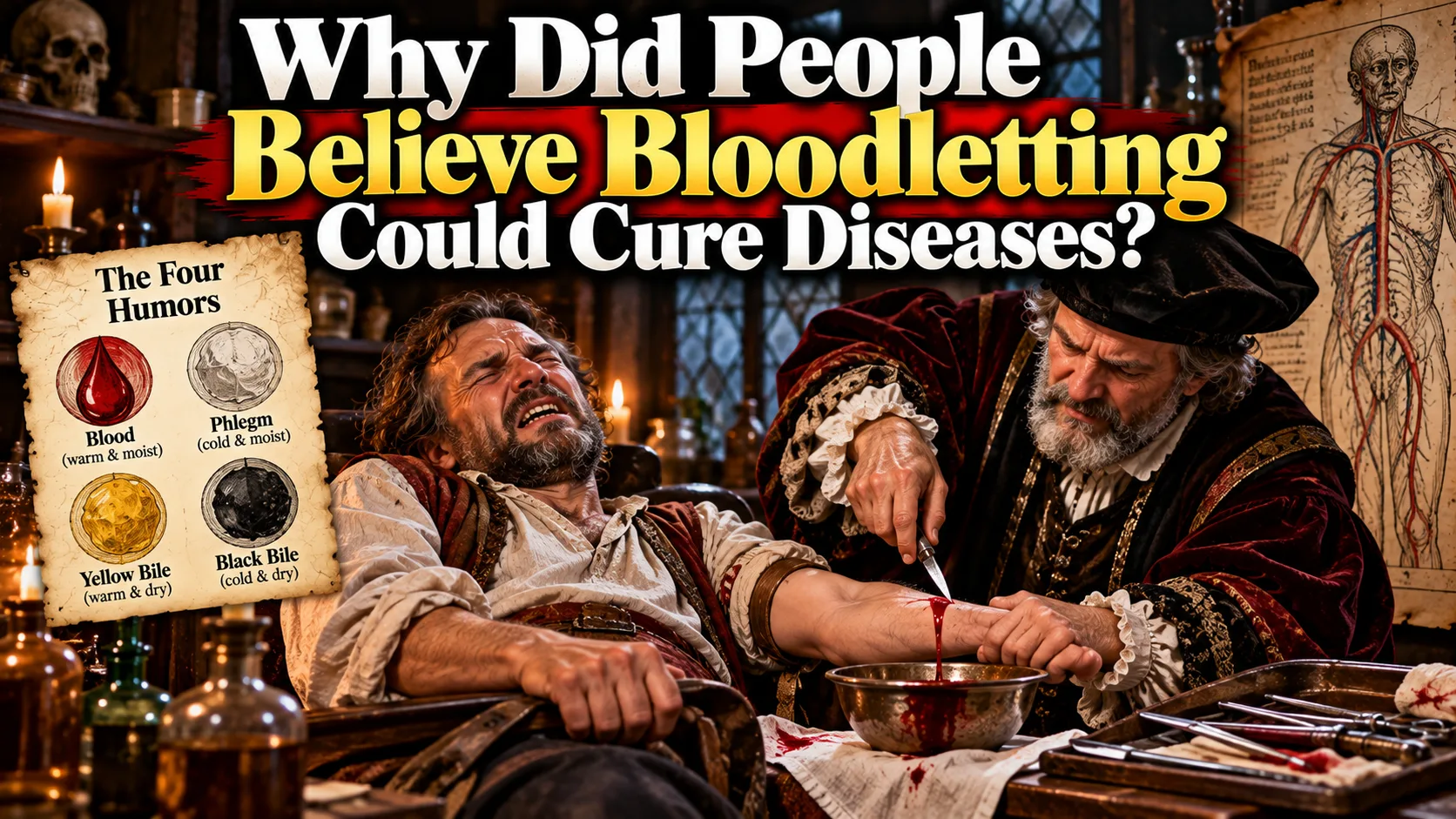
Four humors.
They were:
Blood
Phlegm
Yellow bile
Black bile
Health meant balance.
Disease meant imbalance.
That idea would influence Western medicine for centuries.
🩸 Blood Wasn't Just Blood
To us, blood is a biological fluid carrying:
Oxygen.
Nutrients.
Hormones.
Immune cells.
Waste products.
In ancient humoral medicine, blood had a much larger conceptual role.
It was one of the body's fundamental humors.
Too much?
Potential imbalance.
Too little?
Another problem.
Wrong relationship with the other humors?
Disease.
Once you accept that framework, removing blood can seem perfectly reasonable.
The Four Humors
The classical humoral model generally associated each humor with particular qualities.
Blood
Associated with:
Warmth.
Moisture.
Phlegm
Associated with:
Coldness.
Moisture.
Yellow bile
Associated with:
Warmth.
Dryness.
Black bile
Associated with:
Coldness.
Dryness.
These categories were not equivalent to modern physiology.
They were attempts to explain health using an internally coherent system of qualities and substances.
Health Became a Problem of Balance
Think of it like a scale.
Too much of one thing?
The system becomes unstable.
Too little of another?
The system becomes unstable.
The solution was therefore:
Restore balance.
That could involve:
Diet.
Exercise.
Bathing.
Vomiting.
Laxatives.
Drugs.
Changes in sleep.
Changes in activity.
And, in many circumstances:
Bloodletting.
Why Bloodletting Made Sense Within the Theory
Suppose a physician believed that a patient had an excess of blood.
The logical response would be:
Remove some blood.
That isn't irrational within the framework.
In fact, refusing to remove it could seem irresponsible.
If a person's illness was believed to result from excess blood, allowing that excess to remain might appear equivalent to leaving a broken pipe leaking.
The treatment wasn't random.
It followed from the diagnosis.
The diagnosis was wrong.
But the reasoning connecting diagnosis to treatment could still be internally consistent.
This Is an Important Lesson About Medical History
A scientific idea can be:
Well organized.
Widely accepted.
Supported by respected authorities.
Passed down through generations.
And still be wrong.
People sometimes imagine scientific progress as:
Ignorance → discovery → truth
Real history is much messier.
It often looks more like:
Reasonable theory → widespread acceptance → anomalies → competing evidence → gradual revision
Bloodletting lasted so long partly because it belonged to a larger medical system.
To overturn bloodletting, physicians had to rethink the system that justified it.
Hippocrates and the Early Humoral Tradition
The Greek physician commonly known as Hippocrates and the collection of texts associated with the Hippocratic tradition played an important role in early Greek medicine.
Hippocratic medicine generally emphasized natural explanations for disease rather than relying solely on supernatural causes.
That was historically significant.
Illness was increasingly interpreted through:
Diet.
Environment.
Lifestyle.
Season.
Physical condition.
The body's internal state.
Within this developing naturalistic framework, treatments designed to restore bodily balance could seem rational.
Hippocrates Didn't Invent Every Medical Idea
This is another place where history gets simplified.
The famous "Hippocratic" medical tradition developed over time.
It wasn't created by one man sitting down and writing the entire medical system from scratch.
The Hippocratic Corpus consists of many texts with different authors and dates.
Still, the tradition is enormously important because it helped establish a naturalistic approach to disease that became foundational to later European medicine.
Ancient Medicine Was Not One Single System
It's tempting to talk about "ancient medicine" as though every civilization believed the same thing.
They didn't.
Medical traditions developed across:
Greece.
Rome.
Egypt.
India.
China.
The Islamic world.
And many other regions.
Bloodletting also appeared in multiple medical traditions, but the theories supporting it were not necessarily identical.
So when discussing bloodletting historically, context matters.
Bloodletting Was Older Than Medieval Europe
Bloodletting wasn't invented by medieval European barbers.
Evidence indicates that bloodletting was practiced in ancient civilizations, including ancient Greece and Rome.
It also appears in older medical traditions outside Europe.
The practice therefore has a very long history.
The medieval period inherited it.
It didn't create it.
The Theory Became More Elaborate
Over time, humoral medicine became increasingly systematized.
Physicians developed ideas about:
Which humor caused which symptoms.
Which seasons affected which humors.
Which foods altered bodily qualities.
Which treatments increased or reduced particular humors.
The body became a kind of dynamic chemical balance in their conceptual model.
The treatment plan depended on restoring equilibrium.
The Four Humors and the Seasons
Humoral medicine often associated different seasons with different bodily tendencies.
Spring, for example, was associated with blood in traditional models.
Summer with yellow bile.
Autumn with black bile.
Winter with phlegm.
This meant health could be understood as changing with the environment.
A physician didn't necessarily think of disease as a permanent condition.
The body was continuously changing.
Food Could Change Your Body's Balance
Diet was therefore extremely important.
Foods were classified according to qualities.
A person might be advised to:
Eat certain foods.
Avoid others.
Change meal frequency.
Adjust preparation methods.
Alter drinks.
Modify activity.
Medicine and nutrition were not completely separate fields.
They were part of the same system.
And Bloodletting Became One More Balancing Tool
If diet could influence bodily balance:
Why not blood?
Blood was a tangible substance.
You could see it.
You could measure approximately how much was removed.
And patients sometimes experienced immediate physical changes after the procedure.
That visibility made bloodletting particularly compelling.
Seeing Blood Leave the Body Is Psychologically Powerful
Imagine feeling ill.
A physician cuts your arm.
A bowl fills with blood.
The treatment is visibly doing something.
Now compare that with taking a substance whose effect you can't see.
Bloodletting had an enormous psychological advantage:
The treatment was visible.
There was a concrete event.
Blood was removed.
Something changed.
That can make a treatment feel effective even before you know whether the illness itself improved.
The Placebo Problem
Modern medicine recognizes that expectations can influence subjective experiences, including symptoms such as:
Pain.
Anxiety.
Perceived wellbeing.
This doesn't mean bloodletting cured infections through placebo effects.
It means a patient can genuinely feel different after a treatment without the treatment correcting the underlying biological cause.
For a historical physician, improvement in symptoms could appear to confirm the treatment.
Symptoms Naturally Change
Another problem is that many illnesses change over time.
A patient gets sick.
The illness peaks.
The body recovers.
The treatment happens somewhere in the middle.
The patient improves.
The obvious conclusion becomes:
"The treatment worked."
But the improvement may have happened regardless.
This is one of the oldest traps in medicine:
Temporal sequence isn't proof of causation.
Regression to the Mean
Suppose someone seeks treatment when symptoms are unusually severe.
Extreme symptoms often don't remain equally extreme forever.
The next measurement or experience may naturally be closer to average.
A person receives bloodletting.
Then feels somewhat better.
It can look as though:
Bloodletting caused the improvement.
But part of the improvement may simply reflect the natural fluctuation of the illness.
Without controlled comparison, that is difficult to distinguish.
The Human Brain Loves Post Hoc Explanations
The pattern is simple:
A happened.
Then:
B happened.
Therefore:
A caused B.
But the world contains countless sequences that aren't causal.
You take medicine.
You get better.
You drink tea.
You get better.
You pray.
You get better.
You sleep.
You get better.
Several things may happen at once.
Without careful testing, attribution becomes guesswork.
Bloodletting Sometimes Appeared to Work
This is important.
The historical persistence of bloodletting cannot be explained simply by everyone observing zero improvement.
Sometimes people probably did feel better afterward.
For certain conditions, losing a small amount of blood could alter symptoms temporarily.
For some very specific modern conditions, controlled blood removal remains medically useful.
But that does not validate the enormous historical range of bloodletting.
The problem was applying one intervention to a huge number of unrelated illnesses.
There Are Real Modern Uses of Therapeutic Blood Removal
Modern medicine still uses therapeutic phlebotomy for specific conditions in which reducing the amount of blood or iron is medically indicated.
Examples can include:
Hemochromatosis, where excess iron accumulates in the body.
Certain forms of:
Polycythemia, where red blood cell mass is abnormally high.
In these cases, blood removal is based on modern physiological understanding.
The existence of legitimate modern phlebotomy is important because it shows something nuanced:
Bloodletting was not fundamentally impossible as a medical intervention.
The historical problem was largely:
Why, when, how much, and for what condition?
Medicine Didn't Have the Modern Concept of Evidence
Today, a treatment is ideally evaluated through:
Clinical trials.
Comparative studies.
Statistical analysis.
Systematic reviews.
Mechanistic evidence.
Safety monitoring.
Historical physicians didn't have these tools.
They relied much more on:
Observation.
Authority.
Experience.
Tradition.
Patient reports.
Reasoning from theory.
If a respected physician said bloodletting worked, that statement carried enormous weight.
Authority Was a Form of Evidence
This doesn't mean historical physicians were irrational.
They lived in an information environment where trusted authorities were extremely important.
If:
A respected physician.
A famous medical text.
A prestigious teacher.
A successful practitioner
supported a treatment, that provided social and intellectual credibility.
The problem was that authority can preserve errors as effectively as truths.
Galen Changed Everything
Perhaps the single most important figure in the history of Western bloodletting was Galen of Pergamum, a physician and writer from the second century CE.
Galen's medical writings became enormously influential.
He developed and systematized humoral medicine in ways that shaped European and Islamic medicine for centuries.
His authority became extraordinary.
Galen's Anatomy and Physiology Were Influential
Galen performed anatomical investigations, often relying heavily on animal dissection because human dissection was restricted in many contexts.
His observations contributed enormously to ancient medical knowledge.
But some anatomical conclusions were wrong because he generalized from animals to humans.
Those errors were later inherited by generations of physicians.
Galen Was Brilliant and Wrong at the Same Time
This is one of the most useful lessons of medical history.
Galen wasn't a fool.
He was a highly influential physician whose work represented a major intellectual achievement for his era.
He also got many important things wrong.
That's exactly why scientific knowledge needs mechanisms that allow respected ideas to be challenged.
No authority should become permanent.
Galen Supported Bloodletting
Galen believed blood could accumulate or become excessive in ways that contributed to disease.
He therefore recommended bloodletting for various conditions.
But he did not necessarily treat it as a universal treatment applied identically to everyone.
He considered factors including:
The patient's condition.
Age.
Strength.
Location.
Timing.
Amount of blood removed.
This shows that historical bloodletting could be more systematic than the cartoon version suggests.
Location Mattered
Historical physicians sometimes believed blood should be removed from particular locations depending on the illness.
They could use:
Venesection.
Leeches.
Cupping.
Other techniques.
The reasoning could involve beliefs about how bodily fluids moved through the body.
These theories were often anatomically incorrect by modern standards.
But they were attempts at systematic intervention.
The Vein Wasn't Chosen Randomly
Practitioners developed knowledge about visible veins.
They knew:
Where blood vessels were accessible.
How to make an incision.
How to control bleeding.
How much pressure to apply.
How to bandage afterward.
Barber-surgeons eventually became skilled at these procedures.
The technique was a practical craft built on an incorrect physiological theory.
Cupping Was Another Form of Blood Removal
Bloodletting wasn't limited to cutting a vein.
Cupping involves placing cups against the skin, with methods that can involve creating suction.
In wet cupping, small skin incisions may be made and blood drawn into the cups.
Cupping has appeared in several medical traditions.
Again, its historical rationale differed across cultures.
Modern evidence for many claimed benefits is limited or mixed, while some specific therapeutic uses remain under investigation.
Leeches Became Famous
Leeches were another tool for removing blood.
Medicinal leeches can attach to the skin and consume blood.
They also produce substances that affect clotting.
Historical medicine used them widely.
At various points, leeches became so popular that enormous numbers were harvested and traded.
This created entire commercial systems around:
Collecting.
Transporting.
Storing.
Selling.
and applying
leeches.
The Leech Industry
In nineteenth-century Europe, demand for medicinal leeches became enormous.
Collectors harvested them from suitable waters.
Dealers transported them.
Medical practitioners purchased them.
Hospitals used them.
Apothecaries supplied them.
An entire economic chain developed around the assumption that blood removal was medically valuable.
When demand rises, humans will apparently build an industry around anything.
Even worms that drink your blood.
Why Leeches Seemed Better Than Cutting
A leech seemed precise.
It could remove blood without making a large incision.
The procedure could be relatively controlled.
And the leech's use could be integrated into humoral explanations.
If blood needed to be removed:
The leech removed blood.
The logic was simple.
The biology was much more complicated.
Bloodletting Was Used for an Enormous Range of Illnesses
Historical records show bloodletting being considered for numerous conditions.
These could include:
Fever.
Headaches.
Inflammatory complaints.
Pain.
Respiratory problems.
Skin problems.
Digestive illnesses.
Neurological conditions.
Mental disturbances.
And many others.
The enormous range tells us something important.
Once the theory of excess blood became widely accepted, many symptoms could be interpreted through that lens.
One Theory Can Swallow an Entire Medical System
If your framework says:
Too much blood causes disease
then almost any illness involving:
Redness.
Heat.
Throbbing.
Fever.
Inflammation.
fullness
might be interpreted as evidence of excess blood.
The theory becomes self-reinforcing.
Symptoms seem to confirm the model.
Treatment is designed around the model.
Improvement becomes evidence that the model worked.
The Problem of Circular Reasoning
The structure can become:
The patient is ill because blood is excessive.
How do we know blood is excessive?
Because the patient is ill.
So:
Illness proves excess blood.
Excess blood explains illness.
The theory becomes difficult to test independently.
Modern science tries to avoid this kind of circularity by using measurements and comparisons that can challenge the hypothesis.
The Color Red Looked Like a Clue
Ancient physicians could directly observe:
Blood is red.
Fever makes people flush.
Injury causes bleeding.
Inflammation can produce redness.
These observations could encourage theories connecting visible blood with heat and disease.
Without microbiology or cellular pathology, it was natural to reason from what could be seen.
Doctors Couldn't See the Microbes
Modern medicine knows that infections can involve microorganisms.
Bacteria.
Viruses.
Fungi.
Others.
Ancient physicians couldn't see them.
Even when a disease spread from person to person, they lacked the technology to identify microscopic causes.
So they searched for explanations at the level they could observe:
Air.
Food.
Body fluids.
Environment.
Balance.
Decay.
Poison.
The Miasma Theory Added Another Layer
Later medical traditions also developed theories involving miasma, or harmful polluted air, as a cause of disease.
This wasn't identical to humoral theory.
But both reflected attempts to explain disease before germ theory.
If bad air caused illness, environmental treatments made sense.
If excess blood caused illness, bloodletting made sense.
Different theories could coexist.
The Medical World Was Full of Competing Explanations
People sometimes imagine old medicine as one rigid belief.
It wasn't.
Physicians argued.
Schools disagreed.
Medical writers criticized each other.
Different regions developed different practices.
Some practitioners used more bloodletting.
Some used less.
Some questioned particular applications.
Medicine was never intellectually frozen.
It was simply operating with different evidence and different conceptual tools.
Why Didn't Someone Notice Patients Getting Worse?
Some undoubtedly did.
But deterioration is difficult to interpret.
A patient becomes more ill after bloodletting.
Was the illness:
More severe than expected?
Untreatable?
Already fatal?
Caused by another factor?
Or did bloodletting contribute?
Without controlled studies, the causal relationship is unclear.
Bloodletting Could Itself Be Harmful
Removing too much blood can cause:
Weakness.
Dizziness.
Low blood pressure.
Anemia.
Fainting.
Circulatory collapse.
In severe cases, death.
The risk depends on:
Amount removed.
Patient condition.
Frequency.
Underlying disease.
Technique.
This is why historical bloodletting could make a seriously ill patient considerably worse.
But "More" Wasn't Always the Rule
Another popular myth says historical doctors would drain enormous quantities of blood from everyone.
That is exaggerated.
The amount varied.
Some procedures removed relatively small quantities.
Others were more aggressive.
Practitioners differed by period and place.
Historical medicine was inconsistent.
That inconsistency is itself important.
The Risk Was Especially High in Already Weak Patients
If a person is:
Malnourished.
Dehydrated.
Anemic.
Bleeding.
Infected.
or otherwise physiologically unstable,
removing more blood can be dangerous.
A treatment intended to restore balance could instead remove something the body urgently needed.
The George Washington Story
One of the most famous historical examples concerns George Washington.
Near the end of his life, Washington developed a severe throat illness in December 1799.
His physicians employed several treatments, including repeated bloodletting.
Historical accounts suggest that substantial quantities of blood were removed during the course of his illness.
Washington died shortly afterward.
This does not prove that bloodletting caused his death.
He was seriously ill, and the historical medical record is complicated.
But the case illustrates how intensely bloodletting was trusted even in the late eighteenth century.
Why Washington's Case Became Famous
Because it creates a vivid counterfactual:
What if the doctors had done nothing?
We cannot know with certainty.
He may have died regardless.
The illness may have been severe enough to be fatal without treatment.
Historical cases cannot always answer causal questions.
But the episode demonstrates the extraordinary confidence practitioners could place in bloodletting.
Bloodletting Was Sometimes Almost Preventive
The logic could extend beyond treating obvious illness.
If disease was associated with bodily imbalance, then some physicians could recommend bloodletting as a preventive measure in particular circumstances.
This reveals how deeply the theory had become integrated.
It wasn't merely:
"You're sick, so we'll bleed you."
It could become:
"We know this bodily state is risky, so we should correct it."
The Practice Became Institutional
Once a treatment becomes part of:
Medical textbooks.
Training.
Guilds.
Hospitals.
Apothecaries.
Physician routines.
it becomes difficult to remove.
The practice no longer belongs to one doctor.
It belongs to an institution.
Changing it requires changing the training system itself.
Medical Students Learned Bloodletting
Students didn't merely encounter the practice as folklore.
They learned procedures.
They studied medical authorities.
They practiced techniques.
They absorbed the theoretical framework that justified them.
When those students became physicians, they passed the system forward.
Knowledge reproduced itself through education.
So did error.
The Authority of Ancient Texts Was Enormous
Galen's influence became particularly powerful.
His writings survived, were copied, translated, commented upon, and incorporated into medical education.
For medieval European medicine, classical authority could be extraordinarily important.
If an ancient authority supported a practice, rejecting it required more than intuition.
You had to argue against a centuries-old intellectual tradition.
Translation Spread the System
Medical knowledge traveled through:
Greek.
Latin.
Arabic.
Persian.
Other languages.
Scholars translated and commented on classical medical texts.
The humoral framework therefore traveled far beyond its original cultural environment.
It became part of a much larger intellectual tradition.
Islamic Medicine Preserved and Expanded Classical Knowledge
During the medieval Islamic Golden Age and afterward, scholars translated, preserved, criticized, and expanded Greek medical knowledge.
Medical authors such as Avicenna produced influential texts that synthesized medical traditions.
Humoral medicine remained important in much of the Islamic medical tradition.
This matters because the history of bloodletting isn't simply:
Ancient Greece → Medieval Europe
Knowledge moved through many intellectual networks.
Avicenna's Canon Became Hugely Influential
The Canon of Medicine by Ibn Sina, known in Latin Europe as Avicenna, became one of the major medical texts of the medieval period.
It discussed:
Diagnosis.
Disease.
Drugs.
Diet.
Anatomy.
Treatment.
Humoral concepts.
Bloodletting also remained part of the broader therapeutic tradition.
Again, this wasn't because medieval scholars couldn't think.
They were building on the best medical framework available to them.
The Barber-Surgeon Connection
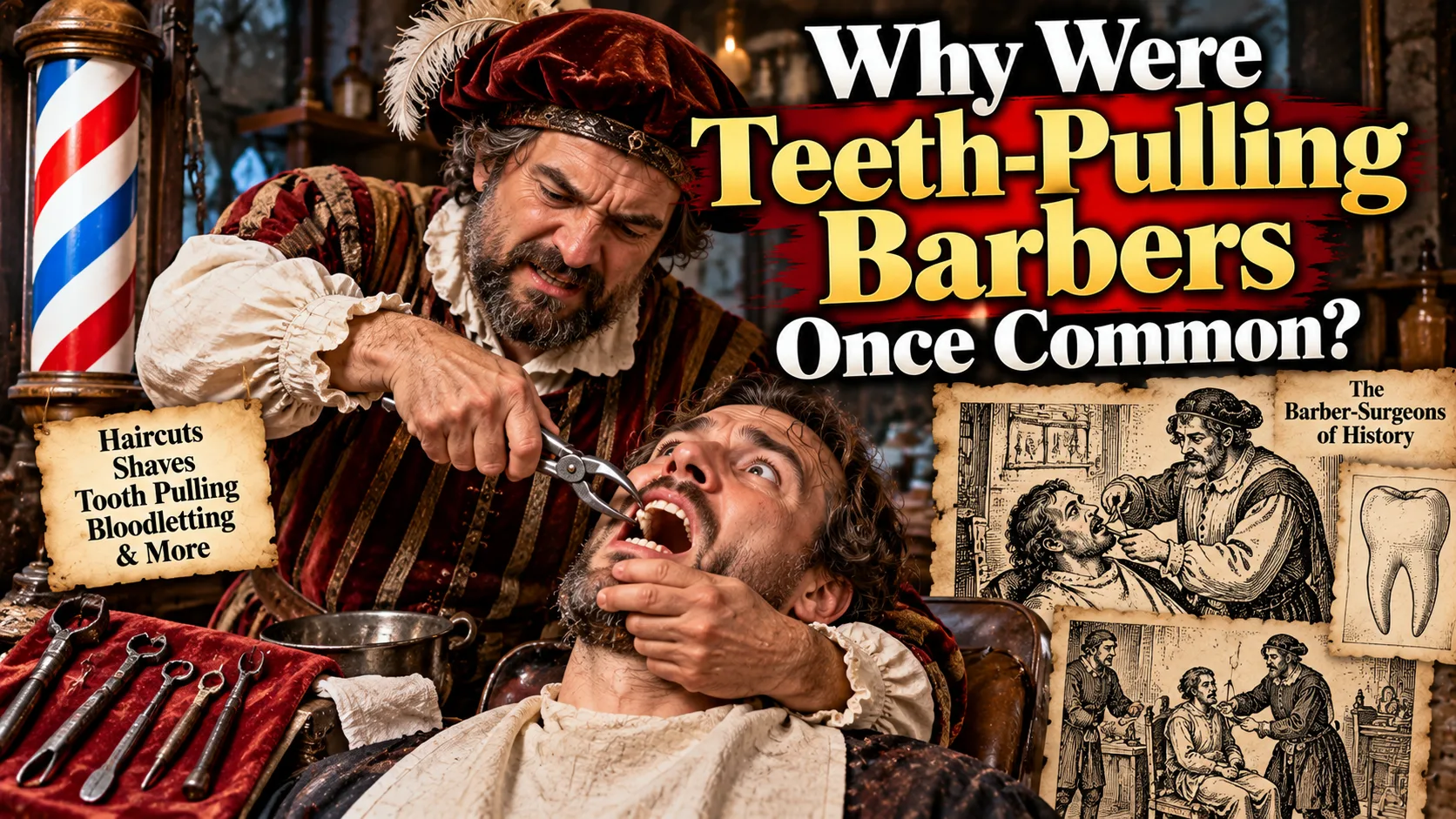
This brings the story back to barbers.
Barbers already worked with:
Razors.
Blades.
Knives.
Scissors.
They possessed practical skills involving the head and face.
In parts of medieval and early modern Europe, barber-surgeons therefore became associated with:
Bloodletting.
Minor surgery.
Wound care.
Tooth extraction.
Other hands-on procedures.
The Barber Pole Has a Medical History
The famous red-and-white barber pole is traditionally associated with the bloodletting history of barber-surgeons.
Red is commonly linked to blood.
White can be associated with bandages.
The symbolism reflects the old connection between:
Barbering.
Bloodletting.
Surgery.
Over time, the medical function disappeared while the visual symbol survived.
So a modern barber pole is effectively a surviving artifact from an era when your haircut might come with a surprisingly large amount of medical intervention.
Why Barbers Were Trusted With Bloodletting
The answer is partly practical.
They:
Handled sharp instruments.
Had steady hands.
Were locally accessible.
Had established customers.
Learned through apprenticeship.
Already performed grooming procedures involving blades.
The distinction between:
craft worker
and
medical practitioner
was much less rigid.
Why Physicians Might Not Perform Every Procedure
Academic physicians could focus more on:
Diagnosis.
Medical theory.
Internal disorders.
Diet.
Lifestyle.
Prescribed treatments.
Surgeons and barber-surgeons handled more manual procedures.
These professional boundaries varied by place and time.
But the broad distinction explains why a barber could be involved in bloodletting without being considered equivalent to a modern physician.
Bloodletting Was Part of Everyday Medicine
This is one of the most striking things.
It wasn't a rare emergency procedure.
In many periods, bloodletting became ordinary enough to be part of routine medical practice.
A person might seek treatment and expect:
A diagnosis.
Advice.
A prescription.
And perhaps:
A little less blood.
The Practice Became Socially Familiar
Once everyone knows a treatment exists, its presence reinforces itself.
Patients expect it.
Physicians offer it.
Medical books describe it.
Apprentices learn it.
A successful case is remembered.
A failed case gets explained another way.
The treatment becomes normal.
Normality itself becomes evidence.
Familiarity Can Look Like Truth
This is a psychological principle that extends far beyond bloodletting.
If a medical practice has existed for:
One generation.
Two generations.
Ten generations.
it's easy to conclude:
"People have always done this, so there must be something to it."
But longevity doesn't prove effectiveness.
A belief can survive because:
It fits a cultural model.
It is institutionally reinforced.
It feels intuitively plausible.
It produces occasional apparent successes.
It is supported by authority.
Bloodletting had all of these.
One Successful Case Can Protect a Bad Theory
Imagine ten patients receive bloodletting.
Seven die.
Three recover.
The three recoveries are remembered.
"Bloodletting saved them."
The deaths are attributed to:
Severe illness.
Late treatment.
Bad luck.
The particular disease.
Another complication.
This makes the treatment difficult to falsify through ordinary observation.
The Confirmation Problem
If a physician believes:
Bloodletting works
they are more likely to notice cases that appear to confirm it.
A patient improves:
Success.
A patient deteriorates:
The disease was too severe.
Without systematic comparison, the physician's belief can survive indefinitely.
This is not unique to historical medicine.
It's a human reasoning problem.
Why Modern Clinical Trials Were Revolutionary
Modern clinical research introduced more systematic ways to ask:
Does treatment A actually perform better than treatment B or no treatment?
Researchers can use:
Control groups.
Randomization.
Blinding.
Statistical analysis.
Standardized outcomes.
These methods aren't perfect.
But they make it much harder for one dramatic success story to determine the entire conclusion.
Bloodletting Could Not Survive Better Evidence Forever
As medicine changed, several developments undermined the old framework.
Anatomy improved
Human anatomy became increasingly accurate.
Physiology developed
Researchers began studying how the body actually functions.
Pathology developed
Disease could be linked to structural changes.
Microscopy improved
Hidden biological structures became visible.
Germ theory emerged
Microorganisms became recognized as causes of many diseases.
Clinical statistics developed
Treatments could be compared more rigorously.
Each discovery weakened the old humoral model.
William Harvey Changed Ideas About Blood
In the seventeenth century, English physician William Harvey demonstrated the circulation of blood through the heart and vessels.
This was revolutionary.
Blood was no longer simply understood as a humor existing within a broad balance system.
It circulated through a mechanical cardiovascular system.
That didn't immediately destroy bloodletting.
But it fundamentally changed the conceptual framework surrounding blood.
Blood Became a Circulating Fluid
Harvey's work helped establish that:
The heart pumps blood.
Blood circulates.
The cardiovascular system has direction and structure.
This was incompatible with some older assumptions.
Medicine was slowly moving toward physiology.
Yet Bloodletting Survived Harvey
This is an excellent reminder:
Scientific progress is not instantaneous.
A new theory can be correct.
An old treatment can remain popular.
People don't abandon an established medical practice simply because one experiment or discovery challenges its underlying theory.
Institutions change slowly.
The Germ Theory Era Was Another Blow
By the nineteenth century, scientists increasingly established that microorganisms could cause infectious disease.
This transformed the understanding of:
Infection.
Contagion.
Wound care.
Surgery.
Public health.
If bacteria cause an infection, removing blood doesn't address the underlying cause.
The logic of bloodletting became increasingly difficult to defend.
Yet Doctors Kept Doing It
Why?
Because medicine doesn't instantly update.
Training systems.
Textbooks.
Senior physicians.
Clinical habits.
Patient expectations.
all carry inertia.
An established practice can continue long after its theoretical foundation becomes questionable.
The Medical Profession Had a Problem
Physicians were facing a deeper question:
How do we know a treatment actually works?
Experience alone wasn't enough.
Stories weren't enough.
Authority wasn't enough.
Plausibility wasn't enough.
Something more rigorous was needed.
James Lind and Comparative Treatment
Earlier medical investigators had already begun using comparative approaches.
A famous example is James Lind's eighteenth-century scurvy experiment, which compared treatments among sailors.
His study wasn't a modern randomized clinical trial.
But it demonstrated the power of structured comparison.
Instead of asking:
"What treatment seems reasonable?"
you ask:
"Which treatment produces better outcomes than another?"
That shift would eventually transform medicine.
Pierre Charles Alexandre Louis Challenged Bloodletting
In nineteenth-century France, physician Pierre Charles Alexandre Louis used numerical analysis to examine the effectiveness of bloodletting for pneumonia and other illnesses.
His work suggested that bloodletting was not providing the benefits physicians assumed.
This was historically important because it attacked bloodletting not merely through theory, but through comparative clinical evidence.
The Old Theory Met Numbers
This is where medicine begins to change dramatically.
Humoral reasoning says:
The patient has excess blood. Remove it.
Clinical statistics ask:
Do patients who are bled actually do better?
That is a much harder question.
And it can produce an uncomfortable answer.
The Samuel Hahnemann Critique
In the early nineteenth century, physicians increasingly debated the dangers and effectiveness of bloodletting.
Some reformers strongly criticized aggressive bleeding.
Others defended it.
The medical profession did not suddenly agree.
Change occurred through prolonged disagreement, accumulating evidence, and shifts in medical theory.
A Turning Point Wasn't a Single Event
There wasn't one morning when doctors woke up and announced:
"Bloodletting is cancelled."
Its decline was gradual.
The rise of:
Modern physiology.
Pathology.
Clinical observation.
Statistics.
Anesthesia.
Antisepsis.
Microbiology.
and better understanding of disease mechanisms
reduced its medical role.
Bloodletting Became a Historical Symbol
Eventually, bloodletting became famous as an example of misguided medicine.
It came to represent:
Overconfidence.
Poor evidence.
Blind adherence to tradition.
Medical dogma.
But the history deserves more nuance.
The practice wasn't maintained simply because doctors were irrational.
It survived because an entire system of explanation supported it.
This Is the Real Lesson
When we look back at bloodletting, the important question isn't:
"How could they believe that?"
It's:
"What would we believe if our entire medical framework pointed in the same direction?"
That question is uncomfortable.
Because modern humans also rely on:
Expert authority.
Established practice.
Institutional consensus.
Intuition.
Anecdotes.
Mechanistic theories.
Historical precedent.
The fact that we're modern doesn't make us immune to medical error.
It gives us better tools for correcting it.
🟢 Established Evidence
Several facts about bloodletting's history are well documented.
Bloodletting was practiced in ancient and later medical traditions.
The Greco-Roman humoral framework strongly influenced its use in Western medicine.
Galen's writings played a major role in preserving and systematizing that framework.
Bloodletting became deeply established in medieval and early modern European medicine.
Barber-surgeons performed bloodletting in many settings.
Leeches and cupping were among the techniques used for blood removal.
Modern medicine still uses carefully controlled therapeutic phlebotomy for specific conditions, but this is based on modern physiology rather than the ancient theory of humoral balance.
🟡 What Historians Still Have to Interpret
The exact frequency and intensity of bloodletting varied enormously.
Not every physician used it in the same way.
Not every patient was treated identically.
Practices differed according to:
Time.
Region.
Medical school.
Disease.
Patient status.
Professional training.
Available tools.
The historical record therefore doesn't support a single universal description such as:
"Everyone was constantly being bled."
🔴 Popular Myth
"Bloodletting was completely random."
It wasn't.
Within humoral medicine, it was based on a theoretical framework involving:
Balance.
Humors.
Symptoms.
Age.
Season.
Constitution.
and other factors.
The framework was incorrect by modern biomedical standards.
But the treatment wasn't random within that framework.
Another Myth: "Ancient Doctors Knew Blood Was Harmful"
They understood that severe blood loss could weaken or kill a person.
That should tell us something.
They weren't unaware that blood mattered.
The problem was determining:
How much blood was safe.
When removing it was beneficial.
Which symptoms meant excess blood.
Whether blood loss corrected disease.
Those questions were answered using an incorrect physiological model.
Why This Story Still Matters
Bloodletting is more than an old medical curiosity.
It demonstrates how knowledge works.
A theory becomes influential.
Institutions adopt it.
Students learn it.
Professionals practice it.
Patients expect it.
Successes reinforce it.
Contradictions are explained away.
Then better evidence accumulates.
Eventually the framework changes.
This is not a uniquely medical phenomenon.
It happens in:
Science.
Economics.
Psychology.
Engineering.
Education.
Technology.
History.
Human beings build models of reality.
Then reality occasionally forces us to rebuild them.
Frequently Asked Questions
Why did ancient doctors think bloodletting worked?
Because many medical traditions understood disease as a problem of bodily imbalance. In Greco-Roman humoral medicine, blood was one of four major humors, so removing excess blood could seem like a logical way to restore health.
Who popularized bloodletting in Western medicine?
Bloodletting existed before Galen, but Galen's influential medical writings helped systematize humoral medicine and bloodletting, contributing to its enormous influence in later European and Islamic medical traditions.
Did bloodletting ever actually help anyone?
Blood removal can be medically useful for a small number of specific modern conditions. Historically, some patients may also have experienced temporary symptom relief, while others were likely harmed. Apparent improvement alone does not prove the historical practice was effective.
Did barbers really perform bloodletting?
Yes. Barber-surgeons in parts of medieval and early modern Europe performed bloodletting along with other hands-on procedures.
Why were leeches used?
Leeches provided a way to remove blood without making a large incision. Medicinal leeches remain useful for certain specialized modern medical procedures, although their modern applications are very different from historical bloodletting.
What were the four humors?
The classical Greco-Roman model identified blood, phlegm, yellow bile, and black bile as four major bodily humors whose balance was believed to influence health.
Did Hippocrates invent the four-humor theory?
The development of humoral medicine was gradual. Hippocratic texts contributed to the broader tradition, but the four-humor system was developed and elaborated by multiple physicians over time.
Why didn't doctors realize bloodletting was harmful?
Many people did observe complications, but without modern clinical trials and physiological knowledge, it was difficult to separate harm caused by the treatment from harm caused by the underlying disease.
When did bloodletting finally disappear?
Its widespread use declined gradually during the nineteenth and twentieth centuries as modern physiology, pathology, microbiology, and clinical evidence transformed medicine. It was not abolished on one specific date.
Is bloodletting still used today?
Yes, but in a very limited and medically specific form called therapeutic phlebotomy, used for conditions such as hemochromatosis and certain forms of polycythemia under medical supervision.
Final Thoughts
Bloodletting seems absurd because we now understand something historical physicians did not:
Blood isn't a harmful humor that accumulates simply because you're sick.
It is a living component of the circulatory system.
It carries oxygen.
Transports nutrients.
Moves hormones.
Supports immunity.
Maintains volume and pressure.
Lose too much, and the body suffers.
But once you place yourself inside the worldview of an ancient physician, the practice becomes easier to understand.
Disease was imbalance.
Blood was one of the body's fundamental substances.
Too much of something could cause illness.
Removing it could restore equilibrium.
The theory was wrong.
The reasoning inside the theory was understandable.
That's why bloodletting survived for so long.
It wasn't merely a superstition passed around by uneducated people.
It became part of:
Medical philosophy.
Professional training.
Textbooks.
Hospitals.
Guilds.
Government.
Religion.
And everyday expectations.
Galen's influence carried it forward.
Medieval physicians inherited it.
Islamic scholars preserved and developed the broader medical tradition.
Barber-surgeons turned it into a practical craft.
Leech collectors built an industry around it.
Patients asked for it.
Doctors expected it to help.
And because some patients occasionally improved afterward, those experiences could reinforce the belief.
The problem was that medicine lacked a reliable way to distinguish:
Treatment effect
from
natural recovery.
That distinction changed everything.
As anatomy improved, physiology developed.
As researchers learned how blood circulated, the old model became increasingly difficult to defend.
As pathology revealed structural changes in disease, humoral explanations weakened.
As microbiology uncovered microorganisms, infections could finally be explained in terms of mechanisms that bloodletting could not fix.
And as clinical statistics and comparative research developed, physicians gained a much more powerful question:
"Does this treatment actually improve outcomes?"
That question is far more dangerous to a medical tradition than argument alone.
Because a theory can survive criticism.
It has a much harder time surviving repeated evidence that patients do better without the treatment.
Bloodletting therefore tells us something profound about medicine.
The greatest danger isn't always ignorance.
Sometimes it is confidence in an internally coherent explanation.
A system can explain everything.
That's precisely the problem.
If every illness becomes evidence of imbalance, and every improvement becomes evidence that the treatment restored balance, the theory can become almost impossible to disprove.
Modern medicine exists partly because we built better ways to challenge our own explanations.
And yet the lesson remains uncomfortable.
Future generations will almost certainly look at some modern medical beliefs and practices and ask:
"How could they possibly have believed that?"
Some of those future judgments will be unfair.
Some will probably be justified.
That's how scientific progress works.
Knowledge expands.
Models change.
Old certainty becomes historical curiosity.
Bloodletting didn't disappear because humanity suddenly became smarter.
It declined because better evidence gave medicine better ways to discover that it was wrong.
And that may be the most valuable lesson of all:
Being reasonable is not the same thing as being correct.
A belief can make perfect sense within a flawed model of reality.
The only reliable way out is to keep testing the model against the world.
Because reality doesn't care how respected the textbook is.