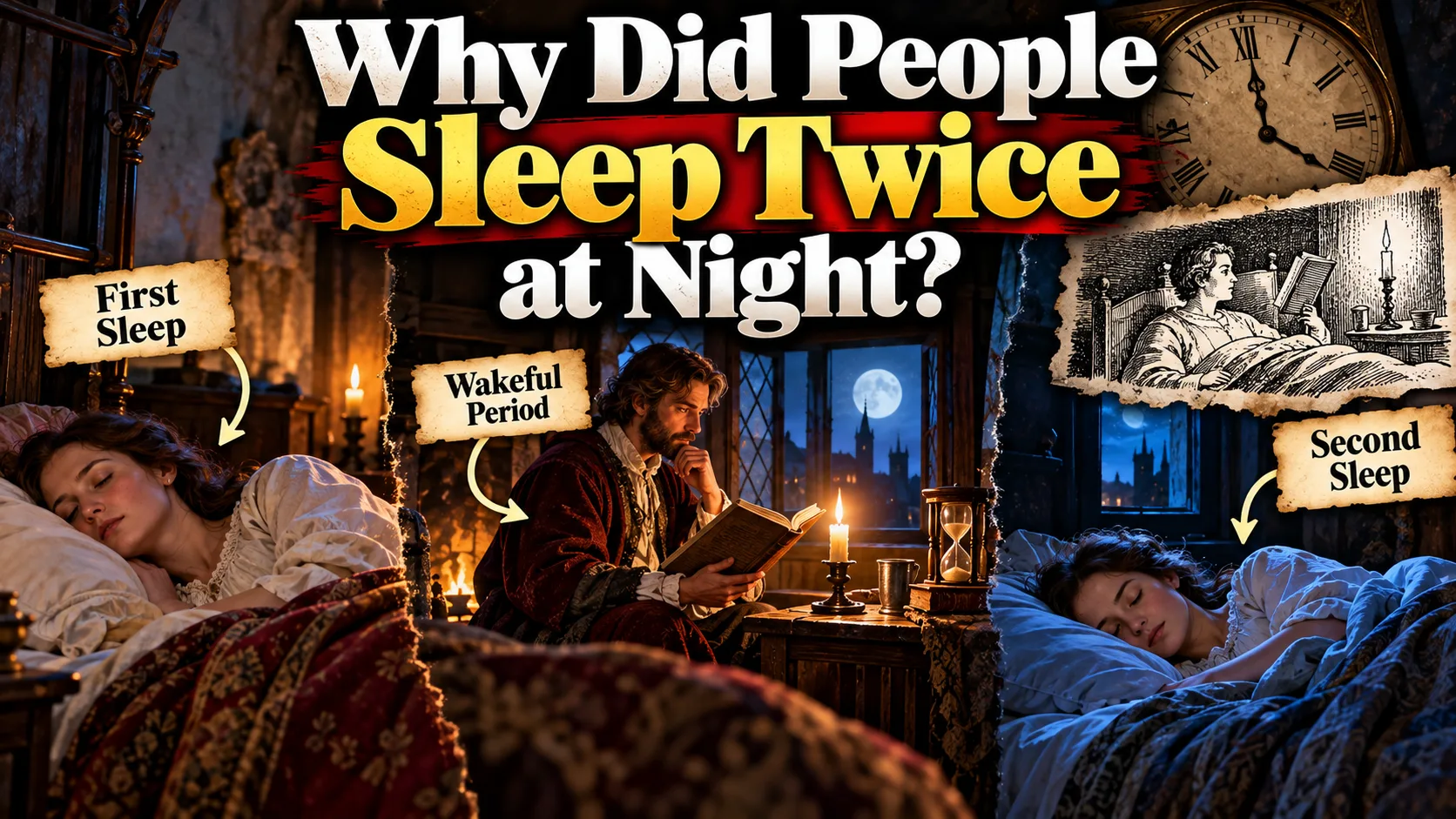
Why Did People Sleep Twice at Night?
Before electric lighting transformed daily life, some historical evidence suggests that people in parts of Europe described a pattern of “first sleep” and “second sleep,” with a period of wakefulness in between.
Why Did People Sleep Twice at Night?
Imagine going to bed around 9:00 PM.
You sleep for several hours.
Then, sometime around midnight, you wake up.
Not because your phone buzzed.
Not because an alarm interrupted you.
Not because somebody sent you a message that absolutely could not wait until morning.
You simply wake up.
You light a candle.
Perhaps you pray.
Read.
Talk with your family.
Work on something.
Think.
Then, after an hour or two, you return to bed.
You sleep again until morning.
To a modern person, this might sound like a problem.
"Why am I waking up in the middle of the night?"
But historical references suggest that a pattern sometimes described as "first sleep" and "second sleep" existed in parts of preindustrial Europe.
The idea has become popular in recent years because it seems to challenge something we take for granted:
Eight uninterrupted hours of sleep.
But the actual history is more complicated.
Were people genuinely sleeping in two nightly blocks?
Was segmented sleep normal for everyone?
Did electric lighting destroy an ancient human sleep pattern?
Or are we looking at a mixture of historical language, cultural habits, and modern interpretations?
The answer requires separating what historical sources actually say from what modern people wish they said.
And, naturally, humanity has managed to turn sleeping into another argument about whether modern civilization ruined everything.
The Idea of "First Sleep" and "Second Sleep"
The central historical claim comes from references to terms such as:
First sleep
and
Second sleep.
These expressions appear in historical writings from parts of Europe, especially during the medieval and early modern periods.
The implication is that nighttime sleep could be described as having two periods separated by a waking interval.
The waking period could involve:
Prayer.
Reading.
Conversation.
Sex.
Household tasks.
Thinking.
or simply lying awake.
That's already interesting.
But there's a critical question:
Was this the standard way everyone slept?
No.
Historical evidence doesn't justify that sweeping claim.
Historical Language Provides the First Clue
References to "first sleep" and "second sleep" appear in works from different periods.
The famous English physician Thomas Browne, writing in the seventeenth century, used language that reflects the concept of a first and second sleep.
Earlier English literature also contains references to sleeping periods described in similar ways.
These references are important because they demonstrate that the concept wasn't invented by modern historians.
People really did use language that distinguished parts of the night's sleep.
But language alone doesn't tell us:
How often people woke.
How long they stayed awake.
Whether most people experienced this every night.
Or whether the pattern was biologically universal.
A Phrase Is Not a Sleep Study
This distinction matters.
Suppose a modern person writes:
"I woke after my first sleep."
That doesn't prove everyone in their neighborhood slept in two equal blocks.
Likewise, historical references to first and second sleep establish that the concept existed.
They don't provide population-level measurements.
There were no medieval sleep laboratories.
Unfortunately, nobody was wearing a smartwatch in 1350 to produce a clean graph.
So Why Are Historians Interested?
Because these references appear in enough historical and literary material to suggest that nighttime waking was culturally recognizable.
People apparently understood sleep as something that could have phases.
That is different from saying:
"Everyone slept four hours, woke up, and then slept another four hours."
The historical record is not that precise.
The World Before Electric Light Was Different
There is another obvious variable:
Light.
Modern humans can make night look almost like day.
Streetlights.
Household lighting.
Phones.
Televisions.
Computers.
Office buildings.
Shopping centers.
Traffic.
LED bulbs.
A person living several centuries ago had much less artificial illumination.
That changed what nighttime meant.
Darkness Was Economically Important
Artificial light used to cost money and effort.
Candles required:
Wax or tallow.
Wicks.
Manufacturing.
Storage.
Maintenance.
Oil lamps required fuel.
Large-scale illumination was expensive.
So once darkness arrived, many ordinary activities became harder.
That could encourage earlier bedtimes.
Sunset Did Not Automatically Mean Bedtime
People weren't necessarily lying down the moment the sun disappeared.
Humans still had:
Household chores.
Cooking.
Animal care.
Religious practices.
Social activities.
Seasonal work.
Different societies also had different lighting systems.
So the relationship between sunset and sleep wasn't simple.
Still, nighttime was generally much darker than it is today.
That matters.
The Segmented-Sleep Hypothesis
One influential interpretation proposes that reduced artificial light could allow a naturally occurring pattern in which people:
Sleep.
Wake.
Sleep again.
Under this model, the first sleep would occur relatively early.
Then a period of quiet wakefulness would follow.
Then the second sleep would continue toward morning.
This is sometimes described as segmented sleep.
But here's where caution is needed.
Evidence for historical segmented sleep is stronger than evidence for a universal ancient human sleep pattern.
The Famous "Waking Hour"
Popular accounts often say people woke for:
One to three hours
during the middle of the night.
That may have happened.
But historical sources don't provide enough consistent data to say that every person regularly experienced the same duration.
Nighttime waking could vary enormously.
Age.
Health.
Season.
Household conditions.
Occupation.
Temperature.
Illness.
Noise.
and social status
all matter.
People Have Always Woken During the Night
This part isn't mysterious at all.
Humans still wake during the night.
Sleep naturally includes transitions between stages.
People can briefly awaken many times without remembering them.
Longer awakenings can occur for:
Temperature.
Noise.
Children.
Animals.
Stress.
Illness.
Urination.
Pain.
Environmental conditions.
The interesting historical question is not whether people woke up.
It's whether some cultures treated a longer waking period as a normal part of nighttime life.
Sleep Isn't One Continuous State
Modern sleep science shows that sleep is not simply:
Off
followed by:
On
Throughout the night, people cycle through different sleep stages.
These cycles repeat multiple times.
Brief awakenings can occur naturally.
Most aren't remembered.
So the idea of nighttime waking isn't biologically strange.
What Changes Is Whether You Remember It
A person can wake briefly and fall back asleep immediately.
They may never know it happened.
Another person wakes for an hour.
That becomes part of their remembered night.
Modern anxiety about sleep can make the second experience feel especially significant.
You look at the clock:
1:20 AM.
Then:
1:47 AM.
Then:
2:15 AM.
Now you're mentally calculating how many hours remain before morning.
Congratulations.
You have transformed ordinary wakefulness into an accounting problem.
Clock Watching Changes the Experience
Before widespread clocks, most people did not have precise minute-by-minute access to nighttime.
There may have been church bells.
Water clocks.
Candle clocks.
Public signals.
But the average person wasn't checking:
"It is 2:13 AM and I have exactly 4 hours 47 minutes remaining."
That difference could matter psychologically.
Modern Sleep Anxiety Is Different
Today, people can become highly conscious of:
Sleep duration.
Bedtime.
Wake time.
Sleep stages.
Heart rate.
Deep sleep.
REM sleep.
Sleep scores.
Wearable data.
This information can be useful.
But it can also increase attention toward normal variations in sleep.
A slightly unusual night becomes:
"My sleep architecture is broken."
Humans really did invent a device that measures how poorly we're sleeping while we're asleep.
Efficiency at its finest.
Artificial Light Probably Changed Sleep Timing
This part is much easier to establish historically.
The spread of artificial lighting allowed people to remain active later.
First:
Candles.
Oil lamps.
Gas lighting.
Then:
Electricity.
Streetlights.
Incandescent bulbs.
Fluorescent lighting.
LEDs.
Each reduced the practical importance of darkness.
As evenings became more usable, bedtime could shift later.
The Industrial Revolution Added Another Pressure
Industrial society introduced more rigid schedules.
Factories.
Railroads.
Office work.
School systems.
Standardized time.
Mass transportation.
People increasingly organized life around the clock.
Sleep became part of a timetable.
You didn't simply sleep when darkness told you to.
You slept because tomorrow's alarm said:
6:00 AM.
Standard Time Changed the Night
Before modern timekeeping, people experienced time differently.
Local solar time mattered.
Seasonal variation mattered.
Work schedules varied.
Mechanical clocks gradually changed this.
Railroads in the nineteenth century helped create pressure for standardized timekeeping in places such as the United States and Britain.
Modern life became increasingly synchronized.
That had consequences for sleep.
The Rise of the Alarm Clock
An alarm clock does something strange.
It separates waking from:
Sunlight.
Birdsong.
Family activity.
Natural environmental cues.
Instead:
a machine decides when you're awake.
The more industrialized societies became, the more sleep and waking were coordinated by artificial schedules.
That doesn't mean earlier societies had perfect natural sleep.
It means their timing was governed by different external forces.
So Did Electric Light "Destroy" Two-Part Sleep?
The answer is:
Not so simply.
Artificial light clearly altered nighttime activity and sleep opportunities.
But the evidence does not prove that humans universally had a biologically fixed first-and-second-sleep pattern that electricity somehow erased.
Sleep is influenced by:
Light exposure.
Circadian rhythms.
Social schedules.
Age.
Work.
Environment.
Individual biology.
The historical record adds culture to that list.
Circadian Rhythms Complicate the Story
Your body contains biological timing systems that help regulate:
Sleepiness.
Alertness.
Hormone release.
Temperature.
Metabolism.
These rhythms are influenced strongly by light.
Morning light helps synchronize the circadian system.
Artificial light can shift the timing of sleep under certain conditions.
So light really does affect when humans sleep.
That doesn't establish one universal two-block pattern.
Your Body Still Knows It's Night
Even with artificial lighting, humans remain strongly influenced by the day-night cycle.
Light reaching the eyes sends signals to brain systems involved in circadian timing.
The hormone melatonin rises in darkness and is suppressed by light.
Bright evening light can delay the body's biological night.
This is one reason modern lighting and screens can affect sleep timing.
But Historical People Weren't Living in Perfect Darkness
This matters too.
Candles existed.
Fireplaces produced light.
Oil lamps were common in many societies.
Urban centers could have nighttime activity.
We cannot assume:
Ancient night = complete darkness.
Lighting varied by wealth, geography, season, and period.
A wealthy household with many candles lived in a different nighttime environment from a poor rural household.
Class Probably Mattered
A historical "sleep pattern" should never be treated as socially uniform.
People with:
Large homes.
Servants.
Multiple rooms.
Reliable heating.
More food.
Better bedding.
more privacy
could experience nighttime very differently from laborers or people sharing crowded spaces.
Sleeping conditions matter.
Temperature Matters Too
Before central heating and modern insulation, nighttime cold could strongly influence sleep.
People used:
Fireplaces.
Bedsheets.
Blankets.
Hot coals.
Shared beds.
Different forms of insulation.
A cold room can create nighttime awakenings.
So historical sleep patterns cannot be explained by light alone.
Noise Was Different Too
Preindustrial nights weren't always peaceful.
There were:
Animals.
People.
Markets.
Church bells.
Travelers.
Neighbors.
Work.
Weather.
Wooden buildings.
Domestic activity.
Some cities could remain active at night.
The soundscape depended heavily on location.
The Bed Was Often a Social Space
In earlier societies, families could share sleeping spaces.
Servants might sleep nearby.
Multiple people might occupy the same household room.
This meant nighttime waking had social possibilities.
A person who woke wasn't necessarily isolated in a silent bedroom.
Someone else might already be awake.
Conversation was possible.
"Waking in the Night" Had Cultural Meaning
This is where historical sources become particularly interesting.
A nighttime waking period could be used for:
Prayer.
Reflection.
Sex.
Reading.
Conversation.
Writing.
Household activity.
These references suggest that at least some people treated nighttime wakefulness as ordinary enough to have a recognizable cultural role.
Prayer Was a Major Activity
Religious life shaped nighttime for many historical communities.
People could pray:
Before sleeping.
Upon waking.
During the night.
At fixed religious hours.
Monastic communities followed structured prayer schedules.
That means a waking period was not necessarily viewed as a sleep disorder.
It could be spiritually meaningful.
Monastic Life Was Different
Monastic communities sometimes divided the night according to religious routines.
Night offices required monks to rise at specific times.
But this shouldn't automatically be used as proof that ordinary European households had exactly the same sleep pattern.
Monastic schedules are highly specialized.
They demonstrate that nighttime waking could be socially institutionalized.
Not that everyone slept on a two-block schedule.
The Medieval Night Wasn't Empty
Popular imagination sometimes portrays medieval nighttime as:
Complete darkness.
Everyone asleep.
No activity.
Then morning.
Reality was more complicated.
People:
Worked.
Traveled.
Prayed.
Cared for animals.
Cooked.
Guarded cities.
Midwives attended births.
Doctors treated patients.
Criminals committed crimes.
People fell in love.
People argued.
Humans remained stubbornly active after sunset.
Work Could Split Sleep Too
Farmers and laborers sometimes had schedules shaped by:
Season.
Animals.
Agricultural demands.
Weather.
Local customs.
Night watchmen had jobs specifically requiring nighttime wakefulness.
So sleep patterns varied depending on occupation.
A person whose livelihood required early morning work did not necessarily sleep like a wealthy urban intellectual.
What About "Everyone Slept in Two Shifts"?
This is where the popular story goes too far.
Historical evidence establishes the concept of first and second sleep.
It does not establish that:
Every person.
Every night.
Across Europe.
for centuries
slept in precisely two equal blocks.
The evidence is not that clean.
The Historical Record Has a Bias
Who wrote the surviving sources?
Often:
Clergy.
Literary authors.
Officials.
Doctors.
Educated elites.
These people don't represent the entire population.
An agricultural worker who woke briefly at night may never have written about it.
A scholar discussing "first sleep" may have been describing a literary or cultural convention.
We have to account for the surviving evidence's social bias.
Language Can Outlive the Practice
A phrase can survive even after behavior changes.
Imagine we still use:
"dial a number"
even though many people no longer use physical dials.
Or:
"hang up"
when there's nothing to hang up.
Similarly, historical references to first and second sleep may reflect an established concept even as actual sleep patterns changed.
Language preserves old systems.
Shakespeare's World Used the Language Too
References to sleep and nighttime in early modern English literature sometimes distinguish different parts of the night.
That demonstrates the language was recognizable.
But literature is not a sleep laboratory.
A playwright uses language for:
Rhythm.
Character.
Meaning.
Poetry.
Cultural familiarity.
The phrase tells us the concept existed.
It doesn't give us a national sleep average.
The Famous "First Sleep" Papers
Historical references have been highlighted by historians studying preindustrial nighttime life.
Roger Ekirch, a historian who wrote extensively about the history of nighttime, argued that segmented sleep was common in preindustrial Europe.
His work brought the concept into modern discussion.
The thesis became widely influential.
But like many historical interpretations, it has also been debated.
What the Debate Is Really About
The important scholarly question isn't:
"Did anyone ever wake up at night?"
Clearly they did.
The debate is about:
How widespread was sustained segmented sleep?
And:
What evidence does the historical record actually provide for it?
Some researchers believe the evidence indicates a substantial historical pattern.
Others argue that the sources don't justify assuming that segmented sleep was universal or even dominant.
The debate is mainly about scale and interpretation.
Modern Experiments Added Another Layer
Researchers have conducted experiments in which people were exposed to long periods of darkness without modern artificial lighting.
Some studies found participants developing a more divided nighttime sleep pattern, with a period of wakefulness between two sleep episodes.
This has been used to support the hypothesis that longer natural darkness may facilitate segmented sleep.
But laboratory conditions are not medieval Europe.
That's an important limitation.
The Famous Thomas Wehr Experiment
Psychiatrist Thomas Wehr conducted controlled experiments in which participants spent long daily periods in darkness.
Under these conditions, participants could develop a pattern involving:
An initial period of sleep.
A period of nighttime wakefulness.
A later period of sleep.
These findings are interesting because they demonstrate that segmented sleep can emerge under particular environmental conditions.
But they don't prove that medieval Europeans universally slept this way.
Why the Experiment Matters
It demonstrates something valuable:
Human sleep is flexible.
It can respond to:
Light conditions.
Schedules.
Environment.
Social expectations.
Biological timing.
That makes historical variation plausible.
But plausibility isn't historical proof.
Modern Sleep Isn't Necessarily Biologically "Normal"
We sometimes assume:
One continuous eight-hour block = the natural human sleep pattern.
That's too simplistic.
Humans vary.
Across:
Age.
Culture.
Work patterns.
Latitude.
Season.
Environment.
social schedules.
Sleep can look different.
Eight Hours Is a Modern Recommendation Framework
The commonly repeated idea that every adult must sleep exactly eight hours is misleading.
Adults differ in sleep needs.
Sleep duration recommendations usually provide ranges rather than one universal number.
A person sleeping seven hours isn't automatically unhealthy.
Someone sleeping nine isn't automatically doing something wrong.
Human biology doesn't operate like a standardized school timetable.
Historically, Sleep Duration Varied
People didn't necessarily sleep the same number of hours every night.
Seasonal work changed.
Sunrise changed.
Weather changed.
Religious schedules changed.
Illness changed.
Childcare changed.
Occupation changed.
Social events changed.
The idea of one universal nightly duration is modern partly because modern schedules demand regularity.
Children Sleep Differently
Historical households with children would have experienced very different sleep dynamics from modern adults living alone.
Infants wake.
Children wake.
Parents wake.
Feeding occurs.
Illness occurs.
Families share rooms.
Any discussion of "historical human sleep" that ignores children is missing a massive part of actual household life.
What Did People Do During the Waking Period?
This is where the historical sources become especially fascinating.
Descriptions mention activities such as:
Prayer.
Reflection.
Reading.
Conversation.
Visiting.
Sex.
Writing.
Household work.
People could use the waking period rather than treating it as a medical emergency.
Imagine a Night Without a Phone
You wake at 1:00 AM.
No smartphone.
No Netflix.
No endless scrolling.
No notifications.
No 24-hour entertainment.
What do you do?
Perhaps:
Talk.
Read.
Pray.
Think.
Sit near the fire.
Do household work.
Return to sleep.
That doesn't prove historical people did exactly that every night.
But it illustrates how differently a nighttime waking period might feel when digital stimulation doesn't exist.
Why We Now Treat Wakefulness as Failure
Modern culture treats sleep almost like a performance metric.
You need:
The correct bedtime.
The correct duration.
The correct room temperature.
The correct pillow.
The correct sleep stage.
Then your wearable gives you a score.
Sleep itself becomes something you're trying to optimize.
A middle-of-the-night awakening can therefore feel like:
"I failed at sleeping."
Historically, that emotional interpretation may not have existed in the same form.
The Clock Changed the Meaning of Waking
Without a precise clock, waking at night doesn't necessarily translate into:
"I have lost 27 minutes of sleep."
It may simply be:
"I'm awake."
That is psychologically different.
Modern timekeeping creates numerical pressure.
Industrial Life Punishes Nighttime Wakefulness
A factory worker with a 6:00 AM shift can't casually spend two hours reading at 1:00 AM.
A modern office worker can't simply say:
"I'm having my second sleep now. See you around 10."
Industrial scheduling turns sleep into a deadline.
Historical flexibility shrinks as standardized work schedules expand.
Why the Industrial Revolution Matters
The nineteenth century brought:
Factories.
Mass transportation.
Standardized working hours.
Artificial lighting.
Urbanization.
Electricity.
These systems changed:
When people worked.
When they traveled.
When they socialized.
When they slept.
Sleep became increasingly coordinated with the clock rather than with the natural availability of darkness.
The Second Sleep Didn't Necessarily "Disappear"
This is one of the biggest misunderstandings.
People still wake at night today.
The difference may be:
We interpret it differently.
We may try to suppress it.
We may become anxious.
We may turn on bright lights.
We may check our phones.
We may get out of bed and work.
The biological event remains.
The cultural response changes.
The Modern Bedroom Is Completely Different
Consider the historical sleeping environment.
Then:
Dark room.
Simple bed.
Limited entertainment.
Few clocks.
No notifications.
No internet.
No blue light from a phone.
Now:
LED lights.
Screens.
Wi-Fi.
Phones.
Smartwatches.
Notifications.
Streaming.
Climate control.
The modern bedroom is practically a small electronics showroom.
Blue Light Gets Too Much Credit
People often hear:
"Blue light is why you can't sleep."
The reality is more nuanced.
Evening light can influence circadian timing.
Short-wavelength light can be particularly effective at affecting the biological clock.
But sleep problems aren't caused by "blue light" alone.
Screen content also matters.
Emotional stimulation.
Attention.
Notifications.
Late-night activity.
Delayed bedtime.
The entire behavior pattern matters.
The Real Enemy May Be "It's 2 AM and I'm Watching Another Video"
The human problem isn't always photons.
It's behavior.
A phone can provide:
Infinite novelty.
Social interaction.
News.
Entertainment.
Work.
Stress.
At 1:00 AM, the brain may receive more stimulation than a person centuries ago could have encountered in an entire night.
That changes the conditions under which wakefulness occurs.
Why Falling Back Asleep Can Become Harder
Suppose you wake at 2:00 AM.
You remain in darkness.
You don't check the time.
You stay relaxed.
You may fall back asleep naturally.
Now compare:
Wake.
Check phone.
See a notification.
Read a message.
Open social media.
See something stressful.
Check the clock.
Start calculating sleep duration.
Now your brain is alert.
The waking period can become self-reinforcing.
Did Ancient People Have Better Sleep?
Not necessarily.
Historical people also experienced:
Illness.
Pain.
Noise.
Infants.
Cold.
Hunger.
Stress.
War.
Pregnancy.
Night work.
Crowding.
Poor bedding.
Environmental danger.
The past wasn't a sleep retreat.
We shouldn't romanticize it.
Preindustrial Sleep Could Be Terrible
Imagine sleeping in:
A cold house.
A crowded room.
With livestock nearby.
With insects.
Without reliable heating.
During illness.
During war.
The absence of electric light doesn't automatically create excellent sleep.
Environmental conditions matter enormously.
Some Historical People Probably Slept in One Block
This should be obvious.
Human behavior varies.
Some people:
Went to bed.
Slept.
Woke in the morning.
Others woke during the night.
Still others worked night shifts.
There is no reason to expect one universal pattern across thousands of years.
So Why Does the Two-Sleep Story Persist?
Because it contains three ingredients that people love:
A fascinating historical claim.
A plausible biological mechanism.
And a modern lifestyle that feels completely different.
That makes a great narrative.
But historical narratives need careful boundaries.
🟢 What We Know
Several points are well supported:
Nighttime waking is normal
Humans can experience brief and longer awakenings during sleep.
Sleep is influenced by light
The circadian system responds strongly to environmental light.
Artificial lighting changed human nighttime behavior
People gained the ability to remain active later.
Historical sources use language describing first and second sleep
This demonstrates that the concept existed in historical European texts.
Experiments show segmented sleep can occur
Extended darkness and certain environmental conditions can produce a sleep-wake pattern involving nighttime wakefulness.
🟡 What Remains Uncertain
The biggest uncertainty is:
How common was segmented sleep in ordinary preindustrial populations?
Researchers debate:
How representative the surviving sources are.
Whether "first sleep" and "second sleep" were literal descriptions of widespread behavior.
How often people experienced prolonged nighttime waking.
Whether the pattern was seasonal.
Whether it varied by class.
Whether it varied by geography.
There isn't enough evidence to produce a universal medieval sleep schedule.
🔴 Popular Myth
"Everyone before electricity slept in two four-hour blocks."
No.
That's far more certain than the evidence allows.
Historical sources support the existence of the idea and probably some real practice of segmented sleep.
They do not demonstrate that every preindustrial person followed a standardized:
4 hours + 1 hour awake + 4 hours
schedule.
Another Myth: "Modern Humans Are Designed for Exactly Eight Hours"
Also too simple.
Adults have different sleep needs.
Sleep duration naturally varies.
The body doesn't contain an ancient clock programmed to:
8:00:00 hours exactly.
What matters is whether the person's sleep is adequate and functioning normally for their circumstances.
Another Myth: "Waking at Night Means Something Is Wrong"
Not necessarily.
Brief awakenings occur naturally.
Longer wakefulness can happen for many reasons.
Stress.
Environment.
Age.
Light.
Illness.
Schedule.
If persistent nighttime awakenings substantially disrupt daytime functioning, that's a different matter.
But waking once during a night does not automatically indicate pathology.
What Did "First Sleep" Mean?
It's possible that in some historical contexts, "first sleep" was a literal description of an earlier block of sleep.
It may also have become a conventional way of talking about early-night sleep.
The language suggests a recognizable distinction.
But historians must avoid treating every occurrence of the phrase as a direct sleep measurement.
Why This Is a Good Example of Historical Reasoning
Suppose historians find:
Ten sources mentioning first sleep.
A modern reader says:
"Everyone slept in two blocks."
That's an inference.
A careful historian says:
"There is evidence that first and second sleep were recognizable concepts. The extent to which this reflected common behavior remains uncertain."
The second statement is less dramatic.
It is also more defensible.
Historical Evidence Is Uneven
Some periods leave:
Diaries.
Medical texts.
Religious writings.
Legal documents.
Literature.
Personal letters.
Other periods leave very little.
This creates blind spots.
A practice that appears often in the surviving sources may be:
Very common.
Very notable.
Or simply more likely to be written about.
You have to consider what kinds of people produced the evidence.
The History of Sleep Is Also the History of Time
Humans changed not only how they slept.
They changed how they measured the night.
Sundials.
Bells.
Mechanical clocks.
Pocket watches.
Factory clocks.
Alarm clocks.
Digital clocks.
Smartwatches.
Each technology changed our relationship with time.
And sleep became increasingly measurable.
From Darkness to Data
This transformation is remarkable.
A historical person:
"I slept for part of the night."
A modern person:
"My device says I had 1 hour 32 minutes of deep sleep, 5 hours 48 minutes total sleep, a resting heart rate of 57, and apparently my recovery score is 63."
Somewhere along the way, sleeping became a quantified activity.
Does More Measurement Improve Sleep?
Sometimes.
It can help people identify:
Irregular schedules.
Snoring patterns.
Potential problems.
Consistent routines.
But measurement can also create anxiety.
The more closely you monitor normal biological variation, the more abnormalities you will notice.
The human body is not a machine that produces identical numbers every night.
What Should You Do if You Wake at Night?
From a modern sleep-health perspective, the key principle isn't:
"You must recreate medieval segmented sleep."
That's romantic history, not treatment.
If you wake briefly and fall back asleep, there's usually no reason to panic.
If you remain awake and become frustrated, constantly watching the clock can make the experience more stressful.
A calm, low-stimulation environment is generally more compatible with returning to sleep than:
Bright lights.
Work.
Scrolling.
Exciting entertainment.
Don't Turn History Into a Sleep Prescription
This is important.
The fact that some historical people may have experienced segmented sleep doesn't mean:
You should deliberately wake yourself at midnight.
Historical behavior isn't automatically healthy.
Ancient people also:
Died young.
Had infections.
Lacked antibiotics.
Experienced nutritional deficiencies.
Had terrible sanitation.
Nobody should start recreating medieval public health just because medieval sleep sounds interesting.
The Past Doesn't Give Medical Instructions
History can tell us:
What people did.
What people believed.
How societies were organized.
How technology affected behavior.
It cannot automatically tell us:
What modern humans should do.
That's a separate scientific question.
Sleep Is Adaptable
Perhaps the most interesting takeaway is that human sleep isn't a rigid block.
It responds to:
Light.
Social schedules.
Environment.
Age.
Occupation.
Culture.
Biology.
That flexibility helped humans adapt to wildly different living conditions.
A hunter-gatherer.
A medieval farmer.
A nineteenth-century factory worker.
A modern American office worker.
may all organize sleep differently.
Yet Biology Remains
Despite cultural variation, humans still have biological sleep systems.
Circadian rhythms remain.
Sleep pressure remains.
Light remains important.
The need for adequate sleep remains.
Culture modifies the schedule.
It doesn't abolish physiology.
Why This Historical Mystery Matters
The debate over first and second sleep isn't really about whether our ancestors had weird bedtime habits.
It's about a broader question:
How much of human behavior is biology, and how much is environment?
Change the environment:
Less light.
Different work schedules.
Different social expectations.
Different technology.
Different timekeeping.
And behavior changes.
That's an enormous lesson.
Modern Life Is an Experiment
We have created an environment in which:
Night is illuminated.
Information never stops.
Work can continue 24 hours.
Entertainment is infinite.
Communication is instantaneous.
Time is measured constantly.
The human sleep system evolved under very different conditions.
That doesn't mean modern life is inherently wrong.
It means our environment has changed dramatically.
The 24-Hour Society
Restaurants.
Hospitals.
Airports.
Call centers.
Factories.
Data centers.
Delivery services.
Online platforms.
are active around the clock.
Someone, somewhere, is always awake.
Modern society has effectively removed the idea that nighttime should belong exclusively to sleep.
That's historically unusual.
We Can See the Difference in Our Bedrooms
The bedroom used to be a place where nighttime happened.
Now it's often:
An office.
Cinema.
Gaming station.
Communication center.
Shopping center.
Newsroom.
The same room can contain nearly every source of stimulation available during daytime.
The biological clock says:
Night.
Your phone says:
Here are 47 new things.
The Strange Paradox
Modern technology makes sleep easier in some ways.
Heating.
Cooling.
Comfortable mattresses.
Soundproofing.
Medical treatment.
Better housing.
Blackout curtains.
At the same time, it makes staying awake dramatically easier.
That's the paradox.
We have the best sleep environments humanity has ever created.
And also the most powerful tools for refusing to sleep in them.
Frequently Asked Questions
Did medieval people really sleep twice every night?
Some historical evidence indicates that the concepts of "first sleep" and "second sleep" were recognized in parts of preindustrial Europe, and segmented sleep may have been practiced. But there is not enough evidence to say that every medieval person followed a two-part sleep schedule.
What is segmented sleep?
Segmented sleep refers to sleep divided into separate periods rather than one continuous block, with wakefulness between them.
Why would people wake during the night?
Possible factors include long periods of darkness, environmental conditions, light exposure, social routines, religious practices, temperature, noise, illness, and individual differences.
Did electricity destroy segmented sleep?
Artificial lighting changed nighttime activity and sleep timing, but it is too simplistic to say electricity single-handedly destroyed a universal ancient sleep pattern.
What did people do during the waking period?
Historical references include prayer, reading, conversation, reflection, household activities, and other nighttime activities.
Was the first sleep exactly four hours?
There is no strong historical evidence establishing a universal four-hour first sleep.
Can modern people naturally sleep in two segments?
Yes. Human sleep can be segmented under some circumstances, and experimental research has demonstrated that prolonged darkness can alter sleep patterns.
Is waking at night normal?
Brief awakenings are normal. Longer periods of wakefulness can occur for many reasons and aren't automatically signs of disease.
Should I intentionally wake up in the middle of the night because ancient people did?
No historical evidence justifies that as a general recommendation. Historical practices and modern sleep-health recommendations are different questions.
Did everyone in ancient times sleep longer?
Not necessarily. Sleep duration varied with age, occupation, season, environment, health, social status, and culture.
Myth vs. Reality
🟢 People historically used terms such as "first sleep" and "second sleep."
Yes.
🟢 Segmented sleep is biologically possible.
Yes.
🟢 Artificial lighting changed nighttime behavior.
Yes.
🟡 Segmented sleep may have been common in some preindustrial societies.
There is historical evidence supporting the possibility, but its exact prevalence is debated.
🔴 Everyone before electricity slept in two four-hour blocks.
No.
🔴 Electricity completely destroyed humanity's natural sleep pattern.
Too simplistic.
🔴 Waking at night is inherently unhealthy.
Not necessarily.
🔴 Historical sleep patterns prove what modern humans should do.
No.
The Bigger Story Behind First and Second Sleep
The history of sleep isn't really a story about people going to bed twice.
It's a story about how technology reshaped the night.
For most of human history:
Darkness limited activity.
Artificial light was expensive.
Timekeeping was less precise.
Work schedules varied.
Nighttime was culturally distinct from daytime.
Then humans changed the environment.
Candles extended the evening.
Gas lamps illuminated streets.
Electricity transformed cities.
Alarm clocks standardized waking.
Factories standardized work.
Television filled late nights.
Computers extended work.
Smartphones brought the entire world into bed.
The night stopped being a boundary.
It became another operating period.
Final Thoughts
The idea of first and second sleep is fascinating because it challenges one of our strongest assumptions:
That everyone has always slept the way we sleep now.
They haven't.
Human sleep has always been influenced by:
Light.
Darkness.
Work.
Culture.
Age.
Environment.
Technology.
Religion.
Social expectations.
Individual biology.
Historical sources suggest that in some preindustrial European contexts, people recognized a distinction between an early "first sleep" and a later "second sleep."
That evidence is real.
The uncertainty lies in how widespread the practice actually was.
It is easy to turn the historical record into a neat story:
People went to bed early.
Slept four hours.
Woke at midnight.
Spent an hour praying and talking.
Then slept four more hours.
Electricity arrived.
Everyone lost their ancient sleep pattern.
It is a beautiful story.
It is also much cleaner than the evidence.
Real history is messier.
People slept differently depending on:
Where they lived.
What they did.
How wealthy they were.
What season it was.
Whether they had children.
Whether they were sick.
How cold the room was.
How much light they could afford.
And what their society expected at night.
Some people may have experienced a genuine two-part sleep.
Others probably slept in one continuous period.
Many likely moved between patterns throughout their lives.
That's the important lesson.
Human biology provides possibilities.
The environment determines which possibilities become common.
Modern artificial lighting didn't magically rewrite the human brain.
It changed the conditions under which the brain operates.
And modern society went much further.
We created:
24-hour businesses.
Night shifts.
Electric cities.
Streaming.
Social media.
Smartphones.
Instant communication.
A world where midnight no longer means:
"The day is over."
It can mean:
"The day is still going."
That's a profound historical change.
The night used to impose limits.
Technology turned many of those limits into choices.
And perhaps that explains why the story of segmented sleep continues to fascinate modern people.
It reminds us that the way we sleep isn't simply a biological command.
It is partly a negotiation between:
The body
and
the world we've built around it.
Maybe our ancestors didn't possess some perfect forgotten sleep system.
Maybe they simply lived under different conditions.
Sometimes they slept.
Sometimes they woke.
Sometimes they returned to sleep.
And sometimes they probably stayed awake far longer than was sensible.
Which, honestly, makes them sound remarkably human.
The real mystery isn't:
"Why did people sleep twice?"
It's:
"How much of the way we sleep is actually human nature, and how much is the schedule civilization built for us?"
That question doesn't end with the medieval night.
It leads directly into our own bedroom.
And the glowing rectangle sitting beside your pillow.