The Weirdest Beauty Standards in History
From bound feet and elongated skulls to pale skin and extreme corsets, beauty standards have changed dramatically across cultures and centuries, revealing how society shapes ideas of attractiveness.
The Weirdest Beauty Standards in History
What makes someone beautiful?
The answer seems obvious until you look at history.
Today, people might associate beauty with:
Clear skin.
Certain facial proportions.
A particular body shape.
Hair styles.
Teeth alignment.
Youthfulness.
But travel backward a few centuries and many of those assumptions begin to collapse.
In some societies, extremely pale skin signaled status.
In others, a suntan suggested wealth.
Some communities considered stretched earlobes beautiful.
Others modified the shape of the skull.
Tiny waists were fashionable.
Long necks were admired.
Blackened teeth could signify sophistication.
Golden hair could be prized.
And in some places, deliberately altering the feet became a marker of beauty and status.
The strange part isn't that people had unusual preferences.
The strange part is how normal those preferences felt to the people living inside them.
Beauty standards can become so deeply embedded in a culture that something physically uncomfortable or even dangerous starts to look desirable.
That raises a bigger question:
How much of beauty is biological, and how much is learned?
The answer is complicated.
Humans appear to share some broad preferences, including sensitivity to indicators associated with health or developmental maturity.
But culture can dramatically reshape what those signals mean.
And history gives us an extraordinary laboratory for watching that process happen.
Beauty Is Not a Universal Rulebook
Imagine showing a modern fashion magazine to someone living in medieval Europe.
They would probably recognize:
People.
Clothing.
Hair.
Faces.
But the specific beauty ideal might be almost unrecognizable.
Now go farther back.
Ancient Egypt.
Classical Greece.
Imperial China.
Victorian Britain.
Mesoamerica.
West Africa.
Different societies developed different ideas about:
Ideal bodies.
Skin tone.
Hair.
Teeth.
Height.
Body proportions.
Ornaments.
Scars.
Cosmetics.
Even posture and movement.
Beauty was never simply one worldwide standard.
It was a social language.
Why Beauty Standards Exist at All
Beauty standards do more than determine who is considered attractive.
They can communicate:
Status.
Age.
Health.
Wealth.
Group identity.
Marriageability.
Religion.
Class.
Occupation.
Fashion.
Political power.
In many societies, appearance became a way to show that someone belonged to a particular social category.
This is why beauty practices often seem irrational when viewed without context.
The goal wasn't necessarily:
"Let's make the human body more comfortable."
It might have been:
"Let's make the body visibly communicate who we are."
Beauty and Status Have Always Been Connected
One recurring pattern in history is that beauty can become associated with economic privilege.
If a particular appearance requires:
Free time.
Expensive products.
Specialized clothing.
Servants.
Medical treatment.
Restricted physical activity.
then possessing that appearance can signal wealth.
That's why certain beauty standards can seem completely impractical.
Impracticality itself can become part of the status signal.
1. Pale Skin in European History
For long periods in European history, very pale skin was associated with higher social status.
Why?
Outdoor manual labor often meant greater exposure to sunlight.
People working in fields or outdoors could become visibly tanned.
Members of wealthier classes could spend more time indoors.
So pale skin became associated with:
Leisure.
Refinement.
Social status.
A life without agricultural labor.
The Meaning of Pale Skin Changed Over Time
This is important.
There is no universal historical rule saying:
"Europeans always preferred pale skin."
Standards changed significantly.
By the twentieth century, especially in parts of the United States and Europe, tanning could become associated with:
Vacations.
Leisure.
Outdoor recreation.
Travel.
A lifestyle in which someone could afford to spend time at beaches.
The same sunlight that once suggested labor could later suggest leisure.
The body didn't change.
The social meaning did.
2. Artificially Pale Skin
Historical beauty practices sometimes attempted to produce paler complexions using cosmetics.
In Europe, white cosmetics could contain dangerous ingredients, including lead compounds.
These products could create a pale appearance but also cause serious health problems when used repeatedly.
The pursuit of beauty therefore sometimes involved exposure to toxic substances.
Humans have repeatedly demonstrated a willingness to put chemistry between themselves and their perceived ideal.
The "Aristocratic" Look
Pale skin wasn't only about appearance.
It could communicate:
"I don't work outdoors."
That implied something deeper:
"I don't need to."
Beauty became a visible representation of economic privilege.
That pattern appears repeatedly in history.
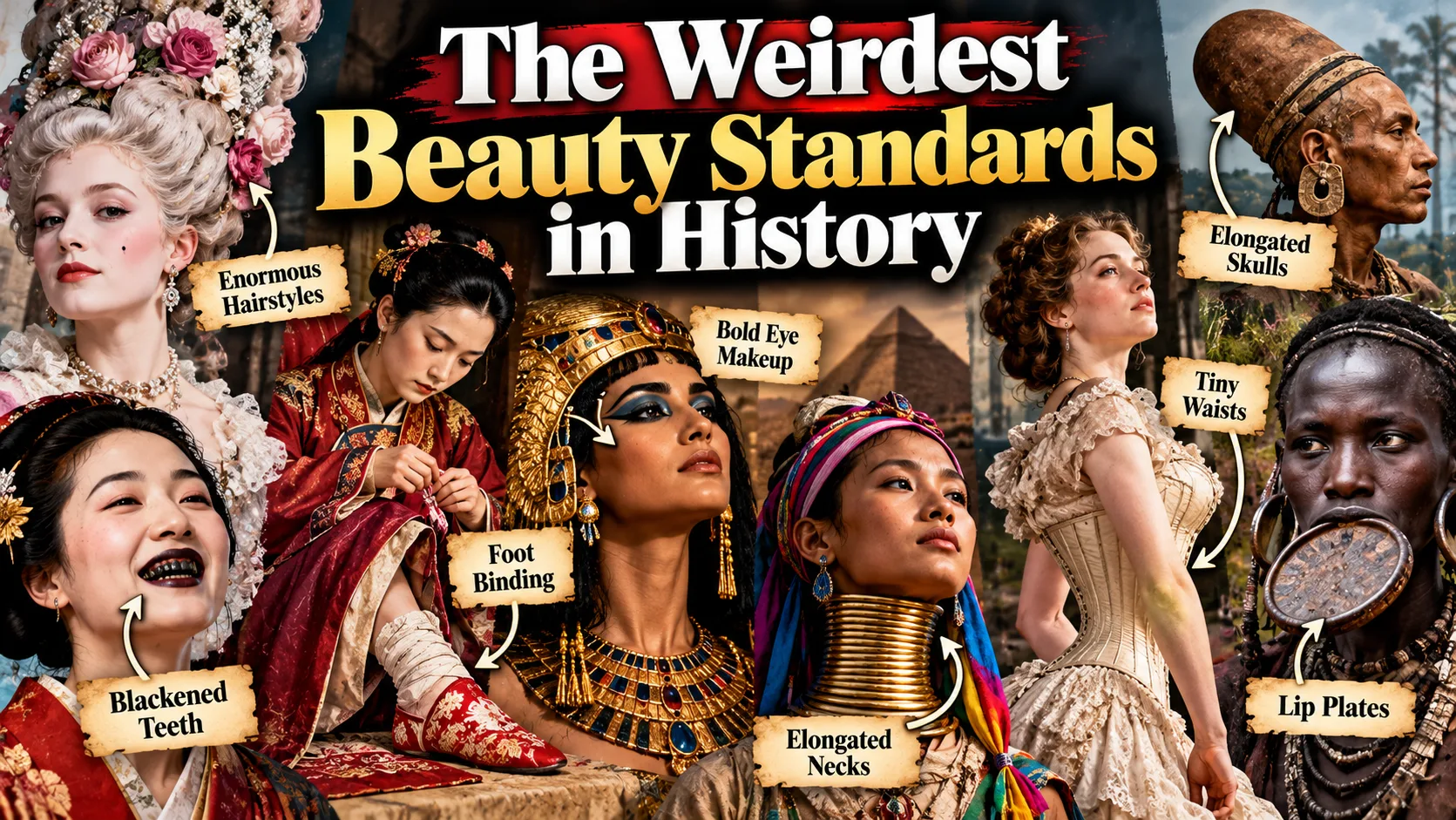
3. Blackened Teeth in Japan
One of the most striking historical beauty traditions was ohaguro, the practice of deliberately blackening the teeth.
The custom was practiced in Japan for centuries and became associated with particular social identities, including married women and members of elite society during certain periods.
From a modern perspective, black teeth can look alarming.
Within the historical context, they could be considered attractive and socially appropriate.
Why Black Teeth?
The practice was not simply cosmetic in the modern sense.
It could be connected to:
Marriage.
Adulthood.
Social status.
Beauty.
Custom.
There was also a practical element: traditional tooth-blackening preparations containing iron could have some protective effects for teeth, although the historical formulation and effects varied.
The point is that appearance and social meaning were intertwined.
Imagine Reversing the Standard
A modern beauty advertisement might say:
"Brighter, whiter teeth."
Ohaguro effectively moved in the opposite direction.
The contrast is useful.
It demonstrates that even something people now treat as obviously beautiful, such as white teeth, has a cultural history.
4. Foot Binding in China
Few historical beauty practices are as famous or disturbing as foot binding.
The practice developed in China and became widespread among some Han Chinese communities, especially among women from elite and later other social groups, though its prevalence varied by period and region.
Young girls' feet were tightly bound to alter their shape.
The desired result was the highly compressed form known as the "lotus foot."
Beauty Through Restriction
Bound feet were associated with:
Beauty.
Femininity.
Marriageability.
Status.
Social respectability.
The practice could also limit mobility and cause chronic pain, deformity, and other health complications.
It was not simply a strange fashion trend.
It was embedded in family expectations and social structures.
Why Did It Continue?
Because beauty standards don't exist in isolation.
They are reinforced by:
Families.
Marriage markets.
Peers.
Economic systems.
Tradition.
Social pressure.
If a society repeatedly rewards a physical characteristic, individuals may feel compelled to adopt it even when the process is painful.
That is one of the most important lessons from foot binding.
A beauty standard can become self-reinforcing.
The "Lotus Foot" Ideal
Tiny feet became associated with elegance.
Shoes themselves became decorative objects.
Walking could become stylized.
The resulting appearance was not merely considered attractive.
It became evidence of conformity to a specific cultural ideal.
The body became a social signal.
5. Neck Elongation Traditions
Some communities in Southeast Asia have historically used neck rings as part of a cultural practice associated with women of particular ethnic groups.
The practice is especially associated internationally with the Kayan communities of Myanmar and Thailand.
Popular descriptions often say:
"They stretch their necks."
That's misleading.
The rings do not literally elongate the neck in the way a rubber band stretches.
They alter the appearance of the neck and shoulder area through prolonged pressure and changes in the position of the clavicles and surrounding structures.
Beauty, Identity, and Cultural Tradition
The practice has been interpreted through:
Beauty.
Identity.
Tradition.
Community membership.
Cultural heritage.
Outsiders sometimes focus entirely on the visual effect.
But for communities themselves, practices involving dress, ornamentation, and body presentation can have meanings far beyond attractiveness.
This is an important reminder:
A body modification isn't automatically a beauty practice simply because outsiders interpret it that way.
6. Lip Plates
In some African communities, including groups in Ethiopia and surrounding regions, lip plates have historically been used as forms of body modification.
A progressively larger ornament can be inserted into a stretched lower lip.
To someone unfamiliar with the tradition, the result can look startling.
But calling it simply:
"extreme beauty"
misses important social context.
Such practices can be associated with:
Identity.
Adornment.
Social status.
Community tradition.
Rites of passage.
Marriage practices.
The meaning varies by group.
The Problem With Calling Historical Customs "Weird"
From the outside, almost every culture has practices that look strange.
Consider:
High heels.
Cosmetic surgery.
Teeth whitening.
Tattoos.
Piercings.
Hair removal.
Hair coloring.
Corsets.
Permanent makeup.
Orthodontics.
None is biologically necessary.
Yet modern societies attach social meanings to them.
So "weird" is always partly a matter of perspective.
History is essentially a giant reminder that normal is local.
7. Artificially Elongated Skulls
This one sounds almost impossible until you see the archaeology.
Various societies around the world practiced forms of intentional cranial modification.
In some cases, infants' skulls were gently shaped using pressure from boards, bindings, or other methods while the skull was still developing.
The resulting head shape could be intentionally elongated or otherwise modified.
Examples have been documented in parts of:
Europe.
Asia.
Africa.
The Americas.
These traditions were not all connected.
They developed independently in different societies.
Why Alter the Shape of the Skull?
The answer depended on the culture.
Possible meanings included:
Identity.
Status.
Group membership.
Aesthetic ideals.
Social distinction.
The practice could communicate:
"This person belongs to us."
Appearance became a marker of culture.
The Human Skull Is More Plastic in Infancy
Infants' skulls are not rigid structures.
The bones are still developing and are connected through sutures.
That makes controlled shaping possible during early life.
Importantly, archaeological evidence shows that intentional cranial modification was practiced in many regions without requiring the fantastical claims sometimes attached to elongated skulls.
Yes, people did it.
No, this doesn't mean aliens redesigned ancient humans.
Humans were already doing strange things perfectly well on their own.
8. High Foreheads in Medieval and Renaissance Europe
Fashionable female hairstyles in parts of medieval and Renaissance Europe sometimes emphasized a high forehead.
This could be achieved through:
Hairline shaping.
Plucking.
Shaving.
Hairstyles that pulled or exposed the front of the scalp.
Why?
Because the fashionable silhouette changed.
A higher forehead could be associated with elegance or refinement.
Beauty Standards Can Literally Move the Hairline
This is a useful reminder that beauty isn't only about:
Body size.
Skin color.
Facial symmetry.
Sometimes society changes how much forehead should be visible.
A feature that appears completely ordinary can become a target of fashion.
9. The Venetian "Blonde" Ideal
During the Renaissance, especially in Venice, lighter hair became fashionable among certain elite women.
Women sometimes used elaborate treatments and methods involving sunlight to lighten their hair.
Special hats could expose hair while protecting parts of the face.
Hair became a major status display.
Why Blonde Hair Became Valuable
Again, cultural symbolism mattered.
Light hair could be associated with:
Youth.
Beauty.
Refinement.
Classical artistic ideals.
Elite fashion.
Artists such as Renaissance painters helped popularize particular visual ideals.
The point isn't that everyone wanted blonde hair.
Beauty standards were never completely uniform.
They circulated most strongly within particular social classes and cultural settings.
10. Corsets and the Tiny Waist
The corset is probably one of the most recognizable examples of historical body fashion.
Corsets were worn in different forms across centuries.
Their purpose varied.
They could:
Shape the torso.
Support clothing.
Produce a fashionable silhouette.
Signal femininity.
Emphasize the waist and hips.
The stereotype of every woman being forced into an impossibly tiny Victorian waist is exaggerated.
Corsets varied enormously.
Not every wearer tightly restricted their body.
But Extreme Tight-Lacing Existed
Some women did practice very tight-lacing.
This could cause:
Discomfort.
Breathing limitations.
Restricted movement.
Pressure on internal organs.
Musculoskeletal changes.
The fashionable silhouette could therefore come at a physical cost.
The interesting part is that the corset wasn't merely a torture device, as some modern narratives portray it.
For many wearers, it was a normal garment.
The historical reality lies between:
"Everyone was permanently crushed by corsets."
and
"Corsets never affected the body."
Neither extreme is accurate.
11. Tall Hair and Enormous Hairstyles
At various moments in European fashion, hairstyles became extraordinarily elaborate.
Eighteenth-century aristocratic women could wear structures involving:
Large quantities of hair.
Extensions.
Powders.
Decorations.
Ribbons.
Flowers.
Objects.
Some hairstyles became so large that they posed practical difficulties.
Why Would Anyone Want Hair That Huge?
Because fashion is partly about differentiation.
If everyone can achieve a look easily, it loses some of its status value.
An elaborate hairstyle required:
Time.
Money.
Skilled assistance.
Materials.
Maintenance.
The difficulty itself could signal wealth.
Beauty becomes a demonstration of resources.
12. Skin as Pale as Possible in Victorian Fashion
Pale skin remained fashionable in certain Victorian and earlier contexts.
Women sometimes avoided sunlight using:
Parasols.
Gloves.
Long sleeves.
Hats.
Cosmetics.
The goal wasn't merely complexion.
It signaled:
Leisure.
Femininity.
Respectability.
A protected life.
Compare That With Modern Tanning Culture
The reversal is fascinating.
In parts of the modern United States, a tan can be associated with:
Vacation.
Outdoor leisure.
Fitness.
Beach culture.
But in other contexts, lighter skin has been associated with status and beauty.
There is no single "human preference" that operates unchanged across history.
Cultural meaning can completely reverse.
13. Hairless Bodies
Hair removal seems normal to many modern people.
But it has a long and complicated history.
Different societies have valued:
Body hair.
Hairlessness.
Facial hair.
Specific hairstyles.
Decorated hair.
Removed eyebrows.
Shaped eyebrows.
Body hair can therefore move between:
Natural feature.
Socially desirable trait.
Something considered unfashionable.
A beauty standard doesn't need to create a new physical trait.
It can simply tell people which existing trait they should hide.
Eyebrows Can Become Historical Fashion
At different times, people have:
Thinned eyebrows.
Shaved eyebrows.
Painted eyebrows.
Extended eyebrows with cosmetics.
Altered their shape dramatically.
Today, one person might spend twenty minutes on eyebrows.
In another century, the ideal eyebrow could look completely different.
The eyebrow didn't evolve.
The fashion did.
14. The "S-Curve" Body in Edwardian Fashion
Early twentieth-century Western fashion created silhouettes that emphasized a forward-thrust chest and pushed-back hips.
The effect was sometimes produced by garments and corsetry rather than the natural body.
Clothing changed posture.
Posture changed the apparent shape of the body.
Beauty therefore became partly an engineering problem.
15. Plumage, Jewelry, and Elaborate Ornament
Not every beauty standard involved changing the body directly.
Some depended on:
Feathers.
Jewelry.
Necklaces.
Scarves.
Headpieces.
Makeup.
Body paint.
Textiles.
Ornaments.
The amount and type of decoration could communicate:
Identity.
Rank.
Age.
Marriage status.
Religion.
Wealth.
Social role.
Beauty Is Often a Language of Belonging
Imagine looking at someone from far away.
Before they speak, their appearance might tell you:
Which group they're from.
What social status they have.
Whether they're married.
Whether they're wealthy.
Which generation they belong to.
Which occupation they have.
Human societies are extremely good at turning appearance into information.
16. Scarification as Beauty and Identity
In some African and other cultural traditions, intentional scarification has been used as a form of:
Adornment.
Identity.
Rite of passage.
Social marking.
Group affiliation.
The process creates deliberate patterns in the skin.
To outsiders, scars may appear like injury.
Within the culture, they can signify identity and beauty.
This is a recurring historical pattern:
The same physical mark can mean completely different things depending on cultural context.
17. Decorative Black Skin in Ancient and Historical Cultures
Black cosmetic substances were used in various societies for reasons ranging from decoration to ritual.
Ancient Egypt is famous for eye cosmetics such as kohl.
The appearance of heavily lined eyes became iconic.
But cosmetics were not simply "makeup."
They could relate to:
Adornment.
Protection.
Religion.
Social status.
Identity.
Some eye cosmetics may also have had antimicrobial or protective properties depending on their ingredients.
Beauty and practicality could overlap.
18. Red Hair, Black Hair, Blonde Hair: Fashion Can Reverse Preferences
Hair color has repeatedly moved through cycles of desirability.
At one point:
Blonde.
At another:
Dark.
At another:
Artificially colored.
The interesting part is how quickly societies can redefine what seems attractive.
A hairstyle that feels elegant in one decade can feel ridiculous in another.
Fashion is essentially collective agreement with excellent marketing.
19. The "Heroic" Greek Body
Classical Greek art presented particular ideals of the human body.
Male figures were often depicted with:
Broad shoulders.
Muscular torsos.
Balanced proportions.
Athletic forms.
But these sculptures should not necessarily be treated as literal photographs of ordinary Greek bodies.
Art is idealization.
The body in sculpture represented what artists and societies considered aesthetically desirable.
The Difference Between Ideal and Average
This distinction is crucial.
A culture can glorify:
A body shape that relatively few people naturally possess.
The same thing happens today.
Magazine covers.
Advertising.
Cinema.
Social media.
Sports.
all can showcase exceptional bodies.
The ideal doesn't necessarily describe the average.
It describes what the culture rewards visually.
20. Victorian "Consumptive" Beauty
In nineteenth-century Europe and the United States, particularly during certain periods and in literary and artistic culture, a pale, thin appearance associated with illness could sometimes be romanticized as delicate or ethereal.
Tuberculosis was not desirable as a disease.
But artistic culture sometimes transformed its visible effects into an aesthetic ideal.
That created a disturbing example of beauty imitating sickness.
Beauty Can Romanticize Suffering
This happens repeatedly.
The pale face.
The fragile body.
The exhausted appearance.
The extremely thin silhouette.
Fashion can take something associated with pain or illness and reinterpret it as desirable.
That doesn't mean people consciously wanted to be sick.
It means cultural aesthetics can detach appearance from the real physical condition producing it.
21. The Extreme Thinness of Certain Fashion Eras
In some twentieth-century fashion periods, very thin silhouettes became highly desirable.
The specific ideal changed over time:
Curvier.
Thinner.
Athletic.
Androgynous.
Soft.
Muscular.
Hourglass.
The body standard can change within a single lifetime.
That is powerful evidence that at least part of physical beauty is culturally flexible.
22. The Hourglass Shape
At several points in modern Western culture, particularly in some twentieth-century periods, an hourglass silhouette became strongly idealized.
The desired proportions emphasized:
Bust.
Waist.
Hips.
Clothing was designed to exaggerate those contrasts.
Again, fashion didn't merely reflect bodies.
It helped construct the appearance of an ideal body.
23. "Healthy" Has Also Changed Meaning
A useful example is physical strength.
In one era, a muscular body might signal:
Manual labor.
Athleticism.
Military ability.
In another, it could signal:
Gym culture.
Discipline.
Professional sport.
Leisure.
Fitness.
The body itself may look similar.
Its social meaning changes.
24. Teeth Gaps, Crooked Teeth, and Perfect Smiles
Modern dentistry has created a powerful beauty ideal around straight, bright teeth.
Orthodontics can transform:
Alignment.
Spacing.
Bite.
Appearance.
But historically, perfectly straight teeth were not universally available or universally considered the defining feature of beauty.
Modern America is particularly familiar with orthodontics because braces became common as part of mainstream dental care.
A smile that would have required no intervention centuries ago might today be labeled:
"Something to fix."
Beauty Standards Can Create Industries
Once a culture establishes an ideal, markets form around it.
If straight teeth are desirable:
Orthodontics.
If smooth skin is desirable:
Cosmetics.
If pale skin is desirable:
Whitening products.
If tanned skin is desirable:
Tanning industries.
If a slim body is desirable:
Diets.
If muscularity is desirable:
Gyms.
The standard creates demand.
The Beauty Industry Doesn't Invent Every Standard
This is another important nuance.
People sometimes claim:
"Corporations invented beauty standards."
Too simple.
Beauty practices existed thousands of years before modern advertising.
But markets can:
Amplify.
Standardize.
Spread.
Commercialize.
and monetize
existing preferences.
Modern media simply gives standards unprecedented reach.
Social Media Creates Faster Beauty Cycles
A beauty standard that once took decades to spread can now become global within months.
One trend appears.
Millions imitate it.
Influencers popularize it.
Algorithms amplify it.
Brands manufacture products.
The trend becomes normal.
Then another appears.
Beauty standards are now operating at internet speed.
The Algorithm Can Become a Fashion Authority
You scroll through images.
The system learns what receives engagement.
You see similar faces.
Similar bodies.
Similar hairstyles.
Similar clothing.
After enough repetition, the visual pattern can begin to feel:
Normal.
And what feels normal can start feeling attractive.
This is one reason representation matters.
Your brain doesn't evaluate beauty in a vacuum.
It learns patterns.
Why Familiar Faces Often Feel Attractive
Repeated exposure can influence liking.
The mere-exposure effect describes the tendency for repeated exposure to increase familiarity and, in some contexts, preference.
That doesn't mean:
"Whatever you see often becomes beautiful."
But familiarity can influence evaluation.
If a certain face shape, hairstyle, or clothing style appears repeatedly in media, it can become psychologically familiar.
Beauty Standards Can Become Self-Reinforcing
Consider the loop:
A certain appearance becomes fashionable.
More people adopt it.
Media shows more examples.
The appearance becomes more familiar.
Familiarity increases acceptance.
Businesses produce more products supporting it.
The look becomes even more common.
Now the original standard seems obvious.
This is a social feedback loop.
Why People Defend Beauty Standards
Once appearance becomes connected to identity, challenging it can feel personal.
Imagine someone says:
"That hairstyle is ugly."
You may hear:
"Your choices are embarrassing."
The beauty standard is no longer abstract.
It's part of:
Identity.
Belonging.
Status.
Self-worth.
That makes beauty norms difficult to change.
Beauty Can Become a Social Requirement
The difference between:
"I like this appearance."
and
"People like me are expected to look like this."
is enormous.
The first is preference.
The second is pressure.
Historically, many beauty practices were maintained not because every individual independently loved them, but because failing to follow them carried social consequences.
Beauty Standards Can Restrict Freedom
A person may spend:
Time.
Money.
Pain.
Energy.
attention
trying to reach an ideal that keeps moving.
That doesn't mean all grooming is harmful.
Humans enjoy decoration.
The issue is what happens when appearance becomes a condition for:
Respect.
Marriage.
Employment.
Social belonging.
Safety.
Acceptance.
That's when beauty becomes social control.
Women Have Historically Faced More Intensive Appearance Rules
In many societies, women have been subjected to particularly elaborate expectations around:
Clothing.
Hair.
Body shape.
Skin.
Marriage presentation.
Modesty.
Cosmetics.
Age.
This doesn't mean men lacked beauty standards.
They did.
But the intensity and consequences of appearance-based expectations have often been gendered.
Men's Beauty Standards Have Changed Too
Men have experienced shifting ideals involving:
Facial hair.
Hair length.
Muscularity.
Height.
Body fat.
Shoulder width.
Clothing.
Complexion.
Even voice and posture.
The "ideal man" of ancient Greece looks different from:
A Victorian gentleman.
A 1950s American actor.
A modern fitness influencer.
The same species.
Very different aesthetic instructions.
Why Ancient People Didn't Think Their Standards Were Weird
This is perhaps the most interesting part.
A person living inside a culture doesn't usually experience its norms as bizarre.
They experience them as:
Normal.
Proper.
Attractive.
Respectable.
Expected.
The same thing happens today.
People in 2026 don't wake up thinking:
"Which of my beauty standards will future historians find completely insane?"
They just follow whatever currently looks normal.
Historical Distance Makes Familiarity Disappear
Once the social system disappears, the aesthetic logic becomes harder to understand.
We see:
Tiny bound feet.
Blackened teeth.
Huge wigs.
Elongated skulls.
Extreme corsets.
and ask:
"Why would anyone do this?"
But someone inside the culture could have looked at those practices and thought:
"Why would you NOT?"
That is how strong social norms can become.
🟢 What We Know
Historical evidence strongly demonstrates that beauty practices vary across:
Cultures.
Periods.
Social classes.
Religious communities.
Gender roles.
Economic systems.
Some recurring themes do appear across societies, including interest in:
Health-related appearance.
Symmetry.
Youthfulness.
Body proportions.
Facial features.
But cultures heavily influence which specific traits are considered desirable.
🟡 What Researchers Continue to Debate
Psychologists and anthropologists continue examining:
How much of attractiveness is biologically influenced.
How much is learned.
How media changes preferences.
How social status shapes beauty ideals.
How repeated exposure changes attraction.
How beauty standards affect self-perception.
There is no single formula for human attractiveness.
Biology provides tendencies.
Culture provides instructions.
Individuals negotiate between the two.
🔴 Popular Myth
"Beauty standards are completely arbitrary."
Not exactly.
If they were completely arbitrary, we'd expect virtually no recurring patterns across cultures.
Some broad preferences appear repeatedly.
But the exact form those preferences take is heavily shaped by culture.
So the better model is:
Biology provides a starting point. Culture edits the interface.
Frequently Asked Questions
Were beauty standards always extreme?
No. Historical beauty ideals ranged from relatively subtle preferences to highly demanding body modifications.
Why did people bind their feet in China?
Foot binding became associated with beauty, femininity, marriageability, status, and social expectations in certain Chinese communities. Its prevalence and meaning varied across time and region.
Did people really blacken their teeth in Japan?
Yes. The practice known as ohaguro was used for centuries and was associated with particular social and cultural contexts.
Did ancient people intentionally reshape skulls?
Yes. Archaeological evidence shows intentional cranial modification in multiple societies around the world.
Did ancient civilizations have beauty standards like ours?
They had beauty standards, but those standards could be radically different in detail.
Why did pale skin become fashionable?
In some historical European contexts, pale skin could signal status and freedom from outdoor labor. The meaning of skin tone later shifted in some settings, demonstrating how cultural context changes aesthetic value.
Were corsets actually dangerous?
Extreme tight-lacing could cause physical problems, but historical corset use varied significantly. It would be inaccurate to treat every corset wearer as being subjected to severe bodily harm.
Why do beauty standards change?
Changes in technology, economics, social structure, media, fashion, political culture, and ideas about status can all influence beauty ideals.
Are modern beauty standards less strange?
Not necessarily. They simply feel normal because we live inside them.
Is there such a thing as universal beauty?
Some broad preferences may have biological components, but the specific features considered attractive vary substantially across cultures and historical periods.
Myth vs. Reality
🔴 "Ancient beauty standards were irrational."
Not necessarily.
They often communicated status, identity, adulthood, marriageability, or group membership.
🟢 Beauty standards differ across societies.
Strongly supported.
🟢 Some beauty practices were physically harmful.
Yes.
Foot binding and extreme tight-lacing are examples.
🔴 Every historical beauty practice was forced on people.
Too broad.
Motivations varied from personal preference to family expectations, social pressure, status, and cultural tradition.
🟢 Beauty can signal wealth.
Yes.
Time-consuming or expensive appearance practices often functioned as status displays.
🔴 Modern beauty standards are purely natural.
No.
Modern standards are influenced heavily by culture, media, fashion, technology, and economics.
🟢 Beauty standards can influence behavior.
Yes.
People may change clothing, grooming, diet, posture, and even their bodies to match social expectations.
The Strange Thing About "Normal"
Take almost any modern beauty practice and imagine it 1,000 years from now.
Perhaps people will find it strange that we:
Spend hours styling hair.
Whiten teeth.
Remove body hair.
Wear uncomfortable shoes.
Use cosmetic fillers.
Inject substances to change appearance.
Train specific muscles for aesthetic proportions.
Use filters that digitally alter facial features.
Apply chemicals to change hair color.
Spend enormous amounts of money trying to appear younger.
Future people may ask:
"Why did they do that?"
And the answer will probably be:
"Because everyone else was doing it."
That's a surprisingly powerful explanation.
Technology Has Made Beauty More Editable
Historically, changing the body could require:
Years.
Pain.
Specialized training.
Clothing.
Physical modification.
Modern technology has added new tools:
Orthodontics.
Cosmetic surgery.
Laser treatments.
Injectables.
Hair transplantation.
Digital filters.
AI image editing.
Now appearance can be modified much more rapidly.
That means beauty standards can become increasingly specific.
The face doesn't merely need to be attractive.
It can be expected to conform to a highly detailed visual template.
Filters Are a New Kind of Beauty Standard
A social-media filter can:
Smooth skin.
Change jaw shape.
Enlarge eyes.
Alter nose proportions.
Modify facial symmetry.
Change lighting.
Adjust body shape.
The result can become a reference point for how someone thinks they should look.
This creates a strange feedback loop:
The filter creates the ideal.
The ideal influences photos.
The photos reinforce the ideal.
The ideal becomes normalized.
When the Ideal Is Literally Unreal
Some modern beauty images aren't just rare.
They're digitally modified.
Perfect skin.
Perfect lighting.
Perfect proportions.
Perfect symmetry.
Perfect hair.
The viewer may then compare an ordinary human body to an edited image.
That's an unfair comparison.
Humans evolved to have:
Pores.
Asymmetry.
Texture.
Wrinkles.
Variation.
And inconveniently, noses.
Beauty Standards and Human Evolution
The existence of cultural variation doesn't mean biology is irrelevant.
Humans often pay attention to features associated with:
Health.
Age.
Facial symmetry.
Body proportions.
Movement.
Expression.
But culture changes the thresholds and meanings.
A person can have features that are widely perceived as attractive while still failing to match the current cultural ideal.
Biology gives us tendencies.
Culture determines which tendencies get amplified.
The Beauty Ideal Is Often an Intersection
Think of attractiveness as influenced by:
Biology
plus
culture
plus
personal preference
plus
social context
plus
familiarity
plus
status
plus
fashion.
There isn't one master switch.
That's why beauty can be both:
Remarkably persistent
and
Remarkably changeable.
Why Beauty Standards Can Be Powerful Social Tools
Appearance can affect:
First impressions.
Dating.
Employment.
Status.
Belonging.
Self-esteem.
Social treatment.
This gives beauty standards real power.
A society doesn't need everyone to consciously enforce a rule.
People can enforce it on themselves.
They compare.
Adjust.
Correct.
Hide.
Enhance.
Repeat.
The Standard Moves, People Follow
The ideal changes.
Then people adapt.
The waist becomes smaller.
Then larger.
Hair becomes long.
Then short.
Pale skin becomes desirable.
Then tanning becomes desirable.
Thin bodies become fashionable.
Then athletic bodies.
Then muscular curves.
Then something else.
Beauty is remarkably good at moving the goalposts.
Humans are remarkably good at chasing them.
What History Actually Teaches Us
The lesson isn't:
"Past people were ridiculous."
That's too easy.
The better lesson is:
"People living inside a culture usually experience its beauty standards as normal."
That includes us.
We are not outside history.
We're inside it.
Future historians will probably look at photographs of the 2020s and 2030s and notice things we don't even recognize as trends.
They may wonder:
Why did everyone pose like that?
Why did everyone want that hairstyle?
Why were certain body proportions suddenly everywhere?
Why did that particular clothing shape become desirable?
We won't be available to defend ourselves.
History wins again.
Final Thoughts
Beauty standards may be one of the clearest demonstrations of how culture can influence the human body.
A hairstyle changes.
A silhouette changes.
Skin tone becomes desirable or undesirable.
Teeth are reshaped.
Feet are compressed.
Necks are adorned.
Skulls are modified.
Faces are painted.
Hair is removed.
Waists are tightened.
Bodies are trained.
Nothing fundamental about human biology changes overnight.
The standards do.
And people adapt.
That is what makes the history of beauty so fascinating.
The past isn't filled with people who were somehow naturally drawn to bizarre practices.
They were responding to the same social forces humans still experience:
Belonging.
Status.
Attraction.
Identity.
Tradition.
Pressure.
Fashion.
Familiarity.
A person may endure discomfort because everyone around them says the result is beautiful.
That isn't uniquely ancient.
It's deeply human.
The strange thing is that when we look backward, we can see the social construction clearly.
We can recognize:
"They were taught to see this as beautiful."
What is harder is applying the same observation to ourselves.
We live inside our own beauty standards.
We see them every day.
Advertisements.
Movies.
Social media.
Celebrities.
Influencers.
Friends.
Family.
Algorithms.
Eventually, repetition makes the aesthetic feel natural.
But history keeps offering the same warning:
What feels universally beautiful today may look completely bizarre to someone living centuries from now.
Perhaps that's the real mystery behind beauty.
Not why humans care about appearance.
We clearly do.
The more interesting question is:
Why are we so capable of learning what beauty is supposed to look like?
A tiny foot.
A pale face.
A blackened smile.
A long neck.
A narrow waist.
A huge hairstyle.
A perfectly straight smile.
A digitally edited face.
Different centuries.
Different cultures.
Different ideals.
Yet the same human desire underneath them:
To look like the kind of person society has taught us is worth admiring.
And once you see that pattern, historical beauty standards stop looking like a collection of bizarre customs.
They start looking like a mirror.
One pointed toward the past.
And one pointed directly at us.