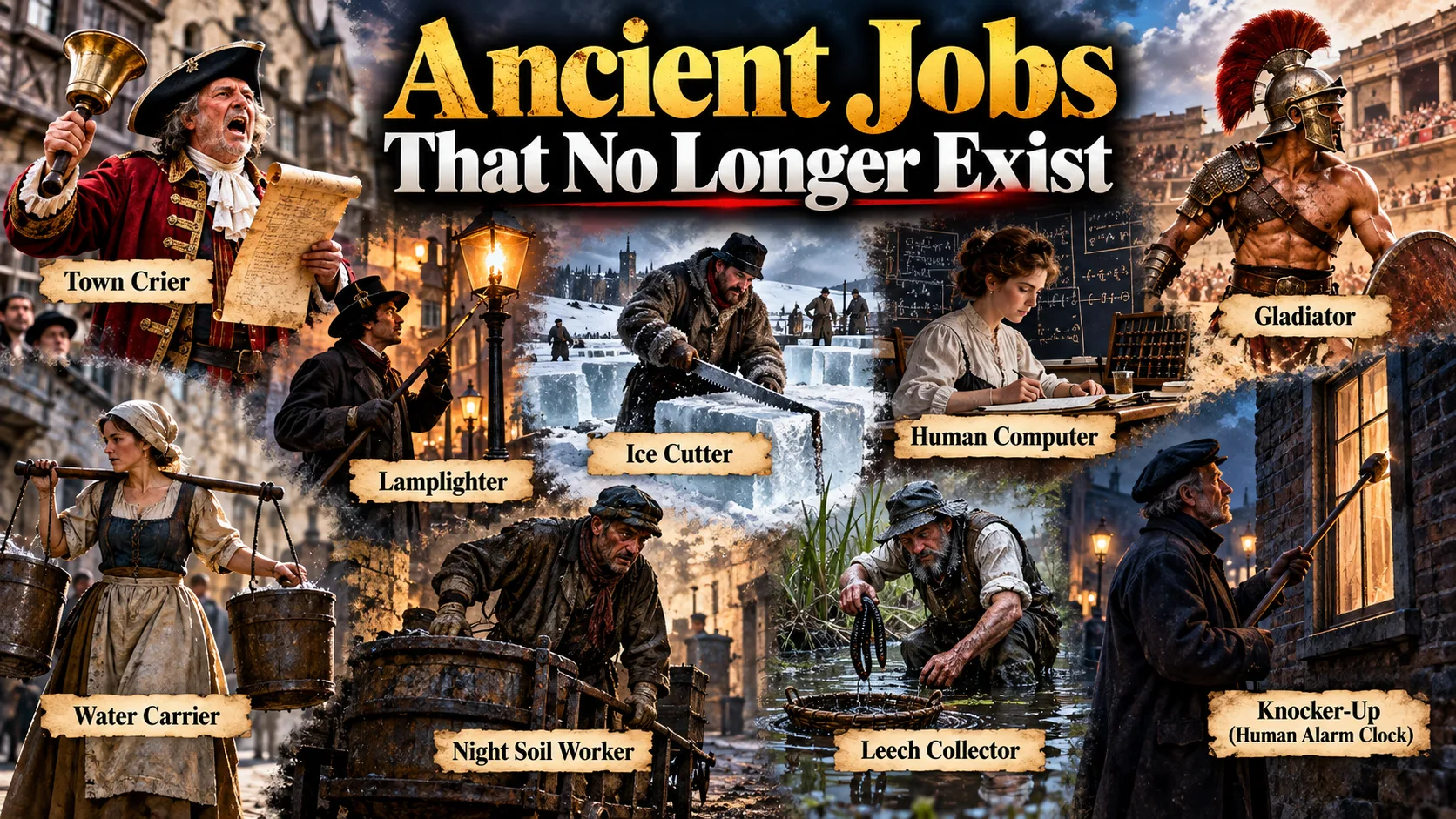
Ancient Jobs That No Longer Exist
Discover ancient jobs that disappeared from everyday life and what these forgotten occupations reveal about technology, society, trade, and changing human needs.
Ancient Jobs That No Longer Exist
What was your job?
If you lived 2,000 years ago, the answer might have been:
professional mourner.
Or:
chariot racer.
Or:
knocker-up.
Or:
human alarm clock.
Or perhaps something even stranger:
official reader of omens.
The modern job market can feel bizarre enough, but ancient societies took occupational specialization to another level.
Every civilization develops work around its technology, economy, social structure, and cultural beliefs.
When those change, occupations change with them.
Some jobs disappear because machines become better at the task.
Some vanish because the materials they depended on disappear.
Others disappear because social customs change.
And some become unnecessary because humanity solves the very problem that created them.
That's why studying extinct professions is surprisingly useful.
A forgotten occupation is more than an odd historical curiosity.
It is evidence of how people once lived.
Imagine trying to explain a smartphone repair technician to someone from ancient Rome.
Now imagine explaining:
"This person's entire career is waking people up by tapping their windows with a long stick."
Suddenly history becomes much more entertaining.
What Makes a Job "Extinct"?
Before listing occupations, we need to define the term.
A job can disappear in several ways.
Completely extinct
The occupation no longer exists in its historical form.
Mostly obsolete
The work survives only in tiny specialist communities.
Transformed
The original job disappeared, but its function survives through modern technology.
Renamed
The task still exists, but the profession has become part of another occupation.
This distinction matters.
For example, a human alarm clock disappeared.
The function didn't.
Your phone simply took the job.
1. Professional Town Crier
Imagine there are no:
Newspapers.
Radio.
Television.
Internet.
Social media.
Public-address systems.
How does a government tell everyone something important?
You hire a person whose job is essentially:
Stand somewhere public and yell the news.
Town criers existed in many societies and remained common in parts of Europe into the modern period.
They announced:
Political decisions.
Market information.
Royal proclamations.
Public meetings.
Legal notices.
Emergencies.
Important events.
Their voice was a communication network.
Why Town Criers Disappeared
Mass communication made them unnecessary.
The printing press could distribute information to thousands.
Then newspapers could distribute it repeatedly.
Later:
Telegraph.
Telephone.
Radio.
Television.
Internet.
Social media.
Each technology reduced the need for one person to physically carry information through a town.
The profession disappeared because communication stopped depending on a human voice in the marketplace.
2. Knocker-Up: The Human Alarm Clock
The industrial revolution produced one of the strangest occupations.
The knocker-up was hired to wake workers.
Their customers needed to get up for:
Factories.
Mills.
Mines.
Railway shifts.
Other early-morning jobs.
The knocker-up walked through neighborhoods carrying:
A long pole.
A stick.
Sometimes a hammer.
They tapped on bedroom windows until the customer woke up.
Then they moved to the next house.
Humanity invented alarm clocks.
Before inventing alarm clocks that people actually trusted.
Why Did People Pay Someone to Knock on Their Window?
Because factory work operated on schedules.
Being late could mean:
Lost wages.
Discipline.
Dismissal.
The worker needed a reliable wake-up system.
If your neighbor's profession was literally:
"Wake you up."
you could trust that someone was physically standing outside your window at 5:00 AM.
It's difficult to snooze a person.
Why the Job Disappeared
Cheap alarm clocks eventually became widely available.
Then:
Electric alarms.
Clock radios.
Phones.
Smartphones.
Wearable devices.
The function survived.
The profession didn't.
This is one of the clearest examples of technology replacing a human service without eliminating the underlying need.
3. Lamplighter
Before widespread electric street lighting, cities needed people to light public lamps.
The lamplighter traveled through streets:
Lighting lamps at dusk.
Extinguishing them at dawn.
Refueling or maintaining them.
Checking equipment.
This sounds simple.
Multiply it across an entire city.
Suddenly it becomes a large logistical system.
Why Lamplighters Became Obsolete
Gas lighting eventually gave way to increasingly automated systems.
Then electric streetlights transformed urban lighting.
Timers.
Automatic ignition.
Remote controls.
Photocells.
Modern maintenance systems
made the original profession largely unnecessary.
The city still needed lighting.
It simply stopped needing thousands of people to carry fire-producing technology from lamp to lamp.
4. Ice Cutter
Before mechanical refrigeration became widespread, frozen water was harvested as a commercial commodity.
Workers cut large blocks of natural ice from:
Lakes.
Rivers.
Ponds.
These blocks were transported and stored in insulated icehouses.
The ice was then used for:
Food preservation.
Household cooling.
Restaurants.
Breweries.
Meat processing.
Medical purposes.
Natural ice became an international trade.
Ice Was Once a Product
Today you buy:
A bag of ice.
In the nineteenth century, the idea that ordinary water could be industrially produced as ice would have seemed technologically extraordinary.
Businesses therefore depended on:
Ice harvesters.
Ice cutters.
Ice storage workers.
Transport companies.
Warehouses.
Retailers.
An entire economic chain existed around something now produced by a refrigerator in your kitchen.
Why the Job Disappeared
Mechanical refrigeration changed everything.
You no longer needed:
A cold winter.
A frozen lake.
A saw.
A horse cart.
A giant icehouse.
You needed electricity and a refrigeration machine.
The occupation disappeared because the underlying technology changed the economics of cooling.
5. Water Carrier
In cities without universal piped water, someone had to bring water to people.
Water carriers transported water using:
Buckets.
Jars.
Barrels.
Carts.
Animals.
The occupation existed in many forms across different civilizations.
It could be a household service.
A municipal service.
A commercial business.
Or even an essential part of urban survival.
Why Water Carriers Became Less Necessary
Modern plumbing transferred the job from people to infrastructure.
Instead of:
Person → container → house
you get:
Reservoir → treatment → pipes → building
The function didn't disappear.
It became invisible.
That's an important pattern in technological history.
Many "jobs that disappeared" were actually absorbed into infrastructure.
6. Ice Man
This sounds like the same profession.
It was, but the historical terminology varied.
In some places, ice men delivered blocks of ice directly to homes.
Families placed ice in specialized iceboxes.
The delivery worker returned regularly with fresh blocks.
The modern refrigerator effectively fired the entire profession.
With no severance package.
History is ruthless.
7. Human Computer
This one sounds like science fiction.
It isn't.
Before electronic computers, a computer could mean a person whose job was to perform calculations.
Human computers worked in:
Astronomy.
Engineering.
Ballistics.
Navigation.
Finance.
Surveying.
Science.
Large projects sometimes employed teams of people performing calculations by hand.
They used:
Tables.
Logarithms.
Mechanical calculators.
Paper.
Pencils.
And enormous amounts of patience.
Humans Were the Original Processors
Imagine calculating thousands of trajectories manually.
One mistake could invalidate pages of work.
Teams divided calculations among workers.
Others checked the results.
The work could become highly specialized.
A person might spend their entire career performing mathematical operations.
Then electronic computers arrived.
The name survived.
The worker didn't.
Why This Job Matters
The modern word computer tells the story.
The machine inherited the job title.
Technology didn't just replace the occupation.
It took its name.
That's one of the clearest examples of technological substitution in history.
8. Telegraph Operator
The telegraph transformed long-distance communication.
Messages could travel much faster than physical mail.
But someone had to:
Receive the signal.
Interpret the code.
Write the message.
Transmit replies.
Maintain communication procedures.
That person was the telegraph operator.
Morse Code Created an Entire Profession
Operators learned:
Dots.
Dashes.
Timing.
Abbreviations.
Specialized communication protocols.
They worked in:
Railway systems.
News organizations.
Government offices.
Businesses.
Military communications.
The telegraph created jobs because new technology often creates professions before eventually destroying them.
Technology Creates and Destroys Jobs
This is one of the central lessons of occupational history.
A new technology may initially require:
Operators.
Repairers.
Trainers.
Inspectors.
Installers.
Then automation improves.
The original job begins disappearing.
Something similar has happened repeatedly:
Horse-drawn transport.
Photography.
Telephone systems.
Manufacturing.
Banking.
Computing.
The pattern is older than the Industrial Revolution.
9. Telephone Switchboard Operator
This occupation survived into the twentieth century and is therefore not truly ancient.
But it illustrates an important transitional pattern.
Early telephone calls required operators to physically connect callers through switchboards.
You contacted an operator.
They connected wires.
The call proceeded.
Thousands of people worked in telephone exchanges.
Why Operators Became Unnecessary
Automatic switching systems gradually replaced manual connection.
Then digital networks replaced much of the underlying infrastructure.
Today, a call can cross:
Multiple countries.
Networks.
Data centers.
Wireless towers.
fiber systems
without one person physically plugging your call into a socket.
The function became automated.
10. Night Soil Worker
Now for one of the least glamorous occupations in history.
Before modern sewer systems, cities still produced enormous quantities of human waste.
Someone had to remove it.
Night soil workers collected human excrement from:
Privies.
Cesspits.
Latrines.
Household toilets.
The material could sometimes be used as fertilizer.
It was dirty.
Dangerous.
Essential.
And frequently performed by workers at the bottom of social hierarchies.
Why This Job Disappeared
Modern sanitation infrastructure changed urban life.
Sewers.
Flush toilets.
Treatment plants.
Wastewater systems.
The job of manually collecting human waste from individual households became largely unnecessary in places with modern sanitation.
The waste did not disappear.
The entire system of managing it changed.
11. Fuller
A fuller was a textile worker involved in processing woolen cloth.
The job included cleaning and thickening cloth through a process historically known as fulling.
In earlier periods, fulling could require:
Water.
Alkaline substances.
Mechanical action.
Sometimes human or animal labor.
It was an important part of textile production.
Why the Occupation Changed
Industrial textile machinery eventually mechanized many processes that had previously required specialist manual workers.
The textile industry didn't disappear.
It became mechanized.
The occupation therefore either vanished or was absorbed into modern textile manufacturing.
12. Scribes
Scribes aren't completely extinct.
People still produce handwritten documents.
But the ancient and medieval professional scribe served an enormously larger role.
Before printing:
Writing was expensive.
Books required:
Skilled handwriting.
Ink.
Parchment or paper.
Time.
Training.
A scribe could spend months copying one major manuscript.
Why Scribes Became Less Central
The printing press transformed information reproduction.
Instead of:
One person copying one book,
printing allowed:
One set of types → many copies.
Later:
Typewriters.
Printers.
Photocopiers.
Computers.
Digital documents.
Each technological step reduced the need for professional manuscript copying.
Yet Scribes Were More Than Copyists
Scribes also served as:
Administrative officials.
Record keepers.
Accountants.
Legal document writers.
Government workers.
Their disappearance wasn't simply caused by printing.
Modern bureaucracies divided their functions among many specialized systems.
13. Royal Messenger
Before reliable postal systems and telecommunications, rulers needed people to physically carry information.
Royal messengers transported:
Orders.
Letters.
Military instructions.
Diplomatic communication.
Legal documents.
They could travel by:
Horse.
Camel.
Ship.
Foot.
Relay systems allowed messages to move faster across large territories.
The Mongol Postal System
The Mongol Empire developed an extensive relay network known as the yam.
Horse stations allowed authorized messengers to travel rapidly across enormous distances.
This wasn't simply a courier carrying one letter.
It was infrastructure designed around changing horses and using established routes.
Eventually, modern postal systems and telecommunications replaced many traditional messenger networks.
14. Town Criers and Official Heralds
Closely related to town criers were heralds.
Heralds could announce:
Royal commands.
Ceremonial information.
Genealogical details.
Tournament announcements.
Political messages.
In medieval Europe, heralds also developed specialized knowledge around coats of arms and genealogy.
Modern bureaucratic record systems largely absorbed these functions.
15. Gong Farmer
The name is almost too ridiculous to be true.
Gong farmer was a historical term for workers who emptied cesspits and privies.
The word "farmer" referred not to agriculture itself, but to the occupation of gathering and sometimes profiting from waste.
It was another sanitation-related occupation.
And yes:
Someone once had a job whose official title sounded like a person raising toilet material as a crop.
Human civilization is endlessly inventive.
16. Rat Catcher
Rat catchers have not completely disappeared.
Modern pest-control workers still deal with rodents.
But the historical professional rat catcher occupied a much more visible role.
Cities depended on them to control:
Rats.
Mice.
Vermin.
Especially during periods when urban sanitation was poor.
Some historical rat catchers also captured rodents for commercial purposes.
Why the Traditional Role Changed
Modern pest control introduced:
Poisons.
Traps.
Building codes.
Sanitation.
Waste management.
Integrated pest management.
The occupation survived.
The methods transformed.
This is a useful reminder:
Not every old profession truly disappears.
Sometimes the old version disappears while the underlying work continues.
17. Leech Collector
Before modern medicine, leeches were widely used for bloodletting.
That created a specialized occupation:
Leech collecting.
Collectors gathered leeches from suitable waters and supplied them to medical practitioners.
The job could be unpleasant.
Workers sometimes entered waters and allowed leeches to attach to their legs so they could collect them.
Why This Profession Collapsed
Medicine changed.
Bloodletting lost its central role in mainstream medical practice.
Pharmacological and surgical treatments became more effective.
Modern medicine no longer depends on leech collectors for routine treatment.
Interestingly, medicinal leeches have not completely disappeared from medicine.
They still have specialized modern uses in certain reconstructive procedures.
But the historical occupation of manually supplying enormous quantities of leeches is essentially gone.
18. Resurrection Men
In eighteenth- and nineteenth-century Britain, medical schools needed cadavers for anatomical study.
Legal supply was limited.
That created a disturbing black-market occupation.
Resurrection men were people who illegally dug up recently buried bodies and sold them to anatomists.
The profession existed because:
Medical education needed bodies.
Demand exceeded legal supply.
The law restricted ordinary access to corpses.
Why the Occupation Disappeared
Changes to anatomy laws expanded lawful access to bodies for medical education.
As the legal supply changed, the economic incentive for grave robbing declined.
This is a fascinating example of legislation indirectly destroying an occupation.
Not every job disappears because of a machine.
Sometimes the legal system eliminates the market.
19. Ratting and Vermin Sports Workers
In some nineteenth-century urban environments, people worked with animals in ways that modern societies would find deeply unfamiliar.
Workers could participate in:
Rat catching.
Animal transport.
Animal handling.
Public animal exhibitions.
Some roles disappeared as urban culture, animal-welfare norms, and entertainment changed.
The occupation may have existed around a social practice that later became unacceptable.
20. Chariot Racer
Chariot racing was a major profession and spectacle in the ancient Mediterranean, especially within the Roman Empire.
Professional charioteers could become:
Famous.
Wealthy.
Politically influential.
Celebrities.
The sport attracted massive crowds.
Some racers had specialized training from childhood.
Why the Profession Disappeared
The cultural and political systems that supported large-scale Roman chariot racing eventually disappeared.
Roman institutions changed.
Major traditional arenas declined.
The economic system supporting professional charioteers collapsed.
The occupation therefore vanished.
The broader concept of professional racing survived.
Humans have apparently retained the ancient desire to watch other humans move dangerously fast in circles.
21. Gladiator
The gladiator was another specialized occupation of the ancient Roman world.
Gladiators could be:
Enslaved people.
Prisoners.
Freedmen.
Volunteers.
They trained to fight in public spectacles.
Some became famous.
The job was brutal.
And socially complicated.
Why Gladiators Disappeared
Gladiatorial combat declined as Roman political structures, religious attitudes, economic conditions, and entertainment systems changed.
By late antiquity, the traditional gladiatorial institution had largely disappeared.
The job didn't survive because the social system supporting it disappeared.
22. Oracle or Official Diviner
Many ancient societies maintained specialists whose role involved interpreting signs believed to reveal divine intentions.
Depending on culture, these specialists might interpret:
Animal behavior.
Dreams.
Celestial events.
Sacrificial organs.
Natural phenomena.
Ritual signs.
In some societies, these roles were deeply institutionalized.
Why the Occupation Declined
Religious transformations changed what counted as legitimate knowledge.
In some societies:
Religious institutions changed.
Scientific methods developed.
Political systems secularized.
Older divination practices lost authority.
Some survive today in religious or cultural forms.
But the formal state-supported diviner of many ancient societies largely disappeared.
23. Court Astrologer
Astrology once occupied a very different position in government.
Kings and rulers sometimes employed astrologers to interpret celestial events and advise on:
Wars.
Marriages.
Travel.
Political decisions.
Coronations.
Important dates.
Some of these practitioners were attached directly to royal courts.
Why the Job Changed
Astronomy separated increasingly from astrology as mathematical and scientific models of the universe developed.
Astrology still exists culturally.
But the professional court astrologer no longer functions as a standard component of modern government.
The stars are still there.
The job description changed.
24. Human Alarm Bell
The knocker-up wasn't the only solution to waking workers.
In some contexts, workers used:
Factory whistles.
Church bells.
Public signals.
Neighbors.
Watchmen.
These systems served as communal timekeeping mechanisms.
Modern people have personal clocks in their pockets.
A medieval town had:
Bells.
Sundials.
Church schedules.
Public announcements.
Time itself became privatized through personal devices.
25. Water Clock Keeper
Ancient and medieval civilizations sometimes maintained water clocks, which measured time through controlled water flow.
Someone had to:
Maintain the mechanism.
Monitor water levels.
Adjust components.
Repair leaks.
Reset the system.
Some water clocks were simple.
Others were elaborate mechanical devices.
The specialist managing them existed because timekeeping technology required maintenance.
Modern atomic clocks don't need someone standing beside a bowl of water.
Humanity has upgraded.
26. Candle Clock Maker
Candle clocks measured time through the predictable burning of candles.
Some were marked at intervals.
As the wax burned down, time could be estimated.
This created specialized crafts around producing consistent candles and timekeeping devices.
Modern clockmaking and mechanical technology eventually replaced this system.
27. Telegraph Boy
In some historical communication systems, telegram delivery involved young messengers carrying messages from telegraph offices to recipients.
The telegraph operator might remain.
The messenger might travel through the streets.
Later:
Telephone.
Mail systems.
Automated notification.
Digital messaging
reduced the need for human delivery.
Again:
The information survived.
The human transportation layer disappeared.
28. Human Switchboard Messenger
Large businesses once relied on people to physically move information between departments.
Someone carried:
Documents.
Notes.
Messages.
Orders.
Receipts.
Phones, email, and internal digital systems gradually absorbed much of this work.
The role didn't have a single universal historical title.
But the function existed everywhere:
Human information transfer.
29. Film Projectionist
This job is not ancient, but it belongs to a rapidly disappearing technological era.
Traditional cinema required people to:
Load film reels.
Thread projectors.
Change reels.
Monitor the projection.
Handle film.
Repair equipment.
Digital cinema dramatically reduced the need for traditional projectionists.
Some theaters still employ projection staff.
The profession survived in specialized contexts, but its classic form became rare.
30. Linotype Operator
Before modern digital publishing, newspapers relied on machines such as the Linotype to produce lines of metal type.
Operators typed text.
The machine assembled metal type.
Newspapers could then print large quantities efficiently.
Linotype operators required significant skill.
Digital typesetting eventually made the occupation largely obsolete.
Technology's Favorite Trick: It Replaces the Middleman
Look at many extinct jobs.
They existed between:
Humans
and
a problem.
The knocker-up existed between:
Worker
and
Waking up.
The town crier existed between:
Government
and
Public information.
The water carrier existed between:
Water source
and
Household.
The human computer existed between:
Mathematics
and
Results.
The telegraph operator existed between:
Message
and
Transmission.
Technology repeatedly removes that middle layer.
But Technology Also Creates New Jobs
This is important.
When one occupation disappears, the entire economy doesn't necessarily lose the same number of jobs permanently.
New technologies create new needs.
The disappearance of:
Telegraph operators
helped create demand for:
Telephone technicians.
Electrical engineers.
Network specialists.
Software developers.
Digital communication workers.
The transition can be disruptive.
But occupational change is not the same thing as all work disappearing.
The Horse Industry Provides a Perfect Example
Before automobiles, cities needed huge numbers of workers connected to horses.
Stable workers.
Blacksmiths.
Harness makers.
Horse trainers.
Carriage builders.
Feed suppliers.
Teamsters.
Coachmen.
Horse traders.
Then automobiles arrived.
Many of these occupations declined rapidly.
But new industries emerged around:
Automobiles.
Road construction.
Fuel.
Mechanics.
Insurance.
Manufacturing.
Traffic systems.
The technology changed the entire employment ecosystem.
Blacksmiths Didn't Simply Vanish
Blacksmithing declined in some forms.
But it survives as:
Craft.
Industrial metalworking.
Farriery.
Artisan work.
Specialized manufacturing.
This is another important distinction.
A job can become economically marginal without becoming literally extinct.
The Horse Economy Was Larger Than People Realize
The automobile didn't replace one job.
It replaced an ecosystem.
A horse needs:
Feed.
Stabling.
Care.
Shoeing.
Transportation.
Waste management.
A motor vehicle needs:
Fuel.
Roads.
Repair.
Manufacturing.
Insurance.
Electrical systems.
Infrastructure.
Technology reorganizes labor around new systems.
What Ancient Jobs Teach Us About the Future
There is a slightly uncomfortable lesson here.
People often assume:
"My job is safe because it requires human intelligence."
History doesn't provide that guarantee.
Mechanical systems replaced physical labor.
Machines replaced repetitive calculation.
Automation replaced switchboard connections.
Digital systems replaced typists.
Artificial intelligence is increasingly affecting information-based work.
The historical pattern suggests something important:
Jobs are bundles of tasks.
A profession can survive while large portions of its tasks become automated.
Jobs Don't Need to Disappear Completely to Change Forever
A modern worker may still be called:
Accountant.
Designer.
Teacher.
Programmer.
Doctor.
Engineer.
But the tasks inside those professions can change dramatically.
This is exactly what happened historically.
The title survives.
The work changes.
The Invisible Jobs Behind Modern Life
Some modern occupations might look strange to future humans.
Imagine explaining:
"Content moderator."
"Social media manager."
"Cloud infrastructure engineer."
"Prompt engineer."
"AI safety researcher."
To someone from the year 1700.
They wouldn't merely be confused.
They would probably assume you were inventing occupations for a very elaborate fantasy novel.
Future societies may do the same to us.
🟢 Established Evidence
Historical records show that occupations disappear when the systems supporting them change.
Major drivers include:
Technological innovation.
Industrialization.
Infrastructure development.
Changes in law.
Changes in cultural practice.
Medical developments.
Economic restructuring.
Environmental changes.
Many jobs don't vanish because the underlying human need disappears.
The process or technology used to meet that need changes.
🟡 The Complicated Part
Occupational extinction is rarely instantaneous.
Jobs often:
Shrink.
Split.
Merge.
Change names.
Become specialized.
Move into different industries.
Survive as hobbies.
Remain in niche communities.
So saying:
"This job disappeared"
can sometimes hide a much more interesting transition.
🔴 Popular Myth
"Technology simply destroys jobs."
History doesn't support such a simple story.
Technology can eliminate particular tasks and occupations.
It can also create new industries, new professions, and new forms of work.
The economic effects depend on:
The technology.
The industry.
The skills involved.
How quickly adoption occurs.
Institutions.
Labor markets.
Consumer behavior.
The transition can still be painful for workers whose skills become less valuable.
But extinction of one occupation doesn't automatically mean extinction of work itself.
Frequently Asked Questions
What was the strangest ancient job?
There isn't an objective "strangest" occupation. Professional mourners, leech collectors, human alarm workers, and waste collectors are among the occupations that seem especially unusual by modern standards.
Why did town criers disappear?
Mass communication technologies such as newspapers, radio, television, and digital media replaced the need to physically announce public information through a professional crier.
Did human computers really exist?
Yes. Before electronic computers, people employed as "computers" performed mathematical calculations for science, engineering, astronomy, business, and government.
What happened to professional scribes?
Printing, bureaucracy, typewriters, and eventually digital technology reduced the need for specialists whose primary task was manually copying or writing documents.
Why did ice cutters disappear?
Mechanical refrigeration eliminated the need to harvest natural ice for most commercial and household cooling.
Did night soil workers really exist?
Yes. Before modern sewer systems, workers manually collected human waste from privies and cesspits.
Are blacksmiths extinct?
No. Blacksmithing still exists, although its economic role and tools have changed dramatically.
Are telegraph operators extinct?
The traditional telegraph operator largely disappeared as telephone, radio, digital communication, and internet systems replaced manual telegraphy.
Did gladiators have an actual profession?
Yes. Gladiators were trained combatants who participated in organized public spectacles in the Roman world. Their legal and social status varied.
Are all historical jobs permanently gone?
No. Some survive in altered forms, specialist crafts, cultural traditions, or modern occupations that perform similar functions.
A Job Is Really a Technology
This might be the most interesting way to think about the subject.
A job isn't just something a person does.
It is usually a solution to a problem.
People need:
Information.
Transportation.
Food.
Security.
Communication.
Timekeeping.
Sanitation.
Entertainment.
Medicine.
Construction.
Technology changes the cheapest or most effective way of solving those problems.
And when the solution changes, the occupation changes with it.
Why Jobs Become Obsolete
Consider the chain:
Problem → Human solution → Technology → New system
Wake workers.
→ Human knocker-up.
→ Alarm clock.
→ Smartphone alarm.
Deliver ice.
→ Ice man.
→ Mechanical refrigeration.
→ Household refrigerator.
Move information.
→ Messenger.
→ Telegraph.
→ Telephone.
→ Internet.
Calculate numbers.
→ Human computer.
→ Mechanical calculator.
→ Electronic computer.
The human need remains.
The intermediate job disappears.
Some Jobs Disappear Because People Stop Wanting Them
Technology isn't always responsible.
A job can disappear because:
Social values change.
Laws change.
Religious systems change.
Entertainment tastes change.
Economic systems collapse.
A profession may become morally unacceptable.
The resurrection men are a good example.
The market for stolen corpses existed partly because medical education needed bodies and legal supply was insufficient.
Change the law.
Change the market.
The occupation collapses.
Some Jobs Disappear Because the Problem Disappears
Suppose a city solves a sanitation problem through sewage infrastructure.
The private waste collector becomes unnecessary.
That's different from automating the same job.
The need was solved by building a better system.
This is one of the biggest themes in occupational history:
Infrastructure can make entire categories of labor invisible.
And That's Why Your Modern Life Looks So Convenient
You don't hire someone to:
Deliver water.
Deliver ice.
Wake you up.
Carry messages.
Light street lamps.
Remove household waste manually.
Calculate complex multiplication.
Connect your telephone call.
Print every document by hand.
That's because infrastructure and machines perform these functions.
The work still exists somewhere.
You simply no longer see the worker.
The Future Will Do the Same to Us
A future person may look at today's society and wonder:
"Why did humans spend so much time manually entering data?"
"Why did someone have to answer routine support questions?"
"Why did people spend hours scheduling appointments?"
"Why did humans manually inspect thousands of documents?"
Maybe those tasks will become as strange to them as a knocker-up seems to us.
Not because the people were foolish.
Because the technology surrounding them was different.
Final Thoughts
The history of work is really the history of changing human problems.
When people lacked reliable clocks, someone woke them up.
When information traveled at walking speed, someone shouted announcements.
When refrigeration didn't exist, someone cut and delivered ice.
When clean water wasn't piped into homes, someone carried it.
When calculations were too large to do quickly alone, humans became computers.
When telephone calls required physical connections, switchboard operators connected them.
When cities lacked modern sanitation, people manually removed waste.
When medicine relied on practices that later disappeared, entirely new medical occupations emerged and old ones vanished.
The strangest part is that these jobs often made perfect sense in their own time.
A knocker-up wasn't ridiculous.
They were solving a real problem.
An ice cutter wasn't primitive.
They were operating an important supply chain.
A town crier wasn't inefficient by ancient standards.
They were the communication infrastructure available to the community.
A human computer wasn't merely doing pointless arithmetic.
They were performing calculations that machines later learned to do faster.
That's the pattern behind occupational change.
Jobs don't disappear because history suddenly decides they are silly.
They disappear because the world around them changes.
A new machine arrives.
A new law is passed.
A new infrastructure system is built.
A cultural practice fades.
A scientific discovery changes medicine.
A communication technology changes how information travels.
And suddenly an occupation that once employed thousands becomes unnecessary.
Then a new generation grows up and wonders:
"People actually did that for a living?"
Yes.
And someone in the future will probably look at some of our jobs and ask exactly the same thing.
Because work is never permanent.
The problems are permanent.
The methods aren't.