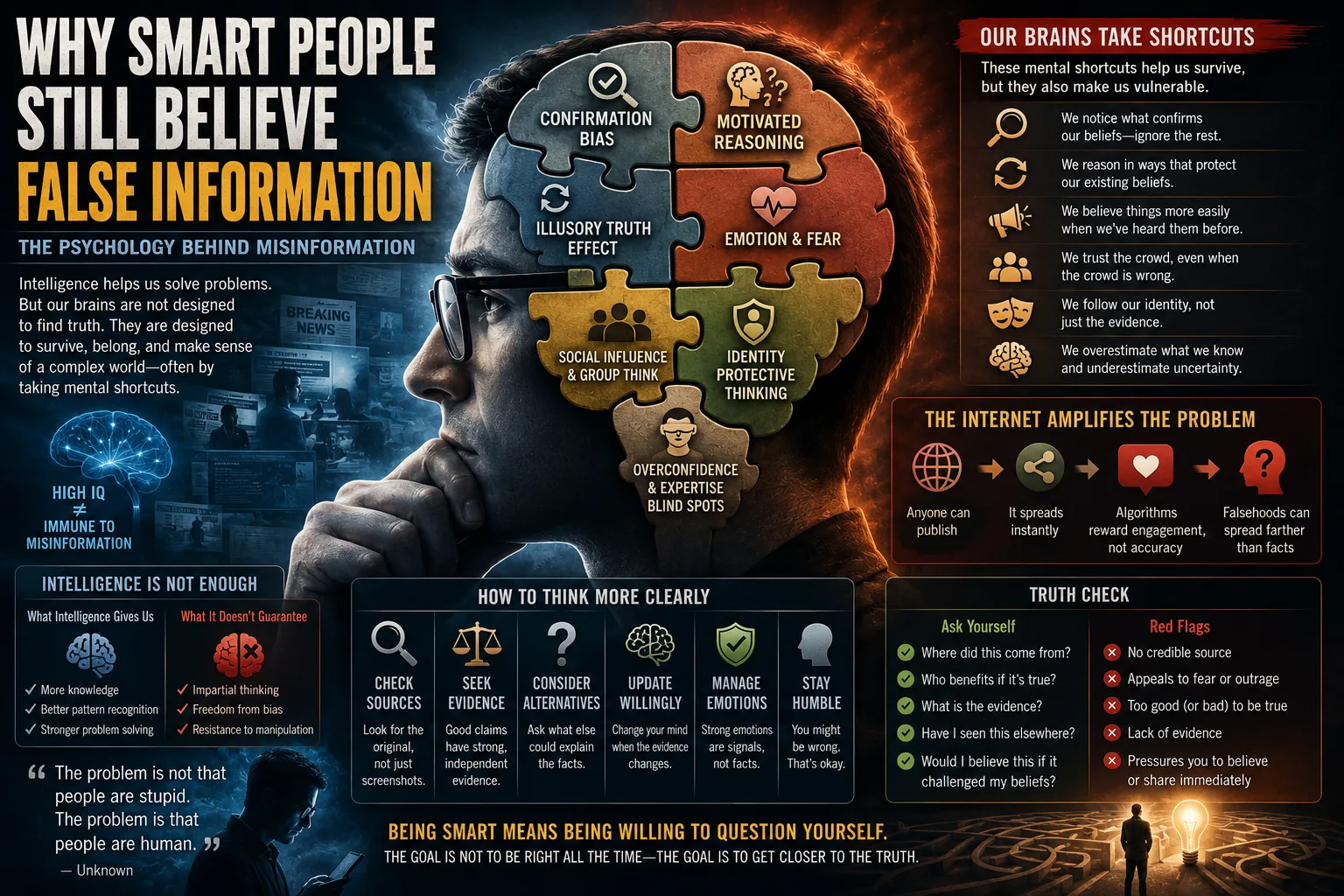
Why Smart People Still Believe False Information: The Psychology Behind Misinformation
Intelligence does not make the human mind immune to misinformation. Discover how confirmation bias, motivated reasoning, repetition, emotion, identity, and social influence can lead even highly intelligent people to confidently believe false information.
Why Intelligence Doesn't Make Us Immune to False Information
Imagine two people encounter the same claim online.
One has little knowledge of the subject.
The other is highly educated, analytically skilled, and accustomed to solving complicated problems.
Who is more likely to recognize that the claim is false?
The obvious answer seems to be the second person.
Often, that will be correct.
But not always.
Intelligence can improve our ability to analyze information, recognize inconsistencies, understand probabilities, and evaluate evidence.
What it cannot guarantee is that we will use those abilities impartially.
Sometimes we investigate a claim because we genuinely want to discover whether it is true.
Other times, without consciously realizing it, we begin with the conclusion we prefer and use our intelligence to defend it.
That distinction is crucial.
A powerful mind can be used to investigate an idea.
It can also be used to rationalize one.
Intelligence and Rationality Are Not the Same Thing
We often use words such as "intelligent," "logical," and "rational" as though they describe the same ability.
They don't.
Intelligence generally refers to abilities such as:
Learning.
Reasoning.
Solving problems.
Recognizing patterns.
Understanding complex information.
Rational thinking involves something slightly different.
It requires evaluating evidence appropriately, considering alternative explanations, updating beliefs when evidence changes, and recognizing when our own preferences may be influencing our conclusions.
A person can therefore be exceptionally capable at solving difficult problems while still making biased judgments.
Being able to reason well does not automatically mean reasoning objectively.
🟢 Established Psychological Evidence
Research in cognitive psychology consistently shows that intelligence and analytical ability can reduce susceptibility to some reasoning errors, but they do not eliminate cognitive biases, motivated reasoning, or belief-based distortions.
Confirmation Bias: The Evidence We Want to Find
Suppose you strongly believe that a particular diet is extraordinarily healthy.
You search online.
One article says the diet dramatically improves health.
You read the entire thing.
Another article reports a large study finding little evidence of those benefits.
You immediately begin questioning the methodology.
A third article supports your original belief.
You send it to your friends.
Without realizing it, you may have stopped asking:
"What does the evidence show?"
And started asking:
"What evidence supports what I already believe?"
This tendency is known as confirmation bias.
Humans naturally pay greater attention to information consistent with existing beliefs while scrutinizing, discounting, or avoiding contradictory information.
Intelligent people are not exempt.
In fact, someone with strong analytical abilities may be particularly skilled at identifying weaknesses in evidence they dislike while being considerably less demanding toward evidence supporting their position.
The intelligence remains.
The standard of evaluation changes.
Motivated Reasoning
Confirmation bias becomes even more powerful when a belief matters personally.
Imagine discovering evidence that threatens:
Your political worldview.
Your religion.
Your profession.
Your investment.
Your social group.
A decision you publicly defended.
Something central to your identity.
At that point, changing your mind may carry a psychological cost.
Accepting the evidence could mean admitting:
I was wrong.
Or worse:
My group was wrong.
The brain may therefore begin treating reasoning less like an investigation and more like a defense attorney.
Instead of impartially weighing evidence, we search for arguments that protect the conclusion we want.
Psychologists call this motivated reasoning.
🟢 Established Psychological Evidence
Motivated reasoning describes the tendency for goals, preferences, and prior beliefs to influence how people evaluate information. People commonly apply greater scrutiny to evidence challenging their beliefs than to evidence supporting them.
When Being Better at Reasoning Can Backfire
Here lies one of the most counterintuitive parts of misinformation psychology.
Greater reasoning ability gives someone more intellectual tools.
Those tools can help detect false information.
But they can also help construct sophisticated justifications.
A highly knowledgeable person may know more counterarguments.
They may recognize more weaknesses in opposing evidence.
They may search more effectively for supporting information.
They may produce explanations that sound extremely convincing.
This does not mean intelligence generally makes people more susceptible to misinformation.
Research often finds the opposite.
Better analytical thinking frequently improves people's ability to distinguish reliable information from unreliable claims.
The important point is narrower:
Intelligence is protection, not immunity.
When identity, emotion, or strong prior beliefs become involved, even excellent reasoning abilities can be redirected toward defending a preferred conclusion.
🟡 Active Scientific Research
Researchers continue investigating when cognitive sophistication reduces bias and when it can instead facilitate motivated reasoning. The relationship depends heavily on the type of belief, the individual's prior commitments, and the context in which information is evaluated.
The Illusory Truth Effect
Now imagine seeing this statement:
"A certain everyday food dramatically improves memory."
You don't believe it.
A week later, you encounter it again.
Then another account repeats it.
A video mentions it.
A friend sends you a post about it.
Eventually, something strange can happen.
The claim begins to feel familiar.
And familiarity can quietly be mistaken for truth.
Psychologists call this the illusory truth effect.
Repeated information becomes easier for the brain to process.
That processing fluency creates a subtle feeling of familiarity.
And familiar statements can feel more believable than unfamiliar ones.
Even when repetition provides absolutely no additional evidence.
🟢 Established Psychological Evidence
Experiments have repeatedly demonstrated the illusory truth effect: repeated statements are often judged as more truthful than equivalent statements encountered for the first time.
Why Repetition Is So Powerful Online
The internet transformed repetition into an industrial process.
One misleading claim can appear as:
A tweet.
A short video.
A screenshot.
A meme.
A news headline.
A forwarded message.
A podcast clip.
Five different sources may appear to confirm the same story.
But sometimes all five originated from one unsupported claim.
To the reader, however, repeated exposure creates the impression of independent confirmation.
"I've seen this everywhere."
That sentence feels reassuring.
It shouldn't.
You may have encountered five independent sources.
Or one source echoed through five thousand accounts.
Those are radically different things.
The human brain is not particularly good at keeping track of the distinction.
Emotion Can Outrun Analysis
False information does not need to defeat your intelligence if it can reach your emotions first.
Content producing strong emotional reactions is especially powerful.
Fear.
Anger.
Disgust.
Outrage.
Excitement.
Vindication.
A shocking headline encourages immediate reaction.
A boring statistical correction encourages careful thought.
Guess which one spreads faster on social media.
A claim that makes someone furious may be shared before they investigate whether it is accurate.
A claim confirming something they desperately hope is true may receive equally little scrutiny.
Emotion does not switch intelligence off.
It changes what the brain prioritizes.
🟢 Established Psychological Evidence
Emotional arousal can influence attention, memory, judgment, and information sharing. Misinformation that provokes strong emotional reactions can therefore spread effectively even when the underlying evidence is weak.
Identity Can Become Stronger Than Evidence
Some beliefs are simply beliefs.
Others become part of who we are.
Once an idea becomes associated with a person's community or identity, questioning it can feel less like evaluating information and more like betraying a group.
People naturally care about belonging.
For most of human history, social exclusion could carry serious consequences.
Our brains therefore pay enormous attention to what people around us believe.
If everyone within a trusted community accepts a claim, rejecting it may require more than evidence.
It may require social courage.
This helps explain why misinformation can persist inside highly educated communities.
The issue is not necessarily that nobody understands the evidence.
Sometimes accepting the evidence threatens something socially more important.
Social Proof: "Everyone Says It's True"
Humans constantly use other people's behavior as information.
If a restaurant has a huge queue, we assume the food might be good.
If thousands of people recommend a product, we become more interested.
If millions of people share a claim...
It begins to look credible.
This tendency is called social proof.
Online platforms amplify it through visible numbers:
2.4 million views.
180,000 likes.
47,000 shares.
Those numbers measure attention.
They do not measure truth.
A claim can become extraordinarily popular while remaining completely false.
Yet popularity itself can influence how seriously we take it.
🔴 Common Myth / Misconception
"Only gullible or unintelligent people believe misinformation."
False.
Lower knowledge or poor analytical reasoning can increase vulnerability in some situations, but misinformation susceptibility is influenced by many additional factors including prior beliefs, repetition, emotion, identity, social influence, source credibility, and information environments.
Intelligence can reduce risk.
It does not create psychological immunity.
The Most Dangerous Sentence
Perhaps one of the most dangerous thoughts anyone can have when encountering misinformation is:
"I'm too smart to fall for this."
Because the moment we become convinced that bias only affects other people, we become less likely to examine our own reasoning.
Critical thinking does not begin with distrusting everything.
It begins with accepting something considerably more uncomfortable:
My brain can fool me too.
And once we understand how that happens, we can start building better defenses against it.
When Expertise Becomes a Blind Spot
Knowledge is usually protective.
Experts know more facts.
They understand context.
They recognize common errors.
They can evaluate evidence more efficiently than beginners.
But expertise creates its own psychological risk.
The more knowledgeable someone becomes in a field, the easier it can be to assume:
"I understand this already."
That confidence is often justified.
Sometimes it isn't.
And when confidence grows faster than accuracy, even highly capable people can become easier to mislead.
Not because they know too little.
Because they may stop checking.
Overconfidence: When Certainty Exceeds Accuracy
Humans are generally poor at judging the reliability of their own beliefs.
We often feel more certain than the evidence warrants.
This is called overconfidence.
A person may correctly answer nine questions and still be equally confident about the tenth answer that happens to be wrong.
The problem becomes particularly dangerous when confidence itself is mistaken for evidence.
Someone who sounds certain can appear knowledgeable.
Someone who speaks cautiously can seem weak.
In reality, scientific thinking often requires the opposite.
Good reasoning includes knowing when the evidence is incomplete.
Certainty is not the same as accuracy.
And confidence is not proof.
🟢 Established Psychological Evidence
Research on judgment and decision-making has repeatedly found that people can be overconfident in the accuracy of their beliefs, especially when evaluating complex questions or making predictions under uncertainty.
What the Dunning-Kruger Effect Actually Means
Few psychological concepts have been abused online as much as the Dunning-Kruger effect.
The popular version usually sounds like this:
"Stupid people think they're geniuses."
That is a cartoon version of the research.
The underlying idea is more subtle.
People with limited knowledge in a domain may sometimes lack enough expertise to recognize the flaws in their own performance.
As knowledge improves, people become better at identifying those weaknesses.
However, experts can also make errors.
The important lesson is not that beginners are uniquely foolish.
It is that accurately evaluating your own knowledge is itself a skill.
Knowing something and knowing how well you know it are different abilities.
🟢 Established Psychological Evidence
Metacognition, the ability to evaluate one's own thinking and knowledge, plays an important role in reasoning accuracy. People can misjudge their competence at many ability levels, although the direction and magnitude of those errors vary by task and context.
Expertise Can Be Highly Local
A brilliant physicist is not automatically an expert in medicine.
A surgeon is not automatically an expert in economics.
A software engineer is not automatically qualified to evaluate nutrition research.
Yet intelligence and success in one field can create a powerful sense of confidence elsewhere.
This is sometimes called expertise transfer.
The reasoning ability transfers.
The subject knowledge does not.
Someone who is genuinely exceptional in one area may underestimate how much specialized knowledge another field requires.
That can make misinformation particularly convincing when it is packaged in technical language.
The reader understands enough to recognize the vocabulary...
But not always enough to evaluate whether it is being used correctly.
The Authority Shortcut
When people cannot personally verify information, they often rely on authority.
Usually, this is sensible.
No individual can independently reproduce every medical study, inspect every bridge, test every aircraft, and confirm every astronomical measurement.
Society depends on specialized expertise.
The problem begins when we use the wrong signals to identify experts.
A person may appear credible because they have:
A prestigious job title.
A large audience.
Professional-looking graphics.
Technical vocabulary.
Academic credentials in an unrelated discipline.
Confidence.
These signals can be useful.
None guarantees expertise on the specific claim being discussed.
Misinformation becomes particularly effective when it borrows the appearance of authority without the underlying evidence.
Social Media Changed the Information Environment
For most of human history, information moved slowly.
Today, a false claim can reach millions of people before qualified experts have even had time to examine it.
Social platforms changed not only the speed of information.
They changed the incentives.
Online systems reward content that receives engagement.
Engagement often comes from material that is:
Surprising.
Emotional.
Controversial.
Outrage-inducing.
Simple.
Easy to share.
Accurate information is not necessarily disadvantaged.
But accuracy is not always what the system optimizes for.
Attention is.
And unfortunately, reality does not always have the best marketing department.
🟢 Established Psychological Evidence
Research on online misinformation shows that social and platform dynamics can influence what information people encounter, how often they see it, and whether they share it. Repetition, emotional salience, and social endorsement can all affect perceived credibility.
The Algorithm Doesn't Need to Believe Anything
Social media algorithms are sometimes described as though they possess political or ideological intentions.
Usually, that is unnecessary.
An engagement-driven system does not need to "believe" misinformation.
It only needs to discover that certain content keeps people watching.
Suppose a dramatic false claim receives:
More comments.
More arguments.
More shares.
Longer watch time.
The system may learn that the content is effective at retaining attention.
That can increase its distribution.
The result can look intentional even when the mechanism is simply optimization.
This creates an important distinction:
What spreads effectively is not necessarily what is most accurate.
The Echo Chamber Problem
Imagine gradually filling your social feed with people who share your worldview.
Every day you see:
Similar opinions.
Similar news sources.
Similar interpretations.
Similar criticisms of outsiders.
Eventually, those beliefs begin to look overwhelmingly common.
This produces an echo chamber.
Inside such environments, repeated agreement creates the impression that a belief is obvious or universally accepted.
Contradictory information begins to appear unusual.
Suspicious.
Even hostile.
The internet didn't invent tribal thinking.
It simply made it possible to construct a personalized tribe that follows you everywhere.
AI Has Changed the Misinformation Problem
For years, producing convincing misinformation required effort.
Someone had to write the article.
Edit the photograph.
Record the audio.
Create the video.
Generative AI has dramatically lowered those barriers.
Today, synthetic systems can create:
Realistic photographs.
Artificial voices.
Fabricated video.
Fake documents.
Persuasive articles.
Impersonated experts.
Thousands of slightly different social posts.
Producing false content at scale has become dramatically easier.
That changes the problem from:
"Can someone create a convincing fake?"
to:
"How many convincing fakes can someone create?"
Deepfakes and the Collapse of "Seeing Is Believing"
For most of modern history, photographs and recordings carried enormous persuasive power.
People would say:
"I saw the video."
That sentence once felt close to proof.
It no longer does.
AI-generated media can now realistically imitate faces, voices, environments, and events.
This creates two opposite dangers.
The first is obvious:
People may believe fabricated evidence.
The second is subtler:
People may dismiss genuine evidence by claiming it was generated by AI.
Researchers sometimes call this the liar's dividend.
The existence of convincing synthetic media makes both fake evidence easier to create and authentic evidence easier to deny.
🟡 Active Scientific Research
Researchers are actively studying how generative AI affects misinformation, trust, political communication, fraud, and people's ability to distinguish authentic from synthetic media. The technology and defensive tools are evolving rapidly, so conclusions remain an active research area.
Why Fact-Checking Doesn't Always Work
Suppose someone believes a false claim.
You show them a correction.
Problem solved?
Sometimes.
But not always.
Corrections work best when they are:
Clear.
Credible.
Easy to understand.
Provided relatively early.
Accompanied by a better explanation.
Simply saying "that's false" leaves a gap.
People still want to understand what actually happened.
Replacing misinformation with a coherent explanation is often more effective than simply removing the false one.
Repetition Creates Another Problem
Correcting misinformation can accidentally repeat it.
And repetition itself increases familiarity.
This does not mean fact-checkers should avoid mentioning false claims entirely.
That would make corrections impossible.
Instead, effective corrections usually emphasize the accurate information first, identify the false claim carefully, explain why it is wrong, and reinforce the correct explanation.
The goal is not merely to win an argument.
It is to improve the mental model.
How to Become Harder to Mislead
Nobody can eliminate bias completely.
But vulnerability can be reduced.
A few habits are particularly valuable.
Slow down when something produces a strong emotional reaction. Emotion is often the moment when verification matters most.
Check the original source. Screenshots and summaries can remove crucial context.
Look for independent confirmation. Ten websites repeating the same source are not ten independent sources.
Ask what evidence would change your mind. If the answer is "nothing," you are defending an identity rather than testing a belief.
Separate confidence from evidence. A confident speaker can still be confidently wrong.
Check expertise carefully. Credentials matter only when relevant to the specific claim.
Be suspicious of information that perfectly confirms what you already wanted to believe. Convenient evidence deserves more scrutiny, not less.
Update without shame. Changing your mind after receiving better evidence is not intellectual weakness.
It is literally what rational thinking is supposed to do.
The Best Defense Is Intellectual Humility
People sometimes imagine critical thinkers as individuals who confidently reject false claims.
A more accurate description may be someone comfortable saying:
"I don't know yet."
Intellectual humility does not mean believing nothing.
It means recognizing that your current understanding could be incomplete.
That single habit makes it easier to:
Seek better evidence.
Consider alternative explanations.
Notice errors.
Update beliefs.
Certainty feels powerful.
Uncertainty feels uncomfortable.
Unfortunately for the human ego, uncertainty is often where good thinking begins.
🟢 Established Psychological Evidence
Intellectual humility, active open-mindedness, and willingness to reconsider beliefs are associated in research with better evaluation of evidence and reduced endorsement of some forms of misinformation.
Frequently Asked Questions
Are intelligent people less likely to believe misinformation?
Often, yes.
Higher analytical reasoning and relevant knowledge can improve people's ability to evaluate information.
However, intelligence does not remove confirmation bias, motivated reasoning, emotional influence, identity-based thinking, or overconfidence.
Can fact-checking change people's minds?
Yes.
Corrections can reduce false beliefs, although effectiveness depends on how the correction is presented, the person's prior beliefs, source credibility, and the surrounding information environment.
Does social media cause misinformation?
Social media did not create misinformation.
False information has existed throughout human history.
However, modern platforms can dramatically increase its speed, scale, repetition, and visibility.
Will AI make misinformation impossible to detect?
Not necessarily.
Detection systems, provenance technology, authentication tools, platform policies, and media literacy are developing alongside generative AI.
But distinguishing genuine content from sophisticated synthetic media will become an increasingly important challenge.
Final Thoughts
The uncomfortable truth about misinformation is that intelligence alone cannot protect us.
Being knowledgeable helps.
Analytical thinking helps.
Education helps.
But none of these eliminates the psychological forces influencing belief.
Human beings do not evaluate information in isolation. We interpret it through memories, identities, emotions, communities, expectations, and previous beliefs. Sometimes our reasoning searches for truth. Sometimes it quietly searches for justification.
The most resilient thinkers are therefore not necessarily those who know the most.
They are those willing to test what they think they know.
In a world where information is abundant, attention is monetized, algorithms determine what reaches us, and artificial intelligence can manufacture convincing evidence at enormous scale, that willingness may become one of the most important intellectual skills of the twenty-first century.
The goal is not to become impossible to fool.
That is probably impossible.
The goal is to become easier to correct.
Because the strongest mind is not the one that never believes something false.
It is the one capable of recognizing when the evidence has changed and having the courage to change with it.