Göbekli Tepe: The 12,000-Year-Old Temple That Rewrote Human History
Discovered in southeastern Türkiye, Göbekli Tepe is nearly 12,000 years old and predates Stonehenge by thousands of years. Discover why this remarkable archaeological site transformed our understanding of the origins of civilization, religion, and human society.
Göbekli Tepe: The 12,000-Year-Old Temple That Rewrote Human History
On a windswept hill in southeastern Türkiye lies an archaeological site so extraordinary that it forced historians to rewrite one of humanity's oldest stories.
For decades, scholars believed civilization followed a familiar path.
First came agriculture.
With reliable food supplies, people settled into permanent villages.
Those villages eventually grew into cities.
Only then, historians argued, could humans organize the labor needed to construct temples, monuments, and complex religious centers.
Göbekli Tepe turned that sequence upside down.
Hidden beneath an artificial mound for thousands of years, archaeologists uncovered enormous circular stone enclosures built nearly 12,000 years ago.
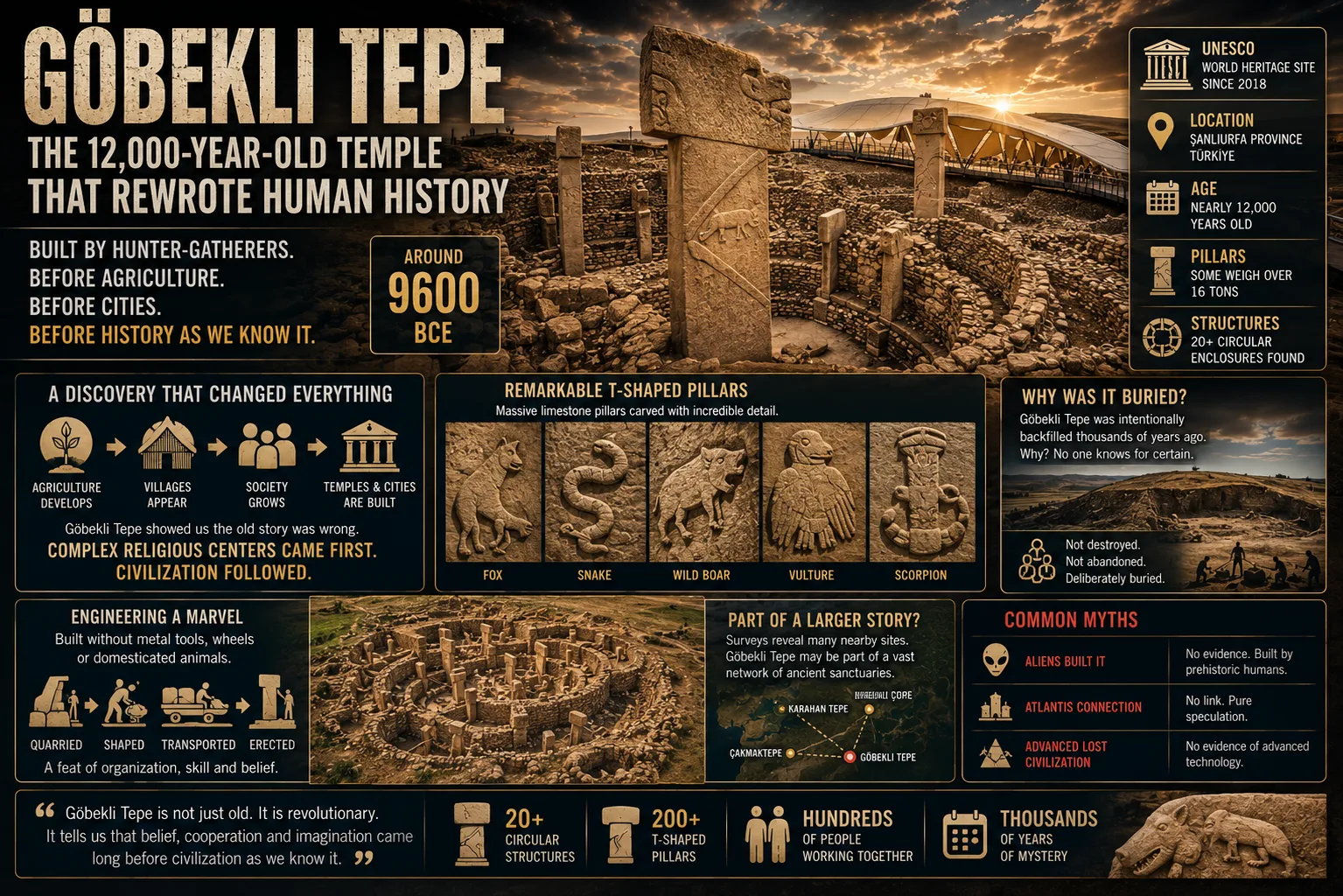
At their centers stood towering T-shaped limestone pillars, some weighing more than 16 tons.
These monuments are older than:
Stonehenge by around 6,000 years.
The Great Pyramids of Egypt by roughly 7,000 years.
The earliest cities of Mesopotamia by several millennia.
Even more astonishing...
The builders were probably hunter-gatherers.
They had no metal tools.
No pottery.
No wheels.
No domesticated draft animals.
Yet they organized hundreds of people to quarry, carve, transport, and erect massive stone monuments unlike anything previously known from that era.
How was such a feat possible?
Why was the site built?
And why, after centuries of use, was it deliberately buried?
Göbekli Tepe is not merely an ancient ruin.
It is one of the most important archaeological discoveries ever made.
A Discovery Hidden in Plain Sight
Although local farmers had long noticed unusual carved stones protruding from the hillside, few suspected their true significance.
In 1963, archaeologists recorded the location during a regional survey but mistakenly believed it to be a medieval cemetery.
The site's true importance remained hidden for another three decades.
Everything changed in 1994.
German archaeologist Klaus Schmidt visited the hill and immediately recognized that the carved limestone pillars were unlike anything previously discovered.
Excavations soon revealed one of the world's oldest monumental ritual complexes.
What appeared to be an ordinary mound concealed thousands of years of extraordinary human history.
🟢 Established Archaeological Evidence
Modern excavations at Göbekli Tepe began in 1995 under the direction of archaeologist Klaus Schmidt. The site has since become one of the most significant Neolithic discoveries ever made.
The World's Oldest Monumental Sanctuary?
Radiocarbon dating places the earliest construction of Göbekli Tepe around 9600 BCE, during the Pre-Pottery Neolithic.
This period came shortly after the end of the last Ice Age.
At the time:
Farming was only beginning to emerge.
Permanent settlements were rare.
Writing had not yet been invented.
Metalworking was still thousands of years away.
Despite these limitations, the people of Göbekli Tepe built monumental architecture on a scale previously thought impossible for hunter-gatherer societies.
For many archaeologists, the discovery fundamentally changed our understanding of early human organization.
The Remarkable T-Shaped Pillars
The most striking features of Göbekli Tepe are its enormous limestone pillars.
Most stand between 3 and 6 meters (10 to 20 feet) tall.
Several weigh well over 10 tons, with the largest estimated at around 16 tons.
The pillars are not rough stone blocks.
Many were carefully carved with remarkable detail.
Some depict:
Foxes.
Snakes.
Wild boars.
Lions.
Vultures.
Scorpions.
Gazelles.
Birds.
Others display carved arms, hands, belts, and loincloths, suggesting that the pillars themselves may represent stylized human figures.
The precision of these carvings demonstrates an artistic sophistication rarely associated with societies of this age.
🟢 Established Archaeological Evidence
The limestone pillars at Göbekli Tepe contain detailed relief carvings of animals and abstract symbols. Several pillars also feature carved human arms and hands, indicating they likely represent stylized human or ancestral figures.
Who Built Göbekli Tepe?
Perhaps the site's greatest mystery is not the stones themselves.
It is the people who built them.
Unlike the Egyptians or Mesopotamians, the builders left behind:
No written language.
No kings' names.
No historical records.
No monumental cities.
Instead, archaeological evidence suggests they were communities of hunter-gatherers living before fully developed agriculture became widespread.
This realization challenged one of archaeology's most fundamental assumptions.
Perhaps large religious gatherings did not emerge because civilization existed.
Perhaps civilization developed because people first gathered for shared rituals.
The idea remains one of the most influential hypotheses in modern archaeology.
🟡 Active Archaeological Debate
Many archaeologists believe Göbekli Tepe demonstrates that complex religious or ceremonial gatherings helped encourage social organization before large-scale agriculture. Others argue that early cultivation and settlement may already have been developing alongside the site's construction. The relationship between religion and agriculture remains an active area of research.
An Engineering Achievement Before Civilization
Building Göbekli Tepe required extraordinary coordination.
Workers had to:
Quarry enormous limestone blocks.
Shape them using stone tools.
Transport pillars weighing many tons.
Raise them into carefully planned circular enclosures.
Decorate them with intricate relief carvings.
Exactly how they accomplished these tasks remains uncertain.
What is certain is that the builders possessed remarkable engineering knowledge, organization, and craftsmanship long before traditional civilizations appeared.
🔴 Popular Myth / Unsupported Claim
Because Göbekli Tepe predates many famous ancient civilizations, some writers claim it was built by aliens or a forgotten advanced society.
There is no archaeological evidence supporting these ideas. Excavations consistently show that the site was built by prehistoric human communities using technologies appropriate for the Neolithic period.
Why Was Göbekli Tepe Buried?
Among all the mysteries surrounding Göbekli Tepe, perhaps none is more puzzling than its ending.
The massive stone enclosures were not destroyed by war.
They were not abandoned after an earthquake.
They did not gradually disappear beneath drifting sand.
Instead...
They were deliberately buried.
Thousands of cubic meters of earth, stone fragments, animal bones, and other material were carefully placed around and over the monuments until the structures disappeared beneath an artificial hill.
This was no accident.
It was an intentional act carried out by the people who used the site.
Why?
No one knows for certain.
🟢 Established Archaeological Evidence
Excavations show that the major enclosures at Göbekli Tepe were intentionally backfilled during the Neolithic period. The fill contains stone debris, animal bones, and other materials placed deliberately rather than deposited naturally.
A Ritual Goodbye?
One leading interpretation is that the burial formed part of a ceremonial process.
Rather than abandoning the sanctuary, its builders may have intentionally sealed older enclosures before constructing new ones nearby.
Evidence suggests Göbekli Tepe was not built all at once.
Over many centuries, new circular structures replaced older ones.
Some archaeologists believe each enclosure had a life cycle.
Once its ceremonial role ended, it was respectfully buried.
If true, Göbekli Tepe was not simply a temple.
It was a monument that continually evolved across generations.
The Language of Animals
Walking through Göbekli Tepe today, one detail immediately stands out.
Animals are everywhere.
The pillars display remarkable carvings of:
Foxes.
Snakes.
Wild boars.
Vultures.
Cranes.
Gazelles.
Bulls.
Scorpions.
Predatory cats.
Interestingly...
There are very few depictions of domesticated animals.
Most belong to the wild landscapes surrounding early hunter-gatherer communities.
Their meaning remains one of archaeology's greatest unanswered questions.
Were they clan symbols?
Religious beings?
Protective spirits?
Representations of seasonal cycles?
Or something entirely different?
Without written records, certainty remains impossible.
🟡 Active Archaeological Debate
Researchers continue to debate the meaning of Göbekli Tepe's animal carvings. Proposed interpretations include symbolic storytelling, ritual beliefs, clan identities, cosmological concepts, and representations of the surrounding natural world. No single explanation has achieved broad consensus.
A Site That Changed Human History
Before Göbekli Tepe, many historians believed that agriculture created civilization.
The traditional sequence looked like this:
Agriculture develops.
Permanent villages appear.
Population increases.
Religion becomes organized.
Monumental architecture follows.
Göbekli Tepe challenged that model.
Its existence suggests another possibility.
Large ceremonial gatherings may have encouraged people to cooperate on an unprecedented scale.
That cooperation could have strengthened social bonds.
Communities gathering repeatedly at ritual centers may eventually have needed reliable food supplies.
Agriculture, rather than causing organized society, may have expanded because organized society already existed.
This idea remains one of the most influential debates in modern archaeology.
A Small Part of a Much Larger Story
Although Göbekli Tepe has become world-famous, archaeologists believe we have uncovered only a fraction of the site.
Ground surveys indicate additional buried structures still remain beneath the hill.
Nearby discoveries, including sites such as Karahan Tepe, suggest Göbekli Tepe formed part of a much larger network of early Neolithic ceremonial centers across southeastern Türkiye.
Instead of being an isolated wonder, it may represent one chapter in a broader cultural transformation occurring at the dawn of civilization.
Every excavation season adds new pieces to this remarkable puzzle.
🟢 Established Archaeological Evidence
Geophysical surveys indicate that much of Göbekli Tepe remains unexcavated. Archaeologists have also identified related Pre-Pottery Neolithic sites across the region, suggesting a broader cultural landscape rather than a single isolated monument.
UNESCO World Heritage Site
Recognizing its extraordinary importance, Göbekli Tepe was designated a UNESCO World Heritage Site in 2018.
Today, protective shelters preserve the ancient pillars while archaeologists continue carefully uncovering new structures.
Unlike many famous archaeological sites, Göbekli Tepe is still actively revealing new information.
Each excavation season has the potential to reshape our understanding of humanity's earliest monumental architecture.
Common Myths
Göbekli Tepe's incredible age has inspired numerous extraordinary claims.
Let's compare them with the evidence.
Myth: Aliens Built Göbekli Tepe
No archaeological evidence supports this claim.
The stone tools, quarry marks, unfinished carvings, and construction techniques all indicate human builders using Neolithic technology.
Myth: It Proves Atlantis Existed
Some writers connect Göbekli Tepe with Atlantis or a forgotten global civilization.
No archaeological evidence links the site to Plato's Atlantis or any lost super-civilization.
Myth: It Was Built by a Highly Advanced Civilization
Although the builders demonstrated remarkable engineering and artistic skill, no evidence suggests they possessed advanced technology beyond what archaeologists have documented for the Pre-Pottery Neolithic.
🔴 Popular Myth / Unsupported Claim
Claims that Göbekli Tepe was built by extraterrestrials, survivors of Atlantis, or a technologically advanced lost civilization are not supported by archaeological evidence. The site's significance lies in demonstrating what prehistoric human societies were capable of achieving through cooperation and ingenuity.
Frequently Asked Questions
How old is Göbekli Tepe?
The earliest structures date to approximately 9600 BCE, making the site nearly 12,000 years old.
Where is Göbekli Tepe?
It is located in Şanlıurfa Province, southeastern Türkiye.
Who built Göbekli Tepe?
Current evidence indicates it was constructed by Pre-Pottery Neolithic hunter-gatherer communities, long before the rise of cities or written history.
Why was it buried?
The exact reason remains unknown. Archaeologists agree the burial was intentional, but whether it represented ritual closure, cultural change, or another purpose remains an active area of research.
Final Thoughts
Göbekli Tepe is one of the rare archaeological discoveries that genuinely changed the way historians think about the past. Its towering stone pillars, intricate carvings, and immense age reveal that prehistoric communities were capable of organizing monumental construction thousands of years before the first cities appeared.
Perhaps its greatest lesson is that human history is rarely as simple as once believed. The relationship between religion, cooperation, settlement, and agriculture is more complex than earlier models suggested, and Göbekli Tepe stands at the center of that debate. It reminds us that the origins of civilization were not a single moment or invention, but a long process shaped by countless generations of innovation and shared belief.
Much of the site still lies buried beneath the hill, waiting to be uncovered. With every new excavation, Göbekli Tepe continues to challenge old assumptions and reveal fresh insights into humanity's earliest chapters. Sometimes the most revolutionary discoveries are not those that answer our questions, but those that compel us to ask entirely new ones.