Easter Island Moai: Who Built the Giant Stone Heads and How Were They Moved?
Nearly 1,000 giant stone statues stand across one of the world's most isolated islands. Discover who built the Easter Island Moai, how they were transported without modern machinery, and what archaeology has revealed about one of history's greatest engineering achievements.
Easter Island Moai: Who Built the Giant Stone Heads and How Were They Moved?
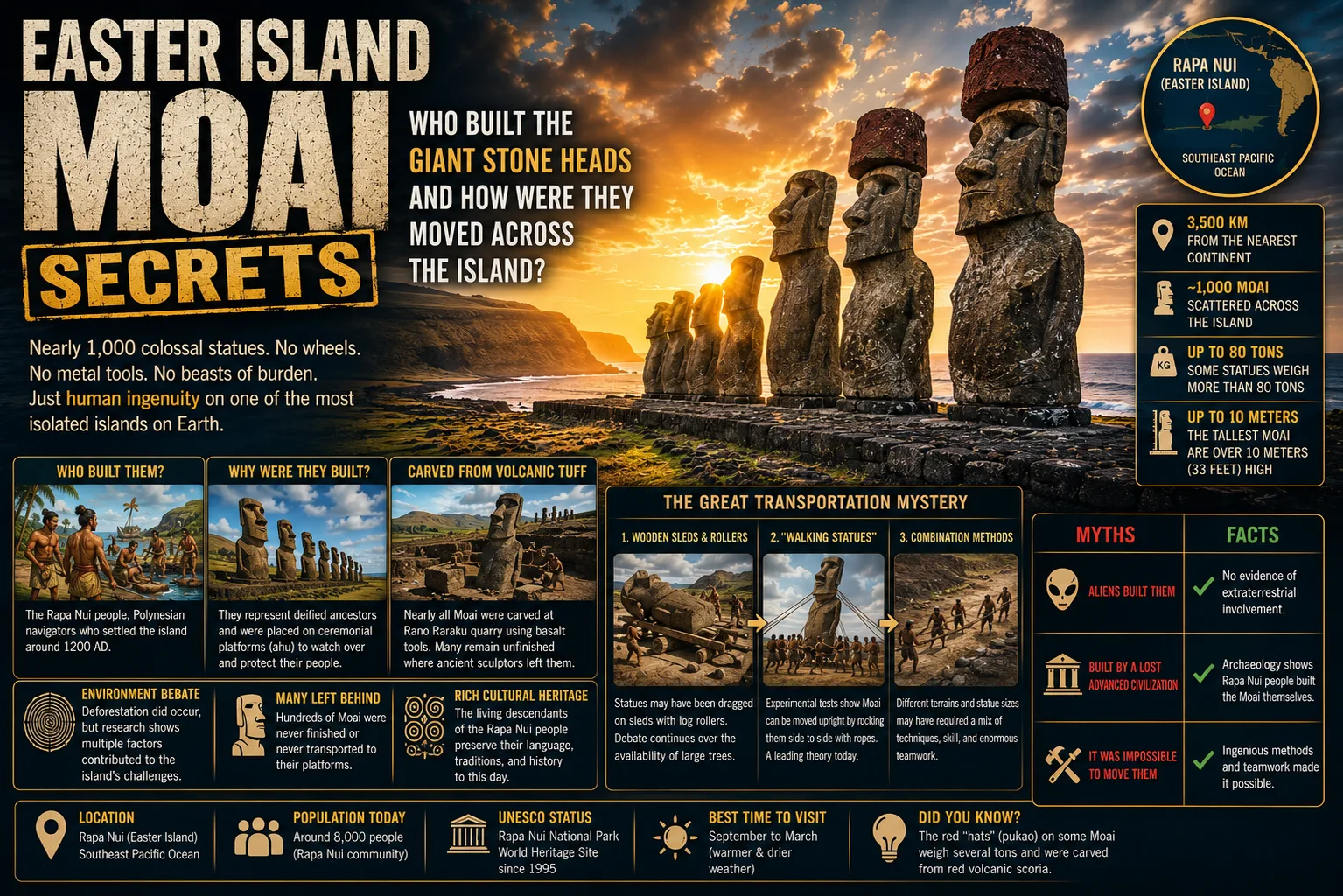
In the middle of the southeastern Pacific Ocean, more than 3,500 kilometers (2,175 miles) from the coast of Chile, lies one of the most isolated inhabited islands on Earth.
Known today as Rapa Nui, or Easter Island, this remote volcanic island is home to one of humanity's greatest archaeological mysteries.
Scattered across its windswept landscape stand nearly 1,000 massive stone statues, known as the Moai.
Some gaze silently inland, watching over ancient villages.
Others remain unfinished inside volcanic quarries.
Several lie toppled along old transportation routes, as though frozen in the middle of an enormous engineering project that ended centuries ago.
The largest completed Moai weighs more than 80 tons.
The tallest standing statue reaches almost 10 meters (33 feet) in height.
Even more astonishing is that the people who built them possessed no metal tools, wheeled vehicles, or draft animals.
How did they carve monuments weighing as much as modern passenger aircraft?
How were they transported across rugged volcanic terrain?
And why were so many left unfinished?
For generations, these questions fueled extraordinary theories.
Some suggested the statues were moved by lost civilizations.
Others claimed extraterrestrials must have helped.
Modern archaeology paints a far more remarkable picture.
The true story is not one of supernatural intervention.
It is one of human ingenuity, cultural devotion, and engineering skill developed in one of the most isolated places on Earth.
The Island at the Edge of the World
Rapa Nui covers only about 163 square kilometers (63 square miles).
Despite its small size, it contains hundreds of archaeological sites, ceremonial platforms, ancient villages, rock carvings, and the famous Moai.
The island was settled by Polynesian navigators, believed to have arrived between the 12th and 13th centuries AD, after remarkable voyages across the Pacific Ocean using sophisticated knowledge of stars, ocean currents, and winds.
Over the following centuries, the island developed into a unique civilization unlike any other.
Its people spoke their own language, developed distinctive traditions, and built monuments on a scale that still astonishes archaeologists today.
🟢 Established Archaeological Evidence
Archaeological research indicates that Polynesian settlers reached Rapa Nui around AD 1200, establishing the civilization responsible for carving and erecting the Moai statues.
More Than Stone Heads
Although commonly called "giant stone heads," the Moai are actually complete statues.
Many visitors never realize that the famous heads continue beneath the ground.
Excavations have revealed full torsos, carved arms, hands, and detailed body features buried over centuries by soil accumulation.
Some statues display intricate carvings on their backs, including ceremonial symbols and geometric designs.
The buried bodies transformed public understanding of the Moai and demonstrated that they were intended as complete human figures rather than oversized heads alone.
Who Did the Moai Represent?
The Moai were not gods.
Nor were they decorative monuments.
Most archaeologists believe they represented deified ancestors, respected chiefs, or important community leaders.
After carving, the statues were placed upon massive ceremonial stone platforms known as Ahu.
From these elevated positions, they faced inland rather than toward the sea.
According to Rapa Nui tradition, the statues symbolically watched over their descendants, providing protection, guidance, and spiritual authority.
The statues were believed to possess mana, a sacred spiritual power associated with leadership and ancestry.
Their importance extended far beyond architecture.
They embodied the identity and prestige of entire communities.
🟢 Established Archaeological Evidence
Most archaeologists agree that the Moai represented revered ancestors or important leaders and were erected on ceremonial Ahu platforms as part of ancestor worship central to Rapa Nui society.
Carving Giants From Volcanic Rock
Nearly all of the Moai were carved from compressed volcanic ash known as tuff.
The primary quarry, called Rano Raraku, contains hundreds of statues in various stages of completion.
Some remain attached to the bedrock exactly where ancient sculptors left them.
Archaeologists believe teams of skilled craftsmen used hard basalt tools to chip away at the softer volcanic rock.
The statue was carved while lying horizontally within the quarry wall.
Only after most of the sculpture was complete would workers detach it from the rock and prepare it for transport.
The process demanded extraordinary planning, coordination, and craftsmanship.
Some of the unfinished statues inside Rano Raraku would have exceeded 20 meters (65 feet) in height had they ever been completed.
🟢 Established Archaeological Evidence
Approximately 95% of the Moai were carved from volcanic tuff at Rano Raraku, where hundreds of unfinished statues remain, providing archaeologists with invaluable insight into ancient carving techniques.
The Great Transportation Mystery
For centuries, the greatest question surrounding the Moai has been remarkably simple.
Once carved...
How did the people of Rapa Nui move these enormous statues across the island?
Some statues traveled more than 15 kilometers (9 miles) from the quarry to their final locations.
The island had no horses.
No oxen.
No cranes.
No iron.
Yet somehow, monuments weighing dozens of tons reached ceremonial platforms scattered across the landscape.
Early European visitors found the task so unbelievable that many concluded the statues could not possibly have been moved by the island's inhabitants alone.
The search for an explanation continues to this day.
🟡 Active Research & Competing Theories
While archaeologists agree the Rapa Nui people transported the Moai themselves, researchers continue to debate the exact techniques used. Proposed methods include wooden sleds, log rollers, rope-assisted "walking," and combinations of these approaches. Experimental archaeology has demonstrated that several methods are physically possible, but no single technique has been proven to account for every statue across the island.
How Did the Moai Move?
Among all the mysteries surrounding Easter Island, none has inspired more debate than the transportation of the Moai.
Some statues weigh as much as 80 tons.
The largest unfinished Moai at Rano Raraku would have exceeded 20 meters (65 feet) in height and weighed well over 150 tons if completed.
Yet these enormous monuments were successfully transported across rugged volcanic terrain without modern machinery.
For centuries, scholars struggled to explain how.
Today, archaeologists broadly agree that the Rapa Nui people themselves moved the statues.
The remaining question is how.
Theory One: Wooden Sleds and Rollers
The earliest scientific explanation proposed that the Moai were laid horizontally on wooden sleds.
Logs placed beneath the sled acted as rollers, allowing teams of workers to pull the statues forward using ropes.
At first glance, the method appears practical.
Similar techniques were used in various ancient civilizations for moving heavy stone blocks.
However, there is one significant problem.
By the time Europeans arrived on Easter Island in the eighteenth century, the island contained very few large trees.
Some researchers argued that extensive deforestation may have resulted from transporting the statues.
Others believe the island never possessed enough mature trees to support moving hundreds of colossal monuments using log rollers alone.
The debate remains unresolved.
🟡 Active Research & Competing Theories
Wooden sleds and rollers remain a plausible transportation method for some Moai, but archaeologists continue to debate whether sufficient timber was available throughout the island's history to support this technique on a large scale.
Theory Two: The Walking Statues
Perhaps the most fascinating explanation emerged from a combination of archaeology and experimental engineering.
According to Rapa Nui oral tradition, the statues did not lie on the ground.
Instead...
"They walked."
For generations this statement was dismissed as symbolic mythology.
Then researchers decided to test it.
Using ropes attached to both sides and the rear of a replica Moai, teams carefully rocked the statue from side to side while pulling forward.
With each alternating movement, the statue slowly advanced.
Rather than dragging it, the participants effectively "walked" the monument across the ground.
To the surprise of many archaeologists, the method worked remarkably well.
The statues moved upright with relatively small teams compared to earlier transportation estimates.
The discovery also explains several observations.
Many Moai possess slightly rounded bases, making controlled rocking possible.
Ancient transportation roads also contain wear patterns consistent with upright movement rather than horizontal dragging.
Although not every researcher agrees that all statues were transported this way, the walking hypothesis has become one of the leading explanations.
🟢 Established Archaeological Evidence
Experimental archaeology has successfully demonstrated that replica Moai can be moved upright using coordinated teams pulling ropes from alternating sides, lending strong support to the "walking statues" hypothesis described in Rapa Nui oral traditions.
Why Were So Many Statues Left Behind?
Visitors to Rano Raraku often notice hundreds of unfinished Moai still emerging from the quarry walls.
Some remain partially carved.
Others appear complete but were never transported.
Why did the work suddenly stop?
Archaeologists believe statue production gradually declined as Rapa Nui society experienced significant political, environmental, and social changes.
Construction eventually ceased altogether.
The quarry became a remarkable archaeological time capsule, preserving every stage of the carving process exactly where ancient craftsmen abandoned their work centuries ago.
The Environmental Collapse Debate
For decades, Easter Island was presented as a cautionary tale.
According to the traditional interpretation, the Rapa Nui people cut down nearly every tree on the island while transporting statues.
The resulting deforestation caused soil erosion, declining agriculture, famine, and eventually social collapse.
More recent research paints a more complex picture.
Evidence suggests multiple factors contributed to environmental change.
These may have included climate variation, intensive agriculture, introduced Polynesian rats feeding on tree seeds, and European diseases and slave raids following outside contact.
Rather than a simple story of ecological self-destruction, modern archaeologists increasingly view Rapa Nui as an example of a society adapting to difficult environmental conditions.
🟡 Active Research & Competing Theories
The causes of Easter Island's environmental changes remain actively debated. While deforestation unquestionably occurred, researchers disagree over the relative roles of human activity, invasive rats, climate fluctuations, and later European contact.
UNESCO World Heritage Site
Recognizing its extraordinary archaeological and cultural importance, Rapa Nui National Park was designated a UNESCO World Heritage Site in 1995.
Today, the island protects hundreds of archaeological sites, including ceremonial platforms, ancient villages, rock art, and nearly all surviving Moai.
Ongoing conservation efforts continue to preserve these monuments against erosion, earthquakes, and increasing tourism.
🟢 Established Archaeological Evidence
UNESCO inscribed Rapa Nui National Park as a World Heritage Site in 1995, recognizing the Moai as one of humanity's most remarkable achievements in prehistoric monumental sculpture.
Common Myths
The extraordinary scale of the Moai has inspired countless sensational theories.
Archaeology tells a different story.
Myth: Aliens Built the Moai
No credible archaeological evidence supports extraterrestrial involvement.
Every stage of carving, transportation, and construction is documented through archaeological excavations and experimental research.
Myth: Only the Heads Exist
This misconception became widespread because many statues are buried up to their shoulders.
Excavations reveal complete torsos, arms, hands, and carved backs beneath the surface.
Myth: The Builders Vanished Without Explanation
The descendants of the ancient Rapa Nui people still live on Easter Island today.
Their culture, language, and traditions continue despite centuries of dramatic historical change.
🔴 Popular Myth / Unsupported Claim
Claims that the Moai were constructed by aliens, Atlantis, or a lost advanced civilization are not supported by archaeological evidence. The monuments were created by the Indigenous Rapa Nui people using sophisticated but entirely human engineering techniques.
Frequently Asked Questions
How many Moai are on Easter Island?
Archaeologists have documented approximately 1,000 Moai, although not all were completed or erected.
Why do the statues face inland?
Most Moai face inland toward former villages, symbolically watching over the communities they represented rather than looking out to sea.
How were the Moai transported?
Researchers continue to debate the exact method, but leading evidence supports a combination of rope-assisted "walking," sleds, and other practical engineering techniques depending on the statue and terrain.
Why are some statues buried?
The statues were originally erected above ground. Over centuries, soil accumulation, erosion, and volcanic sediments gradually buried many of their bodies while leaving the heads exposed.
Final Thoughts
The Moai of Easter Island are among humanity's greatest engineering achievements. Carved with simple stone tools, transported across rugged volcanic landscapes, and raised onto ceremonial platforms without modern machinery, they demonstrate an extraordinary level of planning, cooperation, and craftsmanship.
For generations, their immense size encouraged stories of lost civilizations, supernatural powers, and extraterrestrial builders. Yet archaeology has revealed a far more compelling truth. These monuments were the work of the Indigenous Rapa Nui people, whose ingenuity transformed volcanic stone into enduring symbols of ancestry, identity, and spiritual belief.
Many questions remain. Researchers continue to debate the precise transportation methods, the causes of the island's environmental changes, and aspects of its social history. But the central mystery has been solved. The Moai are not evidence of forgotten giants or alien visitors. They are lasting proof of what determined human communities can accomplish through knowledge, cooperation, and imagination.
Centuries after the final statue was carved, the silent guardians of Rapa Nui continue to watch over their island, reminding the world that history's greatest wonders often arise not from myth, but from human achievement itself.