The Bermuda Triangle: Mystery, Myth, or Misunderstood Ocean?
The Bermuda Triangle has been blamed for the disappearance of ships and aircraft for generations. Discover the real history behind the legend, the science behind its reputation, and why this mysterious region continues to fascinate the world.
The Bermuda Triangle: Mystery, Myth, or Misunderstood Ocean?
Few places on Earth have captured the public imagination quite like the Bermuda Triangle.
Covering a vast region of the western North Atlantic Ocean, this loosely defined area has become synonymous with unexplained disappearances, abandoned ships, missing aircraft, and enduring mystery.
For more than half a century, books, documentaries, and television programs have portrayed it as one of the world's most dangerous places.
Stories tell of aircraft vanishing without distress calls.
Ships supposedly disappear in calm seas, leaving no wreckage behind.
Compasses are said to spin wildly.
Some claim strange lights appear in the sky.
Others believe an unknown force lurks beneath the waves.
The most extraordinary theories go even further.
They blame underwater civilizations.
Alien technology.
Time portals.
Or the legendary lost city of Atlantis.
Yet the Bermuda Triangle is also one of the busiest maritime and aviation corridors on Earth.
Every year, thousands of commercial aircraft and ships safely cross the region without incident.
So why has this particular stretch of ocean become so famous?
Is there truly something unusual happening here?
Or has a mixture of tragic accidents, media sensationalism, and human fascination with mystery created a legend far larger than the evidence supports?
Where Is the Bermuda Triangle?
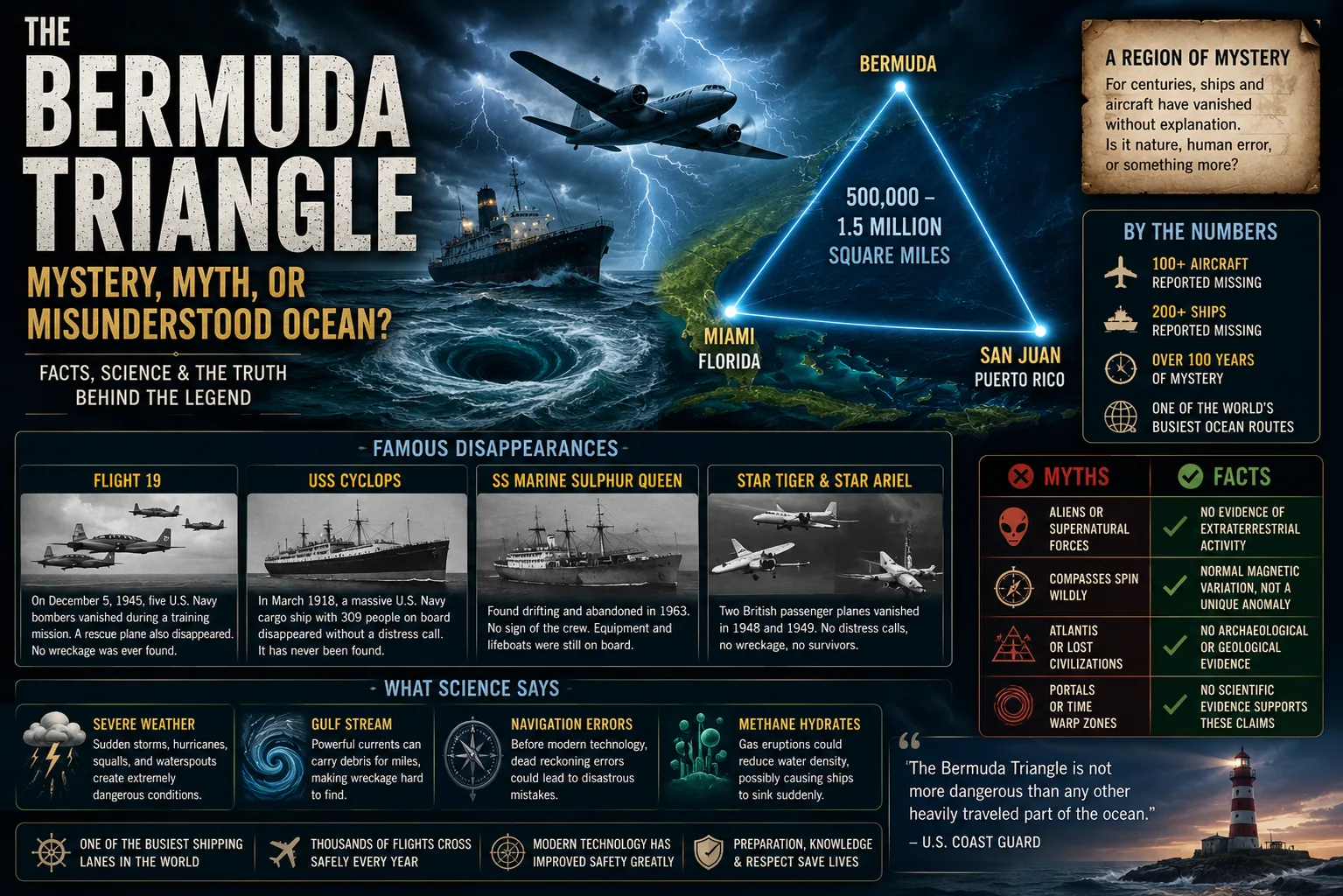
Unlike most geographical regions, the Bermuda Triangle has no official boundaries.
Its commonly accepted corners are:
Miami, Florida
Bermuda
San Juan, Puerto Rico
Together they form a triangle covering approximately 500,000 to 1.5 million square miles, depending on the source.
The area contains deep ocean trenches, powerful currents, tropical storms, hurricanes, and some of the world's busiest shipping lanes.
Its reputation owes less to geography than to the stories told about it.
🟢 Established Historical & Scientific Evidence
The Bermuda Triangle is not officially recognized by the U.S. government, international hydrographic organizations, or major navigation authorities. There are no legally defined boundaries for the region.
How the Legend Began
Although ships had occasionally disappeared in the Atlantic for centuries, the Bermuda Triangle itself is a relatively modern idea.
The legend began to gain attention in 1950, when journalist Edward Van Winkle Jones published an article describing several mysterious disappearances in the region.
Two years later, writer George X. Sand referred to a "sea mystery" involving missing aircraft and ships.
The phrase "Bermuda Triangle" did not become widely known until 1964, when writer Vincent Gaddis used it in an article for Argosy magazine.
His dramatic account linked unrelated disappearances together into a single narrative of unexplained danger.
Over the following decades, bestselling books and television documentaries transformed the Bermuda Triangle into a worldwide phenomenon.
Many accounts emphasized mystery while overlooking weather conditions, navigational errors, or incomplete historical records.
🟢 Established Historical & Scientific Evidence
The term "Bermuda Triangle" was popularized in 1964 by author Vincent Gaddis. Much of the legend grew through popular media rather than official maritime investigations.
The Disappearance of Flight 19
No single event shaped the Bermuda Triangle legend more than Flight 19.
On December 5, 1945, five U.S. Navy TBM Avenger torpedo bombers departed from Naval Air Station Fort Lauderdale on a routine training exercise.
The weather initially appeared favorable.
During the mission, however, the flight leader reported becoming disoriented.
Radio transmissions suggested that the pilots believed their compasses were malfunctioning.
As confusion increased, communication became increasingly difficult.
Eventually...
All five aircraft disappeared.
To make the tragedy even more devastating, a rescue aircraft sent to search for Flight 19 also vanished after takeoff, likely following an in-flight explosion unrelated to the original disappearance.
Despite extensive search efforts covering hundreds of thousands of square kilometers, no confirmed wreckage of Flight 19 was ever recovered.
The mystery remains one of aviation history's most discussed unsolved disappearances.
🟢 Established Historical & Scientific Evidence
Flight 19 disappeared during a U.S. Navy training mission on 5 December 1945. Investigations suggest navigational confusion, deteriorating weather, and fuel exhaustion as the most likely explanations, although the aircraft have never been conclusively located.
The USS Cyclops
Another frequently cited mystery involves the USS Cyclops, a U.S. Navy cargo ship.
In March 1918, the vessel departed Barbados carrying more than 300 crew members and passengers, along with thousands of tons of manganese ore.
The ship never reached its destination.
No distress call was received.
No confirmed wreckage has ever been discovered.
The disappearance remains the largest non-combat loss of life in U.S. Naval history.
Unlike many Bermuda Triangle stories, historians still lack a definitive explanation.
Possibilities include structural failure, severe weather, cargo instability, or a combination of multiple factors.
🟢 Established Historical & Scientific Evidence
The disappearance of USS Cyclops in 1918 remains officially unexplained. However, investigators have found no credible evidence linking the loss to paranormal activity.
A Reputation Grows
Throughout the twentieth century, additional disappearances involving ships such as SS Marine Sulphur Queen and aircraft including Star Tiger and Star Ariel were gradually added to the Bermuda Triangle legend.
Some incidents genuinely remain unsolved.
Others were later explained through weather reports, mechanical failures, navigational errors, or inaccurate reporting.
As more stories accumulated, the Triangle's reputation grew.
Each unexplained disappearance reinforced the belief that something extraordinary might be happening within its waters.
🟡 Active Research & Competing Hypotheses
While individual disappearances continue to be studied, maritime historians emphasize that many cases grouped under the Bermuda Triangle occurred under very different circumstances and should not automatically be treated as evidence of a single mysterious phenomenon.
Weather, Waves, and the Reality of the Atlantic
One reason the Bermuda Triangle has earned its dangerous reputation is that it lies within one of the most active weather regions on Earth.
This section of the Atlantic regularly experiences:
Powerful tropical storms.
Category 5 hurricanes.
Sudden squalls.
Waterspouts.
Large ocean swells.
Strong upper-level winds.
Unlike calm inland waters, conditions here can change rapidly.
A clear morning can become a violent storm within hours.
Before satellites, GPS navigation, and modern weather forecasting, ships and aircraft often had little warning.
Many disappearances once considered mysterious occurred during periods of severe weather that were not fully understood at the time.
🟢 Established Historical & Scientific Evidence
The Bermuda Triangle lies within a region frequently affected by tropical storms and hurricanes. Rapid weather changes have contributed to numerous maritime and aviation accidents throughout recorded history.
The Power of the Gulf Stream
Flowing directly through the Bermuda Triangle is one of Earth's strongest ocean currents.
Known as the Gulf Stream, it carries warm water from the Gulf of Mexico toward the North Atlantic.
Its speed can exceed 6 kilometers (4 miles) per hour in some areas.
While that may not sound impressive, the current has enormous consequences.
If an aircraft crashes or a ship sinks, debris can quickly be scattered over vast distances.
Floating wreckage may disappear within hours.
This makes search-and-rescue operations significantly more difficult.
In many cases, investigators believe the Gulf Stream explains why little or no evidence was ever recovered from certain accidents.
🟢 Established Historical & Scientific Evidence
The Gulf Stream is one of the fastest ocean currents in the world. It can rapidly disperse wreckage, reducing the likelihood of recovering debris from ships or aircraft lost at sea.
Do Compasses Really Go Crazy?
One of the Bermuda Triangle's most enduring myths is that compasses suddenly spin without warning.
In reality, the explanation is much less mysterious.
Earth has both geographic north and magnetic north.
The difference between them is known as magnetic declination.
Around the world, navigators must account for this difference when plotting courses.
At certain times and locations, including parts of the Atlantic, magnetic north and true north align more closely than elsewhere.
This is entirely natural.
Compasses function normally.
The idea that the Bermuda Triangle contains a unique magnetic anomaly capable of disabling navigation has not been supported by scientific evidence.
🟢 Established Historical & Scientific Evidence
No unique magnetic anomaly exists within the Bermuda Triangle that distinguishes it from other parts of Earth. Variations in magnetic declination are well understood and routinely accounted for in modern navigation.
The Methane Hydrate Theory
One scientific hypothesis proposes that large deposits of methane hydrate lie beneath parts of the ocean floor.
If significant quantities of methane gas were suddenly released, bubbles could temporarily reduce the density of seawater.
In theory, a ship passing directly above such a release might lose buoyancy and sink rapidly.
Some researchers have also suggested that methane entering the atmosphere could affect aircraft engines.
Laboratory experiments have demonstrated that methane bubbles can reduce water density under controlled conditions.
However, scientists have found no convincing evidence that methane eruptions occur frequently enough in the Bermuda Triangle to explain its famous disappearances.
🟡 Plausible Scientific Hypothesis
Methane hydrate releases remain a scientifically plausible process in certain marine environments, but there is no evidence that they are responsible for the majority of Bermuda Triangle incidents.
Atlantis, Aliens, and Time Portals
As the Bermuda Triangle became increasingly famous during the twentieth century, increasingly extraordinary explanations emerged.
Some writers claimed the lost city of Atlantis rested beneath the Atlantic Ocean, generating mysterious energy capable of disabling ships and aircraft.
Others suggested alien spacecraft operated beneath the sea.
Some even proposed wormholes, dimensional gateways, or distortions in space and time.
These ideas captured public imagination and became staples of television documentaries and popular culture.
Yet none has been supported by credible scientific evidence.
No archaeological discoveries indicate Atlantis lies beneath the Triangle.
No verified observations support extraterrestrial activity.
No physical evidence suggests the existence of time portals or unexplained energy fields within the region.
🔴 Popular Myth / Unsupported Claim
Claims involving Atlantis, extraterrestrials, underwater alien bases, crystal energy fields, or space-time portals have no credible scientific or archaeological evidence supporting them.
What Do Investigations Conclude?
Organizations including the U.S. Coast Guard, the National Oceanic and Atmospheric Administration (NOAA), and maritime safety experts have repeatedly examined the Bermuda Triangle's reputation.
Their conclusions are remarkably consistent.
While accidents certainly occur within the region, they occur at rates comparable to other heavily traveled areas of the world's oceans.
Most incidents can be explained through combinations of severe weather, human error, mechanical failure, navigational mistakes, or the challenging nature of open-ocean search operations.
Some disappearances remain unsolved.
But unsolved does not necessarily mean supernatural.
🟢 Established Historical & Scientific Evidence
Major scientific and maritime organizations do not recognize the Bermuda Triangle as an area with an unusually high rate of unexplained disappearances compared with other heavily trafficked regions of the world's oceans.
Common Myths
Myth: Ships Disappear More Frequently Here
Current evidence does not support the claim that the Bermuda Triangle experiences an unusually high number of accidents compared with similar shipping routes.
Myth: Compasses Stop Working
Compasses operate normally within the region.
Natural magnetic variation exists worldwide and is well understood by navigators.
Myth: Every Case Is Unexplained
Many famous Bermuda Triangle disappearances have plausible explanations based on weather, navigation, or mechanical failure.
Only a relatively small number remain officially unresolved.
Frequently Asked Questions
Is the Bermuda Triangle officially recognized?
No. There are no internationally accepted boundaries, and it is not recognized as a special hazard zone by major maritime or aviation authorities.
Why is it so famous?
Its reputation grew through books, magazine articles, television documentaries, and films that combined genuine disappearances with sensational storytelling.
Has anyone solved the mystery?
There is no single mystery to solve. Individual incidents have different causes, and many have conventional explanations, while a handful remain unresolved due to limited evidence.
Is it safe to travel through the Bermuda Triangle?
Yes. Every year, thousands of commercial aircraft and ships cross the region safely without incident.
Final Thoughts
The Bermuda Triangle occupies a unique place in modern folklore. It is a location where real tragedies, incomplete historical records, and human imagination have combined to create one of the world's most enduring mysteries.
Some disappearances, such as Flight 19 and the USS Cyclops, remain unsolved, reminding us that the ocean can still conceal its secrets. Yet decades of scientific investigation have found no evidence of supernatural forces, alien technology, or mysterious energy fields. Instead, the Triangle's reputation is best explained by a combination of hazardous weather, powerful ocean currents, navigational challenges, and the sheer volume of ships and aircraft that pass through the region.
The legend will almost certainly endure because people are naturally drawn to stories that leave room for wonder. But perhaps the greatest lesson of the Bermuda Triangle is that reality can be just as fascinating as fiction. Even without paranormal explanations, the Atlantic remains vast, unpredictable, and capable of humbling even the most advanced technology. The true mystery is not that the ocean occasionally keeps its secrets, but that humanity continues to venture into its depths, seeking answers where certainty is often impossible.