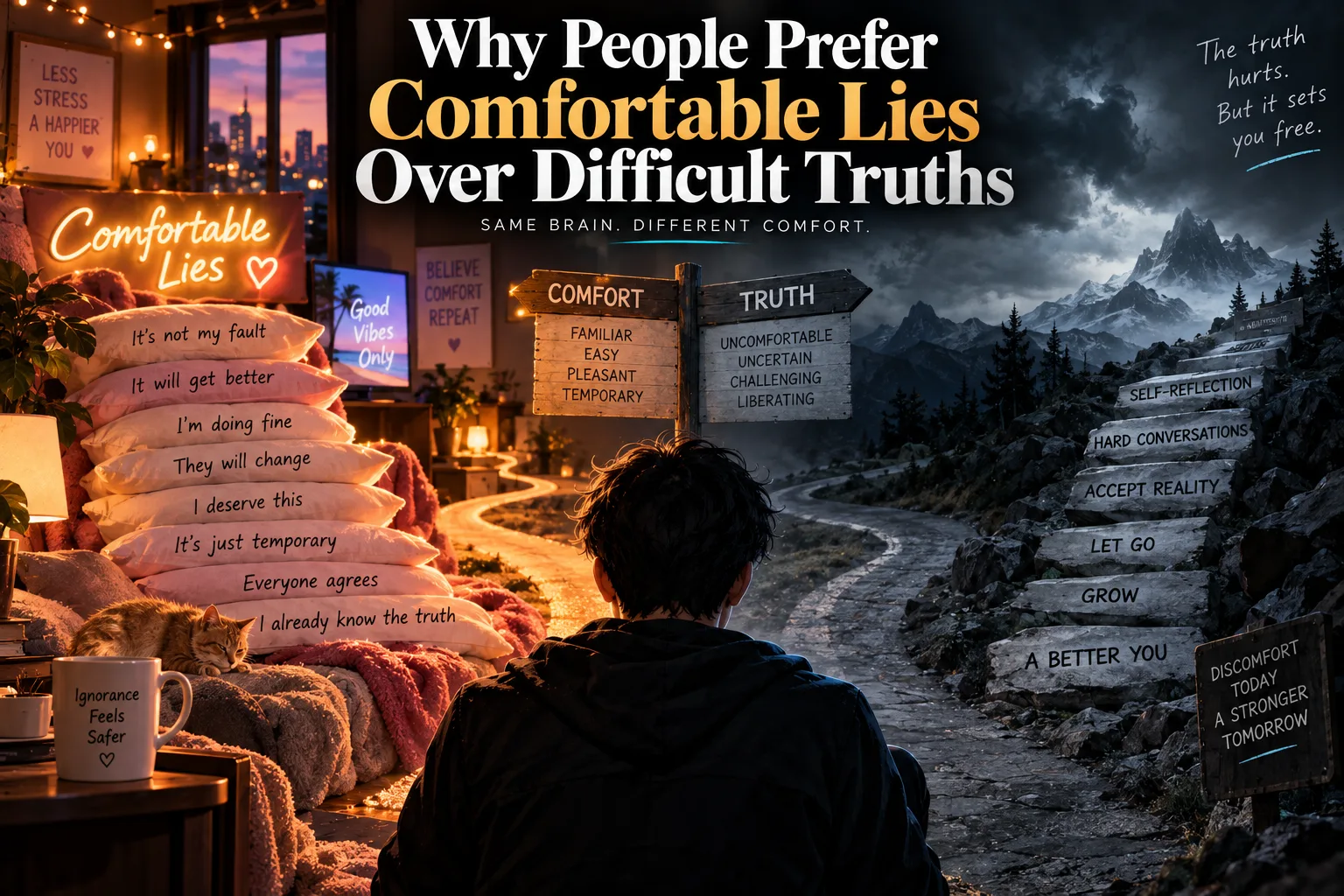
Why People Prefer Comfortable Lies Over Difficult Truths
Why do people sometimes reject uncomfortable facts even when evidence is clear? Explore the psychology of denial, self-deception, motivated reasoning, and why comforting beliefs can feel safer than difficult truths.
Why People Prefer Comfortable Lies Over Difficult Truths
There is a peculiar thing about human beings.
We can spend hours searching for evidence, comparing sources, debating facts, and insisting that we want the truth.
Until the truth threatens something we care about.
Then suddenly the rules change.
The evidence becomes "biased."
The expert becomes "corrupt."
The uncomfortable statistic becomes "an exception."
And the explanation that makes everything feel better becomes strangely persuasive.
This isn't always deliberate lying.
Often, people genuinely believe the explanation they prefer.
That is what makes the psychology of uncomfortable truths so fascinating.
The human mind isn't designed only to discover what is true.
It is also designed to protect:
identity, relationships, hope, belonging, control, and emotional stability.
Sometimes those goals point toward reality.
Sometimes they pull in the opposite direction.
And when that happens, people can choose a comforting interpretation without consciously realizing they've done it.
Why Truth Can Feel Threatening
Imagine someone receives medical results suggesting that a long-held belief about their health is wrong.
Or an investor discovers that the investment they strongly believed in is performing badly.
Or someone realizes that a relationship they desperately wanted to work is unhealthy.
The factual information isn't necessarily complicated.
The difficulty is what accepting it would require.
Maybe they have to change.
Maybe they have to apologize.
Maybe they have to leave.
Maybe they have to admit they were wrong.
Maybe years of effort suddenly look wasted.
The brain doesn't evaluate information in an emotional vacuum.
A fact can carry consequences.
And sometimes the consequences are more painful than ignorance.
The Difference Between Ignorance and Self-Deception
Ignorance is simple:
You don't know something.
Self-deception is more complicated.
You have access to information that could challenge your belief, but your mind finds ways to reinterpret, dismiss, avoid, or minimize it.
This doesn't necessarily involve consciously deciding:
"I will now deceive myself."
The process can happen gradually.
You notice one inconvenient fact.
You explain it away.
Another appears.
You find another explanation.
Eventually you've constructed a story that protects your original belief.
And because you participated in constructing it, the story can feel completely authentic.
Cognitive Dissonance: When Reality and Belief Collide
Psychologists use the term cognitive dissonance to describe psychological discomfort arising from conflicting beliefs, attitudes, or behaviors.
Suppose you believe:
"I make careful financial decisions."
Then you make an impulsive purchase you cannot afford.
Two ideas now conflict.
"I am financially responsible."
"I just behaved irresponsibly."
The mind wants those ideas reconciled.
One possibility is uncomfortable:
"I made a bad decision."
Another is easier:
"I deserved it."
Or:
"The purchase wasn't really that expensive."
Or:
"Everyone spends money sometimes."
The second group of explanations reduces psychological discomfort.
That doesn't automatically make them false.
But the motivation to reduce discomfort can influence which explanation receives more attention.
The Mind Doesn't Like Contradictions
Human beings generally prefer coherent stories.
If your identity is:
"I am intelligent."
and evidence suggests you made a serious mistake, you face a psychological problem.
You can change your self-image.
Or you can reinterpret the evidence.
The second option is often emotionally cheaper.
This is one reason being wrong can feel threatening even when nobody is attacking you.
The mistake isn't merely about information.
It can feel like information about who you are.
When Beliefs Become Part of Identity
A belief becomes especially difficult to change when it becomes connected to identity.
Consider:
Political beliefs.
Religious beliefs.
National identity.
Professional identity.
Family beliefs.
Moral values.
Social groups.
If someone challenges the belief, the brain may interpret the challenge as a threat to the group or self.
Now you're no longer debating an idea.
You're defending yourself.
Confirmation Bias Enters the Room
Once someone strongly prefers a conclusion, they may pay more attention to evidence supporting it and less attention to evidence contradicting it.
This is confirmation bias.
Suppose someone believes:
"This company is going to become enormous."
Good news confirms the belief.
Bad news gets explained:
"The market is temporarily weak."
"Investors don't understand it."
"Management is fixing the problem."
"Everyone is overreacting."
Sometimes these explanations are correct.
The problem is that almost any evidence can be interpreted as temporary if you are sufficiently motivated to preserve the belief.
Motivated Reasoning
This brings us to a more uncomfortable concept.
People don't always reason simply to discover the correct answer.
Sometimes they reason toward an answer they want to be correct.
This is often called motivated reasoning.
The sequence becomes:
Conclusion → search for justification
instead of:
Evidence → conclusion
The reasoning may still look sophisticated.
A person can produce statistics, citations, graphs, and complicated arguments while unconsciously selecting information because it supports the desired conclusion.
Being intelligent doesn't automatically prevent this.
Sometimes intelligence simply provides better tools for defending what you already believe.
Why Smart People Can Be Especially Good at Rationalization
Intelligence and rationality aren't identical.
A highly intelligent person may be excellent at:
Finding patterns.
Constructing arguments.
Remembering evidence.
Detecting weaknesses in opposing arguments.
But those abilities can be used defensively.
If the goal is "prove my belief is correct," intelligence can become an extremely effective lawyer.
If the goal is "find out whether my belief is correct," the same intelligence becomes a much better scientist.
The difference is motivation.
The Lawyer vs. Scientist Mindset
Imagine two people examining the same claim.
Lawyer mindset
"How can I prove this is true?"
Scientist mindset
"What evidence would tell me whether this is true or false?"
The second question is harder.
It requires accepting that the answer might be disappointing.
But it is much closer to genuine truth-seeking.
Why Admitting You're Wrong Feels So Expensive
People sometimes resist changing their minds because they fear what the admission means.
They may think:
"I wasted years."
"I looked stupid."
"I trusted the wrong person."
"I argued about this publicly."
"My friends will mock me."
"I lost money."
"I hurt someone."
"I made choices based on something false."
The mind therefore has an incentive to protect the original belief.
Not because the belief is necessarily correct.
Because abandoning it has a psychological price.
The Sunk Cost of Beliefs
Sunk costs aren't limited to money.
People invest:
Time.
Emotion.
Reputation.
Relationships.
Identity.
Effort.
A person who has defended an idea publicly for ten years may find changing their mind extraordinarily difficult.
The evidence hasn't necessarily become less convincing.
The cost of admitting error has increased.
Why Public Beliefs Are Harder to Change
Imagine privately changing your mind.
You simply think:
"I was wrong."
Now imagine announcing it publicly to thousands of people.
Suddenly you must deal with:
Embarrassment.
Social judgment.
Loss of status.
Questions about past statements.
Potential ridicule.
This creates an additional barrier to intellectual flexibility.
Social media makes the problem worse because people leave permanent records of their opinions.
The internet remembers.
Unfortunately, it remembers screenshots better than context.
Group Beliefs Can Become Stronger Than Individual Beliefs
Humans are social creatures.
We don't merely ask:
"Is this true?"
We also ask:
"What do people like me believe?"
That shortcut can be useful.
Groups contain knowledge.
But group loyalty can sometimes override independent evaluation.
If everyone around you believes something, rejecting it can feel socially dangerous.
The Cost of Being the Person Who Disagrees
Suppose your entire workplace believes a project is succeeding.
You notice serious problems.
Do you speak up?
Maybe.
But now you're challenging:
Your manager.
Your coworkers.
The organization's narrative.
Possibly your own career prospects.
If everyone agrees, disagreement requires courage.
This is related to the psychology behind groupthink, where the desire for group harmony can interfere with critical evaluation.
Comfortable Lies Don't Always Come From Malicious People
This distinction matters.
A "comfortable lie" can be:
A conspiracy theory.
A flattering belief about yourself.
A family myth.
An unrealistic expectation.
A political narrative.
A false promise.
A reassuring explanation.
But the person repeating it may genuinely believe it.
Human beings are capable of sincerely believing things that protect them emotionally.
That is more complicated than ordinary deception.
Hope Can Become a Psychological Shield
Hope is valuable.
It helps people endure uncertainty.
It encourages action.
It supports resilience.
But hope can become distorted when it refuses to incorporate evidence.
Imagine someone facing an obvious business failure.
They continue saying:
"Next month everything will turn around."
Hope can motivate them to improve the business.
But it can also prevent them from recognizing that the business needs to close.
Healthy hope says:
"There is still something we can do."
Unrealistic hope says:
"Nothing needs to change because everything will magically improve."
Those are not the same.
Denial Can Buy Time
Denial is often portrayed as simple stupidity.
It isn't always.
Psychologically, denial can temporarily protect someone from overwhelming emotional information.
After a major loss, for example, a person may initially struggle to emotionally accept what happened.
The mind may need time to process reality.
That doesn't mean denial is always harmful.
The problem occurs when temporary psychological protection becomes permanent refusal to adapt.
Why People Sometimes Prefer Predictability Over Truth
Truth isn't always comforting.
Sometimes it makes the future less predictable.
Suppose you discover that your job is unstable.
Before learning this, you had certainty.
Afterward, you face uncertainty.
Even bad certainty can sometimes feel psychologically easier than uncertain reality.
This is especially important because humans generally dislike uncertainty.
A simple false explanation can therefore feel more satisfying than a complicated truth containing unanswered questions.
The Comfort of a Complete Story
Reality is messy.
Historical events have multiple causes.
Scientific evidence contains uncertainty.
Relationships involve conflicting motivations.
Economic outcomes depend on countless variables.
But humans love simple stories.
"This happened because of that."
Simple.
Memorable.
Emotionally satisfying.
And frequently incomplete.
A complicated truth may be less psychologically rewarding than a clean falsehood.
Why Conspiracy Theories Can Feel So Satisfying
Conspiracy theories can offer something uncertainty doesn't:
agency.
If something terrible happened randomly, that's frightening.
If it happened because a secret group planned it, the world suddenly appears more organized.
The explanation may be false.
But psychologically, it provides:
A cause.
An enemy.
A pattern.
A story.
A sense that someone is in control.
Paradoxically, a malicious explanation can feel safer than a world governed partly by randomness.
The Need for Control
Humans generally prefer believing that events have understandable causes.
If you believe bad outcomes are random, you cannot always prevent them.
If you believe there is a specific cause, you can theoretically fight it.
This can create an illusion of control.
And an illusion of control can be emotionally comforting.
The Backfire Problem
There is a popular claim that correcting misinformation automatically causes people to believe it even more strongly.
The reality is more complicated.
Simply presenting contradictory evidence doesn't guarantee that someone will update their belief.
People may:
Reject the source.
Question the evidence.
Generate alternative explanations.
Become defensive.
But the effect is not universal, and the idea that all fact-checking makes misinformation stronger is itself an oversimplification.
Why Facts Alone Often Aren't Enough
Suppose someone's belief is connected to identity.
You provide ten statistics.
They don't merely hear:
"Here is new information."
They may hear:
"Your group is wrong."
Now the conversation becomes defensive.
If changing the belief threatens belonging, evidence has to compete with social identity.
That's a much harder psychological problem.
The Importance of Intellectual Humility
Intellectual humility doesn't mean believing nothing.
It means recognizing that your knowledge has limits.
You can say:
"I might be wrong."
"I don't know."
"The evidence isn't conclusive."
"I need more information."
"I changed my mind."
These statements aren't signs of weakness.
They're mechanisms for protecting yourself from overconfidence.
Changing Your Mind Is Not Losing
Imagine two people.
Person A believes something incorrect for twenty years because admitting error feels humiliating.
Person B believes the same thing for ten years, encounters better evidence, and changes their mind.
Who is intellectually stronger?
Obviously the second.
Being wrong is unavoidable.
Refusing to update is optional.
Why "I Was Wrong" Can Be Liberating
Admitting error removes the need to defend the past.
You no longer need to explain every contradictory fact.
You no longer need to reinterpret every criticism.
You can stop spending mental energy protecting an outdated belief.
Changing your mind can therefore reduce cognitive load.
The truth may hurt once.
Maintaining a false belief can require constant maintenance.
But Not Every Uncomfortable Claim Is True
This is equally important.
Discomfort isn't evidence.
Something isn't true simply because it is unpleasant.
A person can weaponize "hard truths" to spread misinformation.
Statements like:
"Nobody wants to hear this, but..."
are not evidence.
Neither is:
"The truth hurts."
Sometimes a claim is uncomfortable because it is true.
Sometimes it's uncomfortable because someone wants to sound provocative.
The correct response is not:
"Believe whatever feels painful."
It is:
"What is the evidence?"
The Truth-Seeking Trap
There is a strange modern phenomenon where people become attached to being the person who "knows the uncomfortable truth."
They distrust mainstream information automatically.
They assume popular beliefs are false.
They seek contrarian explanations.
Eventually, being skeptical becomes an identity.
And now the person has another comfortable belief:
"I am one of the few people who sees reality."
Contrarianism can become its own form of conformity.
When Skepticism Becomes Its Own Bias
Healthy skepticism asks:
"What evidence supports this?"
Unhealthy skepticism asks:
"How can I reject this?"
The first protects against gullibility.
The second can protect false beliefs from correction.
You can become so committed to questioning everything that you stop accepting anything.
That isn't critical thinking.
It's another kind of rigidity.
How to Tell Whether You're Protecting a Belief
Try asking yourself:
What evidence would change my mind?
If the answer is "nothing," your belief may no longer be evidence-based.
Would I accept this argument if my opponent made it?
If not, you may be applying different standards.
Am I searching for evidence or justification?
The difference matters.
What would I think if I had no emotional investment?
This can expose motivated reasoning.
What has this belief cost me?
Time, money, relationships, reputation, identity?
Large investments can create resistance to change.
Do I want this to be true?
That question is surprisingly powerful.
Wanting something to be true doesn't make it false.
But it tells you where extra skepticism may be useful.
A Better Way to Change Your Mind
Changing beliefs doesn't require humiliating yourself.
Try separating:
The belief
from
The person who holds it.
Instead of:
"I was an idiot."
try:
"I made the best judgment I could with the information I had, and now I have better information."
That makes updating psychologically easier.
Replace Certainty With Probability
Instead of thinking:
"This is definitely true."
try:
"I'm currently 80% confident this is true."
Now new evidence has somewhere to go.
Your belief doesn't need to collapse completely.
It can move:
80%.
65%.
40%.
15%.
That is how rational updating works.
Reality rarely arrives with a giant green TRUE stamp.
The Most Powerful Question
One question can expose motivated reasoning surprisingly well:
"What would I believe if the evidence pointed in the opposite direction?"
If your answer is:
"I'd still believe the same thing."
then you aren't really testing the belief.
You're defending it.
🟢 Established Evidence
Research in psychology supports several mechanisms relevant to comfortable beliefs, including:
Cognitive dissonance
Confirmation bias
Motivated reasoning
Social conformity
Identity-protective cognition
Self-serving interpretations
The influence of emotion on judgment
These mechanisms help explain why people can resist information that threatens existing beliefs.
They don't mean that humans are incapable of rational thinking.
They mean rational thinking competes with other psychological goals.
🟡 Active Debate
Researchers continue investigating exactly when people:
Update beliefs in response to evidence.
Become more resistant to correction.
Respond to identity-threatening information.
Distinguish trustworthy from untrustworthy sources.
Change their minds through discussion.
There is no universal psychological formula for changing someone's beliefs.
People differ enormously.
🔴 Popular Myth
"People reject facts because they're stupid."
This explanation is attractive because it makes the problem simple.
But it is usually inadequate.
Intelligent, educated people can defend false beliefs.
People can also hold accurate beliefs for bad reasons.
The real challenge isn't dividing humanity into "smart people" and "stupid people."
It's understanding the psychological forces that influence everyone's reasoning.
Frequently Asked Questions
Why do people reject uncomfortable truths?
Because accepting them can threaten identity, relationships, hopes, financial interests, social belonging, or a sense of control.
Is self-deception always intentional?
No. People can construct comforting interpretations without consciously realizing they are doing so.
Are intelligent people less vulnerable to false beliefs?
Not necessarily. Intelligence can improve reasoning, but reasoning can also be used to defend preferred conclusions.
Why is changing your mind so difficult?
Changing a belief can mean admitting previous mistakes, abandoning investments of time or money, changing identity, or facing social consequences.
Is denial always harmful?
Not necessarily. Temporary denial can sometimes function as psychological protection during overwhelming circumstances. Persistent denial that prevents adaptation is more problematic.
Why do conspiracy theories feel convincing?
They can provide simple explanations, clear causes, intentional agents, and a sense of control in situations that otherwise feel uncertain or chaotic.
Does presenting facts automatically change someone's mind?
No. Facts matter, but people interpret evidence through prior beliefs, identity, emotion, trust, and social context.
Is skepticism the best defense against misinformation?
Healthy skepticism is useful, but skepticism without standards can become another form of bias. Evidence must be evaluated consistently.
What's the difference between hope and denial?
Hope acknowledges difficulty while maintaining the possibility of improvement. Denial rejects or minimizes evidence that something needs to change.
How can I become better at recognizing comfortable lies?
Ask what evidence would change your mind, actively consider opposing evidence, separate confidence from certainty, and pay attention to beliefs that provide unusually strong emotional comfort.
Final Thoughts
The human mind doesn't always choose between truth and falsehood.
Often, it chooses between:
truth and psychological comfort.
And psychological comfort can be extraordinarily persuasive.
A comforting belief can protect your identity.
It can preserve hope.
It can maintain a relationship.
It can justify a past decision.
It can keep your worldview coherent.
It can make uncertainty disappear.
That is why difficult truths aren't difficult merely because they're factually complicated.
They're difficult because accepting them sometimes requires changing ourselves.
And humans are surprisingly resistant to that.
But there is an important distinction between protecting yourself temporarily and permanently hiding from reality.
Denial may make tomorrow easier.
It rarely makes reality disappear.
Eventually, the business still fails.
The relationship still changes.
The investment still loses value.
The evidence accumulates.
The consequences arrive.
And the longer a false belief survives, the more expensive correcting it can become.
The healthiest relationship with truth isn't believing everything that sounds unpleasant.
It isn't automatically distrusting popular opinions.
It isn't assuming that the uncomfortable explanation must be the correct one.
It is something much less dramatic:
Being willing to let evidence change your mind.
That requires humility.
It requires uncertainty.
And occasionally, it requires looking at something you desperately wanted to be true and admitting:
"I wish this weren't true. But the evidence says it is."
That sentence may be uncomfortable.
But unlike a comfortable lie, it gives you something incredibly valuable.
A chance to act on reality.