Is Reality Different for Every Person?
We all occupy the same physical world, yet two people can experience the same event completely differently. Explore how perception, memory, emotion, attention, and personal experience shape the reality each person experiences.
Is Reality Different for Every Person?
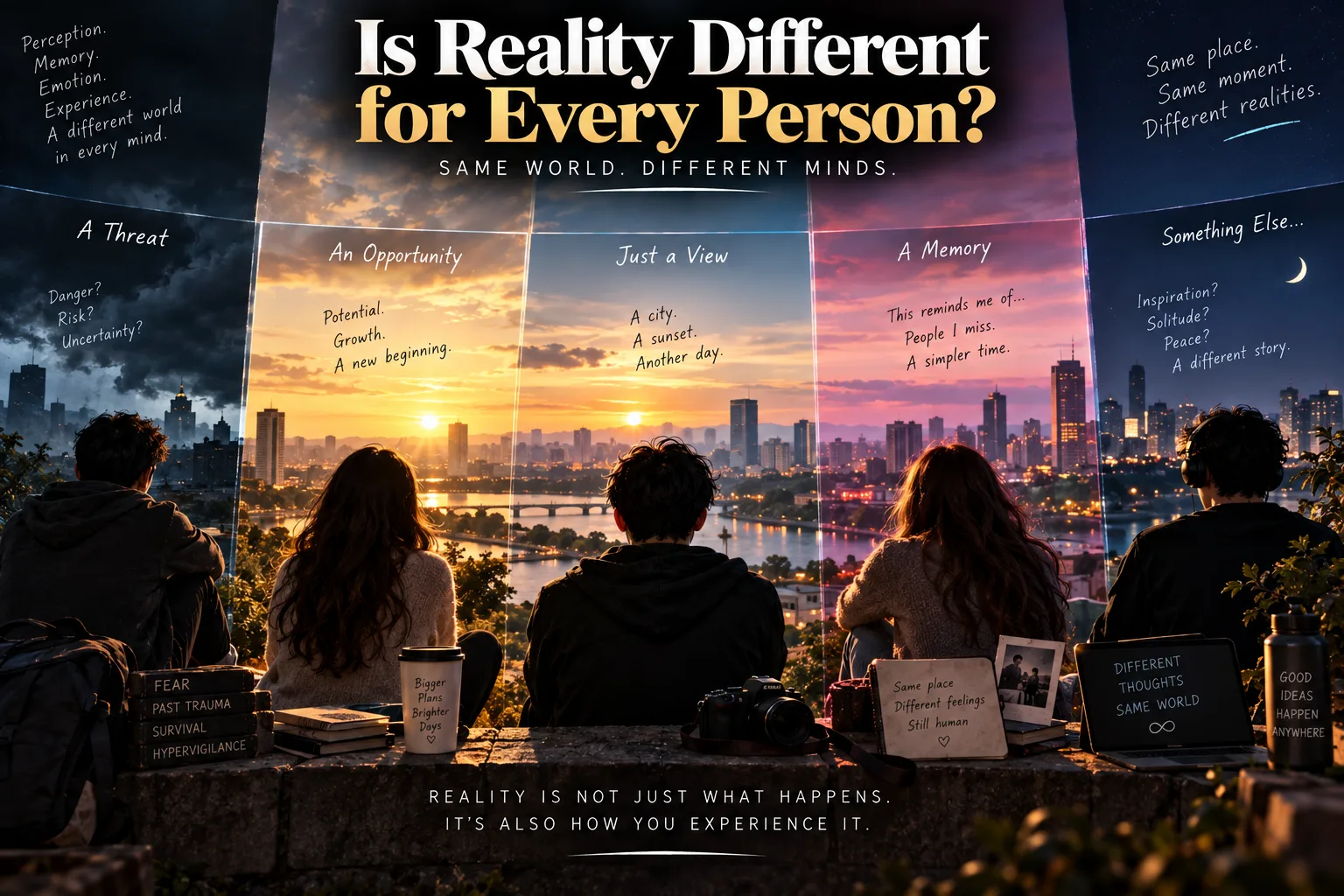
Two people can stand in exactly the same room, watch exactly the same event, and walk away with completely different experiences.
One person sees an insult.
Another sees a joke.
One sees a dangerous situation.
Another sees an opportunity.
One remembers an event as life-changing.
The other barely remembers it happening.
So which person experienced reality correctly?
The uncomfortable answer is that both may have experienced something genuinely real, while neither experienced the entire reality of the situation.
There is a physical world outside our minds.
But the version of that world we actually experience is constructed through our senses, attention, memories, expectations, emotions, and previous experiences.
We don't simply receive reality.
Our brains interpret it.
And that distinction explains why humans can occupy the same world while seemingly living in different ones.
The World Outside Your Head
Before going deeper, an important distinction has to be made.
Saying that people experience reality differently does not necessarily mean reality itself changes for every person.
If a tree is standing outside your window, your perception of the tree may differ from mine.
But that doesn't mean there are now two physically different trees.
There is a distinction between:
Objective reality
and
subjective experience.
Objective reality refers to what exists independently of an individual's perception.
Subjective experience refers to how that reality is perceived and interpreted by a particular mind.
The first is external.
The second happens inside the brain.
Your Brain Never Sees the World Directly
You don't literally see objects.
Light enters your eyes.
Photoreceptors respond to different wavelengths.
Signals travel through neural pathways.
Your brain processes those signals.
Then you experience something you call:
"a red apple."
The apple itself doesn't arrive inside your brain.
Only information about it does.
Your brain constructs the experience.
This happens so automatically that it feels like direct access to reality.
It isn't.
Your Senses Are Measuring Devices
Think of your senses as instruments.
Your eyes detect only a narrow portion of electromagnetic radiation.
Your ears detect only certain frequencies of sound.
Your skin detects particular forms of pressure, temperature, and chemical information.
There are enormous amounts of physical information around you that your nervous system never consciously experiences.
Radio waves surround you.
Infrared radiation surrounds you.
Ultraviolet radiation exists around you.
Ultrasound can exist around you.
You don't experience most of it.
That doesn't mean it isn't real.
It means your nervous system has a limited interface with reality.
The World Is Bigger Than Your Experience of It
Imagine standing in a forest.
You hear birds.
See trees.
Feel wind.
Smell soil.
A dog nearby may experience the same forest through an entirely different sensory system.
It has a much stronger sense of smell.
Different hearing abilities.
Different visual sensitivity.
Different priorities.
The forest hasn't changed.
The experienced forest has.
This is one of the simplest demonstrations that perception isn't identical to reality.
Attention Changes What Becomes Real to You
Your brain receives enormous amounts of sensory information.
It cannot consciously process all of it equally.
So attention acts as a filter.
Imagine you're sitting in a crowded café.
At first you hear dozens of conversations.
Then someone across the room says your name.
Suddenly their voice stands out.
You weren't previously deaf to it.
Your brain simply wasn't prioritizing it.
This is why attention can make something feel as though it suddenly appeared.
It was there.
Your mind simply started treating it as important.
The Invisible Information Around You
You can test this yourself.
Walk through a familiar room and deliberately look for something you've stopped noticing.
A light switch.
A crack in the wall.
A particular sound.
A pattern in the floor.
A smell.
The object didn't suddenly appear.
Your attention changed.
This means two people can be exposed to the same environment while consciously experiencing very different portions of it.
Expectations Change Perception
Your brain doesn't process sensory information in isolation.
It also uses expectations.
If you enter a dark room expecting someone to be standing there, a coat hanging on a chair can briefly look like a person.
If you expect a food to taste terrible, your experience may be influenced before you even take the first bite.
If you expect someone to be rude, ambiguous behavior may appear hostile.
Your brain is constantly asking:
"What is most likely happening here?"
Then it compares incoming information with that prediction.
Perception Is Partly Predictive
Modern neuroscience increasingly emphasizes the importance of prediction in perception.
Your brain doesn't simply wait for information.
It continuously generates expectations about what it is likely to encounter and updates them using incoming sensory signals.
In simple terms:
Prediction + sensory information → perception
When the prediction is wrong, the mismatch provides information.
The brain adjusts.
This predictive process makes perception efficient.
But it also creates opportunities for mistakes.
Why Optical Illusions Work
Optical illusions demonstrate this beautifully.
Your brain can interpret the same visual information in different ways depending on:
Context.
Lighting.
Patterns.
Previous assumptions.
Surrounding objects.
The illusion isn't necessarily a failure of your eyes.
Your brain is doing what it normally does:
trying to construct the most useful interpretation from incomplete information.
Sometimes it gets fooled.
The Same Event Can Feel Completely Different
Imagine two people watching an American football game.
One is a lifelong fan of the winning team.
The other supports the losing team.
The same referee decision occurs.
One person sees:
"Obviously the correct call."
The other sees:
"That referee is blind."
The physical event was the same.
The emotional interpretation was not.
And emotion can influence attention, memory, and interpretation.
Emotion Changes the Experienced World
When you're happy, the environment can feel more inviting.
When you're frightened, ordinary sounds can become threatening.
When you're angry, neutral behavior can appear provocative.
When you're grieving, familiar places can suddenly feel strange.
The physical environment hasn't necessarily changed.
Your internal state has changed the way your brain processes it.
This doesn't make the experience imaginary.
The experience is real.
The interpretation may simply be different from another person's.
Fear Is a Particularly Powerful Filter
Imagine walking alone at night.
A branch moves.
Your brain immediately asks:
"What was that?"
The same branch during the afternoon might barely register.
Fear changes the threshold at which ambiguous information becomes significant.
This is adaptive.
If something really is dangerous, detecting it quickly matters.
The downside is obvious:
Your threat-detection system can produce false alarms.
Evolution apparently preferred occasional paranoia over getting eaten.
Reasonable, if somewhat rude.
Your Past Changes Your Present
Two people don't approach the world with identical histories.
One person may have grown up around dogs and feel comfortable around them.
Another may have been bitten as a child and become extremely cautious.
A dog approaches.
Same dog.
Same movement.
Different experience.
The difference isn't necessarily in the dog.
It's in the history each brain brings to the encounter.
Memory Changes Reality After the Event
Perception doesn't stop when an event ends.
Your memory of the event becomes part of your future reality.
Suppose you have an argument with someone.
You remember:
"They were incredibly rude."
The other person remembers:
"I was defending myself."
Both memories may contain genuine details.
But memory isn't a perfect recording.
It can be reconstructed.
And reconstruction can be influenced by what happened afterward.
Memory Is Not a Video Archive
When you remember something, your brain reconstructs the event from stored information.
That means memories can change.
Details can become less precise.
Emotion can alter recall.
Later information can influence what you remember.
Repeatedly telling a story can strengthen some details while weakening others.
So two people who experienced the same event can eventually possess genuinely different memories of it.
Neither necessarily has deliberately lied.
Their brains reconstructed the past differently.
Why Witnesses Disagree
This is one reason eyewitness testimony can be complicated.
Imagine a stressful event lasting thirty seconds.
Person A notices the person's clothing.
Person B notices the vehicle.
Person C focuses on the weapon.
Person D watches the crowd.
Everyone was present.
Everyone saw something.
Nobody saw everything.
Later, each person reconstructs the event using the information they encoded.
Their memories can therefore diverge.
🟢 Established Evidence: Perception Is Selective
Research across psychology and neuroscience strongly supports the idea that perception depends on more than sensory input alone.
Attention, expectations, context, emotion, and prior knowledge can influence what people notice and how they interpret information.
This doesn't mean the external world doesn't exist.
It means our conscious experience is a filtered representation of it.
The Same Sound Can Mean Different Things
Imagine hearing footsteps behind you.
If you're walking home after watching a horror movie, the sound might feel threatening.
If you're waiting for your friend, it might feel reassuring.
If you're expecting someone to surprise you, it might feel exciting.
Same physical stimulus.
Different interpretation.
The brain asks:
"What does this mean?"
Meaning is not contained entirely inside the stimulus.
The brain helps construct it.
Culture Changes Perception
People don't only differ individually.
Entire cultures can shape attention and interpretation.
Language, social norms, traditions, education, and shared experiences influence what people notice and how they categorize events.
A behavior considered polite in one society can seem strange in another.
A gesture considered friendly somewhere can be offensive elsewhere.
The physical movement is the same.
The meaning is culturally constructed.
Language Gives the World Categories
Language doesn't create physical reality.
But it gives us categories through which we organize experience.
Consider colors.
The electromagnetic spectrum is continuous.
Human languages divide it into categories.
Different languages can divide and label color spaces differently.
The physical light hasn't changed.
The conceptual categories have.
Language therefore influences how we organize what we perceive.
Does Language Create Reality?
Not literally.
You cannot invent a mountain by inventing a word for it.
But language can influence:
Attention.
Categorization.
Memory.
Communication.
Social interpretation.
It can change which distinctions become psychologically prominent.
So language may not manufacture the external world.
It can help determine which parts of that world become meaningful to us.
Social Reality Is Different Again
Some things exist because humans collectively agree that they exist.
Money is a powerful example.
A U.S. dollar bill has physical properties:
Paper or polymer substrate.
Ink.
Security features.
Mass.
Dimensions.
But its economic value depends on a social system.
Without shared institutions and beliefs, the physical object would not function as money in the same way.
The same is true of:
Citizenship.
Marriage.
Contracts.
Companies.
Academic degrees.
Property ownership.
These aren't imaginary.
They're social realities.
Three Layers of Reality
It can therefore be useful to distinguish:
Physical reality
Things that exist independently of human agreement.
Subjective reality
Your personal experience of events.
Social reality
Systems whose existence depends on shared human practices and institutions.
These layers interact constantly.
A dollar has physical properties.
Its monetary value is socially established.
Your emotional response to receiving $100 is subjective.
One object can therefore participate in all three forms of reality simultaneously.
Why Two People Can Have Different "Truths"
People often say:
"That's your truth."
The phrase can be useful when discussing personal experiences.
But it becomes dangerous when subjective experience is confused with objective fact.
For example:
"I felt ignored."
is a statement about someone's experience.
"You deliberately ignored me."
is a claim about another person's intention.
The first can be true regardless of the second.
Recognizing this distinction can prevent enormous numbers of unnecessary arguments.
Humanity has somehow managed to turn misunderstanding into a major social industry.
Experience Can Be Real Without Interpretation Being Correct
Suppose someone genuinely feels that everyone in a room is judging them.
The feeling is real.
But that doesn't prove everyone actually is judging them.
This distinction matters across psychology.
You can validate:
"You experienced this as threatening."
without claiming:
"The situation objectively was threatening."
Both statements address different layers of reality.
Why People See What They Expect
Suppose you buy a particular car.
Suddenly you notice that model everywhere.
Did everyone suddenly start buying it?
Probably not.
Your attention changed.
The car became relevant.
This is sometimes called the frequency illusion or Baader-Meinhof phenomenon.
Once something becomes mentally important, you notice examples that were previously ignored.
The world feels different.
But the information was already there.
Beliefs Can Become Perceptual Filters
If someone strongly believes that other people are untrustworthy, ambiguous behavior may be interpreted suspiciously.
If someone believes people are generally kind, the same behavior may be interpreted generously.
Neither person necessarily thinks:
"I am now filtering reality through my beliefs."
The interpretation happens automatically.
This is one reason beliefs can become self-reinforcing.
The Danger of Personal Reality
The idea that everyone experiences reality differently can become distorted into:
"Everyone has their own facts."
That's not a useful conclusion.
There is still an external world.
If a building is 50 meters tall, your belief that it is 100 meters tall doesn't change its height.
If a medication has a specific chemical composition, personal belief doesn't alter the molecule.
Subjective experience matters.
But subjective experience isn't a replacement for evidence.
🟡 Active Debate: How Much Can Perception Be Constructed?
Researchers agree that perception involves interpretation, but there is ongoing debate about exactly how much perception is driven by:
Bottom-up sensory signals.
Top-down expectations.
Prediction.
Attention.
Learning.
Context.
Different theories emphasize these mechanisms differently.
The brain is not simply a camera.
But it isn't freely inventing reality either.
Sensory information constrains what can reasonably be perceived.
Why Hallucinations Are Different
A hallucination demonstrates an important distinction.
A person can experience something as perceptually real even when the corresponding external stimulus isn't present.
The experience itself is genuine.
The external interpretation may not be.
This reinforces the idea that:
Experiencing something
and
something existing externally
are not identical claims.
Dreams Create the Same Puzzle
During a vivid dream, you can:
See people.
Hear voices.
Feel fear.
Experience physical sensations.
Believe the environment is real.
Only after waking do you realize the experience wasn't occurring in the external world.
Your brain was capable of generating a convincing world model without normal sensory input.
That tells us something profound about consciousness.
The brain doesn't merely observe reality.
It can construct an internally coherent experience of one.
Virtual Reality Makes the Problem Obvious
Put on a convincing VR headset.
Your conscious experience may tell you:
"I'm standing somewhere else."
Your rational mind knows you're in a room.
Yet your body can still react to heights, motion, or approaching objects.
The external physical environment and experienced environment have temporarily diverged.
Modern technology is essentially letting us experiment with the oldest philosophical question:
What exactly counts as reality to a conscious mind?
The Self Is Also Part of the Construction
There is another layer.
Not only do we construct representations of the world.
We construct representations of ourselves.
You have a model of:
Who you are.
What you're good at.
What you fear.
What people think about you.
What your past means.
What your future might look like.
That self-model can change.
Yet it often feels stable.
Everyone Has a Different Internal World
Consider five people at the same university.
One sees:
Opportunity.
Another sees:
Competition.
Another sees:
Pressure.
Another sees:
Friendship.
Another sees:
A temporary step toward a career.
Same buildings.
Same classes.
Same institution.
Different psychological realities.
Their environments overlap.
Their internal worlds don't.
Relationships Are Built From Shared Reality
Healthy relationships require some overlap between subjective realities.
You need to agree on enough things to coordinate:
What happened.
What was promised.
What matters.
What needs to change.
When two people's interpretations diverge too far, conflict grows.
Sometimes the problem isn't that one person is lying.
They may genuinely remember and interpret the relationship differently.
That doesn't make every interpretation equally accurate.
It means resolving disagreement requires more than insisting:
"My experience is reality."
Why Empathy Requires Understanding Subjective Reality
Empathy begins when you recognize:
"The world may not feel the way it feels to me."
A stressful situation for you might be overwhelming for someone else.
Something you consider harmless might carry painful associations for another person.
Something you find exciting might terrify them.
This doesn't require believing every interpretation is objectively correct.
It requires understanding that people don't experience circumstances identically.
The Observer Effect Is Not What People Think
Quantum mechanics sometimes gets dragged into discussions about subjective reality.
You may hear:
"Consciousness creates reality."
That's an enormous leap beyond what the physics establishes.
In physics, measurement and observation have precise technical meanings.
They do not simply mean:
"A human looked at something, therefore their mind created it."
Quantum mechanics is strange enough without adding motivational-poster philosophy to it.
So Is Reality Different for Everyone?
There are really two answers.
External reality
There is good reason to believe that a physical world exists independently of individual perception.
Experienced reality
Everyone experiences that world through a nervous system shaped by:
Biology.
Attention.
Memory.
Emotion.
Expectations.
Culture.
Language.
Personal history.
Therefore, the world isn't necessarily different for everyone.
The experience of the world is.
Frequently Asked Questions
Is reality completely subjective?
No. Subjective experience varies between people, but that doesn't mean there is no external reality.
Why do two people remember the same event differently?
Memory is reconstructive and influenced by attention, emotion, expectations, later information, and individual experience.
Can emotions change perception?
Yes. Emotional states can influence attention, interpretation, threat detection, and what information becomes salient.
Does culture change what people perceive?
Culture can influence categorization, attention, interpretation, and the meaning assigned to behaviors and events.
If everyone experiences reality differently, can there be objective truth?
Yes. Differences in subjective experience don't eliminate the possibility of objective facts. They make careful observation and evidence more important.
Does the brain create reality?
The brain constructs our conscious experience of the world, but that doesn't mean it creates the external physical world itself.
Why do optical illusions happen?
They occur because the brain interprets sensory information using context, expectations, patterns, and learned assumptions, sometimes producing an interpretation that differs from physical measurement.
Can two people both be right about the same event?
Yes, particularly when they're describing different aspects of the experience. But if they make contradictory factual claims about an objective event, both cannot necessarily be correct.
Does language determine how we see reality?
Language influences categorization and attention, but it doesn't determine everything we can perceive or create the external world.
What is the biggest lesson?
Your experience of reality is real as an experience, but it isn't necessarily a complete or perfectly accurate representation of the external world.
Final Thoughts
There is a comforting simplicity in imagining that everyone sees the same world.
The tree is the tree.
The event is the event.
The memory is the memory.
The truth is the truth.
But human consciousness is far messier.
We don't experience the world as raw information.
We experience a version of it constructed by a brain that is constantly:
Filtering.
Predicting.
Comparing.
Remembering.
Interpreting.
Prioritizing.
Ignoring.
And sometimes getting things spectacularly wrong.
That doesn't mean reality is imaginary.
It means our access to reality is indirect.
You never experience another person's consciousness directly.
You don't experience the world without interpretation.
You don't even remember your own past perfectly.
You experience a continuously updated model of existence from inside one particular nervous system.
And so does everyone else.
The person sitting across from you isn't necessarily living in the same psychological world.
They have different memories.
Different fears.
Different expectations.
Different experiences.
Different attention.
Different meanings attached to the same events.
That doesn't mean every opinion is equally true.
It means understanding another person sometimes requires something more difficult than deciding who is right.
It requires asking:
"What does the world look like from inside their mind?"
Perhaps reality itself is not different for every person.
But the window through which each person encounters it is.
And every human being spends their entire life looking through one.