Are Morals Universal or Created by Society?
Are humans born with a sense of right and wrong, or does society teach us what morality means? Explore the evidence for universal moral instincts, cultural differences, and how societies shape our moral judgments.
Are Morals Universal or Created by Society?
Imagine taking a newborn baby from the United States and somehow raising them in a completely isolated society with entirely different customs.
Would they grow up knowing that murder is wrong?
Would they understand fairness?
Would they believe stealing is immoral?
Would they feel guilty for lying?
Or would their entire understanding of right and wrong be constructed by the culture around them?
This question has occupied philosophers for thousands of years.
But today, psychologists, anthropologists, neuroscientists, and evolutionary scientists can approach it from another direction.
And the evidence suggests that the answer is neither:
"Morality is completely universal."
nor:
"Society invents morality from nothing."
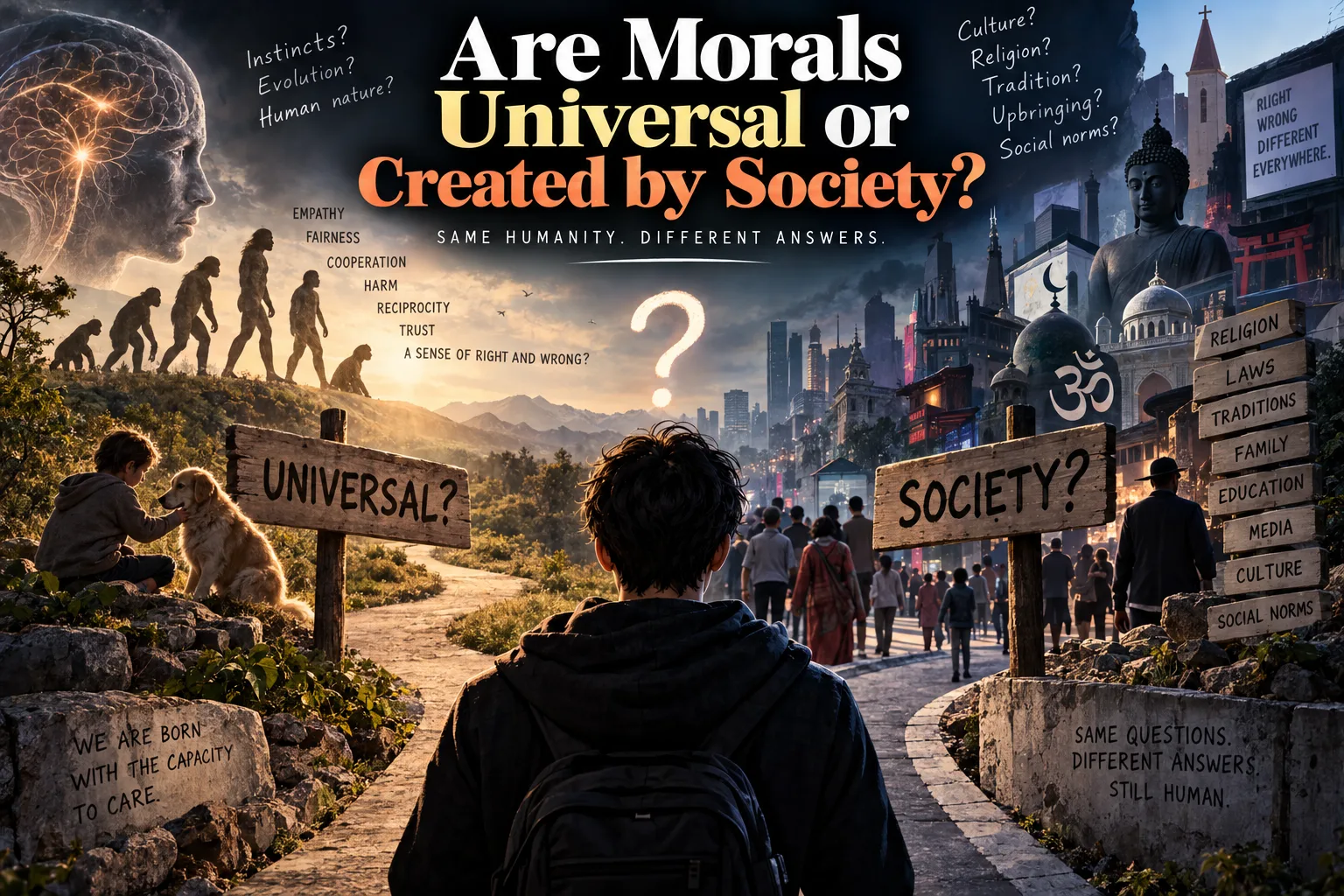
Instead, humans appear to have some psychological foundations that make moral thinking possible, while culture dramatically influences how those foundations are expressed.
In other words:
We may be born with the ingredients for morality, but society helps decide what gets cooked.
The Strange Universality of Moral Rules
Travel across the world and you'll discover enormous differences in moral customs.
Cultures disagree about:
Marriage.
Clothing.
Family obligations.
Punishment.
Gender roles.
Food.
Religion.
Property.
Authority.
Sexual behavior.
Yet beneath those differences, certain moral themes appear repeatedly.
People care about:
Harm.
Fairness.
Loyalty.
Reciprocity.
Trust.
Helping others.
Protecting vulnerable members of a group.
Punishing betrayal.
The exact rules vary.
The underlying concerns often don't.
🧠 Did Morality Evolve?
One major explanation is evolutionary.
Human beings spent most of their history living in relatively small social groups.
Survival depended heavily on cooperation.
You needed other people to:
Find food.
Protect the group.
Raise children.
Share information.
Defend against threats.
Care for injured members.
A person who constantly cheated everyone else would eventually develop a reputation.
And reputation matters in social species.
Evolution could therefore favor psychological tendencies that encourage cooperation.
Why Would Helping Others Help You Survive?
At first glance, cooperation creates a puzzle.
If I give you food, I've lost food.
If I protect you, I spend energy.
If I share information, you benefit.
Why would natural selection favor generosity?
Because human cooperation isn't always one-way.
Today I help you.
Tomorrow you help me.
Your relatives survive.
Your allies remember your behavior.
Your reputation improves.
The group becomes stronger.
This creates several possible evolutionary pathways for cooperative behavior.
Kin Selection
One obvious mechanism is helping relatives.
Your siblings and children share substantial portions of your genes.
Helping close relatives survive can therefore indirectly support the continuation of shared genetic material.
This is called kin selection.
It helps explain why humans often show strong protective instincts toward family.
But humans don't only help relatives.
We also cooperate with unrelated people.
That requires additional explanations.
Reciprocity
Imagine two people repeatedly interacting.
Person A helps Person B today.
Person B helps Person A tomorrow.
Over many interactions, cooperation can become mutually beneficial.
This is reciprocal altruism.
And humans are remarkably sensitive to reciprocity.
We remember:
Who helped us.
Who betrayed us.
Who kept promises.
Who took advantage.
Who returned a favor.
That sensitivity may be one foundation of human moral psychology.
The Anger of Being Cheated
Imagine splitting a pizza with someone.
You agree to divide it equally.
They quietly take 75%.
You immediately feel that something is wrong.
Not because you performed a mathematical proof.
Your brain recognizes a violation of an expected rule.
Fairness appears to have deep psychological roots.
And it can produce powerful emotional reactions.
Fairness Across Cultures
People disagree enormously about what counts as fair.
But concern about fairness itself appears widespread.
Children can react negatively when resources are distributed unequally.
Adults routinely track:
Who contributed.
Who received.
Who sacrificed.
Who benefited.
Who cheated.
That doesn't mean everyone has the same concept of justice.
It means humans appear unusually equipped to think in terms of social exchange and fairness.
What About Babies?
This is where the question becomes particularly interesting.
Young children don't arrive with a complete moral philosophy.
Obviously.
Nobody expects a six-month-old to debate Kant over breakfast.
But researchers have found evidence that infants and young children can display early preferences related to social behavior.
Some studies suggest infants can distinguish helpful from obstructive actions.
Other research examines early reactions to fairness and social evaluation.
The interpretation of these findings remains debated.
But they suggest that morality may not begin entirely from zero.
🟡 Active Debate: How "Moral" Are Infants?
This is important.
Seeing a baby prefer a helpful character doesn't prove that the baby possesses a sophisticated moral system.
Infants may respond to:
Movement.
Familiarity.
Positive emotional cues.
Simple preferences.
Social attention.
So researchers must be careful.
The evidence suggests early social evaluation.
It does not demonstrate that babies are miniature philosophers waiting for society to corrupt them.
Culture Enters the Picture
Even if humans possess basic moral tendencies, culture has enormous influence.
Consider something as simple as respect.
In one culture, directly challenging an elder may be considered deeply disrespectful.
In another, openly questioning authority may be encouraged.
The underlying concern may be social order or respect.
The behavioral rule differs.
This pattern appears across morality.
Universal Principle, Different Rule
Consider fairness.
A society might believe:
Everyone should receive the same amount.
Another might believe:
People should receive according to their contribution.
Another might prioritize:
People with greater need should receive more.
All three systems can claim to value fairness.
They simply define fairness differently.
This is why saying "all humans share the same morality" is too simplistic.
Moral Foundations
Psychologist Jonathan Haidt and colleagues proposed a framework suggesting several recurring moral dimensions, including concerns related to:
Care and harm
Fairness and reciprocity
Loyalty
Authority
Purity
Later versions of the framework have expanded and refined these ideas.
The interesting part isn't whether every culture uses exactly these categories.
It is that humans repeatedly organize moral judgments around themes involving:
Who was harmed?
Who was treated unfairly?
Who betrayed the group?
Who violated authority?
What is considered contaminated or sacred?
Why Political Groups Can Disagree So Dramatically
Consider two Americans debating a controversial issue.
Person A focuses heavily on:
Individual freedom.
Harm.
Equality.
Person B focuses heavily on:
Community.
Tradition.
Authority.
Both may sincerely believe they are defending morality.
They aren't necessarily starting with different amounts of morality.
They may be assigning different importance to different moral concerns.
This can make political disagreement feel almost incomprehensible.
You're not merely disagreeing about policy.
You're operating from different moral priorities.
The Morality of Loyalty
Humans often care deeply about group loyalty.
Sports teams make this obvious.
Someone criticizes your team and suddenly a perfectly ordinary Tuesday becomes a constitutional crisis.
But loyalty has much deeper roots.
Families.
Friend groups.
Military units.
Communities.
Nations.
Religious groups.
Political movements.
Cooperation requires some degree of group commitment.
But loyalty can also create moral problems.
When Loyalty Conflicts With Justice
Imagine your close friend commits a serious wrongdoing.
Should you protect them because they're your friend?
Or report them because justice requires it?
Now two moral principles collide.
Loyalty
versus
Fairness.
There may be no universally accepted answer.
This is one reason morality cannot be reduced to a single instinct.
Humans have multiple competing moral motivations.
The Morality of Authority
Humans also appear sensitive to hierarchy and authority.
Children look toward parents.
Students look toward teachers.
Employees look toward managers.
Citizens look toward governments.
Authority can coordinate groups.
But it can also be abused.
And this creates another moral conflict:
When should obedience be considered virtuous, and when should obedience become wrongdoing?
Different societies answer this differently.
The Problem of Moral Relativism
If cultures disagree about morality, perhaps morality is entirely relative.
Under strict moral relativism:
Something is morally right or wrong only relative to a particular cultural or moral framework.
This position has an attractive feature.
It acknowledges genuine cultural diversity.
But it creates difficult questions.
If a society considers something deeply harmful acceptable, does that automatically make it morally acceptable?
If moral rules are entirely cultural, how can we criticize historical atrocities?
The philosophical debate remains unresolved.
The Opposite Problem: Universal Morality
The alternative is moral universalism.
This proposes that at least some moral principles apply across cultures.
Perhaps:
Unprovoked killing is wrong.
Cruelty is wrong.
Betrayal is wrong.
Unfair treatment is wrong.
But even these apparently simple principles become complicated.
What counts as "unprovoked"?
When is killing justified?
What counts as cruelty?
What constitutes fairness?
Universal moral themes don't necessarily produce universal rules.
Why "Murder Is Wrong" Gets Complicated
Most societies prohibit killing members of their own community.
But historically, societies have often permitted or encouraged killing under particular circumstances.
War.
Self-defense.
Capital punishment.
Rebellion.
Ritual practices.
The boundary between:
killing
and
murder
is itself culturally and legally constructed.
The basic aversion to killing may be widespread.
The moral category assigned to particular killings can vary dramatically.
Empathy and Morality
Another possible foundation is empathy.
When you see someone in pain, you may experience an emotional reaction yourself.
That can motivate helping behavior.
Empathy therefore appears closely connected to moral behavior.
But empathy has a weakness.
It is selective.
You may feel enormous sympathy for one suffering individual while remaining indifferent to thousands of anonymous people.
Emotional closeness can overpower statistical reasoning.
The Identifiable Victim Effect
People often respond more strongly to a specific identifiable person than to abstract statistics.
"One child is starving."
can produce a stronger emotional response than:
"Millions of children experience food insecurity."
The second statement describes a much larger problem.
But the first creates a mental image.
Our moral emotions are often better at dealing with individuals than enormous populations.
Empathy Isn't the Same as Morality
This distinction matters.
Empathy can encourage kindness.
But it can also create bias.
You may feel more strongly for someone who resembles you.
Someone from your community.
Someone whose story you understand.
Someone whose suffering you can imagine.
A consistent moral system sometimes requires overriding emotional favoritism.
Why We Punish People Who Hurt Others
Humans don't only reward cooperation.
We also punish cheating.
This can be costly.
Imagine watching someone steal from another person.
You might feel anger even though you weren't personally harmed.
Why?
Because punishment can help maintain group cooperation.
If cheating is never punished, cooperation becomes less attractive.
People therefore develop social mechanisms for enforcing norms.
Gossip Is More Important Than It Looks
Gossip has a terrible reputation.
But from an evolutionary perspective, information about other people's behavior can be socially valuable.
Who can be trusted?
Who cheats?
Who helps?
Who breaks promises?
Who takes advantage of others?
A community needs ways to track reputation.
Gossip can function as an informal reputation system.
Modern humans simply added smartphones.
Because apparently village gossip needed push notifications.
Shame and Guilt
Two emotions are particularly important to social morality.
Guilt
"I did something wrong."
Shame
"Something is wrong with me."
They aren't identical.
Guilt can encourage repair:
I hurt someone. I should apologize.
Shame can instead produce withdrawal:
I am a bad person.
Healthy moral development therefore isn't simply about maximizing guilt.
It's about learning to recognize wrongdoing and repair relationships.
Children Learn Morality Through Socialization
Even if some moral tendencies are biologically influenced, children don't automatically know every rule their society expects.
They learn through:
Parents.
Teachers.
Peers.
Stories.
Religion.
Law.
Rewards.
Punishment.
Observation.
Culture.
A child doesn't emerge from the womb knowing that cutting in line is unacceptable.
They learn the rule.
But they may possess a broader psychological capacity to understand fairness and social expectations.
Stories Teach Morality
Human societies have always used stories to teach values.
Myths.
Fairy tales.
Religious narratives.
Legends.
Novels.
Films.
Modern television.
Stories allow people to explore:
Betrayal.
Sacrifice.
Justice.
Greed.
Courage.
Loyalty.
Redemption.
A child learns not only:
"Don't steal."
but also:
"What kind of person steals?"
Stories connect behavior to identity.
Religion and Moral Systems
Religious traditions have historically provided powerful moral frameworks.
They can establish:
Rules.
Duties.
Prohibitions.
Virtues.
Punishments.
Rewards.
Community expectations.
But morality and religion aren't identical.
Moral behavior exists in secular societies.
Religious societies also disagree about moral rules.
This suggests that religion can strongly shape morality without necessarily being its only source.
Can Morality Exist Without Religion?
Yes.
Secular ethical systems can develop principles based on:
Human welfare.
Rights.
Justice.
Reciprocity.
Reason.
Social contracts.
Consequences.
Virtue.
At the same time, religion can profoundly influence moral intuitions and social norms.
The relationship isn't simply:
Religion = morality
and
No religion = no morality.
Human moral psychology is older and more complicated than any single institution.
The Role of Law
Law and morality overlap.
But they aren't identical.
Something can be:
Legal but considered immoral.
Illegal but considered morally justified.
For example, civil disobedience movements have sometimes deliberately broken laws they considered unjust.
This demonstrates an important distinction.
Legality asks what the state permits.
Morality asks what people believe ought to be permitted or prohibited.
They can agree.
They can also collide.
Why Morality Changes Over Time
Consider the United States.
Moral attitudes toward:
Slavery.
Women's rights.
Civil rights.
Interracial marriage.
Child labor.
Workplace safety.
Animal welfare.
have changed dramatically across American history.
This doesn't necessarily prove that morality is completely invented.
It demonstrates that societies can radically change their interpretation of moral principles.
Moral Progress Is Possible
If morality were entirely fixed by culture, moral reform would be difficult to explain.
A society can criticize its own traditions.
Individuals can challenge accepted practices.
Movements can argue that the existing moral system is wrong.
Eventually, social norms can change.
This suggests something important:
Culture doesn't merely create morality.
People can also use moral reasoning to criticize culture itself.
Rosa Parks and the Logic of Moral Resistance
The American civil-rights movement provides an obvious example.
Segregation had been embedded in law and social institutions.
But activists argued that legal rules themselves were morally wrong.
The moral argument therefore came against the existing social system.
This is one reason the phrase "society creates morality" is incomplete.
Society teaches norms.
But individuals can evaluate and reject those norms.
🟢 Established Evidence: Biology and Culture Both Matter
The strongest evidence supports a combined picture.
Human beings appear to possess evolved psychological capacities relevant to morality:
Empathy.
Reciprocity.
Fairness sensitivity.
Social learning.
Aversion to certain forms of harm.
Reputation tracking.
Cooperation.
But cultures shape:
Which behaviors are praised.
Which behaviors are condemned.
Who receives moral concern.
How punishment works.
What counts as fair.
Which values take priority.
Morality therefore appears to be neither entirely biological nor entirely cultural.
🟡 Active Debate: How Much Is Innate?
Researchers continue debating exactly how much moral cognition is biologically prepared.
Questions include:
How early do moral preferences appear?
Which moral tendencies are universal?
How much is learned?
How does language shape moral reasoning?
How does culture modify innate social instincts?
How much can childhood experience change moral development?
There is no simple percentage such as:
"Morality is 60% biology and 40% culture."
Human psychology doesn't come with a convenient spreadsheet.
🔴 Popular Myth: Humans Are Born Completely Good or Completely Evil
Neither extreme is supported.
Newborns aren't morally perfect angels.
They also aren't miniature villains waiting for society to stop them.
Humans appear to possess competing tendencies.
We can cooperate.
We can compete.
We can care.
We can become aggressive.
We can sacrifice for others.
We can exploit others.
Which tendencies become dominant depends partly on:
Development.
Environment.
Culture.
Relationships.
Institutions.
Circumstances.
The Dark Side of Morality
Morality doesn't always make humans kinder.
It can also justify cruelty.
Once people believe:
"We are good."
and
"They are evil."
almost anything can become easier to justify.
History contains countless examples of violence carried out in the name of:
Justice.
Purity.
Religion.
National security.
Tradition.
Revolution.
Freedom.
Morality can unite people.
It can also become a weapon.
Dehumanization
One of the most dangerous psychological processes occurs when an out-group is no longer perceived as fully human.
Once that happens, normal moral restraints can weaken.
The enemy becomes:
A threat.
A contaminant.
An animal.
A disease.
A faceless category.
This isn't unique to one ideology or civilization.
Humans repeatedly demonstrate the capacity to construct moral boundaries that exclude particular groups.
The Circle of Moral Concern
Your moral concern isn't necessarily fixed.
People can expand it.
Historically, societies have sometimes expanded moral consideration toward:
Previously excluded ethnic groups.
Women.
Children.
People with disabilities.
Animals.
Foreign populations.
Future generations.
Environmental systems.
This expansion is one possible form of moral change.
Are Animals Part of Morality?
Humans increasingly debate whether animals deserve moral consideration.
Many people experience strong moral concern for dogs or cats but far less for animals commonly used as food.
This reveals another fascinating feature of morality.
Moral concern doesn't always follow a consistent logical rule.
It is influenced by:
Culture.
Emotion.
Familiarity.
Tradition.
Perceived intelligence.
Perceived suffering.
Social norms.
The Future Could Change Moral Boundaries Again
As technology advances, new moral questions appear.
Artificial intelligence.
Genetic engineering.
Autonomous weapons.
Human enhancement.
Animal biotechnology.
Digital privacy.
Brain-computer interfaces.
None of these problems existed in their current form for ancient societies.
Yet humans must use old moral instincts to navigate new technological environments.
Our psychology is ancient.
Our problems increasingly aren't.
So Are Morals Universal?
The best answer is:
Some moral tendencies appear remarkably widespread, but specific moral rules are heavily shaped by culture, learning, institutions, and circumstances.
Humans seem to possess psychological foundations for:
Cooperation.
Fairness.
Care.
Reciprocity.
Social trust.
Punishment of cheaters.
But societies build elaborate moral systems on top of those foundations.
Think of it like language.
Humans appear biologically prepared to learn language.
But nobody is born speaking English.
The capacity is biological.
The particular language is cultural.
Morality may work somewhat similarly.
Frequently Asked Questions
Are humans born with morality?
Evidence suggests humans may be born with social and emotional tendencies that contribute to moral development, but mature moral systems are heavily shaped by learning and culture.
Are moral rules the same everywhere?
No. Moral rules differ substantially across cultures and historical periods, although certain themes such as cooperation, fairness, harm, and reciprocity appear widely.
Is morality purely created by society?
Probably not. Humans appear to possess biological and psychological predispositions relevant to cooperation and moral judgment.
Is morality purely biological?
No. Culture, upbringing, institutions, language, religion, education, and social experience profoundly influence moral beliefs.
Why do cultures disagree about morality?
Different societies face different environments, histories, institutions, and social structures. They also prioritize different moral concerns.
Can society's moral rules be wrong?
Yes. Moral reform often involves individuals or groups challenging accepted norms and arguing that existing practices are unjust.
Can morality exist without religion?
Yes. Secular ethical systems can be based on concepts such as welfare, rights, justice, reciprocity, virtue, and reason.
Why do people punish strangers who behave badly?
Humans appear to have strong psychological responses to norm violations, and punishment can help maintain cooperation and social expectations.
Does empathy create morality?
Empathy can contribute to moral behavior, but it is not sufficient by itself. Empathy can be selective and biased toward people we identify with.
Will humans ever agree on morality?
Probably not completely. Humans share some recurring moral concerns but differ greatly in how those concerns are prioritized and translated into rules.
Final Thoughts
The oldest moral question may not actually be:
"Are humans good?"
It may be:
"Why do humans care about how other humans behave?"
We are animals capable of extraordinary selfishness.
We can lie.
Cheat.
Betray.
Exploit.
Hurt.
But we're also capable of extraordinary cooperation.
We rescue strangers.
Share resources.
Protect children who aren't ours.
Sacrifice for people we'll never meet.
Risk our lives for principles.
And sometimes stand against our own society because we believe the society is wrong.
That combination is what makes human morality so strange.
Our instincts provide the foundation.
Our families teach us rules.
Our cultures organize them.
Our institutions enforce them.
Our experiences challenge them.
And our reasoning can sometimes overturn them.
So perhaps morality is neither something we are simply born knowing nor something society completely invents.
Instead, humans may be born with a psychological capacity for moral life, and then spend their entire lives learning what that capacity should mean.
The result is messy.
Different societies build different moral worlds.
Those worlds sometimes clash.
They sometimes evolve.
And occasionally, an individual looks at the moral rules surrounding them and says:
"Everyone believes this is right. But what if everyone is wrong?"
That question is dangerous.
It is also one of the reasons moral progress is possible.
Because if morality were completely fixed by biology, society could never change it.
And if morality were nothing more than whatever society currently says, there would be no basis for challenging injustice.
The uncomfortable possibility lies somewhere between the two.
We inherit the capacity to care about right and wrong.
Society teaches us what those words are supposed to mean.
And then, sometimes, we have to decide whether society got them right.