The Ship of Theseus Explained in Modern Life
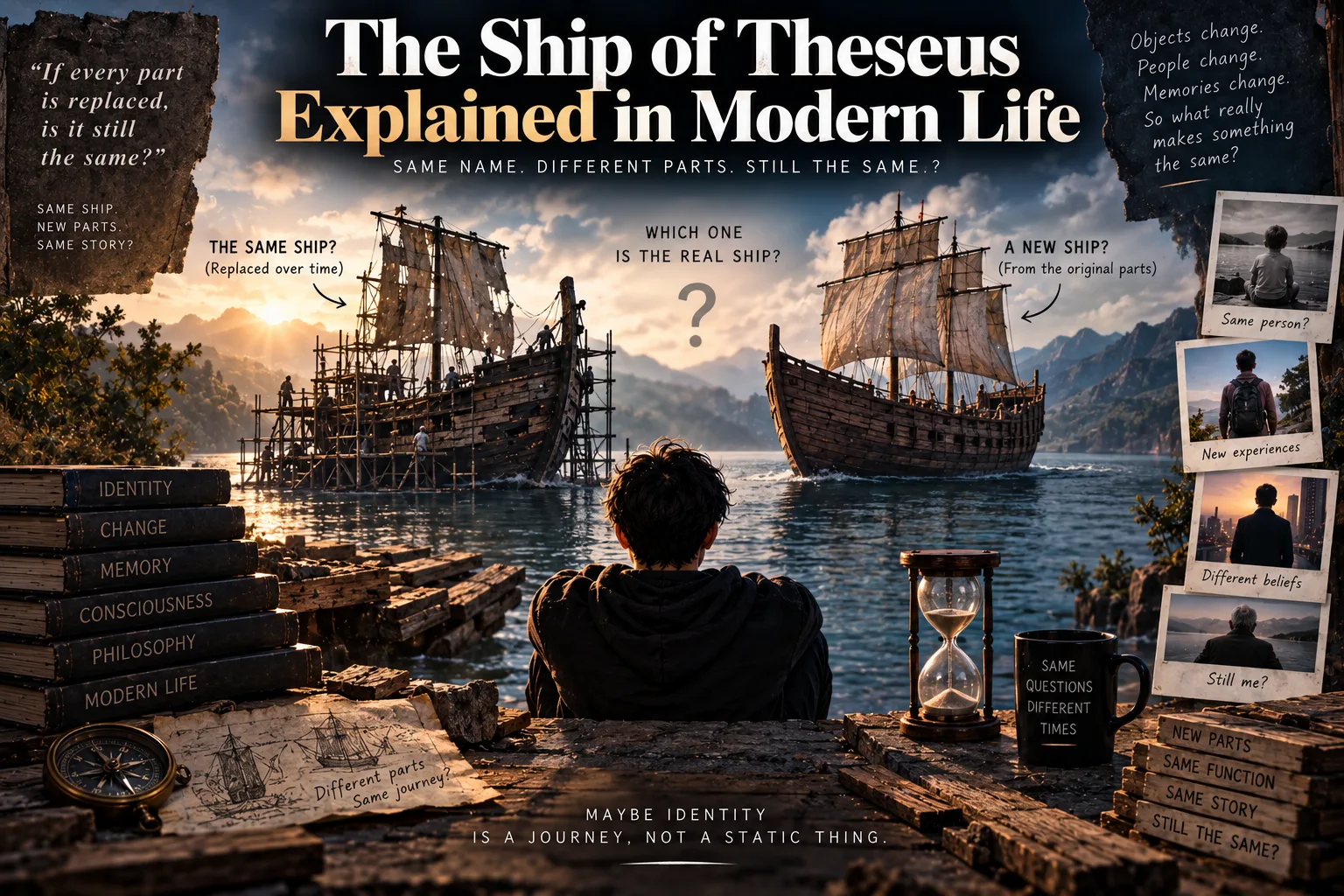
If every part of something is gradually replaced, is it still the same thing? The ancient Ship of Theseus paradox becomes surprisingly relevant when we examine our bodies, memories, relationships, technology, and identity.
The Ship of Theseus Explained in Modern Life
Imagine you own a wooden ship.
Over the years, one plank begins to rot.
You replace it.
Then another.
And another.
Eventually, every original piece of wood has been removed and replaced with new material.
The ship still has the same name.
It has the same design.
It has traveled the same route.
Everyone still calls it the same ship.
But is it?
Now make the problem stranger.
Suppose someone collects every original plank you removed and eventually uses them to construct another ship that looks exactly like the original.
Which ship is the real one?
The newly repaired ship?
The ship reconstructed from the original pieces?
Both?
Neither?
This ancient thought experiment is known as the Ship of Theseus, and it asks a deceptively simple question:
What makes something remain the same thing when everything about it changes?
The question sounds like a problem for philosophers sitting around in ancient Greece with far too much free time.
But it turns out to be a problem you encounter constantly.
Your body changes.
Your memories change.
Your personality changes.
Your relationships change.
Your possessions are replaced.
Your technology upgrades.
Even your beliefs can become completely different from what they once were.
And yet you continue saying:
"I'm the same person."
So what exactly does "same" mean?
The Original Ship of Theseus
The paradox is associated with the Greek hero Theseus, whose ship was preserved by Athenians as a historical object.
According to the famous philosophical version, the ship was maintained over time by replacing deteriorating components.
Eventually, all of its original parts had been replaced.
Philosophers then asked whether it was still the same ship.
Later versions add the second ship constructed from the discarded original parts.
That creates the real puzzle.
If physical material determines identity, the reconstructed ship seems important.
If continuity of structure and history determines identity, the continuously maintained ship seems important.
And if neither is sufficient, perhaps the question itself is based on a mistaken assumption.
The Difference Between Change and Identity
The paradox works because we normally treat two concepts as though they're identical:
Change
and
identity.
But something can change while remaining recognizably itself.
A tree loses leaves.
A river constantly replaces its water.
A building gets renovated.
A company changes employees.
A person ages.
We still describe each as the same entity.
So identity clearly doesn't require every physical component to remain unchanged.
The difficult question is:
How much can change before identity breaks?
Your Body Is Already a Ship of Theseus
Consider your own body.
Cells are constantly being replaced through biological processes.
Some tissues renew relatively quickly.
Others persist much longer.
Your body today is not physically identical to the body you had as a child.
Yet you don't wake up every morning wondering whether the person in the mirror is an impostor.
You simply say:
"That's me."
But why?
Your answer probably isn't:
"Because exactly the same atoms are still present."
Because they aren't.
Something else is providing the sense of continuity.
The Body Changes, But the Story Continues
One possibility is continuity.
Your body today developed from the body you had yesterday.
Yesterday developed from the previous day.
There isn't a sudden moment when one body disappears and another unrelated body appears.
The changes are gradual.
That gradual process gives us a continuous history.
This may be one reason gradual replacement doesn't feel like destruction of identity.
What If the Change Happened Instantly?
Now imagine a machine scans you perfectly and reconstructs you somewhere else using completely different matter.
The original body disappears.
The reconstructed body has:
Your appearance.
Your memories.
Your personality.
Your habits.
Your relationships.
Your beliefs.
Is that person you?
Many people instinctively say yes.
Others say the original you died.
Now make the problem worse.
The machine creates two perfect copies.
Both remember being you.
Both have your personality.
Both insist they are you.
They cannot both be numerically identical to the original person in the ordinary sense.
Now the paradox has escaped the ship and moved directly into your identity.
Memory Might Be the Real Anchor
One theory is that personal identity depends heavily on psychological continuity.
You remember being the person who went to school.
You remember your childhood.
You remember embarrassing moments you'd rather your brain had politely deleted.
You remember people you've loved.
Those memories connect your present self to your past self.
But memory creates another problem.
Memory is not perfectly reliable.
Your Memories Are Not Recordings
Human memory is reconstructive.
When you remember an event, your brain isn't opening a perfectly preserved video file.
Memory can be influenced by:
Later information.
Emotion.
Expectation.
Repetition.
Suggestion.
Other people's accounts.
Time.
Each act of remembering can involve reconstruction.
So if your identity depends entirely on memory, what happens when your memories are wrong?
The Person You Remember May Not Have Existed Exactly as You Remember Them
Imagine remembering your childhood bedroom.
You can picture the furniture.
The walls.
The window.
The objects.
But some details may have been reconstructed from photographs or later stories.
You still feel:
"I remember this."
The emotional sense of ownership can be powerful even when individual details are inaccurate.
This creates a fascinating possibility.
Perhaps identity doesn't require perfectly accurate memories.
Perhaps it requires a continuous psychological narrative.
The Narrative Self
Humans constantly construct stories about themselves.
"I've always been ambitious."
"I was shy as a child."
"I became more confident after college."
"I've always loved music."
These stories connect different versions of ourselves.
But the story can change.
You may reinterpret your childhood differently at 25 than you did at 15.
You may look back on an old decision and think:
"I can't believe I was that person."
And yet you still identify that person as yourself.
The Strange Phrase: "I Was a Different Person"
People say this constantly.
After changing careers.
Leaving relationships.
Recovering from addiction.
Changing political beliefs.
Growing older.
Moving to another country.
Experiencing major life events.
They may say:
"I'm not the same person anymore."
Literally, they're still the same individual.
Psychologically, however, something important has changed.
This reveals that identity has multiple dimensions.
Numerical Identity vs. Psychological Identity
Philosophers distinguish between different senses of identity.
Numerical identity means being literally one and the same entity.
You are one individual, not two.
Qualitative identity means being extremely similar.
Two identical smartphones can be qualitatively identical while still being two separate phones.
This distinction helps explain the Ship of Theseus.
The repaired ship may remain numerically continuous even while becoming materially different.
What Happens to a Smartphone?
Now forget ancient ships.
Consider an iPhone or Samsung Galaxy.
You replace:
The screen.
Battery.
Camera.
Motherboard.
Housing.
Eventually, almost everything is replaced.
Is it still the same phone?
Most people would probably say yes, provided repairs happened gradually.
But now imagine buying a completely new phone and transferring:
Your data.
Photos.
Apps.
Messages.
Settings.
Account.
Wallpaper.
Contacts.
From a user's perspective, it can feel like:
"This is my phone."
But physically, it is completely different.
Software Makes the Paradox Even Stranger
A digital object can change without its physical structure being obvious.
Your operating system updates.
Apps update.
Files change.
Cloud data synchronizes.
Your digital identity follows you between devices.
So what exactly is the "same" thing?
The hardware?
The software?
The account?
The data?
The user's relationship with it?
Modern technology turns an ancient philosophical puzzle into an everyday experience.
Companies Are Also Ships of Theseus
Consider a major American corporation that has existed for a century.
Over time:
Founders die.
Employees leave.
Executives change.
Products disappear.
Offices move.
Shareholders change.
Technology changes.
Business strategies change.
The company's physical assets are replaced.
And yet the company remains legally and socially continuous.
How?
Because institutional identity doesn't necessarily depend on the same physical components.
It can depend on:
Legal continuity.
Ownership structures.
Records.
Brand.
Mission.
Organizational processes.
Historical continuity.
The United States Has Its Own Identity Puzzle
The United States provides an interesting large-scale example.
The country has undergone:
Wars.
Constitutional amendments.
Economic transformations.
Mass migration.
Major demographic changes.
New states joining the union.
States leaving and returning.
Technological revolutions.
Generations of political change.
And yet Americans generally regard the United States today as the same country founded in 1776.
Not physically identical.
Not culturally identical.
Not politically identical.
Yet historically continuous.
That is a very large Ship of Theseus.
What About Your Favorite Restaurant?
Imagine a restaurant you've visited for years.
The owner changes.
The chef changes.
The menu changes.
The furniture changes.
The kitchen is rebuilt.
Eventually none of the original staff or equipment remains.
But the sign outside still has the same name.
Is it the same restaurant?
You might answer:
"Technically yes."
Then you eat there and discover the food is completely different.
Suddenly you're reconsidering the entire philosophy of identity.
Human beings are remarkably philosophical when dinner is disappointing.
Relationships Change Too
Consider a friendship that has lasted twenty years.
You and your friend have changed dramatically.
Your interests changed.
Your careers changed.
Your beliefs changed.
Your personalities changed.
You live different lives.
And yet the relationship persists.
What exactly stayed the same?
Perhaps not the people.
Perhaps the relationship itself has continuity.
Shared memories.
Trust.
History.
Emotional meaning.
Repeated interaction.
The relationship survives because its pattern continues.
The Pattern Theory of Identity
One possible answer to the Ship of Theseus is that identity depends more on pattern and continuity than on individual pieces.
Imagine replacing every part of a chair while preserving:
Its structure.
Its function.
Its design.
Its history.
The chair remains recognizable.
Under this view, the components are less important than how they are organized.
This idea becomes particularly interesting when thinking about brains and information.
Could a Mind Be a Pattern?
Suppose every physical component of your brain could somehow be replaced while preserving exactly the same functional organization.
Would your consciousness continue?
This is a philosophical question, not something current science can demonstrate.
Some theories of personal identity would say psychological and functional continuity could preserve identity.
Others argue that the original physical brain matters.
There is no scientific experiment currently capable of settling the question.
The Teleporter Thought Experiment
Science fiction frequently uses a variation of the paradox.
You enter a machine.
It records every detail of your body.
The original is destroyed.
A perfect version appears on Mars.
The Mars version remembers entering the machine.
It has your personality.
It has your memories.
It looks exactly like you.
Is it you?
Now imagine the original isn't destroyed.
Suddenly there are two versions.
The problem becomes impossible to avoid.
If both claim to be you, which one owns your house?
Philosophy has apparently found a way to turn teleportation into a property dispute.
What If You Gradually Replace the Brain?
This is where the thought experiment becomes even more disturbing.
Suppose a tiny portion of your brain is replaced with an artificial component that performs exactly the same functions.
Then another.
Then another.
Eventually the entire brain has been replaced.
At what point did "you" disappear?
If the answer is "when enough components were replaced," how many?
51%?
90%?
One neuron?
There is no obvious boundary.
Maybe There Is No Exact Moment
One possible conclusion is that identity isn't always the kind of thing that has a precise boundary.
We often ask:
"When did it stop being the same thing?"
But reality may not provide a clean answer.
A forest can gradually become a different forest.
A company can gradually transform.
A person can gradually change.
Sometimes continuity matters more than an exact threshold.
The Problem of Gradualism
Consider a famous paradox involving removing grains from a pile.
If one grain is removed, it is still a pile.
Remove another.
Still a pile.
Keep removing grains.
Eventually there is no pile.
But when exactly did it stop being a pile?
This is the Sorites paradox.
The Ship of Theseus has a similar structure.
If replacing one component doesn't destroy identity, why should replacing the next one?
And the next?
Eventually all components are different.
Where is the boundary?
Why Language Creates Some of the Problem
Part of the difficulty may come from language.
We use words like:
"same."
"thing."
"person."
"object."
as though reality naturally divides itself into perfectly stable categories.
But many categories are human constructions designed for practical communication.
A river is constantly changing.
Yet we call it one river.
A cloud changes continuously.
Yet we refer to the same cloud for a period of time.
Identity may therefore sometimes be a practical concept rather than a fundamental property of the universe.
Identity Depends on What You're Asking
Suppose someone asks:
"Is this the same car?"
You might care about the vehicle identification number.
A mechanic might care about the engine.
A collector might care about original parts.
An insurance company cares about legal identity.
A sentimental owner may care about its history.
All are asking slightly different questions.
There may be no single definition of "same" that works perfectly for every purpose.
The Same Problem Appears With People
If someone asks:
"Are you the same person you were at age ten?"
Biologically?
Partly.
Psychologically?
Partly.
Legally?
Yes.
Emotionally?
Maybe.
Philosophically?
Congratulations, you've just opened a problem that philosophers have been arguing about for centuries.
Personality Changes More Than We Notice
People often imagine personality as fixed.
But traits can change over time.
People can become:
More conscientious.
More emotionally stable.
More socially confident.
More cautious.
More independent.
More empathetic.
These changes don't usually make us conclude that a completely different person has replaced us.
Again, continuity seems to matter.
Beliefs Can Change Completely
Imagine someone who strongly believed something at 18 and completely rejects it at 30.
Were they wrong then?
Are they wrong now?
Is the current person responsible for what the earlier person believed?
The answer depends partly on how we understand personal continuity.
We usually hold people responsible for their past actions because we regard their present selves as continuous with their past selves.
Memory Loss Creates a Difficult Case
Now imagine someone loses substantial autobiographical memory.
Their personality changes.
Their memories disappear.
Their relationships become unfamiliar.
Are they still the same person?
Legally, yes.
Biologically, yes.
Psychologically, the answer becomes more complicated.
This shows why no single criterion seems sufficient.
The Self May Be a Process
One increasingly interesting way of thinking about personal identity is to treat the self not as a static object but as an ongoing process.
You aren't a frozen collection of properties.
You're continuously:
Remembering.
Learning.
Updating.
Reacting.
Changing.
Interpreting.
Predicting.
The "self" may therefore resemble a river more than a statue.
The water changes.
The pattern persists.
Heraclitus and the River
The ancient Greek philosopher Heraclitus famously emphasized continual change.
His philosophy is associated with the idea that reality is constantly in flux.
A river provides the classic illustration.
You step into a river.
Step into it again later.
The water is different.
Yet you call it the same river.
This captures something central to the Ship of Theseus:
Identity can persist through change.
But How Much Change Is Too Much?
This remains the hardest question.
Suppose a person changes:
Their appearance.
Their memories.
Their personality.
Their beliefs.
Their body.
Their relationships.
At what point would we say they are no longer the same person?
There isn't an obvious scientific measurement.
That's because personal identity is partly philosophical.
Science can describe what changes.
Philosophy asks what those changes mean.
🟢 Established Evidence
Several facts relevant to the paradox are well supported:
Human bodies undergo continual biological change.
Memory is reconstructive rather than a perfect recording.
Personality can change across the lifespan.
Human identity is strongly influenced by autobiographical memory and social relationships.
Objects and institutions can maintain continuity despite changes in their physical components.
But none of these facts alone solves the Ship of Theseus.
🟡 Active Debate
Philosophers continue to disagree about what fundamentally determines personal identity.
Major approaches emphasize different things:
Physical continuity
Your body or brain remains continuously connected.
Psychological continuity
Your memories, intentions, personality, and mental life provide continuity.
Narrative identity
Your sense of self emerges from the story you construct about your life.
Pattern or functional continuity
What matters is the organization and functioning of the system.
None has universally defeated the others.
🔴 Popular Myth
"The Ship of Theseus has one correct answer."
It doesn't.
The paradox isn't a puzzle where someone forgot to calculate the correct number.
It's designed to expose an ambiguity in the concept of identity itself.
The answer depends partly on what we think makes something the same thing.
Frequently Asked Questions
What is the Ship of Theseus paradox?
It asks whether an object remains the same object after all of its original parts have gradually been replaced.
Why is it important?
Because it challenges our assumptions about identity, continuity, change, and what makes something fundamentally "the same."
Is the Ship of Theseus a real historical event?
The story is associated with the ancient Greek tradition surrounding Theseus and the preservation of his ship, but the philosophical paradox is a later formulation built around the problem of replacing its parts.
Does the paradox apply to humans?
Yes. Human bodies, memories, personalities, and relationships change over time, making personal identity a natural extension of the same philosophical problem.
Are you physically the same person you were as a child?
You are biologically continuous with your childhood self, but your body has undergone enormous change. Whether that physical continuity is sufficient for personal identity is a philosophical question.
What if every part of a ship is replaced?
There is no universally accepted answer. Some theories emphasize continuity of structure and history, while others emphasize original material.
What if the original parts are rebuilt into another ship?
That creates the strongest version of the paradox because both ships can claim a connection to the original. Different theories of identity produce different answers.
Does memory determine who you are?
Memory is an important part of personal identity, but it is not necessarily the only factor. Memory is also imperfect and reconstructive.
Could technology create a copy of you?
Current technology cannot create a perfect conscious duplicate of a human being. The idea remains a philosophical and science-fiction thought experiment.
What does the Ship of Theseus teach us about modern life?
It suggests that identity may depend less on possessing exactly the same components and more on continuity, relationships, patterns, history, and the way we understand ourselves.
Final Thoughts
The Ship of Theseus looks like a question about an old wooden boat.
It isn't.
The ship is merely the bait.
The real question is about you.
Your body changes.
Your beliefs change.
Your memories change.
Your personality changes.
Your relationships change.
The things you own are replaced.
The places you live change.
Even your understanding of your own past can change.
And yet, through all of this, you experience a continuous thread:
I am still me.
Maybe identity is not about preserving every original piece.
Maybe it is about continuity.
Maybe it is memory.
Maybe it is the pattern connecting one version of yourself to the next.
Maybe it is the story you tell about your life.
Or perhaps the question assumes that there must be one permanent essence when reality doesn't actually work that way.
The strange thing is that you don't need to solve the paradox to live.
You simply continue changing.
The child becomes the teenager.
The teenager becomes the adult.
Old beliefs disappear.
New ones emerge.
People enter your life.
People leave.
Your body changes quietly in the background.
And somewhere along that continuous chain, every version of you looks back at the previous one and says:
"That was me."
Perhaps that's the most human answer to the Ship of Theseus.
You aren't exactly the same collection of parts you once were.
You are the continuation of what came before.
And tomorrow, another version of you will inherit the same story.