Why Do Some Memories Feel Like Dreams—And Some Dreams Feel Like Memories?
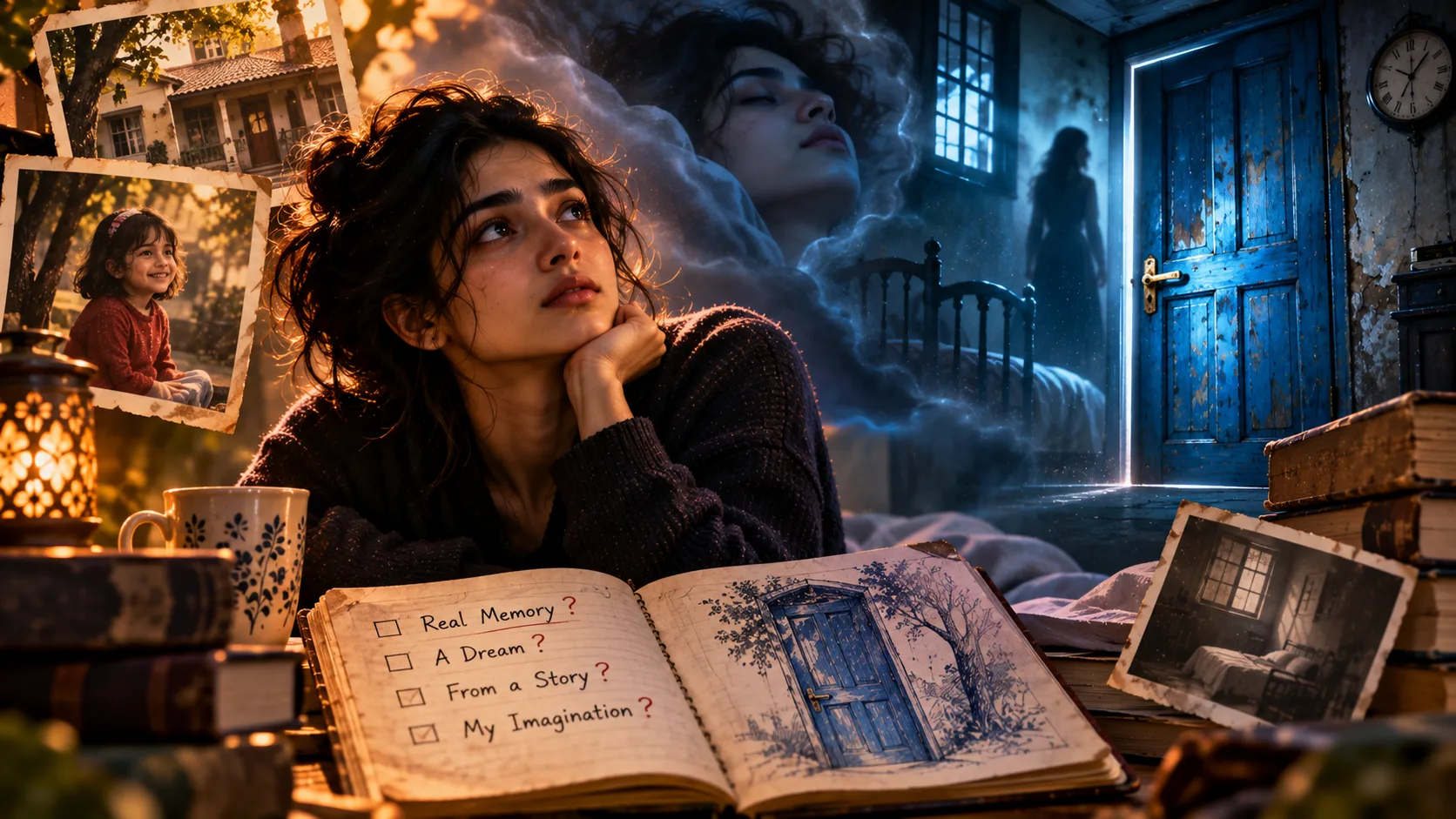
She remembers a blue door, a childhood summer, and a voice calling her name. But when she returns to the house, the door has never existed. Was it a forgotten memory, a vivid dream, or something her mind quietly invented?
The door was blue.
Not sky blue. A deep, bruised blue, with a brass handle cold enough to hurt her fingers.
Every time Aditi dreamed of it, she heard the same voice from the other side.
“Come in. You're late.”
Then she woke, heart racing, with an impossible certainty.
She had been there before.
Back at her childhood home, the blue door was gone.
In its place stood a wall.
A Room Everyone Remembered Differently
At thirty, Aditi returned to help her parents sell the house. The cracked kitchen tiles and steep staircase were just as she remembered.
At the end of the upstairs hallway, she stopped.
“Why did you seal this room?”
Her mother looked confused.
“What room?”
“The one with the blue door.”
“There was never a room there, beta.”
Aditi laughed, waiting for her mother to join in.
She didn't.
The floor plan showed no space for another room.
Yet Aditi could describe it.
A narrow bed. A neem tree beyond the window. A clock with one broken hand.
She remembered standing there at seven. Or thought she did.
The Photograph That Made It Worse
That night she opened the childhood albums. In one photograph she stood on the staircase in a red sweater. In another, her brother carried a birthday cake past the same wall.
No blue door in either.
Then her brother called.
“You've remembered that weird door again?” he asked.
Again.
The word lodged in her throat.
“What do you mean, again?”
“You used to talk about it all the time. Said a woman was waiting behind it.”
Aditi gripped the phone.
“So it was real?”
“No. You said you saw it when you were asleep.”
She went quiet.
For years, she'd believed she remembered entering a childhood room.
What if she actually remembered telling people about a dream?
And somewhere along the way, she'd forgotten the difference?
The Brain Doesn't Stamp Every Experience ‘REAL’
Memory isn't a stored video. Recall reconstructs experiences from images, emotions, sensations, and later knowledge. Dreams leave fragments too.
A vivid dream may contain a convincing place, a recognizable voice, even a strong sense of having lived through an event.
Later, we can mistake the source of a mental image. Psychologists call this a source-monitoring error: knowing a detail, but confusing whether it came from experience, imagination, a story, or a dream.
Context often helps identify a memory's origin, but childhood memories can be patchy. Retelling an imagined scene may make it increasingly familiar.
Dreams aren't secret recordings of past events; a dreamlike memory isn't necessarily false.
Aditi understood the explanation.
She just couldn't explain the voice.
The Voice Behind the Door
“Come in. You're late.”
The words sounded old-fashioned, impatient, almost affectionate.
She had never told anyone the exact sentence.
At least, she didn't think she had.
Aditi searched an old box of her school notebooks. Between spelling exercises and crooked drawings was a page covered in blue crayon.
A door.
A brass handle.
And beneath it, in seven-year-old handwriting:
She says I am late.
For a moment, Aditi felt triumphant.
Evidence.
But evidence of what?
The drawing proved she'd pictured the door, not that it existed.
On the next page was a picture of a purple elephant driving a bus.
Suddenly the distinction seemed less reassuring.
The Missing Piece
Her mother found her amid scattered notebooks.
“I know that picture.”
She brought a battered storybook from the cupboard.
Inside was an illustration of a blue door in a dark hallway.
Aditi stared at it.
The shape was right. The brass handle was right.
But the book showed no narrow bed or broken clock.
Her mother sat beside her.
“When you were little, I used to read this before bed. You were scared of that door. So you invented a room behind it where nothing bad could happen.”
“And the woman?” Aditi asked.
“I don't remember a woman.”
The uncertainty stung.
Because she was sure the woman had been there.
Perhaps another dream supplied her. Perhaps her mother had forgotten.
The book explained part of the memory, not all.
When Real Memories Feel Like Dreams
The next morning she recalled her father carrying her on his shoulders under the neem tree. Her mother confirmed it; photographs existed.
Yet the scene felt distant and weightless, like a dream.
Memory researchers distinguish a sense of familiarity from the retrieval of contextual details. A real event can become hazy as details fade, while an imagined scene may stay unusually sharp because we've rehearsed it.
Clarity is not the same as accuracy.
Our certainty can outlast the evidence supporting it.
And sometimes the most honest answer to a treasured memory is simply: I don't know.
One Last Night
Before leaving, Aditi slept in her childhood room.
She dreamed of the blue door again.
This time the hallway was bright.
She reached for the handle.
“Come in,” the voice said. “You're late.”
But instead of opening it, she asked, “Who are you?”
There was no answer.
Then she woke to the sound of her mother moving dishes downstairs.
For the first time, she didn't run to the hallway to search for a door.
She wrote the dream in her notebook and labeled it carefully. Beneath it she listed what she knew: the storybook, her childhood drawing, and the absence of evidence for a room.
She left a space under one final heading.
Things I might never know.
She didn't fill it.
Outside, her mother called, “Breakfast is ready!”
Aditi smiled and went downstairs.
Maybe the blue door had come from a book. Maybe the voice had come from another dream. Maybe the years had woven several separate moments into one impossible childhood scene.
She could live without choosing an answer she couldn't prove.
And still, as she reached the bottom step, a thought followed her:
If a dream can become a memory, how many of the places we think we've visited exist only in the stories our minds have told us?