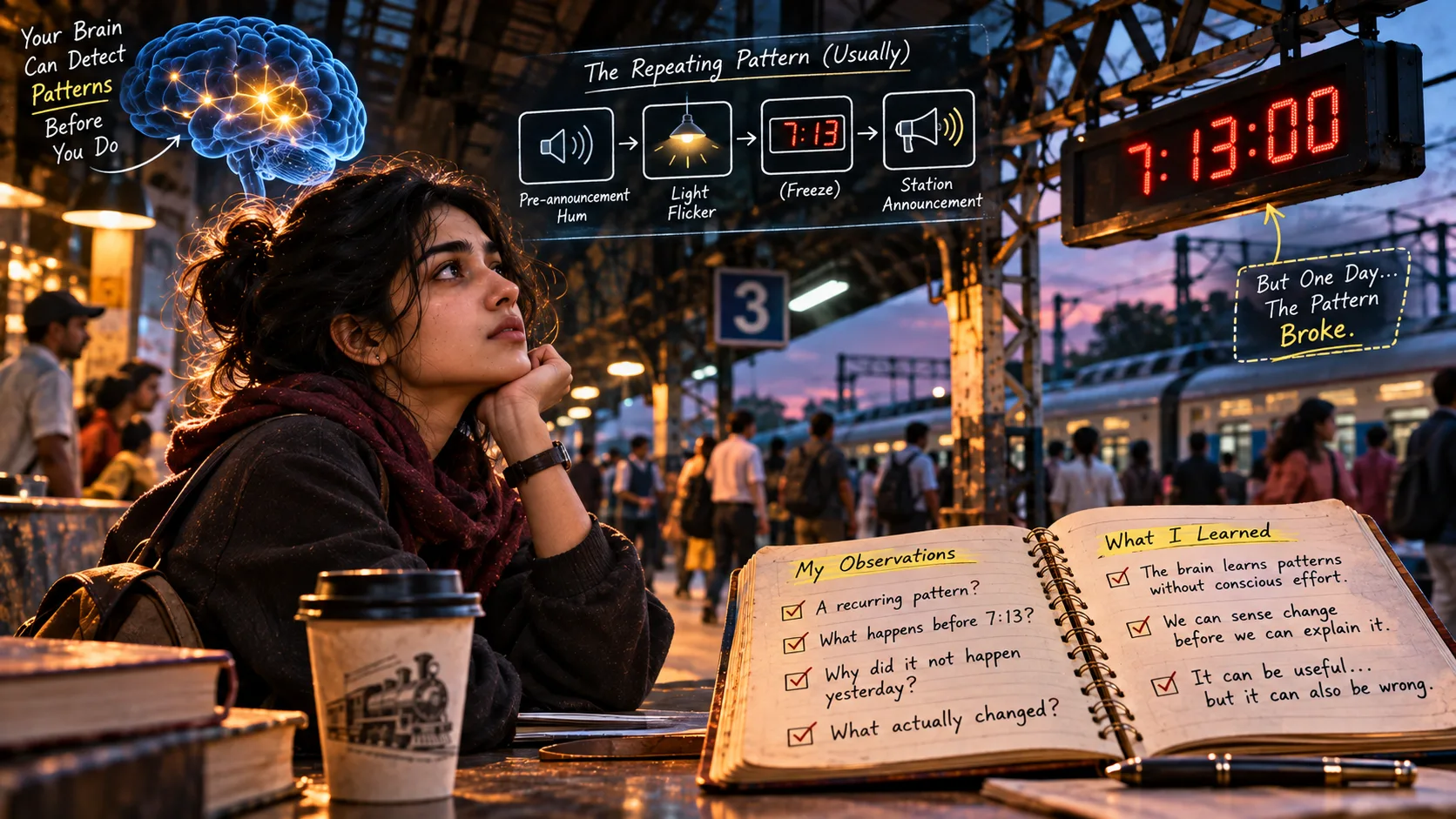
What If Your Brain Recognizes a Pattern Before You Recognize It?
Every evening, an old station clock stops for three seconds. Anaya never notices it, yet somehow she looks up just before it happens. Then one night, the clock keeps ticking, and the uneasy feeling she's ignored leads her to a detail everyone else missed.
At 7:12 p.m., Anaya stopped walking.
She didn't know why.
The railway station was as crowded as ever. Porters shouted over rolling suitcases. A child cried near the ticket counter. Somewhere, a tea seller argued with a customer about change.
Everything seemed normal.
Except something was missing.
Anaya looked up.
The enormous digital clock above Platform Three read 7:12:58.
Two seconds passed.
7:13:00.
7:13:01.
7:13:02.
The numbers kept moving.
Anaya felt an inexplicable chill.
For nine months, that clock had stopped for approximately three seconds every evening.
She had never consciously paid attention to it.
Yet somehow, every night, she looked up just before it happened.
And tonight, for the first time, it didn't.
The Three Seconds Nobody Noticed
Anaya worked at a publishing office across the street.
Every evening, she crossed the station to catch the 7:19 local train.
It was a routine so familiar she could perform it while thinking about something else.
Buy a ticket.
Pass the newspaper stall.
Walk beneath the old yellow lights.
Wait near the third pillar.
She knew which staircase was usually crowded and where the platform roof leaked during heavy rain.
But she had never thought much about the clock.
Not until a stranger pointed something out.
Three weeks earlier, an elderly passenger had been watching her.
"Excuse me," he'd said. "Why do you look up at the clock every evening?"
Anaya laughed.
"To check the time?"
"But you check it before the announcement."
"What announcement?"
The man pointed toward the speakers.
"The one at seven thirteen."
Anaya frowned.
She'd never noticed an announcement at that particular time.
Yet the next evening, as she approached Platform Three, she caught herself looking up.
The clock froze.
Three seconds later, it resumed.
For the first time, she wondered whether she'd been doing this for months without realizing it.
And now the pattern had broken.
The Feeling Before the Thought
That night, Anaya couldn't stop thinking about the station.
What had made her stop walking?
She hadn't checked her watch.
Nobody had told her something was wrong.
The clock had simply continued working.
Yet she'd experienced an unmistakable sense of anticipation, followed by discomfort when the expected event failed to happen.
Was it intuition?
Coincidence?
Or had her brain noticed something she hadn't consciously understood?
The following morning, she began investigating.
She bought a small notebook and wrote three questions.
What happens before 7:13?
What happens during those three seconds?
What changed yesterday?
She underlined the last question twice.
The answers would be stranger than she expected.
The Patterns We Learn Without Knowing
Human brains are extraordinarily good at learning regularities.
We recognize familiar footsteps, anticipate the next note of a song, and sense when a repeated routine changes.
Sometimes we can explain exactly how we know.
Other times, the learning happens without our being able to describe the pattern.
Psychologists study this through processes including implicit learning.
Repeated exposure can influence expectations and behavior even when we have limited conscious awareness of what we've learned.
Consider someone who travels the same road every morning.
They may begin slowing down before a particular junction without deliberately thinking about why.
Perhaps traffic frequently builds there.
Perhaps a familiar sound or visual cue usually precedes congestion.
With experience, the response becomes increasingly automatic.
But there's a catch.
Our brains can also detect patterns that aren't genuinely meaningful.
Coincidences happen. Expectations create bias. Once we suspect a pattern, we may selectively notice events that confirm it.
Intuition can be useful.
It can also be wrong.
Anaya was about to discover both possibilities.
Three Sounds Before the Silence
On Wednesday, she arrived at the station early.
She stood near the third pillar, holding her notebook.
At 7:12, she closed her eyes and listened.
A train brake screeched.
Someone dragged a metal trolley.
A vendor shouted, "Chai! Garam chai!"
Then came a quiet metallic click.
Anaya opened her eyes.
An overhead light flickered.
A low humming sound rose from the direction of the announcement speakers.
And the clock stopped.
7:13:08.
Three seconds later, the display resumed.
Then a recorded voice announced the arrival of an evening passenger train.
Anaya stared.
She'd heard that announcement hundreds of times.
But she had never connected the sounds that came before it.
She wrote:
Click. Flicker. Hum. Clock freezes. Announcement.
The next evening, she watched again.
Almost the same sequence.
Friday, too.
By Saturday, Anaya could anticipate the frozen display from the faint electrical click alone.
It felt almost supernatural.
Until she realized something uncomfortable.
She hadn't discovered a mysterious ability.
She'd discovered a cue.
But that raised another question.
Why had the sequence disappeared on Tuesday?
The Man Who Knew the Clock
On Monday, Anaya approached a railway maintenance worker near the control room.
His name was Mahesh.
He had been repairing station equipment for eighteen years.
When she mentioned the clock, he sighed.
"That old display has been troublesome for months."
Anaya showed him her notebook.
Mahesh studied the sequence.
"Interesting."
He explained that the display and nearby announcement equipment used aging electrical connections.
When the announcement system powered up for a scheduled message, the clock occasionally froze momentarily.
The display's controller would recover and synchronize the time.
It was an equipment fault, not an intentional feature.
"Then why didn't it happen last Tuesday?" Anaya asked.
Mahesh frowned.
"Tuesday?"
He searched through a maintenance register.
Then his expression changed.
"The announcement amplifier was reported faulty that evening."
"What does that mean?"
"The scheduled message never played."
Anaya remembered the crowded platform.
The shouting vendors.
The passing train.
She hadn't noticed that one recorded voice was missing.
But something inside her had responded to the absence of the usual sequence.
"Is that why the clock didn't freeze?"
"Possibly. The faulty unit wasn't drawing power normally. We need to inspect the connections before saying for certain."
It was an ordinary explanation.
Old wiring.
Repeated electrical behavior.
A familiar routine.
Yet Anaya felt strangely disappointed.
She'd spent days imagining that her mind had detected something extraordinary.
Instead, it might simply have learned the sound of a faulty speaker.
Then Mahesh turned another page in the maintenance register.
And stopped.
The Detail Everyone Missed
"That's odd," he said.
Anaya leaned forward.
"What?"
"The amplifier was replaced on Wednesday. But someone's reported the same flicker again."
He looked toward Platform Three.
"The clock isn't the only equipment connected through that junction."
Together, they walked toward the old announcement cabinet.
Mahesh opened the inspection panel.
Inside, a section of wiring showed signs of overheating.
He immediately called another technician and arranged for the affected equipment to be isolated.
Anaya stepped away.
"So the clock was warning us?"
Mahesh shook his head.
"Not exactly. It was malfunctioning. The flicker and other symptoms were reasons to check the electrical system."
There was no dramatic explosion.
No evacuation.
No crowd applauding her extraordinary instincts.
Just maintenance staff dealing with a problem that needed attention.
But as Anaya watched them work, she understood something important.
For months, she'd treated the clock as the center of the pattern.
It wasn't.
The clock had merely been the most visible symptom.
The subtle electrical sounds and changes in lighting had been occurring alongside it.
Her attention had learned a sequence without her understanding its cause.
When part of that sequence disappeared, the station had felt different.
And she'd noticed the difference before she could name it.
Why a Feeling Isn't Enough
On her journey home, Anaya looked through her notebook.
She had been right about something.
There really was a recurring sequence.
But her first interpretation had been wrong.
The strange feeling hadn't predicted an accident.
It hadn't revealed the future.
It hadn't even told her precisely what was broken.
It had only drawn her attention toward a change in a familiar environment.
Everything else required observation, comparison, questions, and evidence.
This distinction matters beyond railway stations.
A teacher may sense that a classroom feels different.
A musician may notice something wrong with a performance before identifying the missed note.
An experienced worker may recognize that a machine sounds unusual.
Such impressions can emerge from learned patterns, particularly when a person has repeatedly encountered useful cues.
But the sensation itself doesn't prove what caused it.
Experience can produce informed intuition.
It cannot guarantee correctness.
Sometimes an uneasy feeling reflects a genuine change.
Sometimes it reflects anxiety, coincidence, or an expectation that simply wasn't fulfilled.
The challenge is learning when to investigate rather than automatically believe.
The Evening Nothing Happened
Two weeks later, Anaya returned to Platform Three.
The announcement system had been repaired.
The damaged connections had been replaced.
The overhead lights no longer flickered.
At 7:12, she stood near the third pillar.
She listened.
Suitcases rolled across the floor.
A train approached.
The tea seller shouted his familiar invitation.
Then the announcement began, clear and uninterrupted.
The clock continued moving.
7:13:01.
7:13:02.
7:13:03.
Nothing unusual happened.
Anaya smiled.
For months, her brain had quietly learned to anticipate three missing seconds.
Now those seconds were gone.
Yet she still looked up.
Habits, she'd discovered, didn't disappear merely because their causes had changed.
She boarded her train and took a seat beside the window.
As the station disappeared behind her, she thought about all the patterns she'd learned without realizing it.
The sound of her mother's footsteps.
The pauses before a friend's laughter.
The familiar rhythm of a street she crossed every day.
How many expectations had she developed without knowing their origins?
And how often had she mistaken an unexplained feeling for something mysterious?
She took out her notebook and wrote one final sentence.
Sometimes your brain notices that something has changed before you know what you're noticing.
Then she added:
That is the beginning of a question, not the end of an explanation.
Outside, the city rushed past.
And Anaya realized that perhaps the most remarkable thing about intuition wasn't that it could sometimes make us feel one step ahead.
It was that our experiences could teach us to expect things we had never consciously learned to recognize.