The Day You Discover You Were Someone Else’s Worst Memory
At a school reunion, she laughs about an old classroom joke. Then a former classmate quietly says, "That was the day I stopped coming to school." She remembers a harmless moment. He remembers something else entirely.
“You were the reason I stopped coming to school.”
Tara almost laughed.
Not because it was funny.
Because the man standing before her had just described a completely different childhood from the one she remembered.
They were at their school reunion, fifteen years after graduation.
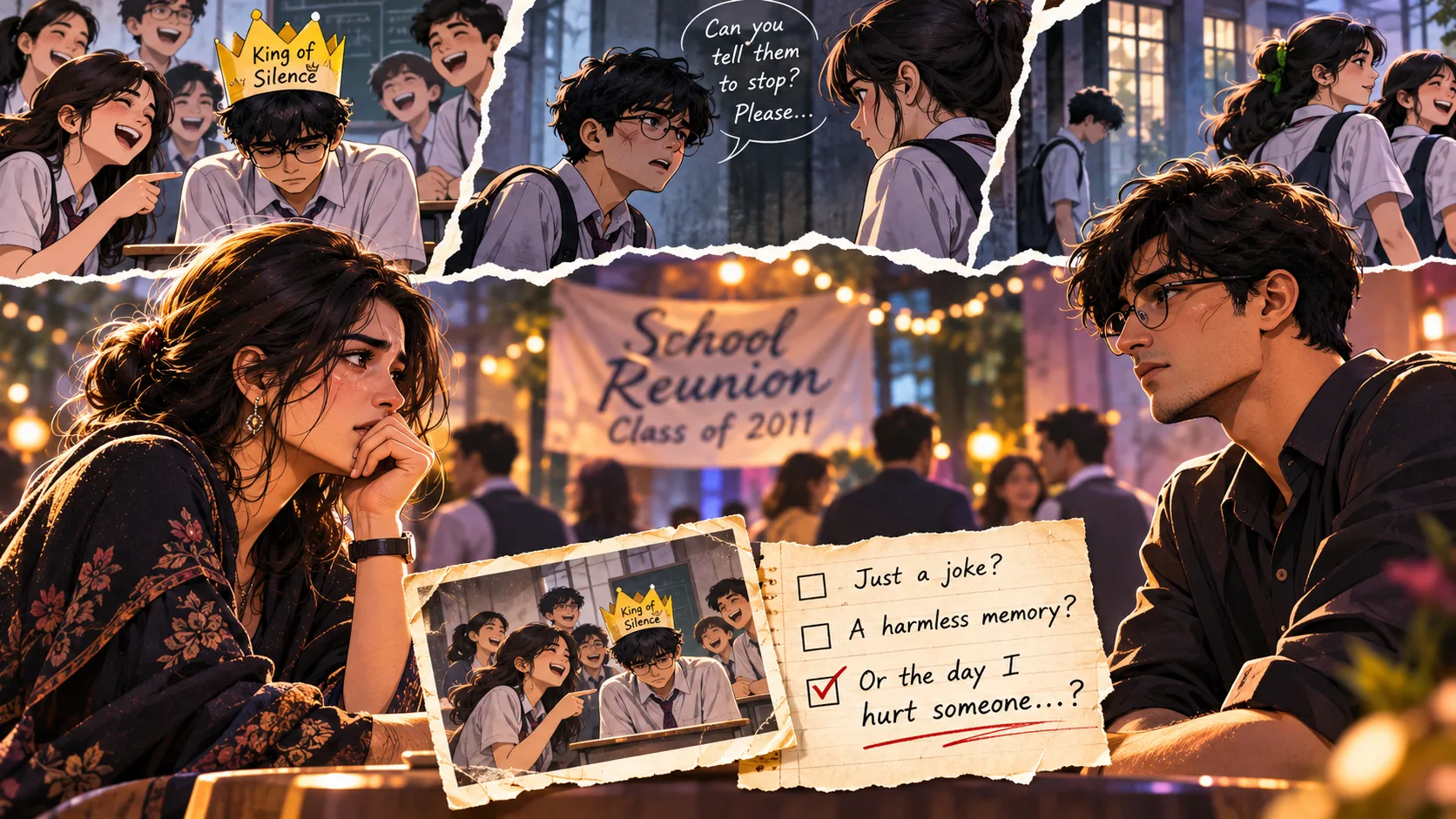
The music was loud. Former classmates embraced beneath paper decorations. Someone had hung an enormous banner reading Welcome Back, Class of 2011!
Tara held a glass of lemonade.
Across from her stood Ishaan, a quiet boy she remembered as kind, awkward, and almost impossible to make angry.
She had greeted him with a smile.
“Remember that ridiculous paper crown we made you wear?”
He hadn't smiled back.
Instead, he'd asked one question.
“Is that really how you remember it?”
The Boy Everyone Forgot
Tara remembered ninth grade as a collection of harmless disasters.
Unfinished homework.
Secret crushes.
Terrible school lunches.
And an afternoon when her friends had decided to give their quietest classmate a ridiculous title.
King of Silence.
They made a crown from yellow chart paper, wrote his title across the front, and placed it on Ishaan's desk.
Everyone laughed.
Even Tara remembered laughing.
She also remembered Ishaan smiling, although now she wasn't certain.
“It was just a silly school joke,” she told him.
Ishaan looked toward the reunion photographs.
“Do you remember what happened afterward?”
Tara frowned.
“The teacher took the crown?”
“No. After school.”
She searched her memory.
Nothing.
He nodded slowly, as though her silence confirmed something.
“I thought you wouldn't.”
Then he walked away.
And just like that, an afternoon Tara had forgotten became the most disturbing thing she'd heard in years.
Two People, Two Different Pasts
That night, Tara opened her old school photographs.
There was Ishaan, standing at the edge of their class picture.
She remembered his oversized backpack and how carefully he wrote in his notebooks.
She remembered that he rarely spoke during lessons.
But she couldn't remember him being unhappy.
Had he really stopped attending school because of a paper crown?
It seemed impossible.
The next morning, she called her old friend Ritu.
“Do you remember what happened with Ishaan in ninth grade?”
Ritu laughed.
“The King of Silence thing?”
“Yes.”
“We were such idiots.”
“Did he stop coming to school afterward?”
A pause.
“I think he missed a few weeks.”
“Why?”
“I don't know. Wasn't he sick?”
Tara felt relieved.
Perhaps Ishaan had confused two unrelated events.
Perhaps the memory had grown more painful over time.
But before she could accept that explanation, Ritu added something.
“Wait. Didn't you promise him something?”
Tara sat upright.
“What promise?”
“I don't remember exactly.”
And suddenly, Tara wanted to know everything.
Memory Doesn't Treat Everyone Equally
We often assume people remember shared experiences in similar ways.
But memory is reconstructive.
Our attention, emotions, knowledge, and experiences influence what we notice and later recall.
Two people can witness the same event yet remember different details.
And the emotional significance of an event can differ enormously.
A casual remark may vanish from the speaker's memory while remaining deeply meaningful to the listener.
Researchers also describe self-serving bias, our tendency in some circumstances to interpret events in ways that protect our self-image.
That doesn't mean every unpleasant memory is accurate or that everyone who forgets harm is deliberately avoiding responsibility.
Memory is fallible for both people.
But when Tara remembered a harmless prank and Ishaan remembered humiliation, neither feeling alone could settle what had happened.
She needed more than confidence.
She needed to listen.
The Photograph With the Yellow Crown
Three days later, Tara visited their former school.
The classrooms were smaller than she remembered.
The corridors smelled of floor cleaner and old books.
Their former class teacher, Mrs. Fernandes, still worked there.
When Tara mentioned Ishaan, the older woman became unusually quiet.
“He was a bright boy,” she said.
“Do you remember why he stopped attending?”
Mrs. Fernandes removed her glasses.
“He was having a difficult time. I don't think we handled it well.”
Tara showed her a photograph of the yellow crown.
Mrs. Fernandes studied it.
“I remember this.”
Then she said something Tara hadn't expected.
“Ishaan came to me afterward. He said the other children wouldn't leave him alone.”
Tara's stomach tightened.
“Because of the crown?”
“Not only that. They kept calling him the name. They laughed whenever he tried answering questions.”
Tara looked at the photograph again.
The boy in the picture wasn't smiling.
His head was lowered.
And for the first time, she noticed how tightly his fingers gripped the edge of the desk.
The Promise
That evening, Tara found Ishaan's contact through the reunion group.
She wrote a message.
I'm sorry about the crown.
She deleted it.
It sounded too simple.
Then she typed:
I didn't realize it affected you so much.
She deleted that too.
Finally:
I want to understand what happened. Would you be comfortable telling me?
His reply arrived the following morning.
You already knew.
Tara stared at the screen.
Then another message appeared.
You promised you'd tell them to stop.
Something shifted inside her.
A memory, faint and uncomfortable.
A school corridor.
A boy standing beside the drinking-water taps.
Yellow paper crushed in his hand.
“Can you tell them to stop calling me that?”
Tara remembered feeling embarrassed.
She remembered glancing toward her friends.
And she remembered saying:
“Okay. I'll talk to them.”
But she hadn't.
The Afternoon She Walked Away
The memory returned in fragments.
After the crown incident, the nickname had spread beyond their classroom.
Students shouted it in the corridor.
They wrote it on Ishaan's notebooks.
Whenever he raised his hand, someone whispered, “The king has spoken.”
Tara had noticed.
Once, Ishaan approached her after school.
His eyes were red.
“They keep doing it,” he said.
“I know.”
“Please tell them it was supposed to be a joke.”
She promised she would.
Then her friends appeared.
One shouted the nickname.
Another laughed.
Ishaan looked at Tara.
Waiting.
She could have said something.
It wouldn't necessarily have ended the bullying.
But she could have tried.
Instead, she smiled nervously and walked away with her friends.
That was the moment he'd remembered.
Not the crown.
Not the laughter.
The moment someone who knew it was wrong decided not to stand beside him.
The Worst Part Wasn't What She Said
Tara spent the following night replaying that corridor.
She remembered wanting to belong.
She remembered being frightened her friends would turn on her.
She remembered telling herself it wasn't serious.
And she remembered how quickly she'd forgotten the entire thing afterward.
For Ishaan, the consequences had continued.
For her, the afternoon had simply ended.
That difference was almost unbearable.
Tara had always considered herself a compassionate person.
She volunteered at community events. Helped friends through difficult relationships. Spoke passionately about kindness.
Yet she'd once watched someone ask for help and chosen her own comfort instead.
Was she a bad person?
The question consumed her.
Until she realized it was the wrong question.
Whether she was fundamentally good or bad wouldn't change what Ishaan had experienced.
And focusing on defending her identity risked making his pain about her.
What mattered was acknowledging her choice.
Without explanations designed to make it disappear.
An Apology That Couldn't Fix Anything
A week later, Ishaan agreed to meet her.
They sat in a small café across from their old school.
Tara had rehearsed dozens of sentences.
But when he arrived, she abandoned them.
“I remember the corridor,” she said.
Ishaan looked at her.
“I remember promising I'd help. And I remember walking away.”
He said nothing.
“I was afraid my friends would turn against me. That's what I was thinking.”
She swallowed.
“But being afraid doesn't excuse what I did.”
For a long time, Ishaan stared at his coffee.
Then he spoke.
“You know what's strange?”
Tara shook her head.
“I don't remember everything about that year. I don't even remember every person who called me that.”
He looked up.
“But I remember asking you for help.”
His voice remained calm.
“That was the worst part. I thought you understood.”
Tara felt tears forming.
“I did understand. I just didn't do anything.”
Ishaan nodded.
“Exactly.”
She apologized.
Not once.
Not dramatically.
She said it plainly.
And for the first time, she didn't add a sentence beginning with but.
Not Every Story Ends With Forgiveness
Tara had secretly hoped their conversation would end with an embrace.
That Ishaan would smile and tell her it was all in the past.
That fifteen years would somehow make the harm smaller.
But life rarely offers such convenient endings.
“I appreciate you acknowledging it,” Ishaan said.
Then he stood.
“I hope you've changed.”
Tara nodded.
“I think I have.”
“I hope so.”
He picked up his bag.
And left.
No forgiveness.
No promise to stay in touch.
No declaration that everything was finally okay.
Tara sat alone for a long time.
She realized she had wanted him to release her from the shame.
But that wasn't his responsibility.
An apology could acknowledge harm.
It couldn't demand that the person harmed feel better.
The Stories We Tell About Ourselves
Years later, Tara would still remember that reunion.
Not because Ishaan had called her cruel.
He hadn't.
Not because he had demanded revenge.
He hadn't done that either.
He'd simply told her something she hadn't wanted to know.
That the version of herself she carried through life was incomplete.
She could remember being a kind friend.
A thoughtful student.
Someone who disliked bullying.
And still have been the person who failed Ishaan when he needed help.
Those truths could exist together.
Memory doesn't preserve every consequence of our actions.
Sometimes we remain the heroes of our own stories because we never discover how those stories looked from the other side.
That possibility is uncomfortable.
But it also leaves room for something important.
Responsibility.
Not the kind that rewrites the past.
The kind that changes what we choose to do next.
Tara couldn't return to that school corridor.
She couldn't make her younger self speak.
But years later, when she saw a colleague being humiliated during a meeting, she interrupted.
“That isn't appropriate,” she said.
Her voice trembled.
She said it anyway.
She never told Ishaan about that moment.
It wasn't a debt she could settle with one good deed.
And perhaps that was the lesson she would carry longest.
You may be the worst memory in someone else's story without ever intending to be.
You cannot always change how that story ends. But you can decide whether the person you are today would make the same choice again.