The House Was Empty. So Why Did Everyone Remember Living There?
Nobody has lived in the house at the end of Bell Lane for thirty years. Yet six strangers remember growing up inside it, each with a key, a bedroom, and a childhood that should be impossible.
The first key arrived at 5:12.
By 5:28, there were six.
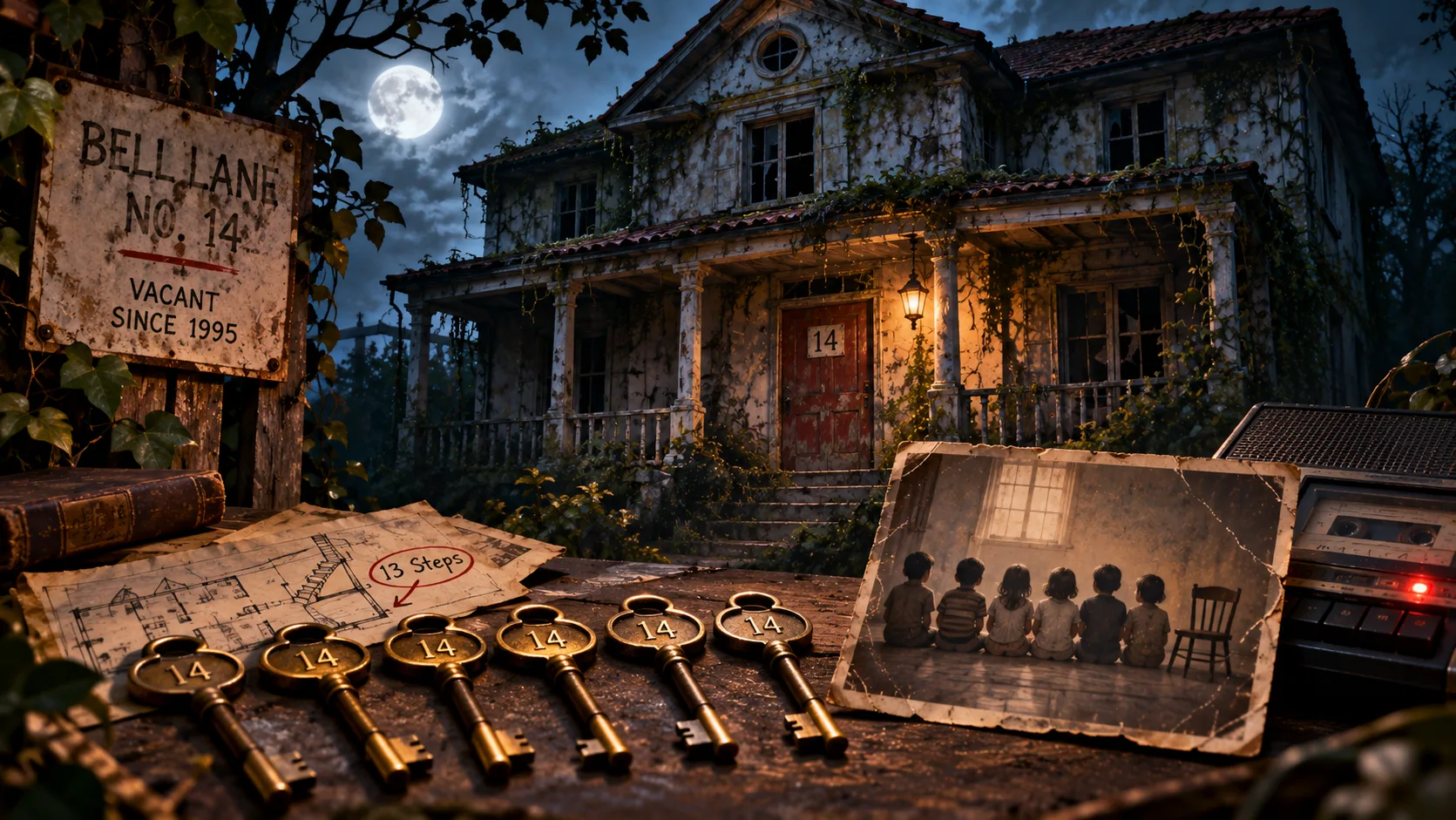
Every key was brass, darkened with age, and stamped with the same crooked number: 14.
Nisha placed hers on the demolition officer’s desk. Five strangers did the same.
“I grew up here,” she said.
“So did I,” answered the man beside her.
They looked toward the house at the end of Bell Lane.
Its windows were boarded. Ivy swallowed the veranda. According to town records, nobody had lived there since 1995.
Yet all six remembered sleeping upstairs.
And all six remembered a woman calling them down at six.
Thirteen Steps
Mr. Sen, the council officer, reluctantly let them inside.
The door opened with a wooden sigh.
Nisha smelled boiled milk and damp wool.
For an instant she was seven again, barefoot in the hall, waiting for her mother to finish brushing her hair.
But her mother had never lived in this town.
“Kitchen’s on the left,” Farah announced.
“No,” Arun said. “Right.”
They searched the corridor.
Both were correct.
To the left was a kitchen. To the right, another room held the remains of a stove and sink.
“How many stairs?” whispered Joseph.
“Thirteen,” they answered together.
On the final step, Nisha found a shallow groove in the wood.
She remembered carving it with a toy car.
“I made that,” Arun said.
From his wallet he pulled a photograph of a boy holding a red car beside the same staircase.
The boy was him.
Nisha had never owned a red car.
She was almost certain.
Six Families
In the upstairs hall, their memories collided.
Meera remembered her father painting the walls blue.
Vikram remembered yellow.
Farah swore they had always been green.
Beneath peeling wallpaper, the paint appeared in layers: yellow, blue, green.
At the corridor’s end stood a locked bedroom.
Nobody remembered entering it.
Everybody remembered the rule.
Never open that door after she calls you downstairs.
“Who was she?” Mr. Sen asked.
“My mother,” Nisha replied.
“So was mine,” whispered Meera.
Yet the women in their family photographs looked nothing alike.
A knocking came from behind the locked door.
Three taps.
Then three more.
At exactly six, a woman’s voice floated through the corridor.
“Children. Come downstairs.”
The Room That Remembered
Mr. Sen forced the lock.
Inside stood six small chairs facing a blank wall, and a seventh chair behind them.
An old cassette recorder sat on a desk.
Across the wall were six names:
NISHA. ARUN. FARAH. MEERA. VIKRAM. JOSEPH.
Under each was a birth date.
Every one correct.
The recorder clicked.
“Good evening, children,” a woman said. “Who wants to tell me what home looks like?”
“Blue walls,” answered a child's voice.
“Yellow,” said another.
“Green.”
Nisha dropped into a chair.
“Very good,” the woman continued. “Now close your eyes. Imagine this is your house.”
A child giggled.
“Can we have our own bedrooms?”
“Of course. Whatever you remember belongs here.”
Almost an Explanation
Joseph opened a desk drawer.
Inside was a folder marked:
BELL LANE RECONSTRUCTION PROJECT — 1995
The six names filled its first page.
After a devastating flood, displaced children had attended sessions in this unused house. A visiting research team encouraged them to recreate a sense of home through games, painting, and guided imagining.
They had never lived here.
They had rehearsed living here.
The keys were keepsakes from the project.
Nisha thought of the two kitchens, the layers of paint, the toy-car groove.
Different children had changed the same building.
Over decades, the stories had taken on the texture of lived memory.
“There,” Mr. Sen said. “That's your answer.”
But who had started the recorder?
There was no electricity.
He pressed Stop.
Silence.
Then the recorder clicked again.
“Children,” the woman said, nearer this time. “One of you is missing.”
The Seventh Chair
They turned back to the folder.
Six names. Six signatures. One photograph from the final day.
Six smiling children sat in a row.
Beside them was a seventh chair, facing the wall.
On its wooden back, someone had scratched a word:
MOTHER
Farah stepped toward the exit.
Mr. Sen twisted the handle.
It would not turn.
Behind them, the woman began counting.
“One. Two. Three. Four. Five. Six.”
A long pause.
“Where is my seventh?”
Nisha looked again at the old photograph.
Something was wrong.
The children were not smiling at the camera.
They were looking toward the empty chair.
As if someone were sitting there.
Someone Has to Stay
The room smelled of damp wool.
Nisha remembered being seven, her feet barely reaching the floor. The woman in grey walked behind them, placing a hand on each shoulder.
“Picture your family,” she'd instructed. “Picture your kitchen. Picture your bedroom.”
Then she'd reached the last chair.
And stopped.
“Who will picture me?”
Nisha looked toward the seventh chair.
Mr. Sen was standing beside it.
His expression had emptied.
“I remember,” he whispered.
A brass key slipped from his coat pocket and hit the floor.
It was polished, almost new.
Stamped 14.
Its tag read:
SEN — AGE 7
Outside, the demolition workers called for their supervisor.
Nobody answered.
Through an upstairs window they saw seven silhouettes seated in a row.
When police broke down the door, the room was empty.
Seven chairs faced the wall.
The recorder played softly.
“Good evening, children. Who wants to tell me what home looks like?”
The following morning, seven adults in different towns contacted the council.
Each insisted they had grown up at number 14, Bell Lane.
Each enclosed a photograph of a childhood bedroom.
And each included a brass key.
Their letters ended with the same sentence.
Please don't tear it down. Mother says we're coming home.