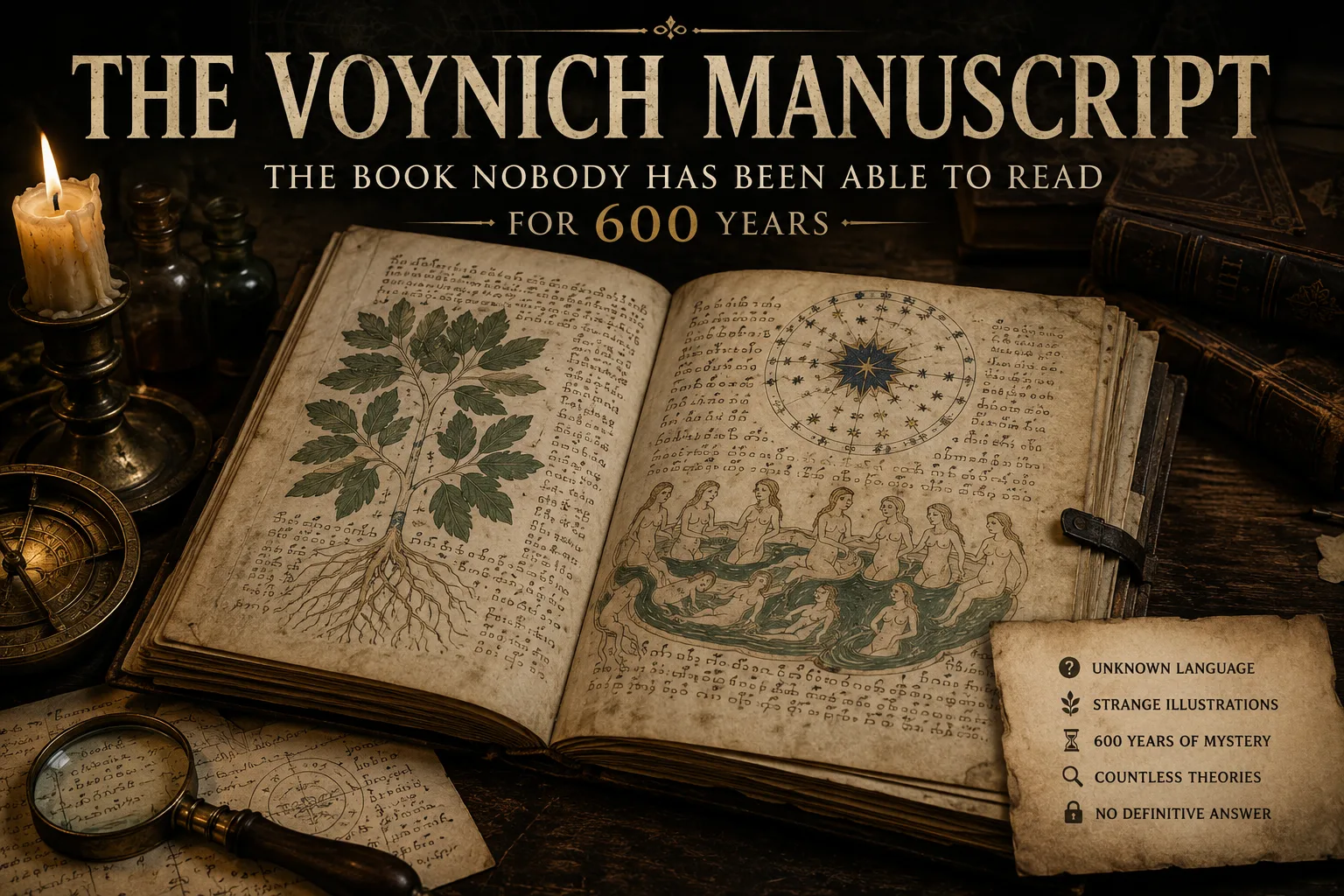
The Voynich Manuscript: The Book Nobody Has Been Able to Read for 600 Years
Filled with strange plants, mysterious star charts, unknown symbols, and a language that nobody has successfully decoded, the Voynich Manuscript has puzzled scholars for more than six centuries. Is it an encrypted scientific encyclopedia, an elaborate medieval hoax, or a forgotten language lost to history? Explore one of the world's greatest unsolved mysteries.
The Voynich Manuscript: The Book Nobody Has Been Able to Read for 600 Years
Locked inside a secure library at Yale University rests a book unlike any other in human history.
Its pages are filled with elegant handwriting.
Its illustrations depict plants that appear to belong to no known species.
Its diagrams resemble stars, constellations, strange machinery, and mysterious biological systems.
Scattered throughout the manuscript are hundreds of drawings of unidentified women bathing in elaborate networks of green pools and pipes.
Most astonishing of all...
Nobody knows what any of it means.
For more than six centuries, some of the world's brightest minds have tried to decipher its text.
Historians.
Linguists.
Cryptographers.
Codebreakers.
Mathematicians.
Artificial intelligence researchers.
Even military cryptanalysts who successfully broke enemy codes during the World Wars have studied its pages.
None has produced a universally accepted translation.
The book has become known as the Voynich Manuscript, and despite modern technology, it remains one of history's greatest unsolved mysteries.
Is it an encrypted scientific encyclopedia?
A forgotten language?
A medieval masterpiece hiding dangerous knowledge?
Or one of the most elaborate hoaxes ever created?
To understand why this manuscript continues to resist explanation, we must begin with the book itself.
A Book That Shouldn't Exist
At first glance, the Voynich Manuscript resembles an ordinary medieval book.
It contains approximately 240 surviving pages, although researchers believe several pages have been lost over the centuries.
The pages are made from vellum, a high-quality writing material prepared from animal skin that was commonly used before paper became widespread in Europe.
Its text flows neatly from left to right.
Paragraphs are carefully organized.
Characters repeat in recognizable patterns.
Illustrations are placed deliberately throughout the manuscript.
Nothing about its construction appears random.
Yet one problem immediately becomes obvious.
Nobody recognizes the language.
🟢 Historical Fact
Scientific analysis confirms that the manuscript is a genuine medieval artifact rather than a modern forgery.
Radiocarbon dating of the vellum places its creation between 1404 and 1438, making it more than six hundred years old.
The Man Who Gave the Manuscript Its Name
Although the manuscript itself dates to the fifteenth century, its modern story begins much later.
In 1912, a Polish-American rare book dealer named Wilfrid Voynich discovered the mysterious volume while examining manuscripts at the Villa Mondragone, a Jesuit college near Rome.
Voynich immediately realized the book was extraordinary.
Despite his experience handling rare manuscripts, he had never seen anything similar.
Because no known language matched its writing system, the manuscript eventually became known by his surname:
The Voynich Manuscript.
For the rest of his life, Voynich attempted to solve its mystery.
He never succeeded.
A Language Nobody Can Read
Perhaps the manuscript's most fascinating feature is its writing.
The pages contain roughly 170,000 individual characters, arranged into thousands of words.
At first glance, the script appears surprisingly natural.
Certain symbols appear frequently.
Others are rare.
Words follow grammatical-looking patterns.
Paragraphs begin with larger decorative characters.
Repeated phrases occur throughout the text.
To experienced linguists, it behaves remarkably like a genuine language.
Yet no one has identified it.
It matches neither Latin nor any known medieval European language.
It doesn't correspond to Arabic, Hebrew, Greek, Sanskrit, Chinese, or any recognized writing system.
The alphabet itself appears unique.
Researchers often refer to it simply as:
Voynichese.
🟢 Historical Fact
Computer analysis has shown that the manuscript's word patterns are far too structured to resemble random gibberish.
The text follows statistical properties similar to natural human languages, although its exact meaning remains unknown.
The Strange Illustrations
If the writing puzzles researchers, the illustrations are equally bewildering.
The manuscript appears to be divided into several thematic sections.
Each raises new questions.
Botanical Pages
Nearly half the manuscript contains detailed drawings of plants.
At first, scholars assumed they represented medieval medicinal herbs.
But there is a problem.
Most of the plants cannot be confidently identified.
Some appear to combine features from several different species.
Others resemble no known plant on Earth.
Were the artist's drawings inaccurate?
Have certain species disappeared?
Or are the illustrations entirely imaginary?
No consensus exists.
Astronomical Diagrams
Another section contains circular diagrams resembling astronomical charts.
Researchers have identified illustrations that appear to depict:
Stars
The Sun
The Moon
Zodiac symbols
Constellations
Several zodiac pages include groups of women arranged around celestial circles.
Their exact purpose remains unknown.
Biological Pages
Perhaps the manuscript's most unusual section features dozens of unclothed women immersed in elaborate networks of green pools connected by pipes and channels.
Some researchers believe these images represent:
Human anatomy
Medieval medicine
Fertility
Alchemy
Spiritual symbolism
Others argue they may depict something entirely different.
No interpretation has gained universal acceptance.
Pharmaceutical Pages
Toward the end of the manuscript appear drawings resembling jars, containers, roots, leaves, and medicinal preparations.
This has led some historians to speculate that the manuscript could be a medical or herbal reference.
Again, certainty remains elusive.
Who Wrote It?
The identity of the author remains one of the manuscript's greatest mysteries.
Over the centuries, several famous individuals have been proposed.
These include:
Roger Bacon
John Dee
Edward Kelley
Unknown medieval physicians
Monastic scholars
Most modern historians reject these specific attributions because the manuscript's confirmed age does not match the lifetimes of some proposed authors.
At present, the true author remains unknown.
🟡 Historical Possibility
The manuscript may have been created by a single highly educated individual or by multiple contributors over several years.
No surviving historical record conclusively identifies its creator.
A Puzzle That Defeated the World's Best Codebreakers
As news of the manuscript spread, experts from around the world attempted to decode it.
Some of the people who studied it had extraordinary credentials.
Professional cryptographers.
Military intelligence specialists.
Academic linguists.
Even codebreakers who helped decipher encrypted communications during the First and Second World Wars examined its pages.
They searched for:
Hidden ciphers
Mathematical patterns
Letter substitutions
Secret alphabets
Compression systems
None produced a convincing solution accepted by the scholarly community.
Every proposed translation eventually encountered serious problems.
The manuscript continued to resist explanation.
Modern Computers Join the Search
The arrival of computers transformed the investigation.
Instead of manually counting symbols, researchers could analyze every character statistically.
Artificial intelligence has added another powerful tool.
Machine learning systems have searched for similarities between Voynichese and hundreds of known languages.
Some studies suggested possible connections.
Others found none.
While AI has revealed fascinating structural patterns, it has not translated the manuscript.
Ironically, one of humanity's most advanced technologies still cannot confidently read a six-hundred-year-old book.
🔴 Legend / Unverified Claim
From time to time, headlines claim that the Voynich Manuscript has finally been "decoded."
So far, none of these announcements has gained acceptance from the broader academic community.
As of today, there is no universally accepted translation of the manuscript.
A Trail of Owners Across Six Centuries
One reason the Voynich Manuscript remains so difficult to understand is that much of its early history has been lost.
Unlike many famous medieval books, there is no surviving record describing who commissioned it, why it was written, or how it traveled across Europe during its earliest years.
Researchers have managed to reconstruct only portions of its journey.
The first reliable clues appear in the seventeenth century.
The manuscript eventually came into the possession of Georg Baresch, an alchemist living in Prague.
Unable to understand the strange text, Baresch sent copies of several pages to the Jesuit scholar Athanasius Kircher, one of Europe's most respected linguists.
Kircher was famous for attempting to decipher ancient Egyptian hieroglyphs and had a reputation for solving difficult linguistic puzzles.
Baresch hoped Kircher might succeed where everyone else had failed.
After Baresch's death, the manuscript passed to another scholar before eventually reaching Kircher himself.
From there, its trail largely disappears for centuries until Wilfrid Voynich rediscovered it in 1912.
🟢 Historical Fact
Letters exchanged between Georg Baresch, Johannes Marcus Marci, and Athanasius Kircher still survive today. These documents provide the earliest confirmed historical references to the manuscript and show that scholars were already unable to read it nearly four hundred years ago.
Why Can't Anyone Read It?
At first glance, the solution seems simple.
Surely someone could compare the symbols to known alphabets and decode the message.
Yet every serious attempt has encountered the same obstacle.
The manuscript behaves like a real language without matching any known one.
Researchers have observed that:
Frequently used words appear in predictable positions.
Certain symbols almost always occur together.
Some "words" appear only in specific sections.
Sentence lengths resemble natural writing.
Word repetition follows recognizable linguistic patterns.
If it is a hoax, it is an extraordinarily sophisticated one.
If it is a language, it belongs to no known linguistic family.
This unusual combination is precisely what makes the manuscript so fascinating.
The Leading Theories
Over the past century, scholars have proposed dozens of explanations.
Some are supported by evidence.
Others remain highly speculative.
Let's examine the most influential theories.
Theory 1: An Encrypted Scientific Encyclopedia
Many historians believe the manuscript may be an encrypted reference book.
Supporters point to:
Botanical illustrations.
Astronomical diagrams.
Medical imagery.
Repeated structural patterns.
According to this theory, the author intentionally encrypted the contents to protect valuable scientific or medical knowledge.
During the Middle Ages, certain knowledge was often closely guarded.
Medical formulas, alchemical experiments, and philosophical writings could be considered valuable intellectual property.
A cipher would have protected that information.
🟡 Historical Possibility
Encryption techniques certainly existed during the medieval period.
However, no known cipher has successfully decoded the Voynich Manuscript.
Whether it uses encryption at all remains uncertain.
Theory 2: A Lost Language
Some linguists believe the manuscript records a genuine language that has since disappeared.
History contains many examples of extinct languages.
Some vanished because entire civilizations disappeared.
Others slowly evolved into modern languages.
If the manuscript represents one such language, it may simply lack enough surviving examples for comparison.
This theory explains why the text behaves naturally while remaining unreadable.
The challenge is obvious.
Without another document written in the same language, verification becomes extremely difficult.
Theory 3: An Elaborate Hoax
Could the entire manuscript simply be meaningless?
Some researchers have argued exactly that.
According to this theory, the author created an impressive-looking book to convince wealthy collectors that it contained rare secret knowledge.
The illustrations, unusual alphabet, and mysterious appearance would have increased its value.
However, this explanation faces several problems.
Creating hundreds of pages of statistically consistent nonsense would have required an astonishing amount of time and effort.
Modern computer analysis suggests the writing follows patterns unlikely to result from random invention alone.
A hoax remains possible, but many experts believe it would have been an extraordinarily sophisticated one.
Theory 4: An Invented Writing System
Another proposal suggests the manuscript was written in a private script created by its author.
The underlying language may not be mysterious at all.
Only the alphabet is.
Throughout history, scholars, monks, and secret societies occasionally developed their own writing systems.
If the key to this alphabet has been lost, the manuscript becomes almost impossible to read.
This theory continues to receive serious academic attention.
Artificial Intelligence Joins the Investigation
In recent years, AI has become one of the newest tools in the search for answers.
Machine learning systems can compare millions of linguistic patterns far faster than humans.
Researchers have asked AI to:
Compare Voynichese with known languages.
Detect grammatical structures.
Identify repeated sequences.
Search for hidden encryption methods.
Predict possible word boundaries.
AI has uncovered intriguing statistical similarities between the manuscript and natural human languages.
Yet it has not solved the mystery.
The manuscript continues to resist interpretation.
Ironically, a document created over six hundred years ago remains unreadable even in the age of artificial intelligence.
Why Scholars Still Disagree
Unlike many historical mysteries, the Voynich Manuscript provides an overwhelming amount of evidence.
The problem isn't the lack of information.
The problem is that every piece of information supports multiple interpretations.
The handwriting appears genuine.
The vellum is authentic.
The illustrations are deliberate.
The language follows consistent rules.
Yet none of these facts reveal what the manuscript actually says.
Every new study seems to answer one question while raising two more.
That is why, after decades of research, scholarly debate continues.
Frequently Asked Questions
Has anyone successfully translated the Voynich Manuscript?
No.
Numerous individuals have claimed to decipher it, but none of their translations has gained broad acceptance among historians or linguists.
Where is the manuscript today?
The Voynich Manuscript is preserved in the Beinecke Rare Book and Manuscript Library at Yale University in the United States.
Is it written in code?
Possibly.
Some researchers believe it uses encryption, while others argue it represents an unknown language or writing system.
There is currently no consensus.
Could artificial intelligence eventually solve it?
It is possible.
Future advances in AI, computational linguistics, or the discovery of related historical documents could provide new breakthroughs.
For now, however, the manuscript remains undeciphered.
Final Thoughts
The Voynich Manuscript stands apart from most historical mysteries because its central puzzle is tangible. It is not a story passed down through folklore or a legend preserved in fragments. The book exists. Its pages can be examined, photographed, and studied by anyone with access to it.
Science has already answered some important questions. Radiocarbon dating confirms the manuscript is genuinely medieval. Its ink, vellum, and construction fit the period in which it was created. The mystery is not whether the book is real. The mystery is why no one can read it.
Perhaps it contains encrypted scientific knowledge. Perhaps it records a forgotten language. Perhaps it is the product of an extraordinary imagination. Or perhaps the correct explanation has not yet been considered.
Every generation has believed it possessed the tools necessary to solve the puzzle. Renaissance scholars, military codebreakers, modern linguists, and artificial intelligence have all taken their turn. None has delivered a universally accepted answer.
Until that changes, the Voynich Manuscript remains one of history's most remarkable reminders that even in an age of supercomputers and machine learning, humanity can still be humbled by a quiet little book written more than six centuries ago, patiently waiting for someone who finally understands its language.