The Roanoke Colony Mystery: How 117 People Vanished Without a Trace
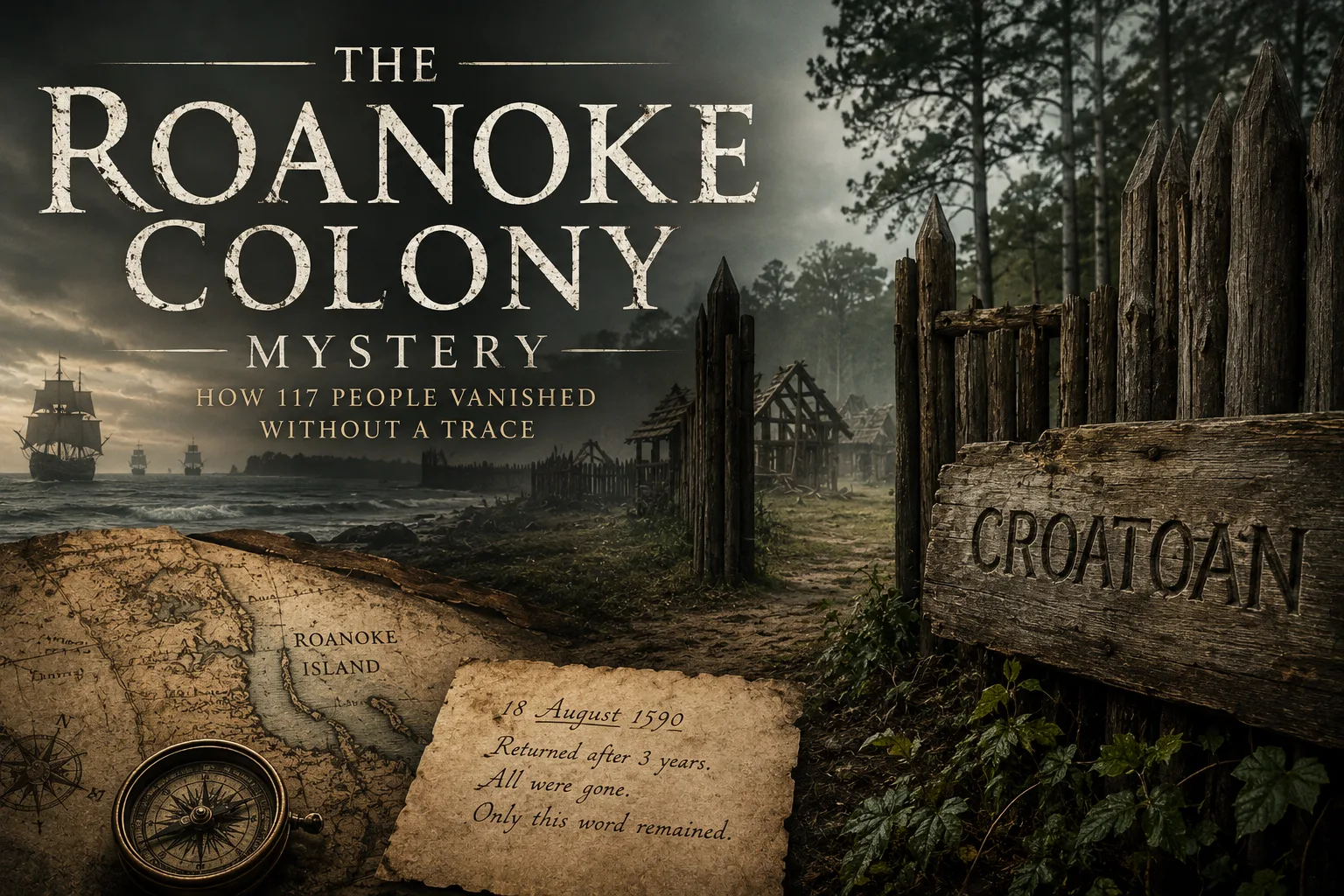
In 1590, English governor John White returned to North America's first English colony after a three-year absence. Instead of finding 117 settlers, he found deserted buildings and a single mysterious word carved into wood: "CROATOAN." No bodies. No signs of battle. No explanation. More than four centuries later, the fate of the Lost Colony of Roanoke remains one of history's greatest unsolved mysteries.
The Roanoke Colony Mystery: How 117 People Vanished Without a Trace
On a warm August day in 1590, English governor John White finally returned to Roanoke Island after a journey that had taken far longer than anyone had expected.
Three years earlier, he had left behind 117 men, women, and children with a promise.
He would return with supplies.
Instead, war between England and Spain delayed his voyage, forcing him to remain in Europe while the colony survived on its own.
When White's ships finally reached the island, he expected to hear familiar voices and see the settlement bustling with activity.
Instead...
There was silence.
The houses still stood.
The fortifications remained.
There were no signs of battle.
No burned buildings.
No scattered belongings.
No graves.
No bodies.
The entire colony had vanished.
Only one clue remained.
Carved into a wooden post was a single word:
CROATOAN
More than four centuries later, historians still cannot say with certainty what happened to the settlers of Roanoke.
Their disappearance remains one of the oldest and most enduring mysteries in American history.
Before the Mystery Began
To understand the disappearance, we first need to understand why the colony existed in the first place.
During the late sixteenth century, European powers were racing to establish colonies across the Americas.
Spain had already built a vast overseas empire.
Portugal controlled profitable trade routes.
England, however, had fallen behind.
Queen Elizabeth I wanted England to compete with its rivals by establishing permanent settlements in North America.
One of the men leading this effort was Sir Walter Raleigh, an English explorer, writer, and favorite of the Queen.
In 1584, Raleigh received royal permission to establish England's first colony in the New World.
The chosen location was a small island off the coast of present-day North Carolina.
It would later become known simply as:
Roanoke.
🟢 Historical Fact
Although Sir Walter Raleigh organized the colonization effort, he never personally visited Roanoke.
Instead, he financed expeditions and appointed governors to oversee the settlement.
England's First Attempts
The first expedition reached Roanoke in 1585.
Rather than establishing a permanent civilian settlement, it consisted mainly of soldiers and explorers.
Life proved far more difficult than expected.
Food shortages became common.
Relations with some Indigenous communities deteriorated.
Supply lines from England were unreliable.
Within a year, the settlers abandoned the colony and returned home.
Many English officials viewed the expedition as a failure.
Yet Raleigh refused to give up.
A second attempt would soon follow.
A New Beginning
In 1587, another expedition sailed toward North America.
This time, the mission was different.
Instead of soldiers, many of the passengers were families hoping to build permanent lives.
Among them were:
Farmers
Craftsmen
Women
Children
Leading them was John White, an experienced artist and explorer who had previously visited the region.
His responsibility was enormous.
He was expected to establish England's first lasting colony in North America.
The First English Child Born in America
One event from the expedition would become famous in its own right.
Soon after arriving, White's daughter, Eleanor Dare, gave birth to a baby girl.
She was named:
Virginia Dare.
She is widely recognized as the first English child born in North America.
For the settlers, her birth symbolized hope.
It suggested that this harsh frontier might truly become a permanent home.
Unfortunately, that hope would not last.
🟢 Historical Fact
Virginia Dare was born on 18 August 1587.
Her birth is well documented through surviving colonial records.
What happened to her afterward remains unknown.
Trouble Begins Almost Immediately
The settlers quickly discovered that establishing a colony was far harder than imagined.
Food supplies were limited.
Relations with nearby Indigenous groups were complicated.
Agriculture had barely begun.
Winter was approaching.
The colonists urgently needed additional supplies from England.
The settlers insisted that John White return home to organize a relief expedition.
Although reluctant to leave his family behind, White agreed.
He expected to return within a few months.
Instead...
Events beyond his control changed everything.
The War That Changed the Timeline
Just as White reached England, Europe entered one of its most significant conflicts.
King Philip II of Spain was preparing a massive naval invasion of England.
Queen Elizabeth ordered nearly every available English ship to assist in national defense.
Civilian voyages across the Atlantic became nearly impossible.
Then, in 1588, the famous Spanish Armada sailed toward England.
The conflict delayed White's return year after year.
By the time he finally secured passage back to Roanoke, nearly three years had passed.
For the settlers waiting across the ocean, those years must have felt endless.
🟢 Historical Fact
The war with Spain is the primary reason John White could not immediately return to Roanoke.
This delay is extensively documented in English historical records.
The Return to an Empty Colony
On 18 August 1590, coincidentally Virginia Dare's third birthday, John White stepped ashore at Roanoke.
What he found has puzzled historians ever since.
The settlement had been abandoned.
The houses had been carefully dismantled rather than destroyed.
The defensive fort showed no signs of attack.
There were no skeletons.
No graves.
No weapons scattered across the ground.
No evidence of panic.
Instead, everything suggested the settlers had left deliberately.
It looked less like the aftermath of a disaster and more like a carefully organized departure.
White immediately searched for clues.
He remembered an agreement made before he left.
If the settlers relocated, they would leave a message indicating where they had gone.
If they departed under danger or attack, they would carve a Maltese cross beside the message.
White searched every visible surface.
Finally, he found one word carved into a wooden palisade:
CROATOAN
On a nearby tree appeared a shorter inscription:
CRO
There was no cross.
To White, this suggested the settlers had not fled under immediate threat.
Perhaps they had simply moved.
But where?
And why?
🟢 Historical Fact
The words "CROATOAN" and "CRO" are recorded in John White's own journal, making them among the most reliable pieces of evidence in the entire mystery.
Their meaning, however, remains the subject of debate.
The First Theory Emerges
White immediately believed he understood the message.
Croatoan was the name of a nearby island, now known as Hatteras Island, and also the name of the Indigenous people who lived there.
White planned to sail there immediately.
If the settlers had relocated, he might still find them alive.
But nature intervened once again.
A violent storm prevented further exploration.
His crew refused to continue.
With no supplies and worsening weather, White was forced to abandon the search.
He sailed back to England.
He would never return to Roanoke.
Neither would anyone ever see the original settlers again.
What Did "CROATOAN" Really Mean?
Among all the unanswered questions surrounding Roanoke, none is more famous than the single word carved into the wooden palisade:
CROATOAN
At first glance, it appears to be little more than a place name.
But to historians, it represents the colony's only direct message.
Before John White departed for England, he and the settlers had agreed upon a simple system.
If the colonists needed to relocate, they would carve their destination where it could easily be found.
If they left because of danger, they would also carve a Maltese cross as a distress signal.
White found no cross.
That detail has shaped historical thinking ever since.
Rather than suggesting violence, the message implied an organized relocation.
The obvious destination was Croatoan Island, now known as Hatteras Island, located roughly 80 kilometers (50 miles) south of Roanoke.
The Croatoan people had previously maintained relatively friendly relations with the English settlers.
If the colony faced starvation, relocating to allies would have been a logical decision.
Unfortunately, White never reached the island.
Storms forced his ships back to England, leaving history with one unanswered clue and no eyewitnesses.
The Leading Theories
Over the centuries, historians have proposed several explanations for the disappearance.
Some are supported by evidence.
Others remain speculation.
Let's examine them one by one.
Theory 1: The Settlers Joined the Croatoan People
This is the explanation most historians consider the strongest.
After White left for England, the colony faced increasingly difficult conditions.
Food supplies were uncertain.
Assistance from England never arrived.
Moving to Croatoan Island may have offered the best chance of survival.
Historical accounts suggest the Croatoan people were more welcoming toward the English than some neighboring groups.
Living alongside them would have provided:
Reliable food sources.
Local agricultural knowledge.
Hunting and fishing skills.
Protection from hostile groups.
Some later English explorers even reported meeting Indigenous communities whose customs or physical features appeared partly European.
While these observations are not conclusive proof, they keep the theory alive.
🟡 Historical Possibility
Archaeological discoveries on Hatteras Island have uncovered English artifacts dating to the late sixteenth century.
These finds suggest some interaction between English settlers and Indigenous communities, although they do not conclusively prove that the entire Roanoke colony relocated there.
Theory 2: The Settlers Moved Inland
Another possibility is that the colonists traveled inland rather than toward Croatoan Island.
This idea gained attention after researchers studying an old map created by John White noticed something unusual.
Hidden beneath a small paper patch appeared what some believe may represent a fort located inland.
Could White have secretly marked an intended relocation site?
Modern archaeological excavations at locations associated with this map have uncovered several sixteenth-century English artifacts.
However, historians caution that the discoveries remain open to interpretation.
The evidence suggests English activity in the region, but not necessarily the presence of the entire colony.
Theory 3: Disease and Starvation
Life in sixteenth-century North America was extraordinarily difficult.
The settlers arrived with limited supplies.
They faced unfamiliar weather, uncertain harvests, and dependence on supply ships that never arrived.
Some historians believe the colony gradually declined through:
Hunger.
Disease.
Malnutrition.
Harsh environmental conditions.
Survivors may then have dispersed among nearby Indigenous communities.
This theory fits many known historical patterns from early colonial settlements.
Theory 4: Conflict with Indigenous Groups
For many years, popular books suggested the colonists were attacked and killed.
Today, historians are more cautious.
Relations between the English and local Indigenous nations varied greatly.
Some communities were allies.
Others were hostile.
An attack cannot be ruled out completely.
However, several observations make this explanation less convincing:
No mass graves were found.
Buildings were dismantled rather than burned.
No obvious signs of violent struggle were reported.
The absence of the agreed distress symbol suggests the settlers did not leave under immediate attack.
Violence may have occurred later, but the evidence does not strongly support a sudden massacre at Roanoke itself.
Archaeology Enters the Mystery
For centuries, historians relied almost entirely on written records.
Modern archaeology has changed the investigation.
Excavations on Hatteras Island have uncovered:
English pottery.
Metal tools.
Gun parts.
Personal objects dating to the Roanoke period.
These discoveries indicate contact between English settlers and Indigenous communities.
At inland excavation sites, archaeologists have also recovered European artifacts consistent with late sixteenth-century occupation.
None of these discoveries solve the mystery outright.
Instead, they suggest that the settlers may have split into smaller groups rather than remaining together.
🟢 Historical Fact
No archaeological excavation has uncovered definitive evidence showing exactly where all 117 settlers ultimately lived or died.
The available evidence points toward several plausible possibilities rather than a single confirmed conclusion.
DNA and Modern Research
As genetic genealogy has advanced, researchers have wondered whether descendants of the Lost Colony might still exist.
Some Indigenous communities and families in the southeastern United States have oral traditions describing ancestors of mixed English and Native heritage dating back to the late sixteenth century.
Scientists have explored whether DNA studies might eventually clarify these connections.
So far, however, no genetic research has conclusively identified descendants of the Roanoke settlers.
The challenge is enormous.
More than four centuries have passed.
Records are incomplete.
Countless family lines have merged over generations.
While DNA remains a promising research tool, it has not yet provided a definitive answer.
Why Historians Still Disagree
Unlike many historical mysteries, Roanoke does not suffer from a complete lack of evidence.
Instead, it suffers from incomplete evidence.
Every important clue seems to support more than one interpretation.
The word "CROATOAN."
The archaeological discoveries.
The map.
The oral traditions.
Each provides part of the puzzle.
None provides the complete picture.
As a result, historians continue to debate the colony's fate rather than declaring the mystery solved.
Frequently Asked Questions
Was the Roanoke Colony ever found?
No.
Although archaeological discoveries have provided valuable clues, historians have not identified a single site that conclusively explains the fate of all 117 settlers.
What does "CROATOAN" mean?
It was both the name of an Indigenous people and the nearby island where they lived, now called Hatteras Island.
Most historians believe it indicated a destination rather than a warning.
Were the settlers killed?
There is no convincing evidence that the entire colony was massacred.
Most modern researchers consider gradual relocation and assimilation more likely than sudden destruction.
Why is the mystery still unsolved?
The disappearance occurred in the late sixteenth century, when written records were limited and archaeological evidence is fragmentary.
Without new discoveries, many questions may never be answered with certainty.
Final Thoughts
The mystery of Roanoke has endured for more than four hundred years because it occupies a rare space between history and uncertainty.
We know the settlers existed. We know they built a colony. We know John White returned to find it deserted, with only the word "CROATOAN" left behind. These facts are firmly documented.
What happened afterward remains one of history's greatest unanswered questions.
The most convincing evidence suggests that at least some settlers likely left Roanoke voluntarily, seeking survival among nearby Indigenous communities rather than waiting for help that never arrived. Archaeological discoveries and historical records point in that direction, even if they stop short of proving it beyond doubt.
Yet the absence of definitive proof is precisely what has kept the story alive for generations. Every new excavation, historical document, or scientific technique offers the possibility that another piece of the puzzle may emerge.
Perhaps one day the Lost Colony will no longer be known for its disappearance but for the remarkable story of adaptation and survival that followed. Until then, Roanoke remains a reminder that history is not only written in books and monuments. Sometimes it survives in a single carved word, a handful of artifacts, and the enduring questions that refuse to fade.