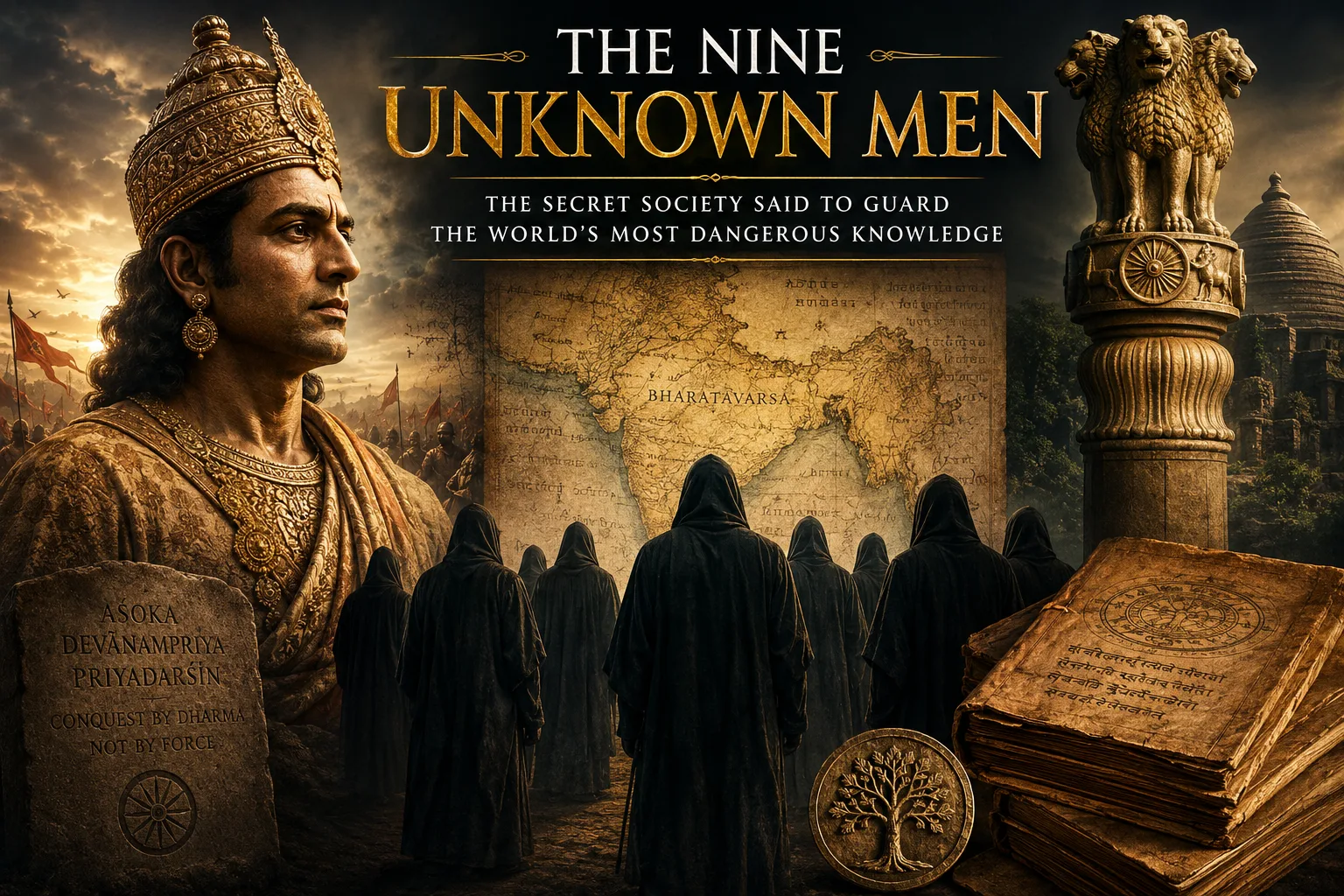
The Nine Unknown Men: The Secret Society Said to Guard the World's Most Dangerous Knowledge
Did Emperor Ashoka create a secret society to hide knowledge too dangerous for humanity? For nearly two thousand years, legends have spoken of the mysterious Nine Unknown Men, guardians of forbidden sciences whose existence remains one of India's most fascinating historical enigmas. Explore the origins of the legend, the historical evidence, and the theories that continue to intrigue researchers today.
The Nine Unknown Men: The Secret Society Said to Guard the World's Most Dangerous Knowledge
For more than two thousand years, one legend has quietly lingered in the shadows of Indian history.
It speaks of nine extraordinary individuals, each entrusted with knowledge so powerful that, if placed in the wrong hands, it could reshape civilizations or destroy them.
According to the story, these men were chosen by Emperor Ashoka, one of India's greatest rulers, after witnessing the unimaginable horrors of the Kalinga War. Their mission was unlike that of any known royal council, military order, or religious institution.
They were to become the guardians of forbidden knowledge.
No monuments bear their names.
No confirmed royal inscriptions describe their activities.
No definitive archaeological discovery proves they ever existed.
Yet the legend refuses to disappear.
For centuries, writers, historians, explorers, and conspiracy theorists have debated whether the Nine Unknown Men were a real secret society, a symbolic legend, or an elaborate myth inspired by history. Stories claim they protected advanced scientific knowledge, influenced world events from the shadows, and passed their responsibilities from one generation to the next.
Were they history's first secret scientific council?
Or simply one of India's greatest legends?
Separating fact from fiction is not easy.
This article examines the origins of the legend, the historical events that may have inspired it, and the evidence that continues to fuel one of India's most enduring mysteries.
A Story Begins with a War
To understand the legend of the Nine Unknown Men, we must first understand the man who was said to have created them.
Long before he became known as Ashoka the Great, he ruled as one of the most ambitious monarchs of the Mauryan Empire.
Founded by Chandragupta Maurya in the 4th century BCE, the Mauryan Empire stretched across much of the Indian subcontinent. By the time Ashoka inherited the throne, it was already one of the largest political powers of the ancient world.
Yet one kingdom remained outside his control.
Kalinga, located along the eastern coast of present-day India.
Around 261 BCE, Ashoka launched a military campaign against Kalinga.
The battle would change Indian history forever.
The Kalinga War
Unlike many ancient battles whose details have been lost over time, the Kalinga War is unusually well documented.
Ashoka himself described its consequences in what is now known as the 13th Major Rock Edict.
According to the inscription:
Approximately 100,000 people were killed.
Around 150,000 people were deported.
Countless others suffered through famine, displacement, and disease in the aftermath.
Although ancient casualty figures should always be interpreted cautiously, historians broadly agree that the war was exceptionally destructive.
More importantly, Ashoka claimed that witnessing this suffering transformed him completely.
Instead of celebrating victory, he expressed deep remorse.
This moment became one of history's most remarkable political transformations.
🟢 Historical Fact
Ashoka's inscriptions are among the earliest surviving written records created by an Indian ruler.
Unlike legends written centuries later, these inscriptions were commissioned during his reign, making them one of the most reliable primary sources for understanding his beliefs and policies.
They clearly show that after the Kalinga War, Ashoka embraced Dhamma, promoted non-violence, encouraged religious tolerance, and invested heavily in public welfare.
From Conqueror to Guardian of Peace
Following the war, Ashoka redirected the empire's priorities.
Instead of expanding through military conquest, he focused on governance and moral responsibility.
Historical records describe initiatives such as:
Building hospitals.
Planting trees along roads.
Digging wells for travelers.
Constructing rest houses.
Supporting Buddhist monasteries.
Sending diplomatic and religious missions abroad.
This transformation made Ashoka one of the most respected rulers in world history.
It also created the perfect foundation for a legend.
If a ruler had witnessed unimaginable destruction, what would he do if he believed certain forms of knowledge could one day cause even greater devastation?
This question lies at the heart of the Nine Unknown Men story.
The Legend of the Nine Unknown Men
According to later accounts, Ashoka feared that humanity could misuse certain scientific discoveries.
Rather than destroying this knowledge, he supposedly chose another path.
He selected nine of the wisest scholars in his empire.
Each scholar became responsible for preserving and expanding one specific field of knowledge.
Their identities would remain secret.
Their work would continue in absolute secrecy.
When one guardian died, another would quietly replace him.
Generation after generation.
Century after century.
The organization would never disappear.
Its members would simply remain...
unknown.
🟡 Historical Possibility
There is no contemporary Mauryan inscription or archaeological evidence confirming the existence of such a secret society.
The earliest detailed descriptions appear much later in modern writings rather than in surviving records from Ashoka's reign.
However, ancient kingdoms frequently relied on confidential advisers, scholars, and intelligence networks, making the concept of a small circle of trusted experts historically plausible, even if the specific legend remains unverified.
The Nine Books of Forbidden Knowledge
Perhaps the most fascinating part of the legend concerns the nine books each guardian supposedly protected.
Different versions of the story describe different subjects, but the most commonly repeated list includes:
Book | Alleged Subject |
|---|---|
1 | Propaganda and psychological influence |
2 | Physiology and the mysteries of the human body |
3 | Microbiology and invisible organisms |
4 | Alchemy and transformation of matter |
5 | Communication across vast distances |
6 | Gravitation and the manipulation of gravity |
7 | Cosmology and the structure of the universe |
8 | Light, energy, and advanced physics |
9 | Sociology and the rise and fall of civilizations |
To modern readers, several of these subjects sound surprisingly advanced.
This has fueled speculation that the books contained knowledge centuries ahead of their time.
Others argue that these descriptions were created much later and simply reflect modern scientific ideas projected onto an ancient legend.
Either way, the alleged contents remain one of the most intriguing aspects of the story.
How Did the Legend Become Famous?
Interestingly, the Nine Unknown Men were not widely known throughout recorded Indian history.
The legend gained significant international attention in the early twentieth century after French author Louis Jacolliot briefly mentioned a secret society associated with Ashoka.
Later, in 1923, British writer Talbot Mundy published the novel The Nine Unknown, transforming the legend into a globally recognized mystery.
Mundy presented the Nine Unknown Men as an ancient organization quietly protecting dangerous knowledge while influencing history from the shadows.
His novel blurred the line between fiction and folklore.
Many later books, documentaries, and internet articles repeated parts of the story, sometimes presenting literary ideas as historical fact.
This makes it especially important to distinguish documented history from later storytelling.
🔴 Legend / Unverified Claim
Claims that the Nine Unknown Men still operate today, possess advanced technology, secretly guide world governments, or have influenced major historical events are not supported by credible historical evidence.
These ideas belong to modern speculation and popular culture rather than verified history.
Did the Nine Unknown Men Really Exist?
This is the question that has fascinated historians, writers, and mystery enthusiasts for more than a century.
Unfortunately, there isn't a simple answer.
Unlike many famous historical figures, the Nine Unknown Men leave behind no confirmed inscriptions, royal decrees, coins, monuments, or archaeological evidence that can conclusively verify their existence.
Yet the absence of evidence does not automatically prove the legend false.
History often survives through fragments. Some events are preserved in stone, others in literature, and many disappear entirely.
The challenge is determining where the Nine Unknown Men belong.
What Does History Actually Tell Us?
Let's separate what historians generally agree upon from what remains uncertain.
Claim | Evidence |
|---|---|
Emperor Ashoka ruled the Mauryan Empire | 🟢 Strong historical evidence |
The Kalinga War took place | 🟢 Confirmed through Ashoka's inscriptions |
Ashoka embraced Buddhism after the war | 🟢 Well documented |
Ashoka promoted peace and public welfare | 🟢 Confirmed |
Ashoka created a secret society called the Nine Unknown Men | 🔴 No contemporary evidence |
Nine secret books existed | 🔴 Unverified |
The organization still exists today | 🔴 No historical evidence |
This distinction is important.
The legend begins with real history before gradually moving into speculation.
Could Such a Society Have Existed?
Although there is no direct evidence for the Nine Unknown Men themselves, the broader idea of secret groups preserving sensitive knowledge is not unusual in history.
Many civilizations restricted access to specialized knowledge.
Examples include:
Egyptian priesthoods protecting religious and astronomical knowledge.
Greek philosophical schools teaching only selected students.
Medieval guilds keeping craft techniques secret.
Chinese imperial courts restricting military technologies.
Ancient Indian traditions where certain knowledge was passed only from teacher to disciple.
Knowledge has often been treated as power.
In that sense, the idea that a ruler might protect dangerous information is historically plausible.
Whether Ashoka actually created such an organization is another matter entirely.
Why Would Ashoka Hide Knowledge?
This question forms the emotional core of the legend.
If the story has any historical inspiration, Ashoka's transformation after the Kalinga War offers a possible explanation.
Imagine witnessing unimaginable destruction.
Imagine believing that future discoveries could create even greater suffering.
Would you destroy that knowledge?
Or would you preserve it until humanity became wise enough to use it responsibly?
According to the legend, Ashoka chose the second path.
Whether that decision happened in reality remains unknown.
The Nine Books: Symbolism or Reality?
The mysterious books themselves deserve careful examination.
Many modern versions describe them as containing knowledge far ahead of their time.
Some believers argue they predicted discoveries in:
Medicine
Psychology
Communication
Physics
Biology
Sociology
However, historians point out an important problem.
The descriptions of these books largely appear in modern retellings rather than ancient Mauryan records.
This raises an obvious question.
Did ancient scholars truly possess this knowledge?
Or did later writers reinterpret old legends through the lens of modern science?
There is currently no evidence allowing historians to answer with certainty.
Why the Legend Refuses to Die
Most ancient legends eventually fade.
The Nine Unknown Men have done the opposite.
Their story continues to appear in:
Novels
Television documentaries
Podcasts
Internet forums
YouTube videos
Conspiracy literature
Why?
Part of the answer lies in human psychology.
People are naturally drawn to mysteries involving hidden knowledge.
The possibility that history contains forgotten secrets is endlessly compelling.
The Nine Unknown Men combine several irresistible themes:
A legendary emperor.
A devastating war.
Secret knowledge.
Hidden books.
Anonymous guardians.
Two thousand years of silence.
It reads almost like a historical thriller.
Popular Theories
Over time, several theories have emerged attempting to explain the legend.
Theory 1: The Secret Society Was Real
Supporters believe Ashoka genuinely created a hidden organization tasked with protecting dangerous knowledge.
According to this view, each member passed both their book and responsibilities to a successor, allowing the organization to survive through the centuries.
Evidence: None that has been historically verified.
Theory 2: The Legend Was Inspired by Real Advisers
Some researchers suggest the story may have grown from Ashoka's trusted circle of scholars, ministers, and Buddhist teachers.
Over generations, ordinary historical figures may have evolved into legendary guardians of secret knowledge.
This explanation aligns with how many historical myths develop.
Theory 3: A Literary Creation
Many historians believe the detailed modern version of the legend owes much to twentieth-century writers, particularly Talbot Mundy's 1923 novel.
In this interpretation, genuine historical events became blended with fiction until readers struggled to separate one from the other.
Theory 4: A Symbol Rather Than a Society
Perhaps the Nine Unknown Men were never intended to represent nine actual people.
Instead, they may symbolize an enduring idea:
Knowledge carries responsibility.
Some discoveries benefit humanity.
Others can be dangerous when misused.
Seen this way, the legend becomes less about hidden scholars and more about ethical stewardship.
Could the Legend Ever Be Proven?
Archaeology continues to reshape our understanding of ancient India.
New inscriptions, manuscripts, and excavation sites are discovered every decade.
Could future discoveries reveal evidence connected to the Nine Unknown Men?
It is possible.
But historians can only work with evidence that currently exists.
Until new discoveries emerge, the legend remains exactly that:
A fascinating possibility rather than an established historical fact.
Frequently Asked Questions
Did Emperor Ashoka mention the Nine Unknown Men?
No.
None of Ashoka's surviving inscriptions mention a secret society by that name.
Are the Nine Books real?
There is no verified historical evidence confirming that the books described in the legend ever existed.
Who first made the legend famous?
Although earlier references exist, the legend became widely known after Talbot Mundy's 1923 novel The Nine Unknown introduced it to an international audience.
Do historians believe the society existed?
Most historians remain skeptical due to the lack of contemporary evidence.
However, the legend continues to attract interest because it begins with genuine historical events surrounding Ashoka and the Mauryan Empire.
Final Thoughts
The mystery of the Nine Unknown Men lies not in what we know, but in what we don't.
History confirms that Emperor Ashoka witnessed one of the bloodiest wars of the ancient world and emerged profoundly changed. It confirms that he devoted much of his reign to peace, morality, and public welfare. Those facts alone make him one of history's most remarkable rulers.
Everything beyond that enters a far more uncertain landscape.
Did Ashoka create a secret society to guard dangerous knowledge? Were there really nine books containing extraordinary sciences? Have their guardians quietly passed these secrets from one generation to the next?
No surviving evidence allows us to answer "yes."
But neither has history completely erased the possibility that remarkable stories can grow from remarkable people.
Perhaps the greatest value of the Nine Unknown Men isn't whether they existed at all. Perhaps it is the question the legend asks of every generation:
If humanity possessed knowledge powerful enough to change the world, would we be wise enough to use it responsibly?
That question remains just as relevant today as it would have been in Ashoka's time, whether the Nine Unknown Men were real guardians of hidden knowledge or simply one of India's most enduring and captivating legends.