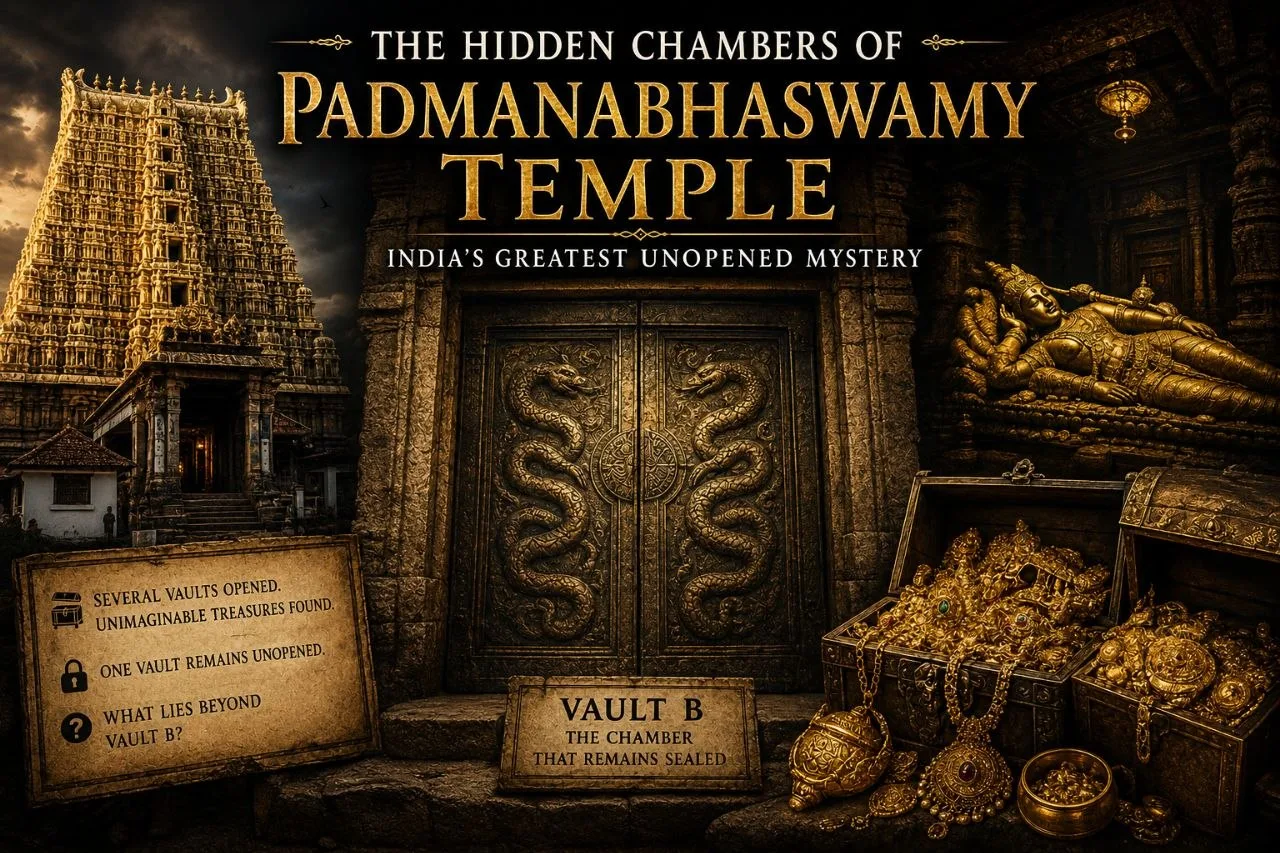
The Hidden Chambers of Padmanabhaswamy Temple: India's Greatest Unopened Mystery
Behind the ancient walls of Kerala's Padmanabhaswamy Temple lies one of the world's greatest unsolved mysteries. While several underground vaults revealed unimaginable treasures, one chamber, known simply as Vault B, remains unopened. Why has it never been unlocked? Is it protected by centuries-old tradition, legal restrictions, or something far more mysterious? Explore the history, evidence, and enduring legends surrounding India's most enigmatic temple.
The Hidden Chambers of Padmanabhaswamy Temple: India's Greatest Unopened Mystery
Beneath the granite floors of one of India's oldest and most revered temples lies a mystery that has fascinated historians, archaeologists, legal scholars, and millions of curious minds around the world.
It is not merely the staggering wealth hidden within its underground vaults that captures the imagination.
It is the existence of one chamber that has never been officially opened.
Known simply as Vault B, this sealed chamber has become the subject of countless theories, legends, and debates. Some believe it safeguards priceless historical treasures untouched for centuries. Others insist it was deliberately sealed to protect sacred traditions. More extraordinary claims suggest it conceals dangerous knowledge, divine relics, or ancient secrets that should never be disturbed.
What makes the mystery remarkable is that, unlike many famous legends, it is rooted in verifiable history.
The Padmanabhaswamy Temple exists.
Its underground vaults exist.
Several of them have been opened under court supervision.
Inside, officials discovered one of the greatest temple treasures ever documented.
Yet one chamber remains closed.
Not because modern technology cannot open it.
But because history, faith, tradition, and law have collided around a single ancient door.
So why has Vault B remained sealed when the others have not?
To answer that question, we must begin centuries before the discovery of the treasure itself.
A Temple Older Than Memory
Located in Thiruvananthapuram, the capital of Kerala, the Sree Padmanabhaswamy Temple is one of the most sacred temples dedicated to Lord Vishnu, who is worshipped here in his reclining form as Anantha Padmanabha.
Although the present structure reflects architecture from the medieval period, historians believe worship at the site dates back much earlier.
Ancient Tamil literature, temple traditions, and historical records suggest that the temple has been an important pilgrimage center for well over a thousand years.
Over the centuries it became more than a place of worship.
It evolved into a symbol of royal authority, spiritual devotion, artistic achievement, and immense wealth.
🟢 Historical Fact
The Padmanabhaswamy Temple is one of the 108 Divya Desams, the sacred Vishnu temples praised in the hymns of the Alvars, Tamil poet-saints whose devotional works date between the 6th and 9th centuries CE.
This recognition confirms the temple's religious importance long before many of the legends surrounding it emerged.
The Kingdom That Belonged to a God
The story of the temple cannot be separated from the history of the Kingdom of Travancore.
In 1750, Maharaja Anizham Thirunal Marthanda Varma made an extraordinary decision.
Instead of declaring himself the supreme ruler of his kingdom, he formally dedicated the entire kingdom to Lord Padmanabha in a ceremony known as Thrippadi Danam.
From that moment onward, the kings of Travancore referred to themselves not as owners of the kingdom but as:
"Padmanabha Dasa"
The Servant of Lord Padmanabha.
This was more than symbolism.
State revenues, royal ceremonies, and administrative traditions became closely tied to the temple.
Over generations, rulers, nobles, merchants, and devotees donated extraordinary wealth as offerings to the deity.
Gold coins.
Jewels.
Precious stones.
Golden ornaments.
Ancient idols.
Ceremonial weapons.
Rare artifacts.
Unlike royal treasuries that were frequently looted during wars, much of this wealth remained inside the temple for centuries.
The Vaults Beneath the Temple
Hidden beneath the temple complex are several underground chambers traditionally identified by letters such as:
Vault A
Vault B
Vault C
Vault D
Vault E
Vault F
For generations, these chambers remained largely undisturbed.
Temple authorities knew of their existence, but access was governed by centuries-old customs and strict religious protocols.
Most people outside the temple had little idea what they contained.
That would change dramatically in the twenty-first century.
A Discovery That Shocked the World
In 2011, following legal proceedings concerning the administration of the temple, the Supreme Court of India ordered an inventory of several underground vaults.
Teams consisting of officials, observers, and experts carefully opened multiple chambers under strict supervision.
What they discovered exceeded almost every expectation.
Inside the vaults were astonishing collections of:
Gold coins from different civilizations.
Diamond-studded ornaments.
Golden crowns.
Precious gemstones.
Ancient necklaces.
Solid gold idols.
Ceremonial objects.
Rare antiques.
Historical artifacts dating back centuries.
The estimated value of the treasure reached billions of dollars, making it one of the largest known collections of temple wealth in the world.
The discovery attracted international attention and transformed the temple into the center of one of history's greatest treasure stories.
🟢 Historical Fact
The existence of the treasure inside several vaults is well documented through court-supervised inventories and official records.
However, assigning an exact monetary value remains difficult because many artifacts possess immense historical, religious, and cultural significance that cannot be accurately measured in financial terms.
The Chamber That Was Never Opened
While several vaults were examined, one chamber remained untouched.
Vault B.
Unlike the others, this vault was treated differently from the beginning.
Temple traditions regarded it as exceptionally sacred.
According to long-standing beliefs, it should not be opened through ordinary means.
This immediately transformed Vault B from a physical location into one of India's greatest mysteries.
Why was it different?
Why had generations protected it?
What made this chamber unique?
These questions soon became the focus of intense public curiosity.
🟡 Historical Possibility
Historical records confirm that Vault B has long been associated with special religious traditions.
However, the precise reasons behind these customs remain difficult to establish because many temple practices are preserved through oral tradition rather than written documentation.
The Door Without a Lock
One of the most frequently discussed aspects of Vault B is its unusual entrance.
According to descriptions from people familiar with the chamber, the outer entrance differs from the more conventional vaults.
Popular accounts often describe an imposing door decorated with images of serpents, symbols closely associated with Lord Vishnu's cosmic serpent, Ananta.
Unlike ordinary doors, many descriptions claim there is no obvious lock or traditional locking mechanism visible from the outside.
This unusual appearance has contributed significantly to the chamber's mysterious reputation.
Over time, stories surrounding the entrance became increasingly dramatic.
Some believe the chamber can only be opened through ancient spiritual rituals.
Others argue these accounts are symbolic rather than literal.
Whatever the truth, the door itself has become almost as famous as whatever may—or may not—lie behind it.
🔴 Legend / Unverified Claim
A widespread legend claims Vault B is protected by a powerful Naga Bandham, a mystical seal that can only be opened through sacred mantras performed by spiritually accomplished individuals.
There is no historical or scientific evidence confirming this claim, and it remains part of temple folklore rather than documented history.
Why Has Vault B Never Been Opened?
More than a decade after the discovery of the temple's extraordinary treasures, the question remains unchanged:
Why does one chamber continue to remain sealed?
The answer is far more complex than many headlines suggest.
Vault B has remained closed not because scientists lack the ability to open it, nor because authorities have forgotten about it.
Instead, it sits at the intersection of religious tradition, legal proceedings, cultural heritage, and public curiosity.
Understanding why requires looking beyond the legends.
The Supreme Court and the Temple
The inventory of the temple vaults did not happen by chance.
In the early 2000s, concerns were raised regarding the administration and security of the temple's assets.
The matter eventually reached the Supreme Court of India, which ordered an inventory of the accessible vaults to document the treasures preserved within the temple.
Several chambers were opened under strict supervision.
Vault B, however, became an exception.
Its status generated immediate debate.
Temple authorities argued that the chamber occupied a unique religious position and should remain untouched according to centuries-old traditions.
Legal authorities, historians, and conservation experts approached the issue from different perspectives.
The discussion quickly became about far more than hidden treasure.
It became a question of balancing:
Religious freedom
Cultural preservation
Historical documentation
Legal responsibility
🟢 Historical Fact
In 2020, the Supreme Court restored the administrative rights of the Travancore royal family over the temple while recognizing the temple's unique religious traditions.
Although discussions surrounding Vault B continued, no order was issued requiring its forced opening.
The chamber therefore remains unopened.
The Legends Surrounding Vault B
Whenever history leaves unanswered questions, legends naturally fill the silence.
Vault B has accumulated many of them.
Some stories are centuries old.
Others appeared only after international media began covering the temple.
The Naga Bandham
Perhaps the best-known legend claims Vault B is protected by an ancient spiritual seal called Naga Bandham.
According to temple folklore, this seal was established through sacred rituals and cannot be broken using ordinary methods.
Some versions even claim that only highly accomplished spiritual masters, using specific mantras, could safely remove the seal.
If anyone attempted to force the door open, terrible consequences would supposedly follow.
🔴 Legend / Unverified Claim
There is no archaeological, historical, or scientific evidence confirming the existence of a supernatural seal protecting Vault B.
The Naga Bandham belongs to temple tradition and folklore rather than documented history.
Stories of Strange Sounds
Another popular claim suggests people approaching the chamber have reported hearing unusual sounds.
Different versions describe:
Flowing water
Ocean waves
Hissing snakes
Echoes from deep underground
These stories have become increasingly dramatic over time, especially on social media and in online videos.
However, none have been verified through official investigations.
Some researchers have suggested that underground architecture, enclosed spaces, or natural acoustics could easily produce unusual echoes inside ancient stone structures.
Without direct scientific study, such reports remain anecdotal.
Could There Be Another Chamber?
One theory proposes that Vault B may not be a single room at all.
Instead, it could serve as an entrance to additional underground passages.
Supporters of this idea point to the remarkable engineering of ancient Indian temples, many of which contain hidden corridors, drainage systems, and multiple architectural layers.
Some speculate that:
Additional treasure chambers may exist.
Secret ritual spaces could lie beyond.
Older temple structures may be buried beneath the current complex.
At present, there is no publicly available archaeological evidence confirming these possibilities.
Nevertheless, the temple's complex architecture continues to fuel speculation.
What Do Historians Think?
Professional historians generally approach Vault B with caution.
Rather than focusing on supernatural explanations, they emphasize historical context.
Many scholars point out that:
Ancient temples often contained restricted ceremonial areas.
Certain chambers were intended only for specific religious purposes.
Not every sealed room necessarily contains treasure.
Religious traditions frequently preserved spaces that were never meant for public access.
From this perspective, Vault B may be mysterious not because of what it contains, but because of how generations chose to protect it.
What Do Archaeologists Say?
Archaeologists tend to avoid dramatic conclusions in the absence of evidence.
Most agree that any future exploration should prioritize:
Structural safety.
Preservation of artifacts.
Religious sensitivity.
Scientific documentation.
Ancient underground chambers can be extremely fragile.
Opening them without proper planning could damage historical materials that have survived for centuries.
Sometimes, preserving a site is considered more valuable than satisfying public curiosity.
The Internet's Wildest Theories
As with many famous mysteries, the internet has produced countless extraordinary claims about Vault B.
Among them are stories involving:
Lost royal treasures.
Ancient weapons.
Secret scriptures.
Hidden tunnels leading beyond the temple.
Divine relics.
Supernatural guardians.
These theories often circulate widely because they are exciting to imagine.
However, none are supported by credible historical evidence.
Separating entertaining speculation from documented history is essential when studying mysteries like this one.
Could Vault B Ever Be Opened?
Technically, yes.
Physically opening the chamber is unlikely to be the greatest challenge.
The real question is whether it should be opened.
Any future decision would likely require agreement among:
Temple authorities.
Religious scholars.
Conservation experts.
Archaeologists.
Legal authorities.
The courts.
Until then, the chamber remains protected by both tradition and law.
Frequently Asked Questions
Has anyone officially entered Vault B?
There is no publicly available evidence confirming that the inner chamber of Vault B has been opened or fully explored in modern times.
Is there treasure inside Vault B?
Nobody knows for certain.
Because the chamber remains unopened, its contents remain unknown.
Claims about vast treasures are speculative.
Why wasn't it opened with the other vaults?
Temple authorities maintain that Vault B holds exceptional religious significance.
Legal proceedings have respected this position, and no order has required the chamber to be opened.
Is Vault B cursed?
There is no historical or scientific evidence supporting claims that the chamber is cursed.
Such ideas belong to folklore and popular storytelling rather than documented history.
Final Thoughts
The mystery of Vault B is compelling not because we know what's inside, but because we don't.
Unlike many famous legends, this mystery begins with indisputable facts. The Padmanabhaswamy Temple exists. Its underground vaults exist. Several of them contained one of the greatest documented collections of temple wealth ever discovered.
And then there is Vault B.
A chamber that remains closed.
Not because humanity lacks the tools to unlock it, but because history, faith, tradition, and modern law have collectively chosen restraint over curiosity.
Perhaps one day new evidence, archaeological discoveries, or legal decisions will reveal what lies beyond its ancient doorway.
Or perhaps the chamber will remain sealed, becoming one of those rare mysteries that endures precisely because no definitive answer is ever found.
Sometimes, history preserves its greatest stories not by revealing every secret, but by reminding us that some questions remain unanswered. Whether Vault B contains priceless artifacts, an empty ceremonial chamber, or something entirely unexpected, its greatest treasure may already be the mystery itself.