The Mandela Effect: Memory Error or Something Stranger?
Why do groups of people sometimes remember the same thing incorrectly? Explore the Mandela Effect and what memory research reveals about shared false memories, suggestion, and social influence.
The Mandela Effect: Memory Error or Something Stranger?
You remember it perfectly.
The logo looked a certain way.
A movie character wore a particular accessory.
A famous phrase was said in exactly that wording.
A childhood book series had a particular spelling.
Thousands of other people remember it too.
Then someone checks the original source.
And suddenly:
It was never like that.
The spelling is different.
The logo never contained the detail.
The character never wore the object.
The quote was never said that way.
You search again.
The evidence is there.
The world appears to be disagreeing with your memory.
This phenomenon became known as the Mandela Effect.
It sounds like something from science fiction.
Millions of people remembering a different version of reality?
Perhaps reality changed.
Perhaps we're living in a simulation.
Perhaps parallel universes briefly overlapped.
Or perhaps something much more ordinary is happening.
Human memory is incredibly reconstructive.
The strange part is that memory errors aren't always random.
Large groups of people can sometimes converge on similar mistakes.
That is what makes the Mandela Effect so fascinating.
The question isn't simply:
"Why do people remember things incorrectly?"
We already know that happens.
The deeper question is:
"Why can many people remember the same wrong version?"
And what does that tell us about how memory is created in the first place?
What Is the Mandela Effect?
The term Mandela Effect became popular after researcher and writer Fiona Broome used it to describe a large group of people who believed that South African leader Nelson Mandela had died in prison during the 1980s.
Mandela did not.
He was released from prison in 1990, became South Africa's president in 1994, and died in 2013.
Yet some people reported memories of:
His funeral.
Television coverage.
News reports.
Speeches.
Public reactions.
The memories could feel surprisingly detailed.
That became the inspiration for the term.
Since then, the phrase has expanded to describe other cases where groups of people report similar memories that conflict with available evidence.
The Name Is New
The underlying phenomenon isn't new.
People have been misremembering:
Names.
Events.
Quotes.
Stories.
Songs.
Dates.
Historical details
for as long as people have been remembering anything.
The internet simply gave those errors a way to become visible at enormous scale.
Before social media, ten people in different cities might each misremember the same thing without ever discovering the others.
Now they can compare memories instantly.
And suddenly:
"Wait, you remember that too?"
The shared surprise becomes part of the phenomenon.
Why Shared False Memories Feel So Strange
A private memory error is easy to understand.
You remember the wrong year.
You confuse two people.
You misremember a detail.
Fine.
But imagine discussing a childhood memory with someone who says:
"I remember it exactly the same way."
Now the memory feels validated.
Then ten people agree.
Then ten thousand.
The conclusion seems obvious:
"We can't all be wrong."
Unfortunately, humans can absolutely be wrong together.
Groups share:
Culture.
Language.
Media.
Advertising.
Education.
Stories.
Memes.
Expectations.
And those shared influences can produce shared memories.
🧠 Memory Isn't a Recording
This is the central scientific fact.
Human memory does not function like a perfect video archive.
You don't store a complete recording of every moment.
Instead, memory involves interacting processes of:
Encoding.
Storage.
Retrieval.
Reconstruction.
Each stage introduces opportunities for distortion.
When you remember something, your brain reconstructs the event from available information.
That reconstruction usually feels complete.
But "feels complete" isn't the same as "was preserved exactly."
The Brain Stores Meaning, Not Every Pixel
Suppose you meet someone at a party.
You probably remember:
Who they were.
What you talked about.
How you felt.
Something interesting they said.
You probably don't remember:
The exact position of every glass.
Every background conversation.
Every movement of every person's hands.
The precise lighting conditions.
Memory prioritizes what seems important.
This is efficient.
But it means details can be reconstructed later.
Why Reconstruction Is Useful
Imagine trying to remember your entire childhood with perfect accuracy.
Every face.
Every word.
Every room.
Every smell.
Every object.
Every day.
You would need an absurd amount of storage.
Instead, the brain extracts patterns.
You remember:
"Our old house had a large backyard."
Not necessarily:
"On June 14, at 3:17 PM, one leaf was lying 12 centimeters from the left side of the steps."
Memory is economical.
That's one reason it can also become inaccurate.
The Reconstructive Nature of Memory
When you remember an event, you're not simply retrieving a frozen object.
Your brain uses:
Existing memory traces.
Knowledge.
Expectations.
Language.
Context.
Current beliefs.
Later information.
to reconstruct what likely happened.
This means memory can change without you consciously deciding to change it.
The Mandela Effect Is Basically a Memory Puzzle
Imagine a childhood logo.
You remember a tiny detail that isn't actually there.
Why?
Several possibilities exist.
Maybe you saw another similar logo.
Maybe the detail was present in an advertisement.
Maybe someone described it incorrectly.
Maybe your brain completed a familiar pattern.
Maybe thousands of people were influenced by the same representation.
The important point:
A false memory doesn't require deliberate deception.
Recognition Can Be More Powerful Than Recollection
Imagine seeing a familiar logo.
You immediately think:
"I know this."
But if someone asks:
"When did you first see it?"
you might have no idea.
This distinction matters.
Recognition tells you something feels familiar.
Recollection provides a specific episode or context.
Human beings are often much better at the first than the second.
Familiarity Can Create Confidence
Suppose you see a particular spelling repeatedly.
Your brain becomes familiar with it.
Later someone asks which spelling is correct.
The familiar version feels right.
But familiarity isn't proof.
You've encountered the pattern many times.
Your brain interprets fluency as evidence.
This can help explain why commonly misremembered spellings become so resistant to correction.
The "Berenstain Bears" Example
One of the most famous Mandela Effect examples involves the children's book series:
The Berenstain Bears
Many people remember:
The Berenstein Bears
The difference is tiny.
One vowel.
But once you believe the spelling was "Berenstein," seeing "Berenstain" can feel almost physically wrong.
The strange part is that the incorrect spelling fits a familiar linguistic pattern.
Names ending in:
-stein
are common.
"Berenstain" is less expected.
That expectation can influence memory.
This Is Called a Schema Problem
A schema is a mental structure used to organize information.
You know common patterns.
Names.
Objects.
Social situations.
Stories.
Grammar.
If something doesn't fit the pattern, your brain may unconsciously reshape it to fit what feels familiar.
That can improve speed and comprehension.
It can also distort details.
Your Brain Predicts What Should Be There
Suppose you see an unfamiliar name.
Your brain doesn't process it in isolation.
It compares it with familiar patterns.
If one version looks more normal, the brain may be more likely to remember that version.
Over time, the memory can stabilize around the expected form.
This doesn't require conscious editing.
The distortion can happen automatically.
The Monopoly Man Example
Many people remember the Monopoly mascot as wearing a monocle.
He doesn't.
Yet the memory feels plausible.
Why?
Because our mental representation of a stereotypical wealthy nineteenth-century gentleman often includes:
Top hat.
Suit.
Mustache.
And sometimes a monocle.
Another famous character, the Pringles mascot, has historically been depicted with distinctive facial features.
Monocles are strongly associated with a broader visual stereotype of wealthy cartoon characters.
Your brain may blend these visual categories.
One character's feature can become attached to another.
Memory Is Vulnerable to Blending
This is called memory integration or source confusion in broader memory research.
You may remember:
A detail.
But forget where you learned it.
Did you see it in the original movie?
A parody?
A meme?
A fan illustration?
An advertisement?
A similar character?
A friend's description?
Without the source, the detail can become attached to the wrong memory.
Source Monitoring Errors
Source monitoring is the process of identifying where a remembered piece of information came from.
Suppose you:
Read a fact online.
Later discuss it with a friend.
Then watch a video about the same subject.
Eventually you remember the fact.
But where did it come from?
Your brain might not know.
If a detail from one source gets attached to another memory, you have a source-monitoring error.
This Can Create the Mandela Effect
Imagine millions of people consuming the same culture.
A parody changes a phrase.
A meme alters an image.
A fan-made graphic spreads.
A misquoted line appears in articles.
Children repeat the mistake.
Years later, people remember the altered version as the original.
Nobody had to coordinate.
The culture itself transmitted the distortion.
The Famous Movie Quote Problem
Many people remember famous movie lines differently from how they were actually delivered.
This isn't mysterious.
Pop culture creates:
Parodies.
Memes.
Quotations.
Imitations.
Trailers.
Articles.
Commentary.
People rarely quote a movie by replaying the original scene in their head.
They quote the culturally familiar version.
Eventually, the paraphrase can replace the original in collective memory.
Why Short Phrases Are Especially Vulnerable
Small wording changes can preserve the meaning while altering the exact language.
That makes them easy to paraphrase.
The brain remembers:
what was meant
better than:
every exact word.
This is useful for communication.
It's terrible for trivia competitions.
Meaning Survives Better Than Wording
Imagine someone tells you:
"The meeting has been moved to Friday because the manager is traveling."
Later you might remember:
"The meeting was postponed because the manager was away."
Meaning preserved.
Exact language changed.
This isn't necessarily a memory failure.
It's often how memory works.
The problem occurs when you later insist:
"Those were the exact words."
Repeated Retelling Makes Memories Feel Stronger
Here's another important mechanism.
You remember an event.
You tell the story.
Then tell it again.
Then again.
Each retelling can strengthen the general narrative.
But the exact original details may become less accessible.
Eventually, the story you remember may partly reflect your previous retellings rather than the original event.
Your Own Storytelling Can Rewrite Your Memory
Imagine telling friends:
"I was terrified that night because it was completely dark."
Maybe the darkness wasn't actually that important at the time.
But you've told the story so many times that "completely dark" becomes part of the memory.
Now, years later, you genuinely remember darkness.
The brain can become its own misinformation source.
Confidence Can Increase Without Accuracy Increasing
This is one of the strangest properties of memory.
A memory can become more vivid through repetition without becoming more accurate.
People often assume:
"I remember it very clearly, therefore it must be true."
But vividness and accuracy are not perfectly linked.
A detailed memory can still contain errors.
Emotion Can Strengthen a Memory
Emotionally intense experiences are often remembered more strongly.
You may vividly remember:
A frightening accident.
A wedding.
A breakup.
A major achievement.
A shocking news event.
But strong emotion doesn't guarantee perfect detail.
In some cases, people can remember the central emotional event well while getting peripheral details wrong.
Flashbulb Memories
People sometimes experience extremely vivid memories of where they were when a major event occurred.
These are often called flashbulb memories.
Examples can include:
Hearing about a national tragedy.
Receiving shocking personal news.
Learning about a major historical event.
The memories can feel photographic.
But research has shown that even highly confident flashbulb memories can change over time.
People may remember:
Where they were.
Who they were with.
What they were doing.
but later discover details differ from earlier records.
The 9/11 Memory Literature
Research on memories surrounding the September 11, 2001 attacks became an important example.
Many people reported exceptionally vivid memories of learning about the attacks.
Yet longitudinal studies found changes in reported details over time.
The emotional significance remained.
The exact memory could shift.
This is an important lesson:
Emotional certainty does not guarantee factual precision.
Group Memory Can Become Socially Reinforced
Suppose you remember an event incorrectly.
A friend agrees.
Then another friend agrees.
Now your confidence increases.
Why?
Because social agreement acts as evidence.
You think:
"If all of us remember it this way, it must be right."
But the group may have influenced each other's memories.
Memory Contagion
Research has shown that information introduced by other people can sometimes become incorporated into someone's memory.
For example:
Person A sees an event.
Person B describes a detail that wasn't present.
Later Person A may remember the false detail.
The information has "contaminated" the memory.
This effect can occur without deliberate lying.
The Internet Creates Massive Memory Contagion Opportunities
Imagine millions of people encountering:
A mislabeled image.
An incorrect quotation.
A fan theory.
A parody.
A fake historical fact.
A misleading caption.
Repeated exposure can make the material familiar.
Then people discuss it.
The discussion itself creates reinforcement.
Eventually, the mistaken information can feel like something everyone independently remembers.
Independent Memories Aren't Always Independent
This is the key to the group aspect.
Suppose 100,000 people remember the same incorrect logo.
That does not mean 100,000 independent brains arrived at the same conclusion.
They may have been exposed to:
The same advertisements.
The same cartoons.
The same memes.
The same cultural stereotypes.
The same parody.
The same online discussion.
The same faulty explanation.
The memories are connected through shared information.
Shared Culture Creates Shared Errors
This is not limited to the Mandela Effect.
Entire populations can share:
Misconceptions.
Historical myths.
Misquoted sayings.
False etymologies.
Urban legends.
Incorrect statistics.
Cultural stereotypes.
The same environment can create the same cognitive mistake.
Why Does the Wrong Version Sometimes Feel Better?
Because a false memory can be:
More familiar.
More symmetrical.
More linguistically natural.
More culturally expected.
More visually coherent.
Take a name ending.
If one spelling is more common in your experience, your brain may unconsciously prefer it.
That creates a bizarre phenomenon:
The wrong version can feel more correct than the correct version.
The Brain Likes Patterns
Human cognition is built to find patterns.
If two pieces of information fit together neatly, they feel satisfying.
The problem is that reality is messy.
Sometimes the correct answer is weird.
A strange spelling.
An irregular rule.
An unusual historical detail.
A one-off exception.
Memory tends to smooth rough edges.
Why "Stein" Feels More Natural Than "Stain"
This is a simple example of linguistic expectation.
Many people have encountered names ending in:
-stein.
Far fewer have encountered:
-stain
in the same kind of name pattern.
So when remembering an unfamiliar name, a familiar suffix can become a plausible substitute.
The brain doesn't consciously say:
"I'll replace this."
It simply reconstructs a more familiar pattern.
The Same Happens With Logos
Brands use visual designs that sometimes resemble one another.
Shapes.
Colors.
Fonts.
Symbols.
Animals.
Letters.
A small detail from one brand can become attached to another.
The more generic the design element, the easier this can be.
Why We Add Missing Details
Your brain has expectations about objects.
A classic cartoon villain might have:
Cape.
Mustache.
Dark clothing.
Dramatic eyebrows.
A rich gentleman might have:
Top hat.
Suit.
Walking cane.
Monocle.
If one expected detail is missing, your brain may mentally supply it.
This doesn't mean you're hallucinating.
You're reconstructing a category-consistent representation.
Stereotypes Can Leak Into Memory
Suppose a person in a memory was:
A scientist.
You may later remember:
Glasses.
Lab coat.
Clipboard.
even if those details were never actually present.
Why?
Because they fit the schema of "scientist."
Memory isn't only preserving what happened.
It's also building a coherent explanation of what probably happened.
The Word "Probably" Is Doing a Lot of Work
When recalling the past, your brain asks:
"What likely happened?"
It doesn't necessarily ask:
"What exact sensory information was present?"
That makes memory efficient.
It also means:
Probability can replace precision.
Why Historical Memory Is Especially Vulnerable
Historical events are often learned through:
Textbooks.
Teachers.
Films.
Documentaries.
Stories.
Family conversations.
News.
Wikipedia.
Social media.
You may remember the event itself without remembering the source.
Then details from different representations merge.
A movie portrayal can become part of your mental picture of history.
Film Can Become Memory
Imagine watching a dramatized historical movie at age ten.
You later study the real event.
Twenty years pass.
A detail returns to mind.
Was it in the documentary?
The textbook?
The movie?
Your brain may not know.
If the movie looked realistic, it can become integrated into your memory for the actual event.
Why Fiction Can Feel Like Fact
The brain doesn't always store:
"This came from fiction."
alongside:
"This came from reality."
Source information can fade.
You remember the detail.
You forget where you obtained it.
This is one reason fictional narratives can influence real-world beliefs.
The DRM Paradigm and False Memories
One famous experimental method in memory research presents people with a list of related words.
For example, many words might revolve around one concept.
People may later falsely remember a related word that was never actually shown.
This is known as the Deese-Roediger-McDermott paradigm.
It demonstrates something important:
Memory can generate plausible information that was never presented.
The false detail isn't random.
It's semantically related.
Your brain creates coherence.
That's What Makes False Memories Dangerous
A random false memory is easy to dismiss.
A false memory that fits the surrounding information is much harder.
It feels right.
It belongs.
It explains the pattern.
That's exactly what many Mandela Effect examples have in common.
The incorrect version is often plausible.
Memory Is Constructive, Not Defective
This distinction matters.
It's tempting to say:
"The brain is bad at remembering."
That's unfair.
The brain's memory system is optimized for useful behavior, not perfect archival accuracy.
You need to remember:
People.
Places.
Lessons.
Threats.
Relationships.
Skills.
Patterns.
You don't necessarily need perfect records of every detail.
A reconstructive system is efficient.
The cost is occasional distortion.
Could Multiple Universes Explain the Mandela Effect?
There is currently no scientific evidence showing that Mandela Effects are caused by parallel universes.
The idea is popular because it matches the subjective experience:
"I know reality used to be different."
But subjective certainty isn't evidence of alternate timelines.
A memory error doesn't require a universe-changing event.
Ordinary cognitive mechanisms already provide plausible explanations.
What About Simulation Glitches?
Another popular theory says:
Reality is a simulation and someone edited the code.
Interesting premise.
Zero established evidence.
Even if simulation hypotheses were philosophically possible, a misremembered logo wouldn't demonstrate one.
The explanation is much larger than the observation.
That is usually a warning sign.
What About Quantum Physics?
Some discussions invoke quantum mechanics.
Again, there is no established scientific mechanism connecting ordinary shared false memories with quantum effects.
Quantum physics does describe counterintuitive phenomena.
It does not automatically explain every strange psychological experience.
"Quantum" is not a universal mystery solvent.
The "Timeline Shift" Theory
Some people interpret Mandela Effects as evidence that reality changed.
This can be a meaningful personal belief.
But scientifically, there is an obvious problem.
If reality changed while:
Historical documents.
Physical objects.
Archives.
Videos.
Photographs.
databases
all remained internally consistent, then the theory becomes difficult to distinguish from ordinary memory error.
The simplest explanation that accounts for the evidence remains cognitive distortion.
Why the Strange Explanation Feels Attractive
The experience is:
Collective.
Vivid.
Confident.
Specific.
That makes an ordinary memory explanation feel too small.
People naturally match the size of the explanation to the intensity of the experience.
But scientific reasoning works differently.
An extraordinary experience doesn't automatically require an extraordinary mechanism.
First test ordinary explanations.
The Internet Changes What "Collective" Means
Before the internet, discovering hundreds of strangers with the same false memory was difficult.
Now it's trivial.
Search a phrase.
Find thousands of people.
Watch videos.
Read comments.
See memes.
Once the group has formed, the experience becomes socially validated.
That creates a feedback loop:
Memory → social confirmation → stronger confidence → more discussion → more shared certainty.
Social Validation Can Strengthen Memory
Imagine you say:
"I remember the logo having a tail."
Ten people reply:
"Yes! Me too!"
You now feel more confident.
Later someone posts the actual logo.
Your brain may still resist.
Why?
Because the group agreement has become part of your psychological evidence.
Social consensus can feel like factual confirmation.
But consensus can be wrong.
Online Communities Can Stabilize a False Memory
A shared belief can become part of a community's identity.
People tell the story repeatedly:
"We all remember this."
The repetition reinforces the memory.
New members encounter the claim.
Some may begin to adopt the same belief.
Eventually, the community itself becomes an engine for transmission.
The original memory error becomes cultural information.
This Is Similar to Folklore
Urban legends work similarly.
A story spreads.
Details stabilize.
People recognize the narrative.
Then new people learn it.
Eventually they may remember it as something that happened rather than something they were told.
The Mandela Effect can operate on smaller pieces of information.
A spelling.
A logo.
A phrase.
A detail in a movie.
Memory and Misinformation Share a Border
The same cognitive systems involved in remembering the past can be influenced by later information.
This is why misinformation is dangerous.
You don't necessarily need to trick someone into believing something forever.
You can simply introduce a plausible detail.
Later, the brain may integrate it into memory.
Why Corrections Don't Always Feel Satisfying
Suppose you've believed a particular detail for 20 years.
Someone shows the original evidence.
Your logical brain accepts it.
Your memory still feels wrong.
This can create a strange sensation:
"I know you're right, but I still remember the other version."
Both experiences can coexist.
The factual belief can update faster than the subjective familiarity.
Cognitive Dissonance Appears
Now two things conflict:
My memory
and
the evidence.
The discomfort can produce explanations:
The source must be wrong.
The footage was changed.
Someone edited the archive.
There must be another version.
The timeline changed.
The mind searches for a way to preserve coherence.
Sometimes it chooses the less complicated explanation:
"Maybe my memory is wrong."
That requires humility.
It's also often the correct answer.
But Could the Historical Record Ever Be Wrong?
Absolutely.
Official records can contain errors.
Documents can be altered.
Archives can be incomplete.
People can misdate things.
Photographs can be mislabeled.
So skepticism toward sources is healthy.
The question is whether the evidence of a Mandela Effect is stronger than the evidence against the memory.
Usually, it isn't.
What Counts as Strong Evidence?
A personal memory is evidence of:
What someone remembers.
It is not automatically evidence of:
What objectively happened.
Stronger evidence can include:
Contemporary recordings.
Original documents.
Independent archives.
Multiple records created before the memory dispute existed.
Physical artifacts.
Dated photographs.
These can be checked independently.
Why Physical Artifacts Matter
Suppose someone remembers a product having a particular logo.
You find:
A product manufactured during the relevant period.
The original packaging.
Archived advertisements.
Catalog pages.
All showing the supposed detail is absent.
The case for the memory being inaccurate becomes stronger.
The physical evidence doesn't merely disagree with one person.
It contradicts the remembered version across multiple independent sources.
The Problem of "Edited Reality"
Imagine someone says:
"Maybe all the old photographs were changed too."
Now the theory becomes unfalsifiable.
If every piece of contradictory evidence can be explained as:
"Someone changed the evidence,"
then no observation can ever count against the theory.
That's not a useful scientific model.
A good explanation should make risky predictions.
The Falsifiability Test
Ask:
"What evidence would prove this theory wrong?"
For a memory-based explanation:
A documented original source can challenge the memory.
For a timeline-shift explanation:
Almost any evidence can be reinterpreted as another shift.
The second becomes difficult to test.
Untestable explanations can be fascinating.
They are much harder to establish scientifically.
Why the Mandela Effect Still Matters Scientifically
Even if there is nothing supernatural happening, the phenomenon is valuable.
It demonstrates:
Memory is reconstructive.
Familiarity isn't certainty.
Confidence isn't perfect accuracy.
Social agreement isn't proof.
Source confusion can occur.
Shared environments can produce shared errors.
Digital culture can amplify those errors.
That's a lot of psychology hiding inside what initially looks like an internet joke.
The Mandela Effect Reveals the Difference Between Memory and Evidence
You can sincerely remember something.
You can remember it vividly.
You can have other people who remember it too.
You can feel completely certain.
And still be wrong.
This isn't an insult to human intelligence.
It's a property of human cognition.
Memory was never designed to function as a courtroom video archive.
🟢 Established Evidence
Several findings relevant to Mandela Effects are strongly supported by memory research:
Memory is reconstructive
Recall involves reconstruction rather than perfect playback.
Memory can be influenced by later information
New information can become incorporated into later recollections.
Source monitoring can fail
People can remember information while misidentifying where it came from.
Confidence and accuracy can diverge
A confident memory isn't guaranteed to be accurate.
Social information can influence memory
Other people's reports can contribute to memory distortion.
Semantic expectations influence recall
People can remember information that fits a concept even when it wasn't actually presented.
These mechanisms provide strong psychological foundations for understanding shared false memories.
🟡 Active Research
Researchers continue investigating:
Why certain false memories become especially vivid.
Why some misinformation spreads more successfully.
How online communities shape memory.
How social reinforcement affects confidence.
Why particular errors become shared across large populations.
How individual differences influence susceptibility.
There may not be one mechanism responsible for every Mandela Effect.
Different examples can arise through different combinations of memory, language, perception, culture, and social reinforcement.
🔴 Popular Myths
"Thousands of people remember it, so it must have happened."
No.
Their memories may have a shared cultural source.
"False memories are random."
Not necessarily.
They often follow patterns based on meaning, expectations, schemas, and familiarity.
"If you remember something very vividly, it's probably accurate."
Vividness and confidence do not guarantee factual accuracy.
"The Mandela Effect proves alternate realities."
There is no established evidence for that.
"Scientists can prove everyone's memories are false."
Also no.
Individual memory claims must be evaluated case by case.
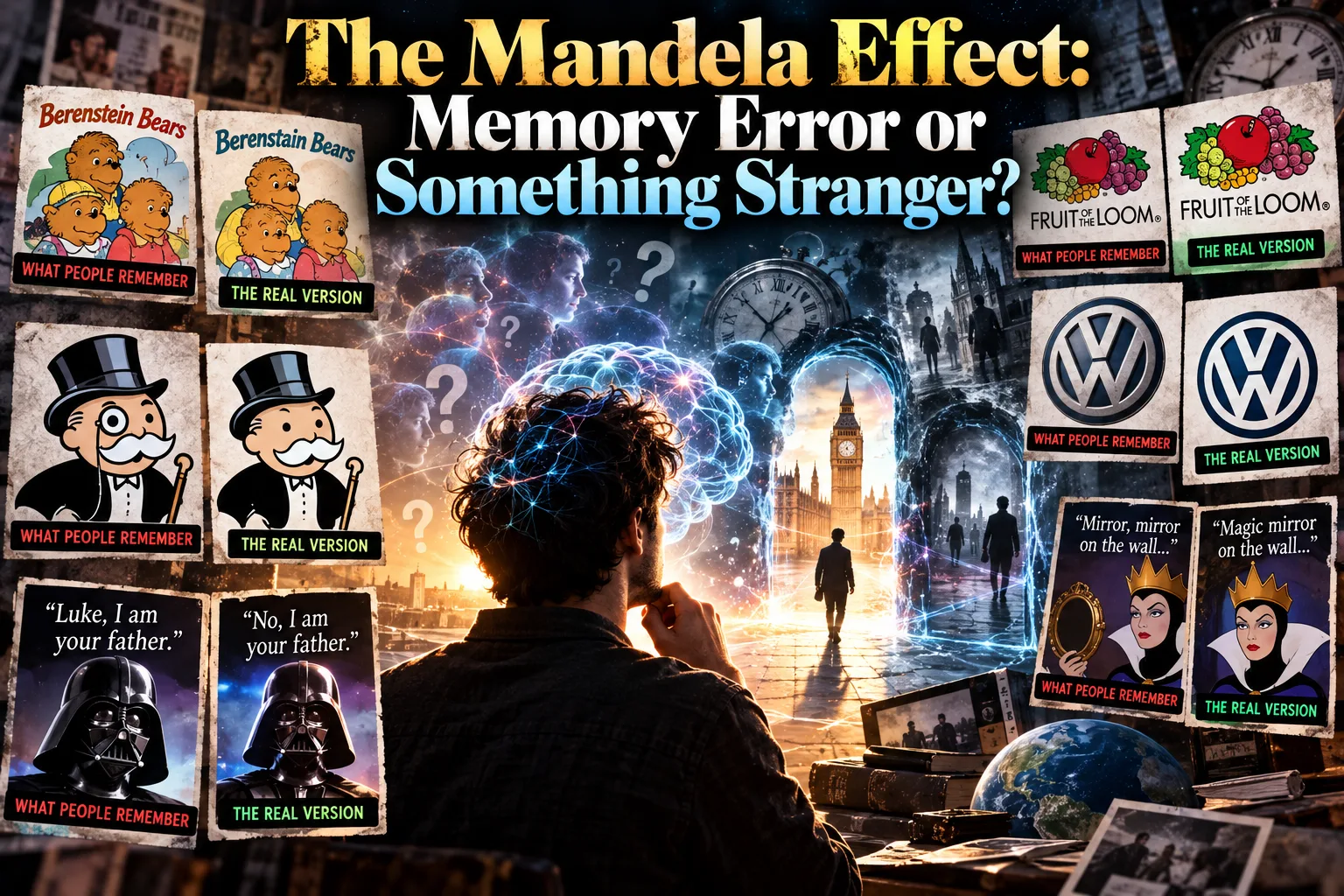
Famous Mandela Effect Examples
The phenomenon has produced many widely discussed examples.
The Berenstain Bears
Many people remember Berenstein.
The documented spelling is Berenstain.
The error may be influenced by familiar naming patterns.
Monopoly's Mascot
Many people remember a monocle.
The character does not have one.
The detail may have been blended from other visual stereotypes.
"Mirror, Mirror"
People often remember the phrase associated with Snow White differently from the film's actual wording.
Pop-culture repetition and paraphrasing likely contribute to such cases.
"Luke, I am your father"
This is commonly remembered as a specific line from Star Wars, but the wording people repeat isn't the same as the actual line in the film.
This illustrates how popular paraphrases can replace original wording in memory.
The Volkswagen Logo
Some people remember different details about the shape and spacing of the historic logo.
Logo memory is especially vulnerable because people often remember the general shape rather than exact geometry.
These examples aren't equally well studied.
Some are strongly documented.
Others are simply internet folklore.
The Important Part: Not Every Viral Example Is Equally Reliable
Someone posts:
"Everyone remembers this!"
But how many people actually do?
Ten?
Ten thousand?
Were they independently remembering it?
Did the discussion influence them first?
Was the original evidence checked?
Is the remembered version merely a common paraphrase?
Scientific analysis requires separating:
A viral claim
from
a demonstrated memory phenomenon.
Why the Internet Makes This Harder
Social platforms reward:
Novelty.
Surprise.
Mystery.
Group participation.
Strong emotions.
"You're not crazy! I remember it too!"
That sentence is incredibly shareable.
"Several mechanisms of reconstructive memory may explain this shared error."
Much less exciting.
Human culture has unfortunately optimized for the former.
The Social Reward of Being "Right"
There is another layer.
Discovering a Mandela Effect makes people feel:
"I caught reality changing."
That creates identity.
You aren't simply remembering.
You're part of a group that noticed something other people missed.
That social reward can increase commitment to the belief.
Why Skepticism Can Feel Like an Attack
If someone says:
"You remembered incorrectly."
you may hear:
"Your experience is meaningless."
But those are different claims.
Your experience is real.
Your memory happened.
You genuinely felt certain.
The question is whether the memory accurately represents the historical event.
Separating those questions makes the conversation much easier.
A Better Way to Investigate a Mandela Effect
When something feels wrong, don't begin with:
"Reality changed."
Begin with:
"What exactly do I remember?"
Write it down before looking at other people's memories.
Then:
"What is the earliest source I can find?"
Search archived material.
Check original footage.
Compare multiple independent sources.
Look for historical versions.
Check whether your memory resembles:
A parody.
A commonly repeated phrase.
Another character.
A related product.
A fan-created version.
This reduces the chance that you're simply inheriting the internet's current explanation.
The Order Matters
Suppose you read:
"Everyone remembers the logo with a tail."
Then you search the logo.
You might now begin constructing your own memory around the tail.
This is one reason it's useful to record your initial recollection before reading other people's descriptions.
Otherwise, you may accidentally contaminate your own test.
Can You Test Your Memory?
Yes, to a degree.
Write down:
What you remember.
How confident you are.
What details you're uncertain about.
Then compare with primary evidence.
You might discover:
The central memory is correct.
The peripheral detail is wrong.
Or:
The entire memory is based on a later version.
Either result teaches you something.
Don't Assume Memory Is Either Completely Right or Completely Wrong
This is another common mistake.
Memory can preserve:
The general event correctly.
while distorting:
The location.
Timing.
Exact wording.
Objects.
Colors.
Names.
Sequence.
You might remember the right story with the wrong detail.
That is normal.
Why Small Details Become the Mystery
Most Mandela Effects involve relatively small differences.
A letter.
A punctuation mark.
An accessory.
A phrase.
A logo detail.
Why?
Because the broad concept remains stable.
You're not forgetting the entire character.
You're remembering:
the character plus a tiny reconstructed feature.
The small error becomes noticeable only because somebody compares your memory to the source.
The Central Memory Usually Survives
Suppose you remember:
A children's cartoon.
The characters.
The basic plot.
The setting.
But one character's accessory is wrong.
Your memory isn't useless.
It preserved the semantic structure.
It distorted one detail.
That is actually quite compatible with reconstructive memory.
Memory Is Better at "What" Than "Exactly How"
You may remember:
What happened.
better than:
Exactly what someone said.
You may remember:
Who was present.
better than:
Where everyone stood.
You may remember:
The product.
better than:
Its exact logo geometry.
This distinction explains many ordinary memory disputes.
Why Humans Argue About the Past
Two people can genuinely remember the same event differently.
Each experiences their memory as real.
Now they debate.
"No, you were standing there."
"No, you weren't."
"I remember exactly."
The disagreement doesn't necessarily mean one person is lying.
Both memories may contain distortions.
Group Memory Is a Negotiation
In families, groups often develop shared stories.
The story gets told repeatedly.
Details become standardized.
A preferred version emerges.
The group's memory becomes partly collective.
Individual memories may slowly move toward the shared narrative.
This is not necessarily manipulation.
It's ordinary social communication.
Collective Memory Isn't One Giant Brain
When psychologists talk about collective memory, they aren't suggesting society has a literal shared neural memory system.
It usually refers to how groups:
Remember.
Represent.
Discuss.
Transmit.
and interpret
the past.
The memory exists across people and cultural artifacts rather than inside one physical brain.
Why History Gets Rewritten
Collective memory changes over time because each generation:
Reinterprets events.
Uses new evidence.
Forgets details.
Adopts new narratives.
Changes terminology.
Reframes old conflicts.
This doesn't mean history is imaginary.
It means people's memories of history are dynamic.
Memory Is Not the Past
This might be the most important sentence in the entire article.
Memory is not the past.
Memory is your brain's current reconstruction of the past.
The distinction matters because:
The past happened once.
Memory can be reconstructed many times.
The Past Doesn't Need Your Memory to Exist
Suppose you misremember a childhood event.
The actual event remains what it was.
Your memory has changed.
This sounds obvious.
Yet we often treat the feeling of remembering as if it were direct access to historical reality.
It isn't.
Why Primary Sources Matter
When investigating the past, researchers prefer evidence close to the event when possible.
A document created at the time.
A recording.
An artifact.
A photograph.
A dated report.
These sources are not automatically perfect.
But they can provide external evidence independent of someone's current memory.
Multiple Independent Sources Are Stronger
Suppose ten websites repeat the same historical fact.
That doesn't necessarily mean ten independent confirmations.
They may all copy one original source.
Strong historical verification looks for:
Different archives.
Different authors.
Different records.
Independent evidence.
This principle is useful for Mandela Effects too.
The "Everyone Remembers It" Argument Has a Weakness
Imagine one false image spreads across:
Facebook.
Reddit.
TikTok.
YouTube.
News blogs.
Now millions have seen it.
Later millions "remember" the image.
That's not millions of independent memories.
That's one cultural input transmitted millions of times.
Shared exposure can create shared recall.
So Is the Mandela Effect Scientific or Psychological?
It's both, depending on what you're asking.
The phenomenon is psychological.
It involves memory, familiarity, source monitoring, social influence, and reconstruction.
The study of the phenomenon is scientific.
Researchers can measure memory accuracy.
Manipulate information.
Test source monitoring.
Study social influence.
Compare recall across groups.
There is no contradiction.
Something can be psychologically experienced and scientifically investigated.
The Most Interesting Explanation May Be the Least Exotic
The human brain is already capable of something remarkable:
Creating a memory that:
Feels authentic.
Contains details.
Has emotional confidence.
Matches other people's memories.
And contradicts the historical record.
We don't need an alternate timeline to produce that.
We already possess a machine capable of doing it.
It's called:
the human brain.
Frequently Asked Questions
What is the Mandela Effect?
It describes cases where groups of people share a memory that differs from the available historical or physical evidence.
Why is it called the Mandela Effect?
The term became popular after Fiona Broome described groups of people who mistakenly believed Nelson Mandela had died in prison during the 1980s.
Does the Mandela Effect prove false memories are real?
Yes, in the ordinary psychological sense that false or distorted memories are a well-established phenomenon. The Mandela Effect is a popular label for particular shared examples.
Can thousands of people remember something incorrectly?
Yes. Shared exposure to the same media, language, cultural patterns, and later information can contribute to similar memory errors.
Why do false memories feel so real?
Memory retrieval is reconstructive, and familiarity, emotion, repetition, and confidence can make an inaccurate recollection feel authentic.
Are shared false memories evidence of parallel universes?
No scientific evidence currently establishes that interpretation.
Can social media create Mandela Effects?
Social media can amplify and reinforce shared memories by repeatedly exposing people to the same claims, images, discussions, and interpretations.
Is every Mandela Effect caused by memory error?
Not necessarily in exactly the same way. Different cases may involve ordinary misquotation, visual confusion, source-monitoring errors, expectation, or social reinforcement.
Can memories be changed by other people's stories?
Yes. Research has demonstrated that information supplied by others can sometimes influence later recollection.
Does confidence prove memory accuracy?
No. People can be highly confident in memories that contain significant errors.
How can I check a Mandela Effect?
Record what you remember first, then examine primary or contemporary sources, compare multiple independent records, and distinguish the original material from later parodies, summaries, or internet discussions.
Myth vs. Evidence
🟢 People can have false memories.
Strongly supported.
🟢 Groups can develop similar memories.
Yes.
Shared information and social influence can produce convergence.
🟢 Memory can be influenced by later information.
Yes.
🟢 Confidence can exceed accuracy.
Yes.
🔴 Thousands of people remembering the same thing proves it happened.
No.
Their memories may have a shared cultural source.
🔴 The Mandela Effect proves alternate timelines.
No scientific evidence establishes this.
🔴 Memory works like a video recording.
False.
Memory is reconstructive.
🟢 Exact wording is often harder to remember than overall meaning.
Yes.
🔴 Every memory contradiction means someone is lying.
No.
People can sincerely remember events incorrectly.
The Deeper Question: What Is a Memory?
We usually imagine memory as something stored.
A file.
An image.
A recording.
But human memory behaves more like a living process.
You retrieve.
Interpret.
Reconstruct.
Update.
Connect.
Reorganize.
The memory you access today can be influenced by what happened yesterday.
And tomorrow, it may be slightly different again.
That doesn't mean every retrieval completely rewrites the past.
It means memory is dynamic.
Why This Matters Beyond Internet Mysteries
The Mandela Effect is entertaining.
Its implications are serious.
Memory influences:
Eyewitness testimony.
Court cases.
Historical narratives.
Relationships.
Education.
Medical histories.
Personal identity.
News reporting.
Everyday disagreements.
If humans can confidently share inaccurate memories about harmless logos, then we should be careful when dealing with much more consequential memories.
Eyewitnesses Are Human Memories
Imagine a crime occurs.
Five people witness it.
Later they give descriptions.
Some details match.
Others differ.
That doesn't automatically mean someone is lying.
Memory, attention, stress, expectation, and later discussion can all affect recall.
This is why forensic investigators try to collect information carefully and avoid unnecessary contamination.
Relationships Depend on Memory Too
Think about an argument from five years ago.
You remember:
"You said this."
The other person says:
"I never said that."
Which memory is correct?
Perhaps one.
Perhaps neither exactly.
Maybe both remember different parts.
Maybe the wording changed in memory.
Maybe later conversations altered the reconstruction.
Old arguments are basically tiny personal Mandela Effects with worse emotional consequences.
Your Personal History Is Partly Reconstructed
The story you tell about yourself changes as you learn more.
Something that once seemed like:
A failure
may later become:
A lesson.
Something once remembered as:
The beginning
may later seem like:
The end of something else.
The facts may not change.
Your interpretation changes.
And interpretation can influence what you remember.
This Is Why Identity and Memory Are Connected
You don't only remember events.
You remember:
Who you were.
And every time you reconstruct your history, you may reinforce a particular narrative about yourself.
"I've always been shy."
"I've always been ambitious."
"I've never been good with people."
"I've always loved science."
These statements can simplify a much messier reality.
The self is partly a story built from memory.
The Mandela Effect Exposes the Fragility of That Story
If something as trivial as a logo can be misremembered collectively, imagine how much reconstruction happens in deeply personal history.
Your memories matter.
But they deserve the same humility we apply to other evidence.
"I remember it"
is information.
It's not the end of the investigation.
Final Thoughts
The Mandela Effect feels mysterious because it challenges something we normally trust without thinking:
the feeling of remembering.
When you remember an event, you don't experience uncertainty about the memory's existence.
You experience:
"This happened."
That's the power of memory.
It presents reconstructed information with a remarkable sense of familiarity and personal ownership.
Then comes the stranger part.
Someone else says:
"I remember that too."
Now the memory feels stronger.
Then a thousand people agree.
The confidence grows.
But shared confidence isn't the same as independent evidence.
People share:
Cultures.
Languages.
Movies.
Advertisements.
Childhood experiences.
Stories.
Memes.
Parodies.
Expectations.
A million people can therefore receive the same misinformation and later remember it in similar ways.
Nothing supernatural has happened.
Something much more ordinary has happened:
Human minds interacted.
That doesn't make the Mandela Effect boring.
It makes it fascinating.
Because the real mystery isn't why reality supposedly changed.
It's how the brain can construct a memory so convincing that you would swear reality itself must have changed.
A single false detail can survive for decades.
A paraphrase can replace an original quote.
A visual stereotype can become part of a character.
A later story can contaminate an earlier memory.
A group can reinforce an error until everyone is certain.
And the person holding the memory may be completely sincere.
That is the part people often miss.
False memory is not the same thing as lying.
Someone can tell you something that never happened and genuinely believe it happened.
Their memory isn't intentionally deceiving you.
It's reconstructing the past.
And sometimes the reconstruction wins.
So the next time you encounter a Mandela Effect, resist two equally tempting reactions.
Don't immediately assume:
"Everyone is remembering wrong."
And don't immediately assume:
"Reality must have changed."
Instead ask:
What do I actually remember?
Where could that detail have come from?
Could another character, quote, image, or story have influenced it?
What does the original evidence show?
Are these genuinely independent memories?
Those questions replace mystery with investigation.
And the conclusion is perhaps stranger than a parallel universe anyway.
You don't need reality to change for your experience of reality to change.
Your brain can do that by itself.
It can take fragments.
Patterns.
Expectations.
Stories.
Social information.
and familiarity
and turn them into something that feels like a precise window into the past.
Sometimes that window is clear.
Sometimes it's distorted.
And sometimes thousands of people are looking through the same slightly crooked glass.
That may be the real lesson of the Mandela Effect:
The human mind is not a perfect archive of reality.
It's a storyteller trying to reconstruct reality from incomplete evidence.
And occasionally, it tells the same wrong story to all of us.