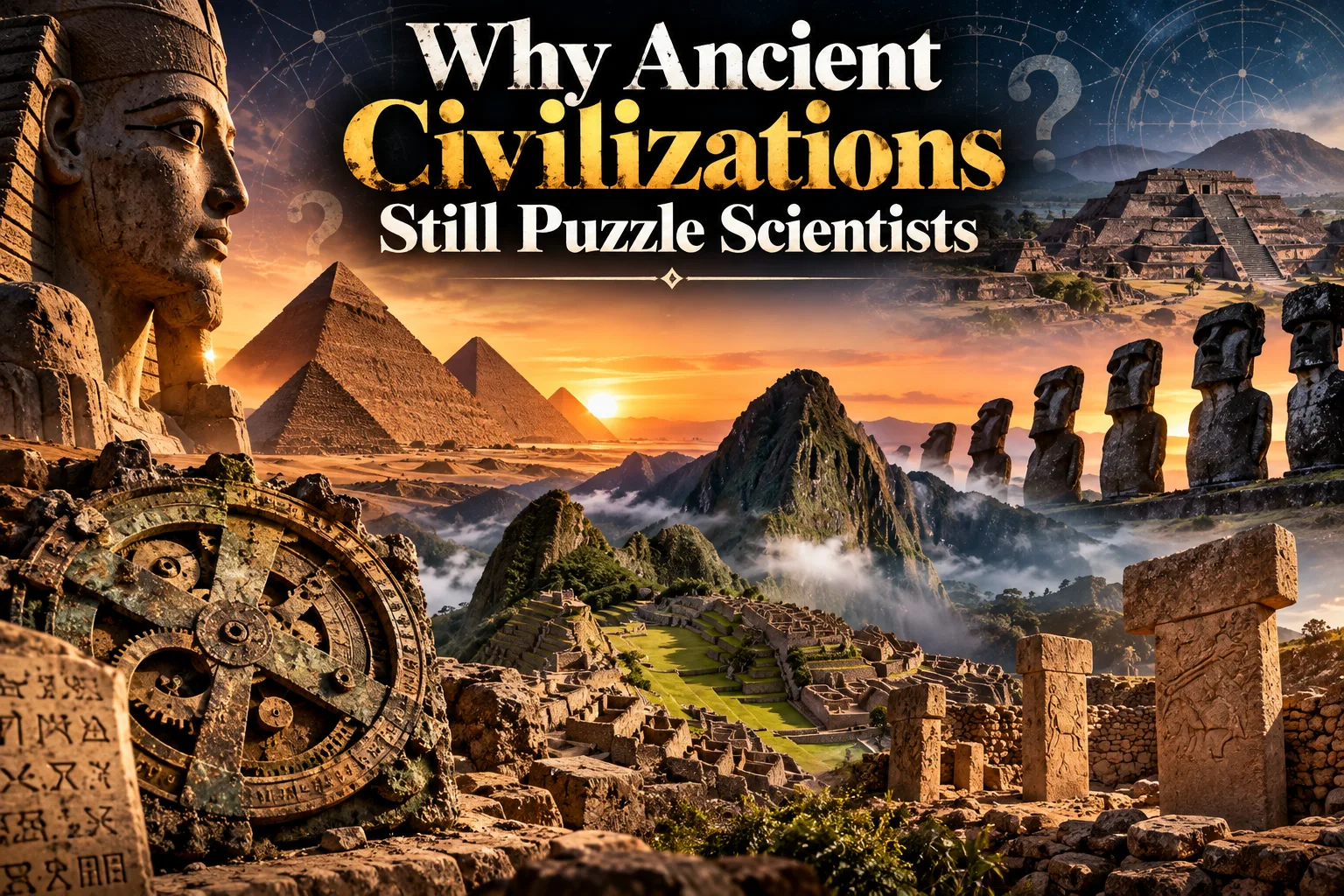
Why Ancient Civilizations Still Puzzle Scientists
Ancient civilizations left behind extraordinary cities, monuments, technologies, and unanswered questions. Discover why modern archaeology still struggles to explain some of their greatest achievements.
Why Ancient Civilizations Still Puzzle Scientists
A massive stone city rises from the jungle.
A monument thousands of years old points almost perfectly toward the sky.
A drainage system appears cleaner than some modern cities.
An ancient workshop contains evidence of sophisticated metallurgy.
A tablet describes mathematics with astonishing precision.
Then comes the question that fuels almost every mystery surrounding the ancient world:
How did they do it?
The question sounds simple.
It rarely is.
Ancient civilizations built extraordinary things without modern cranes, computers, engines, satellites, or industrial machinery.
They developed mathematics.
Astronomy.
Medicine.
Architecture.
Agriculture.
Navigation.
Writing.
Metallurgy.
Governments.
Trade networks.
Some of their achievements are still difficult to reconstruct in detail.
But there's an important distinction between:
"We don't know exactly how they did it."
and:
"There's no possible way humans could have done it."
The first is ordinary archaeology.
The second is usually where the internet gets involved.
The ancient world is genuinely fascinating without pretending that every unexplained detail requires lost supertechnology, aliens, or vanished supercivilizations.
Modern archaeology has answered many old questions.
But every answer creates new ones.
And sometimes the surviving evidence is simply too incomplete to tell us the whole story.
The Ancient World Is Mostly Missing
The first thing to understand is how little has survived.
Imagine someone trying to understand modern America 5,000 years from now.
Suppose:
Most buildings disappear.
Wood rots.
Plastic degrades.
Electronic devices become unreadable.
Paper disappears.
Roads are destroyed.
Libraries burn.
Databases vanish.
Only stone buildings, buried objects, fragments of metal, some ceramics, and scattered documents remain.
Future archaeologists might conclude that our civilization was surprisingly simple.
They might find a smartphone and have absolutely no idea what TikTok was.
Civilizations leave behind only fragments.
Archaeology is the process of reconstructing an enormous lost system from those fragments.
🟢 The First Great Mystery: Lost Information
Ancient societies possessed enormous amounts of knowledge that was never written down.
Construction techniques could be taught orally.
Craft skills could be passed from master to apprentice.
Navigation knowledge could exist entirely in human memory.
Recipes could disappear with a community.
A city could fall.
A specialized craft could vanish.
Once the people who knew a technique were gone, the technique could disappear even if the physical objects remained.
This creates an important archaeological paradox:
The object survives. The instructions do not.
The Great Pyramid of Giza
Few monuments represent ancient mystery better than the Great Pyramid of Giza.
Constructed during the reign of Pharaoh Khufu, around the 26th century BCE, it was the largest pyramid ever built.
It is enormous.
Millions of stone blocks were quarried, transported, shaped, and positioned.
The pyramid was part of a much larger funerary complex.
Its scale alone creates the illusion that something impossible must have been involved.
It wasn't necessarily impossible.
It was extraordinarily difficult.
Those are different things.
How Was the Great Pyramid Built?
Researchers have several lines of evidence.
Workers quarried stone.
Transportation systems moved blocks.
Ramps and lifting techniques likely played roles.
Large organized labor forces coordinated construction.
Archaeological discoveries near Giza have provided evidence for worker settlements, food production, administration, and supply systems.
This is important because the pyramid didn't appear through isolated genius.
It emerged from an enormous organized society.
🟢 What We Know
The pyramids were built by ancient Egyptian society using large organized labor forces, engineering knowledge, quarrying systems, transportation, and extensive logistical planning.
Evidence from workers' settlements and administrative records helps reconstruct this system.
🟡 What We Still Debate
Archaeologists continue discussing the exact methods used to move and raise different categories of stone.
Various ramp configurations have been proposed.
The archaeological evidence doesn't provide a complete construction manual.
That uncertainty is real.
But uncertainty about a specific ramp design is not evidence for:
Anti-gravity.
Ancient lasers.
Extraterrestrial engineers.
Humanity occasionally managed to move heavy rocks without assistance from the galaxy.
Ancient Egyptian Mathematics Was More Sophisticated Than Popular Culture Suggests
Egyptians developed practical mathematical systems for:
Land measurement.
Construction.
Taxation.
Administration.
Architecture.
Their mathematical documents demonstrate knowledge of fractions, geometry, and calculation methods.
They didn't possess modern algebra in its later formalized form.
But they solved practical quantitative problems remarkably effectively.
And that's another reason the monuments shouldn't be judged using a modern stereotype of ancient people as primitive.
"Ancient" doesn't mean "stupid."
The Antikythera Mechanism
Now things become genuinely strange.
In 1901, divers recovering a shipwreck near the Greek island of Antikythera discovered a heavily corroded mechanical device.
At first, it looked like an ordinary lump of bronze.
It wasn't.
Modern imaging revealed an extraordinary system of:
Gears.
Dials.
Scales.
Inscribed surfaces.
Complex mechanical relationships.
The device is generally dated to around the second or first century BCE.
What Did It Do?
The Antikythera mechanism appears to have modeled astronomical cycles.
It could represent relationships involving:
The Sun.
Moon.
Lunar phases.
Calendrical cycles.
Possibly eclipse prediction.
It demonstrates sophisticated geared mechanical knowledge far earlier than many people expect.
Why Is It So Important?
Because it raises another question:
Where are the other machines?
Only one surviving device of this extraordinary complexity is known.
That creates an obvious possibility.
Other advanced mechanisms may have existed but disappeared.
Bronze can be recycled.
Wood rots.
Machines corrode.
Workshops vanish.
Knowledge can disappear.
A surviving artifact may therefore represent the tip of a much larger technological tradition.
🟢 Established Evidence
The Antikythera mechanism is a genuine ancient geared astronomical calculator of remarkable complexity.
🟡 What We Don't Know
We don't know exactly how widespread this level of geared engineering was.
One surviving device cannot tell us how common or rare such technology was in the ancient Mediterranean.
Roman Concrete
The Romans built structures that have survived for nearly two thousand years.
Some Roman marine concrete structures are particularly remarkable.
Certain mixtures appear to have developed chemical properties that helped them remain durable in seawater.
Modern researchers have studied the composition and behavior of ancient Roman concrete to understand why some structures lasted so long.
Did Romans Have "Indestructible Concrete"?
Not exactly.
Roman concrete wasn't universally superior to all modern concrete.
Different mixtures served different purposes.
Some ancient structures survived extraordinarily well.
Others deteriorated.
The interesting scientific question is:
What chemistry made particular Roman concrete formulations so durable?
That's a very different mystery from:
"Romans possessed magical concrete."
Why Archaeologists Study the Chemistry
Ancient materials can preserve information about:
Raw materials.
Temperature.
Manufacturing methods.
Environmental conditions.
Chemical reactions.
Trade networks.
Understanding the material can reveal how ancient societies actually worked.
Archaeology isn't only digging.
Sometimes it is chemistry disguised as history.
The Roman Roads
Another popular claim says:
"All roads lead to Rome, therefore Roman engineering was perfect."
Roman roads were sophisticated.
But they were not all identical.
Construction methods varied depending on:
Terrain.
Climate.
Materials.
Purpose.
Local conditions.
The important achievement was less about one magical road recipe and more about the ability to build and maintain enormous infrastructure across a vast empire.
Infrastructure Is a Hidden Form of Power
A road does more than connect two locations.
It moves:
Soldiers.
Food.
Merchants.
Taxes.
Information.
Officials.
Raw materials.
A road system therefore becomes political infrastructure.
Ancient engineering was often inseparable from state power.
Monuments can look like art.
Roads reveal administration.
The Indus Valley Civilization
Around the third millennium BCE, cities of the Indus Valley Civilization developed across parts of modern-day Pakistan and northwestern India.
Major sites include:
Mohenjo-daro
Harappa
Dholavira
and others.
What makes them fascinating is not merely their size.
It's their urban organization.
Remarkable Drainage Systems
Some Indus cities possessed sophisticated systems involving:
Covered drains.
Wastewater channels.
Wells.
Planned streets.
Water-management infrastructure.
This doesn't mean every city had modern sanitation.
It means urban engineering was an important part of these societies.
The Great Bath
At Mohenjo-daro, archaeologists uncovered a large, carefully constructed structure commonly called the Great Bath.
Its exact purpose is still debated.
Ritual bathing is one interpretation.
A public or ceremonial function is plausible.
But archaeology cannot simply read the original users' intentions from stone.
The building survives.
The explanation doesn't.
The Indus Script Problem
Perhaps the biggest mystery surrounding the Indus civilization is its writing system.
Hundreds of inscriptions have been discovered.
But the script remains undeciphered.
That means an entire civilization left behind written signs whose meaning we still cannot reliably read.
Imagine finding millions of pages of a lost language but having no bilingual dictionary.
That's roughly the problem.
Why Is Decipherment So Difficult?
The inscriptions are often:
Short.
The corpus is limited.
There is no securely established bilingual inscription comparable to the Rosetta Stone.
The underlying language is uncertain.
The signs may not represent language in the exact way later writing systems do.
As a result, proposed decipherments have not achieved scholarly consensus.
🟢 Established Evidence
The Indus civilization used a system of repeated signs that remains undeciphered.
🔴 Popular Myth
Claims that the script has already been definitively decoded appear frequently online.
There is no broadly accepted decipherment.
The Nazca Lines
Across the Peruvian desert lie enormous geometric shapes and images.
Straight lines.
Trapezoids.
Animals.
Birds.
Plants.
Human-like figures.
The Nazca Lines were created over centuries by removing darker surface material to expose lighter ground beneath.
They can be difficult to appreciate from ground level.
From above, their scale becomes obvious.
Why Would Ancient People Make Giant Drawings?
This question has attracted many theories.
Some involve:
Ritual movement.
Water.
Agriculture.
Pilgrimage.
Astronomical alignment.
Social organization.
Landscape symbolism.
Different lines may have served different purposes.
The important point is that there doesn't have to be one universal explanation for every Nazca geoglyph.
They Didn't Need Aircraft
One persistent myth says:
"The Nazca couldn't have made these without seeing them from the air."
That's false.
Large ground-based designs can be constructed using:
Surveying.
Ropes.
Stakes.
Geometry.
Reference points.
The people making them don't need an aircraft.
Humans are surprisingly good at making large geometric patterns from the ground.
Farmers have been doing versions of this for thousands of years.
Göbekli Tepe
In southeastern Turkey lies Göbekli Tepe, a monumental archaeological site dating back to roughly the 10th millennium BCE.
This is extraordinarily early.
The site predates the traditional image of fully developed agricultural civilization in the region.
Large carved stone pillars and monumental structures were constructed by communities living during the transition toward settled life.
The Old Story of Civilization Gets Complicated
The traditional simplified sequence is:
Hunter-gatherers.
Then agriculture.
Then villages.
Then cities.
Then monumental architecture.
Göbekli Tepe complicates that neat sequence.
Large-scale communal construction existed surprisingly early.
It suggests that social organization, ritual activity, and monumental building could emerge before later urban civilization in the way older textbooks imagined.
Did Göbekli Tepe Rewrite Everything?
Not exactly.
Archaeology rarely works through one discovery destroying the entire previous understanding.
Instead, findings modify models.
Göbekli Tepe showed that:
Complex communal organization.
Monumental construction.
Ritual activity.
and early subsistence economies
could coexist in ways that older assumptions had underestimated.
The Terracotta Army
In China, thousands of life-sized clay soldiers were buried near the tomb of Qin Shi Huang, the first emperor of a unified imperial China.
The statues include:
Soldiers.
Horses.
Weapons.
Chariots.
Different facial features.
Different ranks.
The production effort was enormous.
How Could So Many Statues Be Made?
The answer appears to involve organized workshops and mass production techniques.
Bodies and certain components could be produced using standardized methods.
Individual details were added.
The statues were then assembled and finished.
This demonstrates something ancient societies possessed in abundance:
institutional scale.
Modern people sometimes assume that enormous projects require modern machines.
They don't necessarily.
They require:
Labor.
Organization.
Time.
Resources.
Planning.
And a government willing to tell several thousand people that they are absolutely not doing anything else this year.
Machu Picchu
High in the Andes lies Machu Picchu, built by the Inca in the fifteenth century.
The site is famous for:
Terraced agriculture.
Stone architecture.
Drainage.
Water management.
Mountain engineering.
Its stonework is particularly impressive.
Large stones were shaped and fitted with remarkable precision.
The Mystery Is Less "How Could They?" Than "What Exactly Did They Know?"
The Inca did not possess iron tools in the European sense or modern powered machinery.
Yet they developed highly effective stone-working and construction techniques.
They exploited:
Local geology.
Stone shape.
Labor organization.
Levers.
Ramps.
Repeated shaping.
Careful fitting.
Their achievements demonstrate that precision doesn't require modern power tools.
It requires time and skill.
Dholavira and Water Management
Dholavira, an ancient Indus Valley settlement, offers another extraordinary example.
The site contained systems for:
Reservoirs.
Channels.
Water collection.
Storage.
Drainage.
In a region where water availability posed major challenges, engineering water systems was essential to urban survival.
The lesson is important.
Ancient engineering was often less about building spectacular monuments and more about solving brutally practical problems.
Teotihuacan
Near modern Mexico City stands Teotihuacan, one of the largest ancient urban centers in the Americas.
Its enormous pyramids dominate the landscape.
Its streets were planned.
Residential compounds were extensive.
Trade networks connected it to distant regions.
The city's scale suggests complex political and economic organization.
Who Ruled Teotihuacan?
This remains one of the more interesting uncertainties.
Unlike some later Mesoamerican civilizations, Teotihuacan doesn't leave us with a simple royal narrative naming a clearly identifiable ruler who built everything.
The political structure of the city remains debated.
This is a good example of an archaeological mystery that doesn't require supernatural explanations.
The civilization existed.
The city was enormous.
Its people clearly built an elaborate political system.
But the exact political model is still uncertain.
Easter Island and the Moai
On Rapa Nui, enormous stone statues known as moai were created by Polynesian communities.
They are among the world's most recognizable ancient monuments.
The biggest popular mystery is often:
"How did they move them?"
But experiments and archaeological research have demonstrated that multiple methods could potentially move moai using combinations of:
Ropes.
Leverage.
Human coordination.
"Walking" techniques involving rocking a statue from side to side.
The Real Mystery Is More Interesting
The important question isn't:
"How could primitive people move giant statues?"
It is:
"What social system allowed communities to organize these projects?"
Moving enormous stone statues requires:
Food.
Labor.
Planning.
Specialized knowledge.
Leadership.
Rope production.
Quarry organization.
Transportation.
And social cooperation.
The statue itself is evidence of an entire social system.
Baalbek
In modern Lebanon, the Roman-era sanctuary at Baalbek contains some enormous stone blocks.
Certain foundation stones are among the largest ever used in ancient monumental construction.
That makes Baalbek a popular target for claims involving:
Lost technologies.
Giants.
Aliens.
Ancient machines.
But there is a much more interesting reality.
Roman Engineering Was Extremely Ambitious
Roman builders possessed:
Surveying tools.
Cranes.
Pulleys.
Ramps.
Capstans.
Levers.
Organized labor.
Quarry systems.
Sophisticated engineering knowledge.
The exact methods used for moving specific blocks remain uncertain.
That's legitimate.
But uncertainty about a construction detail does not establish impossible technology.
🟢 Evidence
Ancient civilizations demonstrably possessed sophisticated engineering and logistics.
🔴 Myth
"If modern engineers can't immediately reproduce every ancient construction method, the civilization must have possessed lost supertechnology."
No.
Modern replication isn't a magical test for whether ancient humans could do something.
Ancient builders had different:
Time scales.
Labor systems.
Tools.
Materials.
Priorities.
We don't need to reproduce every ancient project in a weekend to accept that humans built it.
The Ancient Egyptian Antenna Problem
Ancient art sometimes depicts objects that modern viewers interpret as:
Light bulbs.
Batteries.
Aircraft.
Computers.
Medical instruments.
The famous example is the "Dendera light bulb" interpretation from Egyptian reliefs.
But mainstream Egyptological interpretation does not treat these carvings as evidence that ancient Egyptians possessed electric light bulbs.
The imagery is understood within the context of Egyptian religious symbolism.
The Baghdad Battery
The Baghdad Battery is another famous example.
It consists of ancient ceramic vessels associated with a metal cylinder and rod.
Some have proposed that it functioned as a simple galvanic cell.
Interesting.
Possible.
Not proven.
Its exact purpose remains debated.
Even if it did produce a small electrical potential, that would not demonstrate ancient electric power systems.
One possible battery isn't a forgotten industrial grid.
Ancient Technology Is Often Underestimated
There's a strange paradox here.
Some people exaggerate ancient technology into science fiction.
Others underestimate it so badly that anything impressive seems impossible.
Both are errors.
Ancient societies developed:
Mechanical engineering.
Hydraulics.
Astronomy.
Surveying.
Metallurgy.
Mathematics.
Navigation.
Architecture.
Medicine.
They were capable of astonishing technical sophistication.
They simply developed it under different constraints.
Why We Keep Losing Ancient Knowledge
Knowledge disappears for many reasons.
Wars.
Political collapse.
Economic decline.
Migration.
Language change.
Institutional destruction.
Loss of specialist communities.
Climate change.
Material decay.
Religious transformation.
A library can burn.
A workshop can close.
A skilled craftsman can die.
A technique requiring twenty years of training can disappear within one generation.
Knowledge is fragile.
The Library Problem
Ancient knowledge isn't stored only in books.
A technological tradition depends on:
People.
Tools.
Materials.
Supply chains.
Apprenticeships.
Institutions.
Markets.
A document describing an ancient technique isn't necessarily enough to recreate it.
You also need the surrounding ecosystem.
The Roman Glass Problem
Ancient glassmakers developed techniques that modern researchers can reconstruct only through archaeological and experimental evidence.
Why?
Because ancient recipes weren't always written down.
Even when written records survive, terminology can be ambiguous.
The practical knowledge existed in people.
Modern science sometimes has to rebuild the knowledge from:
Residues.
Objects.
Experimental archaeology.
Chemistry.
Comparative analysis.
Archaeology becomes reverse engineering.
Experimental Archaeology
Researchers sometimes recreate ancient technologies using tools and materials that approximate what ancient people had available.
They might test:
Stone tools.
Kilns.
Metallurgy.
Boat designs.
Textile production.
Construction methods.
Food processing.
This doesn't prove the reconstructed method was the exact historical one.
But it can demonstrate whether a proposed technique is physically plausible.
That Distinction Is Crucial
Suppose researchers successfully move a huge stone using:
Ropes.
Wooden rollers.
Levers.
Human labor.
That demonstrates:
Ancient humans could plausibly move the stone using similar methods.
It doesn't prove:
This was definitely how the ancient builders did it.
Experimental archaeology tests possibilities.
It doesn't automatically identify the historical method.
Astronomy Was One of Humanity's Oldest Sciences
Ancient civilizations observed the sky constantly.
The reasons were practical.
Calendars.
Agriculture.
Navigation.
Religious rituals.
Seasonal planning.
Political symbolism.
Babylonians tracked astronomical phenomena with remarkable consistency.
Maya astronomers developed sophisticated calendrical and astronomical systems.
Egyptians aligned architecture with celestial patterns.
Ancient Polynesians navigated across enormous stretches of ocean using environmental knowledge that included stars, winds, waves, and currents.
None of this requires supernatural intervention.
It requires generations of observation.
The Maya Calendar Is Often Misunderstood
People once obsessed over the supposed 2012 apocalypse associated with the Maya calendar.
The calendar did not predict the end of the world.
The idea came largely from modern interpretations and sensationalism.
The Maya possessed sophisticated calendrical systems.
The mistake was treating an ancient calendrical transition as a prediction of planetary destruction.
Again:
Ancient people understood calendars.
Modern internet culture understood them less well.
Why Ancient Astronomy Looks Almost Impossible
Imagine observing the night sky for:
One year.
Ten years.
A century.
Several centuries.
Generation after generation.
Record:
Lunar cycles.
Solstices.
Eclipses.
Planetary movements.
Seasonal changes.
Over time, patterns become visible.
You don't need telescopes to discover cycles that repeat predictably.
You need patience.
Human beings used an underrated technology:
writing things down.
Ancient Medical Knowledge
Ancient civilizations produced medical practices that range from surprisingly sophisticated to objectively dangerous.
Egyptian medical papyri describe:
Wounds.
Infections.
Surgery.
Treatments.
Anatomy.
Mesopotamian texts also record illnesses and remedies.
Ancient Indian, Greek, Chinese, and Islamic medical traditions developed extensive systems of diagnosis and treatment.
Some treatments were useful.
Some were ineffective.
Others were harmful.
The fact that a medical practice is ancient doesn't automatically make it wise.
Age is not a quality-control certificate.
The Evolution of Ancient Knowledge
One of the biggest mistakes is imagining ancient civilizations as isolated islands.
They traded.
Migrated.
Conquered.
Borrowed.
Adapted.
Modified.
Knowledge traveled.
Mathematical concepts moved between societies.
Metallurgical methods spread.
Crops traveled.
Religious ideas changed.
Architectural forms were copied.
Technological traditions were exchanged.
The ancient world was globally connected in ways that are easy to underestimate.
Trade Was the Ancient Internet
A caravan arriving from another region could bring:
New materials.
New tools.
New crops.
New ideas.
New techniques.
New languages.
New cultural practices.
Maritime trade could move technologies across entire seas.
Civilizations didn't develop everything independently.
They existed inside networks.
Why Archaeology Keeps Surprising Us
Because archaeology occasionally finds something that contradicts the assumptions of older models.
A settlement appears earlier than expected.
A technology exists farther from its supposed origin.
A trade network is larger than previously thought.
A monument is older.
A written system is more complex.
A society turns out to be more urbanized.
This is not evidence that archaeologists know nothing.
It's evidence that scientific knowledge changes when new evidence appears.
That's what it's supposed to do.
The "Lost Civilization" Problem
Stories about vanished supercivilizations are popular because they provide a clean explanation for unexplained achievements.
But real archaeology usually points toward something more complicated.
Ancient societies rose and fell.
Communities migrated.
Cities were abandoned.
Political systems collapsed.
Knowledge was fragmented.
Yet there is rarely evidence that one technologically superior civilization suddenly disappeared and left mysterious monuments everywhere.
The evidence usually shows many different societies solving problems in different ways.
Climate Can End Civilizations Without a Hollywood Villain
Environmental changes can contribute to social collapse.
Drought.
Floods.
Volcanic eruptions.
Cooling.
Changing river courses.
Soil degradation.
These pressures can interact with:
War.
Political conflict.
Economic inequality.
Migration.
Disease.
A civilization rarely collapses because one variable gets upset.
Systems fail when multiple pressures interact.
The Collapse of the Bronze Age
Around the late second millennium BCE, several major civilizations in the eastern Mediterranean and Near East experienced dramatic disruption.
Cities were destroyed.
Political systems collapsed.
Trade networks broke.
Population movement occurred.
The exact causes remain debated.
Possible contributors include:
Drought.
War.
Political instability.
Migration.
Economic breakdown.
Trade disruption.
The important lesson is not:
"One mysterious invader destroyed everything."
It's:
Complex systems can fail from interacting pressures.
Ancient Cities Were More Fragile Than They Look
A city depends on supply chains.
Food comes from the countryside.
Water must be managed.
Trade provides materials.
Government collects taxes.
Labor maintains infrastructure.
If those systems fail, the city can empty surprisingly quickly.
Some ancient "lost cities" weren't destroyed in dramatic battles.
People simply stopped living there.
Why Entire Cities Were Abandoned
Possible causes include:
Environmental change.
Economic decline.
Political shifts.
Disease.
War.
River movement.
Changing trade routes.
Resource exhaustion.
Sometimes several.
The phrase:
"Abandoned overnight"
is often dramatic.
Archaeological evidence more commonly indicates gradual decline.
Buildings deteriorate.
Population falls.
Neighborhoods disappear.
Finally, a once-important city becomes a landscape of ruins.
Why Some Mysteries May Never Be Solved
Archaeology has an inconvenient limitation:
Missing evidence cannot always be recovered.
If a civilization's writing materials were destroyed, they're gone.
If a wooden machine rotted, its exact mechanism may be unknowable.
If a language has no related surviving languages, decipherment may remain impossible.
If a site was destroyed without documentation, reconstruction becomes probabilistic.
Science isn't omniscience.
Sometimes the correct answer is:
We don't know.
And that's not a failure.
It's an accurate conclusion.
What Makes an Ancient Mystery Scientific?
A mystery becomes scientifically useful when the question can be constrained by evidence.
What materials were available?
How much labor would be required?
How long would construction take?
Could a proposed technology work physically?
What do inscriptions say?
What do surviving tools indicate?
What does the geological record show?
Where are the missing pieces?
The mystery becomes a research problem.
Evidence Has Levels
Consider an ancient claim.
Level 1
Someone says it happened.
Very weak.
Level 2
A later writer describes it.
Interesting, but potentially biased or removed from the event.
Level 3
Contemporary records exist.
Stronger.
Level 4
Archaeological evidence matches the account.
Stronger still.
Level 5
Independent evidence from several sources converges.
Now confidence can become much higher.
Ancient history requires constant calibration.
🟢 Established
Ancient civilizations achieved extraordinary feats in:
Architecture.
Urban planning.
Astronomy.
Mathematics.
Water management.
Metallurgy.
Navigation.
Transportation.
Administration.
Mechanical engineering.
These achievements are supported by physical remains and historical evidence.
🟡 Uncertain
In many cases, researchers still debate:
Exactly how monuments were constructed.
How certain technologies spread.
How some undeciphered writing systems functioned.
Why particular cities were abandoned.
How political systems were organized.
The precise meaning of some ritual structures.
These are real unanswered questions.
🔴 Unsupported
There is currently no credible evidence establishing that ancient civilizations broadly relied on:
Alien engineers.
Anti-gravity.
Modern electrical grids thousands of years ago.
Advanced computers predating known technological history.
A single globally advanced lost supercivilization that built unrelated monuments across the world.
Ancient achievements do not require those explanations.
Why Scientists Are Still Puzzled
The irony is that the more archaeology discovers, the more questions appear.
Finding the Antikythera mechanism didn't end the mystery of ancient engineering.
It created a new question:
How widespread was complex mechanical technology?
Deciphering more Egyptian texts doesn't end the story of Egypt.
It reveals:
New economic systems.
New religious ideas.
New political conflicts.
New relationships between regions.
Discovering a city doesn't answer everything about its people.
It creates questions about:
Who lived there?
What did they eat?
Who controlled it?
Why did they move?
Where did they trade?
Why did they disappear?
Every discovery opens another door.
Frequently Asked Questions
Why are ancient civilizations still difficult to understand?
Because much of their material culture, written records, languages, and technological knowledge has been lost or damaged.
Did ancient civilizations possess technology we no longer understand?
Yes, in some cases specific techniques remain uncertain or incompletely reconstructed. That doesn't automatically mean the technology was more advanced than modern technology.
How did ancient people move enormous stones?
Different civilizations likely used different combinations of ramps, sledges, rollers, ropes, levers, boats, human labor, and specialized engineering. Exact methods remain uncertain for some monuments.
Is there evidence of aliens helping ancient civilizations?
No credible archaeological evidence demonstrates extraterrestrial involvement in ancient construction.
Why hasn't the Indus script been deciphered?
The inscriptions are generally short, the underlying language is uncertain, and there is no securely identified bilingual text comparable to the Rosetta Stone.
Was the Antikythera mechanism an ancient computer?
It is sometimes described as an ancient analog computer because it modeled astronomical cycles mechanically. That comparison can be useful, provided it isn't interpreted as meaning the device was equivalent to a modern electronic computer.
Did ancient Egyptians use electricity?
There is no established evidence that ancient Egypt possessed electrical technology comparable to modern systems. Claims based on the so-called Dendera "light bulb" interpretation are not accepted as evidence of ancient electric lighting.
Why did some ancient cities disappear?
Cities could decline or be abandoned because of environmental change, economic disruption, political collapse, warfare, disease, changing trade networks, or combinations of these factors.
Why don't archaeologists know everything already?
Archaeological evidence is incomplete. Many objects and structures have been destroyed, buried, recycled, or never discovered.
Does an unanswered archaeological question prove a mystery theory?
No. Not knowing the answer means the evidence is incomplete. It doesn't automatically support a particular alternative explanation.
Myth vs. Evidence
🔴 "Ancient people couldn't have built huge monuments."
False.
Archaeological evidence demonstrates sophisticated organization, engineering, and labor systems.
🔴 "If we can't reproduce something immediately, ancient people couldn't have built it."
False.
Modern replication has different tools, goals, and constraints.
🟢 Ancient technical knowledge was sometimes lost.
Yes.
Skills can disappear when institutions and specialist communities disappear.
🟢 Some ancient technologies remain incompletely understood.
Yes.
Especially when surviving evidence is fragmentary.
🔴 Every unexplained monument must involve aliens or a lost supercivilization.
No evidence supports this conclusion.
🟢 Ancient civilizations borrowed knowledge from one another.
Yes.
Trade, migration, conquest, and cultural exchange transmitted technologies and ideas.
🟢 Archaeological discoveries can change accepted interpretations.
Absolutely.
That's how archaeology progresses.
The Real Mystery of Ancient Civilization
Perhaps the biggest mystery isn't how humans built massive monuments.
It's how humans became capable of organizing such enormous collective projects in the first place.
A pyramid requires:
Workers.
Quarries.
Food.
Transportation.
Surveyors.
Administrators.
Architects.
Craft specialists.
Political authority.
Religious motivation.
Economic resources.
Time.
A city requires even more.
Roads.
Water.
Waste management.
Markets.
Storage.
Security.
Government.
Trade.
A monument is therefore never just a monument.
It is a physical record of social organization.
A stone wall can tell us something about engineering.
But it can also tell us:
Who had the authority to organize thousands of people?
The Ancient World Wasn't Primitive
This is perhaps the most important correction.
Ancient people lacked modern technology.
They did not lack intelligence.
Their societies solved problems using the tools available to them.
A modern engineer might solve a problem with:
Steel.
Concrete.
Computer modeling.
Cranes.
Heavy machinery.
An ancient engineer might use:
Stone.
Wood.
Rope.
Levers.
Geometry.
Water.
Animal power.
Thousands of workers.
The physical resources were different.
The human capacity for planning wasn't.
What We Should Actually Find Mysterious
It's reasonable to be amazed by ancient achievements.
But good mysteries are specific.
How exactly was a particular massive stone moved?
What was an undeciphered inscription saying?
Why did a particular city decline?
How did a rare mechanical tradition develop?
What social structure organized a massive construction project?
Those are fascinating questions.
The answer doesn't need to be:
"Aliens."
Sometimes the answer is:
"We haven't found enough evidence yet."
And sometimes that's far more exciting.
Because a mystery that survives careful investigation is much more interesting than one created by ignoring the evidence.
Final Thoughts
Ancient civilizations still puzzle scientists for a surprisingly simple reason.
We weren't there.
We possess fragments.
Ruins.
Tools.
Bones.
Pottery.
Coins.
Inscriptions.
Buried buildings.
Broken machines.
Landscape changes.
And scattered records.
From these pieces, researchers attempt to reconstruct entire societies.
Sometimes the reconstruction is remarkably detailed.
Sometimes one missing piece changes everything.
The Great Pyramid demonstrates the extraordinary logistical capacity of ancient Egypt.
The Antikythera mechanism reveals mechanical knowledge far more advanced than many people expect.
The Indus cities demonstrate sophisticated urban planning and water management while leaving behind a script we still cannot confidently read.
Göbekli Tepe complicates simplistic ideas about how monumental construction emerged.
Roman infrastructure demonstrates the power of organization as much as engineering.
Machu Picchu shows how mountain environments could be transformed through carefully coordinated architecture and water management.
The Nazca Lines reveal large-scale landscape engineering that remains partly open to interpretation.
Baalbek reminds us how ambitious ancient construction could become.
And countless other sites continue to produce smaller mysteries.
What makes these civilizations fascinating isn't that they possessed knowledge humans couldn't possibly have had.
It's almost the opposite.
They demonstrate just how much humans can accomplish through:
Observation.
Experimentation.
Organization.
Patience.
Specialization.
Cooperation.
And generations of accumulated knowledge.
Some of that knowledge survived.
Some disappeared.
Some has only recently been reconstructed.
And some may never be recovered.
That uncertainty is not a weakness of the ancient world.
It is the natural consequence of trying to understand thousands of years of human history from a few surviving fragments.
So when you stand before an ancient monument and think:
"How did they build this?"
there is a better second question.
Not:
"Which impossible technology must they have possessed?"
But:
"What did these people understand about the world that we have forgotten how to see?"
That question leads somewhere far more interesting.
Not toward fantasy.
Toward archaeology.
And archaeology has a habit of making the real past stranger than the myths.