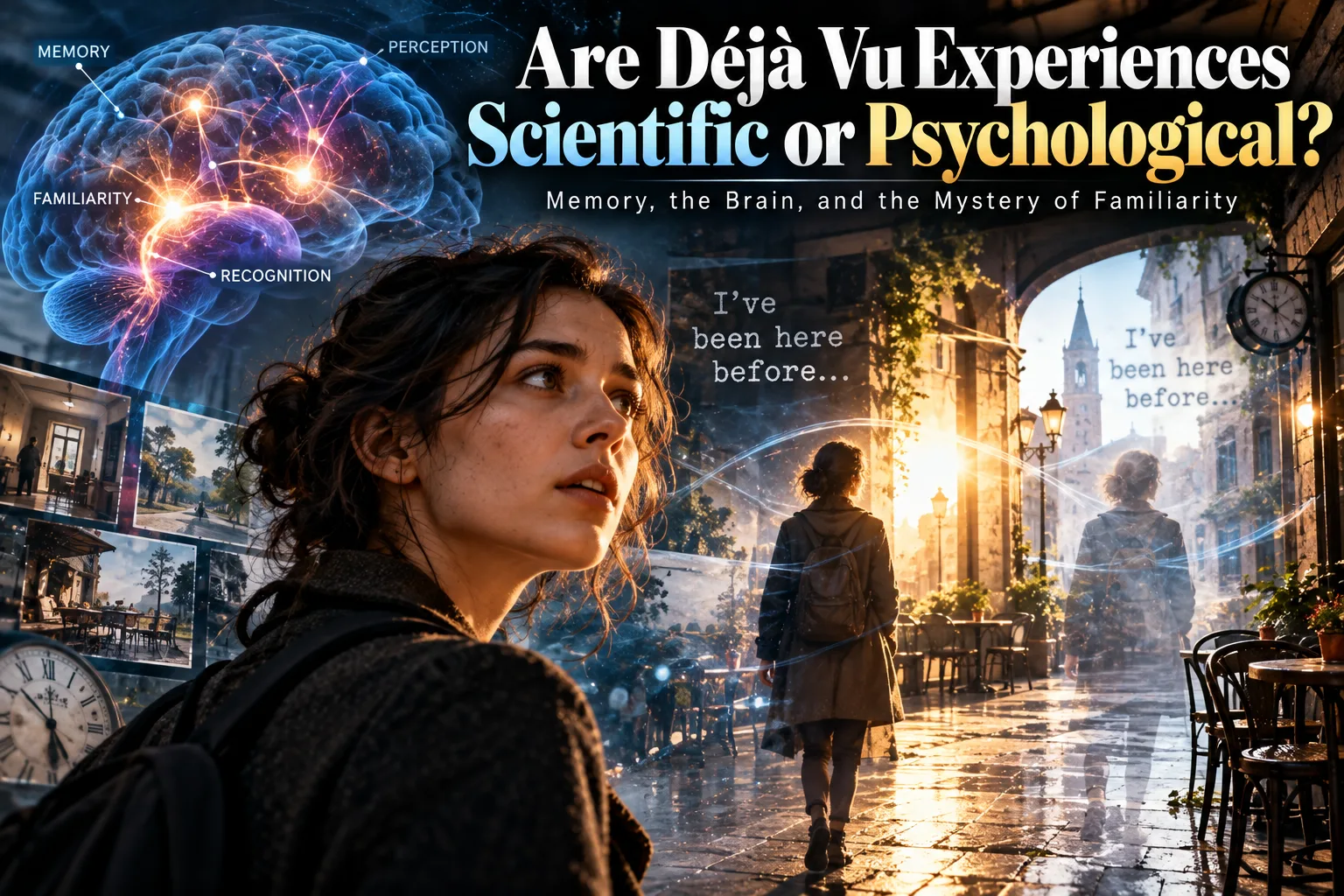
Are Déjà Vu Experiences Scientific or Psychological?
That strange feeling that you've experienced a moment before may seem mysterious, but déjà vu has several scientific explanations involving memory, familiarity, perception, and how the brain processes experience.
Are Déjà Vu Experiences Scientific or Psychological?
You walk into a room you've never seen before.
You have never visited the building.
You don't know the people inside.
And yet, for a few seconds, an unmistakable feeling appears:
"I've been here before."
You look around.
The arrangement of the furniture feels familiar.
The light seems familiar.
The conversation sounds familiar.
You may even feel as though you know what will happen next.
Then, just as suddenly, the feeling disappears.
A few minutes later, you're left wondering what just happened.
Was it a forgotten memory?
A glitch in the brain?
A dream you somehow remembered?
A glimpse of the future?
Or something much stranger?
The experience is called déjà vu, French for "already seen."
It is one of the most common and strangely convincing experiences in human psychology.
And that creates an obvious problem.
If you've never experienced a place before, why can it feel so strongly as though you have?
The scientific answer is considerably less supernatural than the experience feels.
Déjà vu appears to be closely connected to the brain's systems for:
Memory, familiarity, recognition, attention, and perception.
But researchers still don't have a single explanation that accounts for every déjà vu experience.
And that uncertainty is exactly what makes it interesting.
What Does Déjà Vu Actually Mean?
Déjà vu isn't simply remembering something.
It's the feeling of familiarity without a clear memory explaining the familiarity.
Imagine meeting a stranger.
You have no idea who they are.
But something about their face feels strangely familiar.
That's normal familiarity.
Déjà vu is more unusual.
You can know intellectually:
"I've never been here before."
while simultaneously feeling:
"I have definitely experienced this before."
Two mental signals appear to disagree.
Your reasoning says one thing.
Your subjective feeling says another.
That Contradiction Is the Important Part
Suppose you're visiting New York for the first time.
You walk into a café in Brooklyn.
You look around and suddenly experience an intense sensation:
"I've been in this exact place before."
Then you consciously search memory.
Nothing appears.
You can't identify:
When.
Where.
With whom.
Or under what circumstances.
The familiarity exists.
The source of the familiarity doesn't.
That distinction gives researchers an important clue.
Perhaps déjà vu involves the brain generating a familiarity signal without successfully retrieving the corresponding memory.
Familiarity and Recollection Are Not the Same Thing
Memory isn't a single system.
When you recognize something, two broad experiences can occur.
Familiarity
"I know this somehow."
Recollection
"I remember when and where I encountered this."
You recognize an actor.
That's familiarity.
You remember watching that actor in a particular movie on a specific evening.
That's recollection.
Déjà vu can resemble familiarity without recollection.
You feel:
"This is familiar."
But you can't retrieve the event that supposedly makes it familiar.
🧠 Your Brain Is Constantly Measuring Familiarity
Imagine walking through your home.
You don't consciously identify every object from scratch.
Your brain already knows:
That chair.
That wall.
That window.
That desk.
That sound.
Familiarity allows rapid recognition without reconstructing the entire history of the object every time.
This is useful.
You don't need to remember the first day you saw your refrigerator in order to know what it is.
But familiarity is not a perfect database.
It's a signal.
And signals can be triggered incorrectly.
The Brain Can Say "Familiar" Without Knowing Why
This is one possible foundation of déjà vu.
Something about the current experience resembles stored information.
The brain generates a familiarity response.
But the source isn't retrieved.
The result is:
Familiarity without recollection.
That can feel incredibly mysterious because consciousness receives the conclusion without necessarily receiving the underlying process.
Why Doesn't the Brain Simply Say "This Is a False Alarm"?
Because your brain doesn't come with a tiny referee sitting in the corner shouting:
"Incorrect familiarity signal!"
Different systems process different information.
One system can generate a familiarity sensation.
Another can evaluate whether a specific memory exists.
If those signals conflict temporarily, you may consciously experience the conflict as déjà vu.
The Memory Mistake Hypothesis
One family of scientific explanations proposes that déjà vu may arise when current experience accidentally activates memory-related familiarity processes.
Something about the present situation resembles an earlier experience.
Perhaps:
The spatial arrangement.
The lighting.
A facial expression.
The emotional atmosphere.
The sequence of events.
The combination of several small details.
You don't consciously remember the earlier experience.
But part of your brain recognizes a pattern.
The result:
"I've seen this before."
You Don't Need to Remember the Original Scene
Imagine visiting a new hotel.
The hallway resembles one you walked through years ago.
The wallpaper.
Lighting.
Ceiling height.
Carpet.
Furniture placement.
Individually, none seems particularly important.
Together, they might produce a strong sense of familiarity.
You don't remember the original hotel.
But your brain may detect structural similarity.
This is sometimes described as a familiarity-based explanation of déjà vu.
Why Déjà Vu Can Feel So Specific
People sometimes report:
"I knew exactly what would happen next."
This can make the experience feel predictive.
But there is an important distinction.
The feeling that you predicted an event isn't necessarily evidence that you actually predicted it.
The brain may generate a sense of familiarity so strong that the upcoming event itself feels pre-experienced.
In other words:
"I remember this happening."
can become:
"I remember what happens next."
even when no specific memory existed beforehand.
The Feeling of Prediction
Imagine you're sitting at a friend's house.
You experience déjà vu.
You think:
"She's about to say that."
She says it.
Your brain immediately experiences:
Confirmation.
But consider the alternative.
You've had hundreds of conversations.
You know the person's speech patterns.
The statement may have been predictable.
And because déjà vu already created a sense of familiarity, the successful prediction can feel much more extraordinary.
Coincidences Become More Powerful During Déjà Vu
Suppose you suddenly feel déjà vu.
Then:
Someone opens a door.
A phone rings.
A person says a particular phrase.
The sequence feels exactly right.
Your brain may interpret the coincidence as evidence:
"This is what I remembered."
But there is another possibility.
The déjà vu occurred first.
Then ordinary events happened.
The brain connected them afterward.
Human beings are extremely good at connecting events into stories.
Memory Is Reconstructive
This matters enormously.
Your brain doesn't store memories like video recordings.
When you remember something, you reconstruct it from stored information.
That means memories can change over time.
Details may become:
Less precise.
More generalized.
Influenced by later information.
Blended with other experiences.
That makes déjà vu particularly interesting.
The feeling:
"I remember this."
may exist without a clearly retrievable original event.
Could Déjà Vu Be a Memory From a Dream?
This is one of the most popular explanations.
Perhaps you dreamed about the scene months ago and forgot the dream.
Then you encounter a similar situation.
Suddenly:
"I've seen this before."
It sounds plausible.
And it could happen in individual cases.
But there is a major problem.
Dreams are often:
Fragmented.
Vague.
Poorly remembered.
Highly variable.
A person can easily interpret an ordinary resemblance as evidence that they had dreamed the event.
So a dream explanation may account for some people's experiences.
It doesn't appear necessary to explain déjà vu generally.
Déjà Vu Isn't Proof of Precognitive Dreams
Someone experiences déjà vu.
Something seemingly familiar happens.
They conclude:
"I saw this in a dream."
But this claim is difficult to verify unless the dream was documented before the event occurred.
Without a prior record, memory reconstruction can make a vague dream seem much more specific after the fact.
The distinction is important:
Feeling that you predicted something
is different from
having verifiable evidence that you predicted it.
The Temporal Lobe Connection
Déjà vu has another fascinating scientific connection.
People with certain forms of epilepsy, particularly temporal lobe epilepsy, can experience unusually intense déjà vu as part of their seizures.
Researchers studying neurological patients have therefore investigated brain regions involved in:
Memory.
Recognition.
Familiarity.
Emotion.
Conscious experience.
This provides an important clue that déjà vu isn't merely a philosophical idea.
It has measurable neurological associations.
Does Ordinary Déjà Vu Mean You Have Epilepsy?
No.
This is important.
Experiencing occasional déjà vu is common and usually not evidence of epilepsy.
Neurological déjà vu associated with seizures can occur in a different clinical context and may have other symptoms.
A brief familiar feeling by itself is not a diagnosis.
Why Epilepsy Research Matters
Neurological cases can help scientists understand normal brain function.
If disrupting activity in a particular brain region can produce:
Strong familiarity.
Memory sensations.
Unusual emotional experiences.
that suggests the region contributes to those mental processes.
Researchers have sometimes used electrical stimulation during neurosurgical procedures to investigate how particular brain regions affect subjective experience.
These studies have helped illuminate the relationship between:
Brain activity.
Memory.
Recognition.
And conscious experience.
The Medial Temporal Lobe
The medial temporal lobe contains structures strongly involved in memory.
Among them are:
The hippocampus.
The parahippocampal region.
The amygdala nearby, which is involved in emotional processing.
These areas don't perform one isolated function.
Memory is distributed across interacting brain systems.
Still, research involving the medial temporal region has made it a major focus in understanding déjà vu.
The Hippocampus Is Not a "Memory Hard Drive"
People often imagine:
Hippocampus = memory storage.
It's more complicated.
The hippocampus is involved in forming and retrieving certain kinds of memories, particularly episodic memories and representations of places and contexts.
Damage to the hippocampus can profoundly affect memory.
But memory itself isn't stored in one tiny location.
It depends on networks across the brain.
So when discussing déjà vu, it's more accurate to talk about interacting memory and recognition systems than one "déjà vu center."
The Familiarity Signal May Come From Nearby Systems
Research has implicated regions around the medial temporal lobe in familiarity and recognition.
One proposed distinction involves different regions contributing differently to:
Recollection
and
familiarity.
When these systems produce slightly mismatched signals, the subjective experience may resemble déjà vu.
The brain effectively says:
"This feels familiar."
while another system says:
"But I can't retrieve the episode."
Déjà Vu as a Monitoring Error
Another explanation focuses on source monitoring.
Source monitoring means identifying where information came from.
Did you:
See it?
Hear it?
Dream it?
Imagine it?
Read it?
Experience it?
Remembering information without correctly identifying its source can happen in ordinary cognition.
Déjà vu may involve a temporary mismatch where the brain experiences familiarity but cannot identify the source.
Why Source Matters
Imagine you recognize a quote.
You know you've heard it.
But you don't remember where.
Was it:
A movie?
A book?
A YouTube video?
A conversation?
A dream?
The information feels familiar.
The source is missing.
Déjà vu may be an extreme version of something related to this basic problem.
Another Theory: Processing Delay
There is another popular scientific explanation involving slight differences in the timing of information processing.
Imagine the brain receives sensory information.
One processing pathway registers it.
Another pathway receives or interprets related information a tiny moment later.
That timing difference might create the subjective impression that:
"I've already experienced this."
This idea has been discussed for decades.
But evidence does not establish a simple universal "processing delay" as the definitive explanation for déjà vu.
The phenomenon is probably more complicated.
Why Timing Could Matter
Your perception feels continuous.
But the brain processes information through multiple pathways.
Different features:
Color.
Shape.
Motion.
Location.
Meaning.
Memory.
can be processed through interacting systems.
The conscious experience feels unified.
The underlying processing is not one instantaneous event.
That makes timing differences theoretically interesting.
The "Familiar Structure" Explanation
Another influential approach is simpler.
The present scene may share a structure with an earlier scene.
You don't remember the earlier scene consciously.
But your brain recognizes the structural similarity.
For example:
You enter an unfamiliar classroom.
The arrangement resembles:
A classroom from school.
A meeting room from childhood.
A university lecture hall.
The same:
Desk spacing.
Door position.
Lighting.
Viewing angle.
Movement pattern.
may trigger familiarity.
No supernatural memory is required.
Geometric Similarity Can Be Enough
Imagine looking through a doorway.
There is:
A table on the left.
People sitting in a semicircle.
A window at the end.
A wall-mounted screen.
Even though the objects differ, the spatial relationships resemble another place.
Your brain may detect the pattern.
This is why déjà vu can sometimes feel spatial rather than visual.
People often say:
"The whole layout feels familiar."
Why People Experience Déjà Vu More in New Places
This seems contradictory.
If déjà vu comes from familiarity, why does it often happen in unfamiliar environments?
Because new environments contain more uncertainty.
You are actively processing:
Where you are.
What you're seeing.
How the space is organized.
What's happening next.
That heightened attention may make subtle similarities more noticeable.
The environment is new.
Your brain is searching for patterns.
Sometimes it finds one.
Novelty and Familiarity Can Exist Together
Something can be:
Objectively new
and
subjectively familiar.
That's basically the definition of déjà vu.
Your conscious reasoning knows:
"This place is new."
Your familiarity system says:
"This feels known."
The conflict produces the distinctive sensation.
Emotion May Intensify the Experience
Déjà vu isn't necessarily purely visual.
People often describe an emotional component:
Strangeness.
Excitement.
Unease.
Wonder.
A feeling of inevitability.
The emotional intensity can make the experience seem more significant than it objectively is.
A mild familiarity signal may be interpreted as extraordinary because it arrives with a strong sense of:
"Something important is happening."
Why Some Déjà Vu Experiences Feel Supernatural
The experience violates ordinary expectations.
You know you've never been there.
Yet your mind insists that you have.
That contradiction creates explanatory pressure.
The brain asks:
Why would I feel this if it isn't true?
Several explanations become available.
Maybe:
A past life.
A prophecy.
A parallel universe.
A dream.
Psychic ability.
A timeline glitch.
A memory from another reality.
The experience itself doesn't tell you which explanation is correct.
It only tells you that your brain generated a strong feeling of familiarity.
The Brain's Explanation Problem
Humans strongly dislike unexplained experiences.
If something strange happens, we search for a cause.
This is usually helpful.
But when the experience is generated internally, the brain can sometimes mistake the experience for evidence about the external world.
You feel:
"This happened before."
So you infer:
"Therefore it must have happened before."
That inference is not logically guaranteed.
A feeling can be real without its interpretation being correct.
Emotion Doesn't Equal Evidence
Imagine feeling that someone is watching you.
The feeling is real.
It doesn't prove someone is watching.
Imagine feeling that you know a stranger.
The familiarity is real.
It doesn't prove you've met them.
Imagine feeling that you've experienced a place before.
The déjà vu is real.
It doesn't prove you physically experienced that exact place previously.
This distinction is essential.
Déjà Vu and False Memories Are Not the Same Thing
False memory involves remembering an event or detail that did not happen as remembered.
Déjà vu is primarily a feeling of familiarity.
You may experience it without constructing a detailed memory.
That distinction matters.
You can have déjà vu and know:
"I don't actually remember this."
You're experiencing familiarity without a complete recollection.
Déjà Vu May Be a Kind of Metacognitive Signal
Metacognition means thinking about your own mental processes.
You don't simply experience a scene.
You also experience:
"This feels familiar."
That's information about your own cognition.
In déjà vu, the interesting part isn't merely the content of the perception.
It's the brain's judgment about the perception.
You are aware of:
The familiarity itself.
Why This Makes Déjà Vu So Strange
Imagine seeing a red car.
You don't normally think:
"I am experiencing visual recognition."
The recognition is invisible.
In déjà vu, however, the recognition system becomes noticeable.
You experience:
"Something about this is already known."
It's almost like hearing the machinery behind your own cognition.
Healthy Brains Can Produce Weird Experiences
People sometimes assume:
"If my brain can produce something strange, something must be wrong."
Not necessarily.
Healthy brains produce:
Dreams.
Optical illusions.
False alarms.
Memory distortions.
Nightmares.
Pareidolia.
Intrusive thoughts.
Déjà vu.
The brain is a complex predictive system.
Interesting mistakes are part of the package.
Déjà Vu Is Not Necessarily a Bug
It can be useful to think of déjà vu not as:
"The brain malfunctioned."
but as:
"A normal cognitive mechanism produced an unusual output."
Your brain is constantly estimating:
Familiarity.
Similarity.
Recognition.
Context.
Prediction.
Sometimes those signals conflict.
The conflict becomes conscious.
And you experience déjà vu.
Why Does Déjà Vu Usually Last Only Seconds?
Most episodes are brief.
That fits the idea that the experience involves a temporary mismatch in recognition or familiarity signals rather than a stable memory of an actual previous event.
A short-lived signal appears.
You notice it.
The system recalibrates.
The feeling fades.
Reality returns to feeling boringly linear.
Can You Trigger Déjà Vu?
Researchers have attempted to experimentally evoke déjà vu-like experiences.
Approaches have included:
Stimulating particular brain regions.
Manipulating contextual similarity.
Creating familiarity without explicit recollection.
Designing environments that resemble previously experienced spatial layouts.
These studies support the idea that déjà vu can emerge from normal memory and recognition processes rather than requiring an actual repeated event.
The Virtual-Reality Experiment Problem
Imagine you're in a virtual environment.
You enter one room.
Later, you enter another room with:
Similar geometry.
Similar objects.
Similar lighting.
Different surface details.
You may experience a sense of familiarity even though the second space is technically new.
This kind of experimental setup helps researchers separate:
Physical repetition
from
structural similarity.
The "I've Been Here Before" Feeling Can Be Created Without Being Here Before
That's the crucial insight.
If researchers can reproduce déjà vu-like familiarity through similarity or cognitive manipulation, then the feeling itself doesn't require an actual previous experience.
That doesn't prove every natural déjà vu has exactly the same mechanism.
It demonstrates that the brain can generate familiarity independently of conscious recollection of the supposed original event.
Why Some People Experience Déjà Vu More Often
People report different frequencies of déjà vu.
Possible factors studied include:
Age.
Stress.
Fatigue.
Attention.
Travel and exposure to new environments.
Certain neurological conditions.
Individual differences in memory and perception.
However, simplistic claims such as:
"People who experience more déjà vu are more intelligent"
or
"Déjà vu frequency predicts personality type"
aren't established as general truths.
Age Seems to Matter
Déjà vu is reported frequently by younger adults and tends to decline with age in many studies.
But the exact pattern is influenced by:
How often people notice the experience.
How they interpret it.
How memories are formed.
How frequently they encounter novel situations.
The decline doesn't necessarily mean the brain stops producing familiarity mismatches.
It may partly reflect differences in memory, attention, and experience.
Why Novel Experiences Could Matter
You can't feel strong familiarity without encountering something that appears unfamiliar.
Travel.
New schools.
New jobs.
New social environments.
New buildings.
new experiences in general
may provide more opportunities for familiarity mismatches.
Older people may encounter fewer novel environments in some circumstances.
That could affect reported déjà vu.
Stress and Fatigue
Many people report déjà vu during periods of:
Stress.
Fatigue.
Sleep disruption.
Heightened attention.
But these associations don't mean stress directly causes déjà vu in every case.
They may affect:
Attention.
Memory encoding.
Concentration.
Monitoring.
which could make familiarity mismatches more noticeable.
Déjà Vu and Anxiety
An unusual experience can become alarming if you interpret it as evidence of something supernatural or medically serious.
A better approach is to start with the simplest explanation:
The brain sometimes produces inaccurate familiarity signals.
That happens.
It doesn't automatically mean something is wrong.
When Déjà Vu Is Worth Discussing With a Doctor
Ordinary occasional déjà vu is generally not unusual.
But recurrent or unusually intense episodes accompanied by other neurological symptoms can deserve medical evaluation.
For example:
Loss of awareness.
Confusion.
Unusual smells or tastes.
Sudden intense fear.
Memory gaps.
Unusual movements.
Repeated episodes occurring in a concerning pattern.
These can occur in some neurological conditions, including temporal lobe seizures.
The context matters.
The feeling alone isn't enough to diagnose anything.
Déjà Vu in Epilepsy Is Especially Interesting
Some people with temporal lobe epilepsy experience déjà vu as part of their seizures.
In those cases, the sensation may be unusually intense or stereotyped.
It can occur alongside:
Fear.
Strange smells.
Altered awareness.
Memory disturbance.
Other seizure symptoms.
Researchers have used such cases to study how memory and familiarity are generated.
The clinical phenomenon provides a window into normal cognition.
🟢 What We Know
Science supports several important points:
Déjà vu is a real subjective experience.
It is common.
It involves a feeling of familiarity without clear corresponding recollection.
Brain systems involved in memory and recognition are strongly implicated.
Similar experiences can occur in some forms of epilepsy.
Experimental work suggests déjà vu-like familiarity can arise without literal repetition of the exact event.
These findings strongly support psychological and neurological explanations.
🟡 What Researchers Are Still Figuring Out
There is no single universally accepted mechanism explaining every déjà vu experience.
Researchers continue investigating:
Familiarity signals.
Source-monitoring errors.
Structural similarity.
Processing timing.
Memory retrieval.
Attention.
Prediction.
Interactions between these systems.
It's possible that multiple mechanisms contribute to what people casually call "déjà vu."
That would not be surprising.
The brain rarely behaves like a single switch.
🔴 Popular Myths
"Déjà vu proves you've lived this life before."
No scientific evidence establishes that.
"Déjà vu means you predicted the future."
A feeling of prediction isn't evidence of actual precognition.
"Déjà vu proves parallel universes."
Interesting science fiction.
Not scientific evidence.
"Déjà vu is always a sign of epilepsy."
False.
Ordinary déjà vu is common. Neurological evaluation becomes more relevant when episodes are unusual, frequent, intense, or accompanied by other symptoms.
"Scientists completely understand déjà vu."
Also false.
We understand many mechanisms that could produce it, but the phenomenon is not reduced to one universally accepted explanation.
The Déjà Vu Paradox
There's something philosophically beautiful about déjà vu.
Your brain produces the feeling:
"This happened before."
But the experience itself becomes evidence that:
The brain can generate the feeling of prior experience.
That means the feeling of remembering isn't automatically proof of an actual past event.
This applies beyond déjà vu.
Memory, familiarity, confidence, and recognition are all mental states.
They are useful.
They are not infallible.
The Difference Between Memory and Feeling of Memory
This is subtle.
You can remember something.
You can also feel like you remember something.
Usually, they match.
Occasionally, they don't.
Déjà vu may expose that distinction.
You get:
Feeling of prior experience
without:
Retrievable prior experience.
The brain produces the signal.
Consciousness notices the discrepancy.
And suddenly you are staring at a completely ordinary room wondering whether reality has secretly skipped a page.
Could Déjà Vu Be a "Glitch"?
In a loose metaphorical sense, you could call it a glitch.
But a better scientific interpretation is:
An unexpected interaction between normal cognitive systems.
Think of a computer displaying the wrong color because two programs briefly conflict.
The screen is still functioning.
The software is still functioning.
The unusual output comes from their interaction.
The brain may work similarly.
Memory.
Recognition.
Attention.
Prediction.
context
are interacting constantly.
Occasionally the output is strange.
Why the Experience Feels More Important Than It Is
Déjà vu has a built-in emotional message:
"This matters because I've seen it before."
But that's circular.
You feel familiarity.
The brain interprets familiarity as significance.
Significance makes the feeling stronger.
The event therefore seems extraordinary.
This may create the illusion that déjà vu contains a hidden message.
Most likely, the "message" is simply:
"Some part of my recognition system fired unusually strongly."
Not nearly as cinematic.
Much more interesting scientifically.
Why Humans Turn Déjà Vu Into Mysteries
Because the experience is internally convincing.
A person doesn't choose to feel:
"This is familiar."
It simply happens.
If the experience conflicts with your knowledge, your brain searches for an explanation.
A supernatural explanation can feel satisfying because it matches the intensity of the sensation.
If the feeling is extraordinary, the explanation should apparently be extraordinary too.
But that's backwards.
The unusual intensity of an experience doesn't automatically make an unusual explanation more likely.
The Scientific Habit: Explain the Experience Before Explaining Reality
This is a powerful general lesson.
Instead of:
"I felt this happened before, therefore it happened before."
ask:
"What processes could create this feeling?"
That's exactly what science tries to do.
Start with:
Observation.
Then:
Mechanism.
Then:
Test.
Then:
Evidence.
Only after that should you decide what the experience implies about the external world.
A Similar Lesson From Optical Illusions
Earlier we asked:
Can you trust your eyes?
Optical illusions showed that:
Perception can be convincing.
Yet wrong.
Déjà vu adds another layer:
Can you trust the feeling that your mind remembers something?
Again:
Usually.
But not absolutely.
Human cognition is extraordinarily useful.
It isn't a perfect witness.
The Most Interesting Part Is That You Know Something Is Wrong
During ordinary memory errors, you may believe a false memory.
During déjà vu, you often recognize the contradiction.
You think:
"This feels familiar, but I know it shouldn't."
That means another part of your mind is monitoring the first.
One process says:
Familiar.
Another says:
No known source.
Consciousness experiences the disagreement.
That's why déjà vu can feel so strange.
You are not simply confused.
You're aware that your own mind is sending conflicting signals.
The Brain Is Checking Itself
This is perhaps the deepest psychological lesson.
Your mind doesn't only process the world.
It monitors its own processing.
You can notice:
Confidence.
Uncertainty.
Familiarity.
Doubt.
Strangeness.
Recognition.
Déjà vu is partly interesting because the monitoring process itself becomes conscious.
You don't simply know.
You notice that you feel as though you know.
That's a very different experience.
Frequently Asked Questions
What does déjà vu mean?
Déjà vu literally means "already seen" and refers to the unusual feeling that a present situation has been experienced before even when no corresponding memory can be identified.
Is déjà vu scientifically real?
Yes. It is a well-described subjective phenomenon studied in psychology and neuroscience.
Does déjà vu mean I have a hidden memory?
Not necessarily. It may involve a familiarity signal produced without successful retrieval of a specific autobiographical memory.
Is déjà vu proof of past lives?
No scientific evidence establishes that déjà vu comes from past lives.
Is déjà vu proof of precognition?
No. Feeling that an event was previously experienced or predicted does not establish that the future was actually known.
Why does déjà vu feel so convincing?
Familiarity is normally a useful signal for recognizing previously encountered information. When that signal appears without a clear memory source, the experience can still feel extremely authentic.
Can dreams cause déjà vu?
A forgotten dream could theoretically contribute to an individual experience, but there is no need to invoke dreams to explain déjà vu generally, and memories of dreams can themselves be reconstructed.
Is déjà vu related to epilepsy?
It can be. Déjà vu can occur during some temporal lobe seizures, but ordinary occasional déjà vu is common and does not by itself indicate epilepsy.
Why does déjà vu usually last only a few seconds?
The experience appears to involve a brief mismatch or unusual activation within recognition and memory processes, although the exact mechanism is still being studied.
Can scientists trigger déjà vu?
Researchers have produced déjà vu-like experiences experimentally using approaches involving contextual similarity and, in some clinical settings, brain stimulation. These studies help investigate the mechanisms behind familiarity and memory.
Why do I sometimes feel like I know what happens next?
Déjà vu can create a strong impression of prediction. A later event may then appear to confirm the feeling, even though the sense of prediction itself isn't evidence that the event was genuinely foreseen.
Myth vs. Evidence
🟢 Déjà vu is a genuine psychological experience.
Yes.
🟢 Memory and familiarity systems are involved.
Strongly supported.
🟢 Déjà vu can occur in neurological conditions.
Yes, particularly in some temporal-lobe seizure disorders.
🔴 Déjà vu proves you've lived the moment before.
No.
🔴 Déjà vu proves you've seen the future.
No scientific evidence establishes this.
🔴 Déjà vu means there is something medically wrong.
Not by itself.
🟡 Scientists have identified one single definitive cause.
Not yet.
Multiple mechanisms may contribute.
🟢 You can feel familiar with something without retrieving its source.
Yes.
That distinction is central to understanding déjà vu.
Final Thoughts
Déjà vu is one of those experiences that feels like it should reveal something enormous about reality.
For a few seconds, the present and the past seem to overlap.
You know:
"This is new."
Yet another part of your mind insists:
"No. I've been here before."
That contradiction is powerful enough to produce theories about:
Past lives.
Parallel universes.
Prophecy.
Dreams.
Glitches in reality.
But science offers a different starting point.
Before asking:
"What does déjà vu tell us about the universe?"
ask:
"What does déjà vu tell us about the brain?"
And the answer is already fascinating.
Your brain distinguishes familiarity from recollection.
It monitors whether memories have identifiable sources.
It compares current experience with stored patterns.
It predicts what should feel familiar.
It processes information through multiple interacting systems.
And occasionally, those systems disagree.
When they do, consciousness can receive an extraordinary signal:
Familiarity without memory.
The feeling is real.
The explanation your mind immediately attaches to it may not be.
That distinction is one of the most important lessons psychology can teach us.
A feeling can be:
Intense.
Convincing.
Detailed.
Emotionally powerful.
and still not be reliable evidence about what happened externally.
You don't have to dismiss the experience.
You just have to separate:
"I experienced this."
from:
"Therefore my interpretation of this experience must be true."
That separation is the foundation of critical thinking.
And perhaps that is what makes déjà vu so valuable scientifically.
For a few seconds, it lets you catch your own brain in the act.
You feel the past without remembering it.
You recognize without knowing why.
You experience certainty and doubt simultaneously.
Then the sensation disappears.
The room becomes ordinary again.
The mystery fades.
But the lesson remains:
Your mind can generate the feeling of remembering something that you cannot actually remember.
And if something as basic as familiarity can fool you for a few seconds, perhaps the strangest thing about déjà vu isn't that reality sometimes feels repeated.
It's that the brain can make a completely new moment feel like an old one.
Without changing the world at all.