The Devil's Footprints of 1855
In February 1855, mysterious hoof-like tracks appeared across parts of Devon, England, stretching for miles over snow-covered ground. Explore what was reported, what may have caused them, and why the mystery endured.
The Devil's Footprints of 1855
On the morning of 9 February 1855, people across parts of Devon, England, woke to an unsettling sight.
Snow covered the ground.
And across that snow were strange tracks.
They looked vaguely like the marks of a small hoof.
But there was something deeply wrong with them.
The tracks reportedly appeared in a remarkably regular line.
They crossed gardens.
Passed over walls.
Appeared on rooftops.
Continued through places where observers struggled to imagine an ordinary animal could have gone.
Soon, people across a broad area of Devon were talking about them.
What had walked through the countryside during the night?
A strange animal?
A runaway exotic creature?
A person deliberately making the marks?
Some unusual effect of melting and refreezing snow?
Or, as some people apparently began to wonder:
Had the Devil himself visited Devon?
The event became known as the Devil's Footprints, or sometimes the Devil's Hoofmarks.
It remains one of Britain's classic historical mysteries.
But the story has an interesting problem.
The more famous the footprints became, the less clear the original evidence appears to have become.
Contemporary newspapers described an astonishing trail.
Later researchers discovered letters and drawings from people who had actually investigated some of the marks.
And those records suggest something important:
The footprints may never have been one single, continuous trail made by one mysterious creature.
Instead, the famous mystery may have been created from many separate observations, unusual tracks, weather conditions, human curiosity, and an increasingly dramatic press narrative.
That doesn't make the event boring.
Quite the opposite.
It turns the mystery into a fascinating question about how an ordinary landscape can become extraordinary when thousands of people try to explain the same unexplained thing.
The Night Devon Turned White
The event began during a period of heavy snowfall.
On the night of 8–9 February 1855, snow covered large areas of Devon.
The following morning, people began discovering unusual impressions in the snow.
Reports came from numerous communities around the Exe Estuary and southern Devon, including places such as:
Exmouth.
Topsham.
Lympstone.
Dawlish.
Teignmouth.
Torquay.
Totnes.
Contemporary accounts described the phenomenon across a surprisingly large area. Wikipedia
At first, there was nothing inherently supernatural about finding animal tracks after snowfall.
Then people looked more closely.
They Didn't Look Like Ordinary Footprints
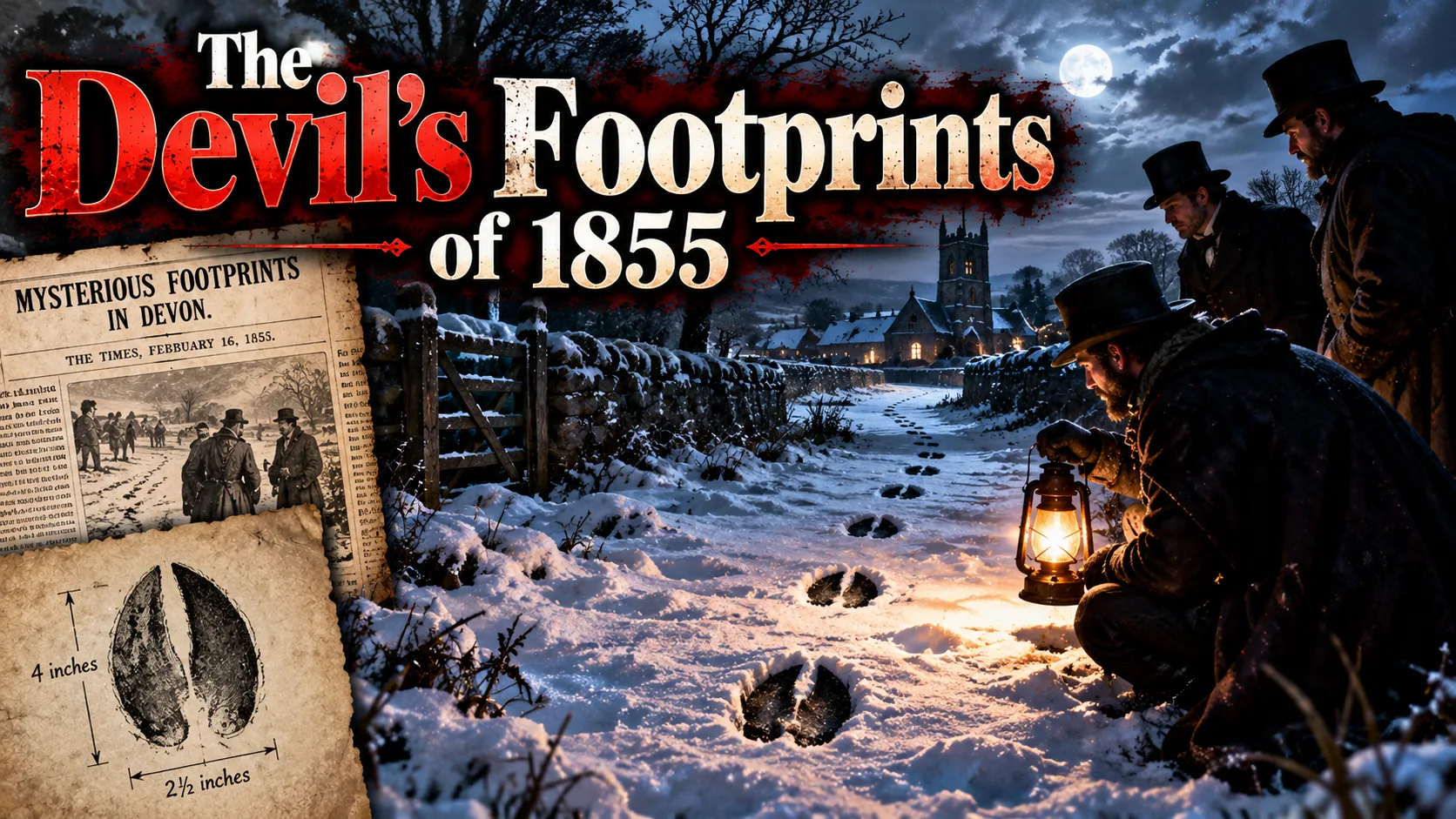
The marks were reported as roughly:
4 inches long
and around:
2½–3 inches wide
in some contemporary descriptions.
The shape was often compared with:
A donkey hoof.
A horse hoof.
A cloven hoof.
Some accounts emphasized that the marks appeared in a nearly straight sequence rather than as the paired tracks people might expect from a four-legged animal.
The unusual appearance immediately created speculation about what kind of creature could have produced them. Studylib
Then Came the Strange Locations
The footprints weren't merely discovered in open fields.
Reports described marks:
Across gardens.
Along narrow walls.
Over rooftops.
Near enclosed yards.
Around buildings.
And in places where the apparent trail seemed to ignore ordinary obstacles.
This was the feature that transformed:
"Strange animal tracks"
into:
"What on Earth made these?"
According to contemporary reporting reproduced in later historical investigations, some witnesses claimed the marks crossed obstacles and appeared in locations that seemed extraordinarily difficult for a normal animal to reach. Exeter Memories
And once that happened, the Devil entered the story.
Why the Devil?
The shape was part of the reason.
A split hoof has long been associated with the traditional European image of Satan.
But there was another reason.
The supposed route seemed impossible.
Something apparently walked:
Across snow.
Over walls.
Across roofs.
Through enclosed areas.
And in some reports even seemed to continue through very narrow spaces.
For nineteenth-century observers steeped in Christian folklore, the combination was irresistible.
A hoof-like trail behaving in impossible ways?
People already had a ready-made explanation.
The Devil.
The Press Made the Mystery Bigger
The story quickly spread through newspapers.
One contemporary account published by The Times on 16 February 1855 described the strange tracks and emphasized their appearance in places such as house tops and narrow walls. Exeter Memories
Other publications picked up the story.
Soon the footprints were no longer merely local observations.
They were becoming a regional mystery.
And then a national one.
This matters because newspapers don't simply transmit mysteries.
They can also shape the mystery.
The "Single Trail" Problem
The most dramatic version of the story suggests that one creature traveled an enormous distance through Devon overnight.
Popular retellings sometimes describe a trail spanning roughly 40 to 100 miles, depending on the source and interpretation. Wikipedia
That's the version most people remember.
But there is an important problem:
There is little evidence that all the reported tracks formed one physically continuous trail.
They were reported at many separate locations.
And the evidence suggests the footprints did not necessarily have identical shapes everywhere.
That changes the mystery considerably.
Separate Tracks Could Have Become One Story
Imagine thirty villages after a snowfall.
People find strange marks.
One person says:
"Looks like a donkey."
Another says:
"Looks like a hoof."
Someone else discovers something similar.
A newspaper hears about it.
The reports get connected.
Soon people are talking about:
The mysterious footprints across Devon.
Then the next reporter describes them as:
A trail.
Another describes:
A 40-mile trail.
The next:
A 100-mile trail.
The story evolves.
That process happens surprisingly easily.
🟡 Contemporary Evidence Was Not Uniform
Later researchers studying surviving documentation discovered that descriptions of the marks varied.
One particularly important archival collection belonged to Henry Thomas Ellacombe, the vicar of Clyst St George.
His papers included:
Letters.
Correspondence.
Drawings.
Tracings of footprints.
And other material relating to the mystery.
These records provide a much more complicated picture than the neat popular narrative. Wikipedia
The Ellacombe Papers
Ellacombe had collected reports from people who had seen the footprints.
Among the material were communications from the Reverend G. M. Musgrove, as well as several apparent tracings.
Some of the surviving evidence suggested that different locations produced footprints that were not necessarily identical.
This is extremely important.
If the marks varied substantially, the idea of one creature producing every track becomes much harder to maintain.
The Strange Case of the "Kangaroo"
One of the most entertaining parts of the story involves an escaped kangaroo.
Several contemporary communications proposed that perhaps an exotic animal had escaped from a private collection or menagerie.
A kangaroo could move in a distinctive hopping pattern.
And Britain in the Victorian period did have wealthy individuals who kept exotic animals.
So:
Kangaroo escapes → leaves weird tracks → Britain panics
is at least entertainingly plausible.
But it isn't established as the explanation.
Why the Kangaroo Theory Is So Famous
Because it demonstrates how quickly humans search for extraordinary but natural explanations.
Once people decided the footprints couldn't be from an ordinary local animal, the candidates expanded:
Badger.
Kangaroo.
Bird.
Toad.
Other animals.
Mechanical causes.
Hoax.
Devil.
The argument moved from:
"What made this mark?"
to:
"What strange thing might be capable of making it?"
That's a subtle but important change.
The Badger Hypothesis
One of the more plausible natural explanations has involved a badger.
Badgers are capable of producing unusual tracks in snow, particularly under specific conditions.
Their gait and paw structure can create impressions that become distorted as snow changes.
If several small impressions merge or deform, they can become much less recognizable.
That could make a familiar animal produce an unfamiliar footprint.
The Problem With Frozen Snow
Fresh snow isn't a permanent photographic surface.
It changes.
Sunlight can melt it.
Rain can alter it.
Wind redistributes it.
Temperature can cause melting and refreezing.
Footprints can widen.
Edges can collapse.
Separate impressions can merge.
A small track can therefore become much larger and less recognizable than it originally was.
Snow Is a Terrible Historical Recorder
This is an important point.
People often imagine a footprint in snow as a perfect cast.
It isn't.
The shape depends on:
Snow depth.
Temperature.
Moisture.
Compression.
Wind.
Subsequent precipitation.
Sunlight.
Refreezing.
The type of surface underneath.
A footprint found hours later may look dramatically different from the footprint produced at the moment an animal stepped into the snow.
The Freeze-Thaw Problem
Imagine a small animal walks across fresh snow.
Its original footprint is ordinary.
Then the temperature rises slightly.
The edges melt.
Water moves into surrounding snow.
The original shape becomes wider.
Then the temperature falls again.
The enlarged depression freezes.
Suddenly:
A small paw mark
can resemble:
A larger hoof-like impression.
If several marks are close together, the result can become even stranger.
Could Snow Explain Everything?
Probably not.
This is where honesty matters.
A freeze-thaw process can explain why animal tracks might become distorted.
It does not automatically explain every famous story about:
Roofs.
Walls.
Drainpipes.
Long-distance continuity.
Or every reported track.
A good hypothesis doesn't have to explain every later legend.
It has to explain the strongest evidence.
The Toad Story
One of the strangest proposed solutions came from a correspondent in St Marychurch, Torquay.
According to material reproduced in Mike Dash's compilation of the original source documents, the man said he had followed unusual marks in his garden and eventually found a large toad beneath a tree.
He claimed the impression matched the famous illustrations of the mysterious tracks. Studylib
A toad.
The supposed Devil's footprints.
The mystery suddenly acquired a creature even less demonic than a badger.
Could a Toad Really Do That?
A large toad moving through shallow snow could leave unusual marks.
Under the right conditions, a track might become distorted.
But this does not mean:
"The Devil's Footprints were caused by one giant toad."
That is another oversimplification.
At most, the observation shows that unfamiliar snow impressions can have surprising mundane explanations.
Birds Were Also Proposed
Another contemporary line of reasoning considered birds.
Wading birds or other birds could potentially create unusual patterns in snow.
A bird's gait is very different from that of a mammal.
And when snow distorts a track, the result can become difficult to interpret.
One nineteenth-century discussion considered whether birds could explain at least some of the markings. Studylib
Again:
Some tracks ≠ all tracks.
The Animal Explanation Doesn't Need One Animal
This may be the most important insight.
Suppose:
A badger made some.
A bird made others.
A human made a few.
Weather altered several.
Someone misidentified the rest.
Then newspapers connected everything.
There is no reason to assume one explanation must account for every reported footprint.
The "mystery" may have been a collection of different events.
The Human Hoax Theory
Another possibility is much simpler.
Someone made the footprints deliberately.
This would not be particularly difficult.
A person could create a hoof-like object and stamp it into the snow.
Or simply manipulate existing marks.
The problem is:
Who?
And:
How many locations?
If multiple unrelated villages had similar reports, a single hoaxer would have needed to travel a remarkable distance.
But separate local hoaxes are possible.
A Hoax Could Also Become Contagious
This is where psychology becomes interesting.
Suppose one person creates a strange track.
People see it.
They hear the story.
Someone else decides to imitate it.
Another person becomes curious.
Soon multiple locations contain similar marks.
Now observers think:
"It can't be a hoax because too many places have them."
But multiple people reproducing a phenomenon can create the appearance of one mysterious source.
That's called:
social contagion.
The Devil Was Already a Familiar Explanation
Victorian Britain had a rich tradition of folklore.
Unusual events could be interpreted through:
Ghost stories.
Witches.
Fairies.
Devils.
Omens.
Supernatural animals.
The language people used to describe a mystery was therefore shaped by their cultural expectations.
A hoof-like print wasn't merely:
A strange track.
It became:
A Devil's hoofmark.
🟡 The Name Changed the Evidence
Once the prints were called "Devil's Footprints," every subsequent observation was interpreted through that framework.
A difficult-to-explain mark became:
Proof of the mystery.
A normal-looking mark became:
Another Devil footprint.
An unusual path became:
Evidence that the creature could cross impossible obstacles.
Labels matter.
They influence what people notice.
Why People Saw a Continuous Trail
Imagine you have separate observations spread across many villages.
You don't see the entire route.
You only hear about:
Point A.
Point B.
Point C.
Point D.
You assume:
A → B → C → D
But perhaps the marks at A and B were unrelated.
Once a narrative exists, humans naturally connect the dots.
This Happens in Modern Conspiracy Theories Too
The psychological mechanism is familiar.
Event A.
Event B.
Event C.
People notice similarities.
A pattern emerges.
The events become part of one story.
The story makes every event seem more significant.
Then the story becomes evidence for itself.
The Devil's Footprints may represent a nineteenth-century example of this process.
The "Impossible" Route
Contemporary reports emphasized how the tracks apparently crossed obstacles.
Some accounts said they appeared:
On roofs.
Over walls.
Through enclosed spaces.
Near drainage pipes.
This created the impression that whatever made them was capable of:
Jumping.
Climbing.
Walking vertically.
Passing through narrow spaces.
The supernatural interpretation became increasingly attractive.
But How Good Were the Observations?
Not very good by modern forensic standards.
People were not:
Photographing every footprint.
Measuring coordinates.
Collecting casts.
Recording weather conditions.
Preserving untouched trails.
Mapping every individual impression.
Instead, people:
Looked.
Described.
Drew.
Copied.
Retold.
By the time the story reached a newspaper, details had already passed through several layers of interpretation.
The Victorian Newspaper Environment
Newspapers competed for attention.
An ordinary animal track isn't exciting.
"Mysterious Devil Footprints Across Devon"
is.
This doesn't mean the journalists deliberately fabricated the entire event.
It means unusual features are emphasized.
The story becomes more coherent.
More dramatic.
Easier to publish.
That's how news works.
Unfortunately, mystery works the same way.
The February 16 Report
The contemporary Times account described the phenomenon in dramatic language and mentioned marks appearing in difficult locations.
The report helped establish the event as a widespread public mystery. Exeter Memories
It became one of the key contemporary sources later historians examined.
But one newspaper report cannot independently verify every claim in it.
Another Important Source Came Later
The Illustrated London News published further discussion and illustrations.
Those illustrations became influential in how people imagined the footprints.
This is important because people later encountered:
A picture of the footprint
rather than:
The actual footprint.
Once the illustration became iconic, later reports could be compared against the drawing rather than against the original tracks.
Pictures Can Become Evidence by Accident
Suppose an illustrator chooses a particular shape.
Later someone sees a strange track.
They think:
"That looks like the newspaper picture."
Now the resemblance becomes confirmation.
The illustration starts influencing interpretation of new observations.
This is a fascinating feedback loop.
The Devil's Footprints Became a Template
Once people knew what they were looking for, ambiguous marks could suddenly look meaningful.
A distorted track:
Before: unknown.
After: Devil's footprint.
The human brain is exceptionally good at recognition.
Sometimes too good.
Why This Happens
Your brain doesn't simply perceive raw sensory information.
It interprets.
If you're told:
"There's a snake in the grass."
you'll examine the grass differently.
If you're told:
"Look for Devil's footprints."
ordinary irregularities become more interesting.
Expectations change perception.
This Doesn't Mean Everyone Imagined the Tracks
Another important correction.
The footprints were not simply hallucinations.
There really were unusual tracks in the snow.
The question is:
What produced them?
And:
How many different events became merged into the famous story?
That is a far more reasonable interpretation of the evidence.
The Great Devon Mystery May Have Had Several Causes
This is probably the strongest overall framework.
Ordinary animal tracks
Possibly some of the marks.
Weather-related distortion
Likely important in interpreting tracks.
Human activity
Possible in some locations.
Misidentification
Almost certainly relevant.
Story amplification
Clearly important.
Supernatural activity
No evidence required.
The "One Creature" Theory Has a Problem
To explain every footprint as one animal, we need to assume:
One animal.
One continuous route.
One shape.
Consistent movement.
Accurate reports.
No major gaps.
No misidentification.
That's a lot of assumptions.
A multiple-source explanation requires fewer extraordinary assumptions:
Different tracks.
Different places.
Weather.
People.
Rumors.
News coverage.
The 100-Mile Journey Is the Weakest Part
A single creature traveling a tremendous distance overnight sounds impressive.
But if the underlying reports were:
Separate local footprints
rather than:
One documented continuous track
then the dramatic distance becomes largely a storytelling result.
That's why later archival research into the original reports is so important.
🟢 What We Can Establish
There was heavy snow in Devon in February 1855.
Unusual tracks were reported across a broad area.
Contemporary newspapers documented the phenomenon.
The tracks were frequently described as hoof-like.
The event caused enough public interest to become a genuine regional mystery.
People proposed numerous natural and supernatural explanations.
Surviving correspondence and tracings provide evidence that the reports were more complicated than the clean modern legend suggests. Exeter Memories
🟡 What Remains Uncertain
We do not know:
Exactly how many separate track events occurred.
Whether any single animal produced a large proportion of them.
How many reports were altered by later retelling.
Whether deliberate hoaxes were involved.
How many of the most spectacular obstacle-crossing claims were accurately observed.
Whether all the tracks were produced by the same mechanism.
🔴 What the Evidence Does Not Establish
It does not establish that:
The Devil walked across Devon.
A single supernatural creature produced every footprint.
One continuous 100-mile track was physically documented.
The tracks involved paranormal activity.
Those are later interpretations.
The Strange "Straight Line" Problem
Many reports emphasized the apparently straight sequence of the footprints.
This has been interpreted as evidence of something unusual about the creature's movement.
But several ordinary processes can produce strange-looking alignment.
An animal may move along:
A path.
A boundary.
A narrow route.
A snow-covered wall.
A previous track.
A convenient terrain feature.
And when separate footprints overlap visually, the line can seem more deliberate than it actually was.
Humans Also Walk in Straight Lines
There is nothing supernatural about linear movement.
We do it when:
Following a path.
Moving between buildings.
Crossing open land.
Avoiding obstacles.
Animals do the same.
The mystery comes from combining:
Straight tracks
with
unusual shape
and
difficult terrain.
Could a Single Animal Have Hopped?
Potentially.
Some animals move by:
Hopping.
Bounding.
Leaping.
Moving their hind feet together.
Such movement can produce track patterns very different from ordinary walking.
That is one reason kangaroo stories emerged.
But again, nothing establishes that an escaped kangaroo produced the Devon tracks.
The Kangaroo Theory Has Its Own Problem
A kangaroo would be highly unusual in rural Devon.
But "unusual animal" isn't the same thing as impossible.
The Victorian period had:
Menageries.
Private exotic-animal collections.
Traveling shows.
Animal dealers.
So the idea was not physically absurd.
It was simply unsupported by convincing evidence.
A Balloon Was Also Mentioned
One particularly odd theory involved the possibility that a balloon or related equipment might have contributed to some marks.
The idea never became a convincing general explanation.
But its existence illustrates how desperate observers became to explain the strange tracks.
Once a phenomenon resists ordinary explanation, the candidate list gets increasingly imaginative.
Victorian Science Had No Internet
This sounds obvious, but it changes the investigation dramatically.
Today:
A mysterious event occurs.
Someone photographs it.
Coordinates are recorded.
Hundreds of people upload images.
Scientists compare reports instantly.
Weather data are available.
Satellite imagery exists.
Historical newspapers can be searched digitally.
In 1855:
You had:
Newspapers.
Letters.
Drawings.
Local witnesses.
Maybe someone took measurements.
The delay between observation and publication created opportunities for distortion.
Weather Data Were Also Limited
Modern meteorology can reconstruct:
Temperature.
Precipitation.
Wind.
Snow depth.
Freeze-thaw cycles.
In 1855, local observers had far fewer systematic measurements.
This makes it harder to determine exactly what the snow was doing overnight.
The Snow May Have Been Shallow
One contemporary discussion noted that the snow was relatively thin in some places.
That matters because thin snow over uneven ground can produce especially distorted tracks.
The underlying terrain influences:
How deeply an animal sinks.
How the snow compresses.
How the footprint freezes.
An apparently uniform footprint can therefore emerge from a complicated surface.
Why Modern Reconstructions Are Difficult
To recreate the event properly, researchers would need:
The original snowfall conditions.
Precise temperature changes.
Snow depth at every location.
Original footprint measurements.
The animal involved.
Timing.
Subsequent weather.
Human activity.
Most of that information is missing.
So any modern explanation has to work with incomplete evidence.
The Devil's Footprints Are a Data-Quality Mystery
That's perhaps the best way to frame the case.
The mystery isn't only:
"What made the tracks?"
It's also:
"How reliable is the historical record describing what the tracks looked like?"
That question is crucial.
If the source material is inconsistent, then the mystery may be partly an artifact of documentation.
This Is Why Primary Sources Matter
Later books often repeat earlier claims.
A modern article repeats a Victorian newspaper.
Another article repeats the modern article.
A YouTube video repeats both.
Eventually:
"Someone once reported..."
becomes:
"It is known that..."
That's how folklore hardens into apparent fact.
Mike Dash and the Source Problem
Historian and writer Mike Dash later assembled a substantial body of original and secondary source material relating to the 1855 event in his work on the Devil's Hoofmarks.
The value of this approach is that it lets researchers look beyond the simplified legend and examine:
Letters.
Newspaper reports.
Tracings.
Correspondence.
Alternative explanations.
Contradictions.
The more closely the original evidence is examined, the less neat the story becomes. Studylib
The Mystery Actually Gets Better
At first:
"The Devil walked across Devon."
That's a fun story.
But after investigating:
"Dozens of separate observations were transformed into one supernatural narrative through imperfect observation, environmental distortion, speculation, and press coverage."
That's a story about:
Psychology.
Media.
Science.
Weather.
Folklore.
Human perception.
History.
That's much richer.
The Devil Wasn't Necessary
You don't have to assume:
A demon.
A monster.
An unknown super-animal.
to explain why Victorian people were confused.
People genuinely encountered something they didn't immediately understand.
That's normal.
Science frequently begins with:
"What the hell is that?"
Then someone investigates.
🟢 Science Doesn't Require a Perfect Explanation of Every Track
A good scientific conclusion can be:
"Several ordinary mechanisms probably explain some of the evidence, but the surviving records aren't sufficient to determine exactly what produced every reported mark."
That is completely legitimate.
Not knowing everything doesn't mean knowing nothing.
🟡 There May Never Have Been One Answer
Different footprints may have come from:
Different animals.
Different snow conditions.
Different locations.
Different nights.
Different observers.
That's entirely possible.
The word:
"phenomenon"
may therefore be more accurate than:
"trail."
Another Night of Tracks?
Some historical accounts suggest reports continued on one or two subsequent nights.
But these later reports are less securely understood and should not automatically be treated as part of one continuous event. Wikipedia
Again:
The broader the story becomes, the more cautious we should become.
Why the Mystery Survived
The Devil's Footprints had everything a legend needs:
A strange physical clue.
A snow-covered landscape.
A frightening interpretation.
A huge geographical range.
Uncertain witnesses.
Newspaper attention.
Competing explanations.
No definitive solution.
That combination is almost impossible for popular culture to resist.
The Role of Fear
Fear changes observation.
If you believe something supernatural is happening, every unusual detail becomes more important.
A normal noise becomes:
Evidence.
A strange footprint becomes:
Evidence.
A missing animal becomes:
Evidence.
A rumor becomes:
Evidence.
Eventually, the story can become self-reinforcing.
The Devil's Footprints and Confirmation Bias
Once people believed something extraordinary was happening, they looked for information consistent with that idea.
Reports that didn't fit might receive less attention.
Reports that did fit became famous.
That's confirmation bias.
It doesn't require dishonesty.
It can happen unconsciously.
The Same Problem Exists Today
Replace:
Devil's footprints
with:
UFO lights.
Ghost photographs.
Cryptids.
Internet mysteries.
People still collect evidence selectively.
The technology is better.
The human brain is mostly the same.
Why Snow Makes Mysteries Better
Snow hides familiar terrain.
It transforms ordinary landscapes into blank surfaces.
Every mark becomes visible.
A normal animal suddenly leaves a dramatic record.
And because the surrounding landscape is white and unfamiliar, the track seems isolated.
Snow creates mystery almost for free.
But Snow Also Creates False Patterns
A footprint can become distorted.
Wind can erase part of a trail.
Animals can reuse tracks.
Humans can walk through.
Meltwater can connect impressions.
Snow can collapse into strange shapes.
The surface is changing while you're interpreting it.
It's a terrible medium for reconstructing movement.
The "Roof" Problem
How could footprints appear on roofs?
There are several possibilities.
An animal could potentially reach some roofs.
Snow may have been transferred.
People may have placed tracks there.
Marks could have been misidentified.
Reports may have exaggerated unusual locations.
We cannot establish one universal explanation for every roof-related claim.
But that uncertainty is not evidence for supernatural movement.
High Walls Aren't Impassable to Everything
Animals climb.
Jump.
Move along narrow surfaces.
And humans can make marks.
The historical reports sometimes treated the locations as physically impossible.
Modern investigation should instead ask:
Exactly how high?
Exactly what kind of wall?
What was nearby?
Were there trees, sheds, fences, or other access routes?
Unfortunately, those details were not consistently documented.
The Narrow Drainpipe Claim
Perhaps the strangest part of the story is the claim that the footprints appeared to lead to or from very narrow drainage pipes.
Such a route would obviously be difficult for many animals.
But again:
A later retelling saying:
"The creature passed through a four-inch pipe"
is not the same thing as a preserved forensic observation.
That's the problem with legendary details.
They become more precise as the original evidence becomes less accessible.
Precision Can Be Misleading
A statement like:
"The creature entered a pipe only four inches wide"
sounds extremely scientific.
Exact measurement.
Clear geometry.
Strong evidence.
But precision in storytelling isn't the same thing as accuracy in observation.
This is a lesson worth remembering.
🟢 The Event Is Historically Attested
This is not simply a twentieth-century ghost story.
Contemporary newspapers and correspondence document a real episode involving unusual footprints in Devon during February 1855. Exeter Memories
🟡 The Cause Is Not Fully Identified
No surviving investigation has established one explanation that convincingly accounts for every reported mark.
That's why the case remains a historical mystery.
🔴 "The Devil Walked Across Devon" Is a Cultural Interpretation
The name tells us what some people thought.
It does not tell us what caused the footprints.
That distinction is fundamental.
Frequently Asked Questions
What were the Devil's Footprints?
They were strange hoof-like tracks reported in snow across parts of Devon, England, in February 1855.
When did the event happen?
The principal reports concern the night of 8–9 February 1855, following snowfall, although some accounts mention additional reports on later nights. Wikipedia
Where were the footprints found?
Reports came from numerous locations around southern and eastern Devon, including Exmouth, Topsham, Lympstone, Dawlish, Teignmouth, Torquay, and Totnes. Exeter Memories
How big were the footprints?
Contemporary descriptions commonly gave dimensions around four inches long and roughly two-and-a-half to three inches wide, though descriptions varied. Studylib
Did one animal really walk 100 miles?
There is no strong evidence that one continuous 100-mile trail was documented. The famous distance appears to combine reports from many locations.
Why were they called the Devil's Footprints?
Because the marks were often described as resembling hoofprints, and their reported behavior around obstacles seemed mysterious enough that some people associated them with the traditional cloven hoof of the Devil.
Could a badger have made them?
A badger or another ordinary animal has been proposed as a natural explanation for at least some of the tracks. Weather-related distortion could also have altered their appearance.
Was there really an escaped kangaroo?
Contemporary reports and correspondence did propose an escaped kangaroo as a possible explanation, but there is no convincing evidence establishing that a kangaroo caused the phenomenon. Studylib
Could snow have distorted ordinary animal tracks?
Yes. Snow can change through melting, refreezing, compression, wind, and precipitation, potentially making ordinary tracks look quite different from their original form.
Could the tracks have been a hoax?
Yes, deliberate human manufacture is one proposed explanation for at least some reports. But there is no evidence proving that every footprint was part of one coordinated hoax.
Did the footprints really cross rooftops?
Contemporary accounts reported marks in unusual places including rooftops and walls. The precise circumstances of each reported location are difficult to reconstruct today. Exeter Memories
Is the mystery solved?
Not completely. Natural explanations can account plausibly for some or much of the evidence, but the surviving documentation isn't sufficient to identify one cause for every reported track.
Myth vs. Evidence
🟢 Strange footprints really were reported in Devon in 1855.
Yes. Contemporary newspapers and surviving correspondence document the event. Exeter Memories
🟢 The tracks were often described as hoof-like.
Yes.
🟢 Reports came from many different communities.
Yes.
🟢 Natural explanations were proposed at the time.
Yes. Badgers, birds, toads, kangaroos, and other possibilities were discussed. Studylib
🟡 Weather may have distorted some footprints.
Highly plausible, but it cannot be demonstrated as the explanation for every reported track.
🟡 Some tracks may have been created by animals while others had different origins.
Possible and consistent with the inconsistent source record.
🔴 One supernatural creature left a continuous 100-mile trail.
Not established.
🔴 The Devil himself made the tracks.
No evidence.
🔴 Every reported footprint was part of one event.
Not established.
🔴 The entire mystery has been completely solved.
No.
What Probably Happened?
The safest interpretation isn't a single answer.
It is a combination.
There were unusual tracks.
Animals almost certainly contributed to at least some unexplained marks.
Snow conditions likely altered some impressions.
People probably misunderstood or misidentified others.
Local stories spread.
Some reports were exaggerated.
Some unusual observations may remain genuinely unexplained.
The press connected separate reports into one compelling narrative.
The Devil's name gave the story a ready-made supernatural explanation.
And once that explanation existed, people interpreted new evidence through it.
The Mystery Was Partly Created by the Evidence
This might sound strange.
The footprints were real.
But the legend was constructed.
Not necessarily deliberately.
It emerged through:
Observation.
Interpretation.
Rumor.
Correspondence.
Newspaper reporting.
Illustration.
Retelling.
Each stage simplified the previous one.
Eventually, a complicated collection of footprints became:
The Devil walked across Devon.
That's how historical mysteries are born.
A Single Question Became a Bigger One
The first question was:
"What made these strange marks?"
Then:
"How could one creature cross these obstacles?"
Then:
"How could it travel so far?"
Then:
"Could it be supernatural?"
The mystery expanded with every unanswered question.
The answer became harder to reach because the question itself had grown beyond the original evidence.
Why the Devil's Footprints Still Matter
The story isn't important because it proves the supernatural.
It matters because it demonstrates how humans respond to uncertainty.
We:
Notice anomalies.
Look for patterns.
Share explanations.
Compare stories.
Prefer coherent narratives.
Use familiar myths.
And sometimes turn several unrelated observations into one extraordinary event.
That process is as relevant today as it was in 1855.
The Real "Monster" May Have Been a Snowstorm
Not literally.
But consider what snow did.
It:
Covered ordinary terrain.
Preserved tracks temporarily.
Distorted tracks over time.
Made movement visible.
Made anomalies dramatic.
And then disappeared.
The evidence was naturally temporary.
By the time investigators wanted answers, much of the original physical evidence was already gone.
The Perfect Historical Mystery
The Devil's Footprints have survived because they exist in a narrow zone between:
Documented event
and
unresolved explanation.
There is enough evidence to say:
Something happened.
There isn't enough evidence to say:
Exactly what caused every footprint.
That is the sweet spot in which mysteries thrive.
Final Thoughts
The Devil's Footprints of 1855 are often presented as an impossible journey.
A mysterious creature supposedly crossed enormous distances through Devon overnight, leaving strange hoof-like marks everywhere it went.
It crossed:
Fields.
Gardens.
Walls.
Roofs.
And somehow seemed capable of ignoring the normal rules of geography.
The obvious conclusion, at least in Victorian folklore, was:
The Devil had come to Devon.
But the deeper we look, the less tidy the story becomes.
There really were unusual footprints.
That much is supported by contemporary newspapers and surviving correspondence.
People really did investigate them.
People really did debate what caused them.
The story wasn't invented a century later.
But there is an enormous difference between:
"Strange tracks were reported."
and:
"One supernatural creature crossed 100 miles of Devon."
The second claim requires us to trust a much more complicated chain of interpretation.
Separate observations became connected.
Different footprints may have looked different.
Weather could alter tracks.
Animals could produce unfamiliar patterns.
People could misinterpret what they saw.
Hoaxes were possible.
Newspapers had every incentive to emphasize the strangest details.
And once the idea of a Devil's trail became established, every new footprint could be absorbed into the same narrative.
The surviving papers of Reverend Henry Thomas Ellacombe are especially valuable because they reveal how messy the original evidence was.
Instead of giving us one perfect trail, they preserve:
Letters.
Drawings.
Tracings.
Disagreements.
Alternative explanations.
Reports from different places.
They show us something that the legend often hides:
The mystery was never as neatly documented as the popular story makes it sound. Wikipedia
That doesn't mean nothing unusual happened.
It means we have to distinguish the event from the story that grew around it.
Perhaps some marks were made by badgers.
Perhaps others were produced by birds or other animals.
Perhaps snow distortion transformed ordinary tracks into bizarre shapes.
Perhaps people deliberately created some.
Perhaps some reports were exaggerated.
Perhaps a few locations remain genuinely difficult to explain.
There is no requirement that every footprint share one cause.
That may actually be the most plausible interpretation.
The idea of one mysterious creature creates a clean narrative.
The reality may have been dozens of small events that happened around the same time.
And then humans did what humans have always done.
We connected them.
The footprints became a trail.
The trail became a mystery.
The mystery became a legend.
The legend became a newspaper story.
The newspaper story became folklore.
And eventually, more than a century later, people are still asking:
What walked across Devon that night?
Perhaps the most honest answer is:
Several ordinary things may have left extraordinary-looking traces.
And the rest was supplied by imagination.
But there is something even more interesting here.
The Devil's Footprints demonstrate how easily humans can mistake a strange observation for a strange cause.
We see the effect.
We don't know the mechanism.
The brain hates the gap.
So it fills it.
Sometimes with:
A badger.
Sometimes with:
A kangaroo.
Sometimes with:
A toad.
And sometimes:
With the Devil.
That instinct hasn't disappeared.
Today, when people encounter something strange, we still search for explanations before we fully understand the evidence.
The difference is that modern science gives us better tools:
Cameras.
Sensors.
Weather stations.
GPS.
Laboratory analysis.
Statistical models.
Remote monitoring.
And yet the underlying psychological challenge is exactly the same.
Don't confuse an unexplained event with evidence for an extraordinary explanation.
The Devil's Footprints remain mysterious because some questions may never be answered.
But that uncertainty doesn't make the supernatural explanation stronger.
It simply tells us that the original evidence was incomplete.
And perhaps that is the real lesson buried beneath the snow.
The strangest thing about the Devil's Footprints may not be that an impossible creature crossed Devon.
It may be that a collection of ordinary footprints, altered by weather and human interpretation, was enough to convince an entire region that something impossible had happened.
No demon required.
Just:
Snow.
A strange track.
A curious witness.
A rumor.
A newspaper.
And a human brain trying desperately to make sense of something it couldn't immediately explain.
Which, honestly, is much scarier.
Because unlike the Devil, that part of the story is still walking around with us.