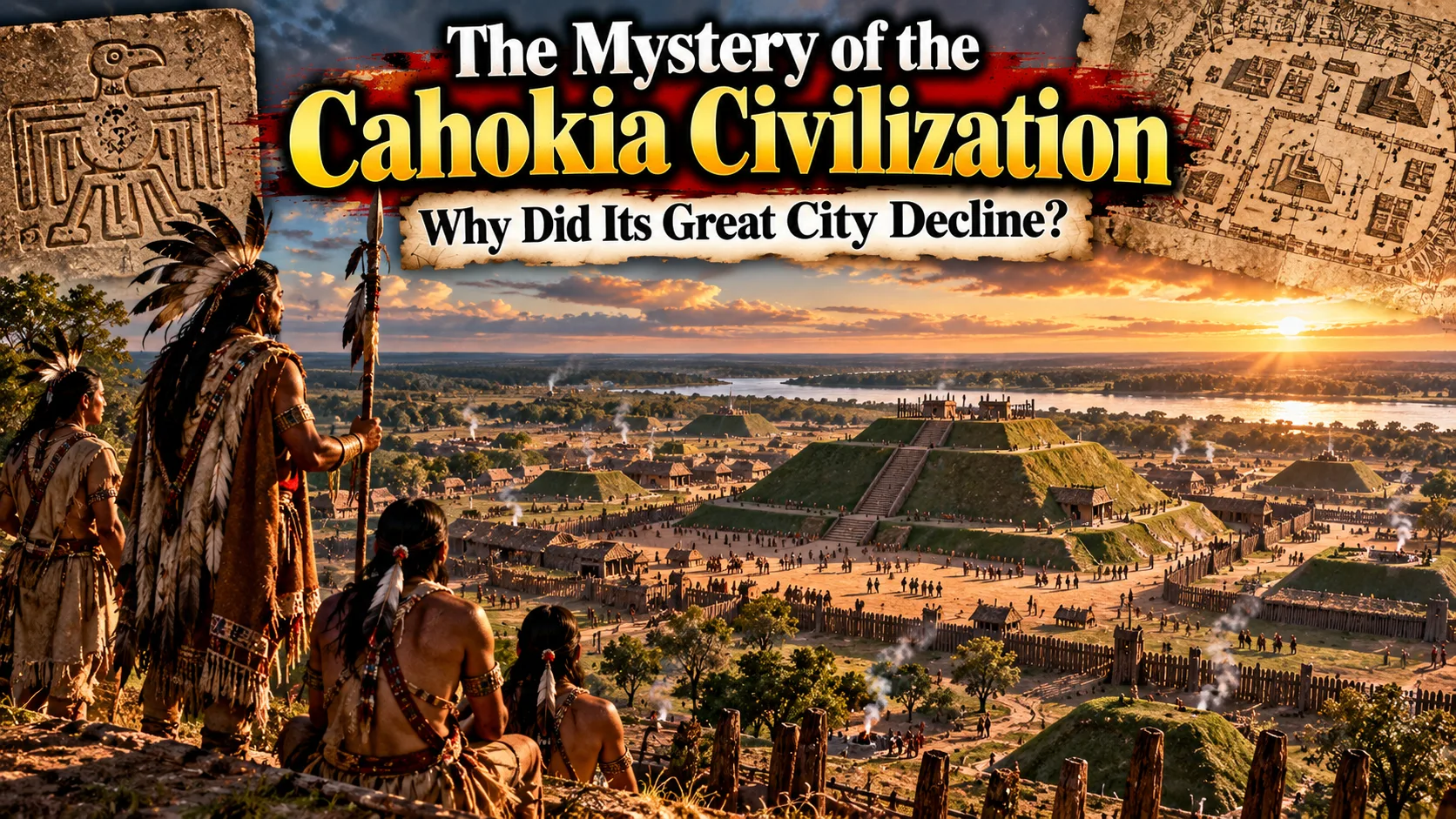
The Mystery of the Cahokia Civilization: Why Did Its Great City Decline?
Long before European colonization, Cahokia became one of the largest urban centers in ancient North America. Explore how this remarkable city rose, flourished, and gradually declined.
The Mystery of the Cahokia Civilization: Why Did Its Great City Decline?
Long before skyscrapers rose over Manhattan.
Long before European colonization reshaped North America.
Long before the United States existed.
A vast urban center grew beside the Mississippi River, near what is now St. Louis, Missouri, and Collinsville, Illinois.
Its name was Cahokia.
At its height, Cahokia was one of the largest urban centers in pre-Columbian North America.
Thousands of people lived there.
Huge earthen monuments dominated the landscape.
A massive central plaza organized the city.
Farmers produced food on an enormous scale.
Craft specialists worked in stone, shell, clay, copper, and other materials.
Traders moved goods across enormous distances.
Religious ceremonies brought large crowds together.
Political authority connected Cahokia to settlements far beyond the central city.
And then, over the course of several centuries, the great center declined.
By around AD 1400, Cahokia had been abandoned as a major urban settlement. National Park Service
The question that follows almost automatically is:
Why?
Was it climate change?
Drought?
Flooding?
Deforestation?
War?
Disease?
Political instability?
Social conflict?
Overpopulation?
Or did the people simply decide that life somewhere else was better?
The uncomfortable answer is that archaeology does not support one neat explanation.
Cahokia's decline appears to have been a long and complicated process, and researchers continue to debate how different pressures interacted.
That makes the story much more interesting than the familiar idea of a mysterious civilization that simply vanished.
Because Cahokia did not disappear.
Its people did not evaporate.
Its culture did not suddenly become meaningless.
The city declined.
People moved.
Political systems changed.
Communities reorganized.
And descendants of the wider Mississippian world continued living across North America.
The real mystery is not:
"Where did the Cahokians go?"
It is:
"Why did one of the most impressive urban centers in ancient North America stop functioning as a city?"
A City Where Nobody Expected One
Cahokia developed in a region known as the American Bottom, a broad and fertile floodplain along the Mississippi River.
The location was strategically extraordinary.
The Mississippi connected enormous parts of the continent.
Nearby rivers and waterways created transportation routes.
Rich soils supported agriculture.
Forests supplied:
Wood.
Game.
Wild plants.
Construction materials.
The landscape offered resources, transportation, and agricultural potential.
That combination helped create one of the most important centers of the Mississippian cultural tradition. National Park Service
Cahokia Was Not a Small Village That Got Really Ambitious
The scale is difficult to visualize.
At its height, the central Cahokia settlement probably housed roughly 10,000 to 20,000 people, according to National Park Service estimates. The broader urban complex of what researchers call Greater Cahokia may have involved tens of thousands more people across associated settlements. National Park Service
The exact population remains debated because ancient population estimates are reconstructed from archaeological evidence rather than census records.
Still, even the conservative estimates make Cahokia enormous.
We're not talking about:
A large village.
We're talking about a major urban society.
🟢 Established Evidence
Cahokia was:
A large urban center.
A ceremonial and political center.
Part of the Mississippian cultural world.
A major agricultural society.
A center of craft production and trade.
A place where people from different regions lived and interacted.
Archaeology provides abundant evidence for these characteristics. National Park Service
The Mounds Were the Skyline
The most obvious surviving evidence of Cahokia is its enormous earthworks.
The ancient landscape once contained roughly 120 mounds, although only a portion survive today. Some were enormous platform mounds used for important structures and activities. Others served different ceremonial, residential, or funerary purposes. National Park Service
The largest surviving structure is Monks Mound.
It is the largest known prehistoric earthen structure in North America.
Its scale is extraordinary.
It wasn't created by one person.
Or one generation.
It required organized labor and enormous quantities of earth.
Monks Mound Was a Massive Construction Project
Imagine building a hill.
Not because nature put it there.
Because you wanted it there.
Then imagine building it larger.
Then larger again.
Cahokia's monumental earthworks required planning, labor coordination, transportation of soil, construction knowledge, and long-term maintenance.
The mound itself is therefore evidence of more than engineering.
It is evidence of social organization.
Someone had to convince or compel people to work.
Someone had to organize materials.
Someone had to decide what the monument was for.
Someone had to maintain the political and religious system that gave the monument meaning.
A mound is therefore a physical representation of power.
The City Was Carefully Organized
Cahokia wasn't a random settlement that happened to acquire giant mounds.
Archaeologists have identified:
Central plazas.
Residential areas.
Specialized activity zones.
Mound groups.
Palisades.
Agricultural areas.
Roads and pathways.
Associated settlements.
Its layout reflects deliberate planning. National Park Service
The city's organization is one of the reasons Cahokia is so important.
The Plaza Was the Center of the World
At the heart of Cahokia was a massive open area associated with important buildings, ceremonies, gatherings, and political activity.
Imagine thousands of people gathering in one enormous public space.
A city plaza isn't just an empty patch of land.
It creates:
Visibility.
Hierarchy.
Community.
Ceremony.
Political theater.
A ruler or religious authority standing in a central location can make power physically visible.
Cahokia's architecture therefore helped create the society that occupied it.
The City Was Built Around Corn
Agriculture was fundamental.
Mississippian societies became heavily dependent on maize, or corn.
Corn provided a productive food source that could support larger populations.
That helped make:
Permanent settlements.
Population growth.
Political centralization.
Specialized labor.
Monument construction
more feasible.
But agricultural success created its own vulnerabilities.
A city dependent on agriculture is dependent on:
Rain.
Soil.
Growing seasons.
Water.
Labor.
Storage.
Transport.
If any of these systems become unstable, urban life becomes harder.
🟢 The Agricultural Foundation
Research on Greater Cahokia indicates that the rise of the urban complex was closely connected with intensified maize agriculture. Archaeological and climatic evidence suggests that migration into the region contributed to the expansion of maize production and associated agricultural technologies. Illinois Experts
That's important.
Cahokia wasn't simply a city that happened to have farms nearby.
Agricultural organization was part of the process that made the urban center possible.
People Came to Cahokia
One of the more fascinating discoveries is that Cahokia was not populated only by people who had always lived in the immediate area.
Bioarchaeological work suggests that a substantial portion of Cahokia's population consisted of immigrants, with one study estimating that as many as one-third of residents may have come from elsewhere. Illinois Experts
This changes the story dramatically.
Cahokia wasn't just:
One local population building a city.
It may have been:
Different populations coming together around a new urban center.
Cahokia Was a Magnet
People may have arrived because the city offered:
Opportunity.
Trade.
Food.
Political influence.
Religious significance.
Social connections.
Protection.
New forms of community.
We can't assign one motivation to every migrant.
But the evidence suggests movement into Greater Cahokia played a major role in its growth. Illinois Experts
Imagine the Cultural Mix
If large numbers of migrants arrived from different regions, Cahokia would have contained:
Different traditions.
Different dialects or languages.
Different religious practices.
Different foods.
Different craft traditions.
Different social experiences.
The city may have been culturally diverse by ancient North American standards.
That diversity could have been a strength.
It could also have created political challenges.
Diversity Was Part of the Mystery
One research perspective specifically examines social diversity and the consolidation and dissolution of Cahokia.
Researchers have considered whether tensions among culturally distinct populations contributed to instability.
That is not the same thing as saying:
"Cahokia collapsed because immigrants caused problems."
The evidence absolutely does not justify such a simplistic conclusion.
The more interesting question is:
How did an extremely diverse urban population maintain political unity, and what happened when that unity weakened?
That's a much more sophisticated problem. Illinois Experts
A Civilization Without Written Records
One reason Cahokia remains difficult to understand is that we don't have the kind of written records historians possess for:
Rome.
China.
Egypt.
Mesopotamia.
The Maya.
Instead, much of Cahokia's history comes from:
Mounds.
Buildings.
Artifacts.
Burials.
Food remains.
Soil.
Animal bones.
Plant remains.
Isotopes.
Settlement patterns.
Environmental evidence.
This means archaeologists have to reconstruct social history indirectly.
Archaeology Is Reading a Civilization Without Its Books
Imagine trying to understand a modern city after:
All books vanished.
All phones vanished.
All government databases vanished.
All newspapers vanished.
All electronic records vanished.
Then imagine the buildings were gradually buried and destroyed.
Five hundred years later, someone finds:
A supermarket foundation.
A stadium.
A cemetery.
Some coins.
Bits of plastic.
Pipes.
Kitchen waste.
Concrete.
From those fragments, they try to reconstruct society.
That's essentially the challenge archaeology faces.
The Cahokians Didn't Leave Us a Newspaper Explaining the Collapse
There's no surviving document saying:
"Dear future archaeologists,
We have decided to abandon the city because the summers are getting drier, political tensions are rising, and everyone is increasingly annoyed with the grain distribution system.
Best regards,
The Cahokian Government."
Humanity continues to neglect historians in its final paperwork.
So researchers have to infer.
The Rise Was Fast
Cahokia's emergence was surprisingly dramatic.
Around AD 1050, the region underwent significant transformation.
Settlement patterns changed.
Large-scale construction expanded.
Population increased.
Agriculture intensified.
The central city became enormously important.
Researchers describe this as a major political and economic transformation. Illinois Experts
Why Did the City Grow So Quickly?
Several factors probably interacted.
Agriculture
Maize production supported more people.
Geography
The Mississippi River system connected Cahokia to broad regions.
Migration
People moved into Greater Cahokia.
Political organization
Leadership coordinated large projects.
Religion
Ceremonial institutions helped create shared identity.
Trade
Materials and ideas moved across long distances.
Labor
A large population could build enormous structures.
The city was therefore the product of a system, not one invention.
Cahokia Was More Than Its Mounds
It's easy to reduce ancient civilizations to monuments.
Pyramids.
Temples.
Walls.
Mounds.
But ordinary life happened between them.
People:
Cooked.
Raised children.
Made tools.
Worked fields.
Traded.
Crafted objects.
Built houses.
Held ceremonies.
Buried relatives.
Fought.
Celebrated.
Argued.
Lived.
The city was not a museum.
It was someone's home.
Evidence of Feasting
Archaeologists have found evidence suggesting large-scale communal feasting at Cahokia.
Feasting could have had:
Religious.
Political.
Social.
Economic
functions.
Feasts bring people together.
Someone provides food.
Someone organizes it.
Someone decides who receives what.
That creates relationships.
A feast can therefore be political infrastructure.
Alcohol Wasn't the Only Way to Impress Guests
Cahokian feasting likely involved foods gathered and produced across the region.
Meat.
Fish.
Corn.
Other plants.
Large quantities of food required organization.
If elites could feed hundreds or thousands of people, they demonstrated:
Resources.
Authority.
Generosity.
Control.
The ability to mobilize labor.
Food can become political power.
Cahokia Had Trade Networks
Artifacts found at Cahokia reveal connections extending far beyond the immediate region.
Materials such as:
Marine shell.
Copper.
Exotic stone.
and other nonlocal goods
indicate long-distance exchange.
Cahokia was part of a network, not an isolated settlement.
Why Trade Matters to the Collapse
A city can depend on trade for:
Prestige goods.
Raw materials.
Political relationships.
Information.
Economic exchange.
If regional political networks weaken, a city can lose influence even if its farmland remains productive.
This is another reason decline doesn't necessarily require famine.
A city can become less useful.
Political Power Can Move
A capital isn't necessarily permanent.
If:
Trade routes shift.
Religious authority changes.
Political alliances change.
Another center becomes more powerful.
people can relocate.
The city may decline because its function changes.
That's not necessarily collapse in the Hollywood sense.
It can be political decentralization.
The Great Palisade
One especially interesting feature of Cahokia's later history is the construction of a very large defensive palisade around central areas.
Research on climate and Cahokia notes the construction of a roughly 20,000-log palisade around Monks Mound and the Grand Plaza during a period associated with social change and environmental stress. Illinois Experts
That's a huge amount of timber.
And the decision to build it tells us something.
Someone was worried.
A Defensive Wall Means Something Changed
A palisade requires:
Trees.
Workers.
Planning.
Labor.
Authority.
Maintenance.
You don't build one because everything is perfectly peaceful.
The wall suggests concerns about:
Conflict.
Social instability.
Political competition.
Or protection of especially important spaces.
It doesn't tell us exactly which.
But it indicates that later Cahokia was not identical to earlier Cahokia.
Did Warfare Cause the Collapse?
Possibly a factor.
Not proven as the sole cause.
Other Mississippian societies show evidence of warfare and increasing fortification in periods of instability.
But Cahokia's story doesn't fit comfortably into:
"Enemy army attacked and destroyed city."
There is no single archaeological signature showing one catastrophic invasion ended Cahokia.
The evidence looks more like long-term transformation.
🟡 Warfare Is One Candidate, Not the Answer
Archaeologists have considered:
Competition between political communities.
Internal conflict.
Resource pressure.
Social unrest.
Changing alliances.
These could have weakened centralized authority.
But none alone explains every part of the decline.
The Climate Theory
This is one of the most discussed explanations.
Tree-ring records and other paleoclimate evidence indicate periods of climatic variation affecting the Cahokia region.
One influential study found that Cahokia's rise occurred during a notably wet period, while later persistent droughts may have contributed to its decline. Illinois Experts
That sounds like a satisfying answer.
Climate changes.
Crops fail.
City dies.
Done.
Except archaeology is rarely that cooperative.
The Drought Wasn't One Giant Disaster
The climate evidence points toward repeated periods of drought rather than one single apocalyptic event.
This matters.
A city can survive one bad year.
Several difficult years are different.
Repeated drought can produce:
Lower harvests.
Food stress.
Political conflict.
Migration.
Competition over resources.
Reduced ability to support urban populations.
The effects accumulate.
Climate Can Destabilize Politics Without Destroying Agriculture Completely
Imagine crops decline by:
10%.
Then recover.
Then decline again.
Food prices rise.
Poorer households suffer.
Elites compete.
People move.
Trade changes.
Political legitimacy weakens.
Nobody wakes up one morning to discover:
"The climate destroyed us."
Instead, a system becomes increasingly difficult to maintain.
A Climate Stress Model
The basic hypothesis is:
Climate change
↓
Agricultural stress
↓
Political and social pressure
↓
Migration and conflict
↓
Urban decline
This is plausible.
But plausible doesn't mean complete.
🟡 The Climate Debate Is Still Open
Research from the Illinois State Archaeological Survey specifically notes that the environmental history of Cahokia is more complicated than simple "environmental collapse."
Recent archaeological work has challenged the idea that Cahokians simply destroyed their environment through poor resource management. Illinois Sustainability Survey
That's an important correction.
The easy story:
"They cut down too many trees and destroyed themselves."
isn't securely established.
Did Cahokians Destroy Their Environment?
This was once a popular explanation.
A massive city uses:
Wood.
Fuel.
Food.
Water.
Land.
Construction materials.
It seems logical that tens of thousands of people could exhaust their surroundings.
But recent sedimentary and archaeological evidence has complicated this picture.
Studies of buried sediments from central Cahokia do not support a straightforward model of severe environmental mismanagement. Illinois Sustainability Survey
The Landscape May Have Been Managed Successfully
This is actually more impressive.
Rather than destroying the environment around them, Cahokians may have been remarkably capable of managing:
Waterways.
Farmland.
Woodlands.
Agricultural production.
Urban space.
That doesn't mean environmental stress didn't occur.
It means:
Human impact ≠ automatic ecological collapse.
Flooding Was Also Possible
Cahokia lived near the Mississippi floodplain.
Floods are part of river environments.
Too much water can:
Destroy crops.
Damage infrastructure.
Alter channels.
Move sediment.
Change habitats.
Flooding therefore belongs in the discussion.
But again, there is no simple:
"One flood destroyed Cahokia."
The city's history is too long and complex.
The Mississippi Was Both an Advantage and a Risk
The river helped make Cahokia possible.
It provided:
Transportation.
Fishing.
Water.
Trade routes.
Fertile floodplain environments.
But river systems are unstable.
They can:
Flood.
Shift.
Change channels.
Transform wetlands.
Alter agricultural conditions.
The same geography that creates urban opportunity can also create vulnerability.
Disease Has Also Been Proposed
Large urban populations can support the spread of disease.
Crowding.
Waste.
Movement.
Trade.
Animal contact.
Food storage.
all affect disease transmission.
Researchers have therefore considered disease as one possible contributor to population decline.
But there is no single epidemic that has been demonstrated to be the cause of Cahokia's disappearance.
🟡 Disease Is Possible, Not Proven
This distinction matters because people often use:
"Disease"
as a universal explanation for ancient population decline.
That's dangerous.
Without clear archaeological or biological evidence, disease is a hypothesis.
Cahokia's decline may involve disease.
But we cannot simply declare that it did.
Population Decline Was Gradual
The archaeological record suggests that Cahokia's influence and population declined over an extended period rather than vanishing in one night.
One climate-oriented study estimated that the population had fallen by roughly half by around AD 1200, with further decline continuing afterward. Illinois Experts
The exact population estimates remain debated.
But the broad picture is important:
Cahokia declined over time.
The City Didn't Suddenly Empty
This is one of the most important myths to eliminate.
Cahokia wasn't:
Thriving Monday.
Abandoned Tuesday.
The process unfolded across generations.
Different neighborhoods may have declined at different times.
People may have left gradually.
Political influence may have weakened before population disappeared.
The city's meaning may have changed.
That is what real urban decline usually looks like.
People Probably Moved
If a city becomes harder to sustain, people have choices.
Move closer to:
Better farmland.
Other settlements.
Different political centers.
New trade routes.
Family networks.
Safer regions.
The abandonment of one city doesn't mean the disappearance of its population.
People take knowledge with them.
This Explains Why Cahokia's Culture Didn't Simply Vanish
The broader Mississippian cultural tradition continued.
Other mound centers existed throughout the region.
Communities changed and reorganized.
The decline of Cahokia was therefore not equivalent to:
"Native civilization in North America ended."
It didn't.
The archaeological landscape remained populated.
Political centers changed.
Cultures transformed.
Cahokia's Influence Extended Beyond the City
The city appears to have influenced a wide region.
Archaeologists identify Cahokian-style artifacts, architecture, symbols, and practices far beyond the central site.
This suggests:
Trade.
Migration.
Political influence.
Religious influence.
Cultural exchange.
When Cahokia declined, its wider cultural connections did not instantly disappear.
Think of Cahokia as a Network
Instead of imagining:
Cahokia = Civilization
consider:
Cahokia = One major center inside a larger Mississippian world.
That distinction is essential.
Cities can collapse while cultures survive.
Rome declined.
Roman culture continued.
Maya cities declined.
Maya communities continued.
A capital can disappear without a civilization disappearing with it.
That's Probably What Happened Here
The simplest broad interpretation is:
Cahokia's urban political system declined, while the people and cultural traditions persisted in different forms.
That is much better supported than:
"The entire civilization vanished mysteriously."
Why Would a Centralized System Break?
Several possibilities exist.
Environmental stress
Repeated droughts may have increased pressure.
Political conflict
Competition could weaken central authority.
Social fragmentation
A diverse population may have become harder to integrate.
Trade changes
Cahokia's economic relationships may have weakened.
Migration
People may have moved to other communities.
Changes in religious or political legitimacy
The institutions that justified Cahokia's central authority may have become less effective.
These factors could reinforce one another.
Collapse Is Often a Feedback Loop
Imagine:
Drought reduces harvests.
↓
Food becomes harder to acquire.
↓
Leaders lose legitimacy.
↓
People migrate.
↓
Population falls.
↓
Labor for monumental construction declines.
↓
Political power weakens further.
↓
Trade networks shrink.
↓
More people leave.
Now the city declines even if the original drought eventually ends.
This is why identifying one cause can be misleading.
The original stress may trigger a chain reaction.
The "Complex Systems" Explanation
Cahokia may have been a complex system.
It depended on:
Agriculture.
Political authority.
Religious institutions.
Trade.
Labor.
Migration.
Environmental stability.
Those systems interact.
Change one significantly and the others respond.
That means collapse doesn't require one catastrophic event.
It can happen because the system becomes increasingly difficult to maintain.
The Rise and Fall Were Connected
Here's an especially interesting possibility:
The same factors that made Cahokia successful may have contributed to its later vulnerability.
A huge population:
Creates labor.
But also increases food demand.
A powerful central government:
Coordinates projects.
But creates dependency on political legitimacy.
Trade:
Provides wealth.
But creates dependence on external networks.
Migration:
Adds labor and ideas.
But increases social complexity.
Agriculture:
Feeds the city.
But makes climate especially important.
Success creates its own dependencies.
The Great Mound Problem
Think about maintaining Monks Mound.
It isn't just built once.
Large monumental structures require:
Maintenance.
Ceremonial use.
Political authority.
Labor.
Social meaning.
If fewer people remain:
Who maintains it?
If leaders lose influence:
Why continue building?
If religious practices change:
What does the mound represent?
A monument can therefore decline because the social system that gave it meaning has declined.
The City Can Die Before the Buildings Do
A structure can survive after the society that built it has disappeared.
This is a common archaeological phenomenon.
The buildings remain.
The political system doesn't.
The ruins therefore create an illusion:
The city is still here.
But a city isn't only its buildings.
It's:
People.
Institutions.
Economy.
Relationships.
Daily activity.
Without those, architecture becomes archaeology.
Why Don't We Know More About the Cahokians?
Because archaeology doesn't preserve everything.
Wood decays.
Textiles disappear.
Food decomposes.
Skin and hair rarely survive.
Buildings collapse.
Artifacts get moved.
Modern development destroys archaeological deposits.
The written record is essentially absent.
The surviving evidence is therefore incomplete.
Modern Development Complicated Things
The Cahokia site is located in a heavily developed part of the modern Midwest.
Roads.
Housing.
Agriculture.
Industrial development.
Urban expansion.
These activities have affected archaeological remains.
Some portions of the ancient landscape have been permanently lost.
The surviving mounds are therefore only part of what once existed.
Archaeologists Are Reconstructing a Lost Landscape
This means modern researchers don't simply excavate mounds.
They use:
Excavation.
Remote sensing.
Soil analysis.
Geographic mapping.
Plant remains.
Animal remains.
Isotopic studies.
Artifact analysis.
Settlement patterns.
These methods can reveal things that aren't visible from the surface.
The Ground Contains Invisible History
A flat field might once have contained:
A house.
A workshop.
A road.
A garden.
A burial.
A trash pit.
A palisade.
Just because nothing remains standing doesn't mean nothing happened there.
Archaeology is partly the science of discovering what the landscape remembers.
Cahokia Had Specialized Areas
Archaeologists have identified different kinds of spaces:
Residential.
Public.
Ceremonial.
Craft-related.
Agricultural.
Administrative.
This indicates the city had differentiated functions.
People weren't simply living everywhere randomly.
The urban system had structure. National Park Service
Craft Specialization
Complex urban centers usually depend on specialized labor.
Cahokia provides evidence for specialists working in:
Stone.
Copper.
Shell.
Pottery.
Other crafts.
Specialization matters because it means people were not all producing everything they needed themselves.
They were part of a broader economic system.
That Economic System Creates Dependencies
A specialist needs food.
A farmer needs tools.
An elite needs ceremonial objects.
A trader needs goods.
A builder needs labor.
The city becomes an interconnected network.
Break enough connections and urban life becomes more difficult.
Why Climate Alone Doesn't Explain Everything
Suppose drought happened.
Did every household experience it equally?
Probably not.
Elites may have had better food access.
Some regions may have retained water better.
Other settlements may have experienced less stress.
People can respond differently.
This creates social consequences.
Environmental stress can increase inequality.
Inequality can increase conflict.
Conflict can increase migration.
Again, the system matters.
Why Social Diversity Alone Doesn't Explain Everything
Cahokia's population included immigrants.
But diversity can be:
A strength.
A source of innovation.
A source of trade.
A source of political legitimacy.
It can also create conflicts if institutions can't integrate different communities.
We don't have enough evidence to say:
"Cahokia collapsed because of cultural diversity."
That would be an unjustified simplification.
Why Warfare Alone Doesn't Explain Everything
A defensive palisade suggests concern about conflict.
But defensive structures can appear before actual war.
Political competition doesn't necessarily mean total destruction.
A city could become militarized and then gradually decline through:
Migration.
Political fragmentation.
Economic change.
Disease.
Climate stress.
Again:
More than one process can occur at once.
Why "Famine" Is Too Simple
Agricultural stress can cause food shortages.
But a food crisis doesn't automatically destroy an urban system.
People can:
Ration.
Trade.
Move.
Change crops.
Hunt.
Fish.
Store food.
Relocate.
The ability to respond matters.
Cahokians weren't helpless.
They had sophisticated agricultural and resource-management systems.
🟢 A More Sophisticated View
Rather than asking:
"What killed Cahokia?"
archaeologists increasingly ask:
"What processes reduced the city's ability to remain a major urban center?"
That's a much better question.
It allows:
Climate.
Politics.
Migration.
Economics.
Social organization.
Environment.
to operate simultaneously.
The City May Have Lost Its Reason to Exist
This possibility is often overlooked.
A settlement remains large if the benefits of urban concentration outweigh its costs.
If those benefits decline:
Trade decreases.
Political influence falls.
Food becomes more expensive.
Religious importance shifts.
New centers emerge.
Then people may ask a brutally practical question:
"Why stay here?"
No invasion required.
No apocalypse.
Just changing incentives.
This Happens Throughout Human History
Cities decline for ordinary reasons.
A river changes course.
A trade route shifts.
A political capital moves.
Resources become expensive.
Another city becomes more important.
People migrate.
Cahokia may have experienced some version of this.
🟡 But We Don't Know the Exact Balance
Archaeologists can identify:
Climate changes.
Population shifts.
Migration.
Construction changes.
Defensive structures.
Agricultural patterns.
But connecting each factor into one precise causal sequence remains difficult.
This is why Cahokia remains a genuine archaeological mystery.
Could Climate Have Started the Process?
Absolutely plausible.
Could climate alone explain everything?
Probably not.
Could conflict have amplified climate stress?
Certainly possible.
Could migration both strengthen Cahokia early and complicate it later?
Yes.
Could changing trade networks weaken the city?
Possible.
Could disease have contributed?
Possible.
The hardest part is identifying:
Which factors were causes, which were consequences, and which simply happened at the same time?
Correlation Isn't Causation, Even in Archaeology
Suppose drought appears before population decline.
That establishes:
Drought preceded decline.
It doesn't prove:
Drought caused decline.
Maybe political instability was already occurring.
Maybe the economy had changed.
Maybe migration had started.
Maybe disease contributed.
Maybe drought was simply one additional stress.
Historical reasoning requires the same caution as science elsewhere.
Climate Data Cannot Tell Us What People Thought
A tree-ring record can indicate:
Drier conditions.
It cannot tell us:
The council argued about food.
The farmers became angry.
A priest lost influence.
A family moved away.
A ruler blamed neighboring communities.
Those social responses have to be inferred from archaeology.
Archaeology Gives Us Behavior, Not Private Thoughts
We can find:
A defensive wall.
That indicates some form of concern or organization.
We can't automatically say:
"People were terrified."
We can find:
Population decline.
We can't automatically say:
"People hated their leaders."
The physical evidence constrains interpretations.
It doesn't give us direct access to emotions.
The People of Cahokia Had Choices
This is another important correction.
Ancient people weren't passive victims waiting for climate to destroy them.
They could respond creatively.
They could:
Change crops.
Move settlements.
Build structures.
Alter trade.
Change political alliances.
Adopt new social strategies.
Migrate.
The outcome depended partly on how people responded to changing circumstances.
Ancient People Were Problem-Solvers
Cahokia itself is evidence of extraordinary problem-solving.
Building giant mounds.
Managing agriculture.
Organizing large populations.
Creating trade systems.
Constructing defensive works.
These aren't the actions of a civilization incapable of adapting.
The mystery is therefore:
Why did adaptation eventually stop being enough to preserve the urban system?
What Happened Around AD 1200?
This is roughly when several important changes become visible.
Climate research points to a period of drought.
Population decline appears to have begun.
The defensive palisade was constructed.
Some agricultural complexes were abandoned.
Researchers have linked these developments in different ways. Illinois Experts
But the chronology does not automatically reveal causation.
It gives us a sequence.
The explanation remains debated.
The Richland Farming Complex
Research into Cahokia's agricultural landscape has identified the Richland farming complex in Illinois uplands.
A major drought episode around the mid-twelfth century coincided with the abandonment of much of that agricultural complex, according to one influential climate-focused study. Illinois Experts
If that interpretation is correct, it matters enormously.
Because the city depended on food.
Lose part of the agricultural system.
The city becomes harder to support.
But Again, It Wasn't Instant
An agricultural complex can decline.
People can move.
Other food sources remain.
The city can continue.
This is why Cahokia's later history looks like deterioration rather than sudden destruction.
The City May Have Shrunk Before It Was Abandoned
That's an important distinction.
Imagine:
Year 1050:
Huge growth.
Year 1150:
Population pressures and climate stress.
Year 1200:
Population falling.
Year 1250:
Political influence reduced.
Year 1300:
Fewer residents.
Year 1400:
No longer a major urban center.
That's a process.
The final abandonment is just the last stage.
What Does "Abandoned by 1400" Actually Mean?
It doesn't necessarily mean:
Nobody ever came back.
It means the site was no longer functioning as the major population center it had once been.
People can continue using a landscape after a city declines.
Hunting.
Gathering.
Ceremony.
Travel.
Settlement.
The abandonment of an urban center is not the abandonment of an entire region.
The Landscape Continued to Matter
Native peoples continued living in and using the broader Mississippi Valley.
Later Indigenous communities maintained relationships with the region.
European contact occurred centuries afterward.
So the disappearance of Cahokia as a city should never be interpreted as:
"The land became empty."
It didn't.
European Observers Arrived Much Later
By the time Europeans began describing the region in detail, the monumental city had long since declined.
That created an extraordinary historical disconnect.
European settlers saw enormous mounds.
They didn't witness:
The city.
The crowds.
The ceremonies.
The political system.
The builders.
The farmers.
The original urban landscape.
They encountered ruins.
And Ruins Create Myths
When people see massive structures but don't know who built them, they often invent explanations.
This happened repeatedly in North American history.
Some European and later American observers incorrectly attributed monumental earthworks to lost European, Middle Eastern, or mythical civilizations.
The actual builders were Indigenous peoples.
Cahokia is a powerful reminder that such myths often emerge because later societies underestimate the complexity of Indigenous civilizations.
The "Mound Builders Were Someone Else" Myth
This idea became widespread in nineteenth-century America.
Some writers argued that Native Americans couldn't have constructed the monumental earthworks.
That claim was false.
Archaeological evidence demonstrates that Indigenous peoples created the mound-building traditions of the Eastern Woodlands, including Cahokia.
The myth tells us more about nineteenth-century prejudice than ancient North American history.
🟢 The Archaeological Evidence Is Clear
Cahokia was built by Indigenous societies.
Its monumental architecture.
Agriculture.
Craft production.
Settlement patterns.
burials and material culture
all belong to the Mississippian cultural tradition.
Cahokia is not evidence of a lost European colony or an unidentified Old World civilization. National Park Service
Cahokia and the Wider Mississippian World
Cahokia was the largest known center of the Mississippian cultural tradition.
But it wasn't the only one.
Other major centers existed across the Southeast and Midwest.
This matters because when Cahokia declined, other communities continued.
The political map changed.
The cultural system didn't simply collapse everywhere.
Why Cahokia Matters Today
Cahokia forces us to rethink North American history.
Before European arrival, North America was not:
An empty wilderness.
It contained:
Cities.
Farms.
Trade networks.
Political systems.
Religious institutions.
Engineered landscapes.
Large populations.
Specialized crafts.
Complex societies.
Cahokia is one of the clearest archaeological demonstrations of that reality.
Cahokia Was a City Without Stone Pyramids
This is partly why its significance was underestimated for so long.
The monumental structures were made largely of:
Earth.
Earth doesn't survive visually like stone.
A limestone temple can survive thousands of years.
An earthen mound can erode.
Trees grow over it.
Plows flatten it.
Roads cut through it.
Houses cover it.
Modern development destroys it.
The material itself makes the civilization easier to forget.
Nature Hid the City
For centuries, vegetation covered portions of the landscape.
What had once been:
Public plazas.
Houses.
Roads.
Ceremonial spaces.
Mounds.
became fields and forests.
The civilization didn't vanish.
Its physical visibility did.
Archaeology Is Revealing the City Again
Modern archaeological work has reconstructed parts of the original urban landscape.
Remote sensing and excavation reveal:
House locations.
Post structures.
Mound footprints.
Activity zones.
Palisades.
Roadways.
Agricultural areas.
The ancient city is slowly becoming visible beneath the modern landscape.
The "Lost City" Was Never Truly Lost to Everyone
This is important.
The surrounding landscape remained part of Indigenous history and geography.
The idea of Cahokia as a "lost city" reflects the perspective of later outsiders who had forgotten or ignored its history.
The people who built it did not necessarily think:
"One day archaeologists will call this a lost civilization."
They were simply living their lives.
🟢 Established Evidence
The National Park Service recognizes Cahokia Mounds as a major example of the Mississippian cultural tradition and identifies it as a UNESCO World Heritage Site. The complex once covered thousands of acres and included numerous monumental mounds, homes, farms, public areas, and specialized activity zones. National Park Service
🟡 The Biggest Unanswered Question
There isn't one.
There are several.
But the central question remains:
Why did Cahokia stop functioning as a major urban center?
We know roughly when the decline occurred.
We have evidence of environmental changes.
We have evidence of demographic change.
We have evidence of social and political transformation.
But the precise combination remains unresolved.
🔴 The Popular Answer
"Drought destroyed Cahokia."
Too simple.
Drought may have been important.
Climate research provides evidence of periods of persistent drought that correlate with aspects of Cahokia's decline. Illinois Experts
But the archaeological picture includes:
Migration.
Political changes.
Social diversity.
Defensive construction.
Agricultural transformation.
Potential conflict.
Environmental adaptation.
So:
Drought = possible major factor
is defensible.
Drought = single proven cause
is not.
Another Popular Answer
"Cahokia collapsed because they destroyed their environment."
Also too simple.
Research from the Illinois State Archaeological Survey reports that sedimentary evidence does not support a straightforward story of catastrophic environmental mismanagement by Cahokians. Illinois Sustainability Survey
The city may actually have managed parts of its environment impressively.
Again, the ancient people were not helpless idiots waiting for nature to punish them.
Another Popular Answer
"They were attacked and wiped out."
No evidence establishes a single military invasion that destroyed Cahokia.
The palisade suggests concern about conflict or social instability.
But that is not the same as evidence of a final battle.
Another Popular Answer
"The civilization disappeared."
Not exactly.
The city declined.
Its political importance diminished.
Its population dispersed.
Mississippian societies continued elsewhere.
Descendant communities continued across the region.
The word "disappeared" hides too much.
🟢 The Better Historical Description
Cahokia experienced:
Urban decline.
Not:
Human disappearance.
That distinction matters.
The Broader Story Is About Transformation
Perhaps Cahokia did not "fail."
Perhaps its political system became unsustainable.
The people responded by:
Dispersing.
Moving.
Reorganizing.
Joining other communities.
Creating new political centers.
Changing economic relationships.
From the viewpoint of one city, that's collapse.
From the viewpoint of the people living through it, it may have been adaptation.
Civilizations Are Not Organisms With Birth and Death Dates
The phrase:
"rise and fall of civilization"
makes societies sound like biological organisms.
Born.
Grow.
Peak.
Die.
Real societies are messier.
Institutions disappear.
People move.
Cultures merge.
Political identities change.
Languages evolve.
Religions transform.
Technology spreads.
A city can decline while its people thrive elsewhere.
Cahokia's Greatest Mystery May Be Misunderstood
We often ask:
Why did Cahokia disappear?
But perhaps the better question is:
Why did people stop choosing Cahokia as the center of their world?
That is a different question.
It brings humans back into the story.
Instead of:
Nature killed civilization.
we ask:
What combination of conditions changed the choices available to Cahokian communities?
The Human Side of Collapse
Imagine living in Cahokia around AD 1200.
Your grandparents remember enormous public ceremonies.
Your parents helped maintain the city.
You know the mounds.
You know the traditions.
Then harvests become less predictable.
People leave.
Trade changes.
Political conflicts increase.
The crowds become smaller.
Some buildings stop being maintained.
Neighbors move away.
The city becomes quieter.
Maybe you leave too.
Not because you watched civilization end.
Because you were looking for a better place to live.
That's how historical collapse often feels from the inside.
Not like the end of the world.
Like moving.
The City Leaves a Skeleton
What remains afterward?
Mounds.
Burials.
Pottery.
Stone.
Copper.
Soil changes.
Palisade traces.
House foundations.
The physical skeleton of the city.
Archaeologists reconstruct the living world from those remains.
Why Archaeology Hasn't Finished the Story
Because we are still discovering new evidence.
Every excavation can reveal:
New neighborhoods.
New populations.
New trade links.
New environmental information.
New burial patterns.
New evidence about diet.
New evidence about migration.
New questions.
The story keeps changing.
A Civilization That Forces Us to Be Humble
Cahokia reminds us of something important:
Absence of written records does not mean absence of complexity.
A society can build:
A giant city.
Monumental architecture.
Agricultural infrastructure.
Trade networks.
Specialized crafts.
Political institutions.
without leaving us a single surviving book explaining itself.
The 500-Year Mystery
Cahokia flourished for centuries.
Its major urban phase emerged around the eleventh century.
Its influence declined over subsequent centuries.
By about AD 1400, the great urban center was no longer functioning as it once had. National Park Service
That gives archaeologists a huge span of history to reconstruct.
The mystery isn't one event.
It's a transformation lasting generations.
The Big Question
So why did Cahokia decline?
Perhaps:
Climate stress weakened agriculture.
Perhaps:
Political conflict reduced central authority.
Perhaps:
Migration and social diversity changed the political structure.
Perhaps:
Trade networks shifted.
Perhaps:
Disease contributed to population decline.
Perhaps:
Some combination of all of these made the city increasingly difficult to sustain.
That final possibility is increasingly useful.
Because complex societies rarely have simple endings.
🟢 What We Know
Cahokia was a huge Indigenous urban center.
It reached its greatest prominence around the eleventh and early twelfth centuries.
Its population likely reached the tens of thousands when the broader urban region is considered.
It contained enormous earthen monuments.
It depended heavily on maize agriculture.
It attracted migrants.
It participated in long-distance exchange networks.
Its political and cultural influence extended far beyond the central site.
Its population and influence later declined.
The site was largely abandoned as a major urban center by around AD 1400. National Park Service
🟡 What Remains Under Debate
Researchers continue investigating the relative importance of:
Climate variability.
Drought.
Flooding.
Agricultural stress.
Political conflict.
Social unrest.
Migration.
Disease.
Trade disruption.
Environmental management.
The causes probably interacted rather than operating independently.
🔴 What We Should Not Claim
Cahokia was not:
A vanished European colony.
An alien city.
A civilization wiped out overnight.
A completely destroyed society whose people mysteriously vanished.
A proven case of ecological self-destruction.
Those narratives are far more dramatic than the evidence.
Frequently Asked Questions
What was Cahokia?
Cahokia was a major Indigenous urban and ceremonial center of the Mississippian cultural tradition located near present-day St. Louis and Collinsville, Illinois.
How large was Cahokia?
Estimates for the central city commonly fall around 10,000–20,000 people, while Greater Cahokia may have involved a much larger population across associated settlements. Exact estimates remain debated. National Park Service
When did Cahokia exist?
The broader site was occupied for centuries, with its major urban florescence occurring roughly from the eleventh through early fourteenth centuries. The city was largely abandoned as a major center by around AD 1400. National Park Service
Who built Cahokia?
Indigenous peoples of the Mississippian cultural tradition built and inhabited Cahokia.
What is Monks Mound?
Monks Mound is the largest surviving earthen monument at Cahokia and the largest known prehistoric earthen structure in North America. National Park Service
Did Cahokia have pyramids?
Cahokia had enormous earthen platform mounds, some of which supported important buildings. Calling them "pyramids" is possible as a broad comparison, but they were culturally and structurally different from Egyptian pyramids.
Why did Cahokia decline?
There is no single proven explanation. Climate stress, drought, agricultural pressures, political instability, migration, social change, conflict, disease, and shifting economic networks have all been investigated.
Was drought the main cause?
Drought is one important hypothesis. Paleoclimate research has identified periods of persistent drought that correlate with stages of Cahokia's decline, but drought alone does not fully explain the archaeological evidence. Illinois Experts
Did Cahokians destroy their environment?
Evidence does not support a simple story of catastrophic environmental mismanagement. Recent research has emphasized that Cahokians could manage their urban and ecological environment effectively. Illinois Sustainability Survey
Did the people of Cahokia disappear?
The city declined and its population dispersed, but Indigenous communities and Mississippian cultural traditions continued across the broader region.
Was Cahokia destroyed by war?
There is evidence of defensive construction and social instability, but no conclusive evidence of one final invasion that destroyed the city.
Did Cahokia have trade networks?
Yes. Archaeological evidence indicates long-distance movement of materials and goods, demonstrating that Cahokia was connected to wider regional networks.
Why don't we know exactly what happened?
There are no surviving written records that directly explain the city's decline, so researchers must reconstruct the story from archaeological, environmental, and bioarchaeological evidence.
Myth vs. Evidence
🟢 Cahokia was a major pre-Columbian urban center.
Established. National Park Service
🟢 Thousands of people lived there.
Yes, with population estimates commonly reaching the tens of thousands when Greater Cahokia is considered. National Park Service
🟢 Cahokia was part of the Mississippian cultural tradition.
🟢 Large numbers of people migrated into Greater Cahokia.
Bioarchaeological evidence suggests substantial immigration. Illinois Experts
🟢 Climate change may have contributed to the decline.
Yes, this is supported by paleoclimate research, although its exact importance remains debated. Illinois Experts
🟡 Climate change alone destroyed Cahokia.
Not established.
🟡 Warfare caused the collapse.
Possible contributor, not demonstrated as the sole explanation.
🔴 The Cahokians mysteriously vanished.
False.
The urban center declined, while Indigenous populations and related cultural traditions continued elsewhere.
🔴 Cahokia was built by an unknown Old World civilization.
No archaeological evidence supports this.
🔴 Cahokia's environmental destruction has been proven as the cause.
No. Recent research actually complicates that explanation. Illinois Sustainability Survey
Final Thoughts
Cahokia is sometimes described as a lost civilization.
That phrase sounds dramatic.
It is also misleading.
The people who built Cahokia did not vanish into history.
Their city declined.
Their political system changed.
People migrated.
Communities reorganized.
The wider Mississippian world continued.
What disappeared was something more specific:
Cahokia as a major urban center.
That distinction changes everything.
Because once we stop imagining a mysterious civilization simply vanishing, a much more interesting story emerges.
Around the eleventh century, Cahokia experienced an extraordinary transformation.
People moved into the region.
Agriculture intensified.
Maize supported a growing population.
Massive earthworks appeared.
Public plazas expanded.
Trade networks connected distant communities.
Religious and political institutions gained enormous influence.
The city became one of the largest urban centers in pre-Columbian North America. National Park Service
And then something began to change.
Climate conditions shifted.
Droughts became more persistent.
Agricultural systems faced additional pressure.
Political tensions may have increased.
A massive palisade appeared.
Population began declining.
People moved.
The city's influence weakened.
Its monumental landscape remained, but the social system that had made Cahokia a powerful urban center was gradually changing. Illinois Experts
The temptation is to find one culprit.
Drought did it.
Or:
War did it.
Or:
Environmental destruction did it.
Or:
Disease did it.
But complex societies rarely work that way.
A city can survive drought.
A city can survive conflict.
A city can survive migration.
A city can survive economic change.
The real danger comes when several stresses interact.
Agricultural stress can weaken political authority.
Political instability can encourage migration.
Migration can change the labor base.
Changing trade networks can reduce elite power.
Reduced political power can weaken the institutions that maintain the city.
The process feeds itself.
That may be what happened at Cahokia.
We cannot reconstruct every step.
But we can see the broad outline.
And that outline is far more human than the idea of a mysterious disappearance.
The Cahokians weren't helpless.
They were extraordinarily capable.
They managed agriculture.
Built monumental architecture.
Organized large labor forces.
Maintained trade networks.
Managed landscapes.
Moved between regions.
Created political institutions.
And adapted to changing conditions.
Their eventual departure from the city should therefore not be interpreted simply as failure.
It may have been a rational response to changing circumstances.
A family leaves because food is easier to obtain elsewhere.
A farmer relocates because another region offers better land.
A political group breaks away because central authority has weakened.
A religious center loses influence.
A trade route shifts.
People move.
Generations pass.
And the city that once defined a region becomes a monument to a world that no longer exists in the same form.
That is one reason Cahokia is so important.
It shows that complex urban societies existed in ancient North America long before Europeans arrived.
It challenges the old myth of an "empty" continent.
It demonstrates that Indigenous societies could organize cities on an enormous scale.
And it reminds us that civilizations don't have to build in stone to be technologically and politically sophisticated.
Cahokia built its greatest monuments from earth.
Earth erodes.
Trees grow over it.
Modern roads cut through it.
Fields cover it.
Centuries of weather bury it.
And eventually, people forget that an enormous city once stood there.
But the ground remembers.
Under modern landscapes are the traces of houses.
Public spaces.
Workshops.
Agricultural systems.
Burials.
Palisades.
Roads.
Mounds.
And thousands upon thousands of lives.
The final mystery isn't really:
"Where did Cahokia go?"
It is:
"Why did this particular place stop being the center of so many people's lives?"
We don't yet have one answer.
Maybe we never will.
And that's acceptable.
Because historical research doesn't become more scientific by pretending uncertainty doesn't exist.
The evidence tells us Cahokia rose spectacularly.
It tells us the city became extraordinarily large and influential.
It tells us people from different regions gathered there.
It tells us the environment changed.
It tells us social and political structures changed.
It tells us the population declined.
And eventually, the great urban center ceased to function as it once had.
What the evidence cannot yet tell us is the precise weighting of every cause.
Perhaps that is the most useful way to understand Cahokia.
Not as a civilization that mysteriously disappeared.
But as a society that succeeded brilliantly for centuries, encountered changing conditions, and eventually transformed beyond recognition.
The mounds remained.
The people moved on.
The city became history.
And beneath the grass of modern Illinois, an entire ancient urban world is still waiting to be understood.