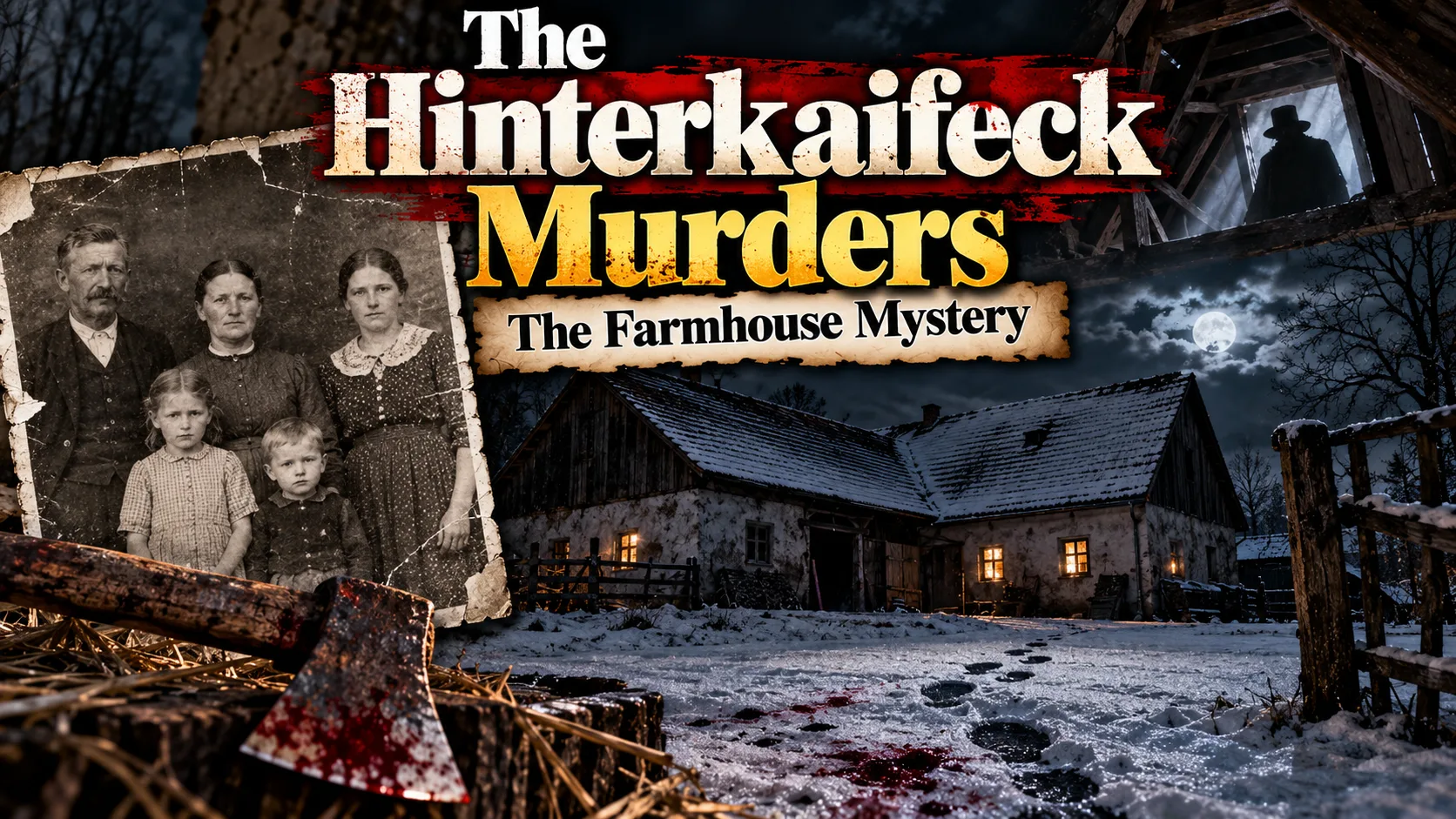
The Hinterkaifeck Murders: The Farmhouse Mystery
In 1922, six people were murdered on an isolated Bavarian farm, yet the killer appeared to remain on the property afterward. Explore the evidence, suspects, strange clues, and unanswered questions surrounding Hinterkaifeck.
The Hinterkaifeck Murders: The Farmhouse Mystery
On a quiet farm in rural Bavaria, something was wrong.
The family living there had begun noticing strange things.
Footprints appeared in the snow.
Sounds were reportedly heard around the property.
A newspaper seemed to have appeared without an obvious explanation.
Someone appeared to have been inside the farm.
And then, in the final days of March 1922, six people were killed.
Their bodies were not discovered immediately.
For several days, the farm continued to function strangely normally.
Animals were fed.
The house remained standing.
Life in the surrounding village continued.
But inside the isolated farmstead known as Hinterkaifeck, an extraordinary crime had already taken place.
The victims were:
Andreas Gruber
Cäzilia Gruber
Viktoria Gabriel
Cäzilia Gabriel
Josef Gabriel
and the family's newly employed maid,
Maria Baumgartner.
All six were brutally killed during the night of March 31 to April 1, 1922, according to the historical reconstruction of the case. Their bodies were discovered four days later. BR.de
The murderer was never conclusively identified.
And that is where the story becomes infamous.
Because Hinterkaifeck wasn't simply a murder case.
It was a murder case surrounded by a disturbing collection of unexplained observations, investigative mistakes, family secrets, rumors, and competing theories.
A century later, the farmhouse itself is gone.
The people who remembered the case firsthand are gone.
Much of the original investigative material was lost.
But the questions remain.
A Farm Hidden From the World
Hinterkaifeck was an isolated farmstead near Schrobenhausen in Upper Bavaria.
It stood away from the center of the nearby village of Gröbern.
The isolation mattered.
The family was not living in a busy urban neighborhood where dozens of people might have noticed something unusual immediately.
They lived on a farm surrounded by fields and woodland.
That meant:
Fewer witnesses.
Fewer passing travelers.
Less nighttime activity.
And fewer people who could immediately notice that something was wrong.
The farmhouse was eventually demolished in 1923, only about a year after the murders. The original site therefore no longer contains the building in which the crime occurred. BR.de
Who Lived at Hinterkaifeck?
The household contained members of the Gruber and Gabriel families.
At the center was Andreas Gruber, the older farmer, and his wife Cäzilia.
Their widowed daughter Viktoria Gabriel lived there with her children:
Cäzilia, aged seven,
and
Josef, aged two.
The sixth victim was Maria Baumgartner, a maid who had only recently arrived at the farm. BR.de
This detail is especially disturbing.
Maria had reportedly been at Hinterkaifeck for only a very short time before she was murdered.
She had entered a household she barely knew.
Within days, she was dead alongside the family.
A Family With a Troubled Reputation
The Gruber family was reportedly regarded by some locals as eccentric and isolated.
There were also serious rumors and accusations surrounding the household.
Andreas Gruber and his daughter Viktoria had been convicted in connection with an incestuous relationship.
Her son Josef's paternity was also the subject of longstanding speculation.
These details became important after the murders because investigators naturally looked for motives inside the family's complicated personal relationships.
But there is an important distinction:
A person's reputation is not evidence that they committed a murder.
The family's troubled history created possible motives.
It did not identify the killer.
Then Strange Things Began Happening
According to accounts from the period, Andreas Gruber reportedly noticed footprints in the snow leading toward the farm from the direction of the forest.
The unsettling part was supposedly that there were no corresponding footprints leading back.
That created an obvious question:
Who had come to the farm, and where had they gone?
This detail has become one of the most famous elements of the Hinterkaifeck story.
But it should also be treated carefully.
The surviving historical record is incomplete, and later retellings have repeatedly amplified individual details.
The existence and precise interpretation of every famous "mystery clue" should therefore be separated from what can actually be established.
Someone Had Been Watching the Farm
Reports also describe Andreas Gruber as having mentioned strange observations around the property.
There were accounts of:
Unusual noises.
Signs that someone had been around the farm.
Movement or sounds in the attic.
Suspicion that an unknown person was nearby.
These reports are difficult to reconstruct perfectly today because we are relying on historical testimony rather than modern forensic recordings.
But they established a crucial atmosphere:
The residents believed something unusual was happening before the murders.
A Newspaper Appeared
Another famous clue concerns a newspaper that Andreas reportedly found on the property.
The story has often been told as evidence that a stranger had been watching the farm.
Again, the precise circumstances are difficult to establish from the surviving evidence.
But the newspaper story became part of the mythology surrounding the case.
And that's the recurring problem with Hinterkaifeck.
A small historical detail becomes repeated hundreds of times.
Each retelling makes it sound more certain.
Eventually:
Possibility becomes fact.
A Mysterious Object in the Attic
Accounts also mention observations suggesting that somebody may have been hiding around the farm.
The attic became one of the most important locations in later theories.
Why?
Because if an unknown person had been living or hiding there before the murders, then the apparent mystery becomes much darker.
The killer may not have arrived only on the night of the murders.
They may have been watching.
Waiting.
Learning the family's routine.
That possibility is terrifying.
But again:
Possible does not mean proven.
The Farmhouse Was Vulnerable
An isolated farm creates opportunities for someone familiar with the area.
The property included:
Living areas.
Farm buildings.
Animal shelters.
Storage spaces.
An attic.
Outbuildings.
Fields.
Nearby woodland.
A person familiar with the layout could potentially approach without immediately being noticed.
The crime therefore did not require supernatural stealth.
It required:
Opportunity.
Knowledge.
Timing.
And luck.
The Murders
The exact sequence of events cannot be reconstructed with complete certainty.
But the surviving evidence indicates that the six victims were killed one after another during the night.
Several of the victims were found together in a farm building.
The maid was discovered separately in her room.
The youngest child, Josef, was among the dead.
According to the Bavarian public broadcaster BR, the victims were beaten to death with a Reuthaue, a heavy agricultural implement resembling a pick or mattock. BR.de
The violence was extreme.
And then something even stranger happened.
The Farm Didn't Immediately Become Silent
For several days after the killings, the outside world apparently did not realize that the entire household had been murdered.
That seems almost impossible today.
But in an isolated rural setting in 1922, it was possible.
Neighbors didn't necessarily expect immediate contact.
The family could have been:
Away.
Visiting relatives.
Working elsewhere.
Busy with farm activities.
And meanwhile, the animals still needed to be fed.
The Animals Were Fed
One of the reasons the delay in discovery became so remarkable is that the farm animals appeared to have been properly cared for.
That raised an obvious question:
Who was feeding them?
Someone apparently continued tending to the farm after the murders.
Whether this was the murderer himself or someone else remains one of the unresolved questions surrounding the case.
The detail became one of the strongest arguments used by later investigators who believed the killer may have remained on the property after the murders.
But Evidence and Interpretation Must Be Separated
The animals being fed is evidence of something.
It tells us the farm continued receiving care.
It does not automatically prove:
The murderer lived in the attic for days.
That's an interpretation.
The evidence can support a hypothesis.
It does not automatically establish the entire story.
This distinction is particularly important in famous unsolved crimes because later storytellers tend to connect every unexplained detail into one seamless narrative.
Real investigations are rarely that tidy.
Four Days Passed
The murders remained undiscovered until April 4, 1922.
That is an extraordinary amount of time.
Four days.
Six people dead.
A functioning farm.
No killer identified.
The first serious discovery came when local men went to investigate the family's absence.
The bodies were found in the barn and living quarters. BR.de
The Discovery
Three men entered the property and found several of the victims in the barn.
The discovery revealed the scale of the crime.
Six people had been murdered.
The youngest victim was only two years old.
The farm became a crime scene.
And unfortunately, what happened next became almost as important as the murders themselves.
The Investigation Was Criticized
Modern accounts of the case frequently criticize the original investigation.
One especially important problem:
Evidence wasn't collected using methods we would consider standard today.
A 2007 review by police students in Bavaria concluded that major investigative deficiencies had occurred.
Among the most striking examples was that fingerprints were not properly collected, despite fingerprinting being a known investigative technique by that time. BR.de
The Scene Was Disturbed
The crime scene was not preserved according to modern forensic standards.
People entered the property.
Objects were moved.
The bodies were handled.
Potential evidence was exposed.
The investigation therefore faced an enormous disadvantage from the beginning.
In a modern cold case, investigators might rely on:
DNA.
Fingerprints.
Trace evidence.
Detailed scene photography.
Digital records.
Surveillance.
Precise timelines.
In 1922, many of those tools either did not exist or were not used in anything resembling modern practice.
The Farmhouse Was Later Destroyed
In 1923, the farm itself was demolished.
That decision permanently erased one of the most important pieces of physical evidence.
The original building was gone.
No crime-scene reconstruction could be performed later using the intact structure.
The location itself became archaeological rather than forensic evidence. BR.de
Imagine Having a Crime Scene and Then Destroying It
Today this sounds horrifying.
But historical investigators operated differently.
A crime scene was not necessarily treated as an irreplaceable source of physical information.
Once the investigation was finished, buildings could return to ordinary use.
In Hinterkaifeck's case, the structure was ultimately removed.
That decision made future investigation dramatically harder.
The First Major Theory: Robbery
One of the early investigative theories was robbery.
That makes intuitive sense.
Six people were killed on an isolated farm.
Perhaps the murderer wanted:
Money.
Valuables.
Property.
Food.
Or something else.
But there was an obvious problem.
Important valuables and money reportedly remained on the farm.
The Bavarian broadcaster BR notes that the robbery theory was maintained for a long time even though money and valuables had not been taken. BR.de
Why Would a Robbery Killer Leave the Money?
This became one of the central problems with the theory.
If robbery was the motive, why murder everyone and then leave valuables behind?
Possible explanations existed.
The killer could have:
Panicked.
Been interrupted.
Failed to find the money.
Wanted something other than money.
Murdered for another reason and made the scene look like robbery.
But the evidence didn't clearly establish any of them.
No Single Motive Emerged
This is perhaps the biggest weakness of the case.
Murder investigations often focus on motive.
Money.
Revenge.
Jealousy.
Fear.
Silencing a witness.
Hatred.
Sexual violence.
Political ideology.
But Hinterkaifeck never produced a motive that convincingly explained all six deaths.
As author and researcher Peter Leuschner noted in an interview with BR, the case still lacked a definitive motive. BR.de
The Family's Secrets Became Suspect Material
Because the Gruber and Gabriel families had serious internal conflicts, investigators and later researchers naturally examined:
Viktoria's relationships.
Her previous marriage.
Her relationship with Lorenz Schlittenbauer.
The paternity of Josef.
The family's earlier conflicts.
Andreas Gruber's behavior.
These relationships created several possible motives.
But they also created noise.
A dysfunctional family doesn't automatically contain the killer.
Lorenz Schlittenbauer
One of the best-known suspects was Lorenz Schlittenbauer, a local man who had been romantically involved with Viktoria.
He was also involved in the discovery of the bodies.
That combination made him a particularly compelling suspect in later retellings.
He knew the family.
He had a relationship with Viktoria.
He reportedly had an interest in her and her child.
And he was present when the bodies were discovered.
Those are facts worth investigating.
They aren't proof of murder.
Why Being the First Finder Creates Suspicion
In mystery stories, the person who discovers the body often turns out to know more than they claim.
Real life isn't a detective novel.
People discover bodies because:
They notice something unusual.
They have legitimate reasons to visit.
They're concerned.
They've been asked to help.
So being involved in the discovery is not evidence of guilt.
Schlittenbauer's Behavior Has Been Heavily Debated
Later writers have interpreted various aspects of Schlittenbauer's behavior as suspicious.
Other interpretations regard those actions as understandable reactions from a person confronting a horrific crime scene.
The original investigation did not establish his guilt.
He was never convicted.
The case remains officially unsolved.
Karl Gabriel
Another theory involved Viktoria's husband, Karl Gabriel.
Karl had reportedly been declared killed during the First World War.
Later rumors suggested that perhaps he had survived and returned to Hinterkaifeck.
The motive in the story was supposedly revenge.
Again:
This is one of the most famous theories.
It is not established fact.
The evidence does not support confidently rewriting the First World War records to make Karl the killer.
Why These Theories Survive
Because they fit the structure of a mystery.
A known family member.
A secret relationship.
A possible revenge motive.
A dramatic return.
A murder.
It's satisfying.
Perhaps too satisfying.
Historical reality rarely provides such clean narratives.
Another Suspect: Karl's Possible Return
The problem with the returning-soldier theory is basic evidence.
There is no reliable evidence demonstrating that Karl Gabriel survived the war, returned to the farm, and killed the family.
The idea persists because it provides:
A motive.
A connection.
A dramatic explanation.
But those are narrative advantages, not forensic evidence.
A Different Theory: Someone the Family Knew
Some researchers have argued that the killer likely knew the victims.
The reasoning includes:
The apparent lack of conventional robbery.
The killer's knowledge of the property.
The manner in which the victims were discovered.
The possibility that the killer could approach without triggering immediate resistance.
A 2007 police-student reassessment strongly favored the idea that the killer knew the victims, although it did not identify a murderer through a criminal conviction or conclusive forensic evidence. BR.de
But "Known to the Family" Is Not a Solution
Even if the killer knew the victims, that still leaves a huge number of possibilities.
A:
Relative.
Neighbor.
Former employee.
Romantic connection.
Business associate.
Personal enemy.
Local resident.
Or someone with another relationship.
Knowing the family narrows the field.
It doesn't solve the case.
A Killer Familiar With the Property
Another important clue is the apparent knowledge of the farm.
Someone familiar with:
Buildings.
Storage areas.
Animal routines.
Family schedules.
Access points.
could move around the property without immediately attracting attention.
The isolated location gives such a person an advantage.
But again, several people could potentially have possessed that knowledge.
The Attic Theory
Perhaps the most disturbing modern interpretation is that the murderer may have hidden at the property before or after the murders.
This theory often connects:
Attic sounds.
Missing food.
Animals being fed.
The isolated location.
The family's reports of strange activity.
It creates an extraordinary picture:
Someone secretly living near the family.
Watching them.
Waiting.
Then attacking.
And perhaps remaining afterward.
It's the perfect horror story.
But much of this reconstruction rests on interpreting ambiguous historical details.
Could Someone Really Hide in an Attic?
Physically?
Certainly.
Would it have been comfortable?
No.
Would it have been practical?
Possibly, depending on the building.
Could someone remain unnoticed?
Potentially.
Does that prove someone did?
No.
An explanation can be physically possible without being historically established.
One of the Biggest Problems: Missing Records
The case suffered from another devastating loss.
During the Second World War, numerous investigative files were destroyed in a fire in Augsburg.
This means historians cannot consult the full original investigative record.
BR notes that significant files were lost and that this contributed to the continuing uncertainty surrounding the case. BR.de
This is catastrophic for a historical investigation.
Imagine Losing the Case File
Modern investigators could preserve:
Photographs.
DNA samples.
Interviews.
Fingerprints.
Digital evidence.
Maps.
Videos.
Audio.
Electronic records.
In 1922, there was already written documentation.
But when those records disappear, much of the case disappears with them.
The surviving archive becomes a skeleton.
Witnesses Disappeared Too
The people who remembered:
The family's behavior.
The strange footprints.
The sounds.
The discovery.
The investigation.
eventually died.
Every generation that disappears can take memories with it.
And once eyewitness memories are gone, historians are left with:
Documents.
Secondary accounts.
Newspapers.
Books.
Later interviews.
Each one farther removed from the original event.
The Investigation Was Officially Closed
The case did not continue forever as an active investigation.
It was officially closed in 1955.
That means the formal investigative path eventually ended without identifying the killer. BR.de
But the case never really ended culturally.
It became:
A local legend.
A true-crime case.
A subject of books.
Films.
Theater.
Podcasts.
Documentaries.
Internet communities.
The Crime Became a Cultural Mystery
This is where Hinterkaifeck changed.
Originally:
Six people murdered.
Later:
The mysterious farm murder.
Then:
The farmhouse where the killer lived in the attic.
Then:
The killer who stayed for days.
Then:
The perfect unsolved crime.
Each generation added interpretation.
The historical event remained.
The surrounding mythology grew.
Why True Crime Loves Hinterkaifeck
It has nearly every ingredient required for a compelling mystery.
An isolated farmhouse.
A dysfunctional family.
A mysterious stranger.
Strange footprints.
Possible hidden intruder.
Six victims.
A child among them.
A killer who vanished.
A poorly preserved crime scene.
Missing case files.
Multiple suspects.
No conviction.
And a farmhouse that no longer exists.
It's practically designed to generate theories.
But Mystery Isn't the Same as Evidence
This is the line the article must keep drawing.
Evidence:
Six people were killed.
The murders occurred around the end of March 1922.
The bodies were discovered on April 4.
The farm was isolated.
The case was never solved.
Interpretation:
The murderer lived in the attic.
Speculation:
The murderer was a specific named suspect.
Keeping those categories separate prevents history from becoming fan fiction.
🟢 Established Evidence
We can say confidently that:
Six people were murdered at Hinterkaifeck in 1922.
They included two children and a maid.
The murders occurred between the night of March 31 and April 1.
The bodies were discovered four days later.
The victims were beaten with an agricultural implement.
The killer was never conclusively identified.
The investigation suffered major deficiencies.
The farm was demolished in 1923.
Many investigative records were later destroyed.
The Bavarian public broadcaster BR continues to characterize the case as unresolved. BR.de
🟡 Active Debate
Researchers still debate:
Whether the killer knew the family.
Whether robbery was the true motive.
Whether someone remained on the farm after the murders.
Which suspect had the strongest motive.
How reliable individual witness accounts are.
How much significance should be assigned to the famous "mystery clues."
These questions remain open because the surviving evidence is incomplete.
🔴 Popular Myth
"We know the killer stayed in the farmhouse for several days after the murders."
Not proven.
The idea is based on clues such as continued care of the animals and other observations.
It is a plausible theory.
But it is not an established fact.
Another Myth
"The murderer definitely hid in the attic before the killings."
Again:
Possible.
Not proven.
The attic became important largely because of reports of unexplained sounds and later interpretations of the evidence.
Another Myth
"The police knew who the murderer was but deliberately protected him."
There is no established evidence supporting such a sweeping claim.
Investigators made serious errors.
That is different from deliberately covering up a murder.
Why the Original Investigation Matters
The biggest tragedy of Hinterkaifeck isn't only that the killer escaped.
It's that modern investigators will probably never get a clean chance to solve the case.
Some evidence was:
Never collected.
Lost.
Destroyed.
Contaminated.
Misinterpreted.
And some evidence may never have existed at all.
The case therefore became permanently constrained by what 1922 investigators failed to preserve.
The Fingerprint Problem
Fingerprint identification was already known when the murders occurred.
Yet modern accounts of the investigation emphasize the failure to systematically preserve usable fingerprints.
That is a devastating missed opportunity.
Imagine having a scene with:
Six victims.
A murderer moving around.
Objects being handled.
Doors.
Tools.
Buildings.
Then failing to preserve potential prints.
One mistake can erase an entire line of investigation.
Why Early Forensics Were Limited
This wasn't necessarily because investigators were incompetent by every standard of their time.
Forensic science was evolving.
Crime-scene protocols were less standardized.
DNA didn't exist as a forensic tool.
Modern trace evidence techniques were unavailable.
Photography existed, but documentation standards varied.
Investigators relied heavily on:
Witnesses.
Interviews.
Confessions.
Physical objects.
Motive.
Suspicion.
That made errors easier.
The Crime Scene Was Also a Farm
A farmhouse isn't a sterile laboratory.
People naturally needed to:
Feed animals.
Enter buildings.
Walk around.
Move objects.
Investigate.
Clean.
Continue daily life.
The environment was full of objects that belonged to ordinary household activity.
Separating:
Normal farm evidence
from
killer evidence
was extraordinarily difficult.
The Murder Weapon
The primary weapon is generally described as a Reuthaue, a heavy agricultural implement.
It was apparently associated with the farm.
This fact creates another possible clue.
If the weapon belonged to the property, the killer may have:
Already had access to the farm.
Used an available tool.
Known where tools were stored.
Taken the weapon from somewhere accessible.
Again:
The evidence creates possibilities.
It doesn't identify the murderer.
What Does the Weapon Tell Us?
It tells us that the murders could have been committed with an ordinary agricultural tool.
That's significant.
The killer didn't necessarily need to arrive carrying a specialized weapon.
A farm already contains dangerous objects.
This makes planning harder to infer.
Six Victims, One Attacker?
Another popular question:
Was there one killer or more than one?
The case doesn't provide a universally accepted answer.
Some reconstructions assume one offender.
Others consider the possibility of multiple people.
The number of victims alone doesn't prove either.
A single determined attacker can commit multiple murders.
Multiple attackers can also act together.
Evidence must decide.
Was It Planned?
The circumstances can look highly organized.
The killer apparently succeeded in killing six people.
Yet there are also signs that suggest improvisation or uncertainty.
We cannot confidently determine the degree of advance planning.
Again:
Successful crime does not automatically mean perfectly planned crime.
The Four-Day Silence Is One of the Biggest Mysteries
Four days is long.
But rural isolation explains part of it.
The family wasn't necessarily expected to respond to messages instantly.
There were no:
Mobile phones.
Social media.
Doorbell cameras.
Electronic payment notifications.
Instant messaging.
In a rural community of 1922, absence could go unnoticed longer than it would today.
The Village Wasn't Immediately Alarmed
People apparently had reasons to assume the family might simply be elsewhere.
The absence of one household wasn't immediately interpreted as a catastrophe.
That changed as days passed.
A child missing school.
Absence from church.
No obvious communication.
Eventually concern grew.
These small social signals built the path toward discovery. BR.de
The Child's Absence Was Important
One of the early indications that something was wrong was that young Cäzilia did not appear at school.
That mattered because school attendance is a routine social signal.
Adults can disappear and be assumed to be:
Working.
Visiting.
Traveling.
A child failing to appear is more noticeable.
The Sunday Church Absence
The family's absence from church also reportedly attracted attention.
Again, this was not automatically treated as suspicious.
People could have:
Visited relatives.
Stayed home.
Been unwell.
Had another reason.
Only after multiple absences accumulated did the situation become alarming.
This Shows How Ordinary Life Can Hide a Crime
The murderers didn't need to create a perfect cover story.
The victims already lived in a setting where absence could be explained.
That's one reason rural isolation can complicate murder investigations.
The environment provides ambiguity for free.
Why the Case Still Fascinates People Today
The question isn't simply:
Who killed them?
It's:
How could such a terrible crime happen in a place where everyone should have known everyone?
That tension between:
Community
and
Isolation
makes the case psychologically powerful.
Everyone seems close.
Yet nobody knows what happened.
The Psychology of the Mystery
Humans hate incomplete stories.
Six people die.
We need:
A villain.
A motive.
A sequence.
An ending.
Hinterkaifeck provides none.
So the brain starts building one.
This is where speculation becomes dangerous.
Once we have a candidate, we start interpreting every clue around them.
Confirmation Bias Appears
Suppose you believe Schlittenbauer was the killer.
A strange action:
Evidence.
A normal action:
Cover story.
Now suppose you believe a stranger did it.
The same evidence gets interpreted differently.
This is exactly why unsolved historical cases are difficult.
The evidence doesn't exist in a vacuum.
People interpret it through hypotheses.
🟢 The Case Is Unsolved
This is the most important fact.
Nobody was definitively identified and convicted as the murderer.
The official investigation ended without a conclusive answer.
Any modern claim that:
"The Hinterkaifeck killer has been proven to be X."
should therefore be treated extremely cautiously.
BR continues to describe the murders as unresolved. BR.de
🟡 Someone May Have Come to the Farm Before the Murders
The reported footprints and unusual observations make this possibility intriguing.
But we cannot confidently reconstruct:
Who made them.
When exactly.
Why they were there.
Whether all the later stories describe the same event.
That uncertainty should remain visible.
🔴 The Ghost Story Version
Over time, Hinterkaifeck acquired almost supernatural associations.
The farm became:
Haunted.
Cursed.
Occupied by a mysterious presence.
The land was rumored to be strange.
But there is no credible evidence that supernatural phenomena were involved.
The real mystery is already disturbing enough.
Six people were murdered.
The killer disappeared.
That's sufficient horror without adding ghosts.
The Farm Wasn't Exactly "Cursed"
The building was demolished.
The physical location changed.
The murders became folklore.
People later reported stories about the site.
But those stories belong to the cultural afterlife of the crime.
They aren't evidence about the murderer.
The Modern Reinvestigations
Over the years, researchers and police students have revisited the available evidence.
The 2007 project involving Bavarian police students attempted to apply modern investigative thinking to the case.
It highlighted:
Investigative failures.
Potentially overlooked clues.
Questions about motives.
Potential suspects.
The likely limitations of the original inquiry.
Yet even this reanalysis did not produce a legally established murderer. BR.de
Why Modern Analysis Still Can't Solve Everything
You can reinterpret evidence.
You can't manufacture evidence that no longer exists.
If a fingerprint was never recorded:
You can't recover it.
If an eyewitness died:
You can't interview them.
If documents burned:
You can't read them.
If the building was destroyed:
You can't walk through it.
Modern reasoning has limits.
The Case Is a Perfect Example of Historical Uncertainty
We have three layers.
What happened
Six people were murdered.
What probably happened
Someone familiar with the farm may have had access and an opportunity.
What we can't establish
Who the murderer actually was.
That third category is where honesty matters most.
Frequently Asked Questions
Who were the victims of the Hinterkaifeck murders?
The six victims were Andreas Gruber, his wife Cäzilia, their daughter Viktoria Gabriel, Viktoria's children Cäzilia and Josef, and their maid Maria Baumgartner. BR.de
When did the murders happen?
The murders are generally dated to the night of March 31 to April 1, 1922. BR.de
When were the bodies discovered?
They were discovered on April 4, 1922, four days after the murders. BR.de
Was the killer ever caught?
No. The crime remains unsolved, and the formal investigation was eventually closed in 1955. BR.de
Was Lorenz Schlittenbauer the killer?
He was one of the most discussed suspects, but he was never convicted and the available evidence does not establish his guilt.
Did the murderer live in the attic?
This is one of the most famous theories, but it has never been conclusively proven.
Was the crime a robbery?
Robbery was an early investigative theory, but money and valuables reportedly remained at the farm, making the motive difficult to explain. BR.de
Did the killer feed the animals after the murders?
The animals were reportedly cared for during the period before the bodies were discovered. Who provided that care remains uncertain.
Was the murder weapon ever found?
The murders were associated with a Reuthaue, an agricultural implement, which became an important piece of the investigation. BR.de
Why wasn't the case solved with fingerprints?
Modern accounts note that investigators failed to collect fingerprints adequately despite fingerprint identification already being available in 1922. BR.de
What happened to the farmhouse?
It was demolished in 1923, making later reconstruction of the original crime scene much more difficult. BR.de
Myth vs. Reality
🟢 Six people were murdered at an isolated Bavarian farm in 1922.
Established. BR.de
🟢 The crime remains officially unsolved.
Yes. BR.de
🟢 The original investigation had major weaknesses.
Later reviews have identified serious investigative shortcomings. BR.de
🟡 The killer probably knew the victims.
Possible and argued by later investigators, but not conclusively established.
🟡 The killer stayed at the farm afterward.
Possible, based on interpretations of the post-murder circumstances, but unproven.
🔴 The killer definitely lived in the attic.
No conclusive evidence establishes this.
🔴 Lorenz Schlittenbauer was proven to be the murderer.
False.
🔴 The murders were supernatural.
No credible evidence supports this.
Final Thoughts
Hinterkaifeck is often described as one of history's most mysterious murder cases.
That's true.
But the reason it remains mysterious isn't that the crime defies reality.
It is almost the opposite.
Everything about it is painfully human.
A family with complicated relationships.
A remote farm.
Possible enemies.
Rumors.
Fear.
An isolated community.
A violent crime.
Investigative mistakes.
Lost evidence.
And decades of unanswered questions.
The famous clues are fascinating.
Footprints in the snow.
Strange noises.
Reports of an unfamiliar presence.
Animals apparently cared for after the killings.
A farmhouse that seemed to continue functioning after its inhabitants were dead.
But each clue has to be treated carefully.
A footprint doesn't identify its owner.
A noise doesn't prove someone was hiding in the attic.
Animals being fed doesn't prove who fed them.
A suspicious person isn't automatically a murderer.
A motive isn't evidence.
And a compelling theory isn't a solved case.
That's what makes Hinterkaifeck so frustrating.
There are enough clues to construct several plausible narratives.
There aren't enough reliable clues to prove one of them.
The original investigation made that problem worse.
Potential evidence wasn't preserved adequately.
The crime scene was compromised.
The farmhouse was demolished.
Witnesses died.
Important case files were destroyed during the Second World War.
Eventually, even the formal investigation ended.
By 1955, there was no murderer standing in court.
Only a collection of theories. BR.de
And perhaps that's the most haunting part of the entire story.
The killer didn't need to disappear into some elaborate secret organization.
They may simply have walked away.
Into another village.
Another town.
Another country.
Another life.
They may have told nobody.
Or perhaps someone who knew the killer died without ever revealing what they knew.
We cannot know.
That uncertainty creates the mythology.
Every missing piece becomes an invitation to speculate.
And over time, speculation becomes tradition.
The farmhouse itself eventually vanished.
The trees and fields changed.
The people disappeared.
The documents burned.
But the question remained:
Who killed the six people at Hinterkaifeck?
More than a century later, there is still no answer that meets the standard of proof.
And that is where this case should remain.
Not with a confidently named villain.
Not with a supernatural explanation.
Not with a conspiracy invented to fill the gaps.
But with an uncomfortable historical truth:
Sometimes the evidence is simply not enough.
Hinterkaifeck reminds us that solving a crime isn't only about finding a clever theory.
It's about preserving evidence.
Testing competing explanations.
Resisting confirmation bias.
And knowing the difference between:
What we know.
What we suspect.
And what we desperately want to be true.
The murders happened.
The victims were real.
The investigation happened.
The clues existed.
And somewhere inside those fragments is the truth.
The tragedy is that the people who could have given us the missing pieces are gone.
The farm is gone.
And history has kept the question.
Who was the man who walked onto Hinterkaifeck that night, and where did he go when it was over?
For now, nobody knows.
And unlike a fictional mystery, there may never be a final chapter.