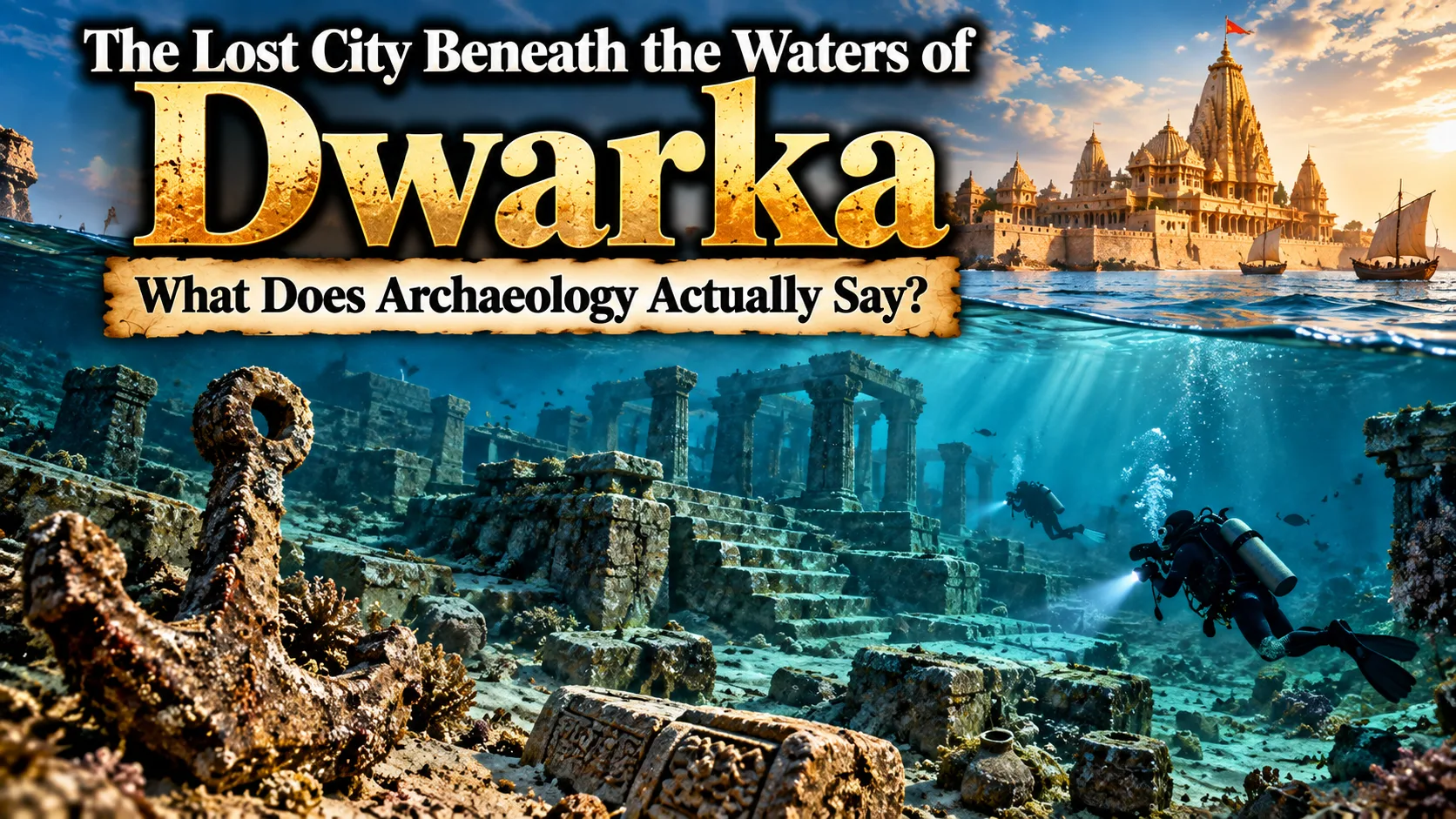
The Lost City Beneath the Waters of Dwarka: What Does Archaeology Actually Say?
Ancient texts describe Dwarka as a magnificent city that was eventually swallowed by the sea. Explore the underwater discoveries, archaeological evidence, dating debates, and what researchers can actually establish.
The Lost City Beneath the Waters of Dwarka: What Does Archaeology Actually Say?
For centuries, the story of Dwarka has existed between two worlds.
In one world, there is the Mahabharata and later Hindu tradition, which describe a magnificent coastal city associated with Krishna, a city that ultimately disappeared beneath the sea.
In the other is the world of archaeology.
Divers descend into the Arabian Sea.
Researchers map the seabed.
Stone anchors are recovered.
Underwater structures are recorded.
Pottery is examined.
Ancient shorelines are reconstructed.
And suddenly, the legend becomes a scientific question:
Is there really an ancient city beneath the waters of Dwarka?
The answer is more complicated than either side usually admits.
There is genuine archaeological evidence for ancient occupation and maritime activity in the Dwarka region.
There are also submerged archaeological structures offshore.
But the much bigger claim, that archaeologists have definitively discovered the Mahabharata's Krishna-era city exactly as described in tradition, is not established.
That distinction matters.
Because Dwarka is one of those subjects where three different things are constantly mixed together:
A real ancient archaeological landscape.
A powerful religious and literary tradition.
And a modern attempt to connect the two.
The first is real.
The second is real.
The third remains debated.
And that is where the story gets genuinely fascinating.
Dwarka Exists in Both History and Tradition
Modern Dwarka lies on the western coast of Gujarat, at the tip of the Saurashtra peninsula.
Its location on the Arabian Sea is one of the reasons the region has such strong maritime significance.
The landscape contains:
Coastal settlements.
Harbours.
Marine resources.
Ancient trade routes.
Religious monuments.
Archaeological remains.
The present city is also one of the most important pilgrimage centers associated with Krishna.
India's official tourism site describes Dwarka through both its religious tradition and its importance as an underwater archaeological area. It also notes that offshore explorations have produced archaeological remains and numerous stone anchors. Incredible India
This creates an unusual situation.
The modern pilgrimage site is not simply sitting beside an unrelated archaeological landscape.
There really is a long history of human activity around this coast.
The difficult question is:
How much of that archaeological history corresponds specifically to the legendary Dwarka?
The Legend of the City That Entered the Sea
According to traditional accounts, Krishna established Dwarka as a great fortified coastal city after leaving Mathura.
The city was said to be extraordinarily prosperous.
Eventually, after Krishna's departure from the mortal world, the sea overwhelmed the city.
The legend therefore describes not merely an abandoned settlement but a dramatic submergence.
Modern tourism literature preserves this tradition.
The Government of India's Incredible India site describes the traditional account in which Krishna's city was eventually swallowed by the sea. Incredible India
But a traditional account is not automatically an archaeological report.
That distinction must remain visible throughout any serious investigation.
🟡 Literary Tradition Is Evidence of Belief, Not Automatically Physical Proof
The Mahabharata is an ancient and enormously important literary tradition.
It preserves cultural memory, religious ideas, political narratives, and descriptions of places.
But historians cannot simply take every geographic or chronological detail in an epic and assume it functions like a modern excavation report.
A text can tell us:
What people remembered.
What people believed.
What stories circulated.
How places were imagined.
Archaeology asks a different question:
What physical evidence survives?
The two can inform one another.
They are not interchangeable.
The Search Beneath the Arabian Sea
Modern underwater investigations around Dwarka began taking shape in the twentieth century.
A major role was played by India's Marine Archaeology Centre / Marine Archaeology Unit associated with the National Institute of Oceanography.
Researchers conducted underwater surveys around:
Dwarka.
Bet Dwarka.
The Gulf of Kachchh.
Nearby coastal areas.
Using methods including:
Diving.
Underwater recording.
Geophysical survey.
Echo sounding.
Side-scan sonar.
Shallow seismic profiling.
The goal was to identify archaeological structures and understand the ancient coastline.
🟢 The Archaeological Search Is Real
This is not a story based on one diver saying:
"I saw a stone underwater."
There have been organized archaeological and geophysical investigations.
A National Institute of Oceanography publication on the 1992 survey describes earlier underwater work beginning in the 1980s and reports the discovery of submerged structural remains, stone anchors, and other archaeological material. DRS NIO
That is important.
The archaeological question is legitimate.
But What Did They Actually Find?
This is where the story becomes much less cinematic.
Underwater investigations have reported:
Stone blocks.
Wall-like arrangements.
Semicircular structures.
Rectangular features.
Stone anchors.
Channels and other submerged features.
Geophysical evidence associated with the offshore extension of the Gomati River channel.
Researchers used these findings to reconstruct a picture of ancient maritime activity around Dwarka. DRS NIO
That is significant evidence.
But it doesn't automatically equal:
"The submerged palace of Krishna has been found."
The Stone Anchors Are Particularly Important
One of the strongest archaeological indicators of maritime activity at Dwarka is the large number of stone anchors found in the region.
Anchors are useful because their presence is difficult to explain as random decoration.
They indicate boats.
And boats indicate:
Navigation.
Harbour activity.
Trade.
Fishing.
Military movement.
Or other maritime uses.
The National Institute of Oceanography's research describes numerous anchors around Dwarka and Bet Dwarka, pointing to significant maritime activity. DRS NIO
A Harbour Is Not Automatically Krishna's City
This distinction is essential.
Suppose archaeologists establish:
There was an ancient harbour at Dwarka.
That tells us the area had maritime importance.
It doesn't tell us:
Who founded it.
Exactly when the harbour was built.
Whether it was the city described in the Mahabharata.
Whether Krishna was historically associated with it.
Those are separate questions.
The Archaeological Timeline Is Complicated
This may be the most important part of the entire investigation.
Different pieces of archaeological evidence from Dwarka and Bet Dwarka belong to different periods.
The NIO research literature describes a long sequence of occupation on Bet Dwarka stretching from the Protohistoric period, including Harappan-era material around 2000 BC, through historic and later periods. DRS NIO
Meanwhile, submerged structures offshore have been assigned different dates by different researchers.
And that is precisely where the debate begins.
The "2000 BC" Claim Needs Context
Official Indian tourism material says offshore investigations revealed remnants of an ancient city dating back to around 2000 BC. Incredible India
But the underlying archaeological literature is more cautious.
Researchers have noted that:
Different artifacts have different dates.
Different structures may belong to different periods.
Some anchors may be historic or medieval.
Some offshore structures have been difficult to date securely.
A stone block bearing Gujarati script raises the possibility that at least some submerged structures are considerably later than the Bronze Age. DRS NIO
That is a major complication.
🟡 One Underwater "Dwarka" May Not Be One Archaeological Phase
This is a crucial possibility.
Instead of:
One city → one destruction → one underwater site
the archaeological picture may be:
Multiple occupations → harbour development → repairs → reuse → coastal change → partial submergence.
That would be much more consistent with how real coastal sites behave.
Ports are reused.
Buildings are rebuilt.
Sea levels change.
Shorelines move.
Structures collapse.
People modify old harbours.
The seabed can contain material from many centuries.
Coastal Cities Are Especially Difficult to Date
Why?
Because coastlines move.
A place that was:
Beach
2000 years ago
might be:
Shallow water
today.
Another area that was once:
Harbour
might now be:
Buried or exposed.
Sea-level changes.
Coastal erosion.
Sediment movement.
Storms.
Tectonic activity.
Human construction.
all modify archaeological landscapes.
The Arabian Sea Doesn't Preserve a City Like a Museum
Popular images show a complete drowned city:
Streets.
Palaces.
Walls.
Temples.
Towers.
all sitting neatly beneath crystal-clear water.
Real underwater archaeology is rarely like that.
Structures collapse.
Stones move.
Sediments bury objects.
Corals grow.
Waves redistribute materials.
Modern anchors and boats disturb deposits.
The seabed is an active environment.
What Geology Says Matters
Some of the most important research around Dwarka has therefore been geological rather than purely archaeological.
Researchers used geophysical surveys to investigate the submerged extension of the Gomati River channel.
One study mapped the submerged channel for roughly 1.5 kilometers offshore, using echo sounding, side-scan sonar, and shallow seismic profiling. DRS NIO
This helps reconstruct the ancient coastal environment.
And environmental reconstruction is essential for understanding whether a settlement could have been where later archaeology places it.
The Gomati Channel Is a Major Clue
The present Gomati creek is central to modern Dwarka.
Understanding how its ancient channel extended seaward can help researchers determine:
Where ancient boats may have entered.
How the shoreline changed.
Where a harbour could have existed.
How sediment and erosion reshaped the coast.
It's not as dramatic as finding a golden palace.
It's more useful.
Because geography determines where a city can actually function.
🟢 A Changing Coastline Is Not Speculation
Research around Dwarka has documented evidence consistent with significant coastal change.
The NIO literature notes that some archaeological contexts indicate rising water levels relative to earlier occupation and identifies coastal erosion as a major factor affecting submerged structures. DRS NIO
So the basic idea that ancient structures could end up underwater is entirely plausible.
The question is:
Which structures?
When?
Why?
Sea-Level Change Can Explain Submergence Without a Catastrophe
This is important.
A city does not need to be hit by one enormous tsunami to become partially submerged.
Over centuries:
Sea level can rise.
Land can sink or shift.
Coastal erosion can remove the shoreline.
Harbours can become unusable.
Storm events can damage structures.
Rivers can change course.
A settlement can gradually end up partly underwater.
That kind of process is archaeologically much more common than a legendary city disappearing in one perfectly timed event.
🟡 Could Dwarka Have Been Submerged Gradually?
Absolutely possible.
The archaeological and geological evidence shows that the coastline changed and that structures in the region entered the marine environment.
But that does not prove the exact dramatic narrative of the Mahabharata.
It only establishes that coastal submergence occurred.
Those are two very different claims.
The Bet Dwarka Connection
Bet Dwarka, an island north of modern Dwarka, is extremely important to the archaeological story.
Investigations there have identified:
Protohistoric material.
Harappan-related pottery.
Later historic remains.
Stone anchors.
Evidence of maritime activity.
The long archaeological sequence demonstrates that this region was repeatedly occupied and used over a very long period. DRS NIO
Why Bet Dwarka Matters
Because it tells us the wider region was not a late invention.
People were using this coastline thousands of years ago.
That makes ancient maritime activity unsurprising.
It also demonstrates why archaeological claims need geographical precision.
Evidence from:
Modern Dwarka.
Bet Dwarka.
Offshore Dwarka.
Nageshwar.
Other sites around Okhamandal
should not automatically be merged into one single ancient city.
Different places can have different histories.
Ancient Trade Was Already Sophisticated
Archaeology from the region indicates long-distance maritime activity.
Stone anchors appear in multiple contexts.
Some anchor types have parallels elsewhere around the Indian Ocean and beyond.
This doesn't prove one specific civilization controlled all of them.
It demonstrates that the western coast of India participated in maritime networks.
🟢 Dwarka Really Was a Maritime Landscape
This is probably the safest major conclusion.
The evidence indicates:
Ports.
Anchors.
Coastal settlements.
Trade connections.
Long-term occupation.
Marine exploitation.
That makes Dwarka historically important even without proving every element of the legendary city.
The Harappan Question
Some archaeological material around Bet Dwarka belongs to the broader Harappan / Indus Civilization horizon.
That puts human activity in the region well into the second millennium BCE and earlier.
But again:
Harappan presence ≠ Mahabharata-era Krishna city.
This is a common mistake.
An ancient date is not automatically evidence for a specific literary figure.
Dates Don't Carry Names
This is perhaps the single most important principle in archaeology.
Suppose we carbon-date an object to:
1500 BC.
What does that tell us?
It tells us the object belongs approximately to that period.
It doesn't tell us:
Krishna used it.
Suppose a wall dates to:
1500 BC.
That doesn't tell us:
This was Krishna's palace.
Archaeology can date objects.
It cannot insert historical characters into contexts without independent evidence.
The Mahabharata Dating Problem
Another complication is chronology.
The Mahabharata is a complex text that developed over a long period and contains layers of tradition.
Its exact historical dating as a whole is difficult.
Different traditional and scholarly chronologies have been proposed.
This means we cannot simply say:
"The Mahabharata happened in year X, therefore anything dating to year X must be its evidence."
The literary chronology itself is debated.
🟡 Literary Date and Archaeological Date Are Different Things
An archaeological site may date to a particular period.
A text may have been compiled or edited at another time.
A story may preserve older traditions.
Those three timelines don't have to match exactly.
Historians therefore have to compare them carefully.
The "3500-Year-Old Dwarka" Claim
Earlier marine archaeological publications associated some finds with dates around 3500 years before present.
A 1992 NIO paper reported thermoluminescence dating of pottery to around 3500 BP, along with comparative evidence from pottery, anchors, seals, and inscriptions. DRS NIO
3500 BP is roughly the second millennium BCE.
That is genuinely ancient.
But again:
A date does not prove an identity.
It establishes an age.
Dating the Pottery Isn't the Same as Dating the City
This is another subtle but important issue.
An artifact can tell you:
When the artifact was made or used.
A site contains many artifacts from different periods.
One piece of old pottery doesn't automatically date every stone structure around it.
Likewise, a structure that looks old isn't necessarily contemporary with an ancient artifact found nearby.
Archaeology works by establishing relationships among evidence.
Why the Underwater Structures Are Difficult
Researchers have noted that some submerged structures are difficult to date precisely.
One NIO study specifically argues that some previously assigned early dates for the underwater structures should be reconsidered, noting:
A block with Gujarati script.
Anchor types associated with later periods.
Construction features inconsistent with straightforward Protohistoric attribution.
The same study concluded that the offshore structures were likely associated with a jetty/harbour and that some components may be medieval or later. DRS NIO
This is a major reason a responsible article has to avoid saying:
"The entire underwater city is proven to be 2000 BC."
The evidence doesn't support such a simple statement.
🟢 There Is Archaeology
That should not be lost in the skepticism.
Sometimes people hear:
"The legendary city hasn't been proven."
and incorrectly conclude:
"Nothing was found."
That's false.
Researchers have documented:
Submerged structures.
Stone anchors.
Ancient pottery.
Coastal archaeological deposits.
A submerged river channel.
Evidence of long-term maritime use.
There is real archaeology here. DRS NIO
🟡 But the Archaeology Doesn't Give Us a Final Identification
The evidence does not presently allow us to say:
"This underwater settlement has been conclusively identified as Krishna's Dwarka described in the Mahabharata."
That is a much stronger claim.
And it remains unproven.
The Anchor Evidence Is Stronger for a Port Than a Palace
Think about what an anchor can establish.
A ship was here.
Someone was operating that ship.
This location had some form of maritime use.
That's strong evidence.
What can't an anchor establish?
Who founded the city.
Which king ruled it.
Whether the city was called Dwarka.
Whether Krishna lived there.
Whether a particular literary event happened there.
This is the difference between:
Evidence of activity
and
evidence of identity.
What About Large Stone Structures?
Stone structures underwater sound impressive.
But stone walls can belong to:
Harbours.
Jetties.
Breakwaters.
Quays.
Fortifications.
Buildings.
Later repairs.
Collapsed architecture.
The form and context matter.
A rectangular stone arrangement isn't automatically a palace.
The "Six Times Submerged" Story
Modern popular descriptions sometimes say that Dwarka has been submerged repeatedly.
Government tourism material even uses language describing the ancient city as having been submerged several times. Incredible India
That may reflect local tradition and repeated coastal change.
But archaeology requires identifying:
Separate occupation phases.
Separate destruction events.
Chronological sequences.
Physical evidence for each episode.
A repeated-submergence story therefore should not be treated as automatically established simply because coastal erosion is real.
Coastal Archaeology Is Full of Reuse
A harbour can be:
Built.
Expanded.
Destroyed.
Repaired.
Abandoned.
Reoccupied.
Rebuilt.
That's normal.
If a port sits on a valuable coast, later communities may reuse the same location repeatedly.
The seabed can therefore contain layers of history that belong to very different centuries.
This Is Probably Happening Around Dwarka
The archaeological sequence around Okhamandal strongly suggests long-term occupation.
Researchers have documented material from:
Protohistoric.
Early Historic.
Historic.
Medieval.
Later periods.
Modern activity.
The underwater landscape is therefore unlikely to represent one single moment.
It is better understood as part of a long-lived maritime zone. DRS NIO
What Does Archaeology Say About an Ancient Port?
Quite a lot.
We can reasonably conclude that:
The western coast of Gujarat was important for maritime activity.
Dwarka and nearby regions were used as ports.
Ships visited.
Stone anchors were used.
People lived in the region over long periods.
Coastal change submerged or damaged some archaeological remains.
That's already remarkable.
What Archaeology Cannot Yet Say
It cannot confidently establish:
That the underwater remains are the exact city described in the Mahabharata.
That Krishna is archaeologically identifiable from these remains.
That the city was destroyed in one specific event.
That every submerged structure belongs to the same period.
That one precise date can be assigned to the entire underwater complex.
Those require evidence we don't currently possess.
Why This Debate Is So Emotional
Dwarka is not merely an archaeological site.
It is a sacred city.
For millions of Hindus, the story has religious significance.
That means archaeology is touching something much larger than a technical research question.
When evidence challenges a literal interpretation, people may feel that their traditions are being attacked.
But archaeology doesn't have to attack the tradition.
It asks a narrower question:
What can physical evidence demonstrate?
Religious meaning and archaeological proof are different categories.
They can coexist without pretending they are the same thing.
Archaeology Doesn't Decide Faith
A person can believe:
Krishna established Dwarka
as a matter of religious faith.
Archaeology may or may not provide independent physical evidence for the historical setting.
The two statements are not identical.
Science can test:
Material.
Date.
Structure.
Environment.
Sequence.
It cannot test the religious significance of Krishna.
🟢 Archaeology Can Confirm Context
Archaeology can potentially establish:
There was a settlement here.
It was prosperous.
It was maritime.
It existed during a particular period.
It was damaged by coastal change.
That can make a literary tradition historically interesting.
But it still doesn't automatically validate every detail of that tradition.
The Difference Between "Consistent With" and "Proves"
Suppose ancient texts describe:
A wealthy coastal city.
Archaeology finds:
A wealthy coastal settlement.
That's:
Consistent with the tradition.
It is not automatically:
Proof that the literary city has been identified.
This distinction is absolutely central.
Imagine the Opposite
Suppose archaeology finds nothing.
Would that prove the Mahabharata's story never happened?
Not necessarily.
A city could be:
Eroded.
Buried.
Submerged.
Rebuilt.
Relocated.
Archaeologically invisible.
Texts can preserve memories that archaeology cannot yet verify.
So the relationship works in both directions.
Archaeological Absence Is Complicated
No evidence can mean:
No event.
or:
Evidence hasn't survived.
or:
We haven't looked in the correct place.
or:
The site is inaccessible.
or:
The expected material signature was wrong.
This is why archaeology rarely makes absolute negative claims from silence.
Why Dwarka Needs More Than One Type of Dating
Ideally, researchers want several independent lines of evidence.
Radiocarbon dating
Useful for organic material.
Thermoluminescence
Can help date certain heated archaeological materials.
Stratigraphy
Shows relative chronological relationships.
Ceramic comparison
Can connect artifacts with known traditions.
Epigraphy
Inscriptions can provide direct historical clues.
Geomorphology
Reconstructs shoreline and environmental changes.
Geophysics
Maps structures beneath sediment.
The more independent methods agree, the stronger the reconstruction becomes.
One Date Alone Isn't Enough
This is a universal archaeological problem.
A date can be:
Contaminated.
Associated with older material.
Associated with later material.
Misinterpreted.
Applied to the wrong object.
That doesn't mean dating is useless.
It means dates need context.
The Gujarati Inscription Problem
One particularly interesting piece of evidence is a stone block bearing Gujarati script reported among the underwater material.
That matters because Gujarati script is much later than the Bronze Age.
Researchers have therefore argued that at least some offshore structures attributed to very early periods may actually belong to later historical or medieval contexts. DRS NIO
This doesn't erase earlier archaeology from the region.
It demonstrates that the underwater assemblage may contain multiple periods.
That Makes the Site More Interesting, Not Less
A layered harbour used for centuries is archaeologically fascinating.
It tells us:
Trade routes changed.
Port facilities were maintained.
Ships visited over long periods.
Communities repeatedly invested in the coast.
The history becomes larger than one legendary city.
The Ancient Coastal Landscape
Imagine the coastline thousands of years ago.
The shape may have been different.
A river channel extended offshore.
Boats entered.
Goods were unloaded.
People lived nearby.
Storms altered the shore.
Structures were repaired.
New generations rebuilt.
Centuries later, parts of that landscape ended up beneath the sea.
Now divers find fragments.
That's the archaeological process.
The "Sunken City" May Actually Be Several Stories Overlapping
The most responsible interpretation may be:
Ancient settlement
plus
long-term maritime activity
plus
coastal change and submergence
plus
the literary tradition of Dwarka
plus
later religious development
All of these can be true simultaneously.
The mistake is forcing them into one sentence:
"Archaeologists found Krishna's city."
They haven't established that conclusively.
🟢 What Is Strongly Supported?
The region around Dwarka has a long archaeological history.
Ancient settlements existed there.
Maritime activity was important.
Stone anchors are abundant.
Underwater structures have been documented.
Coastal and sea-level changes affected archaeological remains.
Bet Dwarka preserves a long cultural sequence extending back into the protohistoric period. DRS NIO
🟡 What Is Plausible but Debated?
A substantial ancient port may have existed at or near the location associated with traditional Dwarka.
Some submerged remains could belong to ancient phases of that maritime landscape.
The coastline may have contributed significantly to the later submergence of archaeological remains.
Some traditional memories may preserve echoes of real coastal settlements.
These are reasonable research questions.
They are not all settled conclusions.
🔴 What Is Not Established?
That the entire underwater complex is one city built by Krishna.
That the remains can be definitively dated to the exact period traditionally assigned to the Mahabharata.
That one catastrophic event submerged the city exactly as the epic describes.
That underwater structures are proof of a supernatural or miraculous event.
Those claims go beyond the evidence.
What About "Ancient India's Atlantis"?
Dwarka is sometimes called India's Atlantis.
It's a powerful comparison.
But the analogy can distort the archaeology.
Atlantis itself is a philosophical/literary tradition rather than a securely identified archaeological civilization.
Dwarka has a real archaeological landscape and a separate religious-literary tradition.
Those should be studied on their own terms.
Why "Atlantis" Is the Wrong Frame
Calling every submerged site an Atlantis encourages people to search for:
One lost supercity.
One catastrophe.
One dramatic disappearance.
Real coastal archaeology is usually:
Messy.
Layered.
Gradual.
Localized.
Human.
Dwarka deserves better than a borrowed mythology.
The Search Is Still Valuable
Even without proving the legendary city, underwater archaeology around Dwarka teaches us about:
Ancient Indian seafaring.
Port construction.
Trade.
Coastal settlement.
Sea-level change.
Harbour technology.
Long-distance connections.
It also helps reconstruct how communities adapted to changing shorelines.
That's genuinely important history.
India's Maritime Past Is More Important Than the Mystery Alone
One danger of focusing entirely on Krishna's city is that it can overshadow the broader archaeological significance.
The evidence already shows that western India had long-standing maritime connections.
Ancient communities were not isolated inland populations.
They participated in:
Coastal trade.
Fishing.
Navigation.
Exchange networks.
This deserves attention even without a sensational conclusion.
The Anchor Fields Tell a Story
Hundreds of anchors across different locations imply repeated maritime use.
Different anchor forms can potentially help archaeologists understand:
Different periods.
Different vessel traditions.
Different users.
Different trade networks.
The NIO literature emphasizes the variety of anchors found around Dwarka and their implications for maritime activity. DRS NIO
The harbour story is therefore quite strong.
The Krishna identification remains the uncertain part.
The Ancient Port May Be the Better Mystery
Think about the question:
Who built Krishna's mythical city?
versus:
How did this coastal region function as a maritime center over thousands of years despite major changes to its shoreline?
The second question is less dramatic.
It is also much more answerable.
And possibly much more historically valuable.
Why the Sea Is an Archaeologist's Enemy
The sea destroys evidence in several ways.
Currents move objects.
Waves break structures.
Marine organisms grow on surfaces.
Sediment buries evidence.
Storms redistribute material.
Modern shipping damages deposits.
Salt affects materials.
Visibility can be poor.
Depth limits access.
Underwater excavation is expensive.
So the fact that anything survives is remarkable.
And the Sea Is Also an Archaeologist's Friend
This is the paradox.
Once submerged, some sites can become protected from:
Agriculture.
Road building.
Urban construction.
Plowing.
Some forms of human disturbance.
The sea can both destroy and preserve.
Certain submerged environments can protect artifacts extraordinarily well.
Why More Discoveries Could Still Happen
Underwater archaeology around Dwarka has not answered every question.
Modern tools can improve:
Seafloor mapping.
Sediment analysis.
Photogrammetry.
Sonar.
Sub-bottom profiling.
Precise positioning.
Dating.
Material analysis.
As technology improves, researchers may distinguish archaeological phases that earlier investigations could only lump together.
The story could become clearer.
Or more complicated.
Usually the latter.
Archaeology Loves Making the Mystery Larger
Suppose researchers discover:
A new structure.
Then ask:
When was it built?
Why there?
Was it connected to the harbour?
What ships used it?
What was the shoreline?
Who maintained it?
Suddenly one discovery creates six questions.
This is normal.
A good archaeological mystery isn't one that produces a dramatic answer.
It's one that produces better questions.
The Most Important Question Is Chronology
If researchers want to connect underwater remains to the traditional Dwarka narrative, the crucial issues include:
What is the age of each structure?
What is the age of each artifact?
Which layers are associated?
Which structures are later repairs?
What was the shoreline at the time?
Do the dates match the proposed historical period?
Without this, the argument remains speculative.
🟢 Science Is More Interesting When It Admits Uncertainty
A responsible conclusion might be:
"There is convincing evidence of ancient maritime activity and submerged archaeological remains around Dwarka, but the evidence does not yet establish that these remains are conclusively the legendary city of Krishna described in the Mahabharata."
That sentence isn't as dramatic as:
"Krishna's lost city found!"
But it tells us much more.
Frequently Asked Questions
Is there really a submerged city near Dwarka?
There are documented submerged archaeological structures and remains associated with ancient and later maritime activity around Dwarka. The exact age and interpretation of individual structures remain debated. DRS NIO
Has Krishna's Dwarka been archaeologically proven?
No. Archaeology has established substantial ancient occupation and maritime activity in the region, but it has not conclusively demonstrated that the underwater remains are the exact city described in the Mahabharata.
Are the underwater ruins 2000 BC?
Some archaeological material from the wider Dwarka-Bet Dwarka region belongs to very early periods, including Harappan/protohistoric contexts. But the underwater structures themselves do not all have one securely established date, and some evidence points to later historical or medieval phases. Incredible India
What have archaeologists found underwater?
Reported finds include stone structural remains, semicircular and rectangular features, stone anchors, and evidence of submerged coastal infrastructure. Geophysical surveys have also mapped the submerged extension of the Gomati channel. DRS NIO
What do the anchors prove?
They are strong evidence of maritime activity and the use of boats in the region. They do not by themselves identify the city's founders or connect the harbour directly to Krishna.
Could the city have actually sunk into the sea?
Coastal archaeological and geological evidence demonstrates that parts of the region have been affected by shoreline change, erosion, and submergence. A coastal settlement ending up underwater is therefore entirely plausible. The exact mechanism and timing for particular structures remain questions of research. DRS NIO
Is Dwarka the same as Atlantis?
Not scientifically. "Atlantis" is a literary tradition, while Dwarka is both a major religious tradition and a real archaeological region with evidence of ancient settlements and maritime activity.
What is Bet Dwarka?
It is an island near the coast of Gujarat associated with a long archaeological sequence that includes protohistoric/Harappan material and later occupations, as well as evidence for maritime activity. DRS NIO
Why is dating the underwater structures difficult?
Underwater sites can contain materials from different periods, and coastal processes can move or bury objects. Some structures may also have been repaired or reused. Researchers have therefore questioned whether all the offshore structures belong to one early period. DRS NIO
Does the Mahabharata prove Dwarka existed?
The Mahabharata is important evidence for a literary and cultural tradition involving Dwarka. It does not by itself function as archaeological proof that a specific excavated underwater structure is the city described in the text.
Myth vs. Evidence
🟢 Dwarka has a genuine archaeological record.
Yes.
🟢 Ancient maritime activity occurred around Dwarka and Bet Dwarka.
Strongly supported by anchors, coastal remains, and archaeological investigations. DRS NIO
🟢 Some archaeological remains are submerged.
Yes.
🟢 The coastline has changed substantially over time.
Yes. Coastal erosion and sea-level changes have affected the archaeological landscape. DRS NIO
🟡 Some submerged material may belong to very early periods.
Possible and supported for some finds, but individual structures and artifacts must be dated separately.
🟡 The archaeological evidence may preserve memories of ancient coastal settlements described in tradition.
Possible, but difficult to demonstrate directly.
🔴 The underwater ruins have conclusively been identified as Krishna's Dwarka.
Not established.
🔴 Every submerged structure dates to the Bronze Age.
False.
Research indicates multiple chronological phases, including later structures and materials. DRS NIO
🔴 One catastrophic tsunami has been proven to have swallowed the entire city.
No.
🔴 The underwater archaeology proves the supernatural elements of the Dwarka tradition.
No.
The Archaeological Puzzle Has Three Layers
Perhaps the cleanest way to understand Dwarka is to separate the evidence into three layers.
Layer One: The Physical Landscape
Archaeology shows:
Ancient settlements.
Ports.
Anchors.
Stone structures.
Long-distance maritime activity.
Coastal change.
This is the strongest evidence.
Layer Two: The Historical Interpretation
Researchers ask:
When were these settlements occupied?
How did the harbour function?
Which structures belong together?
How did the shoreline change?
These questions remain partly unresolved.
Layer Three: The Epic Tradition
Traditional literature describes:
Krishna.
A magnificent city.
A powerful coastal settlement.
And eventual submergence.
The archaeological question is whether any part of that tradition corresponds to the physical remains.
At present:
Some broad similarities are plausible.
A definitive identification is not established.
Why "Actually Say?" Is the Right Question
The Dwarka debate has produced some remarkably confident claims.
Some say:
"The city has been found."
Others say:
"Nothing exists underwater."
Neither extreme accurately reflects the archaeological record.
The evidence is somewhere in the much less exciting middle.
There is real archaeology.
There are real submerged remains.
There is real evidence of ancient maritime activity.
There is real evidence of coastal change.
There is a genuine ancient literary tradition.
But the chain connecting all of these into one specific historical event isn't complete.
What Would Stronger Evidence Look Like?
To make the case for identifying the underwater remains specifically with the traditional Dwarka much stronger, researchers would ideally need:
A well-dated archaeological settlement.
A coherent stratigraphic sequence.
Securely dated structures.
Artifacts clearly associated with the proposed period.
Evidence linking the site to the cultural world expected from that period.
Perhaps inscriptions or other direct historical identifiers.
And ideally:
Multiple independent lines of evidence converging on the same conclusion.
That's the standard archaeological mystery stories rarely mention.
A Name Would Change Everything
Imagine researchers discover an inscription underwater that clearly says:
"This is the city of..."
and the historical context matches.
The debate would transform overnight.
Until something like that appears, researchers have to rely on:
Material culture.
Chronology.
Geography.
Comparative evidence.
Environmental reconstruction.
That's legitimate science.
It's simply slower than a viral headline.
What the Region Already Proves
Even without that inscription, Dwarka demonstrates something significant.
The western coast of India was not a marginal world.
It was connected to:
Maritime trade.
Fishing.
Navigation.
Port systems.
Coastal settlements.
Long-distance exchange.
Humans were interacting with the sea in sophisticated ways thousands of years ago.
That deserves attention in its own right.
The Sea Preserved a Fragment of India's Maritime Past
Underwater archaeology is effectively recovering chapters from a history that was almost erased.
The structures are incomplete.
The dates are sometimes uncertain.
The coastline has moved.
Some artifacts have been displaced.
But enough remains to show:
People built, traded, navigated, and lived along this coast for a very long time.
🟢 What We Can Safely Conclude
There is archaeological evidence for ancient and historic occupation around Dwarka and Bet Dwarka.
There is substantial evidence for maritime activity.
There are submerged archaeological features offshore.
There is evidence of coastal change and erosion.
The broader archaeological sequence includes very old material.
The region deserves continued marine archaeological research. DRS NIO
🟡 What We Should Leave Open
Whether a specific early settlement corresponds to the Dvārakā remembered in the Mahabharata.
Whether literary memories of submergence preserve a historical coastal event.
Exactly which offshore structures belong to which period.
How many separate harbour phases existed.
The precise sequence of shoreline changes.
These remain legitimate research questions.
🔴 What We Should Stop Saying as Fact
"Krishna's palace has been found."
Not established.
"The entire Mahabharata has been archaeologically verified."
Not established.
"All the underwater structures are 2000 BC."
Not supported.
"Dwarka was definitely destroyed by one giant tsunami."
Not established.
"There is no archaeology at all."
Also false.
Final Thoughts
Dwarka is a perfect example of why archaeology becomes difficult when history, religion, geology, and legend occupy the same piece of coastline.
There really is something beneath the waters.
That much isn't a fantasy.
Archaeologists have found submerged structures.
They have documented stone anchors.
They have identified evidence of ancient maritime activity.
They have mapped submerged geological features.
They have recovered material from a region with a very long archaeological history.
The western coast of Gujarat was genuinely important.
People really did live there.
They really did sail.
They really did build.
And parts of that coastal landscape really did end up underwater.
Those are remarkable facts.
But they are not the same as proving that archaeologists have uncovered the exact city described in the Mahabharata.
That's where the evidence becomes complicated.
The wider Dwarka-Bet Dwarka region contains archaeological material from different periods.
Some evidence reaches back into the protohistoric and Harappan horizons.
Other structures and anchors belong to later historical and medieval contexts.
Researchers have explicitly questioned the assumption that every submerged structure belongs to one ancient Bronze Age city. Some have argued that at least portions of the offshore remains represent later harbour or jetty structures affected by coastal erosion and changing shorelines. DRS NIO
That isn't a disappointing conclusion.
It's actually fascinating.
Because it means the underwater landscape may preserve thousands of years of maritime history rather than one single dramatic catastrophe.
Imagine a harbour being used by one generation.
Then repaired by another.
Expanded by another.
Partially damaged by storms.
Modified as the shoreline changes.
Eventually abandoned.
Centuries later, another community builds nearby.
The sea keeps moving.
The coastline changes.
Some structures collapse into the water.
New ones appear.
Eventually archaeologists arrive with sonar, diving equipment, sediment studies, and dating techniques.
What they discover isn't a single frozen moment.
It's layers.
One period over another.
One community over another.
One shoreline over another.
That is how real history usually works.
The literary tradition adds another layer.
For centuries, people have told the story of a magnificent Dwarka associated with Krishna and eventually claimed by the sea.
It is entirely reasonable to ask whether that tradition could preserve memories of a real coastal settlement and real environmental change.
But archaeology cannot answer that question simply by finding old stones.
A 2000-year-old anchor doesn't tell us who owned it.
A Bronze Age pot doesn't carry Krishna's signature.
A submerged wall doesn't automatically become a palace.
And an ancient harbour doesn't automatically become the exact city described in an epic.
Archaeology gives us constraints.
It tells us:
What existed.
When it existed.
How it was constructed.
How the environment changed.
The literary tradition gives us:
What people remembered.
What they believed.
How they described the city.
The real intellectual challenge is discovering where those two records intersect.
Perhaps they do.
Perhaps parts of the tradition preserve memories of genuine ancient coastal settlements that were later transformed through centuries of storytelling.
Perhaps future discoveries will strengthen that connection.
Perhaps they will weaken it.
That is exactly what archaeology is supposed to allow.
New evidence should be capable of changing the story.
For now, the most defensible conclusion is also the most interesting:
There was ancient and long-lived maritime activity around Dwarka, and parts of its archaeological landscape were affected by coastal change and submergence.
What remains unresolved is whether the specific underwater remains represent the legendary Dwarka of Krishna and the Mahabharata.
That question remains open.
And perhaps that's why Dwarka continues to fascinate people.
Not because science has proved the legend.
Not because science has disproved it.
But because beneath the modern pilgrimage city lies a coastline with a genuinely deep human history.
The sea has hidden parts of that history.
Archaeology is slowly bringing pieces back.
A stone anchor.
A fragment of pottery.
A collapsed structure.
A buried channel.
A changed shoreline.
Each one is a tiny message from the past.
The mistake is trying to make every message say the same thing.
Maybe the greatest discovery beneath Dwarka won't be a palace with Krishna's name carved into its walls.
Maybe it will be something quieter.
A clearer understanding of how ancient Indians lived with the sea.
How ports were built.
How trade moved.
How coastlines changed.
How cities adapted.
And how stories survived long after the physical landscapes that inspired them had disappeared.
Because whether or not the legendary city is ever conclusively identified, one fact is already impossible to ignore:
The waters around Dwarka really do contain pieces of a lost maritime past.
The mystery is not whether something is down there.
It is knowing exactly what those pieces belong to.
And for now, the sea isn't giving up the answer.