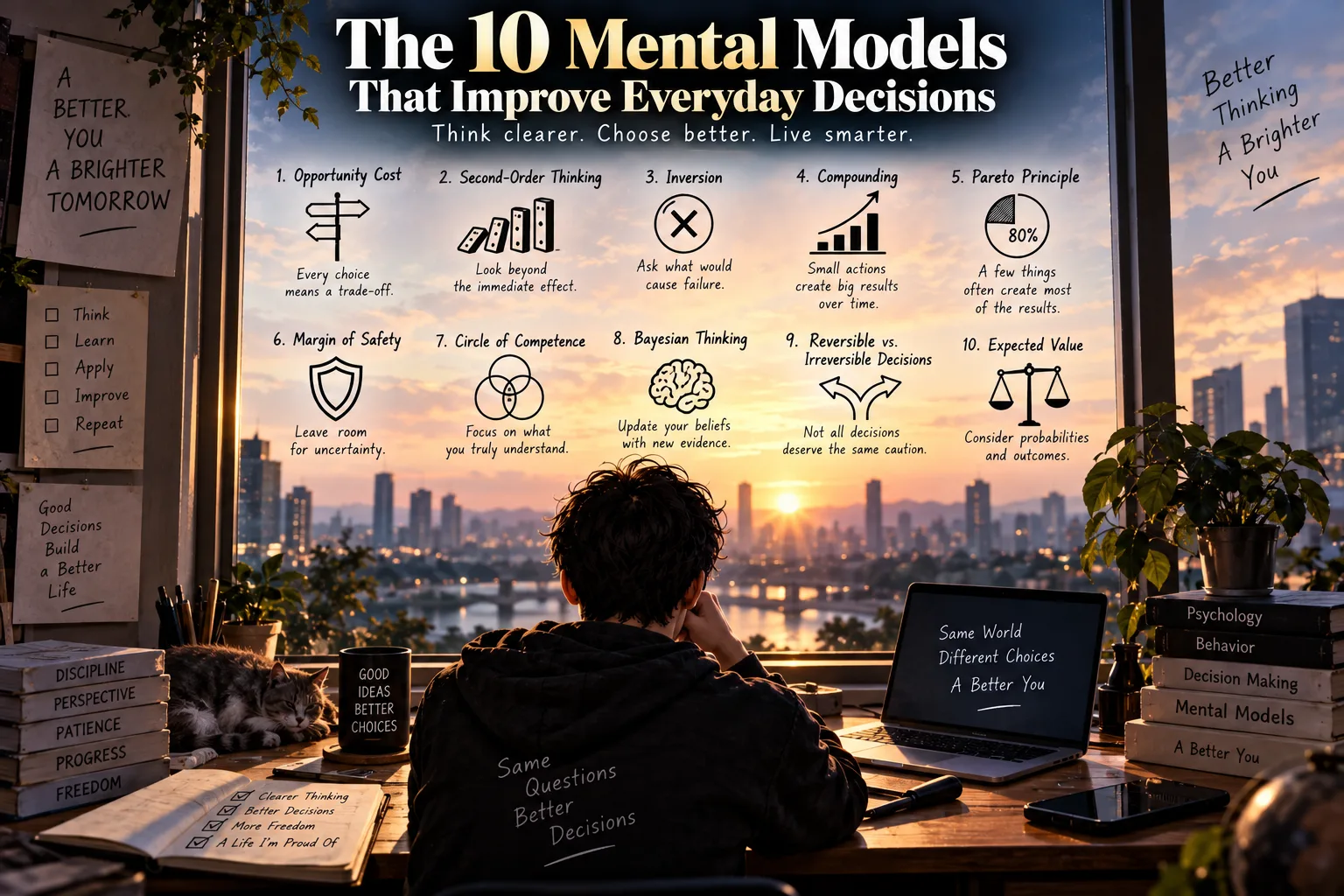
The 10 Mental Models That Improve Everyday Decisions
Ten powerful mental models can help you think more clearly, avoid common mistakes, and make better decisions in everyday life, from money and work to relationships and long-term planning.
The 10 Mental Models That Improve Everyday Decisions
Every day, you make hundreds of decisions.
Some are trivial.
What should I eat?
Which route should I take?
Should I answer that message now or later?
Others matter considerably more.
Should I change jobs?
Should I spend $2,000 on a new laptop?
Should I start a business?
Should I trust this person?
Should I invest this money?
The strange part is that most decisions don't come with instructions.
There is rarely a giant sign saying:
CORRECT ANSWER THIS WAY.
Instead, your brain takes incomplete information and tries to construct the best possible decision.
Sometimes it succeeds.
Sometimes it confidently walks directly into a wall.
One way to improve this process is to use mental models.
A mental model is a simplified framework for understanding how something works. It helps you interpret situations, identify hidden factors, and reason about consequences.
Mental models aren't magical formulas.
They don't guarantee good decisions.
They're more like different lenses.
One lens helps you think about incentives.
Another helps you think about opportunity cost.
Another helps you recognize compounding.
Another helps you distinguish reversible decisions from irreversible ones.
The value comes from asking:
"Which way of thinking fits this problem?"
The right model can turn a confusing decision into a much simpler one.
And humans desperately need simpler decisions because our brains are already busy deciding whether checking the refrigerator for the seventh time might somehow produce new food.
What Makes a Mental Model Useful?
A good mental model does three things.
It simplifies complexity.
It reveals something you might otherwise miss.
And it improves the quality of your actions.
That doesn't mean the model perfectly describes reality.
No useful model does.
A map isn't the territory.
A weather forecast isn't the weather.
A financial model isn't the economy.
A mental model is a representation of reality that helps you reason about it.
The trick is knowing when the model applies.
Mental Model 1: Opportunity Cost
One of the most useful questions in everyday life is:
"What am I giving up by choosing this?"
That is opportunity cost.
Suppose you have $100.
You can spend it on:
A nice dinner.
A new book.
A gym membership.
Savings.
An investment.
The opportunity cost of spending $100 on dinner isn't simply "$100."
It's the value of the best alternative you gave up.
If that $100 could have paid for an important course, that's part of the real cost of the dinner.
Opportunity Cost Is About Time Too
Money makes opportunity cost easy to see.
Time makes it harder.
You have two hours tonight.
You could:
Watch a movie.
Study.
Work on your business.
Exercise.
Sleep.
Meet a friend.
Scrolling for two hours isn't free just because no money changed hands.
You spent two hours that cannot be recovered.
The real cost is whatever valuable alternative those hours replaced.
An American Example
Imagine a college student in the United States working a part-time job for $18 an hour.
They are deciding whether to spend six hours on an optional activity.
The direct financial cost might be zero.
But six hours could represent:
$108 in potential wages
or study time that improves their academic performance.
The exact calculation depends on circumstances.
The important point is conceptual:
Resources are scarce, even when they don't look scarce.
Why Opportunity Cost Improves Decisions
People frequently ask:
"Can I afford this?"
A better question can be:
"What am I sacrificing to get this?"
You can technically afford a $1,500 phone.
But if buying it prevents you from building an emergency fund, the decision looks different.
You can technically afford a three-hour gaming session.
But if you're preparing for tomorrow's exam, the opportunity cost is much higher.
The model forces you to include what you don't see.
Mental Model 2: Second-Order Thinking
Most people naturally think about the immediate consequence.
"What happens next?"
Second-order thinking asks:
"And then what?"
This simple shift can dramatically improve decisions.
Imagine a restaurant owner cuts prices by 20%.
First-order thinking:
More customers.
Second-order thinking:
Lower margins.
Then:
Can increased volume compensate?
Then:
Will customers begin expecting permanently lower prices?
Then:
Can the business maintain quality at those margins?
One decision can create a chain of consequences.
Everyday Example: Skipping Exercise
First-order thinking:
"Skipping the workout gives me another hour."
Second-order thinking:
You get more free time today.
Then your routine weakens.
Then exercise becomes easier to skip again.
Then your fitness gradually declines.
Then restarting becomes harder.
Nothing catastrophic happened on Day 1.
The consequences accumulate.
Second-order thinking makes the future part of today's decision.
Second-Order Effects Can Also Be Positive
Suppose you spend $50 on a book.
First-order effect:
You're down $50.
Second-order possibility:
You learn something useful.
You apply it.
It improves your work.
You earn more.
You teach someone else.
The original decision becomes much more valuable than the immediate transaction suggests.
This is why decisions shouldn't always be judged by their first visible outcome.
Why Businesses Need Second-Order Thinking
Imagine a company wants to reduce customer-support costs.
First-order result:
Lower expenses.
Second-order consequences might include:
Longer wait times.
Lower customer satisfaction.
More refunds.
More negative reviews.
Lower retention.
Higher acquisition costs.
The initial savings may eventually cost more than they save.
Organizations regularly discover this after making the decision rather than before it, which is a very human method of strategic planning.
Mental Model 3: Inversion
Instead of asking:
"How do I succeed?"
ask:
"How would I guarantee failure?"
Then avoid those things.
This is inversion.
It comes from an old but powerful reasoning technique.
Sometimes figuring out what not to do is easier than figuring out exactly what to do.
How Inversion Works
Suppose you want to stay healthy.
You could ask:
"What is the perfect lifestyle?"
That's complicated.
Instead ask:
"What behaviors almost certainly make health worse?"
Then identify obvious problems:
Chronic sleep deprivation.
Smoking.
Excessive alcohol.
Physical inactivity.
Poor diet.
Ignoring medical care.
You don't need a perfect plan before eliminating obvious disasters.
Inversion in Business
Suppose you're starting an online store.
Instead of asking:
"How do I make this business successful?"
ask:
"How would I make this business fail as quickly as possible?"
Perhaps you would:
Ignore customers.
Choose unreliable suppliers.
Spend all your money immediately.
Never test products.
Make shipping unclear.
Hide return policies.
Ignore complaints.
Now do the opposite.
The strategy becomes clearer.
Inversion Helps With Relationships Too
Ask:
"What would guarantee that this relationship becomes unhealthy?"
Probably:
Never communicate.
Never apologize.
Assume bad intentions.
Keep score.
Avoid difficult conversations.
Ignore boundaries.
Use silence as punishment.
Now you have a useful checklist.
Instead of searching for a perfect relationship formula, you're removing behaviors that reliably create problems.
Mental Model 4: Compounding
People understand compounding when discussing bank accounts.
They often forget that it applies to almost everything.
Money compounds.
Knowledge compounds.
Habits compound.
Reputation compounds.
Relationships compound.
Skills compound.
Debt compounds.
The basic idea is:
Small repeated changes can produce enormous long-term differences.
Why Compounding Is Hard to Notice
Suppose you improve something by just 1% per day.
The improvement doesn't look dramatic after a few days.
That's why people underestimate compounding.
The early stages are boring.
Then the differences become enormous.
This is one reason people abandon good habits too quickly.
They expect immediate results from systems whose greatest effects appear later.
Financial Compounding
Suppose someone invests $200 every month for decades.
The early balance may seem insignificant.
Over time, contributions combine with investment returns.
Returns can themselves generate additional returns.
That is the power of compounding.
The exact result depends on contribution amount, return rate, fees, taxes, and time.
But the principle remains:
Time can become an amplifier.
Negative Compounding Exists Too
This may be even more important.
Small problems can compound.
A little debt.
Then interest.
Then more debt.
A little sleep loss.
Then worse concentration.
Then poorer decisions.
Then more stress.
A slightly damaged relationship.
Then less communication.
Then resentment.
Then distance.
Compounding isn't inherently positive.
It amplifies whatever you repeatedly feed into the system.
The Power of Tiny Improvements
You don't always need a dramatic transformation.
Reading ten pages each day.
Saving a small amount each week.
Walking regularly.
Practicing a skill.
Keeping promises.
Cleaning as you go.
Responding to problems early.
These actions look almost embarrassingly small.
That's precisely why people underestimate them.
The model says:
Don't judge a repeated action by one day's result.
Judge it by where it points after months or years.
Mental Model 5: The Pareto Principle
The Pareto principle, commonly associated with the 80/20 rule, describes a pattern where a relatively small portion of causes can account for a large portion of outcomes.
The exact ratio doesn't need to be literally 80/20.
The deeper lesson is:
Results are often unevenly distributed.
A few inputs may produce a huge share of the output.
80% Isn't a Magic Number
This is important.
You shouldn't assume every situation mathematically follows:
80% of results = 20% of causes.
Sometimes the distribution is 70/30.
90/10.
95/5.
The principle is about concentration, not a sacred ratio.
Business Example
Imagine an online store has 50 products.
Perhaps five products produce most of the sales.
If the owner treats all 50 products equally, time is being distributed evenly while results are not.
Pareto thinking asks:
"Which products actually create most of the value?"
The same can apply to:
Customers.
Marketing channels.
Employees' tasks.
Technical problems.
Sources of revenue.
Personal Example
Suppose you constantly feel busy.
List everything you do each week.
You may discover that a surprisingly small number of activities generate most of your meaningful progress.
The rest may create the sensation of productivity without producing much value.
That's an important distinction:
Activity is not the same as impact.
Mental Model 6: Margin of Safety
This model comes from engineering, finance, and risk management.
The basic idea:
Don't operate right at the edge of what the system can tolerate.
Leave room for mistakes.
If your monthly expenses are exactly equal to your income, one unexpected bill creates a crisis.
If you have no spare time in your schedule, one delayed meeting can wreck the entire day.
If a bridge is designed to handle exactly the maximum expected load, unusual conditions become dangerous.
Margin of Safety in Money
Suppose your monthly expenses are $2,500.
Your income is exactly $2,500.
Technically, the system balances.
Practically, it's fragile.
One car repair.
One medical bill.
One temporary income interruption.
One forgotten subscription.
And suddenly the mathematics becomes unpleasant.
An emergency fund creates a margin of safety.
Margin of Safety in Time
You have an appointment at 10:00 AM.
Google Maps says the trip takes 30 minutes.
Leaving at 9:30 means you're assuming:
Zero traffic.
No construction.
No parking problems.
No wrong turns.
No delays.
Leave at 9:00 and suddenly the plan has resilience.
The extra thirty minutes may feel wasteful.
They're insurance against uncertainty.
Margin of Safety in Health
You don't want a plan that only works if:
You sleep perfectly.
You never get sick.
You never miss a workout.
You never have a stressful week.
Real life isn't a controlled laboratory.
Good systems survive imperfect execution.
That's what a margin of safety provides.
Mental Model 7: Circle of Competence
You don't need to know everything.
You need to know what you actually understand.
The circle of competence asks:
"What areas do I understand well enough to make reliable judgments?"
And equally important:
"Where does my knowledge end?"
That second question protects against overconfidence.
Experts Have Narrow Expertise
A cardiologist may understand heart disease extremely well.
That doesn't automatically make them an expert in:
Real-estate investing.
Cryptography.
Climate modeling.
Restaurant operations.
International law.
Everyone has a boundary.
Even extraordinarily intelligent people have domains in which they know very little.
Why This Matters in Investing
Imagine someone is an excellent engineer.
They understand technology.
They understand systems.
They may therefore feel extremely confident evaluating a technology company.
But knowing technology doesn't automatically mean understanding:
Accounting.
Valuation.
Market expectations.
Competitive positioning.
Regulation.
Capital structure.
Investor psychology.
A circle-of-competence mindset creates humility.
"I Don't Know" Is a Decision Tool
Suppose someone asks:
"Will this stock rise next year?"
You could invent a confident answer.
Or say:
"I don't know."
That isn't intellectual failure.
It's information about the quality of your decision.
If you don't understand the variables driving the outcome, reducing exposure may be smarter than pretending expertise.
Mental Model 8: Bayesian Thinking
Bayesian thinking sounds complicated.
The basic idea is actually simple:
Start with what you already know, then update your belief when new evidence arrives.
Instead of asking:
"Is this true or false?"
ask:
"How much should this new evidence change my confidence?"
Example: Weather
Suppose the weather forecast says there is a 70% chance of rain.
You look outside and see a few clouds.
Does that mean rain is guaranteed?
No.
Does the forecast become irrelevant?
No.
Your belief updates gradually as new evidence appears.
That's the essence of Bayesian thinking.
Medical Example
Suppose a disease is rare.
A test is highly accurate.
You receive a positive result.
Many people instinctively think:
"The test is highly accurate, so I must have the disease."
But the correct interpretation also depends on how common the disease was before testing.
When a condition is very rare, even a strong test can produce more false positives than intuition expects.
This is why base rates matter.
Base Rates Are Often Ignored
Imagine a test for a hypothetical disease with:
A very high detection rate.
A low false-positive rate.
But the disease affects only a tiny fraction of the population.
The probability that a randomly selected person with a positive test actually has the disease may still be much lower than people intuitively expect.
This is one reason statistical reasoning is so useful.
The evidence doesn't exist independently of the prior probability.
Bayesian Thinking in Everyday Life
Suppose your friend doesn't reply to your message.
Possible explanations:
They're angry.
They're busy.
Their phone died.
They forgot.
They're sleeping.
Your brain may immediately select one.
Bayesian thinking asks:
"What evidence do I actually have?"
One unanswered message should not dramatically update your belief that someone hates you.
The prior probability matters.
Mental Model 9: Reversible vs. Irreversible Decisions
Not all decisions deserve the same amount of analysis.
Some decisions are easy to reverse.
Others are difficult or impossible to undo.
That distinction should affect how much time and caution you apply.
Reversible Decisions
Trying a new productivity app.
Changing your workout routine.
Testing a new marketing headline.
Buying a different brand of coffee.
You can change your mind.
These decisions don't deserve weeks of analysis.
Hard-to-Reverse Decisions
Buying a house.
Taking on enormous debt.
Quitting a stable job without a backup.
Signing a long-term contract.
Moving across the country.
Major business commitments.
These decisions justify much more careful analysis.
Why People Waste Time on Small Decisions
Humans sometimes spend 45 minutes choosing a restaurant and five minutes deciding whether to sign a major contract.
The allocation is backwards.
A useful rule is:
The harder the decision is to reverse, the more careful the decision process should be.
For reversible choices:
Experiment.
Learn.
Adjust.
For irreversible choices:
Slow down.
Gather information.
Consider downside risks.
Amazon Example
Imagine you're choosing between two $25 office chairs accessories.
The difference is small.
Trying one and discovering you dislike it costs little.
Compare that with spending $25,000 launching an untested business concept.
The second decision demands dramatically more evidence.
Not because it's morally more important.
Because the cost of being wrong is much larger.
Mental Model 10: Expected Value
The final model is one of the most powerful.
Expected value asks:
"If I made this type of decision repeatedly, what would the average outcome tend to be?"
Instead of judging a decision only by one result, you consider probabilities and outcomes.
A Simple Example
Suppose you have a game where:
You have a 50% chance of winning $200.
And a 50% chance of winning $0.
The expected monetary value is:
$100.
That doesn't mean you will receive $100.
You will receive either $200 or $0.
The expected value describes the long-run average across repeated equivalent situations.
Why This Matters
One lucky outcome doesn't automatically prove a decision was good.
Suppose someone makes a terrible investment decision and gets lucky.
They make $20,000.
Was the decision intelligent?
Not necessarily.
Another person makes a carefully researched decision and loses money because the unlikely bad outcome happened.
Was the decision stupid?
Not necessarily.
Outcome and decision quality are not identical.
Decision Quality vs. Outcome Quality
This is one of the most important distinctions in thinking.
A good decision can produce a bad outcome.
A bad decision can produce a good outcome.
That sounds strange until you think about probability.
A professional baseball player can hit a ball perfectly and still have it caught.
A business can make a smart investment and encounter an unexpected recession.
A careful driver can still get hit by another distracted driver.
The outcome doesn't reveal the entire quality of the process.
Expected Value in Everyday Life
Suppose you can spend $20 on a course.
There is a reasonable chance it teaches a skill worth hundreds of dollars over your career.
That doesn't guarantee success.
But the potential upside may justify the relatively small downside.
This is where expected-value thinking becomes useful:
What are the plausible outcomes?
How likely are they?
What is the cost if I'm wrong?
Expected Value Doesn't Mean Ignore Risk
Imagine:
99% chance of gaining $1
1% chance of losing $50,000.
The expected monetary value might look attractive under certain simple calculations.
But one catastrophic loss could still be unacceptable.
That's why expected value should be combined with:
Risk.
Liquidity.
Downside limits.
Margin of safety.
Personal constraints.
Probability uncertainty.
Averages don't protect you from bankruptcy.
How the Ten Models Fit Together
The real power doesn't come from memorizing ten definitions.
It comes from combining them.
Suppose you are considering starting a new business.
You can use:
Opportunity cost
What am I giving up to do this?
Second-order thinking
What happens if it succeeds? What happens if it fails?
Inversion
What would guarantee failure?
Compounding
What skills or brand advantages could accumulate over time?
Pareto principle
Which activities produce most of the results?
Margin of safety
How much cash runway do I need?
Circle of competence
What do I actually understand?
Bayesian thinking
What new evidence should change my assumptions?
Reversibility
How much commitment is actually necessary now?
Expected value
Does the potential upside justify the downside?
Suddenly, one decision becomes much easier to analyze.
Mental Models Are Filters, Not Answers
This is important.
A mental model doesn't tell you:
"Choose option A."
It tells you what to investigate.
Opportunity cost asks:
What am I giving up?
Second-order thinking asks:
What happens afterward?
Inversion asks:
What causes failure?
Compounding asks:
What grows over time?
Pareto asks:
What matters most?
Margin of safety asks:
Where is the buffer?
Circle of competence asks:
Do I actually understand this?
Bayesian thinking asks:
How should evidence change my belief?
Reversibility asks:
How costly is a mistake?
Expected value asks:
What does the decision look like across probabilities and outcomes?
The questions are often more valuable than the answers.
Why Smart People Still Make Bad Decisions
Intelligence isn't enough.
A person can be extremely intelligent and still:
Ignore opportunity cost.
Underestimate second-order effects.
Continue a failing project because of sunk costs.
Overestimate their expertise.
Confuse one lucky outcome with skill.
React emotionally to new evidence.
Take irreversible risks casually.
The problem is not always lack of intelligence.
Often, it's using the wrong mental model for the situation.
One Problem Can Require Multiple Models
Imagine buying a house.
Opportunity cost:
What else could the down payment do?
Second-order thinking:
What happens to maintenance costs, taxes, commuting, and flexibility?
Margin of safety:
Can you afford the mortgage if income drops?
Circle of competence:
What parts of real estate do you actually understand?
Expected value:
How do different scenarios affect your finances?
Reversibility:
How easy would it be to sell if circumstances change?
A single model would miss important dimensions.
Mental Models Protect Against Cognitive Bias
This connects directly to the psychology we've explored in earlier articles.
Cognitive biases can push judgment in predictable directions.
Mental models can introduce deliberate friction.
Anchoring?
Check the price against alternatives.
Sunk cost?
Use opportunity cost and future consequences.
Overconfidence?
Use circle of competence.
Confirmation bias?
Use Bayesian updating.
Status quo bias?
Ask whether the current option is actually best.
Loss aversion?
Evaluate expected outcomes rather than emotional reactions.
Mental models don't eliminate bias.
They give you tools for catching some of it.
The Best Thinkers Often Ask Better Questions
Imagine two people facing the same problem.
Person A asks:
"What should I do?"
Person B asks:
"What are the constraints?"
"What am I giving up?"
"What happens next?"
"What would make this fail?"
"Which assumptions am I making?"
"What evidence would change my mind?"
"How reversible is this decision?"
Person B may not be smarter.
They are simply examining the problem from more useful angles.
Building a Personal Decision System
You don't need to use all ten models on every coffee purchase.
That would be absurd.
For small decisions:
Use intuition.
For medium decisions:
Pause and compare alternatives.
For major decisions:
Slow down deliberately.
Write down assumptions.
Consider downside risk.
Seek evidence.
Ask what happens next.
Check what you're giving up.
Then decide.
The goal isn't to become a human spreadsheet.
It's to become less vulnerable to predictable mistakes.
A Simple Five-Minute Decision Check
Before an important decision, ask:
1. What am I choosing between?
Make the alternatives explicit.
2. What am I giving up?
Opportunity cost.
3. What happens after the obvious outcome?
Second-order thinking.
4. What would make this fail?
Inversion.
5. How costly is being wrong?
Margin of safety and reversibility.
6. What evidence would change my mind?
Bayesian thinking.
7. How confident am I compared with my actual expertise?
Circle of competence.
8. What does the decision look like across likely outcomes?
Expected value.
You don't need to spend an hour.
Five focused minutes can expose assumptions that otherwise remain invisible.
🟢 Established Evidence
Mental models themselves are frameworks rather than a single scientifically standardized system.
However, many of the underlying ideas connect to well-established areas of psychology, economics, statistics, decision science, engineering, and management.
Concepts such as:
Opportunity cost.
Probability.
Base rates.
Compounding.
Risk management.
Reversibility.
Marginal trade-offs.
are widely used in serious decision-making.
The important distinction is that a mental model is a thinking aid, not a guarantee of correctness.
🟡 Active Debate
Researchers continue to debate how effective particular decision-making frameworks are across different environments.
A model useful for:
Finance
may perform poorly when applied mechanically to:
Relationships.
Moral decisions.
Creative work.
Human emotion.
Not every important decision can be reduced to numerical expected value.
People also have goals that can't be measured entirely in dollars.
Time.
Meaning.
Love.
Health.
Freedom.
Identity.
A good decision system has to account for those too.
🔴 Popular Myth
"The more mental models you know, the better your decisions will automatically become."
Not necessarily.
You can know fifty models and still make terrible decisions if:
Your information is wrong.
Your assumptions are wrong.
Your incentives are distorted.
Your emotions overwhelm your judgment.
Or you apply the wrong model to the wrong problem.
The goal isn't collecting mental models like trading cards.
It's knowing which lens to use and when.
Frequently Asked Questions
What is a mental model?
A mental model is a simplified framework for understanding how something works and reasoning about decisions.
Are mental models scientifically proven?
Different mental models have different foundations. Many are grounded in established concepts from economics, psychology, statistics, engineering, and decision science, but a mental model itself isn't automatically scientifically validated simply because it sounds useful.
Which mental model is the most important?
There isn't one universal winner. Opportunity cost, second-order thinking, inversion, and probabilistic reasoning are especially broadly useful.
How many mental models should I use for one decision?
Usually only a few that fit the problem. Using every model on every decision creates unnecessary complexity.
Can mental models eliminate cognitive bias?
No. They can help create deliberate checks against certain biases, but humans remain vulnerable to bias.
How do I learn mental models effectively?
Use them on real decisions. A model becomes useful when you can recognize a situation where it applies and use it to ask a better question.
Should every decision be made logically?
No. Some low-stakes decisions can be handled quickly through intuition and habit. Deliberate analysis is most valuable for important, uncertain, or difficult-to-reverse decisions.
What is the difference between a mental model and a rule?
A rule tells you what to do. A mental model helps you understand what might be happening and what questions to ask.
Can mental models be wrong?
Absolutely. They are simplified representations, not reality itself. A useful model in one environment can become misleading in another.
Final Thoughts
Better decisions don't necessarily come from becoming smarter.
Sometimes they come from looking at the same problem differently.
Opportunity cost reminds you that choosing one thing means sacrificing another.
Second-order thinking reminds you that consequences rarely stop at the first step.
Inversion helps you identify what guarantees failure.
Compounding shows why tiny repeated actions can become enormous.
The Pareto principle helps you find where the real impact lives.
Margin of safety protects you from assuming everything will go perfectly.
The circle of competence reminds you that confidence should have boundaries.
Bayesian thinking teaches you to update beliefs instead of defending them.
Reversibility tells you how much caution a decision deserves.
Expected value helps you judge decisions across probabilities rather than obsessing over one outcome.
None of these models can predict the future perfectly.
That's not their job.
Their job is to improve the quality of the questions you ask before acting.
And perhaps that's the most useful mental model of all:
Good decisions rarely come from having perfect information.
They come from recognizing uncertainty, identifying what matters, understanding the trade-offs, and making the best choice the available evidence allows.
You will still make mistakes.
Everyone does.
You will occasionally choose badly.
You will occasionally get lucky for the wrong reasons.
You will sometimes make the correct decision and still get a terrible outcome.
That's unavoidable.
But the goal isn't to eliminate uncertainty.
It is to become better at thinking inside uncertainty.
Because life rarely gives you a multiple-choice question with the correct answer highlighted.
It gives you incomplete information, competing priorities, limited time, and consequences you won't fully understand until afterward.
Mental models don't make that problem disappear.
They simply give your brain better tools for facing it.