The Richat Structure: The Eye of the Sahara or the Lost City of Atlantis?
Deep within the Sahara Desert lies a colossal circular formation visible from space. Known as the Richat Structure or the Eye of the Sahara, it has inspired theories linking it to the lost city of Atlantis. Discover the geological evidence, competing hypotheses, and why this remarkable formation continues to intrigue scientists and explorers alike.
The Richat Structure: The Eye of the Sahara or the Lost City of Atlantis?
Imagine flying over one of the most desolate places on Earth.
Endless sand dunes stretch in every direction.
The Sahara seems almost featureless.
Then, suddenly...
A gigantic circular pattern appears below.
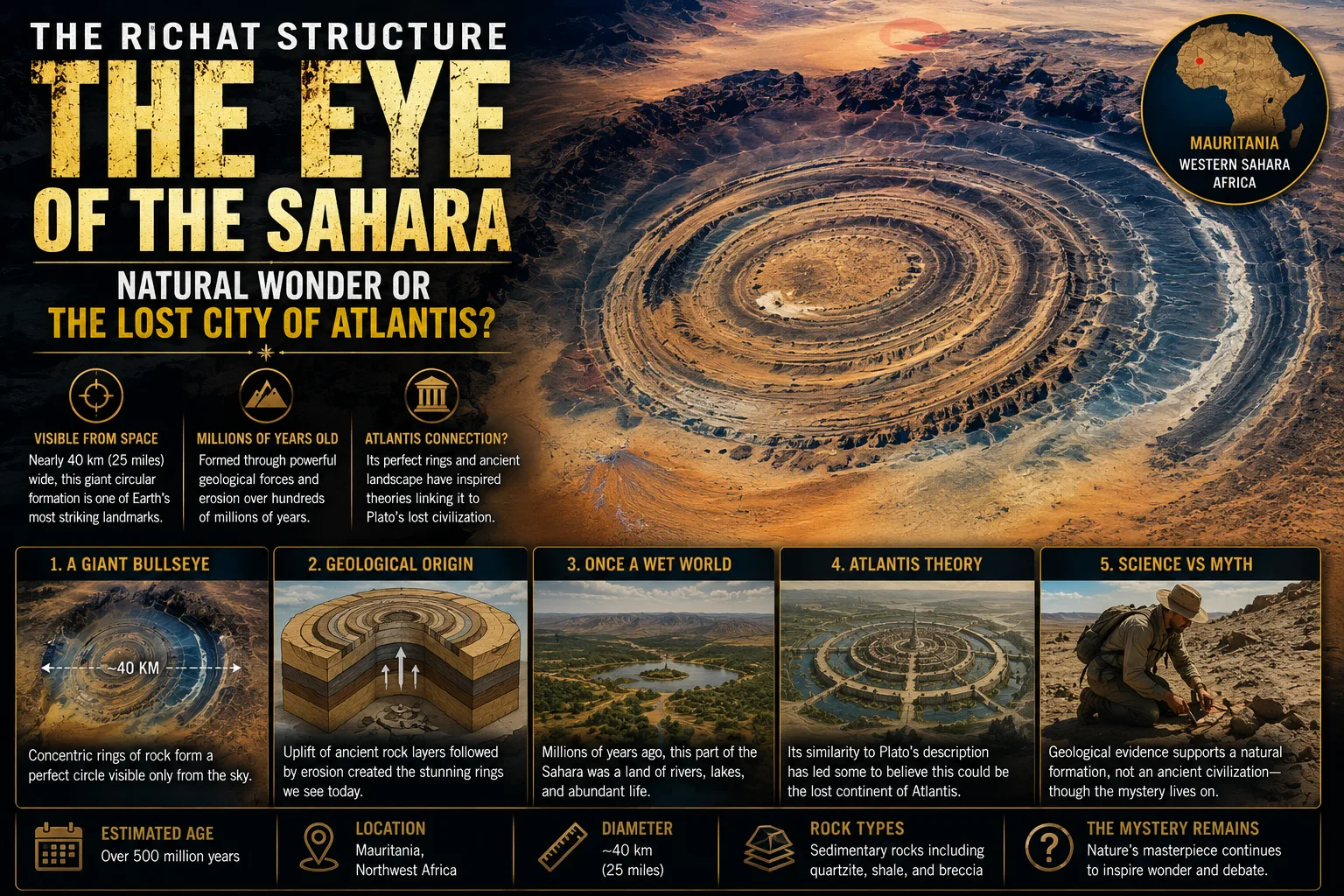
Concentric rings ripple outward like the target of a giant bullseye.
The formation is so enormous that standing on the ground, you would never realize its true shape.
Only from the sky does its remarkable geometry become visible.
Spanning nearly 40 kilometers (25 miles) across, it has become one of the Sahara's most recognizable landmarks.
Astronauts even use it as a natural navigation marker while orbiting Earth.
Known as the Richat Structure, or more famously the Eye of the Sahara, it has fascinated scientists for decades.
Some see nothing more than an extraordinary geological formation.
Others believe it could be the remains of Plato's legendary Atlantis.
The truth lies somewhere between breathtaking geology and enduring myth.
A Discovery From Above
Unlike most famous archaeological sites, the Richat Structure was never hidden beneath the ground.
It was simply too large to recognize.
Early explorers traveling across the Sahara saw only isolated hills and rocky ridges.
No one could appreciate the complete pattern from ground level.
Everything changed during the twentieth century.
As aircraft began crossing the Sahara and satellites later photographed Earth from space, researchers noticed an enormous circular formation unlike anything they had seen before.
The Richat Structure quickly became one of the world's most recognizable geological landmarks.
🟢 Established Scientific Evidence
The Richat Structure is located in Mauritania, in western Africa, and measures approximately 40 kilometers (25 miles) in diameter. Its immense size makes its circular pattern visible primarily from aircraft and space.
Why Is It Called the Eye of the Sahara?
The nickname is obvious from above.
The alternating rings of rock resemble the iris of a gigantic eye staring into space.
The effect becomes even more striking in satellite images.
Different layers of rock weather at different rates.
Harder layers remain elevated.
Softer layers erode away.
Over millions of years, this process created a series of concentric circular ridges that give the Richat Structure its unmistakable appearance.
Nature accidentally produced one of Earth's most beautiful geometric landscapes.
The First Theory: A Giant Meteor Impact
When scientists first studied the Richat Structure, one explanation seemed obvious.
A meteorite.
Large impact craters often produce circular formations.
The Richat Structure certainly looked like one.
For years, many researchers believed a massive asteroid had slammed into Earth here millions of years ago.
The idea was reasonable.
Until geologists looked more closely.
They found something missing.
What Scientists Didn't Find
Meteor impacts leave behind unmistakable evidence.
Researchers typically expect to discover:
Shocked quartz.
Melted rock.
Impact glass.
Fractured minerals formed under enormous pressure.
At the Richat Structure...
These signatures were largely absent.
Without them, the impact theory became increasingly difficult to support.
Scientists had to search for another explanation.
🟢 Established Scientific Evidence
Most geologists no longer consider the Richat Structure to be an impact crater because it lacks the characteristic geological evidence normally produced by large meteorite collisions.
A Geological Mystery
Modern research paints a far more complex picture.
Rather than forming from a violent collision, the Richat Structure appears to be the result of geological processes acting over immense spans of time.
The rocks within the formation were originally laid down as nearly horizontal layers.
Later, deep underground forces pushed portions of these rocks upward into a broad dome.
Over millions of years, wind and water gradually eroded the uplifted layers.
Because different rock types resist erosion differently, the landscape slowly developed into the striking concentric rings visible today.
It wasn't created overnight.
It was sculpted by nature over hundreds of millions of years.
Still Not Fully Understood
Although geologists broadly agree on the general process, important questions remain.
Researchers continue investigating:
Why the uplift became so circular.
The role of ancient volcanic activity.
Whether hydrothermal fluids altered parts of the structure.
How erosion produced such remarkable symmetry.
In other words...
Scientists understand much more than they once did.
But the Richat Structure still holds geological secrets.
🟡 Active Geological Research
Most geologists interpret the Richat Structure as an eroded geological dome created through uplift and long-term erosion. Researchers continue studying the precise combination of tectonic, volcanic, and erosional processes that produced its unusually symmetrical appearance.
Then Came Atlantis
For thousands of years, Plato's story of Atlantis has inspired explorers searching for a lost civilization.
According to his writings, Atlantis featured:
Concentric rings.
Circular waterways.
A large central area.
An advanced society.
A catastrophic destruction.
When satellite images of the Richat Structure became widely available...
Some people noticed a striking resemblance.
Could the Eye of the Sahara be the long-lost Atlantis?
It is an intriguing idea.
It is also one that requires extraordinary evidence.
🔴 Popular Myth / Unsupported Claim
The Richat Structure is frequently claimed to be the location of Plato's Atlantis. However, there is no archaeological evidence of an ancient city within the formation, and mainstream historians and geologists do not accept this identification.
Why Do People Connect the Richat Structure to Atlantis?
Among all the theories surrounding the Eye of the Sahara, none has captured the public imagination more than Atlantis.
The idea became especially popular after satellite imagery made the Richat Structure widely visible.
Its enormous concentric rings seemed to resemble Plato's famous description.
Videos, documentaries, and online discussions quickly asked the same question:
Could this be the lost city that philosophers have searched for for over two thousand years?
To answer that, we first need to understand what Plato actually wrote.
Plato's Description of Atlantis
The only detailed ancient account of Atlantis comes from the Greek philosopher Plato, in two dialogues written around 360 BCE: Timaeus and Critias.
According to Plato, Atlantis was:
A powerful island civilization.
Located beyond the "Pillars of Heracles" (generally identified as the Strait of Gibraltar).
Built with alternating concentric rings of land and water.
Rich in natural resources.
Destroyed by earthquakes and floods in a single day and night.
These writings have inspired centuries of speculation.
The problem is that historians still debate whether Plato intended Atlantis as real history, political philosophy, or an allegorical story.
🟢 Established Historical Evidence
Plato's Timaeus and Critias are the earliest known sources describing Atlantis. No earlier historical records of the civilization have been discovered.
Why the Richat Structure Looks Convincing
Supporters of the Atlantis theory point to several similarities.
The Richat Structure has:
Concentric circular rings.
A large central region.
An immense overall size.
Evidence that the surrounding environment was once much wetter than today's Sahara.
Millions of years ago, this part of Africa looked dramatically different.
Instead of endless dunes, the region experienced rivers, lakes, and abundant vegetation during several wetter climatic periods.
Some proponents argue that these ancient landscapes better match Plato's description than the modern desert.
At first glance, the comparison is certainly intriguing.
The Problems With the Theory
Once archaeologists examine the evidence, however, serious challenges appear.
If the Richat Structure had once supported a highly advanced city, researchers would expect to find evidence such as:
Monumental architecture.
Building foundations.
Roads.
Large-scale human settlements.
Artifacts.
Tools.
Pottery.
Written inscriptions.
To date...
None of this has been found within the Richat Structure itself.
Archaeological surveys have identified evidence of prehistoric human activity in the wider region, but not the remains of a lost advanced civilization occupying the concentric rings.
🟢 Established Scientific Evidence
Although prehistoric people lived in parts of the Sahara during wetter periods, no archaeological evidence has demonstrated that the Richat Structure itself was the site of a large ancient city comparable to Plato's Atlantis.
Nature Can Create Remarkable Geometry
One reason the Atlantis theory remains persuasive is that the Richat Structure simply doesn't look natural.
But appearances can be deceptive.
Earth produces many astonishing geometric formations through entirely natural processes.
Examples include:
Giant basalt columns at Giant's Causeway.
Hexagonal salt flats.
Perfect volcanic calderas.
Circular sinkholes.
Layered rock domes.
The Eye of the Sahara joins this remarkable list.
Its symmetry is unusual.
It is not unique proof of human construction.
Why Astronauts Love It
Ironically, the Richat Structure became famous not because of archaeologists...
But because of astronauts.
Unlike mountains or rivers, the Eye of the Sahara stands out dramatically from orbit.
Its enormous concentric rings provide an unmistakable landmark across the otherwise uniform desert.
For decades, astronauts aboard spacecraft have used it as a convenient visual reference while passing over northwest Africa.
Few natural landmarks on Earth are as instantly recognizable from space.
🟡 Active Geological Research
Scientists continue studying the Richat Structure to better understand its uplift history, erosion patterns, and mineral composition. While the broad geological explanation is well supported, researchers are still refining the details of how such an unusually symmetrical formation evolved.
Common Myths
The Richat Structure has become a magnet for extraordinary claims.
Let's compare them with the evidence.
Myth: It Is Definitely Atlantis
There is no archaeological evidence proving that the Richat Structure was Plato's Atlantis.
The similarities are interesting but remain circumstantial.
Myth: It Was Built by Aliens
No evidence supports extraterrestrial involvement.
The structure consists of naturally occurring rock layers that have been extensively studied by geologists.
Myth: It Is a Giant Impact Crater
This was once a leading scientific hypothesis.
However, the absence of diagnostic impact features such as shocked quartz and widespread impact melt has led most geologists to reject this explanation.
🔴 Popular Myth / Unsupported Claim
Claims that the Richat Structure is definitive proof of Atlantis, alien engineering, or a forgotten super-civilization are not supported by archaeological or geological evidence. The site's significance lies in its extraordinary natural geology, not in evidence of a lost advanced society.
Frequently Asked Questions
Where is the Richat Structure?
It is located in Mauritania, in the western Sahara Desert of northwest Africa.
How large is it?
The structure measures approximately 40 kilometers (25 miles) across, making it easily visible from space.
Is it an impact crater?
Current scientific evidence suggests no. Most geologists interpret it as a deeply eroded geological dome rather than the result of a meteorite impact.
Is it Atlantis?
There is no credible archaeological evidence supporting this claim. While the circular shape has inspired comparisons with Plato's writings, the theory remains speculative.
Final Thoughts
The Richat Structure reminds us that nature can create landscapes so extraordinary they seem almost impossible to believe. Rising from the heart of the Sahara, its immense concentric rings have inspired scientists, explorers, and dreamers alike. From orbit, it resembles a giant eye watching over one of the harshest environments on Earth. On the ground, it is a testament to the immense geological forces that have shaped our planet over hundreds of millions of years.
Its connection to Atlantis continues to capture the imagination, but imagination alone is not evidence. So far, archaeology has uncovered no traces of the advanced city described by Plato, while geology offers a compelling explanation rooted in uplift, erosion, and deep time.
Perhaps that is what makes the Eye of the Sahara so enduringly fascinating. It sits at the crossroads of science and legend, inviting us to ask bold questions while reminding us that the real history of our planet is often just as awe-inspiring as the myths we create. Sometimes the greatest mysteries are not those waiting to be solved, but those that inspire us to keep exploring.