The Lost Library of Alexandria: Did Humanity Lose Thousands of Years of Knowledge?
For centuries, the Library of Alexandria has been remembered as the greatest center of learning in the ancient world. But what truly happened to its legendary collection? Was it destroyed in a single catastrophic fire, or did centuries of political conflict slowly erase one of humanity's greatest treasures? Explore the evidence behind one of history's most enduring mysteries.
The Lost Library of Alexandria: Did Humanity Lose Thousands of Years of Knowledge?
Imagine a place where the greatest minds of the ancient world gathered under one roof.
A place where mathematicians, astronomers, physicians, philosophers, poets, and historians exchanged ideas that shaped civilization.
Shelves stretched across enormous halls, filled with scrolls collected from every corner of the known world.
Works by Greek philosophers.
Egyptian records.
Persian texts.
Babylonian astronomy.
Indian mathematics.
Early scientific observations.
Thousands upon thousands of handwritten manuscripts.
Now imagine that almost all of it disappeared.
Not copied.
Not preserved.
Simply...
Lost.
For over two thousand years, the Library of Alexandria has stood as one of history's greatest symbols of lost knowledge.
Some believe it was destroyed in a single catastrophic fire.
Others argue it slowly declined over centuries through war, politics, and neglect.
The truth is far more complex than the legend.
What is certain is this:
The Library of Alexandria once represented humanity's greatest attempt to gather all human knowledge in one place.
And today, almost nothing remains.
A City Built for Knowledge
The story begins not with the library itself, but with the city that gave it life.
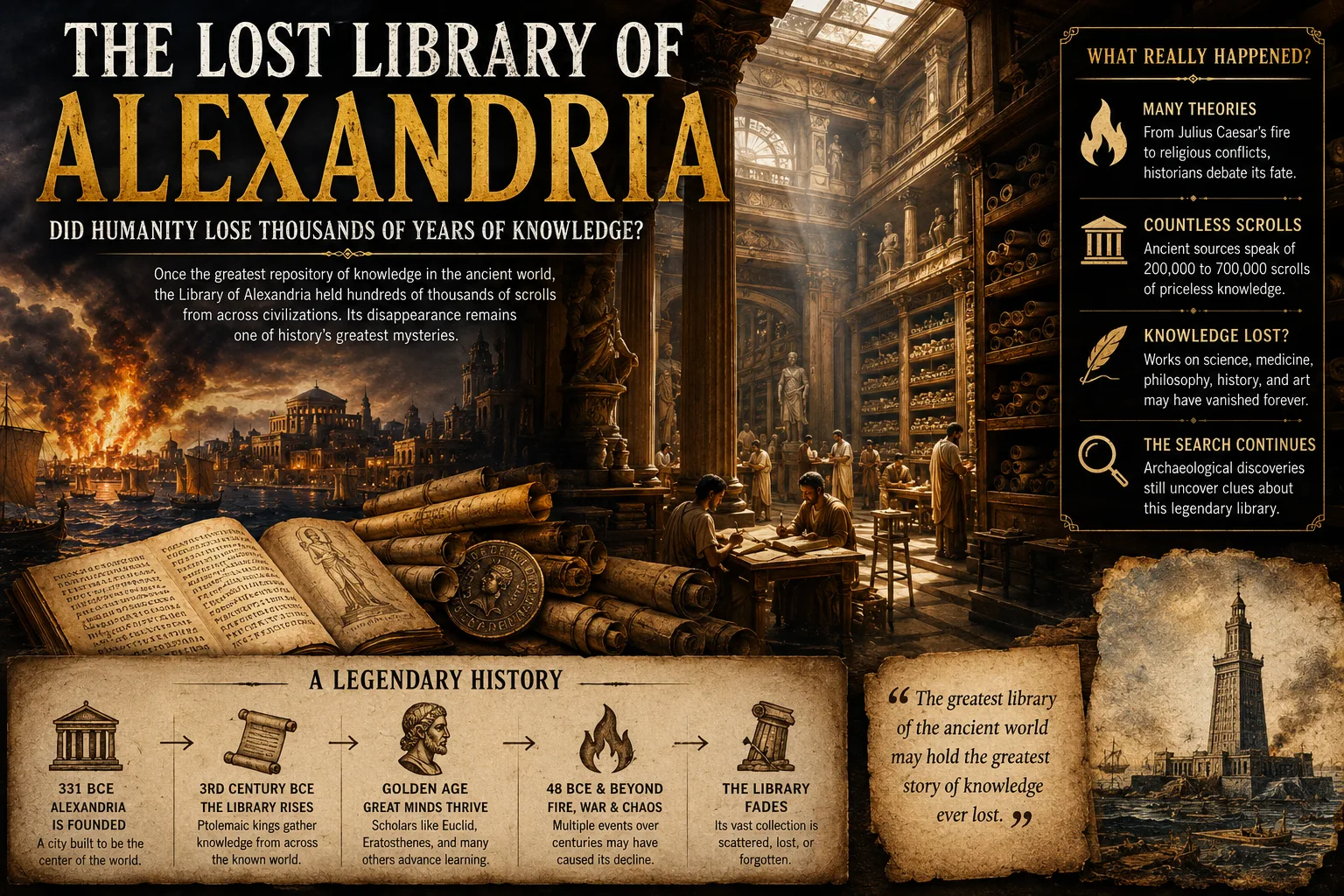
In 331 BCE, Alexander the Great founded the city of Alexandria on the Mediterranean coast of Egypt.
Although Alexander died only a few years later, his successors transformed the city into one of the greatest cultural centers of the ancient world.
Located between Africa, Asia, and Europe, Alexandria became a crossroads of civilizations.
Merchants arrived carrying goods from distant kingdoms.
Scholars arrived carrying ideas.
The city quickly grew into a center of trade, politics, science, and education unlike anything the ancient world had seen.
🟢 Established Historical Evidence
Alexandria was founded by Alexander the Great in 331 BCE and rapidly became one of the most important cities of the Hellenistic world, serving as a major center of commerce, learning, and culture.
The Dream of Collecting All Human Knowledge
Alexander's successors, particularly the Ptolemaic dynasty, shared an ambitious vision.
They wanted Alexandria to become the intellectual capital of the world.
At the heart of that vision stood an extraordinary institution:
The Library of Alexandria.
Unlike modern public libraries, this was more than a building filled with books.
It formed part of a larger scholarly complex known as the Mouseion, meaning "Temple of the Muses."
Here, scholars lived, studied, debated, taught, and conducted research supported by the royal court.
The goal was breathtakingly ambitious.
To collect every important written work known to humanity.
Building the World's Greatest Collection
Ancient rulers spared little expense.
Agents traveled across the Mediterranean purchasing manuscripts.
Ships arriving at Alexandria's harbor were reportedly searched for books.
Any scrolls found were copied by royal scribes.
The library kept the originals.
Owners received beautifully made copies in return.
Whether every such story is literally true remains uncertain.
But historical evidence leaves little doubt that the Ptolemies aggressively expanded the library's collection.
Texts arrived from:
Greece.
Egypt.
Persia.
Phoenicia.
Mesopotamia.
Anatolia.
Parts of India.
Every new manuscript strengthened Alexandria's reputation as the greatest center of learning in the ancient world.
🟢 Established Historical Evidence
Ancient sources describe systematic efforts by the Ptolemaic rulers to acquire manuscripts from across the Mediterranean. Although some stories may have been embellished over time, historians broadly agree that the library actively sought to build one of the largest collections of written works in antiquity.
How Many Scrolls Were There?
This question has fascinated historians for centuries.
Ancient writers reported astonishing numbers.
Some claimed the library housed:
200,000 scrolls.
400,000 scrolls.
Even 700,000 scrolls.
Unfortunately, these figures come from different historical sources written at different times.
Modern historians caution that exact numbers cannot be verified.
Another complication is that a single work might occupy several scrolls.
A long historical account or epic poem was often divided across multiple rolls of papyrus.
As a result, the number of scrolls does not necessarily equal the number of individual books.
Still, even conservative estimates suggest the Library of Alexandria was one of the largest collections of written knowledge anywhere in the ancient world.
More Than Just Books
The Library of Alexandria was not simply a place where texts were stored.
It functioned as one of history's earliest research institutions.
Scholars worked there on subjects including:
Mathematics.
Astronomy.
Geography.
Medicine.
Philosophy.
Engineering.
Literature.
Linguistics.
Some of the greatest thinkers of the ancient world were associated with Alexandria.
Among them was Eratosthenes, who estimated the circumference of the Earth with remarkable accuracy using shadows and geometry.
Another was Euclid, whose work Elements became one of the most influential mathematics books ever written.
Alexandria wasn't preserving knowledge.
It was creating it.
🟢 Established Historical Evidence
The Library and Mouseion attracted many of the ancient world's leading scholars, contributing significantly to mathematics, astronomy, geography, literature, and medicine during the Hellenistic period.
A Legend Is Born
As the centuries passed, the Library of Alexandria became more than an institution.
It became a symbol.
A symbol of humanity's desire to understand the world.
But it also became the center of one of history's greatest mysteries.
If the library truly contained so much knowledge...
What happened to it?
Most people know a simple story.
They imagine a single night.
A massive fire.
Thousands of scrolls consumed by flames.
Civilization losing irreplaceable knowledge in one catastrophic event.
It is a dramatic story.
It is also almost certainly an oversimplification.
The real history appears to be far more complicated.
🔴 Popular Myth / Unsupported Claim
A common belief holds that the entire Library of Alexandria was destroyed in a single fire on a single day.
Most modern historians reject this simplified narrative. Evidence suggests the library likely experienced multiple periods of damage, decline, and political upheaval over several centuries rather than one definitive moment of destruction.
What Really Happened to the Library?
For centuries, one question has overshadowed every discussion about Alexandria.
Who destroyed the Library?
The answer depends on whom you ask.
Roman historians.
Byzantine writers.
Medieval chroniclers.
Modern archaeologists.
Each offers a different piece of the puzzle.
The challenge is that many surviving accounts were written decades or even centuries after the events they describe, making absolute certainty impossible.
Rather than one clear culprit, historians now believe the Library's disappearance may have been the result of several destructive episodes spread across hundreds of years.
Theory 1: Julius Caesar's Fire
The most famous theory begins in 48 BCE.
Julius Caesar arrived in Alexandria during a civil war between the Egyptian rulers Cleopatra VII and her brother Ptolemy XIII.
Trapped inside the city, Caesar ordered parts of the harbor set on fire to prevent enemy ships from capturing his fleet.
The flames spread.
Ancient writers later claimed that warehouses, docks, and nearby buildings were destroyed.
Some accounts suggest the fire reached collections of books associated with the Library.
Others make no mention of the Library at all.
This has fueled centuries of debate.
Did Caesar accidentally destroy the world's greatest library?
Or were only nearby storage buildings affected?
🟡 Historical Hypothesis
Many historians believe Caesar's campaign likely damaged part of Alexandria's book collections, but there is little convincing evidence that it completely destroyed the Library itself. Several later historical references suggest scholarly activity continued in Alexandria after Caesar's lifetime.
Theory 2: Slow Decline Under Roman Rule
Another explanation is less dramatic but perhaps more realistic.
Institutions survive only if they receive funding.
For generations, the Ptolemaic kings generously supported scholars, maintained buildings, and expanded the library's collection.
After Egypt became part of the Roman Empire, political priorities gradually changed.
Royal patronage declined.
Economic pressures increased.
Wars repeatedly disrupted the city.
Over time, fewer resources may have been available to preserve such an enormous institution.
Instead of one catastrophic disaster, the Library may simply have deteriorated over centuries.
Theory 3: Religious Conflict
By the fourth century CE, the Roman Empire had undergone profound religious transformation.
Christianity became the empire's dominant religion.
Some pagan temples were closed or repurposed.
One important scholarly center in Alexandria, the Serapeum, was destroyed in 391 CE after orders connected with Emperor Theodosius I.
Because the Serapeum housed a collection of books and was associated with learning, some later writers connected its destruction with the fate of the Library.
However, historians continue to debate exactly how much of the original Alexandrian collection, if any, still existed there by that time.
🟢 Established Historical Evidence
The Serapeum of Alexandria was destroyed in 391 CE during religious conflict. Whether it still contained significant portions of the original Library of Alexandria remains uncertain.
Theory 4: The Arab Conquest
One of the most widespread stories claims that when Muslim forces captured Alexandria in 642 CE, Caliph Umar ordered the remaining books burned.
The famous quotation often attributed to him states:
If the books agree with the Qur'an, they are unnecessary. If they disagree, they should be destroyed.
It is a dramatic story.
There is one major problem.
No contemporary source mentions it.
The earliest versions appear centuries after the conquest, making them highly unreliable.
Most modern historians reject this account as a later legend rather than established history.
🔴 Popular Myth / Unsupported Claim
The claim that Caliph Umar ordered the destruction of the Library is not supported by contemporary historical evidence. Most historians consider this story a much later tradition rather than a reliable account of actual events.
Did Humanity Lose Irreplaceable Knowledge?
This is perhaps the most emotional question surrounding Alexandria.
What exactly disappeared?
The honest answer is:
No one knows.
Many ancient works survive only because later scholars copied them elsewhere.
Others vanished completely.
Among the losses may have been:
Historical records.
Scientific observations.
Philosophical writings.
Plays.
Poetry.
Medical texts.
Mathematical treatises.
Some ancient authors are known only through brief quotations preserved by later writers.
Entire books mentioned by classical historians have simply disappeared from history.
Whether they were lost in Alexandria or elsewhere cannot always be determined.
Could Ancient Science Have Been More Advanced?
Popular documentaries sometimes suggest the Library contained technologies centuries ahead of their time.
There is little evidence for such extraordinary claims.
Ancient scholars certainly achieved remarkable things.
They accurately estimated Earth's circumference.
Developed sophisticated geometry.
Studied anatomy.
Mapped stars.
Built complex mechanical devices such as the Antikythera Mechanism.
But historians caution against imagining the Library as a storehouse of forgotten super-technology.
Its greatest value lay not in hidden inventions but in preserving and sharing the accumulated knowledge of many civilizations.
🟢 Established Historical Evidence
Ancient scholars working in Alexandria made lasting contributions to mathematics, astronomy, geography, medicine, and literature. However, there is no credible evidence that the Library contained lost technologies far beyond the scientific capabilities of its era.
Are We Still Finding Clues?
Modern Alexandria is a thriving city built atop much of the ancient one.
That creates a difficult challenge for archaeologists.
Many ancient structures now lie beneath roads, buildings, and neighborhoods.
Excavations continue whenever possible.
Researchers have uncovered:
Ancient lecture halls.
Public buildings.
Residential districts.
Harbor structures.
Artifacts connected to Hellenistic Alexandria.
Although no excavation has definitively identified the main Library building, each new discovery improves our understanding of the city's intellectual landscape.
The search is far from over.
Frequently Asked Questions
Was the Library destroyed in one fire?
Probably not.
Most historians believe its decline resulted from multiple events over several centuries, including warfare, political instability, reduced funding, and changing religious and cultural circumstances.
How many books were in the Library?
Ancient estimates vary widely, ranging from approximately 200,000 to 700,000 scrolls. The exact number is unknown.
Has the Library ever been rebuilt?
Not in its original form.
However, the modern Bibliotheca Alexandrina, opened in 2002, was created to honor the spirit and legacy of the ancient Library as a major international center for learning and culture.
Is the mystery solved?
Not entirely.
Historians broadly agree that the Library existed and became one of antiquity's greatest centers of knowledge. They continue to debate the precise sequence of events that led to its disappearance.
Final Thoughts
The mystery of the Library of Alexandria endures not because we lack evidence that it existed, but because we cannot reconstruct exactly how one of humanity's greatest centers of learning faded from history. Rather than a single dramatic night of flames consuming every scroll, the evidence points toward a slower and more complex story shaped by war, political upheaval, economic decline, and changing cultural priorities.
Perhaps the greatest loss was not a secret invention or forgotten machine. It was the countless voices of the ancient world. Historians, poets, physicians, philosophers, astronomers, and mathematicians whose works were never copied simply vanished from the historical record. We often know they existed only because another writer briefly mentioned their names.
The Library of Alexandria reminds us that knowledge is fragile. Civilizations rise, ideas flourish, and remarkable discoveries are made, but preserving them requires constant effort. Every manuscript copied, every archive protected, and every generation willing to learn becomes part of a chain stretching across thousands of years.
In that sense, the true legacy of Alexandria is not the mystery of how it disappeared. It is the enduring reminder that humanity's greatest achievements are measured not only by what we discover, but also by what we choose to preserve for those who come after us.