How Great Thinkers Solve Complex Problems
Great problem-solvers don't necessarily know every answer. They know how to break complicated problems apart, question assumptions, identify patterns, and work toward solutions systematically.
How Great Thinkers Solve Complex Problems
Complex problems rarely arrive neatly labeled.
They arrive as a mess.
A business isn't growing, but nobody knows why.
A city has traffic congestion despite building more roads.
A student studies for hours but remembers very little.
A company launches a product that customers apparently don't want.
A scientific experiment produces a result nobody expected.
A family argues about the same issue for years without solving it.
The obvious temptation is to attack the problem immediately.
Find an answer.
Try a solution.
Fix the most visible symptom.
Move on.
Great problem-solvers tend to do something different.
They slow down.
They ask what the problem actually is.
Then they break it apart.
They question assumptions.
They separate facts from interpretations.
They look for relationships between seemingly unrelated factors.
They test ideas.
And, perhaps most importantly, they remain willing to discover that their original understanding of the problem was wrong.
That sounds simple.
It isn't.
Complex problems are difficult partly because the human brain wants simple explanations.
We prefer:
One cause.
One villain.
One solution.
One satisfying conclusion.
Reality rarely cooperates.
So how do exceptional thinkers approach problems when the obvious answer isn't enough?
There are several recurring methods.
The First Rule: Define the Problem Before Solving It
This may be the most underestimated step in problem-solving.
Suppose a company says:
"Our sales are too low."
That sounds like a problem.
But it isn't specific enough.
Why are sales low?
Are there too few customers?
Are people visiting but not buying?
Are customers buying once and never returning?
Is the product poorly positioned?
Is the price wrong?
Is the sales team underperforming?
Is the company targeting the wrong market?
Or is demand strong but the company simply unable to deliver enough inventory?
The sentence "sales are low" describes an outcome.
It doesn't explain the mechanism producing the outcome.
Define the Gap
A useful way to frame a complex problem is:
Current state → desired state
Suppose a business currently generates:
$20,000/month
and wants:
$50,000/month
The problem isn't simply "make more money."
There is a measurable gap.
Now ask:
What creates the current $20,000?
How many customers?
What is the average order value?
How frequently do customers return?
What percentage of visitors purchase?
How much does customer acquisition cost?
How much inventory can the business actually fulfill?
The vague problem becomes several smaller problems.
Decomposition: Break the Monster Into Pieces
One of the most reliable approaches to complexity is decomposition.
Instead of asking:
"Why is this entire system failing?"
ask:
"What smaller components determine the outcome?"
Imagine a university wants to improve graduation rates.
Graduation depends on multiple factors:
Enrollment.
Attendance.
Course completion.
Academic performance.
Financial stability.
Student support.
Course availability.
Mental workload.
Transportation.
Family obligations.
One giant problem becomes a system of smaller variables.
Now you can investigate them individually.
Why Decomposition Works
The brain struggles with enormous, interconnected problems.
It handles smaller questions much more effectively.
Compare:
"How do we fix American healthcare?"
with:
"Why do emergency-room wait times increase on Monday mornings?"
The second question is narrower.
You can measure it.
Compare locations.
Collect data.
Identify bottlenecks.
Test interventions.
Solve one component.
Complex systems often become manageable when you reduce the size of the question.
But Don't Break the Problem Too Far
Decomposition has a danger.
You can divide a system into tiny pieces and lose the relationships between them.
Imagine analyzing traffic by studying:
Cars.
Traffic lights.
Roads.
Pedestrians.
Buses.
Intersections.
Parking.
separately.
You might miss the fact that changing one intersection simply moves congestion to the next.
That brings us to another powerful method.
Systems Thinking: Study the Relationships
A system is more than a collection of parts.
The parts interact.
Change one variable and others respond.
Raise prices.
Demand may fall.
But profit could still increase if margins improve enough.
Add more lanes.
Traffic capacity may temporarily improve.
But increased convenience can attract more drivers.
Hire more customer-service employees.
Support improves.
But operating costs rise.
The important question becomes:
"What happens when the parts interact?"
The Feedback Loop
Complex systems often contain feedback loops.
A simple positive feedback loop might look like:
More customers
→ more revenue
→ more advertising budget
→ more visibility
→ more customers
The system reinforces itself.
A negative loop might look like:
More demand
→ longer waiting times
→ dissatisfied customers
→ fewer repeat customers
→ lower demand
The problem isn't one isolated event.
It is the loop.
Why Great Thinkers Look for Loops
A simple cause-and-effect explanation says:
A causes B.
Systems thinking asks:
A causes B, B affects C, C changes A, and the cycle continues.
This is much closer to how real organizations, economies, ecosystems, and relationships behave.
The Second Rule: Question the Assumptions
Many difficult problems aren't difficult because the solution is complicated.
They're difficult because the assumptions are wrong.
Suppose you are told:
"We need more customers."
Stop.
Do you?
Maybe the company already has enough customers.
Perhaps the actual problem is:
Poor retention.
Low margins.
High refund rates.
Unprofitable acquisition.
Weak repeat purchases.
The assumption was:
More customers = better business.
That may not be true.
First-Principles Thinking
This leads to first-principles thinking.
Instead of starting with:
"How is this normally done?"
start with:
"What must fundamentally be true?"
The method involves stripping away assumptions until you reach basic facts or constraints.
Then rebuild the solution from there.
The Famous Spaceflight Example
Imagine someone says:
"Launching rockets is extremely expensive because rockets are expensive."
First-principles thinking asks:
What is a rocket actually made of?
How much do the materials cost?
How much of the total price comes from:
Manufacturing?
Testing?
Labor?
Fuel?
Infrastructure?
Launch operations?
One can then investigate whether every traditional assumption is necessary.
This style of reasoning became strongly associated with modern engineering and technology entrepreneurship.
But the underlying method is much older.
Ask "Why?" Until the Explanation Stops Being a Label
Suppose:
"The project failed."
Why?
The team missed deadlines.
Why?
The work took longer than expected.
Why?
Requirements kept changing.
Why?
Different departments had different definitions of success.
Why?
Nobody established one shared specification.
Now you've moved from:
"The team was slow."
to:
"The system lacked a common definition of the objective."
Those produce very different solutions.
Beware of Fake Explanations
Some explanations sound informative but merely rename the problem.
"The business failed because management was bad."
Okay.
What does "bad management" mean?
Poor hiring?
Bad forecasting?
Weak incentives?
Slow decisions?
Communication failures?
Excessive risk?
Inadequate technical knowledge?
A label isn't an explanation.
Great thinkers keep asking:
"What specifically caused that?"
The Third Rule: Separate Symptoms From Causes
This is one of the most important distinctions in complex problem-solving.
Suppose an employee repeatedly misses deadlines.
The symptom:
Deadlines are missed.
Possible causes:
Poor time management.
Unclear instructions.
Unrealistic workload.
Dependencies on other teams.
Insufficient skills.
Constant interruptions.
Bad project planning.
Motivation problems.
The fastest solution is often to punish the visible symptom.
The better solution is to identify the mechanism generating it.
The Medical Analogy
Doctors don't normally treat every fever as an independent disease.
Fever is a symptom.
Possible causes include:
Infection.
Inflammation.
Other medical conditions.
Treating the symptom without understanding the cause can miss the actual problem.
Good problem-solving works similarly.
The visible failure isn't necessarily the root cause.
Root Causes Are Often Multiple
People love root-cause stories.
"We found the one reason everything failed."
Complex systems rarely behave so politely.
A product might fail because:
The target market was too small.
Marketing was weak.
The product had usability issues.
Pricing was poorly chosen.
Customer support was slow.
Competitors improved.
Several small problems can interact.
This is why searching for the cause can be misleading.
You may need a network of causes.
The Fourth Rule: Think in Probabilities
Great thinkers rarely need absolute certainty.
Instead of:
"This will work."
they may think:
"This seems more likely to work given the evidence."
That distinction matters.
Most real-world problems involve uncertainty.
You don't know:
What customers will do.
How markets will change.
Whether an experiment will succeed.
What competitors will do.
How people will respond.
So the question becomes:
"What do I currently believe, and how confident am I?"
Bayesian Updating
A powerful form of probabilistic reasoning is to update beliefs when new evidence arrives.
Imagine you believe a new product has a strong chance of succeeding.
Then you conduct a small market test.
Only 2% of visitors buy.
That evidence should change your confidence.
Perhaps dramatically.
But it doesn't necessarily prove the entire idea is impossible.
Maybe the price is wrong.
Maybe the landing page is bad.
Maybe the audience is wrong.
Good thinkers update.
They don't cling to the original prediction merely because they made it.
The Ability to Say "I Was Wrong"
This sounds trivial.
It isn't.
A person's identity can become attached to an idea.
You proposed the strategy.
You defended it.
Other people trusted you.
Now evidence says it isn't working.
The psychologically easy response is:
"We just need more time."
The intellectually difficult response is:
"Our assumption was wrong."
The second response creates an opportunity to improve.
The first can turn a small mistake into an expensive one.
The Fifth Rule: Invert the Problem
Instead of asking only:
"How do I succeed?"
ask:
"What would guarantee failure?"
Then avoid those conditions.
This is inversion.
Suppose you're trying to create a successful study routine.
Instead of asking:
"What is the perfect study schedule?"
ask:
"What would make studying consistently almost impossible?"
Perhaps:
No fixed time.
No realistic workload.
Phone beside you.
No sleep.
No revision system.
No way to measure progress.
Constant multitasking.
Now the solution becomes clearer.
Remove the predictable failure mechanisms.
Inversion Is Powerful Because Avoiding Disaster Is Easier
Finding the perfect answer can be extremely difficult.
Finding obvious ways to make something fail can be much easier.
A startup doesn't need a magical formula for success to avoid:
Running out of money.
Ignoring customers.
Building something nobody wants.
Ignoring competitors.
Spending without measurement.
A student doesn't need the perfect study method to avoid:
Studying only the night before exams.
Never practicing recall.
Sleeping four hours.
Constantly switching tasks.
Avoiding difficult subjects.
Eliminating predictable failures can produce enormous gains.
The Sixth Rule: Look for Bottlenecks
In many systems, one constraint limits the whole system.
This is a bottleneck.
Imagine a factory can produce:
1,000 units of packaging per day.
But one machine can produce only:
300 units of a critical component.
Total output cannot exceed roughly 300 units through that production path.
Improving every other machine doesn't solve the problem.
You need to improve the bottleneck.
Bottlenecks Exist in Everyday Life
Imagine someone wants to become fitter.
They buy:
Supplements.
Workout clothes.
Smartwatch.
Protein powder.
Training equipment.
But they sleep five hours every night.
Sleep might be the major constraint affecting recovery and performance.
Buying another supplement doesn't address the bottleneck.
Business Bottlenecks
A company might have:
Excellent marketing.
Strong demand.
A beautiful website.
Great pricing.
But poor fulfillment.
Then fulfillment is the bottleneck.
Increasing advertising may make the problem worse because you create even more demand the system cannot satisfy.
A bottleneck can therefore turn an apparently helpful improvement into a new problem.
Find the Constraint Before Adding More Resources
This principle appears everywhere.
A restaurant with:
Many customers.
Enough food.
Enough tables.
But one slow kitchen station
doesn't need more advertising.
A student with:
Plenty of study time.
Good books.
Good notes.
But poor recall
doesn't necessarily need more resources.
A business with:
Many leads.
But poor conversion
may not need more leads.
It may need better sales processes.
More is not always the solution.
Sometimes the constraint is the real problem.
The Seventh Rule: Distinguish Correlation From Causation
This is one of the easiest ways to make a bad decision while feeling extremely scientific.
Two things happen together.
You assume one caused the other.
Imagine ice-cream sales rise when drownings rise.
Does ice cream cause drowning?
No.
Both increase during hot weather.
Temperature is a third variable influencing both.
Confounding Variables
Suppose a company introduces a new productivity app.
Employee productivity rises.
Did the app cause the increase?
Maybe.
But perhaps:
The company also hired more staff.
The workload dropped.
A major project ended.
Management changed.
A bonus was introduced.
Without controlling for alternatives, we can't confidently assign causation.
Good thinkers ask:
"What else could explain this?"
The Counterfactual Question
One of the most powerful tools is:
"What would have happened if we had not done this?"
Suppose a marketing campaign launches and sales increase.
To estimate its effect, you ideally want some comparison with what would have happened without the campaign.
That's the logic behind:
Control groups.
A/B tests.
Natural experiments.
Statistical comparisons.
Counterfactual reasoning.
Why Experiments Beat Arguments
People can debate all day.
One person says:
"This headline will perform better."
Another says:
"No, customers prefer the first version."
Both can provide reasons.
An experiment can simply test them.
Show Version A to one group.
Version B to another.
Compare outcomes.
The result won't answer every question.
But it can replace speculation with evidence.
The Eighth Rule: Use Multiple Mental Models
No single model explains everything.
A complex problem may require several.
Suppose an online business has declining profits.
Use:
Opportunity cost
What resources are being spent elsewhere?
Pareto principle
Which products actually generate most of the profit?
Bottleneck thinking
Where is the constraint?
Second-order thinking
What happens if prices or advertising change?
Inversion
What would destroy profitability?
Bayesian thinking
What new evidence should change our assumptions?
This creates a richer picture than any one framework.
Great Thinkers Switch Lenses
Imagine looking at a problem through a camera.
One lens shows the big picture.
Another shows the details.
Another shows the hidden structure.
Another reveals movement over time.
A mental model works similarly.
Good thinkers aren't necessarily people who have one brilliant way of seeing the world.
They're people who can switch perspectives.
The Ninth Rule: Ask Better Questions
Sometimes the biggest breakthrough isn't an answer.
It's a better question.
Instead of:
"How can we sell more?"
Ask:
"Why do people who visit the site fail to buy?"
Instead of:
"How can I work harder?"
Ask:
"Which part of my work actually creates results?"
Instead of:
"Why is this person difficult?"
Ask:
"What need or incentive might be driving this behavior?"
Instead of:
"Why does this always happen?"
Ask:
"Under what conditions does this happen?"
Good questions reduce the search space.
"Under What Conditions?" Is an Underrated Question
A statement such as:
"People hate change."
is too broad.
Under what conditions?
They may resist changes that threaten status.
But embrace changes that improve convenience.
People don't simply love or hate change.
Their response depends on:
Perceived cost.
Perceived benefit.
Uncertainty.
Control.
Trust.
Identity.
Timing.
Context.
Complexity becomes easier when universal statements are replaced with conditional ones.
The Tenth Rule: Think in Trade-Offs
People often search for solutions that improve everything simultaneously.
Lower cost.
Higher quality.
Faster delivery.
Better service.
Greater flexibility.
More profit.
Sometimes technology makes that possible.
Often, there are trade-offs.
Improve one dimension and another suffers.
A budget airline can reduce prices partly by reducing certain services.
A luxury hotel spends more to improve service.
A startup may move faster by accepting less bureaucracy.
A mature company may sacrifice speed for reliability.
A good solution isn't necessarily the one without costs.
It's the one where the trade-offs are acceptable.
Optimization Always Has a Constraint
Suppose you want:
Maximum speed.
Maximum safety.
Minimum cost.
Maximum customization.
You may discover that achieving all four simultaneously is impossible.
So ask:
"Which variable matters most?"
Then optimize accordingly.
That's much more useful than pretending all objectives are equally important.
The Eleventh Rule: Use Fermi Estimates
Great thinkers don't always need exact numbers immediately.
Sometimes they make rough estimates to determine whether a problem is even plausible.
These are often called Fermi estimates, named after physicist Enrico Fermi.
Suppose someone claims:
"A new U.S. city program could save $10 billion annually."
Before spending months evaluating the idea, estimate:
How many people are affected?
How much could each person realistically save?
How often?
What would implementation cost?
Even rough mathematics can expose impossible assumptions.
Approximate Before You Calculate Precisely
Suppose an online store receives:
100,000 visitors per month.
You estimate:
2% conversion.
Average order value:
$40.
Approximate monthly revenue:
100,000 × 0.02 × $40 = $80,000
You don't yet know exact revenue.
But now you know which variables matter.
Visitors.
Conversion rate.
Average order value.
Maybe repeat purchases.
The rough model reveals the structure of the problem.
Precision can come later.
The Twelfth Rule: Search for Leverage
Some actions have disproportionately large effects.
That's leverage.
A tiny change at the right point in a system can outperform enormous effort elsewhere.
Imagine a website has:
100,000 visitors.
But only 1% purchase.
Increasing traffic by 10% may add some customers.
Increasing conversion from 1% to 2% doubles the number of purchases without adding traffic.
The exact business outcome depends on implementation and economics.
But the principle is powerful:
Find the variable where a small improvement produces a large effect.
Leverage Is Everywhere
Learning a programming skill might save hundreds of future hours.
Automating a repetitive business task might remove thousands of manual actions.
Improving a product's onboarding process might increase retention across every new customer.
Improving sleep may improve:
Mood.
Attention.
Learning.
Exercise recovery.
Decision-making.
One intervention can influence multiple outcomes.
The highest-value move isn't always the hardest one.
The Thirteenth Rule: Think in Second-Order Effects
A decision doesn't end with its immediate consequence.
Suppose a company cuts support staff.
First-order effect:
Lower payroll.
Second-order effects:
Longer response times.
Lower customer satisfaction.
More refunds.
Worse reviews.
Lower retention.
Higher acquisition costs.
The initial savings may create later costs.
This is why great thinkers ask:
"And then what?"
Then ask again.
Second-Order Thinking in Personal Life
Suppose someone decides to stop exercising to gain more study time.
Immediate result:
More study hours.
Second-order possibility:
Less energy.
Worse sleep.
Lower concentration.
Reduced mood.
Eventually poorer study efficiency.
The decision may still be correct in a particular situation.
But the consequences need to be considered beyond the first step.
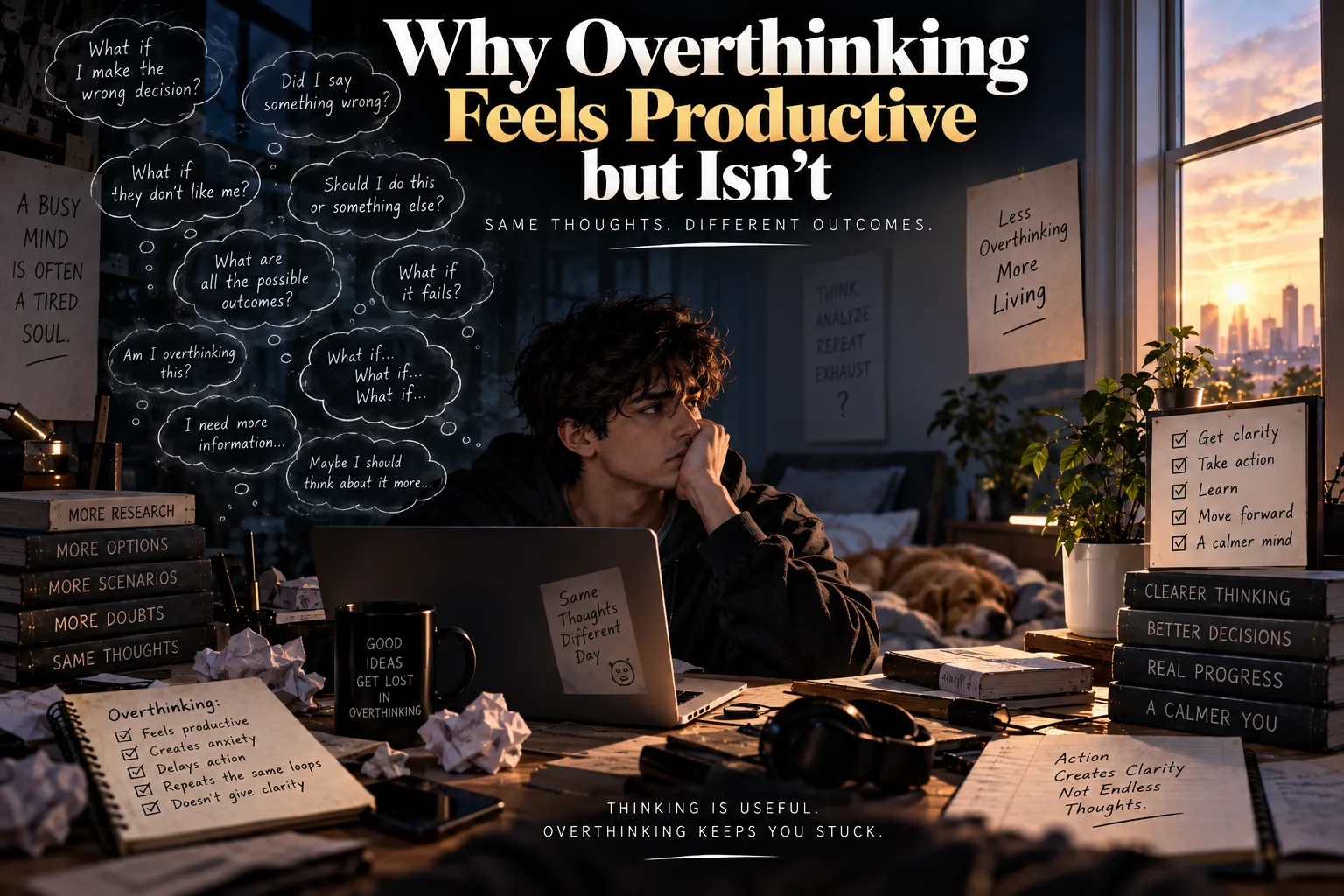
The Fourteenth Rule: Know When to Stop Analyzing
This sounds strange in an article about great thinkers.
But endless analysis can become another form of failure.
At some point:
More information costs time.
The remaining uncertainty cannot be eliminated.
The decision is reversible.
Further research produces diminishing returns.
That's when action becomes more valuable than additional thought.
Great thinkers aren't people who analyze forever.
They know when the evidence is good enough to act.
Decision Quality Is Not the Same as Outcome
This is crucial.
Suppose you make a careful decision based on good information.
The unlikely bad outcome happens.
That doesn't automatically mean the decision was bad.
Likewise, a reckless decision can produce an excellent result by chance.
A gambler can win.
That doesn't make the strategy sound.
Separating process from outcome protects you from learning the wrong lesson.
The Fifteenth Rule: Run Small Experiments
When possible, don't make a giant irreversible bet based on an untested assumption.
Test cheaply.
Suppose you're considering launching a product.
Instead of ordering:
10,000 units
immediately, perhaps test demand with:
A small batch.
A prototype.
A landing page.
Preorders.
Customer interviews.
A limited launch.
The specific method depends on the business.
The principle is:
Buy information before buying massive quantities of risk.
Experiments Reduce Uncertainty
Suppose you aren't sure whether customers prefer:
Option A
or
Option B.
You can argue.
Or you can test them.
Suppose you're unsure whether people will use a feature.
Prototype it.
Suppose you're unsure whether a study technique works for you.
Test it under controlled conditions.
Action can generate evidence that thought alone cannot.
The Difference Between Exploration and Execution
Early in a problem, uncertainty is high.
Exploration matters.
Later, once the major uncertainties are resolved, execution matters more.
A common mistake is staying in exploration forever.
Research.
Compare.
Analyze.
Research more.
Eventually, the decision becomes a habit of postponement.
Good problem-solvers shift modes.
Explore → decide → execute → measure → revise.
That loop is far more powerful than endless preparation.
Feedback Is What Turns Action Into Learning
Action alone isn't enough.
You need feedback.
Suppose you change a website.
Sales increase.
What caused the improvement?
If you don't measure anything, you may not know.
Then you can't reproduce the success.
A strong problem-solving cycle is:
Hypothesis
What do we think is happening?
Intervention
What will we change?
Measurement
What happened?
Update
What does the result tell us?
Iteration
What should we try next?
This is essentially scientific thinking applied to everyday problems.
What Great Thinkers Do Differently
They don't necessarily think faster.
They often:
Define problems more precisely.
Break complexity into manageable pieces.
Look at systems rather than isolated events.
Question assumptions.
Separate symptoms from causes.
Think probabilistically.
Use experiments.
Consider second-order effects.
Search for bottlenecks.
Look for leverage.
Update when evidence changes.
And remain comfortable saying:
"I don't know yet."
That last ability may be more important than it sounds.
The Greatest Advantage: They Don't Fall in Love With Their Explanation
An explanation is a tool.
Not an identity.
If new evidence destroys it, replace it.
This sounds easy.
It becomes much harder when:
You spent months developing the idea.
Your team believes it.
Your reputation is attached to it.
You publicly defended it.
Money has been invested.
People are emotionally attached.
The ability to abandon a beautiful explanation when reality disagrees may be one of the clearest signs of intellectual maturity.
A Practical Framework for Any Complex Problem
When faced with a difficult problem, begin with:
1. Define the problem
What exactly is wrong?
What outcome do you want?
2. Separate facts from assumptions
What do you know?
What are you merely believing?
3. Decompose it
What smaller variables create the outcome?
4. Find the bottleneck
What constraint is limiting the system?
5. Identify causes
Which factors produce the observed symptoms?
6. Invert
What would guarantee failure?
7. Consider second-order effects
What happens after the immediate result?
8. Estimate probabilities
How confident are you?
9. Find leverage
Where could a small change create a large improvement?
10. Run the smallest useful experiment
What can you test before making a huge commitment?
11. Measure
What actually happened?
12. Update
What did reality teach you?
That is a practical problem-solving loop.
🟢 Established Evidence
Many of these techniques connect to well-developed fields:
First-principles reasoning is widely used in mathematics, science, engineering, and philosophy.
Systems thinking is used to analyze interconnected systems where feedback and interactions matter.
Experimental testing is fundamental to scientific inquiry and evidence-based decision-making.
Bayesian reasoning provides a formal framework for updating beliefs using evidence.
Fermi estimation is a recognized approach for approximating quantities when exact data isn't immediately available.
Opportunity cost, bottleneck analysis, and second-order effects are widely used concepts in economics, operations, strategy, and decision science.
They are tools, not guarantees.
🟡 Active Debate
Researchers disagree about how consistently people can apply these methods in real-world conditions.
Human decisions are affected by:
Time pressure.
Emotion.
Incomplete information.
Social incentives.
Institutional constraints.
Cognitive biases.
Different environments also reward different reasoning styles.
A model that is excellent for engineering may be much less useful for a relationship.
A model designed for financial optimization may perform poorly when the goal is meaning or emotional wellbeing.
The important skill isn't collecting frameworks.
It's matching the framework to the problem.
🔴 Popular Myth
"Great thinkers solve complex problems because they're naturally smarter."
Intelligence helps.
But complex problem-solving depends on much more than raw intelligence.
Knowledge.
Discipline.
Curiosity.
Good questions.
Feedback.
Experience.
Willingness to revise beliefs.
And the ability to recognize when your first explanation is wrong.
A brilliant person using a bad model can reach a terrible answer with extraordinary confidence.
Frequently Asked Questions
What is the most important problem-solving skill?
Defining the problem correctly is one of the most important. A poorly defined problem can make even excellent solutions irrelevant.
What is first-principles thinking?
It means reducing a problem to fundamental facts, constraints, or assumptions and rebuilding an approach from those basics rather than relying entirely on convention.
What is systems thinking?
Systems thinking examines how different parts of a system interact, including feedback loops and unintended consequences.
Why is decomposition useful?
Breaking a complex problem into smaller components makes it easier to measure, understand, and solve while reducing cognitive overload.
What is inversion?
Inversion asks what would cause failure and then works backward to avoid those conditions.
Why are bottlenecks important?
A bottleneck limits the performance of the wider system. Improving areas that aren't constrained may produce little overall improvement.
Why should decisions be made probabilistically?
Because most real-world outcomes are uncertain. Thinking in probabilities prevents false certainty and allows beliefs to be updated as evidence changes.
Why are experiments so useful?
Experiments replace some speculation with evidence. Small experiments can also reduce the cost of being wrong.
Can mental models solve every complex problem?
No. They simplify reality and help organize thinking, but they cannot remove uncertainty or guarantee correct decisions.
What makes someone a great thinker?
Not merely intelligence. Strong problem-solvers tend to combine curiosity, structured reasoning, skepticism toward assumptions, evidence-based updating, and a willingness to change their minds.
Final Thoughts
Complex problems rarely yield to one brilliant idea.
More often, they yield to a better process.
Define the problem.
Break it apart.
Find the relationships.
Question the assumptions.
Identify the bottleneck.
Separate symptoms from causes.
Estimate uncertainty.
Look for leverage.
Test small.
Measure honestly.
Update quickly.
Then repeat.
That process may sound less exciting than the myth of the lone genius suddenly having a revolutionary insight.
But history's greatest thinkers often did something much more disciplined.
They asked questions other people weren't asking.
They noticed assumptions everyone else had accepted.
They tested ideas against reality.
And when reality disagreed, they changed the idea.
That final step is the one people underestimate.
Anyone can become attached to an explanation.
A great thinker can abandon one.
Because the objective isn't to prove:
"I was right."
The objective is to discover:
"What is actually happening?"
Once you know that, the solution has somewhere to begin.