Why Overthinking Feels Productive but Isn't
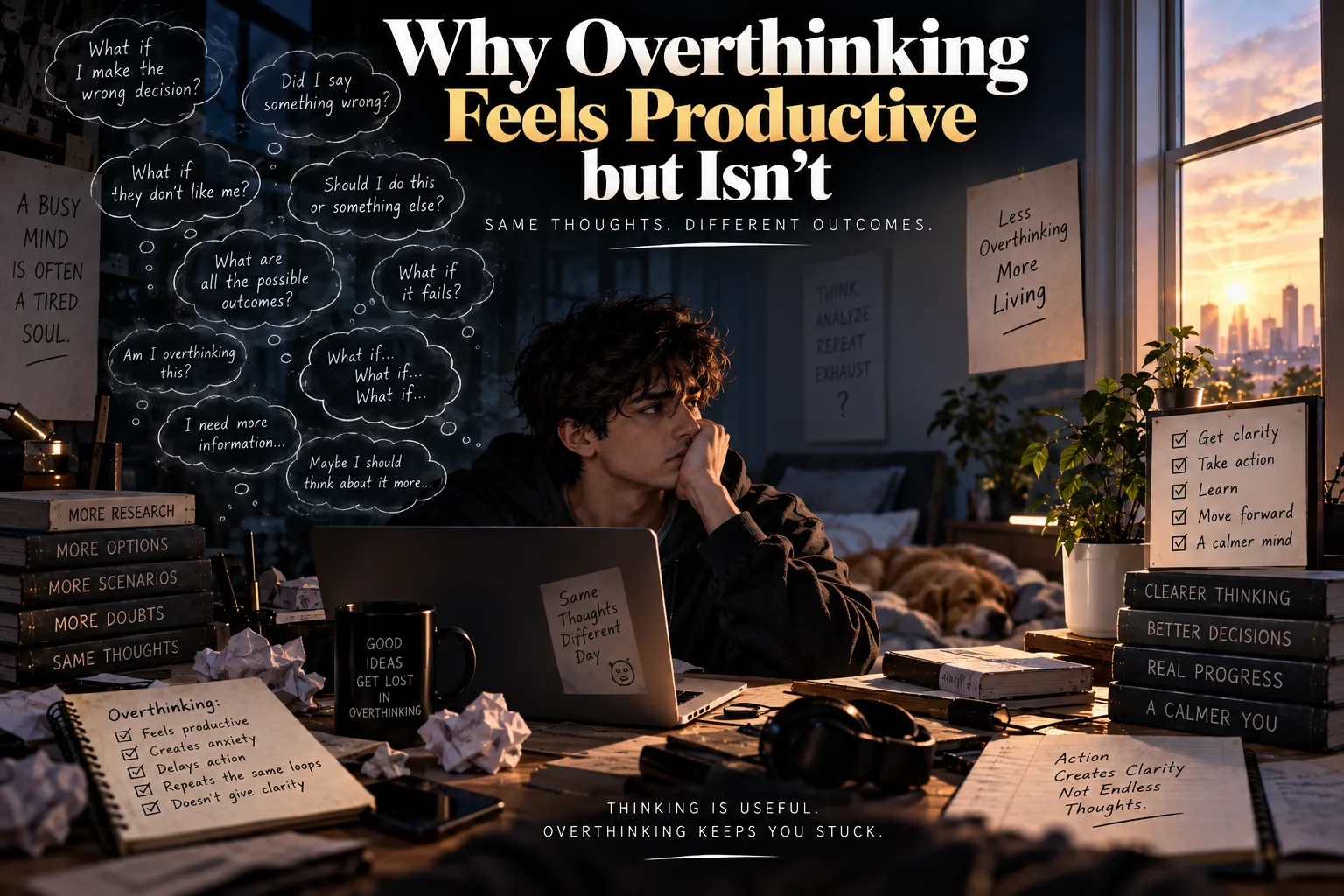
Overthinking can feel like careful problem-solving, but repeatedly analyzing the same possibilities often creates the illusion of progress without producing action, clarity, or better decisions.
Why Overthinking Feels Productive but Isn't
You have a decision to make.
You think about it.
Then think about it again.
You imagine one outcome.
Then another.
You replay a conversation.
You construct possible future conversations.
You search for more information.
You ask yourself what could go wrong.
Then you wonder whether you're thinking too much.
So you analyze that.
At the end of three hours, something remarkable has happened:
You have thought about the problem a lot.
And yet the problem is still sitting there.
This is the strange psychology of overthinking.
It feels like work because your brain is active.
You're analyzing.
Comparing.
Predicting.
Reviewing.
Planning.
But mental activity isn't automatically productive activity.
Sometimes thinking moves you toward an answer.
Sometimes it simply moves around the same question repeatedly.
The distinction is subtle enough that humans can spend an entire evening confusing mental effort with progress.
Thinking and Overthinking Are Not the Same Thing
Thinking is necessary.
You need it to solve problems, evaluate risks, understand people, plan the future, and make decisions.
Overthinking begins when additional thinking stops producing useful new information.
You ask:
"What should I do?"
Then generate ten possibilities.
Then twenty.
Then imagine what could happen after each possibility.
Then reconsider the original assumptions.
Then generate another possibility.
The number of thoughts increases.
The quality of the decision doesn't necessarily improve.
The Illusion of Progress
Your brain tends to associate effort with productivity.
If something feels difficult, you may assume you're accomplishing something.
This is true for physical work.
It becomes less reliable for mental work.
Imagine spending an hour rearranging the same spreadsheet cells without changing the underlying analysis.
You're busy.
But you're not moving forward.
Overthinking can work exactly like that.
The mind is moving constantly.
The problem isn't.
Rumination vs. Problem-Solving
This is one of the most important distinctions.
Problem-solving
What is the problem?
What information do I need?
What options do I have?
Which option best fits the evidence?
What action can I take?
Rumination
Why did this happen?
What if I had done something different?
What if it happens again?
Why am I like this?
What if they secretly meant something else?
What if I'm missing something?
The first process tends to move toward action.
The second can keep generating questions without resolution.
Why Rumination Feels So Serious
Rumination often focuses on important subjects.
Your career.
Relationships.
Money.
Health.
Mistakes.
The future.
Because the topic matters, your brain assumes continued thinking must be useful.
But importance and productivity aren't the same thing.
You can spend four hours thinking about an important problem and end the evening knowing exactly what you knew at the beginning.
Just with considerably more fatigue.
The Brain Likes Problems It Cannot Finish
A fascinating feature of unresolved questions is that they can remain mentally active.
You remember unfinished tasks.
Unanswered questions.
Unresolved conflicts.
Ambiguous social situations.
Your mind keeps returning to them because there is no satisfying conclusion.
This can create a loop:
Uncertainty → analysis → temporary relief → more uncertainty → more analysis
The thinking itself becomes part of the coping mechanism.
Uncertainty Is the Fuel
Overthinking often grows when you cannot know the answer with certainty.
Suppose you're waiting for someone to respond to an important message.
Possible explanations:
They're busy.
They're upset.
They forgot.
Their phone died.
They need time.
They're ignoring you.
You don't know.
Your brain dislikes the gap.
So it starts filling it.
Not necessarily with facts.
With possibilities.
Possibility Is Cheap
The human brain can generate possibilities almost indefinitely.
What if...?
is an extraordinarily productive sentence.
It can produce:
10 scenarios.
50 scenarios.
500 scenarios.
The problem is that generating a possibility doesn't make it probable.
And generating more possibilities doesn't necessarily bring you closer to the truth.
The Difference Between Possibility and Probability
Imagine you are preparing for a trip.
Almost anything is technically possible.
Your flight could be delayed.
Your hotel could lose your reservation.
Your luggage could disappear.
A storm could arrive.
Your phone could break.
You could accidentally meet a famous actor.
A meteor could hit the airport.
The fact that all of these are possible does not mean they deserve equal attention.
Good decision-making asks:
How likely is this?
Overthinking often asks:
Can I imagine this?
Those are very different questions.
Why More Analysis Doesn't Always Create More Certainty
Suppose you are deciding whether to accept a job offer.
You research:
Salary.
Benefits.
Commute.
Company reviews.
Industry trends.
Promotion possibilities.
Management structure.
Long-term career implications.
That can be useful.
Then you keep researching.
Another review.
Another Reddit thread.
Another article.
Another opinion.
Eventually, new information stops meaningfully changing the decision.
You're no longer gathering evidence.
You're seeking certainty.
And certainty may not exist.
Analysis Can Become Avoidance
This is one of the most useful ways to understand overthinking.
Sometimes thinking isn't being used to solve the problem.
It's being used to avoid the discomfort of acting.
As long as you're analyzing:
You haven't chosen.
As long as you haven't chosen:
You haven't failed.
As long as you haven't acted:
You can still imagine a perfect outcome.
Action closes possibilities.
Thinking keeps them open.
That can feel safer.
The Comfort of Staying in Your Head
Imagine someone wants to start a business.
They spend months researching:
Market size.
Competitors.
Logos.
Business names.
Websites.
Pricing.
Marketing strategies.
Potential customers.
Every question leads to another.
Research feels responsible.
And sometimes it is.
But eventually, there is a point where the only useful next step is:
Talk to a customer.
That introduces something thinking cannot provide.
Reality.
Reality Produces Information Faster Than Endless Speculation
You can predict how customers might respond.
Or you can actually ask them.
You can imagine whether an exercise program will work for you.
Or you can test it.
You can endlessly analyze whether someone likes your idea.
Or you can ask.
Action creates new evidence.
Overthinking often creates more hypothetical worlds.
The Fear of Making the Wrong Decision
At the center of many overthinking loops is a hidden assumption:
There is a perfect decision, and I need to find it before acting.
But many real decisions don't have perfect answers.
They have:
Better options.
Worse options.
Trade-offs.
Uncertainty.
Incomplete information.
Potential consequences.
You make the best judgment available.
Then you adjust.
Reversible Decisions Need Less Thinking
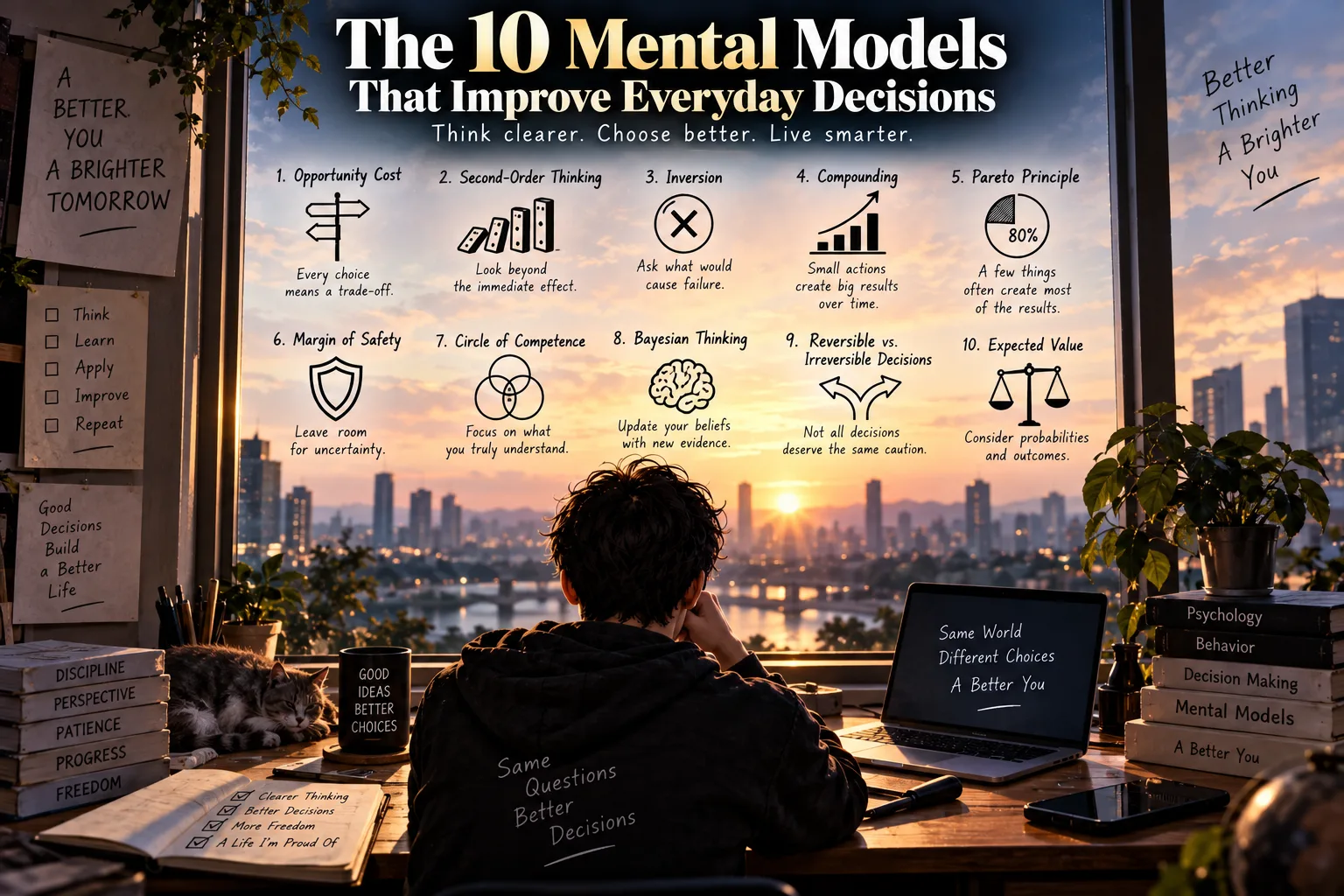
This connects to one of the mental models from the previous article.
If a decision is easy to reverse, endless analysis is often unnecessary.
Trying a different productivity app?
You can switch.
Testing a new marketing strategy?
You can stop it.
Choosing a restaurant?
Humanity has somehow survived this decision for millennia.
The more reversible the choice, the less useful perfectionism becomes.
Irreversible Decisions Deserve More Deliberation
Some choices are different.
A major career change.
Large financial commitments.
Long-term contracts.
Moving to another country.
These decisions can justify extensive analysis.
But even here, overthinking eventually stops being useful.
At some point, you reach the boundary of available information.
Beyond that boundary, you're no longer improving the decision.
You're trying to eliminate uncertainty itself.
Humans have yet to invent that feature.
Why Overthinking Gets Worse at Night
Many people notice that difficult thoughts become louder late at night.
There are several plausible reasons.
You're tired.
There are fewer distractions.
Emotional regulation can become harder.
Problems that felt manageable during the day suddenly receive your full attention.
The environment becomes quiet.
And your brain decides that 2:17 AM is the perfect time to reopen that conversation from four years ago.
Fatigue Changes the Quality of Thinking
Sleep deprivation can impair attention, working memory, emotional regulation, and decision-making.
This matters because overthinking often depends on exactly those systems.
When you're tired, you may:
Interpret ambiguity negatively.
Become more emotionally reactive.
Have difficulty stopping repetitive thoughts.
Make less flexible decisions.
So the attempt to "think until I solve this" late at night can become self-defeating.
Emotional Problems Don't Always Need More Logic
Suppose you're upset because someone hurt you.
You may try to solve the emotion intellectually.
Why did they do it?
What exactly did they mean?
What does this imply?
What if you had responded differently?
Maybe the problem isn't lack of analysis.
Maybe you are hurt.
Emotions sometimes need:
Time.
Conversation.
Rest.
Boundaries.
Action.
Acceptance.
Not another seventeen hypothetical scenarios.
Why Replaying Conversations Feels Useful
After an awkward interaction, people often replay it.
"Why did I say that?"
"Why did they pause?"
"Did that sound stupid?"
"What did they actually mean?"
The brain is searching for information.
But if the event is over and no new evidence exists, repeated replay cannot magically reveal hidden facts.
It can only generate more interpretations.
The Spotlight Effect
People often overestimate how much other people notice their behavior.
You remember your embarrassing moment because it happened to you.
Everyone else has their own embarrassing memories occupying their attention.
This is related to the spotlight effect.
You may spend an evening replaying one awkward sentence.
The other person may have forgotten it before reaching their car.
Human consciousness is egocentric in the most literal sense.
Everyone is starring in their own movie.
You're a supporting character in theirs.
Overthinking and Perfectionism
Perfectionism can create especially strong overthinking loops.
If the goal is:
"Make the right choice."
you can stop once the evidence is sufficient.
If the goal is:
"Make the perfect choice."
you can continue forever.
There is always:
One more article.
One more comparison.
One more possibility.
One more revision.
Perfectionism quietly changes a decision from:
Good enough to act on
into:
Impossible to finalize.
Why Smart People Can Overthink More
More cognitive ability does not automatically create better decisions.
It gives you the ability to generate more possibilities.
That can be useful.
But it can also make the mental loop more elaborate.
Someone who can think of:
Five explanations
may stop.
Someone who can think of:
Fifty explanations
may become paralyzed.
More mental horsepower can produce more sophisticated uncertainty.
Again, intelligence isn't the same thing as decision quality.
When Thinking Becomes a Substitute for Action
This is the central problem.
Thinking can create the feeling of control.
You're doing something.
You're engaged.
You're analyzing.
You're not helpless.
But the important question is:
"What changed because I thought about this?"
If the answer is:
"Nothing."
then more thinking may not be the missing ingredient.
A Useful Test: Has New Information Appeared?
Ask:
"Did I learn anything new during the last thirty minutes?"
If yes, thinking may still be productive.
If no, ask:
"Am I solving the problem or repeating it?"
This simple distinction can reveal a surprising amount.
Another Test: Can I Turn This Into an Action?
Suppose you're worried about an exam.
Thinking:
"What if I fail?"
produces no new information.
Action:
Study chapter three for 45 minutes.
That changes reality.
Suppose you're worried about your health.
Thinking:
"What if something is seriously wrong?"
produces speculation.
Action:
Arrange appropriate medical evaluation.
Again, reality changes.
Convert Anxiety Into a Concrete Next Step
Overthinking often thrives on abstract questions.
Try converting:
"What if everything goes wrong?"
into:
"What is the most useful thing I can do next?"
Not:
Everything.
Not:
The perfect solution.
Just:
Next useful action.
That reduces the problem from an infinite future to a finite present.
The Two-Minute Rule for Decisions
For small, reversible decisions, you can deliberately limit analysis.
Ask:
What do I know?
What matters most?
What are the realistic options?
Can I reverse the decision?
Then choose.
The goal isn't speed for its own sake.
It's preventing a low-stakes decision from consuming high-stakes amounts of mental energy.
Set a Decision Deadline
For decisions that genuinely require research, create a stopping point.
For example:
"I'll spend one hour researching this, then decide based on what I've learned."
Without a boundary, research expands to fill available time.
Like water.
Or browser tabs.
Mostly browser tabs.
Separate Information From Reassurance
This is especially important.
Ask:
"Am I looking for information, or am I looking for reassurance?"
Information changes what you know.
Reassurance temporarily changes how you feel.
If you keep asking the same question after receiving an answer, you may not need more information.
You may be trying to remove uncertainty completely.
And that usually isn't possible.
You Don't Need 100% Confidence
A useful decision can be made at:
60% confidence.
70%.
80%.
Sometimes even lower, depending on the decision and its reversibility.
Waiting for 100% certainty can mean waiting forever.
The goal is not:
"I know exactly what will happen."
It's:
"I have enough information to make a reasonable next move."
Overthinking Often Hides a Different Question
Sometimes the stated question is:
"What should I do?"
The deeper question is:
"Can I handle the consequences if I'm wrong?"
That is different.
A person may already know what they want to do.
What scares them is:
Failure.
Regret.
Rejection.
Embarrassment.
Loss.
Change.
So they keep analyzing the decision because the real problem is emotional risk.
The Fear of Regret
People often try to make decisions that guarantee they will never regret their choice.
Impossible.
Any meaningful decision can create regret.
You can regret:
Choosing.
Not choosing.
Leaving.
Staying.
Trying.
Not trying.
The goal isn't eliminating regret.
It is making decisions you can reasonably defend with the information you had at the time.
Good Decisions Can Still Hurt
A decision can be correct and emotionally painful.
Ending an unhealthy relationship.
Leaving a job that isn't right.
Rejecting a risky opportunity.
Setting a boundary.
Giving up a project.
Walking away from something you wanted.
Pain after a decision does not automatically mean the decision was wrong.
This is another reason emotions can keep overthinking alive.
The brain sometimes interprets discomfort as evidence that more analysis is required.
🟢 Established Evidence
Research distinguishes repetitive negative thinking, such as rumination and worry, from constructive problem-solving.
Repetitive thinking can be associated with greater emotional distress, while effective problem-solving generally involves identifying actionable steps and moving toward them.
Stress and sleep loss can also impair cognitive and emotional functioning, making clear decision-making harder.
🟡 Active Debate
Researchers continue studying exactly why some people become trapped in repetitive thought more easily than others.
Factors can include:
Personality.
Uncertainty sensitivity.
Perfectionism.
Stress.
Mood.
Past experiences.
Cognitive habits.
The relationship between worrying, rumination, anxiety, and decision-making is complex.
Not every instance of extensive thinking is harmful.
Sometimes difficult decisions genuinely require prolonged analysis.
🔴 Popular Myth
"Overthinking means you're being careful."
Sometimes.
Not always.
Careful thinking produces useful information and improves a decision.
Overthinking can produce more possibilities without improving the decision.
The key question isn't:
"How long have I thought about this?"
It's:
"Did the thinking make the decision better?"
Frequently Asked Questions
What's the difference between thinking and overthinking?
Thinking generally moves toward understanding, problem-solving, or action. Overthinking often repeats the same questions without producing meaningful new information.
Is overthinking the same as anxiety?
No. They can overlap, but anxiety is an emotional state involving fear or apprehension, while overthinking refers more broadly to repetitive or excessive mental analysis.
Why does overthinking feel productive?
Because your brain is actively working. Mental effort can create a subjective feeling of productivity even when no new information or action is being produced.
Why do I keep replaying conversations?
The brain may be attempting to resolve uncertainty, learn from social experiences, or determine what another person meant. Replaying becomes unproductive when it repeatedly generates speculation without new evidence.
Can intelligent people overthink more?
High cognitive ability doesn't automatically protect against overthinking. Greater analytical capacity can sometimes generate more possible explanations and scenarios.
Does overthinking help with important decisions?
It can, up to a point. Research and information gathering can improve decisions, but continued analysis after useful information stops accumulating can become counterproductive.
How do you stop an overthinking loop?
Identify whether you're gaining new information. Define the next actionable step, limit further research, and accept the remaining uncertainty when it cannot be eliminated.
Why is overthinking worse at night?
Fatigue, reduced distractions, emotional vulnerability, and sleep disruption can all contribute to repetitive thinking becoming more noticeable at night.
Is making a quick decision always better?
No. Important or irreversible decisions often deserve substantial thought. The goal is not maximum speed but an appropriate amount of analysis for the decision's stakes.
Final Thoughts
Overthinking is difficult to recognize because it doesn't look like doing nothing.
Your brain is busy.
Very busy.
It is calculating possibilities.
Replaying events.
Predicting consequences.
Searching for certainty.
And sometimes, after hours of this activity, you feel exhausted enough to conclude:
"At least I worked on the problem."
Maybe you did.
But perhaps you only worked on the feeling of working on the problem.
The difference is whether anything changed.
Did you learn something new?
Did you eliminate an option?
Did you make a decision?
Did you identify a useful next step?
Did you gather evidence?
Did you take action?
If not, more thinking may not be what you need.
You may need to stop.
Not because the problem isn't important.
Because sometimes the next piece of information can only come from doing something.
The world outside your head contains data that imagination cannot manufacture.
Ask the person.
Run the experiment.
Submit the application.
Make the call.
Take the first step.
Gather the real result.
Then think again.
Because good thinking should eventually point somewhere.
Otherwise, you're not moving toward the answer.
You're simply walking around it.
And human beings are remarkably good at walking in circles while calling it progress.