How Cognitive Biases Shape Every Decision You Make ?
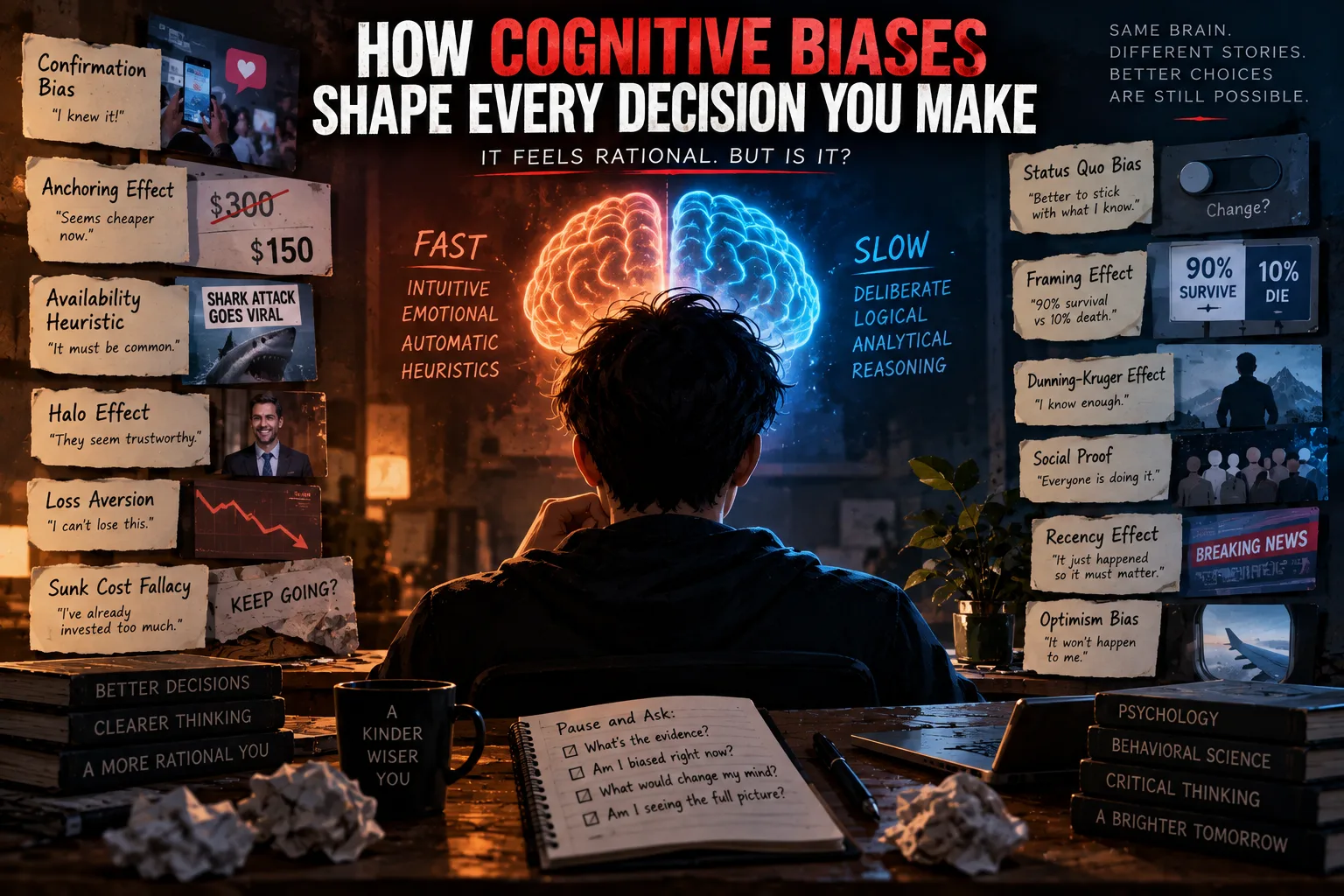
Your brain makes thousands of decisions every day, but many aren't as rational as they feel. Cognitive biases quietly influence what you believe, choose, remember, and ignore.
How Cognitive Biases Shape Every Decision You Make
You like to think you make decisions for good reasons.
You compare the options.
You consider the evidence.
You weigh the risks.
Then you choose.
It feels deliberate.
But much of the time, something else is happening first.
Your brain has already begun steering the decision before your conscious reasoning catches up.
You see a price and immediately decide whether something is expensive.
You meet someone and form an impression within seconds.
You remember an embarrassing event and suddenly overestimate how likely it is to happen again.
You hear an argument that agrees with what you already believe and find it unusually convincing.
You make a prediction, receive new evidence, and somehow discover that the evidence supports what you thought all along.
None of this necessarily means you are irrational.
It means you're human.
The brain evolved to make decisions efficiently in environments where time, information, and energy were limited. Cognitive biases are partly a consequence of that efficiency.
They can produce mistakes.
They can also be useful shortcuts.
The interesting question is not whether you have cognitive biases.
You do.
The interesting question is how much they influence your decisions before you realize they're there.
What Exactly Is a Cognitive Bias?
A cognitive bias is a systematic tendency in thinking that can influence judgment, perception, memory, or decision-making.
The word systematic matters.
A random mistake is simply an error.
A bias is a recurring pattern.
For example, if you repeatedly give more weight to information that supports your existing beliefs, you're demonstrating a pattern commonly called confirmation bias.
If a number you encounter first influences your later estimate, that's related to the anchoring effect.
If an easily remembered event seems more common than it actually is, that's the availability heuristic.
These mechanisms don't operate like little villains sitting inside your brain.
They're shortcuts.
And shortcuts exist because thinking everything through from first principles would be exhausting.
Your Brain Is an Efficiency Machine
Imagine having to consciously analyze every tiny decision.
Which foot should I move first?
How much force should I use to pick up this cup?
Is that person's facial expression friendly?
Should I step onto the road now?
Is this sentence grammatically structured correctly?
You would accomplish almost nothing.
The brain therefore automates enormous amounts of processing.
Most of the time, that's useful.
You don't consciously calculate the physics of every step.
You simply walk.
Decision-making works similarly.
Your brain uses previous experience, patterns, emotional signals, assumptions, and shortcuts to reach conclusions quickly.
The problem appears when the shortcut works poorly in the situation you're facing.
🧠 Fast Thinking vs. Slow Thinking
Psychologist Daniel Kahneman popularized a useful framework describing two broad modes of thinking.
One is fast, intuitive, automatic, and associative.
The other is slower, more deliberate, and effortful.
These aren't literally two separate brains.
They're a way of describing different styles of mental processing.
Fast thinking is what lets you immediately recognize a familiar face.
Slow thinking is what you use when calculating a complicated probability.
The first is efficient.
The second is demanding.
And your brain generally prefers not to spend expensive cognitive energy when it thinks a shortcut will work.
Humans have apparently optimized consciousness for efficiency rather than giving it unlimited processing power.
A questionable design choice, perhaps, but we're stuck with it.
The First Bias: Confirmation Bias
Suppose you believe a particular political candidate is competent.
You encounter an article praising their economic policies.
You read it carefully.
Then you encounter an article criticizing their policies.
Suddenly you become suspicious of the source.
This is confirmation bias.
We tend to search for, interpret, and remember information in ways that can support existing beliefs.
And social media can intensify the effect.
You follow people you agree with.
You interact with posts you like.
Algorithms learn your preferences.
Your feed becomes increasingly compatible with your worldview.
Eventually, your beliefs can feel more objectively obvious because you're surrounded by evidence that appears to confirm them.
The Dangerous Part: You Don't Feel Biased
That's what makes cognitive biases powerful.
A person experiencing confirmation bias rarely thinks:
"Excellent. Time to activate my confirmation bias."
They think:
"I'm evaluating the evidence."
The bias operates inside the evaluation.
That's why simply knowing that biases exist isn't enough.
You need to recognize the situations in which they are likely to appear.
The Anchoring Effect
Imagine walking into a store and seeing a jacket marked:
$300
Then you see another jacket for:
$150
The second suddenly looks affordable.
But suppose the first jacket had never been shown.
Would $150 still seem cheap?
Maybe.
Maybe not.
The first number can influence your later judgment.
That's the anchoring effect.
Anchors Appear Everywhere
Salary negotiations.
Real-estate prices.
Discounts.
Product pricing.
Restaurant menus.
Legal negotiations.
Financial decisions.
Even guesses about quantities.
If a salesperson tells you a laptop normally costs $2,000 and offers it for $1,200, the original price becomes a reference point.
Your brain evaluates the discount relative to the anchor.
The important question isn't merely:
"Is $1,200 a good price?"
It's:
"What would I think about $1,200 if I hadn't first seen $2,000?"
The Availability Heuristic
Imagine someone asks:
"How dangerous are shark attacks?"
You recently watched several news reports about a shark attack.
The event is vivid.
You can easily imagine it.
You may therefore estimate shark attacks as more common than they actually are.
This is related to the availability heuristic.
We often judge the likelihood or frequency of something partly by how easily examples come to mind.
News Can Distort Your Intuition
Rare events can receive enormous media attention precisely because they're rare and dramatic.
Plane crashes.
Murder cases.
Terrorist attacks.
Celebrity deaths.
Natural disasters.
Strange medical cases.
Because these events are memorable, people can overestimate their probability.
Meanwhile, ordinary risks receive far less attention.
Nobody produces a breaking-news special because someone successfully crossed the street without incident.
The Representativeness Heuristic
Suppose you meet someone who is quiet, loves books, and prefers working alone.
You might immediately assume they're a librarian.
But there are many more occupations than librarian.
Your brain may match the person's characteristics to your mental stereotype.
That's related to the representativeness heuristic.
We judge probability partly by how much something resembles our mental model of a category.
The problem?
Similarity isn't probability.
Stereotypes Can Exploit the Same Mechanism
People naturally categorize.
It's cognitively efficient.
But categorization can become harmful when we infer individual characteristics from group stereotypes.
A person's appearance, accent, occupation, clothing, or background can trigger assumptions that aren't actually supported by evidence about that individual.
The brain wants patterns.
Reality frequently refuses to cooperate.
The Halo Effect
Imagine meeting a person who is extremely attractive.
You may unconsciously rate them as:
More competent.
More trustworthy.
More intelligent.
More socially skilled.
Even when you have no evidence for those traits.
That's the halo effect.
One positive characteristic influences judgments about unrelated characteristics.
The reverse can also happen.
A negative first impression can color everything that follows.
Why First Impressions Are So Powerful
Once you've formed an initial judgment, later information doesn't always receive equal weight.
If you think someone is intelligent, their complicated explanation may sound insightful.
If you think they're incompetent, the same explanation may sound confusing.
The words haven't changed.
Your interpretation has.
This is one reason interviews, dating, networking, and even casual social interactions can be influenced by remarkably small pieces of information.
The Sunk Cost Fallacy
You've spent $80 on a concert ticket.
You arrive and discover the concert is terrible.
Should you stay?
Many people think:
"I've already spent $80, so I might as well stay."
But the $80 is gone regardless.
The relevant question is:
"Given what I know now, is staying for the next two hours worth it?"
That's the logic behind avoiding the sunk cost fallacy.
Past investment shouldn't automatically determine future decisions.
Sunk Costs Control More Than Entertainment
People remain in:
Unprofitable businesses.
Unhappy relationships.
Bad investments.
Unproductive projects.
Unnecessary subscriptions.
Poor career paths.
because abandoning them feels like admitting that previous effort was wasted.
But continuing a bad decision doesn't recover the original investment.
It only adds a new cost.
Sometimes the smartest decision is admitting:
"This isn't working anymore."
Humans are remarkably uncomfortable with that sentence.
Loss Aversion
Suppose you can:
Receive $50 for certain
or
have a 50% chance of receiving $120, and a 50% chance of receiving nothing.
Different people will make different choices.
Now reverse the situation.
You can:
Lose $50 for certain
or take a gamble with a 50% chance of losing $120 and a 50% chance of losing nothing.
People often become more willing to gamble when trying to avoid a certain loss.
This reflects loss aversion.
Losses often feel psychologically more powerful than equivalent gains.
Why Discounts Feel So Powerful
Retailers understand this instinct.
"$50 OFF"
can feel more emotionally compelling than:
"Now $150."
The first frames the purchase as avoiding a loss or capturing a gain.
The second simply gives you a number.
The psychology of pricing is rarely as innocent as the price tag suggests.
The Endowment Effect
Once something belongs to you, you may value it more.
A mug you wouldn't pay $5 for in a store can suddenly feel worth $15 when it's yours.
That's the endowment effect.
Ownership changes perception.
This helps explain why people can demand more money to sell an object than they would have been willing to pay to acquire it.
The object didn't change.
The relationship between the object and the owner did.
The Status Quo Bias
People often prefer keeping things the way they are.
Even when alternatives might be better.
Your current phone plan.
Your bank.
Your workplace routine.
Your software settings.
Your investment allocation.
Your subscription services.
Changing requires effort.
The current option is familiar.
So the brain can interpret "nothing changes" as the safer choice.
Sometimes it is.
Sometimes you're simply paying for inertia.
The Framing Effect
Consider two medical treatments.
Treatment A
"90% of patients survive."
Treatment B
"10% of patients die."
Mathematically, they're equivalent.
Psychologically, they don't feel equivalent.
That's the framing effect.
The way information is presented can influence decisions even when the underlying facts remain identical.
Framing Is Everywhere
A product can be:
90% fat-free
instead of:
10% fat
A tax can be described as:
$500 in annual cost
or:
$1.37 per day
A business can report:
10% failure rate
or:
90% success rate
Same underlying reality.
Different psychological response.
The Mere Exposure Effect
Repeated exposure to something can increase familiarity and sometimes liking.
A song becomes more appealing after repeated listening.
A brand becomes familiar after seeing its logo repeatedly.
A political slogan can begin feeling strangely recognizable.
Familiarity can create a sense of comfort.
But familiarity is not proof of quality.
And repeated exposure to a false claim doesn't make it true.
It can simply make it familiar.
The Illusory Truth Effect
When people repeatedly encounter a statement, they can become more likely to perceive it as true.
This is particularly relevant in modern information environments.
A claim appears:
On Instagram.
Then TikTok.
Then X.
Then YouTube.
Then a friend's post.
Then a meme.
Eventually the thought becomes:
"I've heard this everywhere."
The brain can mistake familiarity for evidence.
The Dunning-Kruger Effect
This concept is frequently misunderstood.
The original research concerned how people with limited knowledge in certain domains can struggle to recognize their own lack of knowledge.
The popular internet version is:
"Stupid people think they're geniuses."
That's much too simplistic.
The deeper lesson is that knowing enough to recognize competence often requires some competence yourself.
If you don't understand a subject, you may also lack the knowledge needed to identify what you're missing.
Why Confidence Can Be Misleading
Imagine two people answering a difficult question.
Person A:
"I'm 55% confident."
Person B:
"I'm 99% certain."
You might assume Person B knows more.
But confidence isn't automatically calibrated to accuracy.
Someone can be extremely confident and extremely wrong.
Good decision-making therefore requires separating:
How certain do I feel?
from
How accurate have I actually been?
Those are different measurements.
The Planning Fallacy
Humans are surprisingly optimistic about how long tasks will take.
"I'll finish this tonight."
Three hours later:
Still working.
The planning fallacy describes our tendency to underestimate the time, costs, and difficulties involved in completing future tasks.
Students experience it.
Businesses experience it.
Governments experience it.
Software projects experience it with almost religious dedication.
Why We Underestimate Problems
When planning, people often focus on the intended sequence:
Write article.
Edit article.
Publish article.
Done.
Reality adds:
Technical problems.
Distractions.
Unexpected revisions.
Missing information.
Delays.
Human beings.
The last category alone has destroyed many schedules.
The Optimism Bias
People often underestimate their own probability of experiencing negative events.
You know other people get divorced.
Other people lose jobs.
Other people get sick.
Other people have accidents.
But somehow:
"I'll probably be fine."
This can be useful.
Without optimism, people might never take risks or pursue difficult goals.
But excessive optimism can produce poor planning.
The Pessimism Trap
Biases don't always make people overly optimistic.
Some produce the opposite.
A person who has experienced several failures may overestimate future failure.
One bad investment can make someone believe all investing is dangerous.
One painful relationship can make someone expect future relationships to fail.
One embarrassing public presentation can make public speaking seem permanently terrifying.
Past experience provides information.
But sometimes the brain gives one experience far more weight than it deserves.
The Recency Effect
Recent information can receive disproportionate weight.
Imagine evaluating a restaurant after ten excellent visits and one terrible visit.
If the terrible visit happened yesterday, it may dominate your judgment.
Your entire history hasn't changed.
Your memory of the history has become temporarily tilted toward the most recent event.
This matters in:
Performance reviews.
Investing.
Sports.
Relationships.
Business decisions.
Hiring.
The Peak-End Rule
People don't always remember an experience by averaging every moment.
Instead, memory can be strongly influenced by:
The emotional peak.
And the ending.
A vacation can be wonderful for nine days and miserable on the final day.
That final experience may disproportionately shape how you remember the entire trip.
The same principle can influence:
Movies.
Restaurants.
Dates.
Medical experiences.
Travel.
Customer service.
The Bandwagon Effect
If everyone seems to believe something, you're more likely to believe it too.
Humans are social learners.
If hundreds of people are buying something, it may seem valuable.
If millions follow an influencer, they may seem credible.
If everyone in your group supports an opinion, disagreement becomes psychologically harder.
Popularity provides a shortcut:
Other people believe this, therefore perhaps they know something I don't.
Sometimes they do.
Sometimes everyone is simply copying everyone else.
Social Proof Can Be Useful
This bias isn't purely irrational.
If you're choosing an unfamiliar restaurant in an unfamiliar city, thousands of positive reviews can provide useful information.
The problem comes when popularity becomes a substitute for independent evaluation.
A million people can be wrong.
History has demonstrated this repeatedly.
Humans have occasionally achieved impressive levels of coordinated incorrectness.
The Authority Bias
People tend to give greater weight to information from perceived authorities.
A doctor.
A professor.
A government official.
A CEO.
A celebrity.
A person wearing a laboratory coat in a YouTube thumbnail.
Authority can be useful.
Experts often genuinely know more.
But expertise is domain-specific.
A brilliant physicist isn't automatically an expert in nutrition.
A famous athlete isn't automatically an economist.
A successful entrepreneur isn't automatically qualified to explain neuroscience.
The Fundamental Attribution Error
When someone else makes a mistake, we may attribute it to their personality.
"They're careless."
When we make a mistake:
"I was exhausted."
This tendency is related to the fundamental attribution error.
We can underestimate situational factors affecting other people's behavior while emphasizing circumstances affecting our own.
That creates unfair judgments.
Why Relationships Suffer From Bias
Imagine your partner forgets something important.
You think:
"They don't care."
Later, you forget something.
Your explanation:
"I've been overwhelmed."
Same behavior.
Different interpretation.
Once people develop narratives about each other, confirmation bias can strengthen them.
Every mistake becomes evidence.
Every positive action gets discounted.
This is one reason cognitive bias isn't merely an academic curiosity.
It can affect the people you love.
The Bias Blind Spot
Here is the final insult.
Humans can recognize biases in other people while failing to recognize them in themselves.
You can read a list of twenty cognitive biases and immediately think:
"I know someone who does all of these."
That may be true.
But you are also someone.
The bias blind spot describes the tendency to see oneself as less biased than others.
Knowledge about bias doesn't make you immune to bias.
Sometimes it simply gives you more sophisticated vocabulary for explaining why everyone else is biased.
Can You Eliminate Cognitive Bias?
Probably not.
And trying to eliminate every shortcut would be counterproductive.
Your brain needs efficient heuristics.
The goal isn't:
Never use intuition.
It's:
Know when intuition is likely to mislead you.
That requires something more useful than memorizing a list.
It requires recognizing high-risk situations.
When Should You Slow Down?
Be especially careful when:
The decision is important
Career.
Health.
Relationships.
Large purchases.
Investments.
You're emotionally charged
Anger and fear can narrow attention.
You're extremely confident
Confidence deserves calibration.
You have already invested heavily
Check for sunk-cost thinking.
The information agrees perfectly with you
Look for confirmation bias.
Someone gives you a dramatic number
Check for anchoring.
Everyone seems to agree
Ask whether social proof is replacing evidence.
The decision is irreversible
Slow thinking becomes much more valuable.
A Simple Anti-Bias Checklist
Before making an important decision, ask:
1. What evidence would change my mind?
If the answer is "nothing," you're probably defending a belief rather than testing it.
2. What would I think if the opposite option were presented first?
Useful for detecting framing and anchoring.
3. Am I judging the future based on one memorable example?
Watch for availability bias.
4. Am I continuing because I've already invested too much?
Check for sunk costs.
5. How confident am I, and how accurate have I historically been?
Separate confidence from calibration.
6. What would someone who disagrees with me say?
Force alternative evidence into the room.
7. If I had to decide tomorrow instead of right now, would my answer change?
Useful when emotion is driving urgency.
The Goal Isn't Perfect Rationality
Perfect rationality sounds impressive until you realize what it would require.
You would need:
Complete information.
Accurate probabilities.
Unlimited time.
Unlimited cognitive capacity.
No emotional influence.
No uncertainty.
No conflicting goals.
Humans have none of these.
Real decision-making is therefore about better judgment under constraints.
That's a much more realistic goal.
🟢 Established Evidence
Cognitive biases are well documented across psychology and behavioral science.
Researchers have repeatedly demonstrated systematic effects involving:
Memory.
Probability judgment.
Risk perception.
Decision framing.
Social influence.
Confidence.
Attention.
However, individual biases don't always appear equally strongly in every person or situation.
Human cognition is context-dependent.
🟡 Active Debate
Psychologists continue debating:
How many distinct biases should be recognized?
Which biases represent genuine errors versus useful adaptive strategies?
How strongly do laboratory findings generalize to real-world decisions?
How much can education and debiasing interventions actually reduce these effects?
There isn't a single master list of "the biases humans have."
Different researchers classify them differently.
🔴 Popular Myth
"If you know about cognitive biases, you won't fall for them."
Unfortunately, no.
Knowing about a bias can help you detect it.
It does not install an invisible force field around your brain.
In fact, recognizing biases in other people may sometimes increase your confidence that you're the rational one.
Which is itself rather convenient.
Frequently Asked Questions
Are cognitive biases always bad?
No. Many biases arise from mental shortcuts that can be useful when information is limited or decisions need to be made quickly.
Can intelligent people be affected by cognitive bias?
Absolutely. Intelligence doesn't make someone immune. In some circumstances, highly knowledgeable people may become particularly skilled at constructing arguments that defend conclusions they already prefer.
Can cognitive biases be eliminated?
Not completely. The realistic goal is reducing their influence in situations where they are likely to produce serious errors.
Why do people believe information that confirms what they already think?
Confirmation bias can cause people to preferentially seek, notice, interpret, or remember information consistent with existing beliefs.
Why do expensive products sometimes make cheaper products seem better?
An initial price can act as an anchor, influencing subsequent judgments about value.
Why do people stay in bad investments?
Sunk-cost thinking and loss aversion can make abandoning previous investments emotionally difficult, even when continuing is objectively worse.
Does confidence mean someone knows what they're talking about?
No. Confidence and accuracy are separate qualities. Good judgment requires calibrating confidence against actual performance.
Why are first impressions difficult to change?
Initial judgments can influence how later information is interpreted, allowing early impressions to reinforce themselves.
Can social media increase cognitive bias?
It can create environments where confirmation, repetition, social proof, emotional reactions, and selective exposure become especially prominent. But effects vary substantially by platform and usage.
What's the most important thing to remember about cognitive bias?
You don't need to become perfectly rational. You need to recognize when your brain's shortcuts are most likely to mislead you.
Final Thoughts
The most unsettling thing about cognitive biases is that they rarely feel like mistakes while they're happening.
You don't experience confirmation bias as confirmation bias.
You experience it as research.
You don't experience anchoring as anchoring.
You experience it as judgment.
You don't experience the halo effect as a halo effect.
You experience it as a first impression.
You don't experience the sunk-cost fallacy as irrationality.
You experience it as not wanting your effort to be wasted.
That's why cognitive biases are so difficult to defeat.
They're not glitches that announce themselves with a warning message.
They're integrated into ordinary thought.
And yet that doesn't mean you're powerless.
The first defense isn't perfect rationality.
It's friction.
Pause before buying.
Check the source before sharing.
Consider what evidence would change your mind.
Ask whether you would make the same decision without the original price.
Separate what you feel from what you know.
Look for information that contradicts your preferred conclusion.
And occasionally admit that the person who disagrees with you might have a point.
That last one may be the most technologically advanced form of human intelligence we've developed.
Your brain will continue using shortcuts.
It will continue making assumptions.
It will continue trying to save energy.
You cannot turn that system off.
But you can learn to recognize when it has taken the wheel.
And sometimes, the smartest decision you can make is simply to stop for a moment and ask:
"Am I choosing this because it's actually the best option, or because my brain has made it feel like the best option?"