Göbekli Tepe: The Ancient Temple That Rewrote Human History
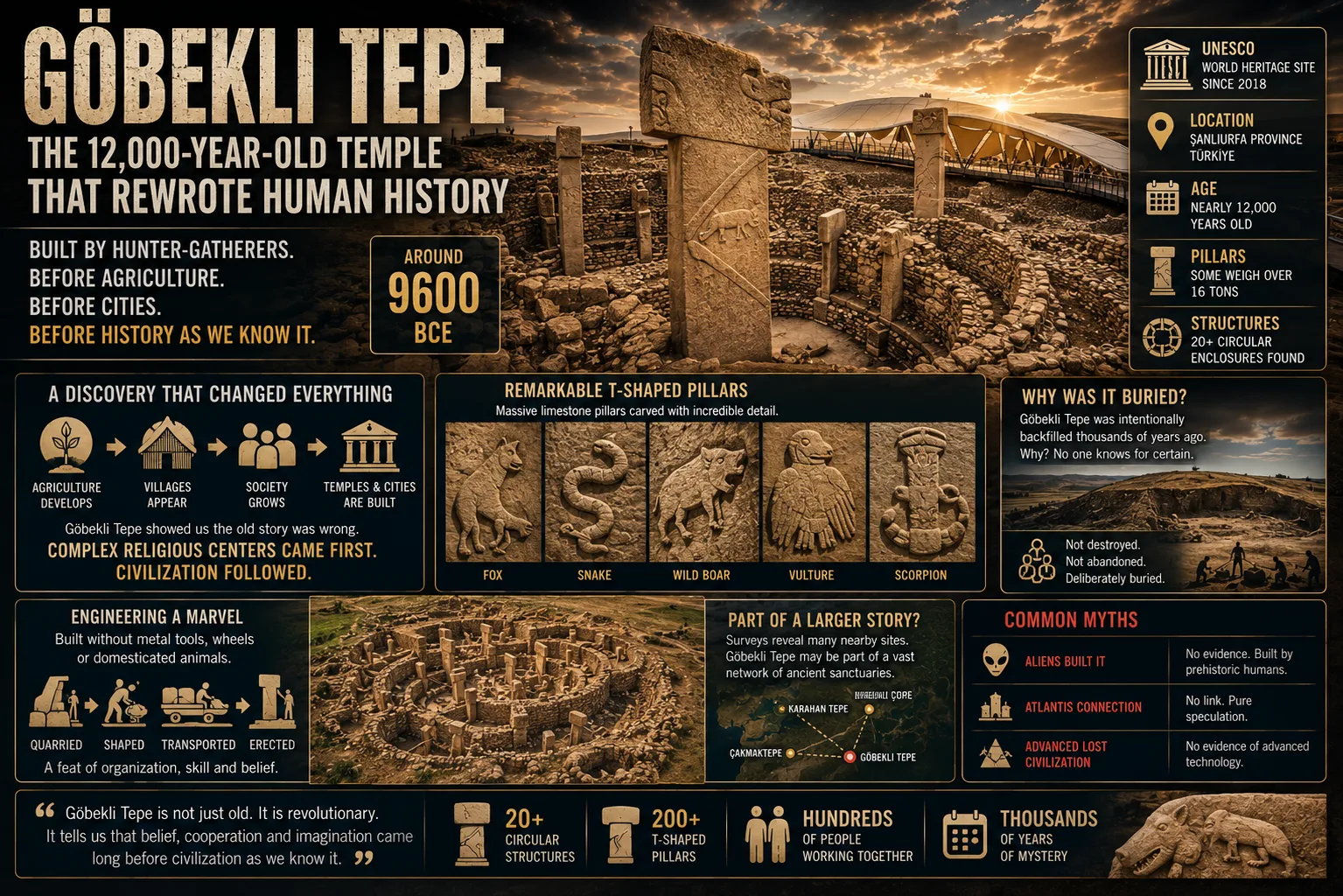
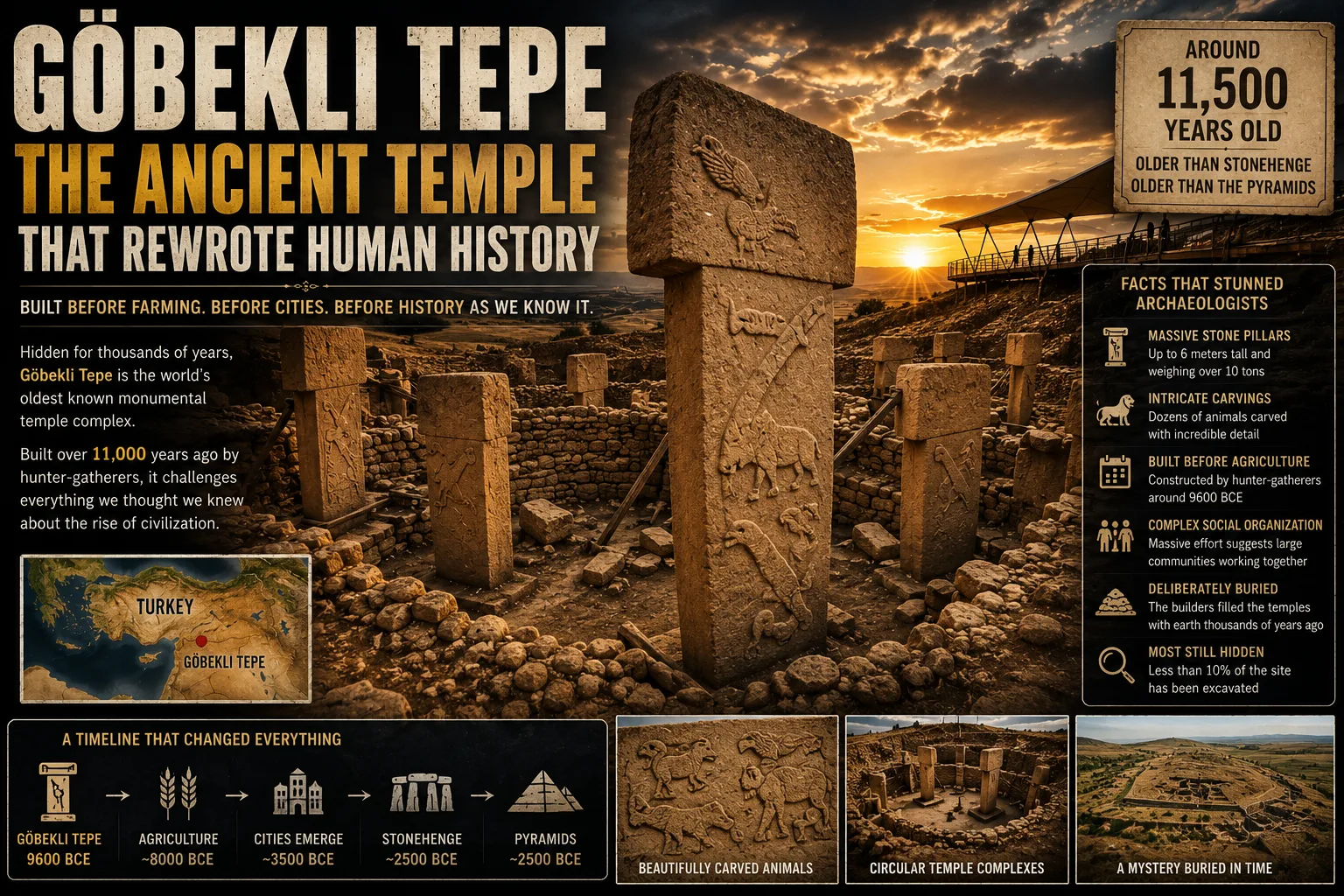
Hidden beneath a hill in southeastern Turkey for thousands of years, Göbekli Tepe is the oldest known monumental temple complex ever discovered. Built over 11,000 years ago by people once believed incapable of such engineering, it has transformed our understanding of early human civilization while raising profound new questions about our distant past.
Göbekli Tepe: The Ancient Temple That Rewrote Human History
Imagine standing before a massive stone monument carved with lions, snakes, vultures, foxes, and towering pillars weighing several tons.
Now imagine learning that it was built over 11,500 years ago.
Long before the pyramids of Egypt.
Long before Stonehenge.
Long before the invention of writing.
Long before cities.
Even before farming, according to the traditional timeline of human history.
For generations, archaeologists believed that civilization followed a simple sequence.
Humans first learned agriculture.
Agriculture created permanent settlements.
Settlements grew into cities.
Cities eventually produced religion, monumental architecture, and complex societies.
Then Göbekli Tepe was discovered.
And suddenly...
That entire sequence no longer seemed so certain.
Buried beneath a quiet hill in southeastern Turkey was an enormous ceremonial complex so ancient that it forced historians to rethink one of humanity's oldest stories.
Who built it?
Why was it constructed?
And perhaps most puzzling of all...
Why was it deliberately buried by the very people who created it?
A Hill That Hid a Secret
For thousands of years, Göbekli Tepe appeared to be nothing more than an ordinary limestone hill overlooking the plains of southeastern Turkey.
Local farmers occasionally found unusual stones while working nearby.
Broken pieces of carved limestone appeared from time to time.
Most assumed they were simply fragments from old graves or abandoned settlements.
Even archaeologists initially overlooked its true importance.
During a survey in the 1960s, researchers noted scattered stone fragments but concluded the site was probably a medieval cemetery.
The hill was cataloged.
Then largely forgotten.
One of history's greatest archaeological discoveries remained hidden beneath their feet.
🟢 Established Archaeological Evidence
Early archaeological surveys recorded the site but significantly underestimated its importance. At the time, no one realized that enormous prehistoric stone structures lay buried beneath the surface.
The Discovery That Changed Everything
Everything changed in 1994.
German archaeologist Klaus Schmidt visited the site while searching for prehistoric settlements.
Unlike previous researchers, Schmidt immediately recognized something unusual.
The scattered limestone fragments weren't natural.
They had been deliberately shaped.
Many displayed carved surfaces.
Others appeared to belong to massive pillars unlike anything normally associated with prehistoric hunter-gatherers.
Excavations began soon afterward.
Within months, archaeologists realized they had uncovered something extraordinary.
Hidden beneath the soil were gigantic circular stone enclosures unlike any previously known from the Stone Age.
The Giant T-Shaped Pillars
At the center of each enclosure stood enormous limestone pillars.
Many reached heights of 5 to 6 meters (16 to 20 feet).
Some weighed more than 10 tons.
Each pillar had been carefully carved from solid limestone using stone tools.
Even more remarkable...
Many were decorated with beautifully carved animals.
Researchers identified images of:
Foxes
Wild boars
Lions
Leopards
Snakes
Scorpions
Cranes
Vultures
Gazelles
Rather than crude carvings, the artwork displayed remarkable precision and artistic skill.
The builders clearly possessed sophisticated stone-working abilities.
🟢 Established Archaeological Evidence
The famous T-shaped pillars are one of Göbekli Tepe's defining features. Many include detailed relief carvings of animals and abstract symbols that remain exceptionally well preserved despite their great age.
Older Than Anyone Expected
As excavations continued, archaeologists collected charcoal, organic remains, and other materials suitable for radiocarbon dating.
The results were astonishing.
Göbekli Tepe dated to approximately 9600 BCE.
That makes it roughly:
11,500 years old
About 7,000 years older than Stonehenge
Around 6,500 years older than the Great Pyramid of Giza
Nothing of comparable scale was previously known from this period.
The discovery forced archaeologists to reconsider what prehistoric people were capable of achieving.
🟢 Established Archaeological Evidence
Radiocarbon dating places the earliest phases of Göbekli Tepe in the Pre-Pottery Neolithic A period, beginning around 9600 BCE. These dates are widely accepted within the archaeological community.
A Monument Built Before Cities
Perhaps the most surprising aspect of Göbekli Tepe isn't its age.
It's when it appears to have been built in relation to human society.
For decades, historians believed large-scale construction projects required:
Permanent villages.
Organized governments.
Agriculture.
Food surpluses.
Large settled populations.
Yet the earliest builders of Göbekli Tepe seem to have lived during a time when hunting and gathering still dominated daily life.
If this interpretation is correct, then groups traditionally viewed as small bands of hunter-gatherers somehow organized:
Massive stone quarrying.
Long-distance transportation.
Precise construction.
Complex planning.
Skilled artistic carving.
That realization stunned archaeologists around the world.
More Than Just One Temple
Excavations soon revealed that Göbekli Tepe was not a single monument.
Instead, researchers uncovered multiple circular and oval enclosures, each featuring its own arrangement of towering pillars.
Ground-penetrating surveys suggest many more structures remain buried beneath the hill.
Remarkably, archaeologists estimate that less than 10% of the site has been excavated.
Most of Göbekli Tepe still lies hidden underground.
Every excavation season has the potential to reveal entirely new chapters of humanity's earliest monumental architecture.
🟡 Active Archaeological Hypothesis
Geophysical surveys indicate that numerous additional structures remain buried beneath the site. While their exact purpose is unknown, future excavations are expected to significantly expand our understanding of Göbekli Tepe.
The Mystery Deepens
As extraordinary as the architecture was, another discovery proved even more puzzling.
At some point in antiquity...
The builders deliberately buried the entire complex.
Not because of an earthquake.
Not because it collapsed.
Archaeological evidence suggests the enclosures were intentionally filled with earth, stone, and debris.
Why would people invest enormous effort constructing one of the world's oldest monumental sites...
Only to bury it themselves?
That question remains one of Göbekli Tepe's greatest unsolved mysteries.
🔴 Popular Myth / Unsupported Claim
Because Göbekli Tepe is so ancient, it has often been linked to Atlantis, extraterrestrials, or forgotten super-civilizations.
There is no credible archaeological evidence supporting these claims. The site's remarkable engineering can be explained through the ingenuity and organizational abilities of prehistoric human communities.