Giant's Causeway: Did a Giant Build This Stone Bridge Across the Sea?
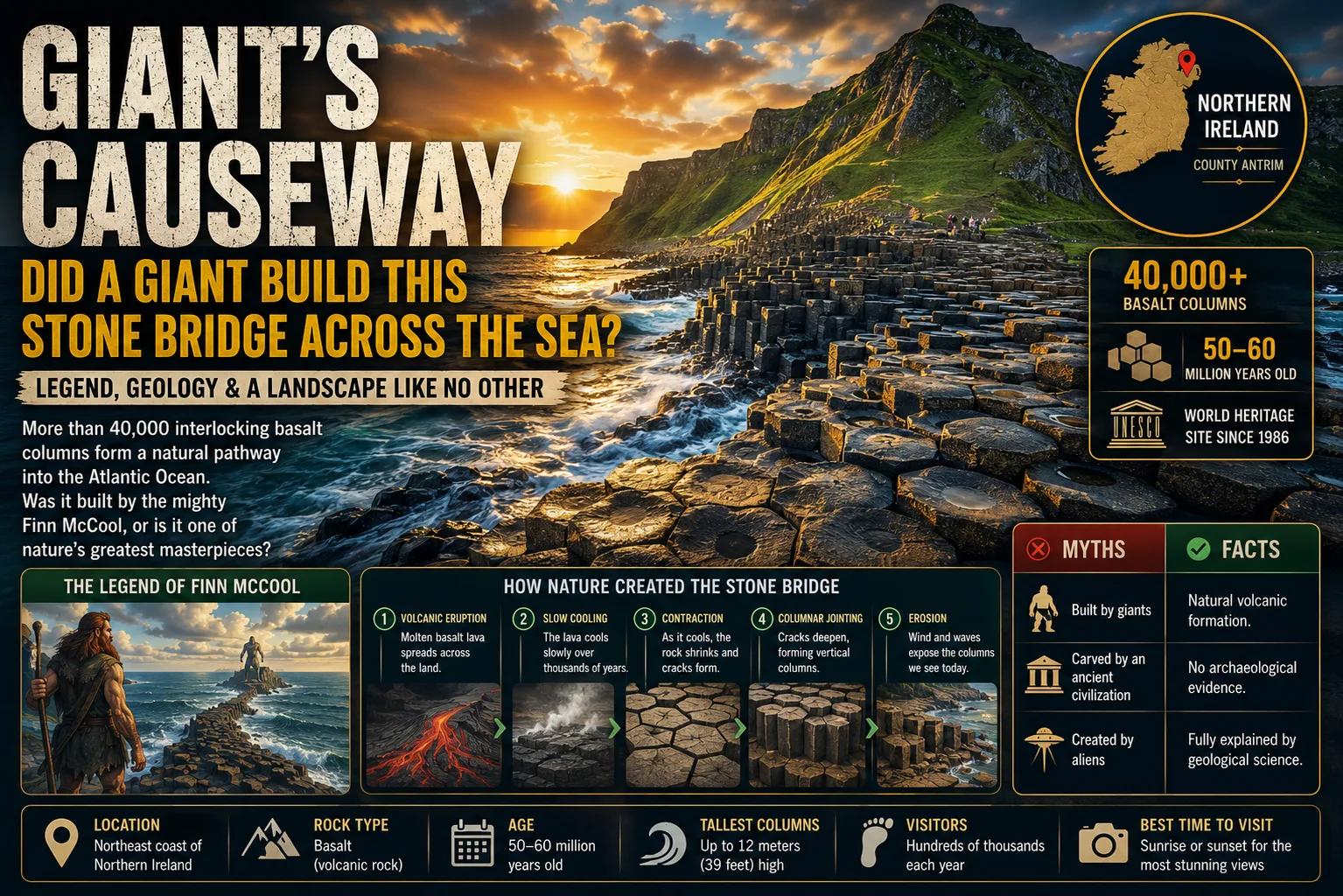
With more than 40,000 perfectly shaped basalt columns stretching into the Atlantic Ocean, Giant's Causeway looks almost too precise to be natural. Was it built by a legendary giant named Finn McCool, or is it one of geology's greatest masterpieces? Explore the science and folklore behind one of the world's most iconic landscapes.
Giant's Causeway: Did a Giant Build This Stone Bridge Across the Sea?
Along the rugged coastline of Northern Ireland, where powerful Atlantic waves crash against black volcanic rock, lies one of Earth's most extraordinary natural wonders.
At first glance, it hardly seems real.
More than 40,000 perfectly interlocking stone columns rise from the shoreline like the ruins of an ancient civilization.
Most are six-sided.
Some have five, seven, or even eight sides.
Together they form what looks like an enormous stone pathway disappearing into the sea.
Their remarkable symmetry has amazed visitors for centuries.
How could nature create something so precise?
Long before geology offered an explanation, the people of Ireland already had an answer.
According to legend, these stones were not formed by volcanic eruptions.
They were built by a giant.
The mighty warrior Finn McCool, they said, constructed this vast stone bridge to cross the sea and challenge his Scottish rival.
Modern science tells a very different story.
It speaks of molten lava, cooling rock, and millions of years of geological change.
Yet both explanations share something important.
They remind us that Giant's Causeway inspires wonder unlike almost any other place on Earth.
The real mystery is not whether giants built it.
The mystery is how nature created something that looks so astonishingly engineered.
A Landscape Unlike Any Other
Stretching along the coast of County Antrim, Giant's Causeway covers several kilometers of shoreline.
The columns vary in height.
Some rise only a few centimeters above the ground.
Others stand more than 12 meters (39 feet) tall.
Many fit together so tightly that they resemble carefully laid paving stones.
Visitors often describe walking across them as though stepping onto the floor of an ancient temple.
The illusion is so convincing that early travelers struggled to believe the formation was entirely natural.
🟢 Established Scientific Evidence
Giant's Causeway is located on the northeast coast of Northern Ireland and consists of approximately 40,000 interlocking basalt columns formed by ancient volcanic activity around 50–60 million years ago.
The Legend of Finn McCool
Long before scientists studied volcanic rocks, Irish storytellers passed down a tale explaining the mysterious stone bridge.
According to legend, the giant Finn McCool (also known as Fionn mac Cumhaill) wished to challenge the Scottish giant Benandonner.
The sea separated them.
So Finn built a massive stone causeway stretching across the North Channel toward Scotland.
When Benandonner crossed the bridge, however, Finn realized his rival was far larger than expected.
Finn's wife, Oonagh, quickly devised a clever plan.
She disguised Finn as a sleeping baby.
When Benandonner saw the enormous "infant," he imagined how gigantic the child's father must be.
Terrified, he fled back to Scotland, destroying the stone bridge behind him so Finn could never follow.
According to the legend, the surviving section is today's Giant's Causeway.
🟡 Historical & Cultural Tradition
The story of Finn McCool forms part of Irish mythology and has been passed down through generations for centuries. It is an important element of Ireland's cultural heritage rather than a historical account.
Early Visitors
For centuries, Giant's Causeway attracted travelers, artists, and natural philosophers.
Before geology became a science, many struggled to explain its perfectly shaped columns.
Some believed they were ancient ruins.
Others imagined they had been carved by supernatural forces.
As scientific understanding grew during the eighteenth and nineteenth centuries, researchers gradually recognized that the rocks shared similarities with volcanic formations found elsewhere in Europe.
The legend remained.
The science began to catch up.
Nature's Perfect Geometry
Perhaps the most astonishing feature of Giant's Causeway is its geometry.
Why are so many columns hexagonal?
Nature rarely produces straight lines and perfect shapes.
Yet here they appear everywhere.
The answer lies in one of geology's most remarkable processes.
When molten lava cools slowly, it contracts.
As it shrinks, internal stresses build.
Eventually, cracks begin to form.
Those cracks spread outward, dividing the cooling rock into polygonal columns.
Hexagons are especially common because they distribute stress efficiently while leaving almost no gaps.
The result is one of nature's most elegant examples of mathematics expressed through geology.
🟢 Established Scientific Evidence
The columns formed through columnar jointing, a natural process in which cooling basalt contracts and fractures into polygonal columns, most commonly hexagons.
A Mystery Solved, Yet Still Inspiring
Today, scientists understand the basic geological processes responsible for Giant's Causeway.
Yet understanding has not diminished its wonder.
Standing among thousands of towering stone columns, it is easy to appreciate why ancient people imagined giants walking these shores.
Sometimes the scientific explanation does not replace the legend.
It simply reveals another layer of an already extraordinary story.
🔴 Popular Myth / Unsupported Claim
There is no scientific evidence that Giant's Causeway was built by giants or any ancient civilization. Its remarkable stone columns are the result of well-understood volcanic processes, although the legend of Finn McCool remains an important part of Ireland's cultural heritage.
Why Are the Columns Mostly Hexagons?
At first glance, Giant's Causeway seems almost designed.
The columns fit together with remarkable precision.
Most have six sides.
Some have five.
Others have seven or eight.
But why hexagons?
Why not circles?
Or squares?
The answer lies in physics.
As molten basalt cooled around 50 to 60 million years ago, it began to shrink.
Cooling rock contracts just as metal contracts when it loses heat.
As the basalt shrank, enormous internal stresses developed.
Eventually, the rock cracked.
Those cracks spread across the cooling lava, dividing it into separate columns.
Nature wasn't trying to create hexagons.
It was simply finding the most efficient way to relieve stress.
Just as soap bubbles naturally arrange themselves into hexagonal patterns, cooling basalt often fractures the same way.
The result is one of Earth's most beautiful examples of natural geometry.
🟢 Established Scientific Evidence
The hexagonal columns formed through columnar jointing, a well-understood geological process in which cooling lava contracts and fractures into polygonal columns. Hexagons are the most common shape because they distribute stress efficiently while minimizing empty space.
A Landscape Born From Fire
Around 60 million years ago, this part of Northern Ireland looked nothing like it does today.
Instead of green cliffs overlooking the Atlantic...
The region was volcanically active.
Large fissures opened within Earth's crust.
Vast quantities of molten basalt poured across the landscape.
Layer after layer of lava spread over the ground.
As the upper portions cooled, contraction began.
Over thousands of years, millions of individual fractures developed.
Each eventually became one of the stone columns visible today.
The Atlantic coastline we admire now is the result of millions of years of erosion exposing these ancient volcanic rocks.
Not Every Column Is Perfect
Although photographs often emphasize perfect hexagons, Giant's Causeway is more varied than many people realize.
Researchers have documented columns with:
Four sides.
Five sides.
Six sides.
Seven sides.
Eight sides.
The overwhelming majority are hexagonal, but nature allows for variation.
Local differences in cooling speed, rock composition, and stress distribution all influence the final shape.
Perfection, it turns out, isn't necessary for extraordinary beauty.
Similar Wonders Around the World
For centuries, Giant's Causeway appeared unique.
Modern geology has revealed otherwise.
The same volcanic process has produced spectacular columnar formations elsewhere on Earth.
Among the best known are:
Fingal's Cave, Scotland.
Svartifoss, Iceland.
Devil's Postpile, California.
Garni Gorge, Armenia.
Organ Pipes National Park, Australia.
Each formed through the same natural process.
Yet Giant's Causeway remains the largest and most famous example.
🟢 Established Scientific Evidence
Columnar jointing occurs worldwide wherever thick basaltic lava cools slowly under suitable conditions. Giant's Causeway is the most famous example but not the only one.
A UNESCO World Heritage Site
In 1986, Giant's Causeway received international recognition when it was designated a UNESCO World Heritage Site.
The designation acknowledged both its geological importance and its exceptional natural beauty.
Today, hundreds of thousands of visitors arrive each year to explore the stone columns, hear the legend of Finn McCool, and witness one of Earth's most remarkable volcanic landscapes.
Few places combine science, history, and folklore so seamlessly.
🟢 Established Scientific Evidence
UNESCO designated Giant's Causeway a World Heritage Site in 1986, recognizing it as one of the finest examples of columnar basalt formed by ancient volcanic activity.
Common Myths
The extraordinary appearance of Giant's Causeway has inspired many imaginative explanations.
Let's compare them with the evidence.
Myth: Giants Built the Causeway
The story of Finn McCool is one of Ireland's most beloved legends.
It is an important part of Irish cultural heritage.
However, geological evidence clearly shows the columns formed naturally through volcanic cooling.
Myth: The Columns Were Carved by Humans
There is no archaeological evidence that humans shaped the basalt columns.
Their internal crystal structure, fracture patterns, and mineral composition are entirely consistent with natural geological processes.
Myth: Giant's Causeway Is Unique on Earth
Although it is the most famous example, similar basalt columns exist on several continents.
What makes Giant's Causeway exceptional is its scale, preservation, and cultural significance.
🔴 Popular Myth / Unsupported Claim
Claims that Giant's Causeway was built by giants, an advanced lost civilization, or extraterrestrials are not supported by geological evidence. The formation is one of the world's best-understood examples of naturally occurring columnar basalt.
Frequently Asked Questions
How old is Giant's Causeway?
The basalt columns formed approximately 50 to 60 million years ago during a period of intense volcanic activity.
Why are the columns hexagonal?
As cooling basalt contracted, it fractured into polygonal columns. Hexagons naturally provide one of the most efficient ways to relieve stress.
Did giants really build it?
According to Irish mythology, yes.
According to geology, the columns formed naturally through volcanic cooling and contraction.
Why is Giant's Causeway famous?
It combines spectacular volcanic geology with one of Ireland's best-known legends, making it one of the world's most iconic natural landmarks.
Final Thoughts
Giant's Causeway is a place where science and storytelling meet without diminishing one another. Geology explains how molten lava cooled, contracted, and fractured into tens of thousands of interlocking basalt columns. Irish folklore tells of Finn McCool building a bridge across the sea to confront a rival giant. One account is supported by evidence, the other by centuries of cultural tradition, yet both enrich the landscape in different ways.
Standing on the Causeway today, it is easy to understand why generations before modern science imagined something supernatural at work. Few natural formations display such striking order and symmetry. Yet the true explanation is no less remarkable. Through volcanic fire, immense pressure, and millions of years of cooling and erosion, nature created a masterpiece that rivals the finest human architecture.
Whether you arrive seeking legends, geology, or simply breathtaking scenery, Giant's Causeway offers a rare reminder that the natural world often produces wonders every bit as extraordinary as the myths inspired by them.