Devil's Tower Mystery: How Did This Giant Stone Monolith Rise From the Earth?
Towering above the Wyoming landscape, Devil's Tower appears almost too perfect to be natural. Its towering columns and isolated location have inspired Native American legends, scientific investigation, and even Hollywood films. Discover how this extraordinary geological landmark formed and why its origin continues to fascinate geologists.
Devil's Tower Mystery: How Did This Giant Stone Monolith Rise From the Earth?
Across the rolling plains of northeastern Wyoming stands a rock formation so unusual that it seems almost impossible.
It rises abruptly from the surrounding landscape.
No mountain range supports it.
No nearby cliffs resemble it.
Just one enormous stone tower climbing nearly 265 meters (867 feet) above the valley floor.
Its sides are astonishingly steep.
Thousands of long, nearly perfect stone columns run from base to summit like giant pillars carved by an ancient civilization.
At first glance, Devil's Tower hardly looks natural.
For centuries, Native American tribes have regarded it as a sacred place.
Modern visitors often compare it to a giant castle, a tree stump, or even an enormous man-made monument.
Hollywood immortalized it in the 1977 film Close Encounters of the Third Kind, forever linking it with UFOs and extraterrestrial mysteries.
But the real mystery is even more fascinating.
How did nature create something so perfectly geometric?
A Landmark Unlike Any Other
Devil's Tower dominates the landscape.
Its summit sits approximately 1,558 meters (5,112 feet) above sea level.
The flat top covers about 1.5 acres (0.6 hectares).
Although impressive from photographs, its true scale becomes apparent only when standing beneath it.
Rock climbers often describe the columns as looking like gigantic bundles of stone pipes reaching toward the sky.
The surrounding plains make the formation appear even more dramatic.
It seems almost as if it erupted directly from the Earth.
🟢 Established Scientific Evidence
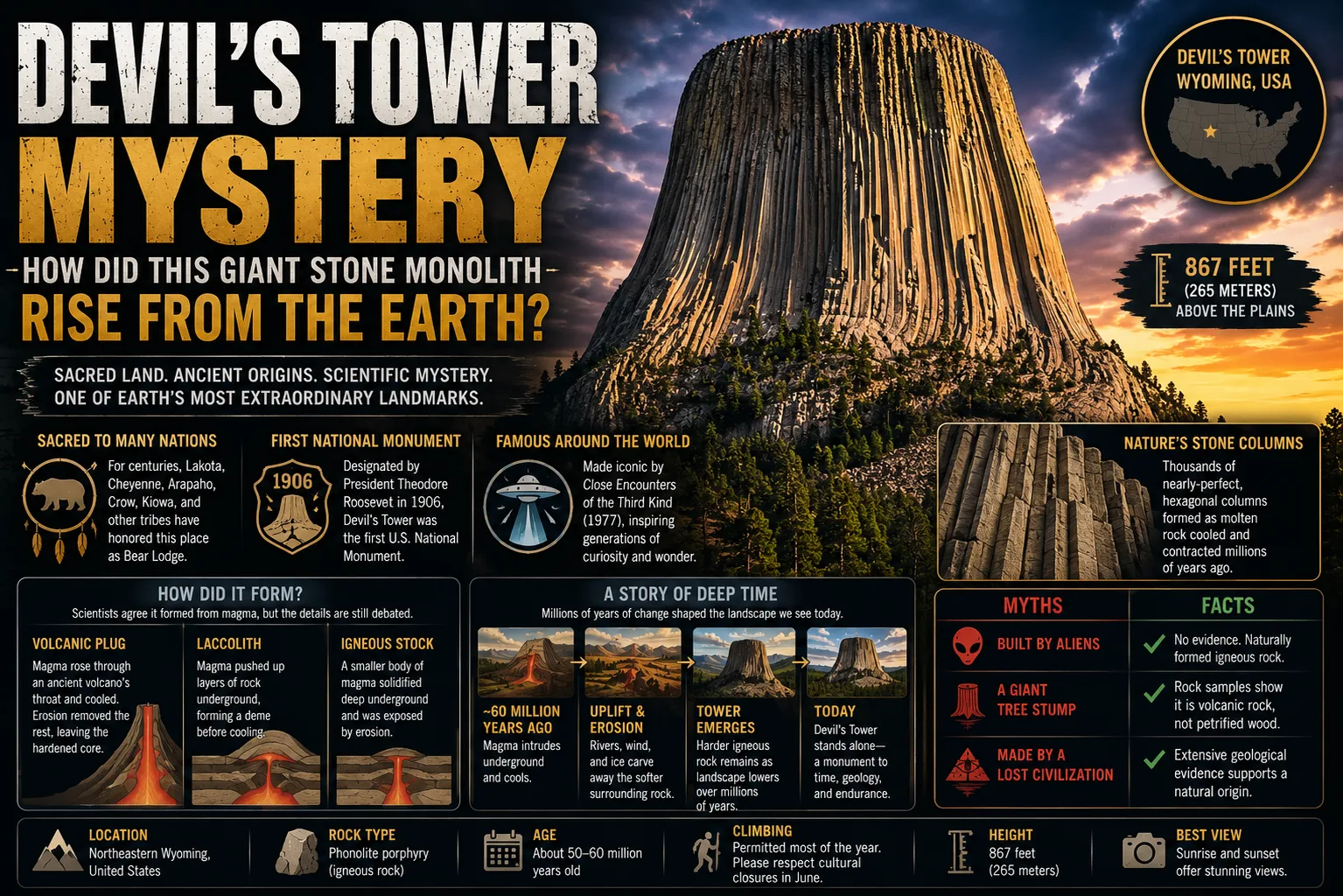
Devil's Tower is located in northeastern Wyoming, USA, and became the first U.S. National Monument in 1906 after being designated by President Theodore Roosevelt.
A Sacred Place Long Before Its Modern Name
Long before European settlers arrived, many Native American nations considered the tower a place of deep spiritual importance.
Among them were the:
Lakota
Cheyenne
Arapaho
Crow
Kiowa
Shoshone
Each nation preserved its own stories explaining the tower's origin.
One of the best-known legends tells of several young girls chased by an enormous bear.
Praying for help, they climbed onto a small rock.
The Great Spirit caused the rock to rise high into the sky, lifting the children beyond the bear's reach.
As the bear tried to climb after them, its claws scraped deep grooves into the stone.
Those grooves, according to the legend, became the towering vertical columns visible today.
These stories are not geological explanations.
They are sacred cultural traditions that continue to hold deep significance for many Native American communities.
Why Is It Called Devil's Tower?
Interestingly...
The name is actually the result of a misunderstanding.
In 1875, during a U.S. military expedition, an interpreter reportedly mistranslated a Native name associated with the site.
Instead of conveying a meaning closer to "Bear Lodge" or "Bear's Tipi," the translation became "Devil's Tower."
The name remained.
Many Native American groups continue to advocate for restoring a name that better reflects the monument's cultural importance.
🟢 Established Historical Evidence
The modern name "Devil's Tower" likely originated from a mistranslation during an 1875 expedition. Numerous Native American tribes continue to use traditional names connected to bears rather than devils.
The Astonishing Stone Columns
The tower's most remarkable feature is impossible to miss.
Its surface is covered with thousands of enormous stone columns.
Most are:
Six-sided.
Five-sided.
Occasionally seven-sided.
Some stretch more than 100 meters (330 feet) without interruption.
They fit together with extraordinary precision, almost like giant pencils standing upright.
At first glance, they appear carved.
In reality...
They formed entirely through natural geological processes.
Nature's Own Geometry
These columns are an example of a phenomenon known as columnar jointing.
When certain types of molten rock cool slowly, they shrink.
As the rock contracts, stress builds.
Eventually, cracks begin to form.
The remarkable part is that these cracks naturally spread into polygonal shapes.
Hexagons are especially common because they distribute stress efficiently.
The result is one of nature's most beautiful geometric patterns.
Similar formations appear at places like Giant's Causeway in Northern Ireland and Svartifoss in Iceland.
Yet nowhere do they rise quite like Devil's Tower.
🟢 Established Scientific Evidence
The columns of Devil's Tower formed through columnar jointing, a natural process in which slowly cooling igneous rock contracts and fractures into polygonal columns.
Was It Once a Volcano?
For many years, geologists believed Devil's Tower was the solid core of an ancient volcano.
The idea seemed logical.
Molten rock rises.
It cools underground.
The softer outer volcano eventually erodes away.
Leaving only the hardened core.
Today...
Scientists are less certain.
Although they agree molten rock created the tower, exactly how that magma reached its present form remains an active area of research.
Several competing geological models exist.
🟡 Active Geological Debate
Most geologists agree Devil's Tower formed from slowly cooled igneous magma, but researchers continue debating whether it represents the core of an ancient volcano, a volcanic plug, a laccolith, or another type of shallow magma intrusion.
A Mystery Millions of Years in the Making
Whatever its precise origin...
One fact is clear.
The tower visible today is only the part that survived.
Over tens of millions of years, wind, rain, rivers, and frost gradually eroded away the surrounding rock.
The magma inside Devil's Tower proved far more resistant.
Slowly, the landscape disappeared.
The tower remained.
Nature spent millions of years sculpting one of North America's most extraordinary landmarks.
🔴 Popular Myth / Unsupported Claim
Because of its unusual appearance and its role in popular culture, Devil's Tower is often associated with UFOs, alien construction, or supernatural forces.
There is no scientific evidence supporting these claims. Its remarkable appearance is fully consistent with known geological processes, even though some details of its formation remain under investigation.
Why Does Devil's Tower Stand Alone?
One question has puzzled geologists for generations.
Even if magma created Devil's Tower...
Why is there only one tower?
If volcanic activity shaped the region, where is the rest of the volcano?
Where are the surrounding mountains?
Why does this immense stone monolith rise alone above the plains?
The answer lies in one of Earth's most powerful sculptors.
Not volcanoes.
Erosion.
Millions of Years of Erosion
When Devil's Tower first formed, it probably didn't dominate the landscape the way it does today.
In fact, it was likely buried beneath thousands of feet of sedimentary rock.
The magma cooled underground, protected from the surface.
Then time took over.
For tens of millions of years:
Rivers carved valleys.
Rain weakened softer rocks.
Winter frost split exposed stone.
Wind carried away loose sediment.
The surrounding sedimentary rocks eroded much faster than the hard igneous rock of Devil's Tower.
Slowly...
The landscape lowered.
The tower remained.
What we see today is not something that rose dramatically above the plains.
It is something that outlasted everything around it.
🟢 Established Scientific Evidence
The rocks surrounding Devil's Tower are significantly softer than the igneous rock forming the monument. Over millions of years, differential erosion removed the surrounding landscape while leaving the harder tower exposed.
How Old Is Devil's Tower?
Determining the monument's age has proven surprisingly difficult.
Scientists have analyzed minerals within the igneous rock using radiometric dating.
Most estimates suggest the magma cooled roughly 50 to 60 million years ago, during the Paleocene or early Eocene.
At that time...
The Wyoming landscape looked dramatically different.
Dinosaurs were already extinct.
Early mammals were diversifying.
The Rocky Mountains were still undergoing significant geological change.
Devil's Tower has witnessed nearly the entire rise of modern mammal life.
The Geological Debate
Although geologists broadly agree that magma created the tower, they continue debating its precise origin.
Several hypotheses remain under discussion.
Theory 1: Volcanic Plug
This idea suggests the tower represents hardened magma that once filled the throat of an ancient volcano.
After the volcano eroded away, only the resistant core remained.
This explanation was widely accepted for many years.
Theory 2: Laccolith
Another proposal suggests magma never reached Earth's surface.
Instead, it intruded between layers of rock, pushing them upward into a dome before cooling.
Subsequent erosion removed the overlying layers, exposing the hardened intrusion.
Theory 3: Stock or Small Igneous Intrusion
Some geologists favor a broader explanation.
Rather than fitting neatly into one category, Devil's Tower may represent a relatively small body of magma that solidified underground before later erosion exposed it.
This interpretation reflects the complexity of underground geological processes.
🟡 Active Geological Debate
Scientists agree that Devil's Tower formed from slowly cooled igneous magma. The primary debate concerns the exact type of magma intrusion that created it, not whether it formed naturally.
Hollywood and UFOs
For millions of years, Devil's Tower was known primarily to Indigenous peoples and regional communities.
Then came 1977.
Steven Spielberg's film Close Encounters of the Third Kind transformed the monument into an international icon.
In the movie, Devil's Tower becomes the site of humanity's first major encounter with extraterrestrial visitors.
The film's enormous success permanently linked the monument with UFO culture.
Even today, many visitors arrive expecting mysterious stories.
The real geological history, however, requires no science fiction.
Nature created something every bit as extraordinary.
Common Myths
Devil's Tower has inspired many imaginative explanations.
Let's separate legend from evidence.
Myth: It Was Built by Aliens
There is no scientific evidence supporting this claim.
The tower's rock composition, cooling patterns, and columnar joints are fully consistent with natural geological processes.
Myth: It Is the Remains of a Giant Tree
Some internet theories claim Devil's Tower is the stump of an enormous prehistoric tree.
This idea has no geological basis.
The monument consists of igneous rock, not fossilized wood.
Myth: Scientists Don't Know Anything About It
Not true.
Scientists understand many aspects of Devil's Tower remarkably well.
The remaining debate concerns which specific geological process formed the intrusion, not whether the monument is natural.
🔴 Popular Myth / Unsupported Claim
Claims that Devil's Tower is an alien structure, the stump of a gigantic tree, or evidence of lost advanced civilizations are not supported by geological evidence. Extensive scientific study consistently identifies it as a natural igneous rock formation shaped by millions of years of erosion.
Frequently Asked Questions
Where is Devil's Tower?
Devil's Tower is located in Crook County, northeastern Wyoming, USA.
Why are the columns hexagonal?
As molten rock cooled and contracted, natural fractures formed to relieve internal stress. This process, called columnar jointing, commonly produces five-, six-, and seven-sided columns.
Is Devil's Tower an extinct volcano?
Possibly, but not exactly.
Most geologists agree it formed from magma, but they continue debating whether it represents a volcanic plug, a laccolith, or another type of igneous intrusion.
Can people climb Devil's Tower?
Yes.
Rock climbing is permitted for much of the year, although climbers are encouraged to voluntarily avoid climbing during June out of respect for Native American cultural and spiritual practices.
Final Thoughts
Devil's Tower reminds us that nature can create forms so striking they seem almost beyond belief. Rising in isolation above the Wyoming plains, its towering columns and sheer walls have inspired sacred stories, scientific investigation, and popular culture alike. Whether viewed as a place of spiritual significance, a geological marvel, or an icon of cinema, it commands attention in a way few natural landmarks can.
Modern geology has answered many of the monument's mysteries. We know it formed from slowly cooling magma, and we understand how millions of years of erosion stripped away the softer rocks that once surrounded it. Yet the precise nature of the original magma intrusion remains an active area of research, showing that even well-studied landmarks can continue to challenge scientific understanding.
Perhaps that is Devil's Tower's greatest lesson. It stands not because it resisted the forces of nature, but because it endured them. While the surrounding landscape slowly vanished over immense spans of time, this remarkable monolith remained, offering a reminder that some of Earth's greatest wonders are shaped not in moments of catastrophe, but through the patient work of deep time.