Can You Trust Your Own Eyes?
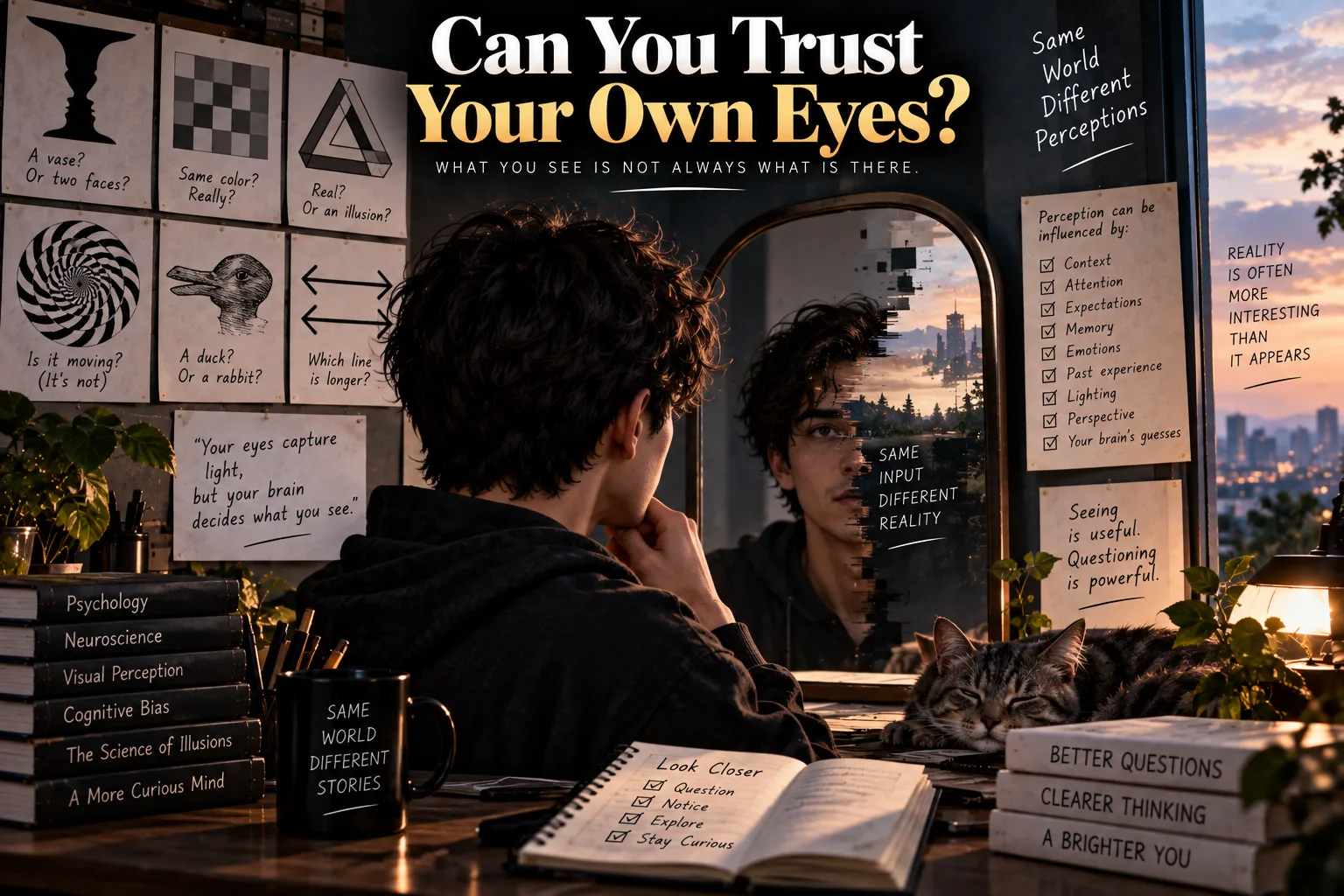
Your eyes capture light, but your brain decides what you see. Explore optical illusions, visual blind spots, context, attention, and why your perception can confidently disagree with reality.
Can You Trust Your Own Eyes?
Your eyes are probably the most convincing liar you own.
They don't feel like they're lying.
When you look at a red apple, you don't experience:
"Photons entered my retina, signals traveled through neural pathways, and my visual cortex generated an interpretation."
You experience:
"There is an apple."
It feels direct.
Immediate.
Certain.
And yet your visual system regularly makes mistakes.
It misses objects that are directly in front of you.
It changes the apparent size of things.
It can make stationary images appear to move.
It can interpret identical colors as different shades.
It can invent details that aren't actually there.
And sometimes it confidently tells you that two identical objects are different.
So can you trust your eyes?
The fascinating answer is:
You can trust them enough to navigate the world. You should not trust them as a perfect recording device.
Because your eyes don't actually tell you what reality is.
They collect information.
Your brain does the rest.
Your Eyes Don't "See" Anything
This distinction sounds philosophical, but it's biological.
Your eyes detect light.
Photoreceptor cells in the retina respond to different wavelengths and light levels.
Those signals are processed through several neural pathways and eventually interpreted by the brain.
What you experience as vision is the result.
Your eye is therefore closer to a sensor than a camera.
And even "camera" is misleading because cameras record information without constructing a conscious interpretation of it.
Your brain does.
The World Arrives as Signals
Imagine looking at a coffee mug.
The mug doesn't travel into your head.
Light reflected from its surface enters your eye.
The retina detects patterns.
Neurons process edges, contrast, color, movement, and other visual features.
Higher-level visual systems integrate that information.
Your brain then produces the experience:
"Mug."
You never directly experience the raw visual signal.
You experience the brain's processed interpretation.
Vision Is a Prediction Machine
Modern neuroscience increasingly describes perception as involving both incoming sensory information and the brain's expectations about what is likely to be there.
Your brain has enormous prior knowledge about:
Faces.
Objects.
Lighting.
Depth.
Motion.
Shapes.
Gravity.
Perspective.
It uses that information to interpret incomplete signals quickly.
This is incredibly useful.
Imagine having to consciously calculate every edge and shadow before recognizing a chair.
You'd never make it to the chair.
But Predictions Can Be Wrong
Suppose you see a dark shape in your bedroom at night.
Your brain interprets it as:
Person.
You turn on the light.
It's a jacket.
The visual information wasn't completely wrong.
The interpretation was.
Your brain made a rapid prediction based on incomplete information.
In darkness, that prediction can become more influential.
This is one reason ambiguous environments produce so many false perceptions.
Optical Illusions Exploit the Same System
Optical illusions are not merely amusing images.
They reveal how normal vision works.
An illusion succeeds because your brain applies a rule that usually works.
The problem is that the rule doesn't work in that particular image.
It's like using a normally excellent shortcut on the one road where someone secretly removed the bridge.
The Müller-Lyer Illusion
One famous example uses two lines with arrow-like endings.
The lines can appear to have different lengths even when they are physically identical.
Your visual system isn't malfunctioning in some random way.
It's interpreting the surrounding geometry.
The brain has learned patterns associated with depth, corners, and perspective.
Those assumptions can influence perceived length.
Your ruler can settle the argument.
Your eyes cannot.
Context Can Change Color
One of the most famous demonstrations of visual perception involved an image of a dress that people perceived differently.
Some observers saw:
Blue and black.
Others saw:
White and gold.
The physical image was identical.
What differed was interpretation of lighting conditions.
Your visual system tries to determine:
What illumination is falling on this object?
If the brain makes different assumptions about the lighting, perceived colors can change.
The pixels remain the same.
The experience changes.
Why Lighting Matters So Much
Imagine holding a white sheet of paper under:
Bright sunlight.
Warm indoor light.
Blue-tinted artificial light.
The amount of light reaching your eyes changes dramatically.
Yet you still perceive the paper as approximately white.
Your brain is performing something like color constancy.
It attempts to compensate for changes in illumination.
Most of the time, this is useful.
Without it, the apparent color of objects would shift dramatically throughout the day.
The downside is that compensation requires assumptions.
And assumptions can fail.
Your Brain Cares About Objects, Not Just Light
This is one of the deepest features of perception.
You're not usually interested in the raw light pattern.
You're interested in:
What is that?
Is it a person?
A car?
A dog?
A tree?
A threat?
A tool?
The brain therefore prioritizes meaningful interpretation.
This makes vision fast and useful.
It also means perception is influenced by what your brain believes matters.
Attention Creates Blind Spots
Imagine you're watching a basketball video.
You're told to count passes.
While focusing on the passes, you may completely miss an unexpected figure walking through the scene.
This phenomenon is associated with inattentional blindness.
The object was visible.
Your eyes received the information.
But your attention was directed elsewhere.
The Famous Invisible Gorilla
In a classic experiment, participants watched people passing a basketball and counted passes.
A person in a gorilla suit walked through the scene.
A surprising number of observers failed to notice.
This became one of the most famous demonstrations of inattentional blindness.
The lesson isn't:
"Your eyes are bad."
It's:
"Seeing something isn't the same as consciously noticing it."
Your Brain Has a Limited Attention Budget
Look around your room.
You are technically receiving information about:
Wall textures.
Shadows.
Temperature.
Sounds.
Furniture.
Screen brightness.
Peripheral movement.
Your brain cannot give equal conscious attention to everything.
So it prioritizes.
That creates an unavoidable trade-off.
The more attention you allocate to one thing, the less attention remains for other things.
Change Blindness
Another remarkable phenomenon is change blindness.
A substantial change in a scene can sometimes go unnoticed when it occurs during:
A visual interruption.
A blink.
A camera cut.
Movement.
A brief distraction.
You might watch two versions of a scene and fail to notice that an object has disappeared.
Again, the information was available.
Conscious awareness simply didn't register the change.
Why Security Footage Isn't Perfect
This matters outside psychology experiments.
People sometimes assume:
"There's video, so we know exactly what happened."
Not necessarily.
Video can be:
Incomplete.
Low resolution.
Occluded.
Misinterpreted.
Captured from poor angles.
And human observers can miss important changes even when footage exists.
Visual evidence is valuable.
It isn't automatically infallible.
Your Peripheral Vision Is Different From Central Vision
Your visual system doesn't have uniform resolution.
The center of your visual field provides much more detail than peripheral vision.
You can demonstrate this easily.
Focus on one word on your screen.
Now try reading another word several degrees away without moving your eyes.
It becomes much harder.
Your brain isn't rendering your entire visual field in perfect detail.
It prioritizes.
Why You Feel Like You're Seeing Everything
Your subjective experience feels continuous.
It seems like:
Everything is visible everywhere.
But your brain combines:
High-detail central information.
Lower-detail peripheral information.
Stored expectations.
Eye movements.
Memory.
Context.
and creates a coherent experience.
The result feels richer than the raw sensory information actually available at every moment.
Saccades: Your Eyes Are Constantly Jumping
Your eyes don't smoothly inspect the world continuously.
They make rapid movements called saccades.
During these movements, visual sensitivity changes.
You generally don't notice the world becoming blurred because your brain suppresses awareness of much of the motion.
Imagine seeing every tiny eye movement consciously.
Your visual experience would be chaotic.
Instead, your brain stitches together a stable world.
The stability is useful.
It is also constructed.
The Blind Spot You Don't Notice
Each eye has a natural blind spot where the optic nerve exits the retina.
There are no photoreceptors at that location.
Yet you don't normally walk around seeing a black hole in your vision.
Why?
Your brain fills in the missing information using surrounding patterns.
This is one of the clearest demonstrations that visual experience is not simply a direct map of retinal input.
Your brain literally supplies information where your eye doesn't have any.
You Can Find Your Blind Spot
Take a simple image containing two separate marks.
Close one eye.
Focus on one mark.
Move the image slowly.
At a particular distance, the other mark can disappear.
Then continue moving.
It reappears.
Nothing happened to the mark.
You moved its image onto the blind spot.
Your brain normally hides the omission so effectively that you don't notice it.
The Brain Fills in Missing Pieces
This doesn't only happen in the blind spot.
Your brain constantly fills gaps.
If part of an object is hidden behind another object, you generally perceive a complete object.
If a sentence is partially obscured, you can often infer the missing words.
If lighting hides part of a face, you still perceive a complete face.
The brain prefers coherent explanations.
Why Faces Are Special
Humans are extremely sensitive to faces.
A few simple shapes can be enough to produce the experience of a face.
Two dots and a curved line.
Suddenly:
: )
Your brain detects a socially meaningful pattern.
This sensitivity is useful because faces provide information about:
Identity.
Emotion.
Direction of attention.
Social interaction.
But it also creates pareidolia.
Seeing Faces Where None Exist
People see faces in:
Clouds.
Electrical sockets.
Car fronts.
Buildings.
Rock formations.
Toast.
Trees.
The object isn't secretly growing facial features.
Your brain is detecting a familiar pattern in ambiguous information.
Because recognizing a face can be extremely important, the visual system is particularly good at finding face-like structures.
Sometimes it gets enthusiastic.
Pareidolia Isn't the Same as Hallucination
This distinction matters.
In pareidolia, there is usually an ambiguous external pattern that your brain interprets as something meaningful.
A face-like arrangement exists in the clouds.
The brain recognizes it.
A hallucination can involve experiencing a perception without the corresponding external stimulus.
The mechanisms and clinical significance can be quite different.
Motion Can Be an Illusion Too
Some static images appear to move.
Patterns with carefully arranged:
Contrast.
Shapes.
Colors.
Edges.
can create a sensation of motion.
This happens because the visual system is extraordinarily sensitive to changes associated with movement.
Once again:
The image doesn't move.
Your brain says:
"Movement detected."
Why Peripheral Motion Is So Sensitive
From an evolutionary perspective, rapidly detecting movement at the edge of your vision can be useful.
Something moving toward you could be:
A predator.
Another person.
A falling object.
Your visual system therefore prioritizes motion in certain circumstances.
That makes sense.
Unfortunately, a curtain moving in the wind can occasionally receive the same psychological treatment as an approaching tiger.
Your Brain Uses Shadows as Information
Shadows tell you about:
Depth.
Shape.
Lighting direction.
Object position.
Your brain has learned these associations.
But unusual lighting can produce strange effects.
A shadow may make a flat surface appear raised.
A familiar object photographed upside down can become difficult to recognize.
Context changes interpretation.
Why Faces Look Strange Upside Down
Humans are unusually good at recognizing upright faces.
Turn a face upside down and recognition becomes harder.
Some face-specific illusions become dramatically stronger when facial features are inverted.
This suggests that the brain processes faces using specialized patterns rather than simply treating them as ordinary collections of shapes.
The result is a strange asymmetry:
A face can look obviously normal when upright and bizarre when inverted.
Your Expectations Can Change What You Notice
Suppose you are told:
"There is a snake somewhere in this room."
Suddenly, every cable starts looking suspicious.
A piece of clothing looks threatening.
A shadow becomes interesting.
The physical environment hasn't changed.
Your expectations have.
Threat-related information becomes more important.
This Is Useful and Dangerous
Expectations help you find important things quickly.
If you're searching for your lost keys, you mentally prepare for:
Shape.
Color.
Location.
Familiar surfaces.
This increases efficiency.
But expectations can also cause false alarms.
You may think you've found the keys because an object resembles them.
The brain values speed.
Accuracy is not always the only objective.
The Same Thing Happens With People
Suppose you expect someone to be rude.
They send a short message:
"Okay."
You interpret it as irritation.
Another person receives the same message and thinks:
"They're probably busy."
The words are identical.
Interpretation differs.
Vision isn't the only sense affected by expectations.
Human perception in general is deeply contextual.
Eyewitness Testimony Is Especially Vulnerable
Imagine witnessing a crime.
Your attention may focus on:
The weapon.
The face.
The direction people ran.
The vehicle.
Later, someone asks:
"Was the suspect wearing a red shirt?"
You hadn't noticed.
But now the question exists in your memory.
Later still, you might remember a red shirt.
Memory and perception interact.
That's one reason eyewitness identification can be less reliable than people intuitively assume.
Confidence Doesn't Guarantee Visual Accuracy
A witness can sound extremely certain.
That doesn't mean the memory is necessarily correct.
Confidence is influenced by:
Repetition.
Feedback.
Social reinforcement.
Emotion.
Time.
The way questions are asked.
A person's subjective certainty therefore isn't equivalent to objective accuracy.
Why Reconstructing Memory Matters
Suppose you see something ambiguous.
Later someone tells you what they think happened.
Your memory can incorporate information from the later conversation.
Now you remember the event differently.
You may sincerely believe the revised version is what you originally saw.
This is one reason investigators try to minimize suggestive questioning during sensitive interviews.
"Seeing Is Believing" Is Only Partly True
Visual evidence is often incredibly valuable.
Photographs.
Microscopy.
Astronomical observations.
Medical imaging.
Video.
But vision always requires interpretation.
A photograph can be real while its interpretation is wrong.
A scan can be accurate while its significance is misunderstood.
An eyewitness can be sincere while mistaken.
Evidence is only useful when interpreted carefully.
So Can You Trust Your Eyes?
Yes.
But trust them with calibration.
You can trust your visual system to do what it evolved and developed to do:
Help you navigate.
Recognize objects.
Detect movement.
Estimate depth.
Find faces.
Identify patterns.
Interact with the environment.
But don't treat conscious perception as a perfect copy of reality.
Your vision is:
Selective.
Constructive.
Predictive.
Context-sensitive.
And occasionally wrong.
🟢 What We Know
Several features of visual perception are strongly established:
Your retina samples incoming light.
The brain processes visual information through multiple interconnected systems.
Attention influences conscious perception.
Context influences interpretation.
The visual system predicts and integrates information.
Optical illusions exploit ordinary perceptual mechanisms.
Humans possess a retinal blind spot.
Eye movements contribute to visual sampling.
Memory and expectations can influence later reports of what was seen.
🟡 What Researchers Still Debate
Scientists continue investigating exactly how the brain combines:
Sensory evidence.
Predictions.
Attention.
Learning.
Memory.
Context.
Different theories emphasize these mechanisms differently.
The broad principle is clear:
Vision isn't passive recording.
The precise architecture of conscious perception remains an active research area.
🔴 Popular Myth
"Your eyes show you exactly what is there."
They don't.
They provide sensory information from which your brain constructs your visual experience.
That experience is usually extremely useful.
Useful isn't the same as perfect.
Frequently Asked Questions
Can your eyes actually lie?
Not literally. Your eyes detect physical signals. Errors usually arise from how the nervous system processes and interprets those signals.
Why do optical illusions work?
They exploit normal visual mechanisms involving context, perspective, contrast, depth, motion, and expectations.
Can you miss something directly in front of you?
Yes. Inattentional blindness can occur when attention is focused elsewhere.
What is a blind spot?
It's an area of the visual field corresponding to the optic-nerve exit point, where the retina lacks photoreceptors. Your brain normally fills in the missing information.
Why do people see faces in clouds?
This is called pareidolia, where ambiguous patterns are interpreted as familiar meaningful objects, especially faces.
Can emotions change what you see?
Emotional states can influence attention, threat detection, interpretation, and perceptual judgments, especially under ambiguous conditions.
Why do two people see the same thing differently?
They may have different expectations, attention, prior experiences, emotional states, and interpretations of the same sensory information.
Are optical illusions evidence that reality doesn't exist?
No. They demonstrate that perception is an interpretation of sensory information, not that there is no external reality.
Can eyewitnesses be wrong even when they're confident?
Yes. Confidence and accuracy can diverge, particularly when memories are influenced by time, suggestion, or later information.
Is human vision better than a camera?
That's the wrong comparison. Cameras and biological vision perform different tasks. Human vision combines sensory input with attention, prediction, memory, and interpretation to create a useful experience of the environment.
The Most Important Lesson About Vision
Your brain has a difficult job.
It receives incomplete information.
The environment is constantly changing.
Light varies.
Objects overlap.
Your eyes move.
Your attention is limited.
Yet you still need to make sense of everything quickly.
So the brain makes predictions.
It fills gaps.
It uses context.
It remembers patterns.
It ignores irrelevant information.
It creates stability.
Most of the time, this works beautifully.
And when it fails, the failure is often revealing.
An optical illusion doesn't show that your vision is broken.
It shows you how your vision normally works.
The blind spot doesn't prove your eyes are unreliable.
It reveals that your brain quietly fills missing information.
Inattentional blindness doesn't mean your eyes stopped functioning.
It shows that seeing and noticing are different processes.
Different interpretations of the same image don't mean everyone lives in a separate universe.
They show that perception depends partly on the observer.
Final Thoughts
Your eyes are astonishing.
They allow you to read.
Navigate.
Recognize faces.
Judge distances.
Avoid obstacles.
See stars billions of kilometers away.
Watch a sunset.
Read a tiny message on your phone at an hour when you should probably be asleep.
But your eyes were never designed to provide a perfectly objective recording of reality.
They're part of a larger system.
Light enters.
Signals are processed.
Attention selects.
Expectations influence.
Memory contributes.
The brain interprets.
And consciousness receives the final result.
That result is usually so convincing that you forget it is a construction.
Perhaps that's why optical illusions are so fascinating.
They briefly expose the machinery normally hidden behind your experience.
For a moment, the brain's prediction and the world's physical structure disagree.
You know the lines are identical.
You know the image is stationary.
You know there isn't a face in the cloud.
And yet you still see the opposite.
That is not your brain failing to do its job.
It is your brain revealing how the job is actually done.
So, can you trust your own eyes?
Trust them as remarkably useful sensors.
Don't treat them as unquestionable witnesses.
Because sometimes the most convincing thing in the room isn't what your eyes detected.
It's what your brain decided the evidence meant.