Blood Falls in Antarctica: Why Does a Glacier Bleed Red?
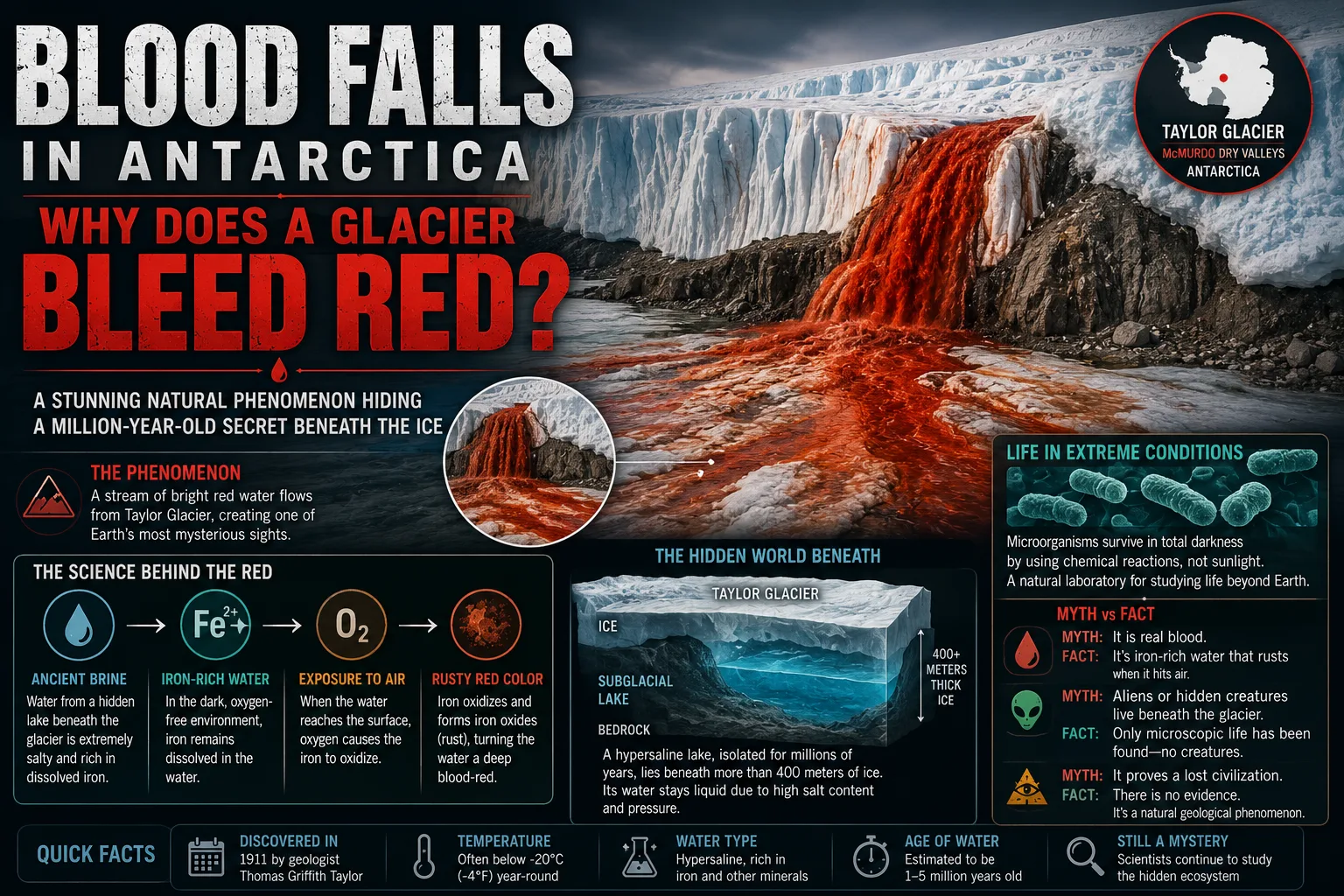
Flowing from Antarctica's Taylor Glacier is a stream of deep crimson water that resembles blood spilling across the ice. For more than a century, Blood Falls puzzled explorers and scientists alike. Discover the remarkable geology, hidden ancient lake, and chemical reactions that explain one of Earth's most mysterious natural wonders.
Blood Falls in Antarctica: Why Does a Glacier Bleed Red?
Imagine standing in the endless white wilderness of Antarctica.
The snow stretches to the horizon.
The air is so cold it burns your lungs.
Everything around you is frozen.
Then, without warning, you notice something impossible.
A stream of deep crimson liquid pours from the side of a glacier, staining the ice below with what looks disturbingly like fresh blood.
For early explorers, the sight was both fascinating and unsettling.
How could a glacier bleed?
Was it caused by strange algae?
A hidden volcanic source?
Some unknown life form trapped beneath the ice?
More than a century later, scientists finally uncovered the answer.
And it turned out to be far stranger than anyone expected.
Beneath one of Earth's coldest glaciers lies an ancient lake sealed away from the outside world for millions of years.
Its water contains almost no oxygen.
It is saltier than the ocean.
It hosts microscopic life surviving in complete darkness.
And when that hidden water finally reaches the surface...
It turns blood red.
A Discovery at the End of the World
The story begins in 1911.
Australian geologist Thomas Griffith Taylor was exploring Antarctica's McMurdo Dry Valleys, one of the driest and coldest deserts on Earth.
While surveying a glacier later named Taylor Glacier, he noticed an extraordinary sight.
Bright red water was flowing from the ice.
Against the white Antarctic landscape, the crimson stream looked almost unreal.
Taylor named the feature Blood Falls.
For decades, scientists debated what caused its remarkable color.
🟢 Established Scientific Evidence
Blood Falls was first documented in 1911 by geologist Thomas Griffith Taylor during the Australasian Antarctic Expedition. It flows from the front of Taylor Glacier in Antarctica's McMurdo Dry Valleys.
A Glacier That Appears to Bleed
At first glance, Blood Falls seems impossible.
Glaciers are made of frozen freshwater.
The temperature in this part of Antarctica often remains well below freezing.
So why does liquid water emerge at all?
And why is it bright red?
The mystery puzzled researchers for nearly a century.
Early theories suggested that red algae might be responsible.
Others suspected unusual minerals.
Neither explanation fully matched the evidence.
The true source remained hidden deep beneath the glacier itself.
Beneath the Ice Lies a Hidden Lake
Modern scientific investigations revealed something astonishing.
Far below Taylor Glacier exists an ancient subglacial reservoir.
This isn't an ordinary lake.
It has been trapped beneath hundreds of meters of ice for millions of years.
Unlike most lakes, its water is:
Extremely salty.
Rich in dissolved iron.
Almost completely deprived of oxygen.
Under immense pressure.
Because the salt concentration is so high, the water remains liquid even at temperatures well below the normal freezing point of freshwater.
In effect, the glacier hides an underground world that has remained isolated since long before humans existed.
🟢 Established Scientific Evidence
Geophysical surveys have confirmed that Blood Falls originates from a hypersaline subglacial reservoir beneath Taylor Glacier. The high salt content lowers the freezing point, allowing liquid water to persist beneath the ice.
Why Is the Water Red?
The answer lies in chemistry.
Deep beneath the glacier, the trapped water contains large amounts of dissolved iron.
While underground, the iron remains dissolved because there is almost no oxygen.
Everything changes when the water reaches the surface.
As it comes into contact with Antarctic air, the iron reacts with oxygen.
This process creates iron oxides, the same compounds responsible for rust.
The result is a dramatic transformation.
Clear underground water becomes a vivid crimson stream.
In other words...
The glacier isn't bleeding.
It's rusting.
🟢 Established Scientific Evidence
The red color of Blood Falls is caused by iron-rich brine oxidizing when exposed to oxygen at the surface. This reaction forms iron oxides, producing the characteristic blood-red appearance.
Water That Shouldn't Exist
One of the greatest surprises wasn't the color.
It was the water itself.
Scientists long believed glaciers like Taylor Glacier were completely frozen solid.
Blood Falls proved otherwise.
Tiny fractures inside the glacier allow highly pressurized brine to slowly migrate upward.
Eventually, it escapes through cracks in the ice and spills onto the glacier's surface.
Modern radar studies have even mapped hidden channels carrying this ancient water through the glacier's interior.
The ice isn't a perfectly solid block.
It's more like a frozen maze with narrow pathways hidden deep inside.
Life in Complete Darkness
Perhaps the most astonishing discovery came after researchers analyzed the water itself.
Despite being trapped beneath ice for millions of years...
They found life.
Microscopic organisms survive in this isolated environment without sunlight.
Without photosynthesis.
Without fresh oxygen.
Instead, these microbes obtain energy through chemical reactions involving iron and sulfur compounds dissolved in the ancient brine.
Their existence has transformed Blood Falls from a geological curiosity into one of the most important natural laboratories on Earth.
🟡 Active Scientific Research
Scientists continue studying the microorganisms living within Blood Falls because they demonstrate how life can survive in extreme environments with no sunlight and very limited oxygen. These discoveries are also helping researchers understand where life might exist beyond Earth.
🔴 Popular Myth / Unsupported Claim
Because of its appearance, Blood Falls is sometimes described as a supernatural phenomenon or evidence of hidden creatures beneath Antarctica.
There is no scientific evidence supporting these claims. The crimson color results from well-understood chemical reactions involving iron-rich water emerging from an ancient subglacial reservoir.
How Did Blood Falls Stay Hidden for Millions of Years?
For decades, scientists could explain what Blood Falls looked like.
They still couldn't explain where the water came from.
The biggest mystery was simple.
If Antarctica remains frozen year-round...
How could liquid water continue flowing beneath hundreds of meters of ice?
The answer required decades of research and some of the most advanced scientific instruments ever deployed in Antarctica.
Looking Beneath the Glacier
Drilling directly through the glacier would risk contaminating the hidden environment.
Instead, scientists turned to technology.
Using:
Ice-penetrating radar
Ground-penetrating radar
Satellite measurements
Electromagnetic surveys
Researchers gradually built a picture of what lay beneath Taylor Glacier.
What they found surprised everyone.
Instead of solid ice extending all the way to the bedrock...
They discovered an interconnected network of highly salty liquid water flowing through hidden channels beneath the glacier.
Blood Falls wasn't supplied by a single underground pool.
It was connected to a much larger hidden system.
🟢 Established Scientific Evidence
Geophysical surveys have revealed a network of hypersaline brine channels beneath Taylor Glacier. These hidden pathways allow ancient subglacial water to slowly migrate toward the surface.
Why Doesn't It Freeze?
This may be the most surprising part of the entire mystery.
Temperatures around Taylor Glacier regularly fall below -20°C (-4°F).
Freshwater would freeze solid.
Yet Blood Falls continues to flow.
The reason is salt.
The hidden water beneath the glacier is far saltier than seawater.
Salt dramatically lowers water's freezing point.
Combined with the immense pressure beneath the glacier, the brine remains liquid even in temperatures that would instantly freeze ordinary water.
Nature has created its own underground antifreeze.
A World Without Sunlight
For millions of years, the hidden reservoir beneath Taylor Glacier has existed in complete darkness.
No sunlight reaches it.
No plants grow there.
No photosynthesis occurs.
Yet microscopic organisms continue to survive.
How?
Instead of relying on sunlight, these microbes obtain energy through chemical reactions involving:
Iron compounds
Sulfur compounds
Dissolved minerals
This process, known as chemosynthesis, allows life to exist independently of the Sun.
It completely changed scientists' understanding of where life can survive.
🟢 Established Scientific Evidence
Microorganisms found within Blood Falls survive through chemical reactions rather than photosynthesis, making the ecosystem one of Earth's best examples of life thriving without sunlight.
A Window Into Other Worlds
Blood Falls is more than a geological curiosity.
It has become one of the most important research sites in astrobiology.
Scientists studying the hidden ecosystem believe it may resemble environments found elsewhere in our Solar System.
Several icy worlds contain evidence of underground oceans.
Among the most promising are:
Europa, a moon of Jupiter
Enceladus, a moon of Saturn
Possibly ancient Mars
If microscopic life can survive beneath Antarctica's ice for millions of years...
Perhaps similar life could survive beneath thick layers of extraterrestrial ice.
Blood Falls offers scientists a natural laboratory for testing that possibility.
🟡 Active Scientific Research
Researchers use Blood Falls as an analogue for icy worlds such as Europa and Enceladus. While no extraterrestrial life has been discovered, the site helps scientists understand how organisms might survive beneath ice-covered oceans elsewhere in the Solar System.
Common Myths
Because Blood Falls looks so dramatic, it has inspired countless sensational stories.
Let's separate science from speculation.
Myth: It's Actually Blood
No.
The water contains no blood whatsoever.
Its striking red color comes from iron-rich brine that oxidizes when exposed to oxygen, much like metal rusting in air.
Myth: Hidden Creatures Live Beneath the Glacier
No evidence supports this idea.
Scientists have found only microscopic life.
There are no giant organisms or mysterious animals living beneath Taylor Glacier.
Myth: Antarctica Is Hiding a Secret Civilization
Blood Falls is sometimes linked to internet stories about hidden civilizations beneath Antarctica.
There is no scientific evidence supporting these claims.
The phenomenon is fully explained by geology, chemistry, and microbiology.
🔴 Popular Myth / Unsupported Claim
Claims that Blood Falls proves the existence of hidden civilizations, giant underground creatures, or supernatural phenomena are not supported by scientific evidence. The site is one of the best-understood examples of iron-rich subglacial brine emerging through Antarctic ice.
Frequently Asked Questions
Where is Blood Falls?
Blood Falls flows from Taylor Glacier in Antarctica's McMurdo Dry Valleys, one of the coldest and driest regions on Earth.
Why is it red?
The water contains dissolved iron that reacts with oxygen at the surface, forming iron oxides that give the water its distinctive blood-red color.
How old is the water?
Scientists estimate the trapped brine has been isolated beneath the glacier for well over one million years, with some studies suggesting parts of the system may be considerably older.
Is Blood Falls still flowing today?
Yes.
Although the flow is often slow and intermittent, Blood Falls continues to emerge from Taylor Glacier and remains an active subject of scientific research.
Final Thoughts
Blood Falls reminds us that some of Earth's greatest mysteries are not ancient ruins or forgotten civilizations, but natural wonders hiding in plain sight. What appears to be a glacier bleeding across the Antarctic ice is, in reality, the visible edge of a hidden world sealed beneath the continent for millions of years.
Its iron-rich waters, hypersaline chemistry, and remarkable microbial ecosystem have transformed Blood Falls from a geological curiosity into one of the most important scientific sites on the planet. Here, researchers study not only how life survives in extreme conditions, but also how similar environments might exist beyond Earth.
In the end, Blood Falls teaches a lesson repeated throughout science: the first explanation is not always the correct one, and the real story is often even more extraordinary. Beneath the frozen silence of Antarctica, an ancient underground ecosystem has quietly endured through immense spans of time, waiting for humanity to discover that even in the coldest, darkest places, life can still find a way.