The AI Research Workflow That Turns One Topic Into 20 Content Ideas
Running out of content ideas isn't usually an inspiration problem. It's a research problem. Learn how to use AI to transform a single topic into a complete content cluster by discovering audience questions, organizing search intent, identifying content gaps, and building a repeatable research workflow.
The AI Research Workflow That Turns One Topic Into 20 Content Ideas
One of the biggest misconceptions in content creation is that successful creators constantly come up with brilliant new ideas.
In reality, they rarely start with dozens of unrelated ideas.
Instead, they begin with one valuable topic and systematically expand it into an entire content ecosystem.
A single topic can become blog posts, YouTube videos, newsletters, social media threads, guides, FAQs, tutorials, case studies, and comparison articles. The difference isn't creativity alone. It's having a repeatable research workflow.
Artificial intelligence makes this process dramatically faster, but only when it's used correctly. Asking an AI assistant to "give me content ideas" usually results in generic suggestions that thousands of other creators have already received.
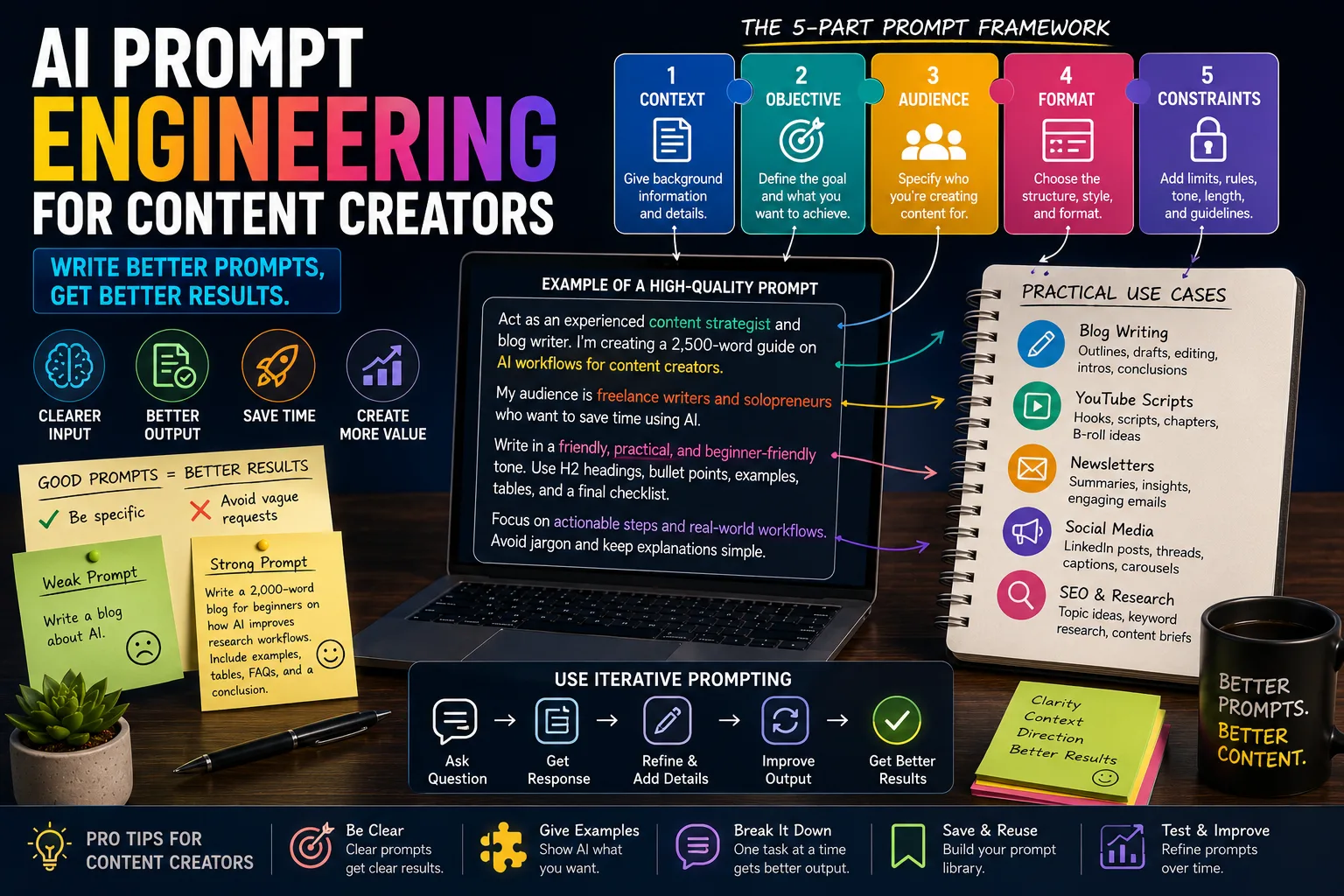
A better approach is to use AI as a research partner. Instead of generating random ideas, AI can help uncover audience questions, organize search intent, identify content gaps, and transform one broad topic into a structured content cluster.
This guide explains a practical AI-powered research workflow that helps creators consistently discover high-quality content opportunities without relying on inspiration alone.
Who This Guide Is For
This workflow is designed for creators who publish educational or informational content on a regular basis.
It is particularly valuable for:
Bloggers
Newsletter writers
YouTubers
Freelancers
SEO specialists
SaaS marketers
Startup founders
Content agencies
Small marketing teams
Whether you're creating one article a week or managing an entire editorial calendar, this workflow helps you build a sustainable pipeline of ideas.
Why Most Creators Eventually Run Out of Ideas
Running out of content ideas usually isn't caused by a lack of creativity.
It's caused by poor research systems.
Many creators rely on questions like:
What should I write today?
What's trending right now?
Can AI give me some blog ideas?
The problem is that these questions start from nothing.
Without context, AI generates broad suggestions that are often repetitive and disconnected from your audience.
Successful creators approach the problem differently.
Instead of asking AI to invent ideas, they collect signals from real people and let AI organize those signals into valuable content opportunities.
Brainstorming vs Research
Although these terms are often used interchangeably, they serve different purposes.
Brainstorming | Research |
|---|---|
Generates possibilities | Validates opportunities |
Based on imagination | Based on audience demand |
Quick and creative | Structured and evidence-driven |
Can produce random ideas | Produces connected content systems |
Brainstorming helps you think broadly.
Research helps you decide what deserves your time.
AI becomes far more valuable when it supports research rather than replacing it.
The AI Research Workflow
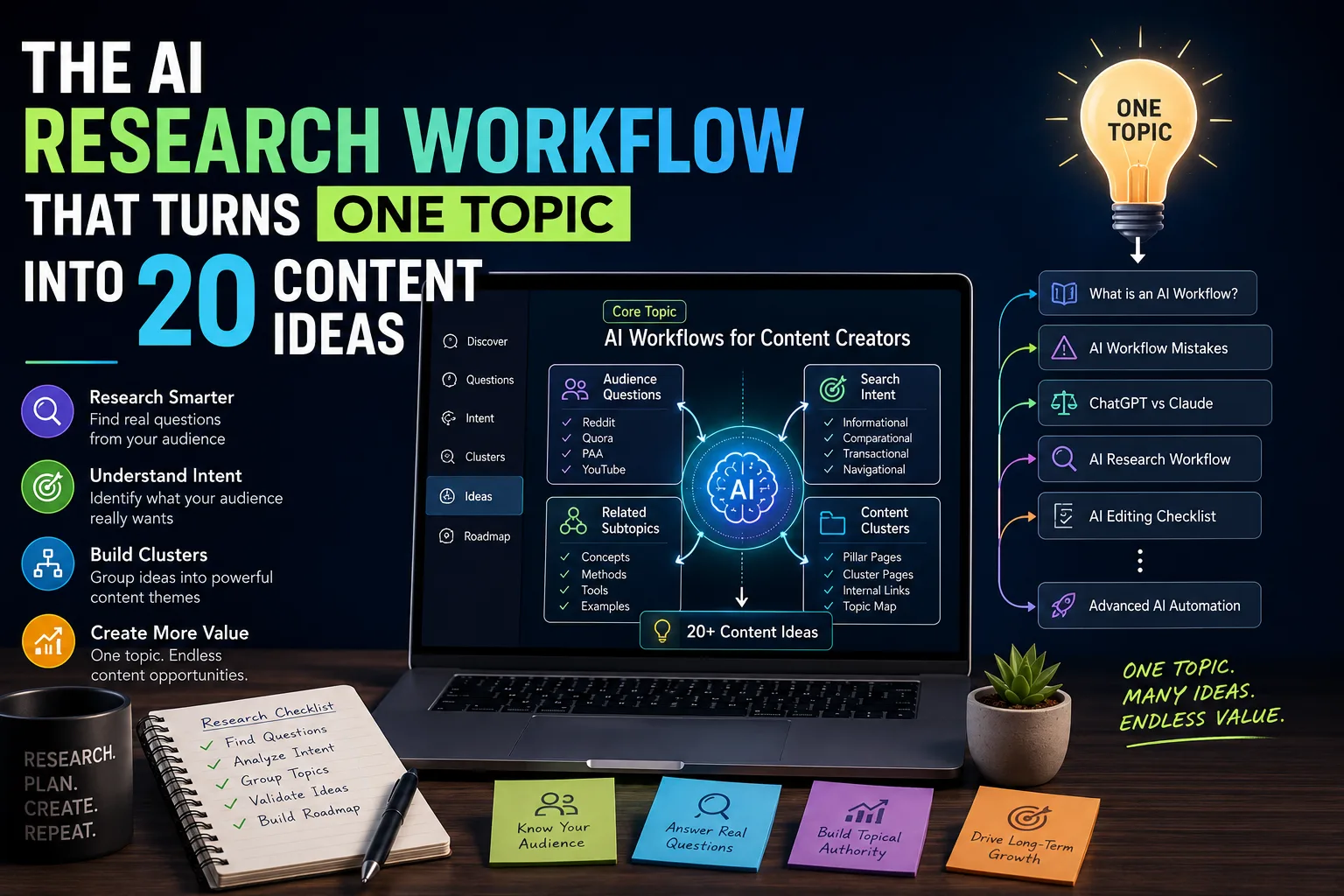
The workflow can be divided into eight repeatable stages:
Choose one core topic.
Discover audience questions.
Identify search intent.
Expand related subtopics.
Organize content clusters.
Prioritize ideas.
Build an editorial roadmap.
Repeat the process for the next topic.
Every stage builds upon the previous one, gradually transforming a single subject into an interconnected content library.
Step 1: Start With One Strong Topic
The biggest mistake creators make is beginning with a list of unrelated article ideas.
Instead, begin with one broad topic that matters to your audience.
Examples include:
AI Workflows
Email Marketing
Notion
Content Strategy
Personal Finance
Productivity
Freelancing
Remote Work
The topic should be broad enough to support multiple articles but focused enough to establish topical authority.
For example:
Instead of:
AI
Choose:
AI Workflows for Content Creators
This immediately narrows the audience while leaving plenty of room for expansion.
Step 2: Understand What Your Audience Is Actually Asking
Great content answers real questions.
Before generating article ideas, identify what your audience genuinely wants to know.
Useful sources include:
Search engine autocomplete
People Also Ask sections
Reddit communities
Quora discussions
YouTube comments
Product reviews
Customer support emails
Community forums
LinkedIn discussions
Social media comments
Rather than copying every question, collect them into one research document.
Once you've gathered enough material, AI can begin organizing the information.
Let AI Organize Questions Into Themes
Imagine you've collected fifty audience questions.
Instead of reviewing each manually, ask AI to:
Group similar questions.
Identify recurring patterns.
Remove duplicates.
Highlight beginner topics.
Separate advanced topics.
Suggest logical learning paths.
For example:
Questions like:
How do creators use AI?
Can AI write blog posts?
Which AI tools are best?
How should beginners start?
might naturally form a cluster called:
Getting Started with AI Workflows
Another group might become:
Advanced AI Automation
Instead of fifty unrelated questions, you now have structured content themes.
Step 3: Identify Search Intent
Not every question has the same purpose.
Understanding intent helps creators produce content that matches what readers are actually looking for.
Most informational content falls into four broad categories:
Intent | Example |
|---|---|
Learn | What is prompt engineering? |
Compare | ChatGPT vs Claude |
Solve | How to automate content planning |
Decide | Best AI tools for creators |
Matching your article to the correct intent improves both reader satisfaction and search visibility.
For example:
Someone searching:
AI research workflow
is probably looking for a practical process.
Someone searching:
Best AI research tools
expects recommendations and comparisons.
Although the subjects are related, they require different articles.
Step 4: Expand One Topic Into Multiple Angles
Once search intent is clear, begin exploring different perspectives.
Suppose your core topic is:
AI Workflows
Instead of writing one article, AI can help generate multiple content angles.
Examples include:
Beginner Guides
What Is an AI Workflow?
AI Workflow Mistakes Beginners Make
AI Tools Every Creator Should Know
Tutorials
Build a Weekly Content Calendar with AI
AI Research Workflow
AI Editing Workflow
Comparisons
ChatGPT vs Claude
Notion vs Trello
Zapier vs Make
Advanced Topics
AI Workflow Automation
Scaling Content Systems
Multi-Platform Publishing
Opinion Pieces
Why Generic AI Content Fails
Should Creators Depend on AI?
Suddenly, one topic has become an entire content roadmap.
Step 5: Build Topic Clusters Instead of Isolated Articles
Search engines increasingly reward websites that demonstrate expertise across an entire subject rather than publishing isolated articles.
Instead of treating every article as a separate project, connect related content around a central pillar.
For example:
Pillar Article
AI Workflows for Creators
↓
Supporting Articles
Weekly Content Calendar
ChatGPT vs Claude
AI Research Workflow
AI Editing Checklist
AI Workflow Mistakes
AI Repurposing Workflow
AI Newsletter Workflow
Each supporting article answers a specific question while reinforcing the broader topic.
This creates a better experience for readers and makes internal linking much more natural.
Step 6: Expand One Topic Into Twenty Content Ideas
Let's look at a practical example.
Suppose your primary topic is:
Content Repurposing
Instead of publishing one guide, AI can help expand it into an entire content series.
Possible ideas include:
What Is Content Repurposing?
Why Repurposing Saves Time
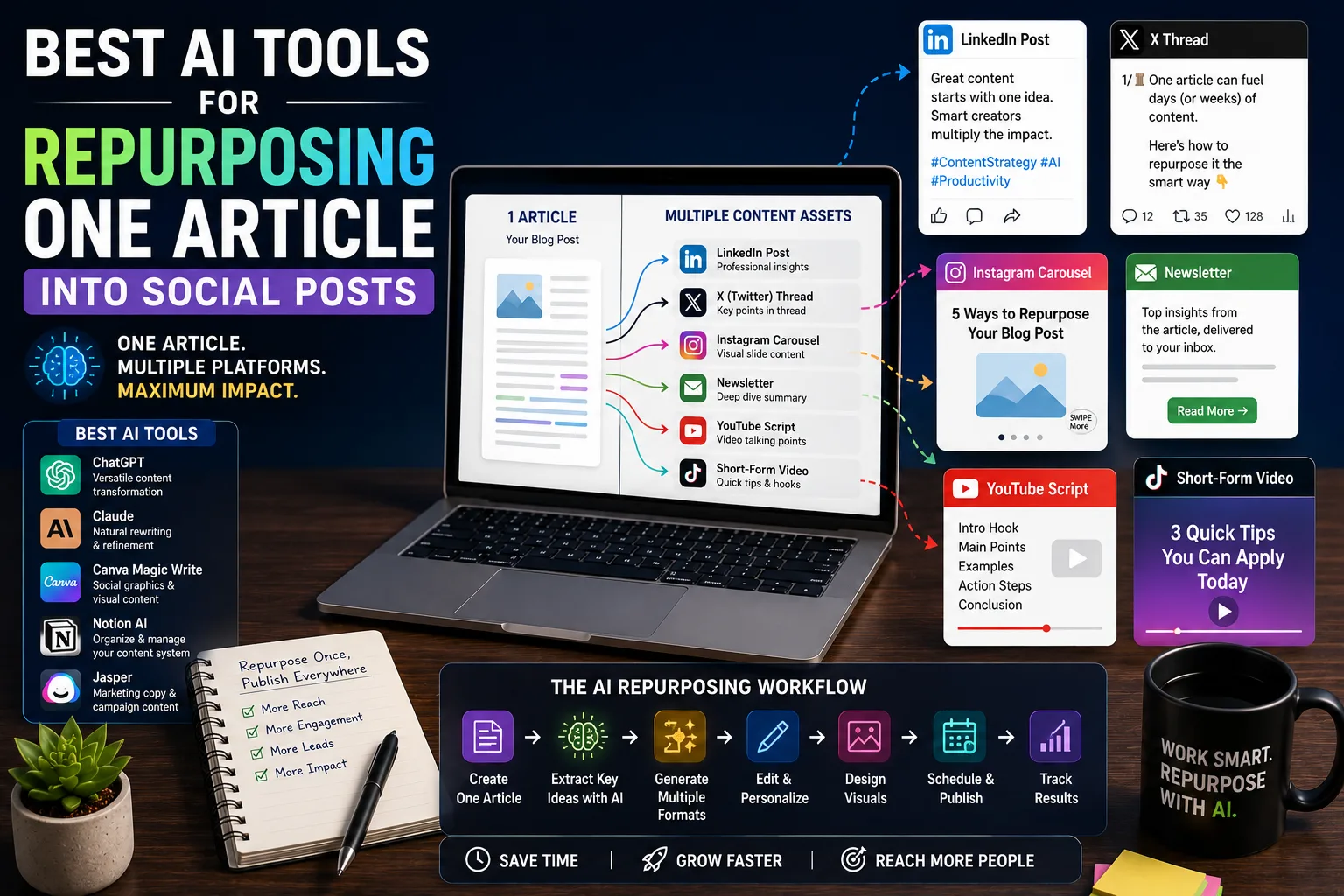
AI Tools for Content Repurposing
Blog to LinkedIn Workflow
Blog to Newsletter Workflow
Blog to X Thread Workflow
Blog to Instagram Carousel Workflow
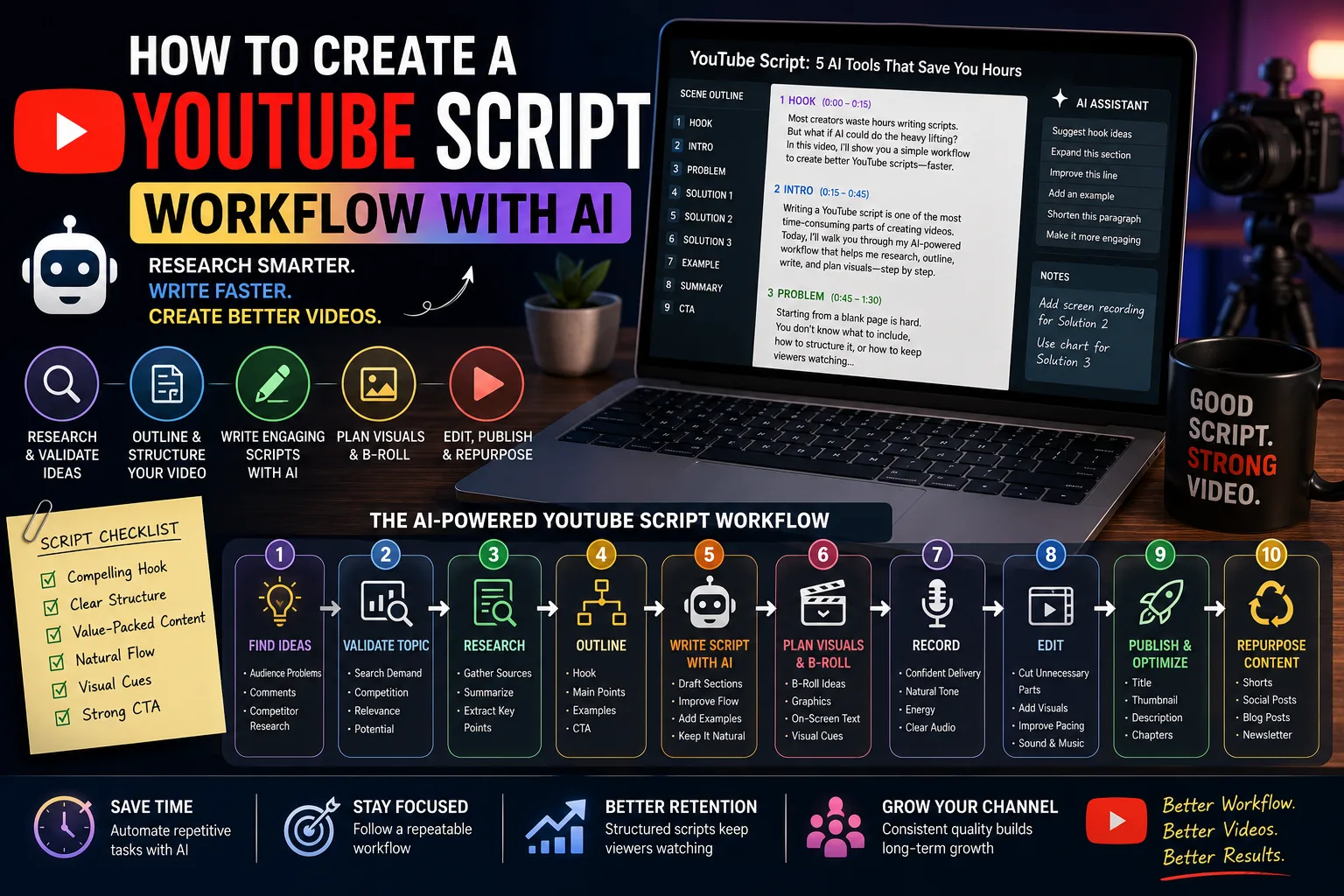
Blog to YouTube Script Workflow
Repurposing Mistakes
Repurposing Checklist
Automation Tools for Repurposing
Content Repurposing Templates
Measuring Repurposed Content Performance
AI Prompts for Repurposing
Case Study: One Blog, Ten Assets
Weekly Repurposing System
SEO and Repurposed Content
Best Tools Comparison
Beginner Repurposing Guide
Advanced Repurposing Workflow
Notice that none of these ideas were random.
They all support the same core topic, making future content planning significantly easier.
End of Part 1.
Part 2 continues directly from expanding one topic into a scalable content ecosystem. It covers idea validation, prioritization frameworks, creating reusable research systems, advanced AI prompting techniques, common research mistakes, a comple
Step 7: Validate Content Ideas Before You Start Writing
Generating dozens of content ideas is relatively easy.
Choosing the right ones is where the real work begins.
Publishing every idea simply because AI suggested it often leads to inconsistent quality and scattered topical coverage.
Instead, evaluate each idea before adding it to your editorial calendar.
A practical validation framework includes five questions:
Validation Question | Why It Matters |
|---|---|
Does it solve a real problem? | Readers search for solutions, not random opinions. |
Is it relevant to my audience? | Even great ideas fail if they target the wrong readers. |
Can I contribute something unique? | Original insights build authority and trust. |
Does it support an existing content cluster? | Connected content strengthens topical authority. |
Can it stay useful over time? | Evergreen articles continue generating value long after publication. |
If an idea scores well across these questions, it deserves a place in your content calendar.
Step 8: Prioritize Before You Publish
Not every valuable idea should be published immediately.
Some topics drive traffic.
Others build authority.
Some generate leads.
Others support internal linking.
A simple prioritization system helps creators focus on what matters most.
Consider scoring each idea based on:
Audience demand
Business relevance
Search opportunity
Evergreen potential
Content difficulty
Example:
Topic | Audience | Business | SEO | Evergreen | Total |
|---|---|---|---|---|---|
AI Workflow Guide | 5 | 5 | 5 | 5 | 20 |
ChatGPT vs Claude | 5 | 4 | 5 | 4 | 18 |
AI Prompt Templates | 4 | 5 | 4 | 5 | 18 |
Productivity Tips | 3 | 3 | 3 | 4 | 13 |
This turns content planning into a strategic process rather than an emotional one.
Step 9: Build a Reusable Research System
The best creators don't restart their research from zero every week.
They build systems.
Create a dedicated research library where you store:
Audience questions
Research notes
Interesting statistics
Product documentation
Screenshots
Case studies
AI prompts
Competitor observations
Industry trends
Frequently referenced sources
Tools like Notion, Obsidian, or any structured knowledge base work well for this purpose.
As your library grows, future research becomes significantly faster because you're expanding an existing database instead of rebuilding one from scratch.
Use AI to Discover Content Gaps
One of AI's most useful capabilities is identifying what's missing.
After reviewing your existing articles, ask AI questions like:
Which beginner topics have I not covered?
Which advanced questions remain unanswered?
Which supporting articles should connect to this guide?
Which comparisons would readers expect next?
What FAQs should become standalone articles?
This shifts your workflow from constantly inventing new ideas to systematically filling knowledge gaps.
Over time, your website becomes a comprehensive resource rather than a collection of unrelated posts.
Create Evergreen Topic Maps
Instead of maintaining a simple list of article ideas, build topic maps.
For example:
AI Workflows
│
├── Beginner Guides
│ ├── What Is an AI Workflow?
│ ├── AI Tools for Beginners
│ └── AI Workflow Mistakes
│
├── Tutorials
│ ├── Weekly Content Calendar
│ ├── AI Research Workflow
│ ├── AI Editing Checklist
│ └── Newsletter Workflow
│
├── Comparisons
│ ├── ChatGPT vs Claude
│ ├── Zapier vs Make
│ └── Notion vs Trello
│
└── Advanced Guides
├── Workflow Automation
├── Content Systems
└── Multi-Platform Publishing
This visual structure makes it easier to identify missing articles while ensuring every new piece strengthens your site's topical authority.
Common AI Research Mistakes
AI can dramatically accelerate research, but it can't compensate for poor habits.
Avoid these common mistakes.
Asking for Ideas Without Context
A prompt like:
"Give me blog ideas."
usually produces generic suggestions.
Instead, provide:
Your niche
Target audience
Existing articles
Publishing goals
Content format
Context leads to significantly better results.
Treating AI as the Only Research Source
AI should organize and accelerate research, not replace primary sources.
Always verify:
Statistics
Product features
Pricing
Research papers
Quotes
Legal or financial information
The strongest articles combine AI efficiency with reliable sources.
Chasing Every Trend
Trending topics can attract short-term attention, but they shouldn't replace evergreen content.
Aim for a healthy balance, such as:
70% Evergreen
20% Industry Updates
10% Experimental Content
This creates a stable content library while leaving room for timely opportunities.
Publishing Isolated Articles
An excellent standalone article is valuable.
Twenty interconnected articles are significantly more powerful.
Think in systems.
Every article should either:
Expand an existing topic,
Answer a related question,
Support another guide, or
Lead readers deeper into your content ecosystem.
AI Prompt Framework for Better Research
Instead of asking AI to "generate ideas," try following a structured sequence.
Define the core topic.
Identify the target audience.
Collect audience questions.
Group similar questions.
Determine search intent.
Generate supporting article ideas.
Prioritize ideas based on impact.
Build an editorial roadmap.
This framework produces more focused, relevant, and scalable content plans than one-off brainstorming sessions.
Frequently Asked Questions
How many content ideas should one topic generate?
There is no fixed number.
Broad topics often support 15 to 30 high-quality articles, while narrower subjects may naturally produce fewer. Focus on depth and usefulness rather than reaching an arbitrary number.
Can AI replace keyword research tools?
Not entirely.
AI is excellent for organizing ideas, clustering topics, and generating content angles. Dedicated SEO tools remain valuable for measuring search volume, competition, and ranking opportunities.
Should every article become a content cluster?
Not necessarily.
Reserve full content clusters for topics that are central to your niche and have enough depth to support multiple high-value articles.
How often should I update my research?
Review evergreen research every few months, and revisit time-sensitive topics whenever products, pricing, regulations, or industry developments change.
Final Takeaway
Great content doesn't begin with endless brainstorming. It begins with understanding what your audience wants to learn and building a system that consistently uncovers those opportunities.
AI makes research faster, but the real advantage comes from using it strategically. Instead of asking for random ideas, use AI to organize questions, uncover patterns, validate opportunities, and build interconnected content clusters around topics that matter.
Over time, this approach creates a library of articles that reinforce one another, making your content easier to discover, easier to navigate, and more valuable to readers.
The goal isn't to publish more articles. It's to publish the right articles in the right order, each one strengthening the next. A single well-researched topic can become months of meaningful content if you approach it with a repeatable research workflow instead of waiting for inspiration to strike. Inspiration is wonderful, but it has an unfortunate habit of taking unscheduled vacations.