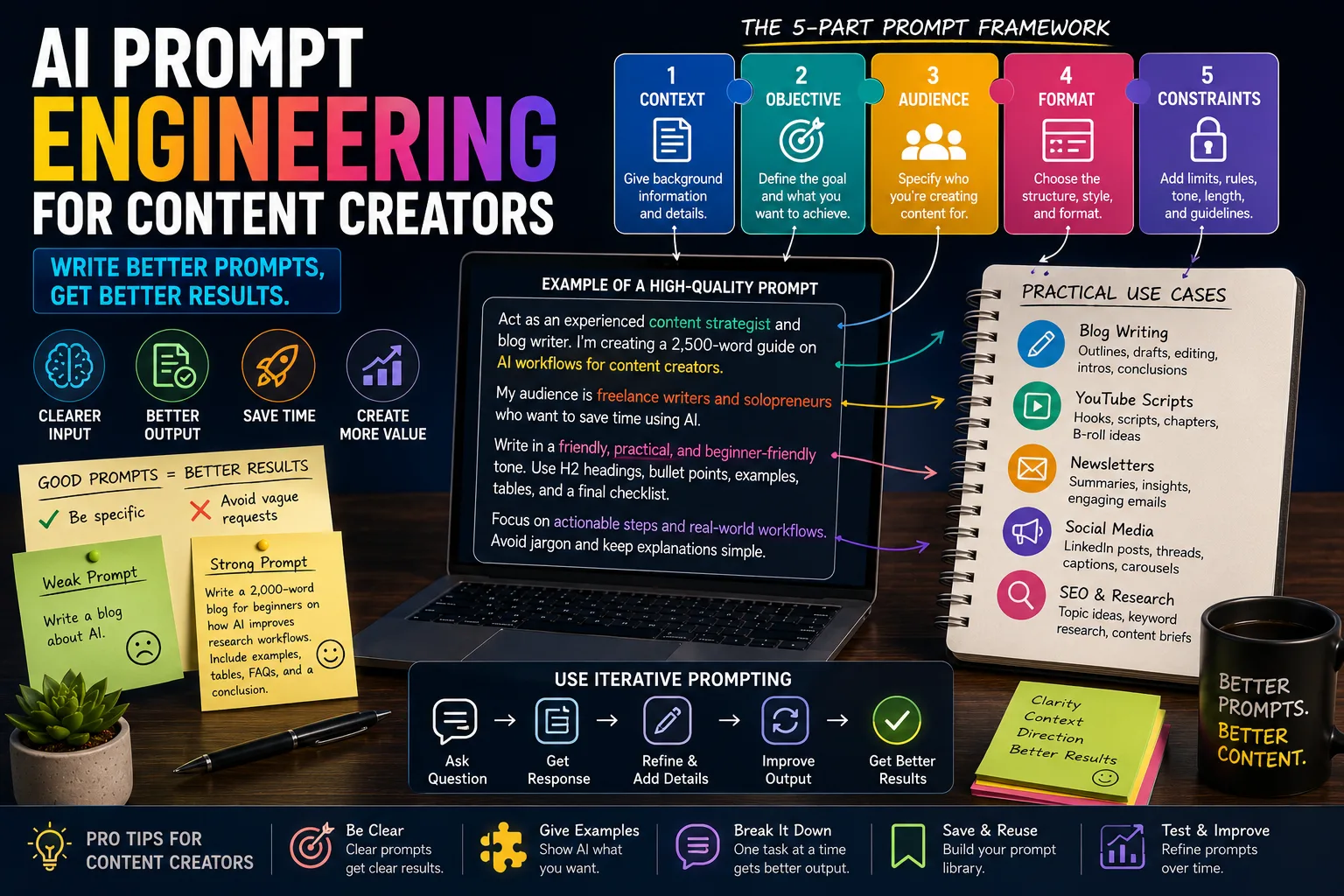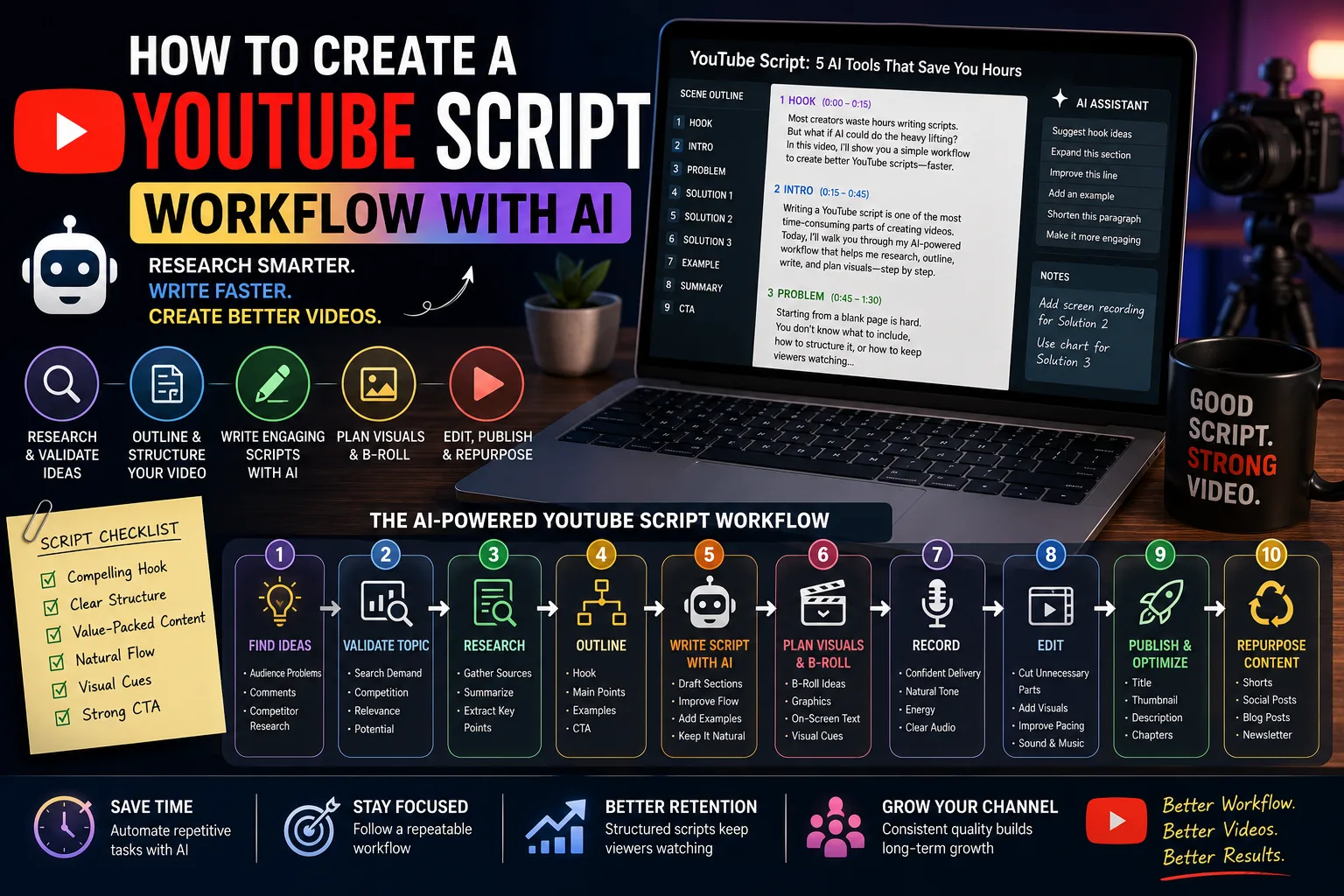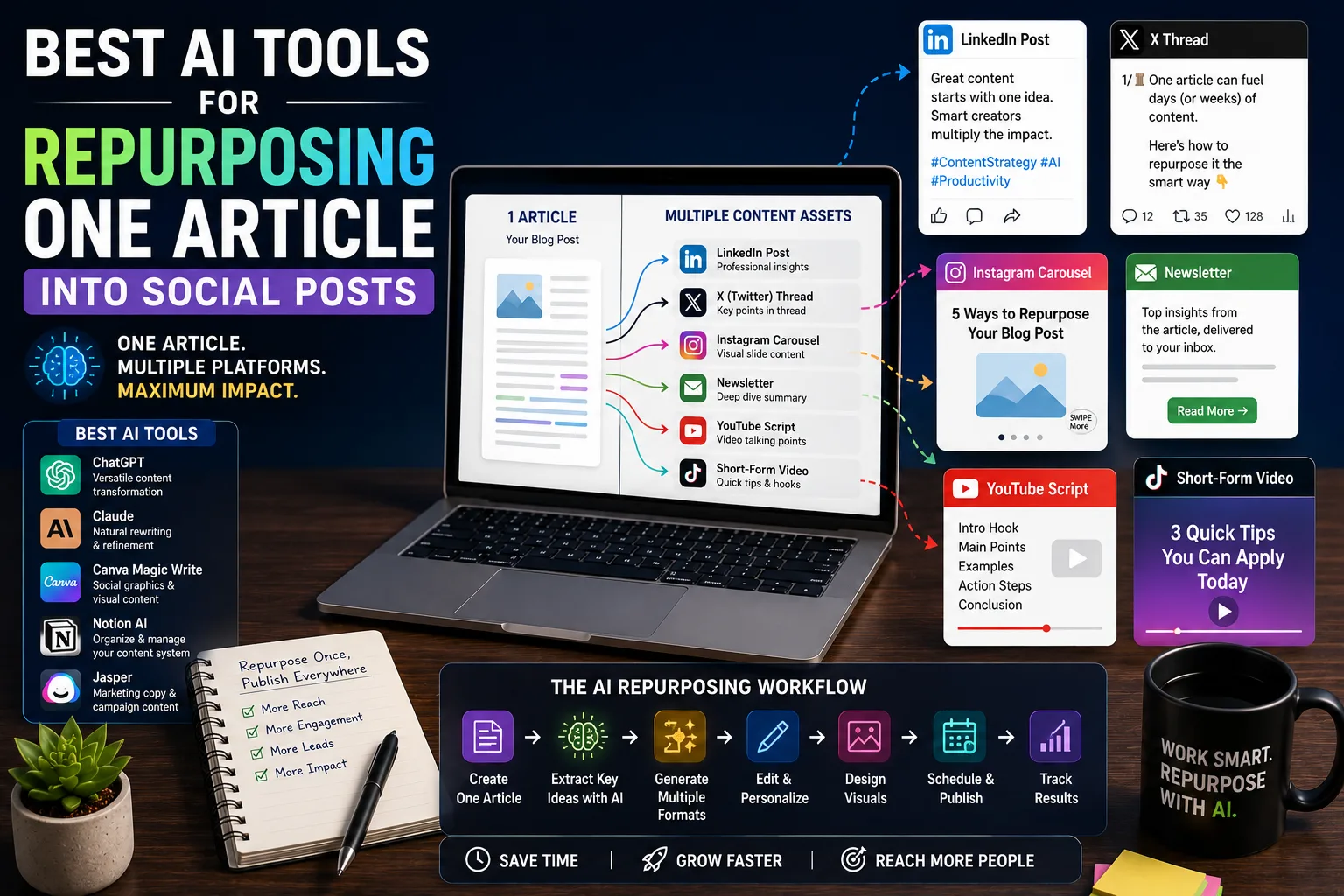
AI Workflows for Creators: The Complete Practical Guide to Creating Better Content Faster
Creating great content isn't about letting AI do all the work. It's about building a workflow that combines research, writing, editing, design, publishing, and analytics into a repeatable system. This guide shows creators how to use AI at every stage without sacrificing originality, quality, or their unique voice.
AI Workflows for Creators: The Complete Practical Guide to Creating Better Content Faster
Creating content consistently has never been easier, yet producing content that people genuinely want to read, watch, or share has never been more challenging.
Artificial intelligence has dramatically reduced the effort required to generate words, images, and ideas. But as AI-generated content floods search engines and social media, audiences have become better at recognizing generic, low-value content. Publishing more isn't enough anymore. The creators who succeed are those who use AI as a productivity partner rather than a replacement for their expertise.
A well-designed AI workflow doesn't replace creativity. Instead, it removes repetitive work so creators can spend more time thinking, experimenting, and delivering value.
This guide walks through a practical, end-to-end AI workflow for creators, covering research, planning, writing, editing, design, publishing, and performance analysis. Whether you run a blog, YouTube channel, newsletter, podcast, or freelance business, you'll learn how to build a repeatable system that produces higher-quality content in less time.
Who This Guide Is For
This guide is designed for creators who want to build sustainable content systems rather than relying on inspiration alone.
It will be particularly useful if you're a:
Blogger publishing long-form articles
YouTuber creating educational or informational videos
Newsletter writer
Freelancer managing content for multiple clients
Solo entrepreneur building a personal brand
Small marketing team with limited resources
SaaS founder creating educational content
Content strategist responsible for multiple channels
You don't need to use every AI tool mentioned in this guide. The goal isn't to build the most complex workflow. It's to create one that fits your process and eliminates repetitive tasks without compromising quality.
What Is an AI Workflow?
An AI workflow is a structured process where artificial intelligence assists with specific tasks throughout the content creation lifecycle.
Instead of asking an AI assistant to "write an article," creators break the work into smaller stages, allowing AI to support each one while the human creator remains responsible for strategy, judgment, and originality.
A typical workflow might look like this:
Stage | AI Helps With | Human Focus |
|---|---|---|
Research | Collecting information, summarizing sources, finding related questions | Evaluating relevance and verifying facts |
Planning | Outlines, content structures, headline ideas | Choosing the best angle |
Writing | Draft generation, transitions, formatting | Personal insights, examples, storytelling |
Editing | Grammar, clarity, consistency | Brand voice and factual accuracy |
Visuals | Image ideas, design briefs, thumbnails | Creative direction |
Publishing | Metadata, SEO suggestions, formatting | Final review |
Analytics | Performance summaries, trend detection | Strategic decisions |
Notice that AI supports every stage, but it doesn't own any of them.
That's an important distinction. The most effective creators use AI to accelerate execution, not replace critical thinking.
Why AI Workflows Matter in 2026
AI tools are now capable of producing articles, scripts, emails, presentations, images, and even videos in minutes. While that sounds impressive, it also means audiences are exposed to more repetitive content than ever before.
Search engines and social platforms increasingly reward content that demonstrates expertise, originality, and practical value. Simply publishing AI-generated text is unlikely to create a lasting competitive advantage.
A structured AI workflow helps creators solve several common problems.
Consistency
Many creators stop publishing because content creation becomes difficult to sustain alongside client work, business operations, or personal commitments.
By reducing repetitive work, AI workflows make publishing on a consistent schedule more realistic.
Speed Without Sacrificing Quality
Starting from a blank page is often the hardest part of creating content.
AI can generate outlines, summarize research, and suggest structures, allowing creators to spend their time refining ideas rather than staring at an empty document.
Better Decision-Making
Content creation involves hundreds of small decisions.
Which topic should you cover?
What questions should you answer?
Which headline will attract readers?
Which keywords deserve attention?
What should your call to action be?
AI can provide options quickly, helping creators evaluate possibilities instead of generating everything manually.
Scaling Across Platforms
Modern creators rarely publish on a single platform.
One article may become:
A LinkedIn post
An X thread
A YouTube video
A newsletter
An Instagram carousel
A podcast discussion
Multiple short-form videos
An effective AI workflow makes repurposing content significantly faster while maintaining consistency across channels.
The Modern Creator Workflow
Instead of treating AI as a writing tool, think of it as an assistant that supports every stage of production.
A practical workflow typically follows this sequence:
Discover opportunities
Validate ideas
Research thoroughly
Plan the content
Draft efficiently
Edit carefully
Create visuals
Optimize for search
Publish
Repurpose
Measure performance
Improve the next piece
Each stage builds upon the previous one, creating a repeatable system that becomes faster over time.
Let's examine each stage in detail.
Step 1: Discover Content Opportunities
Every successful piece of content begins with understanding what people actually want to learn.
Rather than brainstorming topics randomly, creators should build an "idea collection system."
Potential sources include:
Customer questions
Blog comments
YouTube comments
Reddit discussions
Community forums
Product reviews
Support emails
Social media conversations
Industry news
Competitor content gaps
AI can help organize these inputs into categories, identify recurring themes, and suggest related topics that deserve further exploration.
For example, instead of asking:
"Give me blog ideas."
Try asking:
"Group these 50 customer questions into themes and identify the five topics with the highest educational value."
The difference is subtle but important. You're asking AI to analyze existing information rather than invent ideas without context.
Step 2: Validate the Topic Before Creating Anything
Not every interesting idea deserves an article.
Before investing hours into writing, validate whether the topic aligns with your audience and goals.
Ask questions such as:
Does this solve a real problem?
Is the topic evergreen or time-sensitive?
Can I contribute something unique?
Are there unanswered questions competitors haven't addressed?
Will this article support future content?
A simple validation framework can help:
Question | Yes/No |
|---|---|
Solves a real problem | ☐ |
Matches audience intent | ☐ |
Fits brand expertise | ☐ |
Offers unique insights | ☐ |
Supports internal linking | ☐ |
Can be updated over time | ☐ |
If most answers are "Yes," the topic is worth pursuing.
Step 3: Research Like an Editor, Not a Search Engine
Research is where many AI-generated articles fall apart.
Some creators ask AI to explain a topic and immediately turn the response into a published article. The result is often generic, inaccurate, or missing important context.
A stronger workflow treats AI as a research assistant, not the final authority.
Start by gathering information from multiple sources, including:
Official documentation
Product websites
Case studies
Industry reports
Academic papers (where relevant)
Interviews
Podcasts
Expert blogs
Public datasets
Once you've collected credible material, AI can help by:
Summarizing lengthy documents
Comparing different viewpoints
Extracting key takeaways
Identifying missing information
Creating research notes
Organizing findings into themes
This approach gives you a much stronger foundation than relying on AI-generated summaries alone.
Building a Research Library
One habit shared by experienced creators is maintaining a personal knowledge base.
Instead of researching the same topic repeatedly, store useful resources in a central location such as Notion, Obsidian, or another note-taking system.
Organize information into categories like:
Statistics requiring periodic verification
Favorite examples and case studies
Industry trends
Useful prompts
Workflow templates
Screenshots
Product comparisons
Quotes from interviews
Original observations
Over time, this library becomes a competitive advantage. While AI can access public information, your curated collection reflects your experience, interests, and editorial judgment.
Step 4: Plan Before You Write
Many creators jump directly from research to drafting, only to spend hours reorganizing their work later.
A better approach is to create a detailed outline before writing the first paragraph.
Think of the outline as the blueprint for your article. It defines the reader's journey, ensures ideas flow logically, and highlights any gaps before time is spent on drafting.
A practical planning session should answer questions such as:
What is the primary problem the reader wants to solve?
Which questions should be answered first?
What examples will make the article more useful?
Which sections require screenshots or visuals?
Where should internal links naturally appear?
What action should the reader take after finishing the article?
AI excels at proposing multiple outline structures, comparing different approaches, and identifying missing sections. The final structure, however, should always be shaped by the creator's understanding of the audience, not accepted word-for-word.
A strong outline doesn't make writing feel restrictive. It makes writing faster because every section has a clear purpose. Step 5: Draft Smarter, Not Faster
With a well-structured outline in place, drafting becomes significantly easier. Instead of asking AI to produce a complete article in one go, work section by section.
This gives you more control over the quality, accuracy, and flow of the final piece.
A practical drafting workflow looks like this:
Generate a detailed introduction.
Write one section at a time.
Add real examples.
Include personal insights or observations.
Verify any technical information.
Move to the next section.
This approach has two major advantages.
First, it keeps the article focused because each section is written with a clear objective. Second, it makes editing much easier since you're reviewing smaller, more manageable pieces instead of one massive draft.
Think of AI as a First-Draft Assistant
The first draft doesn't need to be perfect.
Its purpose is to transform research and ideas into something editable. Many experienced writers spend less time creating the first draft than they do improving it.
Instead of expecting AI to write your final article, ask it to:
Explain difficult concepts more simply
Suggest analogies
Rewrite awkward paragraphs
Improve transitions
Generate multiple headline options
Create comparison tables
Format complex information
Notice that none of these tasks replace the creator. They simply reduce repetitive work.
Step 6: Edit Until It Sounds Human
Editing is where average content becomes memorable.
One of the biggest signs of low-quality AI content is that everything sounds technically correct but emotionally empty. It lacks experience, personality, and practical detail.
Before publishing, ask yourself:
"Could someone else have written this exact article?"
If the answer is yes, your content probably needs more originality.
Remove Generic Language
AI often produces vague phrases like:
"In today's fast-paced digital landscape..."
"It's important to note..."
"Leveraging cutting-edge technology..."
"Unlock your full potential..."
Readers have seen these phrases countless times.
Replace them with specific observations, examples, or direct advice.
Instead of writing:
AI saves time.
Write:
AI can reduce the time spent creating a first article outline from 30 minutes to just a few minutes, allowing you to invest more effort in research and editing.
Specificity builds trust.
Add Original Value
Ask yourself what you can contribute that AI cannot.
Examples include:
Lessons from personal experience
Client stories (with permission)
Screenshots
Workflow diagrams
Original frameworks
Product comparisons
Mistakes you've made
Lessons learned
Templates you've tested
These additions transform an ordinary article into one readers are more likely to bookmark and share.
Step 7: Create Visual Assets with AI
Great content isn't only about words.
Visuals improve readability, explain complex ideas, and keep readers engaged.
AI can assist with:
Featured image concepts
Infographic outlines
Flowchart ideas
Thumbnail concepts
Presentation graphics
Social media visuals
However, AI-generated visuals should support the article rather than exist solely for decoration.
For example, if you're explaining an AI workflow, a simple process diagram is often more useful than a futuristic illustration of glowing robots typing on holographic keyboards. Somehow the internet decided every AI article needed neon blue brains floating in cyberspace. Readers mostly wanted clarity.
Ask yourself:
Does this image explain something?
Does it simplify a concept?
Does it support the surrounding text?
If the answer is no, it probably isn't needed.
Step 8: Optimize for Search Without Writing for Search Engines
SEO has evolved.
Modern search engines increasingly reward content that demonstrates expertise, satisfies user intent, and provides practical value.
Rather than chasing keywords, optimize around questions your audience actually asks.
For example, if your topic is AI workflows for creators, your article should naturally answer questions like:
What is an AI workflow?
Which AI tools should creators use?
Can AI replace content creators?
How do professionals use AI responsibly?
Which workflow saves the most time?
How do you avoid generic AI content?
Answering these questions comprehensively is often more valuable than repeating the same keyword dozens of times.
Build Topic Depth
Pillar articles should cover the topic broadly enough to become a central resource.
Include:
Definitions
Practical workflows
Examples
Frequently asked questions
Common mistakes
Recommended tools
Decision frameworks
Related topics
This creates opportunities for future internal links while improving the usefulness of the article.
Step 9: Publish Once, Distribute Many Times
One of the biggest mistakes creators make is treating publishing as the finish line.
In reality, publishing marks the beginning of your content distribution process.
A single high-quality article can be transformed into multiple formats without rewriting everything from scratch.
For example:
Original Content | Repurposed Into |
|---|---|
Blog article | LinkedIn post |
Blog article | X thread |
Blog article | Newsletter |
Blog article | YouTube script |
Blog article | Instagram carousel |
Blog article | Short-form video |
Blog article | Podcast talking points |
This doesn't mean copying and pasting the same content everywhere.
Each platform has different audience expectations, content formats, and engagement patterns. AI can help adapt the core message while preserving consistency.
By treating every article as a content asset rather than a one-time publication, creators can significantly increase the return on the time invested in research and writing.
Step 10: Measure Performance and Improve Your Workflow
Publishing consistently is valuable, but publishing without learning from the results is like navigating with yesterday's weather forecast. Technically informative, practically less so.
Review your content regularly using analytics from your website, newsletter, or social platforms.
Track metrics such as:
Organic traffic
Average engagement time
Scroll depth
Click-through rate
Newsletter sign-ups
Comments and feedback
Social shares
Conversions
Look for patterns instead of isolated numbers.
Questions worth asking include:
Which topics consistently attract readers?
Which headlines generate the most clicks?
Which articles encourage newsletter subscriptions?
Where do readers stop scrolling?
Which examples receive positive feedback?
Use these insights to refine your future workflow.
Recommended AI Tools for Different Workflow Stages
No single AI tool is best at everything. The strongest workflow often combines several tools, each performing the task it does best.
Workflow Stage | Recommended Tool Types |
|---|---|
Research | AI assistants, search tools, official documentation |
Note Organization | Notion, Obsidian, Evernote |
Drafting | Large language models |
Editing | Grammar and style checkers |
Design | Canva AI, image generation tools |
Automation | Zapier, Make, workflow platforms |
Scheduling | Social media scheduling platforms |
Analytics | Website analytics and platform insights |
Before choosing any paid tool, verify its current pricing, feature limits, privacy policy, and integration options, as these can change over time.
Common Mistakes That Make AI Content Feel Generic
Many creators blame AI when their content performs poorly, but the issue is often the workflow rather than the technology.
Avoid these common mistakes:
Publishing the first AI-generated draft without editing.
Using only one source for research.
Ignoring fact-checking.
Writing without understanding search intent.
Adding no original examples or experience.
Chasing every new AI tool instead of improving your process.
Using AI to replace thinking instead of supporting it.
Focusing on speed instead of usefulness.
A useful rule of thumb is this:
If AI generated every sentence and you changed almost nothing, your readers probably won't remember it. If AI helped you organize, refine, and accelerate your ideas, they'll remember the value you created.
Creator AI Workflow Checklist
Before publishing your next piece of content, run through this checklist:
□ Validate the topic against audience needs.
□ Gather information from credible primary sources.
□ Create a detailed outline before drafting.
□ Draft section by section instead of generating everything at once.
□ Add original examples, observations, or case studies.
□ Verify facts, product names, and pricing.
□ Improve readability with short paragraphs and clear headings.
□ Include relevant visuals where they add value.
□ Optimize naturally for search intent.
□ Repurpose the finished content for multiple platforms.
□ Review analytics and document lessons for future articles.
Final Takeaway
AI isn't replacing great creators. It's replacing repetitive tasks.
The creators who benefit most from AI aren't necessarily the ones using the newest tools. They're the ones with the best systems. A structured workflow turns scattered ideas into repeatable results, helping you publish consistently without sacrificing quality or originality.
Start small. You don't need to automate every step on day one. Choose one stage of your workflow, improve it with AI, and refine the process over time. As your system matures, you'll spend less energy on routine work and more on what truly differentiates your content: your expertise, perspective, and ability to solve real problems.
In the long run, those human qualities remain the hardest to automate and the most valuable to your audience.