AI Prompt Engineering for Content Creators: Write Better Prompts, Get Better Results
Most disappointing AI responses aren't caused by bad AI models but by unclear prompts. Learn practical prompt engineering techniques that help content creators generate better research, outlines, articles, scripts, social posts, and marketing content with consistent, high-quality results.
AI Prompt Engineering for Content Creators: Write Better Prompts, Get Better Results
Artificial intelligence has transformed how creators research, write, edit, and publish content. Yet one misconception continues to frustrate beginners and experienced users alike.
Many people believe better AI models automatically produce better results.
In reality, the quality of an AI's response often depends just as much on the quality of the prompt as it does on the model itself.
A vague prompt usually produces a vague answer.
A detailed prompt with clear context, objectives, formatting instructions, and audience information gives the AI far more direction, resulting in responses that require less editing and are significantly more useful.
This practice is known as prompt engineering.
Despite its technical-sounding name, prompt engineering isn't about writing complicated instructions or learning programming concepts. It's about communicating clearly with AI so it understands exactly what you're trying to accomplish.
This guide explains practical prompt engineering techniques specifically for content creators, helping you generate higher-quality research, articles, newsletters, YouTube scripts, social posts, and marketing content without relying on trial and error.
Who This Guide Is For
This workflow is useful for anyone using AI to create content regularly.
It is especially valuable for:
Bloggers
YouTubers
Newsletter writers
Freelancers
Content marketers
Copywriters
Startup founders
Agency teams
Social media managers
Small businesses
Whether you're using ChatGPT, Claude, or another AI assistant, the principles discussed here remain broadly applicable.
What Is Prompt Engineering?
Prompt engineering is simply the process of giving AI clear, structured instructions that improve the quality of its responses.
Think of AI like an extremely knowledgeable assistant that has no context unless you provide it.
Imagine asking a designer:
"Make me a logo."
Now compare it with:
"Design a modern minimalist logo for an AI productivity startup targeting entrepreneurs. Use blue and white colors, avoid gradients, and create something suitable for both websites and mobile apps."
The second request is far more likely to produce a useful result because it provides direction.
AI works in much the same way.
The clearer your instructions, the better the output.
Why Prompt Quality Matters
Many disappointing AI responses have little to do with the AI itself.
Instead, they result from prompts that are:
Too short
Too vague
Missing context
Missing objectives
Missing formatting instructions
Missing audience information
For example:
Weak Prompt
Write a blog about AI.
The AI has to guess:
Your audience
Your tone
The article length
The purpose
The structure
The reading level
Now compare it with:
Write a 2,500-word beginner-friendly blog for content creators explaining how AI improves research workflows. Use clear H2 headings, practical examples, comparison tables, and end with actionable takeaways.
The difference is dramatic.
Good prompts reduce guessing.
AI Is Predictive, Not Psychic
One of the biggest misunderstandings surrounding AI is the expectation that it somehow knows what you're thinking.
It doesn't.
AI predicts the most appropriate response based on the information you provide.
If your instructions are incomplete, AI fills the gaps with assumptions.
Sometimes those assumptions are useful.
Sometimes they're completely wrong.
Prompt engineering minimizes those assumptions by giving AI the information it needs before it starts generating content.
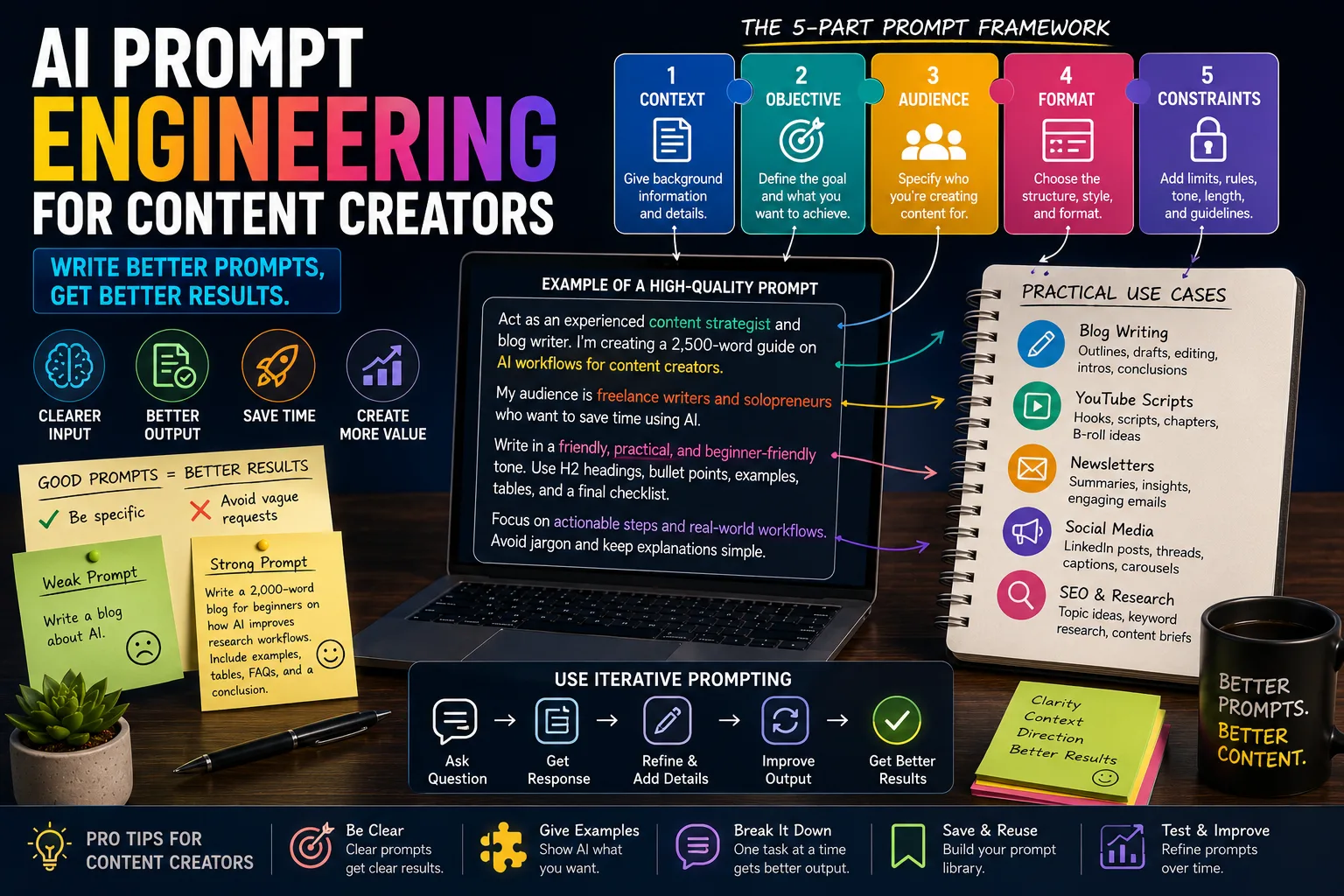
The Five-Part Prompt Framework
One of the easiest ways to improve your prompts is to follow a consistent structure.
A practical framework includes five parts:
Context
Objective
Audience
Format
Constraints
Following these five components dramatically improves response quality.
Part 1: Give AI Context
Context explains the situation.
Without context, AI has no idea why you're asking the question.
Instead of:
Write an article about newsletters.
Try:
I'm creating educational content for freelance writers who want to grow an email audience. I need a practical guide explaining newsletter workflows.
Context immediately narrows the scope of the response.
Part 2: Define the Objective
Tell AI exactly what success looks like.
Examples include:
Teach beginners
Compare two tools
Create a tutorial
Explain a concept
Persuade readers
Generate ideas
Rewrite existing content
Clear objectives prevent AI from wandering into unrelated topics.
Part 3: Identify the Audience
The same topic should be explained differently depending on who will read it.
Examples:
Beginners
Small businesses
Marketing teams
Developers
Startup founders
Students
Content creators
For example:
An article explaining SEO to experienced marketers should look very different from one written for someone publishing their first blog.
Always tell AI who you're writing for.
Part 4: Specify the Format
Formatting instructions significantly improve readability.
Instead of asking for:
Explain prompt engineering.
Try:
Create a blog article with H2 headings, bullet points, comparison tables, practical examples, FAQs, and a conclusion.
Formatting guidance helps AI organize information before writing.
Part 5: Add Constraints
Constraints define boundaries.
Examples include:
Maximum length
Writing style
Tone
Reading level
Avoid certain phrases
Include examples
Use Markdown
Create tables
End with a checklist
Rather than limiting creativity, constraints usually improve consistency.
The Difference Between Good and Great Prompts
Consider this example.
Basic Prompt
Write about content marketing.
Now compare it with:
Improved Prompt
Write a 2,000-word educational article for beginner content creators explaining how content marketing works. Use conversational language, include comparison tables, practical examples, H2 headings, FAQs, and conclude with actionable steps. Avoid marketing jargon and focus on real workflows instead of theory.
Notice how the second prompt removes ambiguity.
AI no longer has to guess what you want.
Stop Using One-Shot Prompts
Many beginners expect AI to generate a perfect article from a single instruction.
Professional creators rarely work this way.
Instead, they build content gradually.
For example:
Step 1
Research the topic.
↓
Step 2
Generate an outline.
↓
Step 3
Expand one section at a time.
↓
Step 4
Rewrite awkward paragraphs.
↓
Step 5
Improve readability.
↓
Step 6
Optimize formatting.
↓
Step 7
Create supporting assets.
Breaking work into smaller stages consistently produces higher-quality content.
Use AI as a Collaborative Partner
Prompt engineering becomes significantly more powerful when viewed as a conversation rather than a command.
Instead of asking AI to complete everything immediately, work together.
Examples include:
Ask for three outline variations.
Compare two introductions.
Suggest stronger headlines.
Rewrite one paragraph.
Improve transitions.
Simplify technical explanations.
Challenge weak arguments.
Small refinements often create better results than generating entirely new drafts.
Practical Prompt Examples
Instead of discussing prompt engineering only in theory, let's look at practical examples.
Blog Writing
Create a detailed outline for a beginner-friendly article explaining AI workflows for freelancers. Include H2 headings, FAQs, practical examples, and a final checklist.
YouTube Script
Write a conversational YouTube script explaining prompt engineering to beginners. Include a compelling hook, clear transitions, visual suggestions, and a strong closing.
Newsletter
Summarize this article into a friendly newsletter of approximately 600 words. Focus on practical takeaways rather than repeating every section.
Transform this article into a professional LinkedIn post that highlights three actionable lessons while encouraging discussion.
SEO
Analyze this outline and suggest missing subtopics that would better satisfy search intent for beginner readers.
Each example provides context, audience, format, and purpose instead of relying on a generic request.
Create Reusable Prompt Templates
One of the biggest productivity improvements comes from saving prompts that work well.
Rather than writing new prompts every day, build a personal prompt library.
Examples include templates for:
Research
Blog outlines
Long-form drafting
Editing
Newsletter creation
Social media posts
Video scripts
Repurposing content
SEO optimization
Content summaries
Over time, these templates become valuable assets that improve both speed and consistency.
Advanced Prompting Techniques That Actually Improve Results
Once you've mastered the basics of prompt engineering, the next step is learning techniques that consistently produce better outputs without making prompts unnecessarily long.
The goal isn't to write massive prompts.
The goal is to remove ambiguity.
Build Conversations Instead of Starting Over
Many creators make the mistake of opening a new chat for every task.
Instead, keep related work inside the same conversation whenever possible.
For example:
Research →
Outline →
Draft →
Edit →
Repurpose →
Optimize
Because AI already understands the previous context, later responses are usually more consistent.
This approach also reduces the need to repeat instructions.
Give AI a Role
One simple way to improve outputs is by assigning AI a specific role.
Instead of:
Write a blog article.
Try:
Act as an experienced technical writer creating educational content for beginner software developers.
Or:
Act as a YouTube script editor helping improve audience retention.
Roles don't magically make AI smarter.
They simply encourage it to prioritize knowledge and writing styles relevant to that perspective.
Show AI Examples
Examples often communicate expectations better than lengthy explanations.
Suppose you want LinkedIn posts similar to your existing writing style.
Instead of saying:
Write like me.
Provide an example.
AI can then imitate:
Sentence length
Tone
Formatting
Vocabulary
Structure
This is often called few-shot prompting, where a few examples guide future responses.
For creators, it can dramatically improve consistency across articles, newsletters, and social posts.
Break Large Projects Into Smaller Tasks
Long prompts aren't always better.
Large projects usually produce stronger results when divided into smaller stages.
For example, instead of requesting:
Write my entire course.
Break it into:
Create the curriculum.
Outline Module 1.
Expand Lesson 1.
Create practical exercises.
Generate quiz questions.
Improve readability.
Review for consistency.
Smaller tasks are easier to review, refine, and improve.
Ask AI to Critique Its Own Work
One powerful technique is asking AI to review what it has already written.
For example:
Identify weak arguments.
Find repetitive wording.
Suggest stronger examples.
Improve transitions.
Simplify complex sections.
Rewrite the introduction.
Shorten the conclusion.
Treat the first draft as raw material rather than the finished product.
Compare Multiple Versions
Instead of accepting the first answer, ask AI for alternatives.
Examples include:
Three different introductions.
Five headline options.
Two article structures.
Multiple calls to action.
Different writing styles.
Comparing alternatives often leads to better decisions than accepting the first response automatically.
Prompt Libraries Save More Time Than Better Models
Many creators spend hours testing different AI tools while repeatedly writing the same prompts.
A better investment is creating your own prompt library.
Organize prompts by workflow.
For example:
Research
Topic research
Competitor analysis
Question discovery
Source organization
Writing
Blog outlines
Introductions
Conclusions
FAQs
Case studies
Editing
Grammar improvements
Readability
Simplification
Tone adjustments
SEO optimization
Social Media
LinkedIn posts
X threads
Instagram captions
Newsletter summaries
Over time, these prompts become reusable assets that improve both speed and consistency.
Create Prompt Variables
Rather than creating dozens of nearly identical prompts, design flexible templates with placeholders.
Example:
Topic:
Audience:
Goal:
Tone:
Word Count:
Platform:
Special Instructions:
Changing only a few variables allows you to reuse the same prompt across many projects.
Common Prompt Engineering Mistakes
Prompt engineering isn't difficult, but several mistakes consistently reduce output quality.
Being Too Vague
Instead of:
Write about AI.
Provide:
Audience
Purpose
Format
Length
Tone
Specific instructions reduce unnecessary assumptions.
Giving Too Many Unrelated Instructions
Trying to achieve ten different objectives in one prompt often leads to inconsistent results.
Focus on one clear task whenever possible.
Ignoring Context
AI performs better when it understands:
Previous work
Existing articles
Brand voice
Target audience
Business goals
Context is often more valuable than prompt length.
Accepting the First Draft
The first response is rarely the final one.
Professional creators typically:
Refine
Rewrite
Compare
Improve
Expand
Think of prompting as an iterative process rather than a single request.
Expecting AI to Know Hidden Information
AI only knows what you tell it within the conversation and any capabilities it has access to.
If a requirement is important, include it explicitly instead of assuming the model will infer it.
Prompt Engineering Workflow
A practical workflow might look like this:
Define Goal
│
▼
Provide Context
│
▼
Identify Audience
│
▼
Specify Format
│
▼
Generate First Draft
│
▼
Review & Improve
│
▼
Request Revisions
│
▼
Finalize Content
Following this process consistently produces stronger outputs than relying on a single prompt.
Frequently Asked Questions
Do longer prompts always produce better responses?
No.
Clear and relevant prompts usually outperform unnecessarily long ones. Include enough detail to remove ambiguity, but avoid adding unrelated instructions.
Should I use the same prompt for every AI model?
The general principles remain the same, but different AI assistants may respond better to slightly different prompting styles. Testing and refinement are part of building an effective workflow.
Is prompt engineering only for writers?
Not at all.
Designers, developers, marketers, educators, researchers, business owners, and students can all benefit from writing clearer prompts.
Should I save prompts that work well?
Absolutely.
A well-organized prompt library becomes increasingly valuable over time, allowing you to reuse proven workflows instead of reinventing them for every project.
Prompt Engineering Checklist
Before submitting an important prompt, check whether you've included:
□ Clear context.
□ A specific objective.
□ The intended audience.
□ Formatting requirements.
□ Tone or writing style.
□ Relevant constraints.
□ Examples where helpful.
□ Enough detail to avoid ambiguity.
□ A plan to review and refine the output.
Final Takeaway
Prompt engineering isn't about learning complicated tricks or discovering secret phrases that unlock perfect AI responses. It's about communicating clearly.
The more context, direction, and structure you provide, the easier it becomes for AI to generate useful results. Strong prompts reduce unnecessary revisions, improve consistency, and help transform AI from a simple text generator into a reliable creative assistant.
As you build reusable templates, refine successful prompts, and develop repeatable workflows, prompt engineering becomes less about writing better instructions and more about designing better systems. Those systems compound over time, helping you create articles, videos, newsletters, and marketing content more efficiently without sacrificing quality.
The best prompt isn't necessarily the longest or the most technical. It's the one that gives AI exactly enough information to understand your goal while leaving room for your own expertise, creativity, and judgment to shape the final result.