How Scammers Exploit Human Thinking
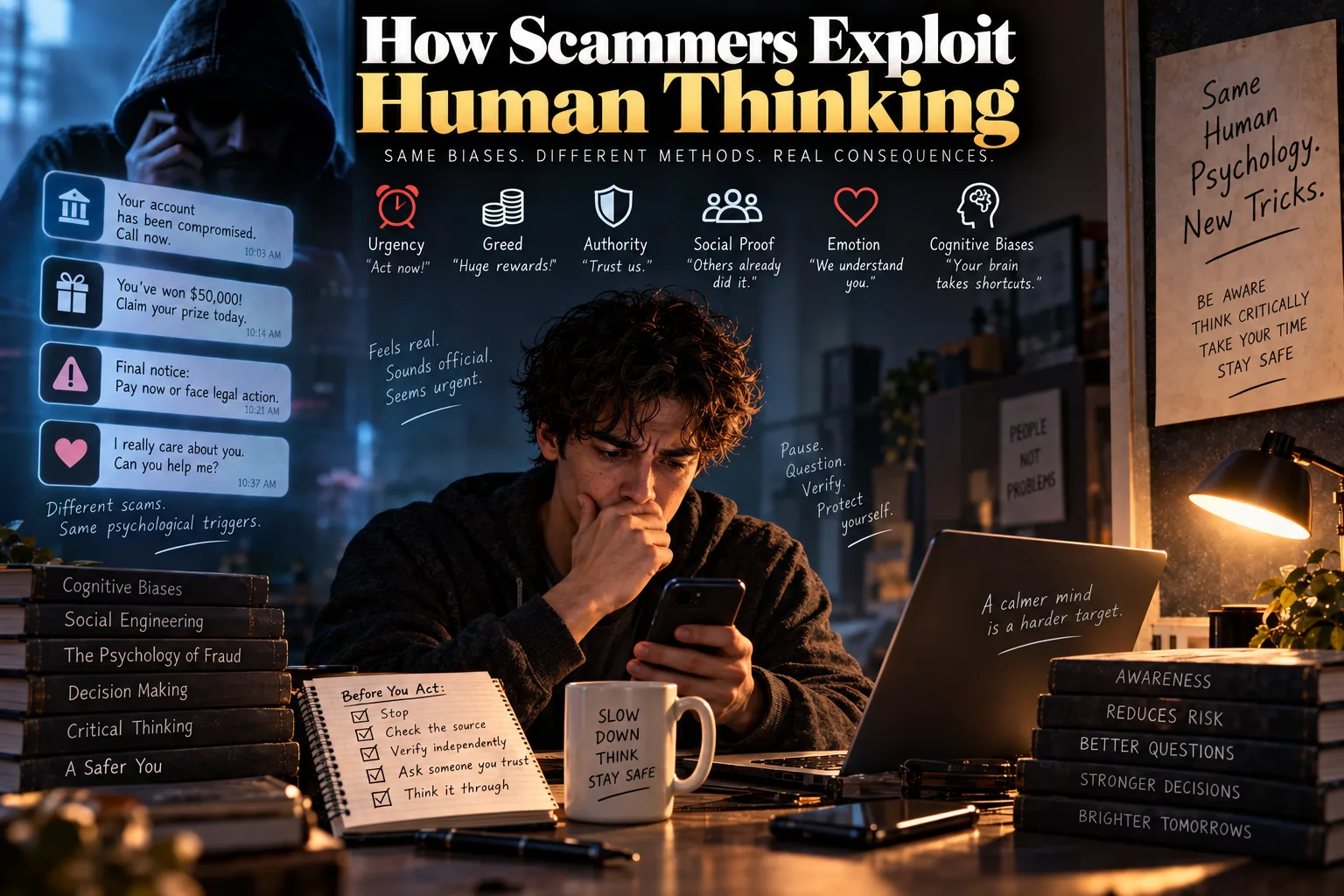
Scammers rarely succeed through technology alone. They exploit predictable features of human thinking, using urgency, fear, trust, authority, and social pressure to influence decisions before we stop to question them.
How Scammers Exploit Human Thinking
A scammer doesn't always need to break into your computer.
Sometimes they only need you to make one small decision.
Click.
Reply.
Trust.
Pay.
Call.
Share a code.
Send a screenshot.
And the frightening part is that the decision may feel completely reasonable while you're making it.
Scammers understand something important about human psychology:
People don't make decisions using logic alone.
We use shortcuts.
We respond to urgency.
We trust familiar institutions.
We obey perceived authority.
We become emotional.
We dislike uncertainty.
We want to avoid losses.
We want to believe good news.
We sometimes act first and think afterward.
Scammers don't necessarily need to understand neuroscience in detail.
They only need to discover what reliably makes people react.
That is why many successful scams look surprisingly similar across different countries, technologies, and generations.
The phone changes.
The website changes.
The payment method changes.
The psychological tricks remain remarkably familiar.
The Scam Usually Begins Before the Money Appears
A common mistake is imagining a scam as:
Scammer asks for money → victim sends money.
Modern fraud is often more complicated.
The first objective may simply be:
Get the target emotionally engaged.
Once someone becomes:
Frightened.
Excited.
Confused.
Curious.
Embarrassed.
Or rushed.
their decision-making environment changes.
The scammer then exploits that altered state.
🧠 The First Weapon: Urgency
One of the most reliable scam techniques is:
"Act now."
Your bank account has been compromised.
Your package will be returned.
Your tax payment is overdue.
Your account will be suspended.
Your computer has a virus.
Your relative needs help.
Your prize expires in ten minutes.
Why create urgency?
Because time pressure reduces opportunities for reflection.
Why Urgency Works
Imagine receiving this message:
"Your bank account has been compromised. Call immediately."
Your first thought isn't:
"Let's examine the probability distribution of financial fraud."
It's:
"What happened?"
Your emotional system reacts first.
You want the threat removed.
A scammer wants exactly that.
Because once you're focused on solving the emergency, you may stop asking whether the emergency is real.
The Psychology of Scarcity
Scammers also use scarcity.
Only five spots remain.
Offer expires tonight.
Last chance.
Limited inventory.
Scarcity can increase perceived value.
It also creates a fear of missing out.
The same psychological principle appears in legitimate marketing.
The difference is that scammers use artificial scarcity to compress your decision window.
The less time you have to think, the more valuable instinctive shortcuts become.
Loss Aversion
Humans often react strongly to potential losses.
Imagine two messages.
Message A
"You could receive a $100 reward."
Message B
"You may lose $100 if you don't act."
The second can produce a much stronger emotional response.
Scammers know this.
So instead of offering you something, they may threaten to take something away.
Your money.
Your account.
Your access.
Your reputation.
Your identity.
The scam becomes about preventing a loss rather than gaining a benefit.
The Fake Bank Call
Imagine receiving:
"This is the fraud department. We detected suspicious activity. Unless you verify your account immediately, your funds may be frozen."
The message contains several psychological triggers at once.
Authority.
Urgency.
Fear.
Financial loss.
A clear action.
The scammer doesn't want you calmly evaluating the situation.
They want you emotionally committed to solving the problem.
The Authority Effect
People naturally give weight to people perceived as authorities.
Police officers.
Doctors.
Bank employees.
Government officials.
Teachers.
Managers.
Corporate representatives.
This makes authority extremely useful for legitimate institutions.
And extremely useful to scammers.
A scammer may impersonate:
A bank.
The IRS.
Social Security.
Amazon.
Microsoft.
A delivery company.
A police department.
A hospital.
The goal is to borrow credibility from an institution you already recognize.
Familiarity Creates Trust
Suppose an unknown person says:
"I'm calling from a company you've never heard of."
You're suspicious.
Now compare:
"This is Amazon customer support."
Your brain already knows the brand.
Familiarity creates a starting point of trust.
That doesn't mean familiarity proves authenticity.
It means the scammer has reduced the psychological distance between:
Stranger
and
Trusted institution.
The Logos Are Doing Psychological Work
A fake email containing:
A company logo.
Official-looking colors.
A legal disclaimer.
A support number.
A professional signature.
can feel legitimate before you've checked anything.
Humans use visual cues as shortcuts.
We don't verify every logo we see.
We assume recognizable symbols belong to the organizations they represent.
Scammers exploit that assumption.
Social Proof
Imagine a website saying:
"14,000 Americans have already joined."
Or:
"Rated 4.9/5 by 30,000 customers."
Social proof tells your brain:
Other people trusted this, so maybe I can too.
This is normally useful.
If you're visiting a new restaurant, thousands of positive reviews may contain meaningful information.
But social proof can be fabricated.
Fake reviews.
Fake testimonials.
Fake followers.
Fake comments.
Fake "live purchase" notifications.
A crowd can be manufactured.
The Herd Effect
Humans often look to other people when uncertain.
What are they doing?
What do they believe?
What seems normal?
This makes sense evolutionarily.
Other people possess information you don't.
But in scams, the apparent crowd may be artificial.
The website isn't saying:
"Here's evidence."
It's saying:
"Everybody else already trusted us."
And your brain may interpret popularity as credibility.
Reciprocity
Another psychological principle involves reciprocity.
When someone gives you something, you may feel pressure to return the favor.
A free sample.
A free consultation.
An unexpected gift.
A small favor.
Scammers can use this instinct to create psychological obligation.
They may provide:
Free information.
Free access.
A small bonus.
A personal favor.
Then make a larger request.
The target may feel:
"They helped me. I should cooperate."
The "Small Ask" Strategy
A scam doesn't always begin with a huge request.
It may begin with:
"Can you confirm your name?"
Then:
"Can you verify your email?"
Then:
"Can you confirm the last four digits?"
Then:
"Can you read me the code you received?"
Each request seems small.
The problem is that the sequence gradually crosses from harmless information into highly sensitive access.
Commitment and Consistency
Once people publicly commit to something, they often feel pressure to behave consistently with that commitment.
Imagine you've spent thirty minutes talking to someone who seems trustworthy.
You've already:
Answered questions.
Agreed with them.
Shared personal information.
Accepted their explanation.
Then they ask for payment.
Backing out now means admitting:
"Maybe I trusted the wrong person."
Some people continue partly because they have already invested themselves in the interaction.
The scam becomes harder to abandon psychologically.
The Sunk-Cost Trap
Imagine someone has already lost $500 in a scam.
The scammer says:
"Pay another $300 to release the account and recover your money."
The target may think:
"I've already paid $500. If I stop now, I lose everything."
That's sunk-cost reasoning.
The previous money is already gone.
The real question is:
"What should I do with the information I have now?"
Unfortunately, emotional investment can make people throw more resources after the original loss.
The Romance Scam
Romance scams reveal another important psychological mechanism.
Instead of starting with money, the scam may begin with:
Conversation.
Attention.
Affection.
Daily messages.
Emotional support.
Shared stories.
The target may gradually develop trust.
Eventually:
An emergency appears.
A medical problem.
Travel trouble.
A family crisis.
A financial problem.
The request for money comes after emotional commitment.
That timing matters.
People don't evaluate requests from strangers the same way they evaluate requests from someone they believe loves or trusts them.
Why Loneliness Can Increase Vulnerability
This does not mean lonely people are unintelligent.
It means social connection matters.
When someone feels emotionally connected to another person, they may:
Trust more.
Disclose more.
Lower suspicion.
Give the relationship the benefit of the doubt.
Scammers exploit this because emotional trust can bypass some of the checks people would apply to strangers.
The fraud becomes personal.
The Fake Relative Scam
Imagine receiving a call:
"Grandma? It's me. I'm in trouble. I need money right now."
The supposed relative may claim:
Their phone is broken.
They're in legal trouble.
They're stranded.
They're in a hospital.
Why does this work?
Because family relationships create powerful emotional expectations.
The victim may not stop to analyze the voice carefully.
The emotional reaction comes first:
"Something happened to someone I love."
Emotional Hijacking
This is a useful way to think about scams.
A scammer tries to move the target from:
Reflective mode
into:
Reactive mode.
Fear.
Excitement.
Anger.
Greed.
Love.
Embarrassment.
Urgency.
Any strong emotion can narrow attention.
Once attention narrows, irrelevant information disappears from consideration.
The target becomes focused on one thing:
Fix the problem.
Shame Is a Weapon Too
Some scams deliberately create embarrassment.
"We have compromising information."
"Your computer activity was detected."
"You are under investigation."
The target becomes afraid of being exposed.
Now they aren't thinking:
"Is this legitimate?"
They're thinking:
"How do I make this disappear?"
That can be enough to trigger payment.
The Scam Doesn't Need to Be Believable to Everyone
This is an important insight.
A scammer doesn't need a perfect message.
They need a message that strongly affects a small percentage of recipients.
Imagine sending a million messages.
If only 0.1% respond, that's still:
1,000 potential victims.
Fraud at scale doesn't require universal persuasion.
It requires selective persuasion.
That's one reason scam messages can look absurd.
They're not necessarily designed for everyone.
They're designed for the right emotional target.
Why Some Scams Look Obviously Fake
People often ask:
"Why would anyone believe that?"
But if the message is intentionally outrageous, it can filter the audience.
People who immediately reject it disappear.
People who continue engaging are more likely to be:
Open to the story.
Curious.
Less skeptical.
Or emotionally affected by the particular claim.
The scammer then focuses effort on those people.
The Personalization Problem
Scams become more convincing when they contain real information.
Your:
Name.
City.
Employer.
School.
Phone number.
Recent purchase.
Friend's name.
Social-media details.
can potentially be gathered from publicly available or previously exposed information.
The message feels more credible because some details are correct.
But accurate personal information doesn't prove the sender is legitimate.
"They Knew My Name!"
This creates a powerful psychological reaction.
"How could they know that unless they're real?"
Unfortunately, names are not secret.
Neither are many other personal details.
Scammers may obtain information through:
Public profiles.
Data breaches.
Marketing databases.
Previous scams.
Leaked credentials.
Social engineering.
This is why personalization should increase caution rather than automatically create trust.
The Familiar Last Four Digits Trick
A scammer may already know something about you.
Then they ask:
"Can you confirm the last four digits of your card?"
You think:
"They already know my details, so this must be legitimate."
But the partial information may have been obtained elsewhere.
The scammer is using the information they know to convince you to reveal the information they don't.
The Information Gap
Good scams often contain just enough correct information to make the missing details feel harmless.
This creates an illusion:
"They already know so much, so telling them one more thing can't hurt."
But the final missing piece may be exactly what they need.
A one-time password.
A PIN.
A recovery code.
A password.
A verification link.
The last piece can complete the attack.
One-Time Codes Are Not Harmless
Many people know their password matters.
Fewer people realize that a one-time verification code can be just as important.
If a bank or service sends a temporary authentication code, the code may be part of the system used to prove that you control the account.
A scammer asking for that code is often asking you to hand over the final authentication step.
Why Scammers Want You on the Phone
Phone calls create a powerful advantage.
They are immediate.
You cannot easily research while being pressured.
The other person can respond instantly to objections.
They can hear hesitation.
They can increase urgency.
They can change tactics.
They can keep you emotionally engaged.
An email gives you time.
A live conversation removes some of that breathing room.
The Isolation Technique
Scammers may explicitly tell you:
"Do not hang up."
"Don't contact the bank."
"Don't tell your family."
"This is confidential."
Why?
Because outside perspectives are dangerous to the scam.
Your friend might say:
"That sounds fake."
Your bank might say:
"We never do that."
Your spouse might recognize the pattern.
Isolation protects the scammer's version of reality.
Information Control
This is one of the most important warning signs.
A legitimate organization may ask for verification.
A scammer often tries to control where you verify it.
They don't want you visiting the official website yourself.
They don't want you calling the number on your card.
They want you to use:
Their phone number.
Their link.
Their email address.
Their instructions.
That keeps you inside their information environment.
The Verification Trap
Suppose someone calls claiming to be from your bank.
Instead of accepting the call, independently contact your bank using:
The number on the back of your card.
The official mobile app.
The institution's official website.
Now the scammer loses control of the verification process.
That's why independent verification is so powerful.
The Power of a Second Opinion
Humans make better decisions when another person can interrupt an emotional reaction.
A friend may ask:
"Why are they rushing you?"
A family member may notice:
"That email address looks strange."
A colleague may recognize:
"That's not how our company handles payroll."
The second perspective creates friction.
And friction is exactly what scams try to remove.
Why We Ignore Red Flags
Scams often contain contradictions.
Wrong grammar.
Strange payment requests.
Unusual email addresses.
Pressure to keep secrets.
Requests for gift cards.
Requests for cryptocurrency.
Unexpected remote-access software.
Yet people may ignore these clues.
Why?
Because once an emotional story feels convincing, contradictory information receives less attention.
This is similar to confirmation bias.
You notice evidence supporting the story.
You explain away evidence against it.
Confirmation Bias During a Scam
Imagine you believe:
"This person is helping me recover my account."
They provide a real-looking reference number.
That supports your belief.
They make one strange request.
You explain:
"Maybe that's just their security process."
The longer the interaction continues, the harder it can become to reconsider the entire story.
The Commitment Trap
Another factor is embarrassment.
Suppose you've spent twenty minutes following instructions.
Suddenly something feels wrong.
You now have to admit:
"Maybe I should stop."
People sometimes continue because stopping feels like admitting they were fooled.
That's a psychological trap.
The correct decision is not determined by what you've already done.
It's determined by what makes sense now.
"I Don't Want to Look Stupid"
This emotion causes real problems.
Someone may notice the scam but hesitate to tell their family.
They may fear:
Judgment.
Embarrassment.
Anger.
Financial shame.
Loss of independence.
So they continue alone.
The scammer benefits from secrecy.
That is why fraud prevention is not just technical.
It is social.
People need to feel safe admitting:
"I think something might be wrong."
Why Scammers Exploit Greed
Not every scam uses fear.
Some use excitement.
You've won $50,000.
Your investment has doubled.
You have been selected.
Exclusive opportunity.
The brain focuses on the potential reward.
The person begins imagining the outcome.
That emotional projection can overwhelm skepticism.
Reward Anticipation
Humans respond strongly to potential rewards.
A possible:
Prize.
Profit.
Promotion.
Discount.
Inheritance.
Investment return.
can become mentally vivid before it ever exists.
Once you start imagining the reward, the scam isn't asking you to evaluate a stranger's claim.
It's asking you to protect an imagined future.
Why Investment Scams Work
Investment scams often show:
Fake balances.
Fake profits.
Successful testimonials.
Professional dashboards.
Confident explanations.
The victim sees apparent evidence that money is growing.
The psychological trap is powerful because the "proof" isn't just words.
It's a visible number.
$10,000
$17,400
$25,000
The screen creates the feeling that the money exists.
But a number on a website isn't the same thing as withdrawable assets.
The Progress Illusion
A scam may allow small withdrawals early.
That can create trust.
The victim thinks:
"I tried it. It worked."
Then they invest more.
Later, withdrawals become blocked.
A fee appears.
A tax appears.
An account-unlock charge appears.
The victim has already experienced apparent success.
That history becomes psychological evidence.
Why Fake Success Is Powerful
The brain learns from personal experience.
You heard someone say:
"This might work."
That's weak.
You personally received $100 back.
That's much stronger psychologically.
But the initial payout can be part of the deception.
The scam isn't proving the system is legitimate.
It's increasing your commitment.
The Authority of Technology
Modern interfaces create another psychological illusion.
A professional app.
A secure-looking website.
Graphs.
Transaction IDs.
Customer dashboards.
Automated emails.
Digital receipts.
All can make a scam look sophisticated.
People often associate technical complexity with legitimacy.
But complexity is cheap.
A convincing interface can be built without a legitimate underlying business.
Why Crypto Scams Can Be Especially Difficult
Cryptocurrency transactions can be fast and, depending on the system and circumstances, difficult or impossible to reverse.
That makes them attractive to fraudsters.
Scammers may exploit:
Confusion about wallets.
Fake investment platforms.
Impersonation.
Fake giveaways.
Recovery scams.
Urgent payment requests.
The psychological trick remains the same:
Get the person to act before they fully understand the transaction.
The Recovery Scam
Imagine someone has already lost money to fraud.
Then another person contacts them:
"We can recover your money."
The victim desperately wants to undo the loss.
That's a powerful emotional vulnerability.
The scammer asks for a fee.
Then another fee.
Then another.
This creates a second scam built on the first.
The victim isn't just losing money.
They're being sold hope.
Why Victims Blame Themselves
After fraud, people often think:
"How could I have been so stupid?"
That reaction can be psychologically damaging.
Scammers intentionally manipulate ordinary human tendencies.
Being deceived doesn't mean someone lacks intelligence.
A sophisticated fraud operation can manipulate:
Trust.
Attention.
Emotion.
Information.
Authority.
Time pressure.
Social expectations.
The correct lesson isn't:
"Only stupid people get scammed."
It's:
"Any human can be vulnerable under the right conditions."
Intelligent People Get Scammed Too
Education helps.
Knowledge helps.
Experience helps.
But none creates perfect immunity.
A highly educated person might know a lot about medicine but little about banking procedures.
An engineer might recognize technical deception but trust a convincing financial story.
A financially sophisticated investor can still be manipulated by someone exploiting urgency and ego.
Expertise is usually domain-specific.
Why Familiar People Can Be Dangerous Too
Not every scam comes from strangers.
Fraud can involve:
Compromised accounts.
Impersonated coworkers.
Fake friends.
Fake relatives.
Compromised business email.
Someone whose identity appears familiar may be using a stolen account.
So:
"I know this person"
doesn't necessarily mean:
"This message came from this person."
Verify the channel.
The Human Need for Closure
Uncertainty is uncomfortable.
A scammer may exploit that discomfort by offering a neat explanation.
Your account is locked because of suspicious activity.
Your investment failed because of one market event.
Your relative is in trouble because of a legal problem.
Your computer is infected because of one virus.
The story feels complete.
You now know:
What happened.
Why it happened.
What to do.
That psychological closure can feel reassuring.
Simple Stories Beat Complicated Reality
Real financial fraud prevention can involve:
Multiple systems.
Authentication layers.
Fraud monitoring.
Institutional procedures.
Account security.
Different departments.
Legal requirements.
A scam reduces all of that to:
"There's a problem. Do this now."
Simple stories are easier to process.
That is precisely why they can be dangerous.
The Best Defense: Slow the Process
One of the most effective anti-scam principles is remarkably simple:
Don't make important decisions under artificial urgency.
Pause.
End the call.
Open the official app.
Visit the official website.
Contact the organization independently.
Ask another person.
Read the message again later.
The scammer's power often decreases dramatically once the emotional clock stops ticking.
Create Friction
Scammers want:
Fast decisions.
Private conversations.
Unverified links.
Immediate payments.
No second opinions.
You want the opposite:
Delay.
Verification.
Independent contact.
Documentation.
Second opinions.
Multiple checks.
Think of it as building speed bumps into your decision-making.
The scam doesn't have to become impossible.
It just needs to become difficult enough for you to think.
A Five-Question Scam Check
When something urgent or financially important arrives, ask:
1. Who contacted me?
Do I know them?
Is the identity verified?
2. Why are they rushing me?
What happens if I wait ten minutes?
3. Can I verify this independently?
Use contact information you find yourself.
4. What are they asking me to reveal or send?
Passwords?
One-time codes?
Money?
Remote access?
5. Would I do this if I were calm?
This final question is surprisingly useful.
The Most Dangerous Sentence in a Scam
It may be:
"You need to do this right now."
Not because urgency always means fraud.
Sometimes genuine emergencies exist.
But urgency combined with:
Secrecy.
Payment.
Credential requests.
Threats.
Unusual instructions.
should dramatically increase caution.
🟢 Established Evidence
Research across psychology, behavioral economics, and fraud prevention supports the importance of mechanisms such as:
Urgency and time pressure
Authority and impersonation
Social proof
Reciprocity
Loss aversion
Familiarity
Emotional arousal
Commitment and consistency
Confirmation bias
Scarcity
Social isolation
These aren't magical scam buttons.
Their effectiveness varies by person and situation.
But they reflect genuine features of human decision-making.
🟡 Active Research
Researchers continue studying how fraud tactics change with:
Social media.
Generative AI.
Voice cloning.
Deepfakes.
Cryptocurrency.
Online advertising.
Digital payments.
Stolen personal data.
Automated messaging.
The underlying psychology can remain stable while the technology becomes increasingly convincing.
That creates a new challenge:
The cost of looking legitimate keeps falling.
🔴 Popular Myth
"You can't get scammed if you're smart enough."
False.
Intelligence isn't a complete defense against manipulation.
A scammer can attack:
Emotion.
Time pressure.
Identity.
Trust.
Authority.
Information gaps.
Even careful people can make bad decisions when placed inside a carefully engineered situation.
Frequently Asked Questions
Why do smart people get scammed?
Because scams exploit psychological processes that affect everyone, including urgency, trust, emotion, familiarity, social proof, and loss aversion.
Why do scammers create urgency?
Urgency reduces time for verification and encourages reactive decision-making.
Why do scammers pretend to be banks or government agencies?
Authority and familiarity can increase credibility and lower suspicion.
Why do scammers ask for one-time verification codes?
Such codes can be part of account authentication. Giving one away may allow an attacker to complete a login or transaction.
Why do romance scams take so long?
Building emotional trust can make later financial requests feel like requests from a trusted relationship rather than a stranger.
Why do people keep paying after losing money?
Sunk-cost thinking, hope of recovery, embarrassment, and emotional commitment can all make it harder to stop.
Why does a professional-looking website matter?
People use visual and technological cues as shortcuts for judging legitimacy. Scammers can imitate those cues.
Can scammers really know my name and address?
They may obtain personal information from public sources, data breaches, compromised accounts, or other databases. Knowing personal details does not prove authenticity.
What should I do when someone tells me my account is in danger?
Don't use the phone number or link provided by the caller or message. Contact the organization independently through its official app, website, or a trusted contact method.
What's the biggest defense against scams?
Create time between the emotional trigger and the decision. Verification becomes much easier once urgency stops controlling the conversation.
Myth vs. Reality
🔴 "Only careless people get scammed."
False.
Scams exploit ordinary human psychology.
🟢 Urgency is commonly used in fraud.
Yes.
It can reduce the opportunity for careful verification.
🟢 Authority impersonation is effective.
Yes.
People naturally use authority as a credibility shortcut.
🔴 A professional-looking website proves legitimacy.
No.
Appearance is easy to imitate.
🟢 Emotional attachment can increase vulnerability.
Yes.
Trust changes how people evaluate requests.
🔴 If someone knows personal information about you, they must be legitimate.
False.
Personal information can be obtained in many ways.
🟢 Independent verification is powerful.
Yes.
It breaks the scammer's control over the information environment.
🔴 Being intelligent makes you immune.
No.
No one is immune to every form of psychological manipulation.
The Anatomy of a Typical Scam
Many scams can be understood as a sequence:
1. Capture attention
Something surprising arrives.
2. Create emotion
Fear, greed, urgency, curiosity, or affection.
3. Establish credibility
Authority, familiarity, personal information, fake evidence.
4. Narrow the choices
"Do this now."
5. Isolate the target
"Don't tell anyone."
6. Request a small action
Click.
Reply.
Verify.
7. Escalate
More information.
More access.
More money.
8. Prevent verification
Keep the victim inside the scammer's story.
9. Create commitment
The victim has already invested.
10. Extract value
Money, credentials, access, data, or control.
The exact sequence varies.
But the psychology is remarkably consistent.
Why Scams Keep Evolving
Technology changes what scammers can imitate.
Old scam:
Fake letter.
Then:
Fake email.
Then:
Fake website.
Then:
Fake text message.
Now:
AI-generated voice.
AI-generated images.
Synthetic video.
Highly personalized messages.
The more convincing the interface becomes, the more important psychological skepticism becomes.
You can no longer rely on:
"It sounds like them."
or:
"The website looks professional."
or:
"The email has their logo."
These signals can be manufactured.
The Future Problem Is Not Just Fake Information
The bigger problem may be:
Fake authenticity.
A voice that sounds familiar.
A video that looks real.
A message that contains accurate personal details.
A website that perfectly copies a legitimate institution.
The question increasingly becomes:
"Can I independently verify who is actually behind this?"
That may become one of the most important digital skills of the coming years.
Final Thoughts
Scammers don't need to defeat the human brain.
They only need to use its ordinary strengths against it.
Trust helps us cooperate.
They exploit trust.
Attention helps us notice threats.
They manufacture threats.
Loss aversion helps us protect what matters.
They create fake losses.
Authority helps us navigate complex systems.
They impersonate authority.
Social proof helps us learn from others.
They manufacture crowds.
Emotion helps us respond quickly.
They create emotional emergencies.
Our desire for consistency helps us maintain commitments.
They turn small decisions into larger commitments.
None of these traits are inherently weaknesses.
They're part of what makes human social life possible.
The problem comes when someone deliberately designs an environment around them.
That is why the strongest defense against scams isn't becoming permanently suspicious of everyone.
It's learning to recognize when your normal psychological shortcuts are being manipulated.
When someone creates urgency:
Slow down.
When someone claims authority:
Verify independently.
When someone asks for sensitive information:
Stop.
When someone says not to tell anyone:
Get another perspective.
When money is involved:
Verify twice.
When you're emotionally overwhelmed:
Don't make the irreversible decision yet.
And when someone tells you:
"You need to do this right now."
remember that urgency may be part of the attack.
The most powerful thing a scammer can take from you is not your money.
It's your ability to pause.
Because once you slow down, the spell often breaks.
The story has to survive contact with reality.
And reality is considerably harder to manipulate when you give yourself time to look at it.