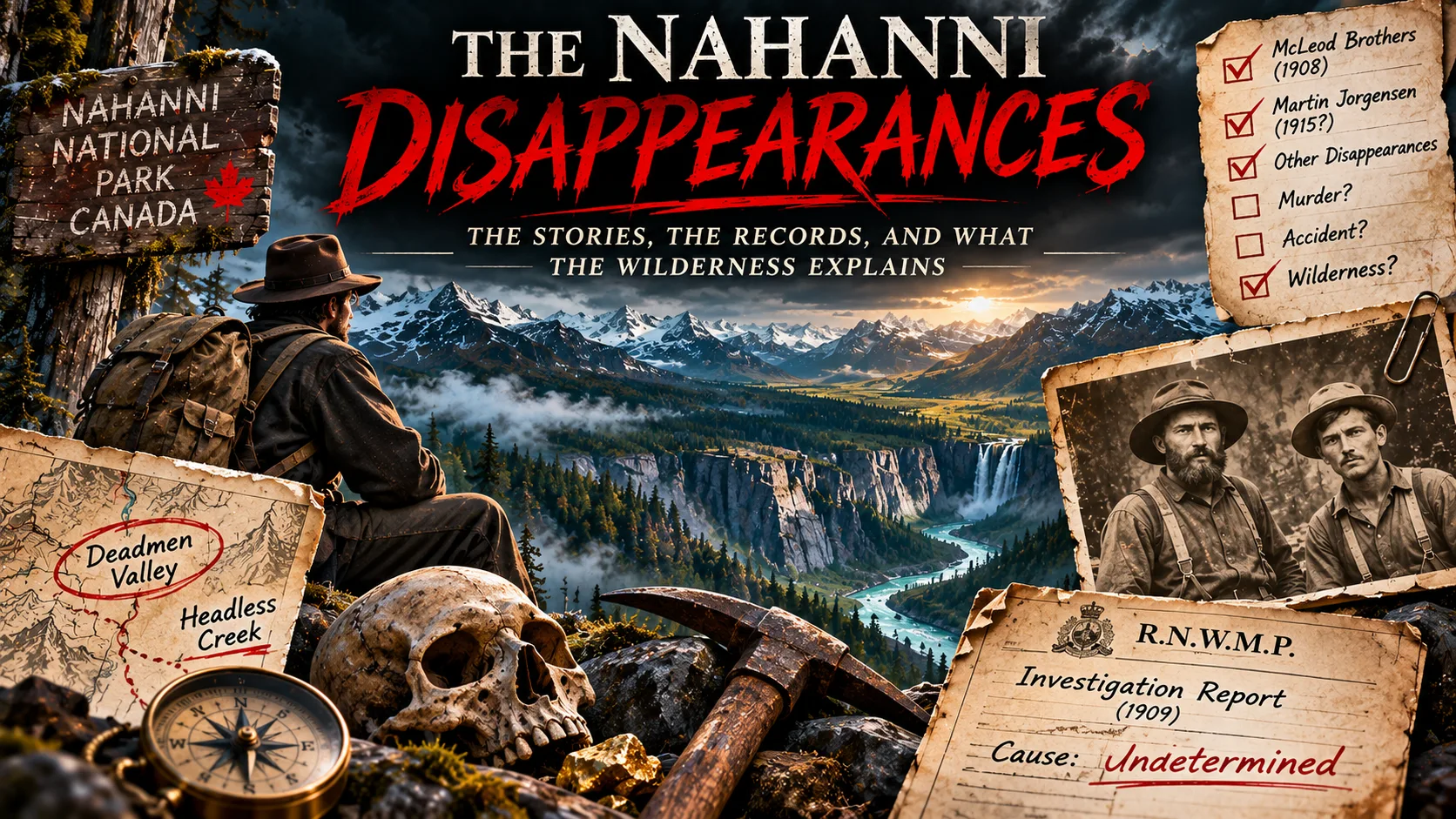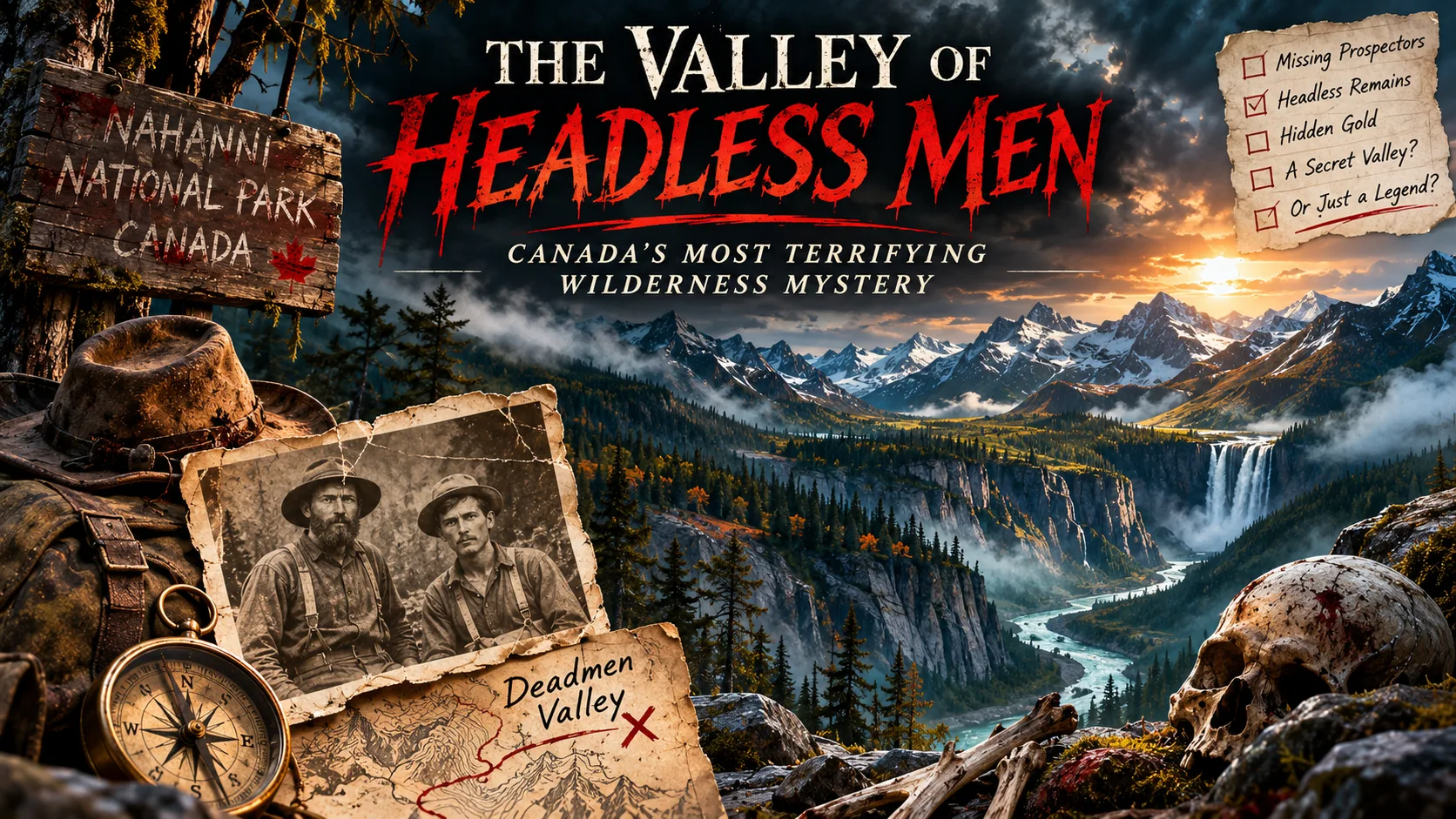
The Valley of Headless Men: Canada's Most Terrifying Wilderness Mystery
Deep in Canada's remote Nahanni wilderness, prospectors vanished and stories of headless remains spread. But behind the terrifying legends lies a darker question: what really happened to the men who entered this unforgiving valley?
Somewhere in the Canadian wilderness, there is a valley with a name that sounds like a warning.
The Valley of Headless Men.
No roads lead comfortably into its heart. Mountains rise above dark forests, rivers cut through towering canyons, and the nearest help can be impossibly far away.
But the landscape isn't what made this place infamous.
It was what people reportedly found there.
In 1908, a search party discovered the remains of two brothers who had entered the Nahanni wilderness searching for gold.
According to accounts that would become central to the legend, their bodies were missing their heads.
The brothers were dead.
Their fortunes were missing.
And a question began haunting the Canadian North.
What had happened to the men who went looking for gold?
More than a century later, the answer remains tangled in history, speculation, and one of Canada's most enduring wilderness legends.
The Brothers Who Never Came Home
In the early twentieth century, stories of gold drew prospectors deep into Canada's Northwest Territories.
Among them were Willie and Frank McLeod.
The brothers had ventured into the South Nahanni region with another prospector, Robert Weir.
They hoped to find the kind of discovery that could transform ordinary men into wealthy ones.
Instead, they disappeared.
When searchers eventually found the brothers' remains in the area now known as Deadmen Valley, the discovery became the foundation of a terrifying reputation.
The nearby Headless Creek acquired its ominous name.
But one detail complicates the story.
Historical retellings don't always agree on when the remains were found or exactly what condition they were in.
The discovery is commonly dated to 1908, although some accounts give earlier dates.
What became of Weir is also uncertain.
And while the missing heads feature prominently in the legend, the surviving accounts don't establish who, or what, caused the brothers' deaths.
That uncertainty should have made the story harder to tell.
Instead, it made the story impossible to forget.
The Valley Claimed Another Name
The McLeod brothers were not the last people whose deaths became associated with Nahanni.
Another frequently repeated account concerns prospector Martin Jorgensen.
He had travelled into the region searching for valuable mineral deposits.
Later accounts describe his remains being discovered near a burned cabin, reportedly without his head.
Other deaths and disappearances followed.
Some involved prospectors.
Others involved trappers or adventurers attempting to navigate unforgiving country.
The stories accumulated.
Each new tragedy seemed to reinforce the old ones.
What kind of place repeatedly swallowed people and returned only fragments?
Whispers grew into theories.
Perhaps someone was murdering the prospectors.
Perhaps a hidden community guarded valuable gold deposits.
Perhaps something far older lived beyond the mountains.
But there was a problem with these explanations.
A frightening pattern is not the same thing as proof of a common cause.
The deaths were real events discussed in historical sources. Their circumstances, however, were not all established with equal certainty.
And what happened next would transform a remote wilderness into something almost mythical.
The Paradise Hidden Behind the Horror
For years, stories circulated about a remarkable secret hidden deep inside Nahanni.
Not a monster.
Not a murderer.
A paradise.
According to the legend, somewhere beyond the mountains lay a warm valley protected from the brutal northern climate.
Hot springs kept the landscape unusually mild.
Animals supposedly thrived there.
And hidden among the mountains was gold.
An entire world, concealed from outsiders.
The idea was irresistible.
But it raised an uncomfortable question.
If such a paradise existed, why were so many stories about the region filled with death?
The answer, believers suggested, was that the valley protected its secrets.
Some tales introduced hostile guardians, strange creatures, and supernatural forces.
None of those extraordinary explanations had reliable supporting evidence.
But the combination of lost treasure and mysterious deaths proved powerful.
By the 1940s, the Nahanni legend had become famous enough to attract a very different kind of explorer.
A journalist.
And he wasn't searching only for gold.
The Expedition That Threatened the Legend
In February 1947, Canadian journalist Pierre Berton travelled into the Nahanni region on an expedition for the Vancouver Sun.
His mission was to investigate the extraordinary stories surrounding the valley.
The journey attracted considerable attention.
Could a tropical sanctuary really exist in Canada's frozen North?
Were the stories of strange inhabitants and mysterious dangers anything more than sensational folklore?
Berton's expedition reached the region by aircraft.
What he encountered was dramatic, but not in the way the legends promised.
There were enormous mountains.
Frozen landscapes.
Deep canyons.
Hot springs.
And evidence of earlier human visitors.
But no hidden tropical paradise.
No discovered civilization of mysterious guardians.
No supernatural explanation for the deaths.
The wilderness itself was spectacular enough.
The legendary paradise remained unverified.
Yet even this investigation couldn't completely erase the valley's reputation.
Because the original question still survived.
What had happened to the dead men?
A Wilderness That Doesn't Need Monsters
Consider the environment.
Nahanni contains powerful rivers, remote mountain valleys, steep terrain, and extreme weather.
Even modern visitors must respect the dangers of its landscape.
The South Nahanni River runs through some of Canada's deepest canyons.
Its current can be dangerous.
Flooding can change conditions rapidly.
A broken canoe, a serious injury, or lost supplies can become life-threatening when assistance is days away.
For early prospectors travelling with limited equipment and communication, the risks were greater.
And if someone died far from civilization, wild animals and natural decomposition could alter the remains before discovery.
Such explanations are plausible in wilderness deaths.
But plausible is not the same as proven.
There is no justification for assigning one explanation to every Nahanni death without sufficient evidence.
The same caution applies to murder theories.
A missing head does not, by itself, establish deliberate decapitation.
Nor does a missing prospector establish the existence of a hidden killer.
The truth may be more complicated than either skeptics or believers would prefer.
Different people could have died for entirely different reasons.
And generations of retelling may have transformed unrelated tragedies into one continuous mystery.
The People the Legend Almost Erased
There's another part of Nahanni's history that sensational accounts often overlook.
Long before gold seekers arrived, Dene peoples and their ancestors knew these lands.
Their connection to the region stretches back thousands of years.
They travelled its rivers, harvested its resources, and developed knowledge of a landscape outsiders often described as unknowable.
The region contains rich Indigenous histories and oral traditions.
But some later adventure stories distorted those traditions into tales of mysterious, threatening inhabitants.
That matters.
Because turning a real Indigenous homeland into a supposedly empty, haunted wilderness changes whose history gets told.
Nahanni was never simply an unexplored kingdom waiting for outsiders to discover it.
It was a lived landscape long before prospectors began searching for hidden fortunes.
Today, the national park reserve is managed through cooperation involving Parks Canada and Indigenous partners.
The valley is more than the legend attached to its name.
And that may be one of the mystery's most overlooked truths.
The Deaths We Cannot Fully Explain
More than a hundred years after the McLeod brothers disappeared, some details remain uncertain.
Did an accident kill them?
Were they victims of violence?
Were their remains disturbed by animals?
What happened to their missing companion?
The available historical accounts do not establish definitive answers to every question.
Some stories have stronger documentation than others.
And the more sensational details have often travelled farther than the evidence supporting them.
The legend became powerful because separate events could be connected into something larger.
A lost prospector became evidence of a hidden danger.
A damaged skeleton became evidence of a murderer.
A remote valley became the entrance to an impossible world.
Each story made the next sound more believable.
Eventually, people weren't simply asking what happened in Nahanni.
They were asking what terrible thing lived there.
Perhaps that was the most important transformation of all.
What Still Waits in Headless Valley?
Today, Nahanni National Park Reserve is celebrated for its extraordinary natural beauty.
Its vast wilderness, dramatic geological formations, and powerful rivers have earned international recognition.
Visitors come to experience the landscape, not to hunt for monsters.
But Deadmen Valley and Headless Creek still carry their names.
Names born from events that became legends.
And names have a peculiar power.
They preserve fear long after the circumstances that created it have faded.
Imagine standing near the river as evening settles over the mountains.
The forest stretches into the distance.
The water continues moving, indifferent to everything that happened along its banks.
There is no reason to believe something supernatural is watching.
No reliable evidence of a hidden tribe of killers waiting among the trees.
Yet you know that people entered this wilderness and never came home.
You know that families waited for news that arrived too late, or never arrived at all.
And you know that the surviving historical record cannot answer every question.
That is frightening enough.
Perhaps the Valley of Headless Men doesn't need a curse to remain mysterious.
Perhaps its most disturbing quality is that real tragedies became stories so extraordinary that, over time, it grew harder to separate the people who died from the legends told about them.
The mountains are still there.
The river still runs.
And the names remain.
Because sometimes the most terrifying mystery isn't what might be hiding in the wilderness.
It's how much of the truth can disappear while the story survives.