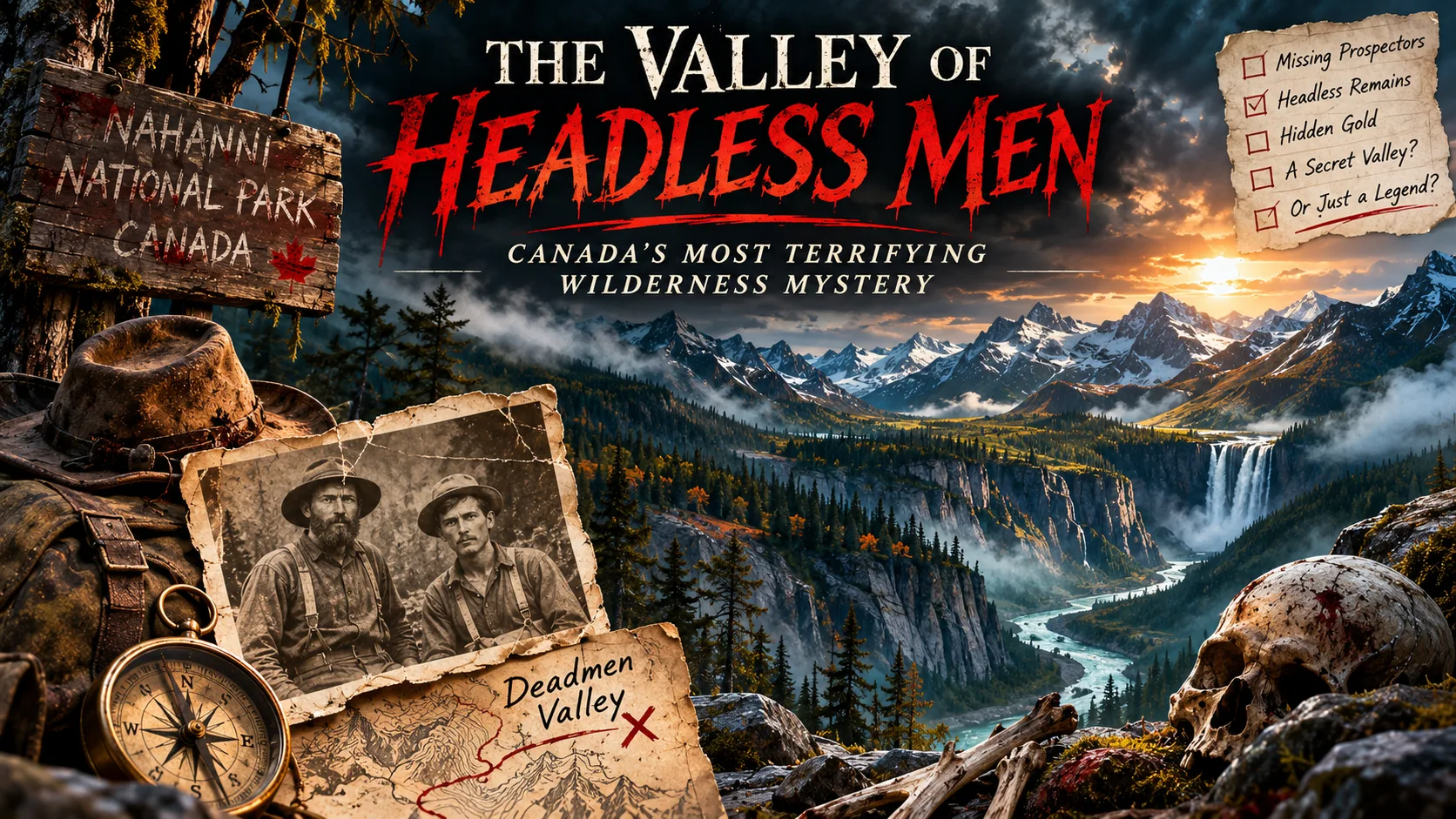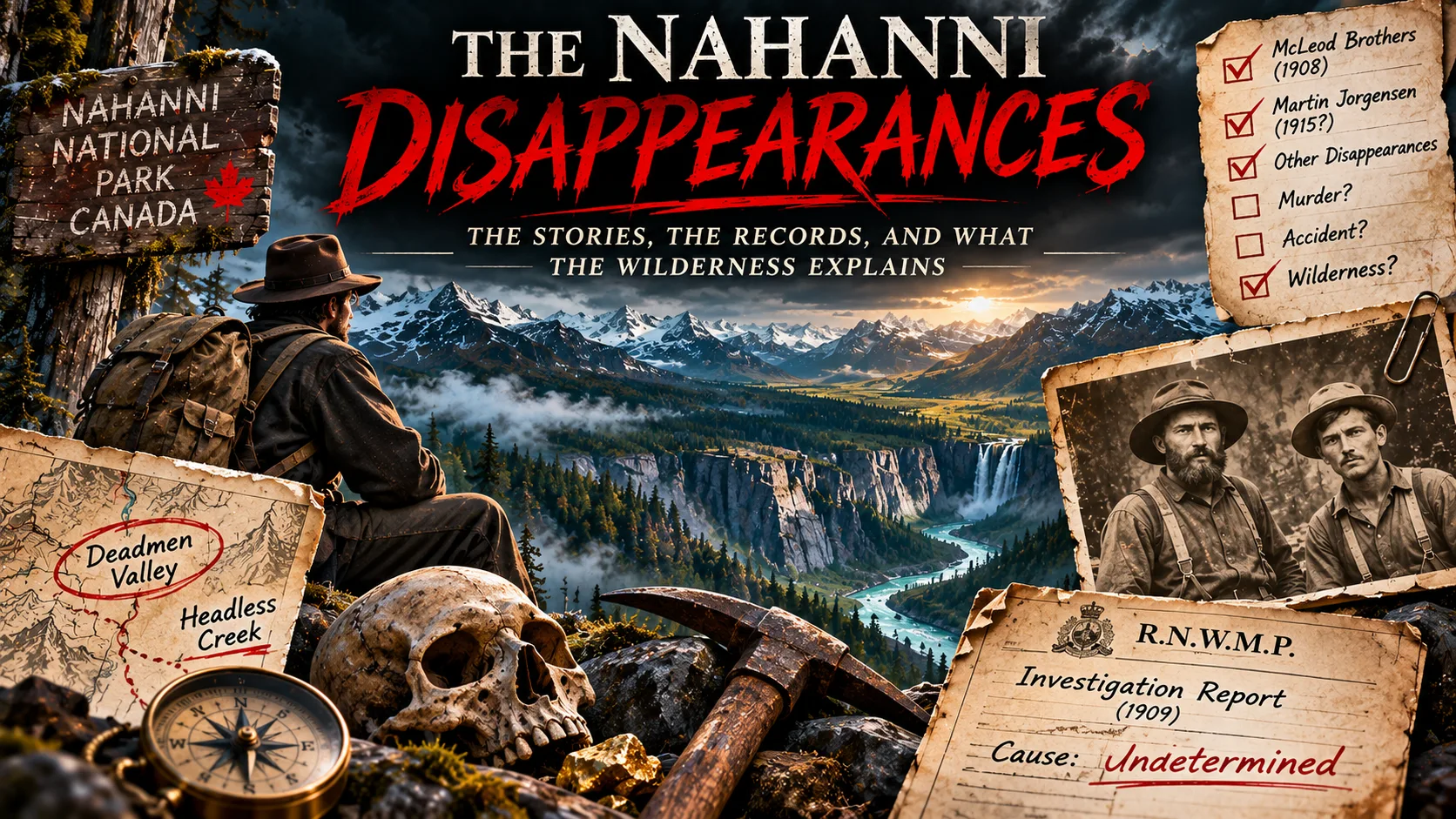
The Nahanni Disappearances: What the Historical Records Reveal
Prospectors vanished in Canada's Nahanni wilderness. Some remains were reportedly found without heads. But what do the historical records actually establish, and which frightening details belong to legend? Follow the evidence into the valley.
The bodies were there.
The heads were not.
In 1908, a search party entered a remote stretch of Canada's Northwest Territories and discovered the remains of two missing prospectors.
Their names were Willie and Frank McLeod.
They had gone looking for gold.
What their family found instead would help give an entire wilderness a terrifying reputation.
The place became associated with two names: Deadmen Valley and Headless Creek.
For decades, newspapers and storytellers would return to the same question.
Who was killing the men of Nahanni?
But buried beneath the terrifying headlines was a detail that changed the mystery.
The police had investigated.
And their findings told a very different story.
The Gold That Started Everything
In the early 1900s, rumours of gold attracted prospectors to the South Nahanni River region.
The McLeod brothers were among them.
Accounts describe an earlier expedition with their brother Charlie, during which they reportedly found placer gold along the Flat River.
But the journey was dangerous.
One account describes their makeshift raft capsizing in rapids, taking their supplies and a small quantity of gold with it.
Despite the loss, Willie and Frank returned.
This time, they were reportedly accompanied by a man named Robert Weir, sometimes identified differently in later versions.
Then they disappeared.
When Charlie eventually searched for his brothers, he found two badly decomposed bodies.
Their heads were missing.
Their companion was absent.
And the gold they had supposedly discovered was nowhere to be found.
To Charlie, the conclusion seemed obvious.
Someone had murdered his brothers and stolen their fortune.
But suspicion was not evidence.
And the investigation that followed would challenge the story.
The Police Report That Changed the Mystery
In 1909, Corporal Arthur H. Mellor investigated the McLeod deaths for the Royal North-West Mounted Police.
Historical research drawing on that investigation describes a conclusion very different from the popular legend.
Mellor found no evidence establishing foul play.
He considered the possibility that the brothers had lost essential equipment in a boating accident and subsequently died of starvation.
The missing heads did not necessarily prove murder.
After bodies decompose, animal scavenging and the separation of skeletal remains can produce disturbing discoveries.
Charlie remained unconvinced.
He suspected Weir.
But the available investigation did not establish Weir's guilt.
That distinction matters.
There were two deaths.
There was a grieving family.
There were missing remains.
But there was no proven murderer.
The most frightening detail in the story was not necessarily evidence of the crime everyone imagined.
And then another prospector died.
The Man Beside the Burned Cabin
His name was Martin Jorgensen.
Years after the McLeod discovery, his remains were found farther upriver.
Accounts described a burned cabin and a missing skull.
But even the timeline became tangled.
A historical study places the discovery in 1915 and describes a police investigation in 1916.
Other popular retellings give 1917.
The conflicting dates reveal how easily historical details can change as a story travels.
Investigators examined the remains and the burned structure.
They could not establish a definitive cause of death.
An accident involving the fire was considered possible.
Murder was not demonstrated.
Yet the resemblance to the McLeod case was irresistible.
Another prospector.
Another remote location.
Another missing head.
Suddenly, two separate tragedies appeared to form a pattern.
And once people began searching for that pattern, every new disappearance seemed to confirm it.
How Many Men Actually Vanished?
This is where the legend becomes particularly difficult to investigate.
Some historical accounts discussed roughly a dozen deaths or disappearances.
Others counted fewer.
The figures depended on which incidents were included, what qualified as mysterious, and whether the deaths were connected by anything beyond geography.
A disappearance, an accidental drowning, a fatal cabin fire, and a suspected murder are not automatically evidence of the same cause.
But sensational storytelling often places them together.
One early report mentioned prospector Yukon Fisher.
Another described Ernest Savard, whose remains were reportedly discovered in 1945 with severe damage near the neck.
These accounts added to the fear.
But they did not establish a single killer operating across decades.
The question was no longer simply how many people had died.
It was how many unrelated events had been transformed into one story.
The Wilderness Nobody Could Control
To understand Nahanni, imagine travelling its rivers before helicopters, satellite communication, or modern emergency equipment.
The mountains rise abruptly.
Rivers accelerate through narrow canyons.
Weather changes.
Supplies run out.
And help may be impossibly far away.
The dangers are not merely historical.
Parks Canada warns that summer water temperatures in the South Nahanni River are commonly around 5–10°C.
Immersion in such cold water can rapidly become life-threatening.
River levels can also rise unexpectedly after heavy precipitation.
In 1995, a person died in a flash flood along Dry Canyon Creek.
Two years later, a sudden flood associated with a natural dam failure caused water levels in Deadmen Valley to rise more than four metres overnight.
The lesson is unsettling.
Even with modern knowledge, the landscape remains dangerous.
For early prospectors, losing a boat or food supply could mean never returning.
But this explanation has limits.
Knowing that a river is dangerous cannot establish exactly how a particular person died.
A plausible accident is not a confirmed accident.
Just as a frightening discovery is not proof of murder.
When the Newspapers Found a Monster
As the deaths became famous, the legend expanded.
Now the valley supposedly concealed more than gold.
Stories described mysterious inhabitants, supernatural forces, enormous creatures, and a hidden tropical paradise warmed by underground springs.
In February 1947, journalist Pierre Berton travelled into Nahanni to investigate the extraordinary claims.
His expedition became a media spectacle.
The supposed paradise was not verified.
But the publicity helped make the region even more famous.
This is one of the strangest contradictions in the story.
Attempts to investigate the legend could also spread it.
And the more incredible the claims became, the farther they travelled.
An uncertain death became a murder.
A missing skull became proof of a headhunter.
A dangerous wilderness became a cursed valley.
Eventually, the legend began to overshadow the actual people who had died.
The History Hidden Beneath the Legend
There is another part of Nahanni's story that deserves attention.
The region was never an empty wilderness waiting to be discovered by gold seekers.
Dene peoples and their ancestors had lived, travelled, hunted, and maintained cultural connections there for thousands of years.
Parks Canada recognizes archaeological evidence of human occupation reaching back as far as 10,000 years.
Yet sensational adventure stories sometimes portrayed Indigenous inhabitants as mysterious threats guarding hidden treasures.
Modern historical research has examined how such stories shaped outsiders' perceptions of the North.
The landscape became famous as a place of monsters and disappearances, while the people who knew it best were pushed into the background.
That distortion may be one of the legend's most enduring consequences.
What the Evidence Actually Tells Us
More than a century later, the Nahanni disappearances are not one solved case.
They are a collection of separate historical incidents surrounded by stories of varying reliability.
The McLeod brothers' deaths were investigated, but murder was not established.
The cause of Jorgensen's death remained undetermined.
Other reported incidents require individual examination rather than being treated as proof of a common threat.
Cold water, difficult terrain, isolation, starvation, accidents, and animal scavenging offer plausible explanations for some features of the stories.
But not every death can be reconstructed with certainty.
And no reliable historical evidence establishes supernatural creatures or a secret society of headhunters as the explanation.
The frightening truth is less dramatic than the legend.
We know people died. We do not know everything about how they died.
The Valley That Became Its Own Witness
Today, Nahanni is protected as a national park reserve and recognized internationally for its extraordinary wilderness.
The South Nahanni River still flows between towering canyon walls.
The mountains remain.
So do the names.
Deadmen Valley.
Headless Creek.
For generations, those names have encouraged visitors to imagine something terrible hiding beyond the trees.
But consider what happens when a place becomes famous for a mystery.
Every tragedy begins to look connected.
Every uncertainty becomes suspicious.
Every unanswered question invites another story.
The search for answers can slowly become a search for confirmation of what people already believe.
Perhaps that is the most revealing lesson of Nahanni.
The wilderness is dangerous enough without inventing a monster.
The historical deaths are tragic enough without assigning motives that evidence cannot support.
And the unanswered questions deserve investigation, not certainty disguised as storytelling.
Somewhere along the South Nahanni River, two brothers once pursued a dream of gold.
Their dream ended in death.
The story that followed survived for more than a century.
And perhaps the most disturbing possibility isn't that the valley has been hiding one terrible secret all this time.
It's that generations of people became so fascinated by the legend that the evidence was never as frightening to them as the story they wanted to believe.