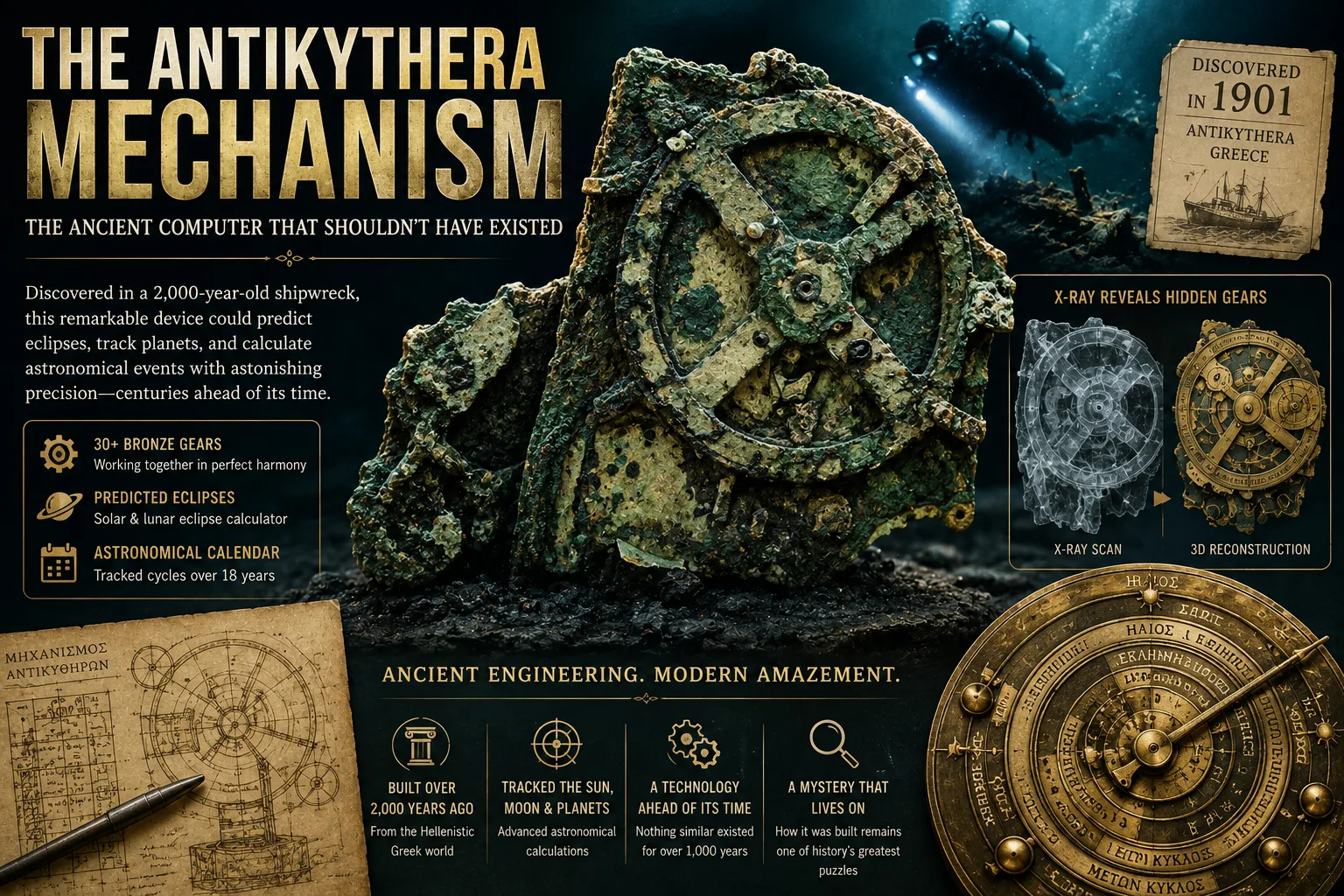
The Antikythera Mechanism: The Ancient Computer That Shouldn't Have Existed
In 1901, divers exploring a shipwreck off the Greek island of Antikythera recovered what appeared to be a lump of corroded bronze. Hidden inside was an astonishing mechanical device more than 2,000 years old, capable of predicting eclipses and tracking the movements of celestial bodies. Even today, historians continue to debate how such advanced technology existed so far ahead of its time.
The Antikythera Mechanism: The Ancient Computer That Shouldn't Have Existed
In the spring of 1901, a group of sponge divers surfaced from the waters near a small Greek island carrying what appeared to be little more than corroded pieces of bronze.
At first glance, the object looked completely ordinary.
It was cracked.
Covered in marine deposits.
Nearly unrecognizable after spending almost 2,000 years beneath the Mediterranean Sea.
Museum staff assumed it was simply another damaged artifact recovered from an ancient shipwreck.
Then something extraordinary happened.
As one fragment slowly dried, it cracked open.
Inside...
Researchers noticed tiny bronze gear teeth.
Not one.
Not two.
Dozens.
Ancient Greece had certainly produced remarkable mathematics, philosophy, and engineering.
But intricate gear systems of this complexity were believed to be inventions of a much later age.
The discovery challenged everything historians thought they knew about ancient technology.
Over a century later, scientists continue to study the mysterious device known as the Antikythera Mechanism, often described as the world's first analog computer.
Its existence is no longer in doubt.
The real mystery is far more astonishing.
How did people over two thousand years ago build a machine so advanced that nothing comparable appeared again for more than a thousand years?
A Shipwreck Hidden Beneath the Sea
The story begins near the Greek island of Antikythera, located between Crete and mainland Greece.
In 1900, sponge divers seeking natural sea sponges encountered something unexpected beneath the waves.
Scattered across the seabed lay the remains of an ancient Roman-era shipwreck.
Instead of cargo alone, the divers discovered what appeared to be an underwater museum.
The wreck contained:
Marble statues.
Bronze sculptures.
Glassware.
Jewelry.
Coins.
Pottery.
Luxury goods.
It quickly became one of the most important archaeological discoveries ever made in the Mediterranean.
Among these treasures lay the heavily corroded bronze fragments that would eventually become famous around the world.
🟢 Established Historical Evidence
The Antikythera shipwreck is one of the richest ancient shipwrecks ever discovered and dates to approximately the late 2nd or early 1st century BCE.
Many of its recovered artifacts are now preserved in the National Archaeological Museum of Athens.
A Lump of Corroded Metal
When archaeologists first examined the mysterious bronze fragments, they had little reason to suspect anything extraordinary.
The pieces resembled broken scraps of metal fused together by centuries underwater.
Some researchers initially believed they were parts of a decorative statue.
Others assumed they belonged to ordinary mechanical equipment.
No one imagined they were looking at one of the most sophisticated scientific instruments ever recovered from antiquity.
That changed when researchers noticed something almost impossible.
Perfectly cut gear teeth.
The First Clues
As conservators carefully cleaned the fragments, more details emerged.
Tiny bronze gears.
Rotating wheels.
Engraved inscriptions.
Circular scales.
The object clearly wasn't decorative.
It had been designed to move.
The question was:
Move for what purpose?
For decades, nobody could answer.
The fragments were incomplete.
Many gears had broken away.
Corrosion concealed much of the internal mechanism.
The device remained one of archaeology's greatest puzzles.
Looking Inside Without Opening It
Everything changed during the twentieth century with the arrival of modern imaging technology.
Researchers used:
X-ray photography.
High-resolution tomography.
Three-dimensional imaging.
For the first time, scientists could examine the hidden interior without damaging the fragile artifact.
What they discovered astonished the world.
Inside the fragments were more than thirty precisely engineered bronze gears, interconnected in ways previously thought impossible for that period.
The mechanism was far more sophisticated than anyone had imagined.
🟢 Established Historical Evidence
Modern X-ray imaging has revealed at least 30 surviving bronze gears, although researchers believe the original device likely contained more than 37 gears.
These discoveries fundamentally changed historians' understanding of ancient mechanical engineering.
More Than a Clock
At first, some researchers assumed the mechanism might simply measure time.
It didn't.
As scientists reconstructed the surviving gears, they realized the device performed something far more remarkable.
By turning a small hand crank, the mechanism could model the motions of celestial bodies.
It could calculate:
The phases of the Moon.
Solar cycles.
Lunar cycles.
Eclipse predictions.
Astronomical calendars.
In other words...
It was performing calculations.
Mechanically.
Without electricity.
Without electronics.
Without computers.
More than 2,000 years before the digital age.
The World's First Analog Computer?
Today, many historians describe the Antikythera Mechanism as the world's oldest known analog computer.
Unlike modern digital computers, which process information using binary numbers, analog computers represent information through continuously moving mechanical components.
Every rotating gear represented a mathematical relationship.
Each complete revolution calculated astronomical events with astonishing precision.
The more researchers studied the mechanism, the clearer its purpose became.
This wasn't merely a clock.
It was a portable astronomical calculator.
🟢 Established Historical Evidence
Most historians of science agree that the Antikythera Mechanism functioned as an advanced mechanical calculator designed to predict astronomical events. While the label "analog computer" is modern terminology, it accurately reflects the device's computational capabilities.
A Device Centuries Ahead of Its Time
Perhaps the most astonishing aspect of the Antikythera Mechanism isn't what it could do.
It's when it was built.
Comparable mechanical gear systems did not become common in Europe until the development of complex astronomical clocks during the medieval period, roughly a millennium later.
For decades, historians asked the same question:
If ancient engineers could build technology like this, where did all that knowledge go?
Was the mechanism a one-of-a-kind masterpiece?
Or was it simply the only survivor of an entire tradition of advanced engineering that has since been lost?
Those questions continue to drive research today.
🟡 Active Historical Hypothesis
Many historians believe the Antikythera Mechanism was unlikely to have been unique. The precision required to manufacture it suggests earlier prototypes and skilled workshops probably existed. However, no other comparable device from the ancient world has yet been discovered.
Who Built the Antikythera Mechanism?
As astonishing as the mechanism itself is, perhaps an even greater mystery remains unanswered.
Who possessed the knowledge to design such an extraordinary machine?
Unlike many ancient inventions, the Antikythera Mechanism carries no signature.
No surviving inscription identifies its maker.
No historical document explicitly describes its construction.
Yet the sophistication of the device leaves little doubt.
Its creator was not simply a skilled craftsman.
They were almost certainly an exceptional mathematician, astronomer, and engineer.
Was Archimedes Responsible?
One of the earliest names connected to the mechanism is the legendary Greek mathematician:
Archimedes of Syracuse.
Archimedes lived during the 3rd century BCE and was renowned for designing remarkably advanced machines.
Ancient writers credited him with creating:
Complex pulleys.
Mechanical war machines.
Mathematical instruments.
Planetary models.
The Roman statesman Cicero even described a mechanical device built by Archimedes that could demonstrate the movements of the Sun, Moon, and planets.
The description bears a striking resemblance to what the Antikythera Mechanism appears to accomplish.
Could Archimedes have designed it?
Probably not directly.
🟡 Active Historical Hypothesis
Most researchers believe the Antikythera Mechanism was built after Archimedes' lifetime.
However, many historians suggest its creators may have inherited scientific traditions inspired by his work or by the broader Hellenistic engineering culture he helped shape.
A Lost Tradition of Engineering
One remarkable question continues to puzzle historians.
Machines this sophisticated rarely appear without predecessors.
Modern inventions rarely emerge fully developed.
Cars followed centuries of engineering.
Computers evolved through generations of earlier devices.
The same principle likely applies here.
If ancient engineers built the Antikythera Mechanism, they almost certainly practiced, experimented, failed, improved, and refined their techniques over many years.
That suggests something extraordinary.
The mechanism may represent the surviving example of an entire technological tradition that has otherwise disappeared.
Reading the Hidden Instructions
For decades, researchers focused primarily on the gears.
Eventually, they realized another treasure had survived.
Tiny inscriptions covered parts of the mechanism.
Using advanced imaging techniques, scientists recovered thousands of Greek characters engraved onto its bronze surfaces.
These inscriptions function almost like an instruction manual.
They describe:
Calendar systems.
Astronomical cycles.
Eclipse predictions.
Dial labels.
Operating instructions.
The text transformed the investigation.
Instead of guessing the machine's purpose, researchers could now compare its mechanical components with the written explanations left by its creators.
🟢 Established Historical Evidence
Advanced X-ray tomography has revealed more than 3,000 Greek characters engraved on the surviving fragments.
These inscriptions have been essential in reconstructing how the mechanism operated.
Rebuilding a Lost Machine
The Antikythera Mechanism did not survive intact.
Only fragments remain.
Many gears are missing.
Entire sections have been lost forever.
To understand the original device, scientists have combined:
Mechanical engineering.
Ancient Greek astronomy.
Computer modeling.
Three-dimensional reconstruction.
Experimental archaeology.
Modern replicas demonstrate that the mechanism could accurately predict:
Solar eclipses.
Lunar eclipses.
Lunar phases.
The position of the Sun.
The position of the Moon.
Ancient calendar cycles.
Some researchers also believe it displayed the positions of the known planets.
Although parts of this reconstruction remain debated, every new study brings us closer to understanding the original machine.
Why Didn't This Technology Continue?
This question may be the greatest mystery of all.
If engineers in ancient Greece possessed knowledge of precision gear systems, why did similar machines disappear for more than a thousand years?
Historians have proposed several explanations.
Some believe:
The workshops producing such devices were extremely rare.
The knowledge was concentrated among only a handful of specialists.
Wars and political upheaval disrupted scientific traditions.
Libraries containing technical writings were destroyed.
Few bronze mechanisms survived because metal was routinely melted down and reused.
Each explanation is plausible.
Perhaps all played a role.
What is certain is that the Antikythera Mechanism appears centuries ahead of anything else that survives from the ancient world.
Popular Myths
Because the mechanism seems so advanced, it has inspired many sensational claims.
Let's separate fact from fiction.
Myth: It Was Built by Aliens
This idea appears frequently online.
There is no archaeological evidence supporting extraterrestrial involvement.
Every component of the mechanism reflects known ancient Greek craftsmanship, mathematics, and astronomy.
Its sophistication is remarkable.
Its origin remains entirely human.
Myth: It Was Found Perfectly Intact
No.
The mechanism survives only as heavily corroded fragments.
Everything we know today comes from painstaking scientific reconstruction rather than a complete working machine.
Myth: It Could Predict the Future
The mechanism predicted astronomical events, not historical events.
It calculated eclipses and celestial cycles using mathematics.
It was an extraordinary scientific instrument, not a mystical device.
🔴 Popular Myth / Unsupported Claim
Claims that the Antikythera Mechanism was evidence of a lost super-civilization or extraterrestrial technology are not supported by archaeological or historical evidence.
Its remarkable complexity can be explained through the advanced mathematical and engineering traditions of the Hellenistic Greek world.
Why the Antikythera Mechanism Changed History
Before its discovery, historians believed sophisticated mechanical gear systems emerged much later.
The Antikythera Mechanism forced scholars to reconsider that timeline.
It demonstrated that ancient engineers possessed:
Advanced mathematics.
Precision metalworking.
Complex gear design.
Deep astronomical knowledge.
Extraordinary mechanical creativity.
Far from being primitive, parts of the ancient world were capable of engineering achievements once thought impossible for their era.
Frequently Asked Questions
Where is the Antikythera Mechanism today?
The surviving fragments are preserved in the National Archaeological Museum in Athens, Greece.
Is it really the world's first computer?
Most historians describe it as the world's oldest known analog computer because it mechanically performed astronomical calculations using interconnected gears.
Did it predict eclipses?
Yes.
The mechanism could predict both solar and lunar eclipses using sophisticated astronomical cycles known to ancient Greek astronomers.
Has another mechanism like it been found?
No.
Although researchers suspect similar devices once existed, no other machine matching its complexity has yet been discovered.
Final Thoughts
The Antikythera Mechanism is one of the rare archaeological discoveries that genuinely changes our understanding of history. It is not mysterious because people imagined impossible stories about it. It is mysterious because the evidence itself is extraordinary.
More than two thousand years ago, skilled engineers crafted a compact machine capable of modeling the movements of the heavens with remarkable precision. Its gears, inscriptions, and mathematical design reveal a level of scientific knowledge that seemed centuries ahead of its time.
The greatest mystery may not be how the mechanism worked. Modern research has answered much of that question. The deeper mystery is why so little of this technological tradition survived. If one such machine existed, others may once have existed as well, only to be lost through war, decay, or the simple recycling of valuable bronze.
The Antikythera Mechanism reminds us that history is rarely a straight line of progress. Civilizations rise, flourish, and sometimes lose knowledge that later generations must rediscover. Hidden inside a corroded lump of bronze at the bottom of the Mediterranean was proof that the ancient world was capable of achievements far more sophisticated than anyone had imagined. And even after more than a century of study, this remarkable machine continues to rewrite the story of human ingenuity.