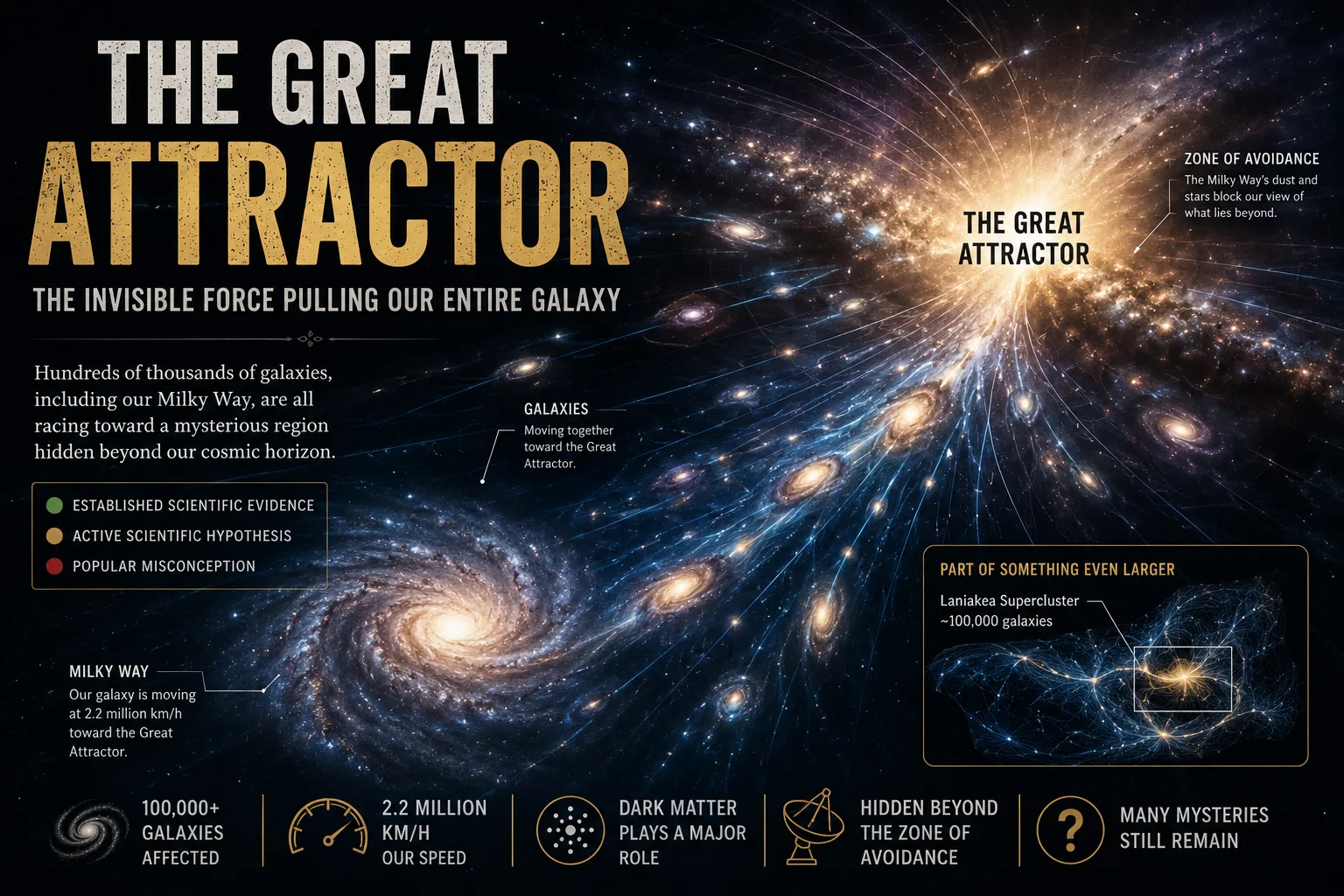
The Great Attractor: The Invisible Force Pulling Our Entire Galaxy
Somewhere deep in space lies an invisible region so massive that it is pulling the Milky Way, the Andromeda Galaxy, and hundreds of thousands of other galaxies toward it at millions of kilometers per hour. Astronomers call it the Great Attractor, but despite decades of research, much of its true nature remains hidden behind our own galaxy.
The Great Attractor: The Invisible Force Pulling Our Entire Galaxy
Right now, as you read these words, Earth is moving through space at incredible speed.
Our planet orbits the Sun at nearly 107,000 km/h (66,500 mph).
The Sun, in turn, races around the center of the Milky Way at roughly 828,000 km/h (514,000 mph).
But the story doesn't end there.
The Milky Way Galaxy itself is also moving.
Not drifting randomly.
Not slowly.
It is traveling through the universe at approximately 2.2 million kilometers per hour (1.4 million mph) toward a destination that astronomers struggled to identify for decades.
The strangest part?
Something enormous is pulling us.
Not just the Milky Way.
The Andromeda Galaxy.
Thousands of nearby galaxies.
Entire galaxy clusters.
Hundreds of thousands of galaxies appear to be moving toward the same mysterious region of space.
Astronomers eventually gave this invisible destination a name.
The Great Attractor.
Yet despite decades of research, nobody has ever seen it directly.
It hides behind one of the greatest obstacles in astronomy...
Our own galaxy.
A Discovery Nobody Expected
For centuries, astronomers assumed that galaxies simply moved apart as the universe expanded.
This idea is supported by one of modern cosmology's greatest discoveries.
After the Big Bang, space itself began expanding.
As a result, most galaxies are moving away from one another.
This expansion was first observed by astronomer Edwin Hubble in the 1920s and remains one of the foundations of modern astronomy.
Everything seemed straightforward.
Until astronomers started measuring galaxies more carefully.
Some weren't moving exactly as expected.
🟢 Established Scientific Evidence
The universe is expanding, causing distant galaxies to recede from one another over time.
However, gravity from nearby galaxies and galaxy clusters also influences their motion, producing additional movements known as peculiar velocities.
These local gravitational effects are well established in modern cosmology.
Something Was Pulling the Milky Way
During the 1970s and 1980s, astronomers began calculating the actual motion of the Milky Way.
Instead of following only the general expansion of the universe, our galaxy possessed an additional velocity.
It was moving toward a specific region of space.
Even more surprising, neighboring galaxies showed similar behavior.
This wasn't unique to the Milky Way.
Entire groups of galaxies appeared to share the same destination.
It was as though an invisible giant were pulling them all together.
Following the Cosmic Trail
Imagine watching leaves floating down a river.
Even if you cannot see the waterfall ahead, you can often determine where it is by observing the direction in which every leaf is drifting.
Astronomers applied the same logic to galaxies.
Instead of watching water currents, they measured galaxy motions across millions of light-years.
Again and again, they found something remarkable.
Galaxies consistently drifted toward the same general region.
The farther observations improved, the clearer the pattern became.
Whatever lay ahead possessed an extraordinary amount of mass.
Enough to influence hundreds of thousands of galaxies.
What Exactly Is the Great Attractor?
Contrary to what the name suggests, the Great Attractor is not a single object.
It is not:
A giant planet.
A supermassive black hole.
A star.
A mysterious spacecraft.
Instead, it appears to be an enormous region containing vast concentrations of matter whose combined gravity affects nearby galaxies.
Think of it less as one giant object and more as an immense gravitational valley in the large-scale structure of the universe.
Everything nearby gradually falls toward it.
🟢 Established Scientific Evidence
Current observations suggest that the Great Attractor is associated with massive galaxy clusters and superclusters distributed across a vast region of space.
Its gravitational influence arises from the combined mass of these structures rather than a single hidden object.
Why Can't We See It?
If something this massive exists, why didn't astronomers simply point a telescope toward it?
Because something enormous blocks the view.
Ironically...
It's us.
More specifically, it's the Milky Way Galaxy.
Our Solar System sits inside one of the spiral arms of the Milky Way.
When astronomers look toward certain parts of the sky, they must peer through billions of stars, immense clouds of gas, and thick layers of cosmic dust.
These materials obscure distant galaxies behind them.
This hidden region became known as:
The Zone of Avoidance.
For decades, much of the Great Attractor lay concealed behind this cosmic curtain.
The Zone of Avoidance
Despite its dramatic name, the Zone of Avoidance is not empty space.
It simply appears empty in visible light because the Milky Way blocks our view.
Imagine trying to observe a distant mountain while standing inside a dense forest.
The mountain still exists.
You just cannot see it clearly because countless trees stand between you and the horizon.
Astronomers eventually began using:
Radio telescopes
Infrared telescopes
X-ray observatories
These instruments can penetrate much of the dust that blocks visible light.
Gradually, hidden galaxies began to emerge.
The mysterious region became less mysterious.
But it also became more complicated.
🟢 Established Scientific Evidence
Modern infrared and radio surveys have revealed numerous previously hidden galaxies behind the Milky Way, significantly improving astronomers' understanding of the Great Attractor region.
However, mapping this area remains challenging because our galaxy continues to obscure portions of the sky.
A Discovery Even Bigger
As observations improved, astronomers made another surprising discovery.
The Great Attractor itself might not be the final destination.
Instead, it appears to be part of something even larger.
Researchers studying galaxy motions identified an immense structure known as the Laniakea Supercluster, containing approximately 100,000 galaxies, including our own Milky Way.
Within this vast cosmic network, galaxies flow along enormous gravitational pathways, somewhat like rivers converging into larger streams.
The Great Attractor appears to be one important gravitational focal point within this much larger structure.
In other words, what scientists once thought was the destination may itself be traveling within an even grander cosmic landscape.
Could Something Even Larger Exist?
The deeper astronomers looked, the more intriguing the universe became.
Beyond the Great Attractor lies another enormous concentration of galaxies known as the Shapley Supercluster.
Some researchers believe its immense gravity also contributes to the motions observed across our region of the universe.
Instead of one dominant gravitational source, there may be several interacting structures influencing one another across hundreds of millions of light-years.
The universe, it turns out, behaves less like isolated islands and more like an interconnected cosmic web.
🟡 Active Scientific Hypothesis
Astronomers continue to study how much of our galaxy's motion is influenced by the Great Attractor compared with larger structures such as the Shapley Supercluster. Current evidence suggests both play important roles, but the exact balance remains an active area of research.
Is the Great Attractor Made of Dark Matter?
Whenever people hear about the Great Attractor, one question almost always follows.
If astronomers can't see it clearly... could it be made entirely of dark matter?
The answer is more nuanced than many headlines suggest.
Dark matter almost certainly plays an important role.
But the Great Attractor is not believed to be a giant invisible ball of dark matter floating through space.
Instead, it appears to be a region containing enormous galaxy clusters surrounded by vast halos of dark matter.
Since dark matter outweighs ordinary matter by roughly five to one, much of the region's gravity comes from something we cannot directly observe.
🟢 Established Scientific Evidence
Dark matter does not emit, absorb, or reflect light.
Astronomers detect its presence indirectly by measuring its gravitational influence on stars, galaxies, and galaxy clusters.
Although dark matter has never been directly observed, its effects are supported by multiple independent lines of evidence and are a central part of modern cosmology.
How Do Astronomers Measure Something They Can't See?
At first, this sounds impossible.
How can scientists study an invisible object?
The answer is surprisingly straightforward.
They don't observe the object itself.
They observe its effects.
Imagine walking through a park on a calm day.
You can't see the wind.
But you can see:
Trees bending.
Leaves moving.
Flags fluttering.
Waves forming on a lake.
The wind is invisible.
Its effects are not.
Astronomers study dark matter and the Great Attractor in much the same way.
They measure how galaxies move and use those motions to estimate where unseen mass must exist.
Mapping the Invisible Universe
Over the past several decades, astronomers have created increasingly detailed maps of the nearby universe.
These maps reveal that galaxies are not distributed randomly.
Instead, they form an immense cosmic web.
This web contains:
Galaxy clusters.
Superclusters.
Filaments stretching hundreds of millions of light-years.
Vast empty regions known as cosmic voids.
Gravity causes matter to collect along these enormous structures.
The Great Attractor sits within one of the densest known regions of this cosmic network.
Rather than existing as an isolated object, it functions as part of a much larger gravitational landscape.
The Laniakea Supercluster
In 2014, astronomers introduced one of the most remarkable discoveries in modern cosmology.
By carefully tracking the motion of thousands of galaxies, they identified a gigantic structure containing our own galaxy.
They named it:
Laniakea
A Hawaiian word meaning:
"Immense Heaven."
The Laniakea Supercluster contains roughly 100,000 galaxies, including:
The Milky Way.
The Andromeda Galaxy.
Thousands of neighboring galaxy groups.
Instead of moving randomly, these galaxies follow gravitational pathways toward common centers, much like rivers flowing into larger waterways.
The Great Attractor appears to be one of these major convergence points.
🟢 Established Scientific Evidence
The Laniakea Supercluster is a scientifically recognized large-scale structure defined by the observed motions of galaxies rather than by traditional cluster boundaries.
It illustrates how gravity organizes matter across hundreds of millions of light-years.
Common Misconceptions
Because the Great Attractor sounds mysterious, it has inspired countless sensational claims.
Let's separate science from fiction.
Myth: The Great Attractor Is a Giant Black Hole
This is perhaps the most common misconception.
A black hole large enough to pull hundreds of thousands of galaxies would produce gravitational effects unlike anything astronomers observe.
Instead, the evidence points toward the combined mass of countless galaxies, galaxy clusters, hot gas, and dark matter spread across an enormous region.
Myth: It Will Eventually Swallow the Milky Way
No.
Although our galaxy is moving toward this region, the universe itself continues expanding.
The Great Attractor is not a cosmic vacuum cleaner consuming everything around it.
Galactic motion occurs over hundreds of millions to billions of years, and gravitational interactions on these scales are far more complex than objects simply falling into a single point.
Myth: It Was Created by Alien Civilizations
From time to time, internet discussions suggest the Great Attractor could be an artificial structure built by advanced extraterrestrials.
There is no scientific evidence supporting this idea.
Every observation made so far is consistent with known gravitational processes operating on enormous cosmic scales.
🔴 Popular Misconception / Unsupported Claim
Claims that the Great Attractor is a hidden superweapon, an alien megastructure, or a portal to another universe are unsupported by credible astronomical evidence.
These ideas belong to speculative fiction rather than observational science.
Why This Discovery Changed Astronomy
Before the Great Attractor was identified, astronomers understood that gravity influenced nearby galaxies.
What surprised them was the scale.
Entire galaxy clusters were moving together.
These weren't isolated objects.
They formed part of a gigantic interconnected system stretching across hundreds of millions of light-years.
The discovery fundamentally changed how scientists viewed the structure of the nearby universe.
Instead of isolated galaxies drifting through empty space, the universe appeared increasingly like a vast network shaped by invisible gravitational currents.
Questions Scientists Are Still Trying to Answer
Despite decades of research, several important questions remain.
For example:
Exactly how much mass exists within the Great Attractor region?
How much influence does dark matter contribute?
What role does the nearby Shapley Supercluster play?
Are there even larger gravitational structures beyond our current maps?
How will future space telescopes refine these measurements?
Each new generation of observatories improves our understanding, but the full picture is still emerging.
Frequently Asked Questions
Can we see the Great Attractor with a telescope?
Not completely.
Much of the region lies behind the dense stars and dust of the Milky Way, making direct observation difficult in visible light. Infrared, radio, and X-ray observations help reveal many of the hidden galaxies.
Is the Great Attractor dangerous?
No.
Although our galaxy is moving toward this region, these motions occur over immense cosmic timescales and pose no danger to Earth or the Solar System.
Is the Great Attractor a single object?
No.
It is best understood as a vast region containing multiple galaxy clusters, enormous amounts of dark matter, and other large-scale structures whose combined gravity influences nearby galaxies.
Has the mystery been solved?
Partially.
Astronomers now understand far more than they did when the Great Attractor was first proposed. However, the precise distribution of mass in the region and its relationship with neighboring structures such as the Shapley Supercluster remain active areas of research.
Final Thoughts
The Great Attractor reminds us that the universe is far more interconnected than it first appears.
Our Solar System circles the Sun. The Sun orbits the center of the Milky Way. The Milky Way itself moves alongside thousands of neighboring galaxies, all responding to gravitational influences spread across unimaginable distances. What once seemed like isolated islands of stars are now understood to be part of an immense cosmic web, woven together by gravity and dominated by matter we cannot even see directly.
Modern astronomy has transformed the Great Attractor from a mysterious invisible force into a scientifically grounded feature of our universe. Yet it has also revealed how much remains unknown. Hidden behind the Milky Way, surrounded by dark matter, and linked to even larger structures such as the Laniakea and Shapley superclusters, it continues to challenge our understanding of the cosmos.
Perhaps the greatest lesson of the Great Attractor is not that the universe hides monsters or supernatural forces. It is that reality itself can be astonishing enough. The invisible currents shaping galaxies across hundreds of millions of light-years remind us that even today, with powerful telescopes and advanced computer simulations, humanity is still only beginning to map the vast architecture of the universe.