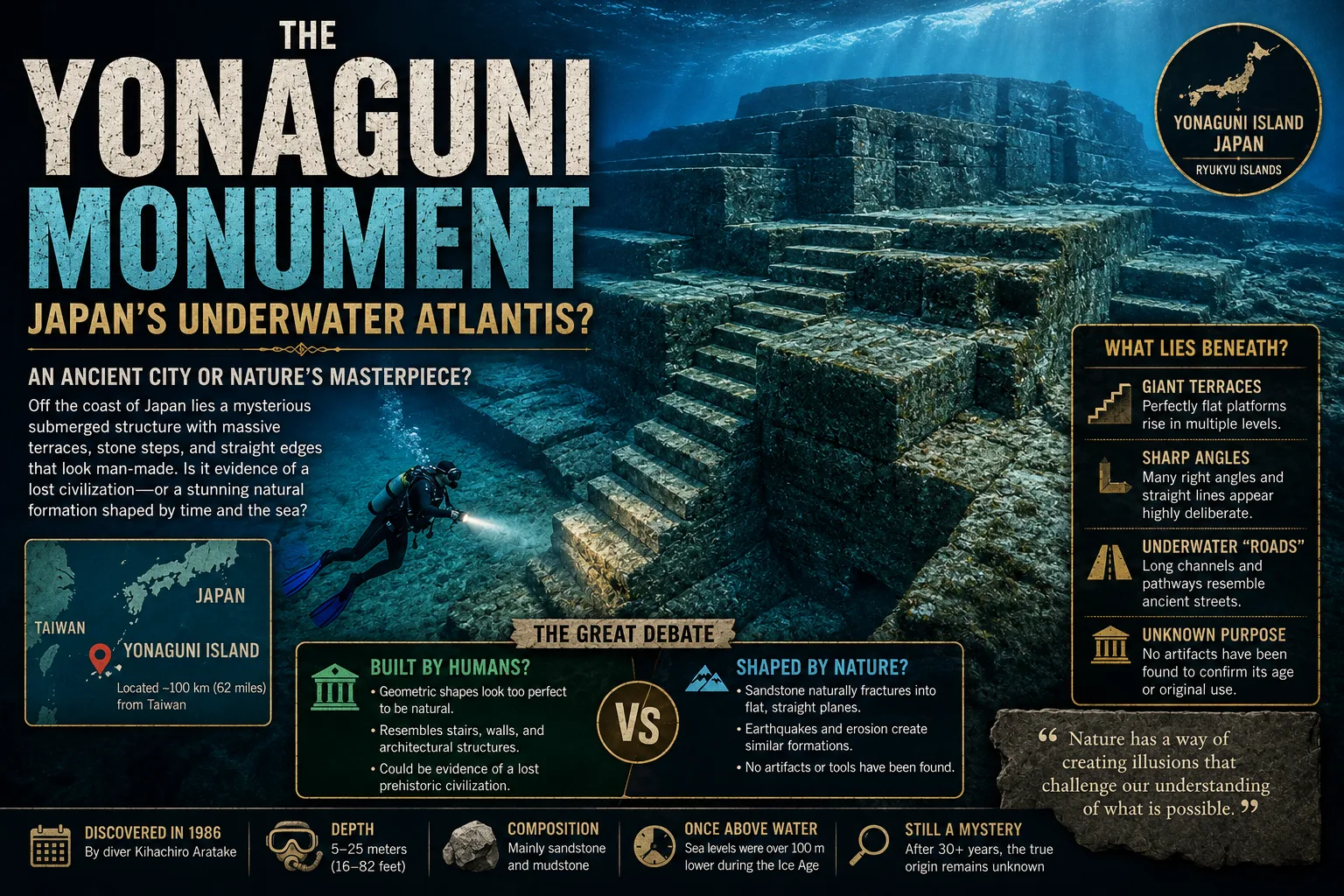
The Yonaguni Monument: Japan's Underwater Atlantis or Nature's Masterpiece?
Off the coast of Japan lies a mysterious underwater formation with giant terraces, sharp angles, and massive stone platforms that resemble the ruins of an ancient city. Is the Yonaguni Monument evidence of a forgotten civilization beneath the sea, or simply one of nature's most astonishing geological creations? Explore the evidence behind one of archaeology's most debated mysteries.
The Yonaguni Monument: Japan's Underwater Atlantis or Nature's Masterpiece?
Around 100 kilometers (62 miles) from Taiwan, off the southern coast of Japan's Yonaguni Island, the ocean floor hides one of the world's most controversial underwater discoveries.
Divers descending through the clear blue waters encounter something extraordinary.
Massive stone terraces.
Perfectly flat platforms.
Sharp edges.
Straight walls.
Staircase-like formations.
Deep channels that appear almost deliberately carved.
At first glance, the scene resembles the ruins of a lost city swallowed by the sea.
Some researchers have gone so far as to compare it to Atlantis.
Others dismiss that idea entirely.
To many geologists, the Yonaguni Monument is not an ancient city at all.
It is simply an unusual natural rock formation shaped by millions of years of tectonic forces and erosion.
Nearly four decades after its discovery, scientists still disagree.
The mystery isn't whether the monument exists.
Anyone can dive to it today.
The mystery is whether nature alone created something that looks so remarkably engineered.
An Unexpected Discovery
The story began in 1986.
Local diving instructor Kihachiro Aratake was searching the waters around Yonaguni Island for new diving locations.
The area was already famous for its schools of hammerhead sharks.
Instead of sharks, he found something entirely unexpected.
Beneath the surface lay an enormous stepped rock formation unlike anything he had seen before.
Its geometric appearance immediately caught attention.
Word spread quickly among divers.
Soon researchers from Japan and around the world arrived to investigate.
What exactly had been discovered beneath the sea?
🟢 Established Scientific Evidence
The Yonaguni Monument was discovered in 1986 by diving instructor Kihachiro Aratake near Yonaguni Island in Japan's Ryukyu archipelago. It remains one of the country's most famous underwater geological sites.
A Monument Beneath the Waves
The main structure is enormous.
Rising from the seabed, it measures roughly:
About 150 meters (490 feet) long.
Approximately 40 meters (130 feet) wide.
Around 25 meters (82 feet) tall.
Its most striking feature is its geometry.
Divers have photographed what appear to be:
Broad terraces.
Flat platforms.
Staircase-like steps.
Long straight walls.
Sharp right angles.
Narrow channels.
Some surfaces look so smooth that they appear machine-cut.
Others resemble roads leading from one level to another.
Viewed underwater, it is easy to understand why many visitors immediately think of an ancient structure.
Why It Looks Artificial
Human brains are remarkably good at recognizing patterns.
Especially straight lines.
Especially symmetry.
Especially right angles.
The Yonaguni Monument seems to contain all three.
Some researchers have pointed to features resembling:
Monumental staircases.
Entranceways.
Pillars.
Courtyards.
Terraces.
A few have even suggested possible carvings, though these claims remain highly disputed.
If the monument truly were man-made, it would represent one of the oldest known monumental constructions on Earth, predating every known civilization.
That possibility has fueled decades of debate.
🟡 Active Scientific Debate
A small number of researchers, most notably marine geologist Masaaki Kimura, argue that parts of the Yonaguni Monument may have been modified by humans or incorporated into an ancient structure. Most geologists, however, remain unconvinced and favor a natural explanation.
The Geological Explanation
Most geologists approach the monument very differently.
They point out that Yonaguni sits within one of the most active tectonic regions on Earth.
Frequent earthquakes have fractured layers of sandstone over millions of years.
When sandstone breaks along natural joints, it often forms:
Straight cracks.
Flat surfaces.
Sharp edges.
Block-like shapes.
Ocean currents then erode the rock along these weaknesses, exaggerating the geometric appearance.
The result can look surprisingly artificial without any human involvement.
Nature, it turns out, is capable of producing astonishingly regular patterns.
🟢 Established Scientific Evidence
The monument is composed primarily of sandstone and mudstone, rock types that naturally fracture along straight planes. Geologists note that similar geometric formations can occur elsewhere through tectonic activity and erosion.
Could It Once Have Been Above Water?
One fascinating point is accepted by nearly everyone involved in the debate.
During the last Ice Age, global sea levels were much lower than they are today.
Around 20,000 years ago, sea levels were more than 100 meters (330 feet) lower than present.
That means the Yonaguni Monument would likely have stood above sea level.
This fact often fuels speculation.
If humans lived nearby at the time...
Could they have used or modified the formation?
So far, there is no definitive archaeological evidence proving they did.
But the possibility keeps the discussion alive.
A Debate That Refuses to End
Unlike many archaeological mysteries, the Yonaguni Monument does not divide experts because of missing evidence.
It divides them because they interpret the same evidence differently.
One group sees geology.
Another sees engineering.
Both examine the same underwater structure.
Both study the same photographs.
Both analyze the same rock.
Yet they reach different conclusions.
That is precisely why Yonaguni remains one of the most fascinating scientific debates in underwater archaeology.
🔴 Popular Myth / Unsupported Claim
The Yonaguni Monument is frequently described online as proof of Atlantis or a lost prehistoric super-civilization.
There is no credible archaeological evidence supporting these claims. The debate centers on whether the formation is entirely natural or whether humans may have modified parts of it, not on the existence of Atlantis.
Is It Really an Ancient City?
Ever since the Yonaguni Monument was discovered, researchers have divided into two camps.
One believes the structure is entirely natural.
The other argues that, while nature created the original rock, humans may have modified parts of it.
Both sides agree on one thing.
The monument is extraordinary.
Where they disagree is why.
The Case for Human Construction
The strongest advocate for a human origin is Japanese marine geologist Professor Masaaki Kimura, who has studied the site for decades.
Kimura argues that several features appear too regular to be explained by geology alone.
Among the observations he highlights are:
Broad terraces arranged in distinct levels.
Staircase-like formations with uniform steps.
Sharp ninety-degree corners.
Long, seemingly straight walls.
Deep channels resembling streets or drainage systems.
Kimura has also suggested that certain markings may represent carvings or symbols, although these claims remain controversial.
If even part of the monument were intentionally shaped by humans, it would dramatically alter our understanding of prehistoric engineering.
🟡 Active Scientific Debate
Professor Masaaki Kimura argues that parts of the Yonaguni Monument may have been modified by ancient humans. While his work has attracted international attention, his interpretation has not gained broad acceptance among most geologists or archaeologists.
The Case for Nature
Most geologists remain unconvinced.
They argue that every major feature of the monument can be explained through well-understood geological processes.
The rock beneath Yonaguni consists primarily of sandstone, which naturally fractures along straight bedding planes and vertical joints.
Over millions of years:
Earthquakes create large fractures.
Ocean currents widen those fractures.
Waves erode softer layers.
Harder rock remains, forming terraces and steps.
This combination can produce surprisingly geometric landscapes.
Similar formations can be found in coastal cliffs and rock platforms around the world.
To geologists, Yonaguni is unusual.
But not impossible.
🟢 Established Scientific Evidence
The sandstone at Yonaguni naturally breaks into flat blocks because of its geological structure. Many researchers consider the monument an exceptional but entirely natural example of this process, shaped further by marine erosion.
The Missing Evidence
Perhaps the strongest argument against the "lost city" hypothesis is not the shape of the monument.
It's what hasn't been found.
If Yonaguni were once a large ancient city, archaeologists would expect to discover evidence such as:
Stone tools.
Pottery.
Human remains.
Foundations built from multiple stones.
Written inscriptions.
Artifacts associated with long-term settlement.
Despite decades of dives and surveys, no definitive archaeological evidence has been recovered from the monument itself to confirm it was a constructed city.
That absence doesn't prove the site is natural.
But it does make extraordinary claims much harder to support.
Could Humans Have Modified a Natural Formation?
A growing number of researchers consider this a reasonable middle ground.
Instead of asking whether the monument is entirely natural or entirely artificial, they suggest another possibility.
Nature may have created the basic rock formation.
Later, prehistoric people could have:
Used it as a ceremonial site.
Carved small sections.
Flattened certain surfaces.
Added limited modifications.
This idea would explain why the monument appears so geometric while also fitting the geological evidence.
At present, however, there is no conclusive proof that such modifications occurred.
🟡 Active Scientific Debate
Some researchers propose that Yonaguni could be a naturally formed rock formation that was later modified by humans. While this hypothesis attempts to reconcile geological and archaeological observations, it remains unproven.
Why the Atlantis Theory Persists
The internet rarely settles for uncertainty.
Because Yonaguni resembles submerged ruins, it is often linked to:
Atlantis.
Lemuria (Mu).
Lost global civilizations.
Advanced Ice Age societies.
Extraterrestrial builders.
These ideas make compelling documentaries and viral videos.
They share one major problem.
Evidence.
No excavation has uncovered artifacts linking Yonaguni to Atlantis or any previously unknown advanced civilization.
Without supporting archaeological evidence, such claims remain speculation rather than history.
🔴 Popular Myth / Unsupported Claim
There is no credible evidence connecting the Yonaguni Monument to Atlantis, Lemuria, extraterrestrials, or a lost prehistoric super-civilization. These theories are popular in books and online media but are not supported by mainstream archaeological research.
Frequently Asked Questions
Where is the Yonaguni Monument?
The monument lies off the coast of Yonaguni Island, Japan's westernmost inhabited island, in the Ryukyu archipelago.
How deep is it?
The main formation begins at depths of roughly 5 to 25 meters (16 to 82 feet), making it accessible to experienced scuba divers.
Has anyone proved it is man-made?
No.
After decades of study, no scientific consensus has concluded that the monument was built by humans.
Is the debate over?
Not at all.
Most geologists support a natural origin, while a smaller group of researchers continues to argue that some features may have been modified by ancient people.
Final Thoughts
The Yonaguni Monument is fascinating not because it offers clear answers, but because it forces us to confront the limits of interpretation. Two experienced scientists can examine the same underwater formation, measure the same angles, study the same rock layers, and still reach different conclusions.
What everyone agrees on is that the monument is real, visually striking, and unlike almost anything else beneath the sea. Its immense terraces, sharp edges, and stepped appearance challenge our instincts, tempting us to see the work of ancient builders where nature may have been the architect.
For now, the evidence leans toward a geological origin, shaped by tectonic activity and erosion over immense spans of time. Yet the possibility that prehistoric people may have used or altered parts of the formation has not been completely ruled out. Until new archaeological discoveries emerge, the Yonaguni Monument will remain one of the world's most compelling underwater mysteries.
Sometimes the greatest mystery is not hidden by darkness or depth, but by the simple fact that the same evidence can tell more than one story.