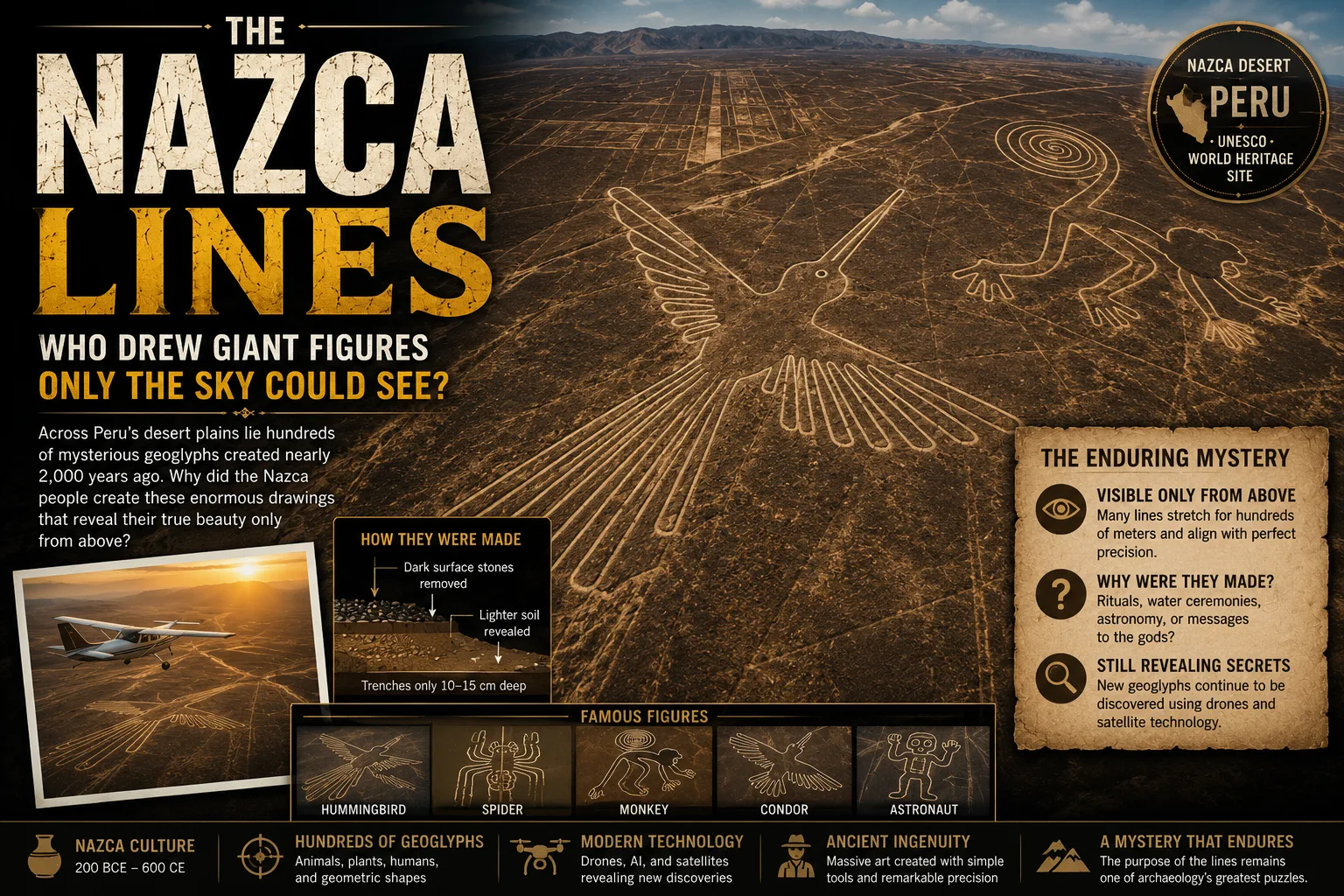
The Nazca Lines: Who Drew Giant Figures Only the Sky Could See?
Etched across the deserts of southern Peru are hundreds of enormous geoglyphs depicting animals, geometric shapes, and mysterious human figures. Many can only be fully appreciated from the air, raising one of archaeology's greatest questions: why did the ancient Nazca people create these colossal artworks nearly two thousand years ago?
The Nazca Lines: Who Drew Giant Figures Only the Sky Could See?
Stretching across one of the driest deserts on Earth lies a masterpiece so enormous that, for centuries, almost no one realized it existed.
From the ground, you might see only a shallow trench in the reddish soil.
Walk a little farther, and another appears.
Then another.
Nothing seems remarkable.
But climb into an airplane...
And the desert transforms into an immense canvas.
A hummingbird with wings spanning more than 90 meters (300 feet).
A monkey with a perfectly spiraled tail.
A spider stretching across the landscape.
A giant condor.
A mysterious human-like figure etched into a hillside, often nicknamed "The Astronaut."
In total, hundreds of enormous lines, geometric shapes, and animal figures cover nearly 450 square kilometers (170 square miles) of southern Peru.
Some extend for several kilometers.
Others are so precise that they remain recognizable after nearly two thousand years.
The greatest mystery isn't who created them.
Archaeologists know they were made by the Nazca culture.
The real question is far more intriguing.
Why would an ancient civilization devote enormous effort to creating artworks whose full beauty can only be appreciated from high above the ground?
A Desert That Preserved a Secret
The Nazca Lines are located in the Nazca Desert of southern Peru.
At first glance, the landscape appears almost lifeless.
Rain is extremely rare.
Strong vegetation is almost nonexistent.
The ground is covered with dark reddish stones that have weathered under the desert sun for thousands of years.
Ironically, these harsh conditions created the perfect environment for preserving one of humanity's greatest archaeological mysteries.
Because there is so little rainfall or erosion, the giant drawings have survived for nearly two millennia with astonishing clarity.
🟢 Established Archaeological Evidence
The Nazca Desert is one of the driest places on Earth. Its stable climate, minimal rainfall, and low wind erosion have allowed the geoglyphs to remain remarkably well preserved for centuries.
The Discovery
Local people had always known that unusual lines crossed parts of the desert.
But no one could truly appreciate their scale.
From ground level, many figures are simply too large to recognize.
It wasn't until the 20th century, when aircraft began flying over the region, that researchers realized something extraordinary lay below.
Pilots reported seeing gigantic geometric patterns stretching across the desert floor.
Soon afterward, archaeologists confirmed that these were not natural formations.
They were deliberately created.
The discovery transformed the Nazca Desert into one of the world's most famous archaeological landscapes.
How Were the Nazca Lines Made?
Surprisingly...
The builders didn't carve deeply into the earth.
Instead, they removed the dark reddish stones covering the desert surface.
Beneath them lay a much lighter layer of soil.
By carefully clearing away the upper layer, they created pale lines that contrasted sharply against the darker ground.
The trenches are generally only 10 to 15 centimeters (4 to 6 inches) deep.
Yet because the surrounding environment changes so little, the designs have remained visible for centuries.
Simple.
Elegant.
Remarkably effective.
🟢 Established Archaeological Evidence
The Nazca Lines were created by removing the darker surface stones to expose lighter soil beneath. This technique, combined with the region's exceptionally dry climate, explains their remarkable preservation.
Giant Figures Across the Desert
Today, archaeologists have documented hundreds of geoglyphs.
Some depict animals.
Others represent plants.
Many consist of enormous geometric patterns.
Among the most famous are:
The Hummingbird
The Monkey
The Spider
The Condor
The Whale
The Dog
The Heron
The Tree
The Hands
Perhaps the most unusual is a human-like figure carved into a hillside.
Because of its appearance, modern visitors often call it:
The Astronaut.
The nickname is imaginative.
But it tells us more about modern curiosity than ancient intentions.
Could Ancient People Create Such Massive Drawings?
At first glance, many people assume aerial assistance would have been necessary.
In reality, experiments have shown otherwise.
Archaeologists have demonstrated that relatively small groups using:
Wooden stakes
Ropes
Measuring cords
Simple surveying techniques
can accurately create enormous geoglyphs without ever leaving the ground.
The Nazca people likely planned their designs using grids and reference points, scaling smaller sketches into monumental artworks with remarkable precision.
🟢 Established Archaeological Evidence
Experimental archaeology has shown that large geoglyphs similar to the Nazca Lines can be constructed using simple tools and careful planning, without requiring flight or advanced technology.
A Mystery Hidden in Plain Sight
If ancient people possessed the knowledge to create these enormous figures...
Why choose a location where no one could fully appreciate them from the ground?
Some lines stretch perfectly across hills.
Others continue uninterrupted for kilometers.
Many geometric figures display astonishing straightness despite crossing uneven terrain.
Clearly, the Nazca builders intended these designs to be seen as complete forms.
But by whom?
Future generations?
The gods?
Or perhaps the people themselves through nearby hills and ceremonial pathways?
That question has inspired decades of archaeological investigation.
More Discoveries Every Year
For many years, researchers believed they had already documented most of the Nazca Lines.
They were wrong.
Modern technology has transformed the search.
Using:
Drones
Satellite imagery
Artificial intelligence
High-resolution aerial photography
Archaeologists continue discovering previously unknown geoglyphs hidden across the desert.
Some depict birds.
Others resemble cats, humans, or abstract symbols.
The Nazca landscape is proving to be far larger and more complex than anyone imagined only a few decades ago.
🟡 Active Archaeological Hypothesis
Recent drone surveys and AI-assisted image analysis continue to reveal previously unknown geoglyphs, suggesting the Nazca cultural landscape is significantly more extensive than earlier archaeological surveys indicated.
🔴 Popular Myth / Unsupported Claim
The Nazca Lines are frequently claimed to be alien landing strips or evidence of extraterrestrial visitors.
There is no credible archaeological evidence supporting these ideas. The geoglyphs are fully consistent with techniques available to the ancient Nazca people and reflect a rich cultural and ceremonial tradition rather than alien intervention.
Why Did the Nazca People Create the Lines?
This is the question that has puzzled archaeologists for more than a century.
Creating one giant geoglyph would have required planning, labor, and careful measurement.
Creating hundreds of them over generations suggests they served an important purpose.
But what purpose?
No written records survive from the Nazca civilization.
No inscriptions explain the drawings.
The desert remains silent.
Archaeologists must therefore rely on excavation, environmental evidence, and the designs themselves.
Several leading theories have emerged.
Theory 1: Ceremonial Pathways
One of the strongest modern interpretations suggests many of the lines were ritual pathways.
Rather than being viewed from above, they may have been walked.
Excavations have uncovered pottery fragments, offerings, and traces of ceremonial activity near some of the geoglyphs.
Researchers believe groups of people may have followed specific routes during religious ceremonies.
In this view, the lines were not simply artwork.
They formed part of sacred rituals.
🟢 Established Archaeological Evidence
Archaeological excavations have uncovered evidence of ritual activity near several Nazca geoglyphs, supporting the idea that at least some lines played a ceremonial or religious role.
Theory 2: Water and Fertility
Water was life in the Nazca Desert.
The region receives almost no rainfall.
Communities depended on underground aquifers and seasonal water sources to survive.
Many archaeologists believe the lines were connected to ceremonies asking the gods for rain or successful harvests.
Some geoglyphs appear to point toward important water sources.
Others may have marked ritual landscapes associated with fertility and seasonal change.
If true, the Nazca Lines represent one of humanity's largest expressions of hope for survival in an unforgiving environment.
Theory 3: Astronomy
For decades, one of the most popular scientific theories suggested the Nazca Lines functioned as a giant astronomical calendar.
Some researchers noticed that certain lines appear to align with:
The rising Sun.
The setting Sun.
Solstice events.
Bright stars.
This idea gained worldwide attention during the twentieth century.
However, later statistical studies produced mixed results.
Given the enormous number of lines crossing the desert, some alignments may occur simply by chance.
Today, most archaeologists believe astronomy probably played some role, but not enough to explain the entire complex.
🟡 Active Archaeological Hypothesis
Some Nazca Lines may have astronomical alignments, but current evidence does not support the idea that the entire site functioned primarily as a giant astronomical calendar.
The Famous "Astronaut"
Among all the geoglyphs, one attracts more attention than almost any other.
Carved into a hillside is a curious human-like figure with large eyes and one raised hand.
Because it appears to wave toward the sky, modern visitors nicknamed it:
The Astronaut.
The name has inspired countless books, documentaries, and internet theories.
Some claim it represents an alien visitor.
Others argue it depicts an ancient deity or mythical being.
The truth is much less dramatic.
Archaeologists simply do not know exactly whom the figure represents.
It remains one of many symbolic images created by the Nazca culture.
New Discoveries Through Technology
The Nazca Desert is still revealing its secrets.
Recent advances in technology have transformed archaeological research.
Using:
High-resolution drones
Artificial intelligence
Satellite imaging
Three-dimensional mapping
Researchers have identified dozens of previously unknown geoglyphs.
Some are only a few meters long.
Others depict birds, cats, snakes, human figures, and geometric patterns never before documented.
Each discovery expands our understanding of the Nazca people.
It also reminds us that the desert still holds many unanswered questions.
🟢 Established Archaeological Evidence
Recent archaeological projects using drones and AI-assisted image analysis have identified numerous previously unknown Nazca geoglyphs, demonstrating that the archaeological landscape is far more extensive than once believed.
Common Myths
Because the Nazca Lines appear extraordinary, they have inspired countless sensational explanations.
Let's separate evidence from speculation.
Myth: They Were Alien Landing Strips
This remains one of the most famous claims.
It became popular through books suggesting extraterrestrial visitors required long desert runways.
The problem is simple.
Many lines are too narrow.
Many cross hills.
Many intersect one another.
Some are delicate animal figures impossible to land upon.
There is no archaeological evidence supporting the idea that the lines served as runways.
Myth: Ancient People Couldn't Design Them Without Flying
Not true.
Modern experiments demonstrate that large-scale geoglyphs can be accurately constructed using wooden stakes, ropes, surveying techniques, and careful planning.
No aircraft are required.
Myth: The Nazca Lines Have Been Fully Mapped
Far from it.
Every few years, researchers announce new discoveries.
Much of the surrounding desert remains archaeologically unexplored.
Future surveys may dramatically expand the known collection.
🔴 Popular Myth / Unsupported Claim
Claims that the Nazca Lines prove alien contact or advanced lost civilizations are not supported by credible archaeological evidence. Current research consistently attributes the geoglyphs to the ingenuity, planning, and ceremonial traditions of the ancient Nazca culture.
Frequently Asked Questions
How old are the Nazca Lines?
Most were created between approximately 200 BCE and 600 CE by the Nazca culture.
How many Nazca Lines exist?
Researchers have documented hundreds of geoglyphs, including straight lines, geometric figures, animals, plants, and human-like images. New discoveries continue to increase this number.
Can they be seen from the ground?
Some can.
However, many of the largest figures are best appreciated from nearby hills or, more dramatically, from the air.
Has the mystery been solved?
Only partially.
Archaeologists understand how the Nazca people created the lines.
The greatest unanswered question remains why such enormous geoglyphs were so important to their society.
Final Thoughts
The Nazca Lines remind us that not every great mystery is hidden beneath the earth or locked inside ancient ruins. Sometimes it stretches across an open landscape, visible for centuries yet still only partly understood. The people who created these immense geoglyphs left no written explanation, but they left behind something just as powerful: a monumental expression of their beliefs, their skills, and their relationship with the world around them.
Modern archaeology has answered many of the practical questions. We know the Nazca people created the lines using simple tools, careful planning, and remarkable precision. We also know that the surrounding desert preserved their work with extraordinary clarity for nearly two thousand years.
Yet the deeper question remains. Why devote so much effort to creating gigantic figures that reveal their full beauty only from above? Whether they marked sacred pathways, honored water and fertility, reflected aspects of the sky, or combined several purposes at once, the Nazca Lines continue to challenge our understanding of ancient cultures.
Each new drone survey, satellite image, and archaeological excavation reveals that the desert still has stories left to tell. Even today, one of the world's greatest open-air galleries continues to grow, reminding us that some of humanity's most remarkable creations are not hidden because they are small, but because they are simply too vast to see all at once.