Is Social Media Making Us Worse Thinkers?
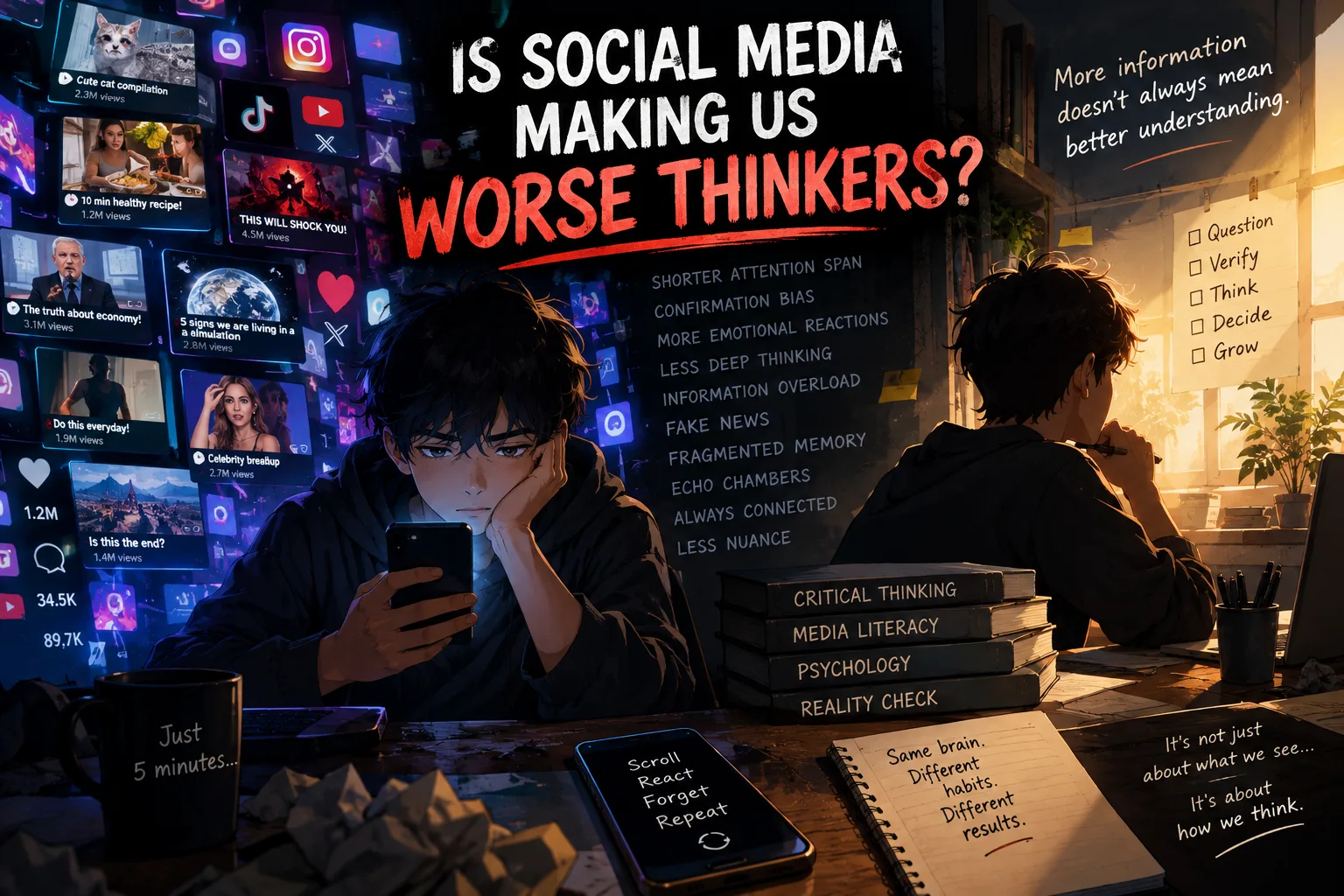
Social media gives us more information than any generation before us. But does constant scrolling, algorithmic content, and rapid-fire opinions actually make us worse at thinking?
Is Social Media Making Us Worse Thinkers?
A person opens Instagram for five minutes.
Twenty minutes later, they have watched a cooking video, an argument between strangers, a political clip, a productivity tip, a conspiracy theory, three advertisements, a celebrity controversy, and a video explaining why they are apparently holding their phone incorrectly.
They remember almost none of it.
Yet they keep scrolling.
This is the strange psychological environment modern humans have built for themselves. Social media gives us access to an extraordinary amount of information, but it delivers much of that information in tiny, emotionally charged fragments.
The question isn't simply whether social media is "bad."
The more interesting question is:
What happens to human thinking when our information environment constantly rewards speed, emotion, novelty, and certainty?
The answer is complicated.
Social media can make people worse thinkers in some circumstances.
It can also expose people to ideas, experts, communities, and information they might never encounter otherwise.
The real issue may not be social media itself.
It may be what constant exposure to algorithmically selected information does to the habits of attention and reasoning.
🧠 The Human Brain Wasn't Built for Infinite Information
For most of human history, information was scarce.
You might know what happened in your village.
You might hear stories from travelers.
You might read a newspaper.
You might watch television.
Today, a smartphone can deliver more information in an afternoon than a person could realistically process in an entire lifetime.
The problem is obvious.
Human cognitive capacity has not expanded at the same speed as the information supply.
We therefore need filters.
And increasingly, algorithms perform those filtering decisions for us.
The Algorithm Doesn't Ask What's True
A social-media recommendation system generally doesn't need to determine whether something is philosophically profound or scientifically accurate.
Its immediate objective is usually closer to:
Will this keep the user engaged?
Content that produces strong reactions can therefore receive an advantage.
Anger.
Surprise.
Fear.
Amusement.
Outrage.
Controversy.
These emotions grab attention.
And attention is the currency on which much of the social-media economy operates.
The Attention Trap
Imagine two posts.
Post A
"Recent research suggests several factors may influence memory reliability, although the evidence remains mixed."
Post B
"SCIENTISTS JUST PROVED YOUR ENTIRE MEMORY IS FAKE!"
Guess which one is more likely to generate comments.
Human beings aren't naturally attracted to nuance.
Nuance requires work.
Certainty is delicious.
Why Extreme Opinions Spread So Easily
A complicated argument might require:
Context.
Evidence.
Definitions.
Exceptions.
Probability.
Uncertainty.
A viral post can remove all of those.
Instead of:
"The evidence suggests X under certain conditions."
you get:
"X IS DESTROYING SOCIETY."
The second statement is cognitively easier to understand and emotionally easier to react to.
That doesn't make it correct.
It makes it shareable.
🟢 Established Evidence: Social Media Can Fragment Attention
One of the most discussed concerns surrounding heavy digital-media use is attention fragmentation.
Rapidly switching between short pieces of information trains people to repeatedly:
Look.
Process.
React.
Swipe.
Repeat.
This doesn't automatically destroy attention.
But frequent interruptions can make sustained concentration more difficult.
Reading a 2,000-word argument requires a different cognitive mode from watching thirty 20-second clips.
One rewards persistence.
The other rewards rapid novelty.
The Problem With Constant Novelty
Your brain notices changes.
A new video.
A new notification.
A new headline.
A new comment.
A new face.
A new argument.
Every swipe provides another opportunity for something interesting to appear.
This creates a powerful feedback loop.
Novelty → attention → engagement → another piece of novelty.
Eventually, silence can feel strangely uncomfortable.
A five-minute wait in a doctor's office becomes unbearable.
So the phone comes out.
Humanity survived thousands of years without having something to watch while waiting for an elevator.
Apparently, we have decided this was unacceptable.
Does Social Media Destroy Your Attention Span?
Not literally.
There is no simple switch where watching short videos permanently reduces your ability to concentrate.
Human attention is more flexible than that.
People can spend hours scrolling and still read a complicated book.
The more defensible concern is that habitual environments can influence attentional preferences.
If your daily information diet constantly rewards rapid stimulation, slower forms of information may initially feel less rewarding.
That distinction matters.
Information Overload Doesn't Automatically Create Knowledge
Having access to more information doesn't mean understanding more.
Imagine receiving 10,000 puzzle pieces without knowing which puzzle they belong to.
You technically have more information.
You don't necessarily have more understanding.
Social media often gives people:
Facts without context.
Statistics without methodology.
Quotes without sources.
Images without dates.
Historical events without chronology.
Scientific findings without limitations.
The result can be something that looks like knowledge.
But isn't necessarily knowledge.
The Illusion of Understanding
One of the most dangerous effects of fast information consumption may be feeling like you understand something because you've encountered it repeatedly.
You see a topic twenty times.
You recognize the vocabulary.
You recognize the arguments.
You recognize the memes.
Eventually your brain thinks:
"I know this."
But recognition isn't the same as comprehension.
You may not be able to explain:
Why the claim is true.
What evidence supports it.
What evidence contradicts it.
What assumptions it depends on.
What would prove it wrong.
That is where genuine critical thinking begins.
Repetition Can Make False Claims Feel Familiar
Psychologists have studied the illusory truth effect, in which repeated exposure can increase perceived familiarity or truthfulness.
This creates an unpleasant problem for social media.
A false claim doesn't necessarily need to be persuasive the first time.
It can simply keep appearing.
Eventually:
"I've heard this before."
can quietly become:
"That sounds true."
Those are very different statements.
🔴 Myth: People Believe Everything They See Online
Not exactly.
Most people don't accept every post they encounter.
People evaluate information using:
Prior beliefs.
Source reputation.
Social cues.
Emotion.
Knowledge.
Political identity.
Personal experience.
And other factors.
The problem is that these same mechanisms can also produce systematic errors.
Confirmation Bias Loves Social Media
Suppose you strongly believe that a particular diet is healthy.
You search for it.
You find ten posts supporting your view.
You follow creators who promote it.
The algorithm learns your interests.
Now it recommends more of the same.
Your information environment begins reflecting your existing beliefs.
Eventually you think:
"Everyone agrees with this."
They don't.
You have simply constructed a room where disagreement enters less often.
The Echo Chamber Problem
An echo chamber occurs when people primarily encounter information and opinions reinforcing their existing worldview.
Social media can contribute to this.
But the phenomenon is more complicated than "algorithms isolate everyone."
People actively choose communities too.
We follow people we like.
We unfollow people who annoy us.
We join groups matching our interests.
We mute opinions we dislike.
The algorithm isn't always locking us inside the room.
Sometimes we're enthusiastically building the room ourselves.
Why Arguments Become So Extreme
Imagine discussing politics with someone face-to-face.
You can see their expression.
You notice when they've become uncomfortable.
You hear their tone.
You may moderate yourself.
Online, many of those social cues disappear.
The other person becomes a username and profile picture.
That makes extreme language easier.
And once an argument becomes public, there is another incentive:
performing for the audience.
You're no longer trying only to convince the other person.
You're trying to win spectators.
Social Media Turns Thinking Into Performance
This is one of its most interesting effects.
A person might privately think:
"I don't know enough about this issue."
But publicly:
"Here's why everyone else is completely wrong."
Why?
Because uncertainty doesn't perform well.
Confidence does.
A carefully qualified argument can look weak beside a confident 30-second monologue.
The result is an environment where certainty can outperform competence.
🟡 Active Debate: Does Social Media Actually Make People Less Intelligent?
This is where we need to slow down.
There isn't strong evidence that social media simply lowers human intelligence.
People haven't collectively lost their ability to reason because TikTok exists.
The relationship is much more complicated.
Different platforms.
Different usage patterns.
Different users.
Different types of content.
Different amounts of time.
Different purposes.
A medical student watching educational lectures isn't doing the same cognitive activity as someone spending four hours consuming outrage content.
"Social media" is far too broad to behave like one psychological substance.
Social Media Can Make Thinking Better
This part often gets ignored.
A person in rural America can watch lectures from a professor at Harvard.
A pharmacy student can discover new research.
An independent researcher can find experts.
A programmer can learn from open-source communities.
A small business owner can discover marketing strategies.
A teenager can find other people interested in an obscure scientific subject.
Someone struggling with loneliness can discover a supportive community.
The same technology capable of spreading nonsense can distribute genuinely valuable knowledge.
The tool isn't inherently stupid.
The information environment is what matters.
The Difference Is Active vs Passive Consumption
Consider two users.
User A
Searches for a specific topic.
Reads several sources.
Checks original studies.
Compares competing explanations.
Takes notes.
Changes their opinion when evidence changes.
User B
Scrolls through whatever the algorithm presents.
Reads headlines.
Watches short clips.
Shares emotionally satisfying claims.
Moves on before checking the source.
Both are "using social media."
Their cognitive experiences are radically different.
Passive Scrolling Is a Different Activity From Learning
This distinction is crucial.
When you deliberately search for information, you control the information stream.
When you endlessly scroll recommendations, the information stream controls you.
That doesn't automatically make one good and the other bad.
But they create different relationships with information.
One begins with a question.
The other begins with:
"Show me something interesting."
Why Outrage Is So Addictive
Anger is cognitively stimulating.
Someone insults something you care about.
You feel compelled to respond.
You open the comments.
Someone says something even worse.
Now you are reading fifteen replies.
You write your own.
Someone responds.
Congratulations.
You have just spent forty minutes participating in an argument with a stranger named "FreedomEagle47."
The platform has successfully converted emotion into engagement.
Emotional Arousal Can Interfere With Reasoning
When emotionally aroused, people can become more focused on defending positions than evaluating them.
This isn't unique to social media.
Humans have always argued.
But social platforms combine emotional stimulation with:
Mass audiences.
Instant feedback.
Public identity.
Algorithms.
Infinite repetition.
That combination is historically unusual.
The Cost of Constant Opinion
One of the strangest features of modern information culture is that people are expected to have opinions about everything.
A celebrity scandal.
A war.
A scientific paper.
A Supreme Court ruling.
A new technology.
A politician.
A corporate controversy.
A medical study published three hours ago.
Sometimes the correct response is:
"I don't know enough about this yet."
That sentence has somehow become unfashionable.
Intellectual Humility Is a Superpower
Good thinkers aren't necessarily people who know everything.
They are people who understand the boundaries of what they know.
They can say:
"I don't know."
"The evidence is mixed."
"I might be wrong."
"I need to check the source."
"That argument changed my mind."
Social media can make these statements socially costly.
Certainty gets likes.
Nuance gets three likes and a reply asking whether you even understand basic science.
The Algorithmic Confidence Machine
Imagine a system where:
Strong opinions get more reactions.
More reactions produce more distribution.
More distribution creates more followers.
More followers reward stronger opinions.
Now imagine repeating that process for years.
You don't necessarily create better thinkers.
You may create people increasingly skilled at producing confident content.
Those are not the same skill.
What Happens to Memory?
Constant exposure to fragmented information can also affect what we remember.
Not necessarily because social media "destroys memory."
Rather, information encountered briefly may never receive enough attention to become deeply encoded.
You remember:
The headline.
The emotional reaction.
The general idea.
But not necessarily:
The source.
The evidence.
The date.
The qualifications.
This can create a dangerous phenomenon:
confidence without detail.
The 20-Second Explanation Problem
Complex subjects rarely fit neatly into 20 seconds.
Climate science doesn't.
Economics doesn't.
History doesn't.
Medicine doesn't.
Psychology doesn't.
Geopolitics definitely doesn't.
Yet platforms reward compressing complicated subjects into highly digestible pieces.
Sometimes that compression is useful.
Sometimes it removes the very context needed to understand the subject correctly.
Context Is the First Casualty
Take a historical event.
You can explain:
"Empire X invaded Country Y."
Technically informative.
But what happened before?
What political agreements existed?
What economic pressures existed?
What happened afterward?
Who benefited?
Who opposed the invasion?
What evidence do historians disagree about?
Without context, a fact can become misleading even when the fact itself is technically true.
Can Short-Form Content Train Superficial Thinking?
Possibly, particularly when it becomes the dominant way someone consumes information.
But the evidence does not justify saying:
"Short videos make everyone stupid."
That's another oversimplification.
Short content can teach useful concepts.
Long content can also be terrible.
A 40-minute conspiracy video is still misinformation.
Length isn't the same thing as quality.
The Real Problem May Be Cognitive Diet
Think about food.
Eating one cookie doesn't make you unhealthy.
Eating cookies occasionally isn't the issue.
Eating nothing but cookies for months probably is.
Information may work similarly.
One meme isn't destroying your reasoning.
One short video isn't destroying your attention.
The concern is what happens when the majority of your information diet consists of:
Rapid novelty.
Emotional stimulation.
Unverified claims.
Constant interruption.
Repetition.
Personalized reinforcement.
And little deliberate reflection.
What Would a Healthier Information Diet Look Like?
You don't need to delete every social-media application and move to a monastery in Montana.
A healthier approach could involve simple changes.
1. Search instead of endlessly scrolling
Start with a question.
2. Check the source
Who actually produced this information?
3. Find the original evidence
Especially for science, medicine, economics, and statistics.
4. Read opposing arguments
Not just people who already agree with you.
5. Slow down important decisions
Don't make major judgments based on a 30-second clip.
6. Protect uninterrupted attention
Spend some time reading without notifications.
7. Practice saying "I don't know"
It is surprisingly liberating.
🟢 Established Evidence: Social Media Is Not Simply Good or Bad
The strongest conclusion is probably the least satisfying one.
Social media can:
Improve access to information.
Connect communities.
Enable education.
Spread useful ideas.
Provide social support.
But it can also:
Amplify misinformation.
Encourage comparison.
Fragment attention.
Reinforce confirmation bias.
Reward emotional reactions.
Create information overload.
These effects can coexist.
Technology can simultaneously make humans more informed and more confused.
Humanity apparently demanded a machine capable of doing both.
The Bigger Question
Maybe the question shouldn't be:
"Is social media making us worse thinkers?"
Maybe it should be:
"What kinds of thinking does social media reward?"
Because platforms don't necessarily reward:
Accuracy.
Patience.
Nuance.
Intellectual humility.
Careful uncertainty.
They often reward:
Speed.
Novelty.
Emotion.
Confidence.
Conflict.
Shareability.
And humans adapt to incentives.
Final Thoughts
Social media hasn't suddenly made humans incapable of thinking.
The human brain remains remarkably capable of:
Learning.
Reasoning.
Creating.
Questioning.
Discovering.
Changing its mind.
The danger is subtler.
We have built an information environment that can make bad thinking extremely convenient.
You don't need to investigate a claim.
Someone else has already summarized it.
You don't need to read the study.
Someone made a video about it.
You don't need to understand the opposing argument.
Your feed already knows what you agree with.
You don't need to sit with uncertainty.
Someone online will confidently tell you exactly what happened.
And perhaps that's the real psychological danger.
Not that social media makes us stupid.
But that it can make thinking unnecessary often enough that we begin to forget how much effort good thinking requires.
The solution isn't abandoning technology.
It is learning to use it without allowing its incentives to become our mental habits.
Because the most valuable thing social media can give you isn't another answer.
It is access to enough information to discover that your first answer might have been wrong.